The Assembly today paid tributes to the four martyrs who laid down their lives in anti-terrorist operations at Pathankot and Srinagar and mourned the death of former colleague and four-time MLA from Gangath in Kangra district.Chief Minister Virbhadra Singh said the nation was proud of the martyrs who had made the supreme sacrifice fighting the militants. “Not just Himachal but the entire country is proud of these soldiers,” he said. He said the state government had decided to give Rs 20 lakh to the families of the martyrs as a mark of respect.He also lauded former MLA Des Raj from Gangath in Kangra who passed away on February 1, 2016. “He remained a member of this House on four occasions in 1982, 1990, 1998 and 2007 and always worked for the uplift of the weaker and downtrodden, for which he will be always remembered,” he said.Leader of the Opposition PK Dhumal said the BJP MLA worked relentlessly for ensuring the development of his constituency. “As Chairman of the Finance Commission and member of various committees, he made immense contribution for which he will always be remembered,” said Dhumal. He also paid tributes to the four martyrs.
Prime Minister Nawaz Sharif today said Pakistan wants to have good ties with all neighbours, including India, and asserted that mutual cooperation was vital for the socio-economic uplift of both countries.Sharif made the remarks during a meeting with India’s newly appointed High Commissioner in Pakistan Gautam Bambawale who called on him at the PM House here.An official source said the two discussed various aspects of India-Pakistan relations and agreed on the importance of improving the relations.“Pakistan was pursuing good relations with all its neighbours, including India, as mutual cooperation was vital for the socio-economic uplift of both the countries,” Sharif was quoted as saying by the state-run APP news agency.Sharif extended a warm welcome to the new High Commissioner and hoped he would work to bring the two countries closer. Bambawale, who arrived in Pakistan last month to assume the charge of the High Commission, thanked the Prime Minister for the welcome and expressed the hope that his role would be beneficial in strengthening relations between the two nations.An official of Indian mission refused to share what Bambawale discussed with the PM during a meeting today. — PTI
Pathankot attack: India awaits Pak SIT
India on Wednesday said it was awaiting a visit by Pakistan’s Special Investigation Team (SIT) and other details in connection with the Pathankot terror attack, days after Pakistan authorities registered an FIR in the case
Minister of State for External Affairs VK Singh said NSAs and Foreign Secretaries of the two countries were in regular touch and that Pakistan conveyed to India that leads provided to it about the attack were being probed
‘India needs to act tough like Israel against terror’
UDHAMPUR/ JAMMU: Father of Capt Tushar Mahajan (24), who was martyred fighting terrorists at Pampore in Kashmir on Sunday, says India should act tough like Israel against terrorists and the forces inimical to the country.
Dev Raj said it’s high time the country has a concrete policy to deal with the menace of terrorism. “How many more youth will lay die down their lives for the nation like this? When will our politicians get out of their slumber and frame a tough policy against terrorism. We should act tough like Israel,” he said while talking to media on Monday. “I am a proud father as my son sacrificed his life for the nation,” he said.
Tushar did his schooling at a local school in Udhampur, 70-km from Jammu, the headquarters of the northern command. His elder brother, an engineer based in the US, was to get married soon and the family was making preparations for it. Hundreds of people attended the funeral of Tushar, who was cremated with full military honours. People raised nationalist slogans.
Former deputy chief minister Nirmal Singh and speaker Kavinder Gupta also attended the funeral. “We are proud of him. For how long our young officers and security personnel will keep on giving up their lives. People forget them after some time,” said Shewat Ketu Singh, a close friend of Tushar.
Earlier in the day, a wreath lying ceremony was held at the army headquarters where Lt Gen DS Hooda, GOC-in-C northern command, and senior army officials laid the wreath. District officials were also present.
short by Anupama K / 08:19 pm on 22 Feb 2016,Monday
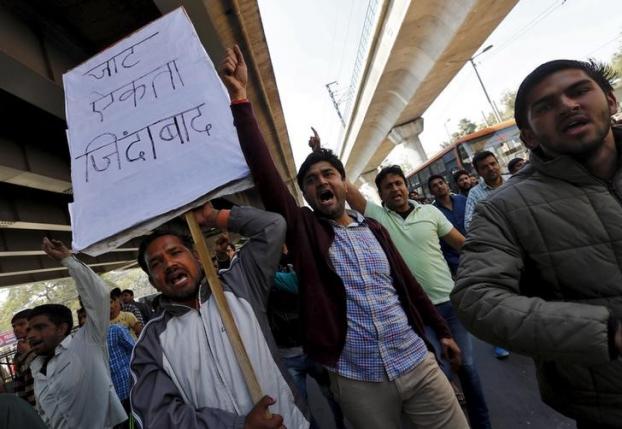
As many as three Jat protesters were killed and nine were injured on Monday after the Army opened fire at a stone-pelting mob in Sonipat, Haryana. The army men were attacked while trying to clear the road blockade on Ambala-Delhi National Highway in the district. The death toll has reached 19 as the Jat agitation entered its 10th day today.
Delhi-Ambala highway cleared; 3 killed in firing
AT QUOTA CHAOS
Toll 19, curfew in Hisar after clashes, army opens fire in Sonepat, govt to give ` 10 lakh relief to kin of those killed, blockades in Rohtak lifted
CHANDIGARH/SONEPAT/ROHTAK: Belying the Manohar Lal Khattar-led BJP government’s hopes of a quick end to the quota stir after the Centre agreed to all demands of Jats a day ago, violence continued in Jat-dominated districts on Monday as three protesters were killed in firing at Larsholi village of Sonepat district, taking the toll to 19.
RAVI KUMAR/HTSoldiers keeping a vigil at Siwah village along national highway-1 near Panipat on Monday.Curfew was clamped in Hisar town and five villages of the district and shoot-on-sight orders were issued as Jat agitators indulged in violent protests.
Though the state police with assistance from the army managed to take control of the damaged portion of Munak canal — the lifeline of water supply to the national capital — in the morning, the respite was shortlived as Jat protesters blocked the canal gates at Khubru village in Sonepat district.
However, the state government got the arterial Delhi-Ambala national highway (NH-1) cleared as blockades at Larsholi, Biswameel and Kamaspur in Sonepat district were lifted. Sonepat deputy commissioner Rajiv Rattan said blockades on NH-1 have been removed. “The road is clear for traffic movement,” he added.
Another major highway linking Rohtak to Delhi was cleared as protesters lifted blockade at Sampla, MDU and several other places. The blockade was lifted after All India Jat Aarakshan Sangharsh Samiti decided to take back stir following an appeal by the state and central ministers. “We have lifted our blockades from Ramayan and Mayyar also. The remaining blockades will be removed by Tuesday mor ning,” samiti leader Ram Bhagat Malik said. Though the protesters have withdrawn from roads and rail tracks at some places, the AIJASS decision doesn’t mean everyone would respond to its call. The state-wide agitation by disparate groups of Jats does not have a clear leader.
“We don’t know who is leading the stir at different places and how to reach out to them, but efforts are on. Hopefully, they will understand that their demands have been met,” a senior IAS officer said. But a more serious worry of the authorities is the deep caste divide created by the agitation which has led to skirmishes between Jats and non-Jats in places such as Kalanaur, Hansi, Gohana and Jhajjar. “There is no way to know the next trouble spot. A minor incident can trigger an all-out fight,” he said.
Parliamentary affairs minister Ram Bilas Sharma said that an ex-gratia of Rs 10 lakh would be given to next of kin of “innocent persons” killed in the ongoing agitation with employment to a family member.
Sources said three people were killed in firing as the army — which landed in Sonepat education city via choppers —tried to lift the blockade from NH-1 at Larsholi village.
Police also cane-charged protesters at Hasangarh village. The Sonepat police are also struggling to lift blockade from Beeswameel. Fresh violence was reported in Rohtak district where protesters allegedly torched official vehicle of the Meham sub-divisional magistrate. Meham is the constituency of Congress MLA Anand Singh Dangi. Police and army failed to remove blockade from several roads in the district.
The government on Monday said all educational institutions in Rohtak will remain closed till February 25.
Sources said more than 150 protesters with covered faces turned up at the Red Square market in Hisar around 5.30pm and went on a rampage. They vandalised many shops in market, following which most of the shopkeepers downed their shutters. The youths fled the spot only after army and police personnel reached the spot to control the situation.
The blockade on road and rail tracks in several parts in Sonepat, Rohtak, Jhajjar and Jind continued despite heavy deployment of the army in the region.
Rapid Action Force (RAF) has been deployed outside the Maharishi Dayanand University (MDU) to clear the area but the blockade continued. Tension prevailed in Kaithal where groups of Jats and non-Jats are confronting each other. The highways to Hisar and Chandigarh are also blocked.
The state government has decided to get an audio clip purportedly featuring professor Virender, a former political adviser ex-chief minister Bhupinder Singh Hooda examined. In the clip, a Sirsa man is being allegedly asked by Virender to flare up the ongoing Jat agitation in the state.
short by Nihal Thondepu / 10:36 am on 22 Feb 2016,Monday
Delhi CM Arvind Kejriwal announced earlier today that the Indian Army has taken control of the Munak canal that supplies three-fifths of the capital’s water supply. Jat protesters demanding reservation had earlier taken control of the canal, thereby pushing Delhi into a water crisis. Although the government agreed to the Jat community’s demands, the protests have not been called off.
Jat protesters keep up blockade; Delhi water restored
Rural protesters paralysed Haryana on Monday despite a deal giving them more government jobs, but there was relief for New Delhi’s 20 million residents as the army retook control of their main water source.
(See pictures here | See a map of Jat protests in Haryana here)
Days of rioting and looting across Haryana by the Jat rural caste have killed at least 16 people and threaten to undermine Prime Minister Narendra Modi’s promise of better days for Indians who elected him in 2014 with the largest majority in three decades.
Thousands of troops have been deployed to quell protests, which flared again on Monday near Sonipat as protesters set fire to a freight train. In neighbouring Rajasthan, Jats attacked and burned buses.
A compromise with the Jats brokered by Home Minister Rajnath Singh on Sunday failed to get protesters to clear highway roadblocks. Further talks to end the crisis were set for Monday evening.
Disruption has been huge, with 850 trains cancelled, 500 factories closed and business losses estimated at $2.9 billion.
“We will continue the protests. The government thinks we will succumb to their pressure tactics but they are making a big mistake by ignoring us,” Ramesh Dalal, convenor of the Jat Arakshan Andolan (Jat Reservation Movement), told Reuters.
The army retook control of a canal that supplies three-fifths of the capital’s water. Delhi’s Chief Minister Arvind Kejriwal said the army had reopened the sluice gates of the Munak canal to the north of the city. Water was expected to reach the metropolis by early Tuesday.
ROADBLOCKS INTACT
The Haryana government put the death toll at 16 while police said that, while order was slowly being restored, there were still tensions in some towns as Jats tried to prevent other communities from reopening their shops.
In Bahadurgarh, to the west of Delhi, Jat protesters were out in force, expressing their anger against Modi and demanding written assurances of more jobs for their community, which makes up a quarter of Haryana’s population.
Many Jats, who number more than 80 million across north India, are farmers whose livelihoods have suffered as families divide farms among their children while two years of drought have harmed their crops.
As a social group they are experiencing downward mobility and missing out on urban job opportunities, explaining their demand for government jobs and student places under affirmative action policies that are typically reserved for deprived groups.
Ramcharan Dekhara, a 52-year-old father of four, has sold his land to pay for his daughter’s marriage and now runs a tea shop near National Highway 10.
“I am fighting for my sons’ future. The boys are sitting at home and there is nothing they can do at the tea shop,” Dekhara told Reuters. “They studied hard to make a new life but now they are wasting time and watching TV all day.”
The gulf is most striking on the frontier of Gurgaon, one of Delhi’s burgeoning satellite cities, where offices, factories and residential apartments give way suddenly to farmers’ fields – many of them tilled by Jats.
The Jats predominantly voted for Modi’s Bharatiya Janata Party (BJP) in the 2014 general election, when he won the biggest parliamentary majority in three decades. Months later the BJP won an outright majority in Haryana for the first time.
Although many of the state’s chief ministers have been Jats, the current minister is not. Commentators have faulted him and other BJP leaders for failing to read the social mood and devoting too much attention to issues like cow protection that are a core part of the party’s pro-Hindu agenda.
In a familiar pattern, Modi completely ignored the protests, instead launching a broadside on Sunday against unnamed conspirators he accused of trying to undermine his government.
Playing on his own humble origins as the son of a tea seller, or chaiwallah, Modi said: “Some people are not able to digest my prime ministership. They can’t digest that a chaiwallah has become PM.
“They are now hatching conspiracies every day to finish and defame me,” he told farmers in a speech in Odisha.
(Reporting by Douglas Busvine and Rupam Jain; Editing by Michael Perry and Nick Macfie)
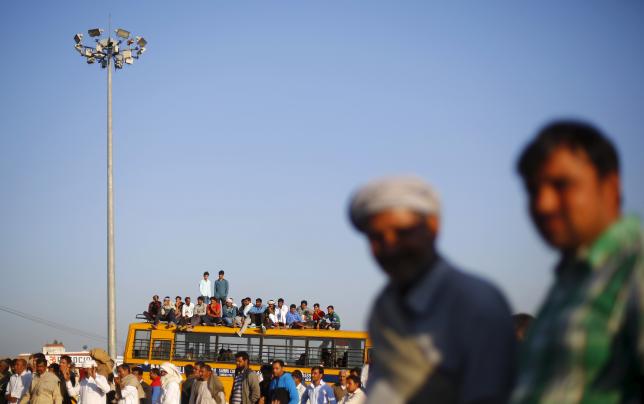
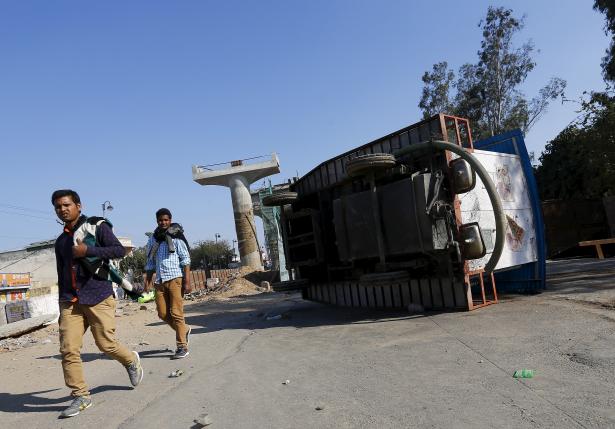
Demonstrators from the Jat community shout slogans during a protest in New Delhi, India, February 21, 2016. REUTERS/Adnan AbidiDemonstrators from the Jat community eat as they block the Delhi-Haryana national highway during a protest in New Delhi, India, February 21, 2016. REUTERS/Adnan AbidiDemonstrators from the Jat community sit on top of a school bus as they block the Delhi-Haryana national highway during a protest at Sampla village in Haryana, India, February 21, 2016. REUTERS/Adnan AbidiPeople walk past an overturned mobile urinal during a demonstration by members of the Jat community in Bahadurgarh in Haryana , India, February 21, 2016. REUTERS/Adnan AbidiPeople stand behind damaged motorcycles and a van that were set alight by protesters during a demonstration by members of the Jat community in Rohtak, in Haryana, India, February 21, 2016. REUTERS/StringerDemonstrators from the Jat community shout slogans as they block the Delhi-Haryana national highway during a protest at Sampla village in Haryana, India, February 22, 2016. REUTERS/Adnan AbidiDemonstrators from the Jat community sit on a road as they block the Delhi-Haryana national highway during a protest at Sampla village in Haryana, India, February 22, 2016. REUTERS/Adnan AbidiDemonstrators from the Jat community sit on top of a truck as they block the Delhi-Haryana national highway during a protest at Sampla village in Haryana, India, February 22, 2016. REUTERS/Adnan Abidi
Army personnel paying last respects to sepoy Mustak Ahmed before being laid to rest at Parnapalle village in Kurnool district on Tuesday. | Express Photo
PARNAPALLE (KURNOOL):Amid full-throated cries of Parnapalle Muddubidda Amar Rahein (long live beloved son of Parnapalle) and Bharata Maata Muddubidda Amar Rahein (long live beloved son of Mother Bharat), the casket carrying the mortal remains of Siachen martyr Syed Mustak Ahmed was lowered into the grave at Parnapalle village in Bandi Atmakur mandal on Tuesday.
Sepoy Syed Mustak Ahmed was among the 10 jawans who died after an avalanche struck Sonam base post on Siachen Glacier on February 3. The mortal remains of the martyr were airlifted from Delhi in a special Air Force copter on Monday. The casket was brought to the village in a special vehicle from Hyderabad.
Family members, relatives and countless people who gathered to receive the mortal remains, broke down. Large numbers of people from Parnapalle and neighbouring villages milled in to pay their respects.
‘’He has rendered a great service to the nation. He made the supreme sacrifice. We are proud. He promised to take good care of us too”, the inconsolable parents of the martyred hero said.
At around 12.30 pm, the body was taken in a procession to the Muslim burial ground, where police paid a ceremonial gun salute. Deputy Chief Minister KE Krishna Murthy laid a wreath on the martyr’s mortal remains and assured all support to the family of Mustak. “Ahmed is a real hero and everyone is proud of his courage and great sacrifice’’, he said. On the occasion, the Deputy CM handed over a cheque for Rs 25 lakh to the family members towards ex-gratia. Also, the government promised a job to Mustak’s wife, pension to his parents and a house site near Parnapalle.
Meanwhile, the army officials who were present at the funeral informed that the Centre has announced a compensation of Rs 30 lakh to the bereaved family. MLC Silpa Chakrapani Reddy, district collector Ch Vijaya Mohan and others were present.
NEW DELHI: The CBI registered a cheating case against three senior army officials for allegedly causing a loss of Rs 2.12 crore to a military farm in Maharashtra by making fraudulent payments to a private firm for milk supply.
Those named were Colonel PK Bahuguna, Lieutenant Colonel JK Joseph, and Lieutenant Colonel Ajit Singh Bhadouria. “CBI has registered a case on allegations that the three entered into a conspiracy with a firm based in Pune, Aasha Associates, during January 2009 and December 2012 when they had worked as the officer-in-charge of a Pimri-based military farm,” said a CBI spokesperson. CBI accused the officers of making “fraudulent” payments against the supply of milk by the Zilla Sahakari Doodh Utpadak Dairy, Pune, to the farm.
Siachen survivor dies after defying death for 9 days
MIRACLE ENDS Service chiefs, politicians line up to pay homage; last rites to be held today at his village in Karnataka
NEW DELHI: Lance Naik Hanamanthappa Koppad, who survived six days buried under 35 feet of snow in Siachen, died at an army hospital on Thursday, ending a nation’s hopes for the soldier’s miraculous recovery.
Koppad, 33, was among the 10 soldiers presumed dead after an avalanche struck their post in the western Himalayas and swept them away at an altitude of 20,500 feet on February 3. The remaining nine perished on the world’s highest battleground.
Koppad’s end came at 11.45 am at the Army Hospital Research and Referral in New Delhi after he suffered multi-organ failure.
For Koppad’s family, it was a cruel quirk of fate. His family and hundreds of people in his village in Karnataka’s Dharwad district had celebrated the news of his dramatic rescue three days ago, hoping to be united with the man who had shown courage and grit against heavy odds.
A solemn wreath-laying ceremony was held at the Brar Square crematorium here where defence minister Manohar Parrikar, the three service chiefs and several dignitaries, including Congress leader Rahul Gandhi and Delhi CM Arvind Kejriwal, were present to pay their last tributes to the fallen hero.
One of the most poignant scenes at the ceremony was Koppad’s two-year-old daughter Netra asking for a journalist’s notepad to make a drawing, oblivious to the grief around her. A special Indian Air Force plane flew Koppad’s body to Hubli near Dharwad on Thursday. The martyr’s last rites will be performed at his village on Friday.
Leading the nation in paying homage to Koppad, Prime Minister Na rend ra Mo di tweeted: “He leaves us sad and devastated. RIP Lance Naik Hanumanthappa. The soldier in you remains immortal. Proud that martyrs like you served India.” At the time of rescue, Koppad, who was from Madras Regiment, was conscious but drowsy, disoriented and severely dehydrated. Later, he developed pneumonia and severe other complications that led to multi-organ failure.
“We tried our best to fight the death of the brave Siachen warrior but this morning his blood pressure dropped despite our best efforts and he had a cardiac arrest,” said Lieutenant General SD Duhan, commandant of the army hospital.
The men from 19 Madras were buried after a massive ice wall measuring 800ft by 400ft collapsed on their post. The soldiers were about to complete their 90-day deployment on the glacier.
Koppad’s death has turned the national spotlight on Siachen. The glacier acts as a wedge between Shaksgam valley under China’s control and Baltistan, which is occupied by Pakistan.
India launched Operation Meghdoot in April 1984 after Pakistan’s army occupied dominating heights on the glacier, a 76-km river of slow-moving ice. India currently sits on dominating positions overlooking Pakistani posts located 3,000 feet below. The tragedy has focused attention on the hardship allowance of soldiers serving in Siachen.
FINAL HOURS OF LANCE NAIK KOPPAD
Lance Naik Hanamanthappa Koppad’s health worsens on February 10, a day after he was pulled out alive from the Saltoro Ridge
Slips into a deeper state of coma
Kidneys fail
Stops responding to medicines
The pneumonia worsens
Koppad dies of multi-organ failure at 11.45 am
WHAT ABOUT OTHER NINE SOLDIERS?
Bodies of the other nine soldiers are yet to be flown out of Kaziranga base, which is at 19,000 ft
Helicopter sorties have not been possible because of bad weather
IAF’s Cheetal helicopters have conducted 206 sorties already
The bodies were retrieved on February 9.
Three retired defence officers booked for ‘fraud’ in Gurgaon
GURGAON: The Gurgaon police have registered a case of fraud against three retired defence officers, including a retired major general, for allegedly siphoning off ` 14 lakh from the Indian Ex-servicemen Movement (IESM) — a society of defence personnel and their families and is involved in the ‘one rank one pension’ agitation.
The accused and the complainants are members of the IESM, the police said. The complainant Lt Gen Raj Kadyan, a resident of Sector 17A and chairman of the society, alleged that the accused had taken a lot of cash from the society funds between January and July 2013.
The case was registered against a major general , a group captain and a wing commander at the Palam Vihar police station on Monday on the directions of a Gurgaon court. Lt Gen Raj Kadyan (retd), chairman of the IESM, and the major general, who is the vice-chairman of the society, formed the IESM in 2008 and various other ex-servicemen groups also aligned with the organisation.
The society account is being maintained at a private bank in Sector 23A. Apart from the complainant, the accused were the other signatories for operating the account, the police said. According to the police, the funds in the account were contributed by officers and their widows. Inspector Sandeep Kumar, SHO of Palam Vihar, said, “We have registered a case and are conducting an investigation. No arrest has been made so far.”
The major general refuted all allegations. “These allegations are baseless and the account has been audited by an independent authorised accountant. We have worked as per law. Earlier, a lower court had rejected the case,” he said.
Six days under snow, soldier survives Siachen avalanche
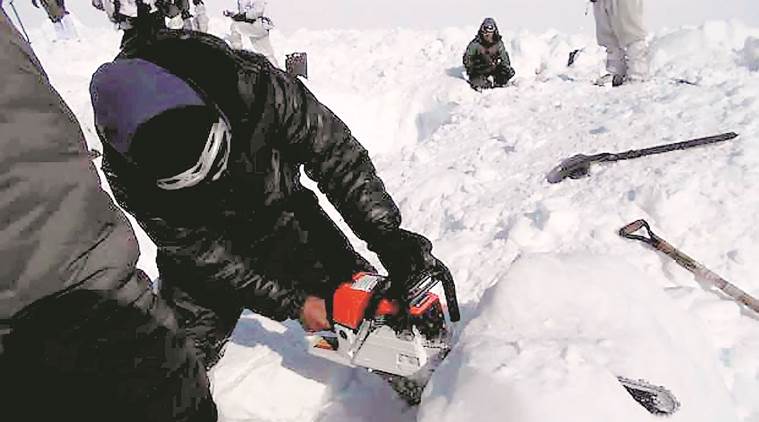
Siachen: Operations by the specialized teams of the Army and the Air Force in progress to search for the bodies of the soldiers hit by an avalanche, in Siachen on Monday. (PTI Photo)
An Army jawan, who was buried under 25 feet of snow following an avalanche in the Siachen glacier, was Monday miraculously found alive in a critical condition after six days of rescue efforts.
“It was a miraculous rescue, all efforts are being made to evacuate Lance Naik Hanaman Thappa to the RR hospital in the morning,” Lt Gen D S Hooda, Northern Army Commander, told PTI.
He said, “Five bodies have been recovered so far and four bodies have been identified. All other soldiers are regrettably no more with us.”
He hoped that Thappa, who hails form Karnataka, will beat the odds and recover.
A Junior Commissioned Officer (JCO) and nine other ranks of Madras Regiment were buried after their post was hit by the avalanche at the altitude of 19,600 feet close to the Line of Control (LoC) with Pakistan where the temperature was minus 45 degrees Celsius.
In the ongoing operation, the rescue teams have had to cut through up to 40 feet of ice at multiple locations after probable locations of the accident were identified by using specialised equipment, an Udhampur-based Defence Ministry spokesperson Colonel S D Goswami had revealed earlier.
The operation has been hampered by frequent snow blizzards, extreme freezing temperatures and low visibility apart from the effects of rarefied atmosphere at such high altitude.
The Army had earlier hinted that all the soldiers might be dead saying that “chances of finding any survivors are very remote” as temperatures range from a minimum of minus 42 degrees during night to maximum of minus 25 degrees during the day in the glaciated area.
(With inputs from PTI)
State Stalwarts
DEFENCES FORCES RANKS
ARMY, NAVY, AIRFORCE RANKS
FORMATION SIGNS
FORMATION SIGNS
ALL HUMANS ARE ONE CREATED BY GOD
HINDUS,MUSLIMS,SIKHS.ISAI SAB HAI BHAI BHAI
CHIEF PATRON ALL INDIA SANJHA MORCHA
LT GEN JASBIR SINGH DHALIWAL, DOGRA
SENIOR PATRON ALL INDIA SANJHA MORCHA
MAJOR GEN HARVIJAY SINGH, SENA MEDAL ,corps of signals
.
.
PATRON ALL INDIA SANJHA MORCHA
MAJ GEN RAMINDER GORAYA , CORPS OF
sanjhamorcha303@gmail.com
PRESIDENT HARAYANA STATE CUM COORDINATOR ESM
BRIG DALJIT THUKRAL ,BENGAL SAPPERS
PRESIDENT TRICITY
COL B S BRAR (BHUPI BRAR)
PRESIDENT CHANDIGARH ZONE
COL SHANJIT SINGH BHULLAR
.
.
PRESIDENT PANCHKULA ZONE AND ZIRAKPUR
COL SWARAN SINGH
PRESIDENT SAS NAGAR (MOHALI)
COL BALBIR SINGH , ARTY
INDIAN DEFENCE FORCES
DEFENCE FORCES INTEGRATED LOGO
FORCES FLAGS
15 Th PRESIDENT OF INDIA SUPREME COMMANDER ARMED FORCES
Droupadi Murmu
DEFENCE MINISTER
Minister Rajnath Singh
CHIEF OF DEFENCE STAFF (2nd)
General Anil Chauhan PVSM UYSM AVSM SM VSM
INDIAN FORCES CHIEFS
CHIEF OF ARMY STAFF(29th)
General Upendra Dwivedi, PVSM, AVSM (30 Jun 2024 to Till Date)























































 Siachen: Operations by the specialized teams of the Army and the Air Force in progress to search for the bodies of the soldiers hit by an avalanche, in Siachen on Monday. (PTI Photo)