



Sanjha Morcha

What’s New

Click the heading to open detailed news

Current Events :

web counter

Print Media Reproduced Defence Related News

India’s run with raksha mantri post by Lt Gen Bhopinder Singh

Sadly since Independence, India’s tryst with this sensitive post has been increasingly time serving, patronising or political.

In the Indian narrative of the 26 ministers of defence till date, only Jaswant Singh could claim any functional and emotional affinity with the military. (Representational image)

 In the Indian narrative of the 26 ministers of defence till date, only Jaswant Singh could claim any functional and emotional affinity with the military. (Representational image)

Militarily, India is arguably the fourth most powerful country after the United States, Russia and China. The executive head of the US military is “secretary of defence” Jim Mattis, a former four-star Marine Corp general. Sergey Shoygu is the “Russian minister of defence of the Russian Federation”, and a four-star general of the Russian Army. In the complex Chinese system of the apex body of “state councillors”, Chang Wanquan is also a career general of the People’s Liberation Army. All three countries are vying for global dominance and security assertions that requires a hybrid framework of economic-military-geopolitical-geostrategic imperatives. These levers are carefully deployed in various degrees, permutations and combinations to further the respective sovereign interests. Besides the defence ministries, there are security experts in other ministries in both China and Russia, and even in the US, eight out of the 24 Cabinet-level officials have served in the US military. This affords strategic culture, military logic and sensitivities of the armed forces in the course of national governance.

In the Indian narrative of the 26 ministers of defence till date, only Jaswant Singh could claim any functional and emotional affinity with the military. Perhaps the strictly enforced civilian control over the military in early years, with the appointment of known military baiters like V.K. Menon, the apolitical stance of the serving soldiers and the veterans, ensured that it was sub-optimally represented in the political leadership ever since. The lacunae went unnoticed initially as the national priorities veered around self-sufficiency, defensive posturing and at best, a regional ambition that could be managed in terms of the security wherewithal offered by the well-oiled and regimented set-up of the Indian armed forces inherited from the British. 1962 was a wake-up call of the unpreparedness and it took a relatively more progressive minister of defence, Y.B. Chavan (1962-66), at the helm for the Indian armed forces to recover and gloriously deliver 1965, 1967 and 1971 in quick successions. This was again followed by an era of either direct control by the Prime Minister’s Office or by regional satraps who had neither the understanding, strategic nuance or “connect” with security matters.

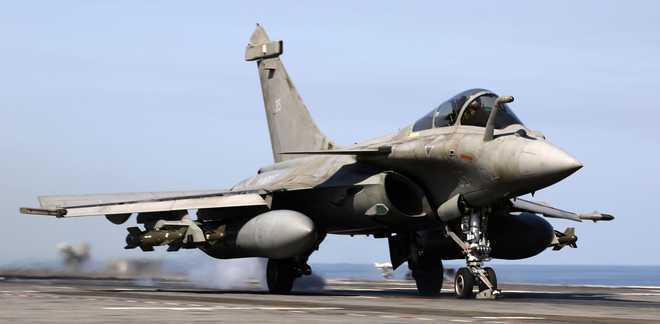
Today India stands at the cusp of immense possibilities and fancies, a place on the global map for its wares, “soft power” and influence, albeit, with more pacifistic undertones as compared to the Chinese. This opportune moment is borne of the economic vibrancy unleashed in the early 1990s, and the geopolitical churn that has seen India emerge as the “pivot” for the free world. Oddly the timing also coincides with an equally unfortunate tag as the “world’s largest arms importer”, with a lopsided development reality that celebrates success with missile technology but cannot develop a perfunctory rifle for its military! Beyond development and inadequacies of materials and weaponry, there have been unresolved issues of force integrations, work conditions, status, personnel nature, etc. all pointing to a consistent relegation of the military issues to the backburner by all political dispensations. The ghosts of Bofors have continued with the “coffingate”, Westland helicopters, Tatra vehicles, etc. to now Rafale getting mired in political and acquisition-related controversy, which has little to do with the “unformed” fraternity themselves. Politico-bureaucrat combine (with some from the institution itself) have failed the forces with a combination of inaction, corruption or simple, disinterest beyond condescending platitudes and selective invocation of the “soldier” as an electoral prop.

The armed forces necessitate a strict command-and-control culture, with defined hierarchies and inviolable traditions that ensure that it retains its “kinetic abilities”. Historically, the military shuns political posturing, usurpations and disdains “voicing” its own opinion publically as that is left to the defence minister to manage the same with the required rectitude, restraint and to-the-point manner without any loaded political import. There has been an unfortunate change in recent times without any meaningful benefit to the institution. The phenomenon of photo-ops of ministers undertaking the Siachen visits, flying in fighter planes or sitting in the front seat of the official cars are all expressively designed for the constituency beyond the armed forces. The spit and polish of decorum, choona-lined cantonments, physical mannerism and “officer-like qualities” are not elitist trappings or colonial hangovers, they are euphemisms for discipline, order and the unflappable conduct that behooves a “soldier”, hence the collective frown when a defence minister takes a guard of honour wearing casual footwear — unfortunately the supposed simplicity does not win battles, only votes beyond the cantonments. It is the deeply-embedded concept of izzat or pride (not hubris) that stands diminished when a soldier is asked to collect garbage in the hills, even though the same soldier would not blink an eyelid to put himself or herself in harm’s way to protect the citizenry, be it in a natural, civil or combat operation. It is this concern of compromise to its security and sanctity of its culture and facilities that rankles the only governmental institution that has retained its professional efficacy by withstanding the larger societal morass by keeping its cantonment doors closed till recently.

Given the avowedly apolitical mandate of the institution, onus is on the defence minister to avoid partaking expansive political debates beyond military matters as such conversations willy-nilly appropriate and reflect on the apolitical soldier. Due to the military’s unique wiring and operational style, the conduct of the defence minister cannot be equated to lateral ministers of agriculture, finance, railways, etc. The domain, stakes and sensitivities of the raksha mantri are not more or less important than other ministries; they are simply different. It is this heightened and holistic sense of institutional empathy, and not the selective and theatrical outrage on the ostensible “morale” of the soldier, that begets the ideal construct of the raksha mantri. Noise around controversies like Rafale should be insulated from the soldier, and a genuine concern of the “ways of the institution” should override all other considerations, with the buck starting with the raksha mantri. Sadly since Independence, India’s tryst with this sensitive post has been increasingly time serving, patronising or political.


Linking PAN To Aadhaar Stands, Not Mandatory For Bank Accounts: Supreme Court

The top court, however, ruled that it is not mandatory to link bank accounts with Aadhaar, the 12-digit personal identification number.

The Supreme Court on Wednesday allowed linking of Aadhaar with PAN or Permanent Account Number, which is mandatory for filing of income tax return (ITR). The top court, however, ruled that it is not mandatory to link bank accounts with Aadhaar or Unique Identity Number, a 12-digit personal identification number issued by the Unique Identification Authority of India. The Supreme Court said benefits under the Aadhaar project should be in the nature of welfare schemes and it cannot be made compulsory for services such as bank accounts, mobile connections or school admissions.
Here are 10 things to know about Aadhaar linking with PAN and bank accounts:
  1. Wednesday’s ruling by the top court means that individuals will not be required to mandatorily link their bank accounts with Aadhaar.
  2. The top court also said that no private company or bank can ask for an individual’s Aadhaar.
  3. The much-awaited verdict on the Aadhaar matter comes after a clutch of petitions challenged the Constitutional validity of the system on the grounds that it violates privacy. (Also read: Aadhaar is treated as unique, says Supreme Court)
  4. The Aadhaar verdict was announced by a five-judge constitution bench comprising Chief Justice Dipak Misra, Justice A.K. Sikri, Justice A.M. Khanwilkar, Justice D.Y. Chandrachud and Justice Ashok Bhushan.
  5. The bench had reserved the verdict after hearing the petitions for over 38 days starting January 17 this year.
  6. The compulsory linking of the Aadhaar card with bank accounts, PAN card, welfare schemes and a host of other utilities violates the fundamental right to privacy, a spree of petitions had alleged challenging its validity.
  7. The bench also said that private companies cannot access Aadhaar data. Seeking biometric details does not violate the right to privacy, said Justice Bhushan.
  8. More than 21.08 crore PANs issued by the Income Tax Department have been linked with Aadhaar till Monday, news agency Press Trust of India cited reported citing official figures. The number of total issued PANs stands at over 41.02 crore.
  9. Aadhaar is a unique 12-digit identification number issued to individuals by the Unique Identification Authority of India after storing their biometrics data. The UIDAI uses iris and fingerprint scans to obtain biometric data from an applicants and stores it in a database.
  10. PAN is a 10-digit alphanumeric number issued to assessees by the Income Tax Department. Quoting of PAN for filing income tax return is mandatory. The taxman had in June this year ordered an extension in the due date for linking Aadhaar with PAN to March 31, 2019.

(With agency inputs)


Memorials & funerals for the living

Memorials & funerals for the living

JP Singh

We Indians believe in hero worship and indulge in too much emotionalism, especially in the event of mishaps, tragedies and national calamities. We forget altogether the practical importance, utility and impact that spur-of-the-moment decisions have on the living.

Holidays are declared, be it on the national, state or village level, but does the common man observe mourning during these holidays? Does he remember the departed leader? Do holidays demonstrate the ‘Work is Worship’ philosophy of the great leaders we are honouring? If not, then holidays are a tremendous waste of national time and energy.

Monuments and memorials are our pride and tradition. They express our homage to these great people. But do they truly speak about their history and deeds? They should reflect the enormous sacrifices they made for their country and become a source of inspiration for the present and future generations.

Miles of area is covered with samadhis of our leaders, to whom we owe a great deal — our very freedom — and whom we hold in high esteem.But the practical utility and impact becomes nothing for the common man. It is but a place of homage and respect, visited by a few dignitaries once or twice a year; and these memories fade away with time.

Soon the older samadhis are frequented less and less and new heroes take the place of older ones. Let us make all these memorials, ‘living memorials’. They could be smaller in size but bigger in the ideals of the great man they portray. Let them be attached to an institution or organisation that believes in and venerates the cause for which the man lived and died. Art galleries, museums, auditoriums for seminars and workshops for cultural training and associated programmes could reflect this cause. A true and living example for the world to emulate — functional and useful for all, i.e. hospitals and learning institutions.

We cannot build Taj Mahals as tourist spots for all. Future generations should learn and take inspiration from the lives and work of these great men and women, the cause for which they lived and suffered for us.

Memorials should be planned and designed while keeping in view the personality, objectives and dreams of those who are no more with us. The institute, organisation or monument should not eclipse the real character and personality but be a part and parcel of it.

Let the example come from the top. Let the big foundations and big business houses and the government take the first step, with enough funds at their disposal.

Otherwise, these samadhis and memorials, like other graveyards and cemeteries, will say only one thing:

‘Oh! Passersby/One day you will be here as I’.

Part of the same Mother Earth — not richer in any way, perhaps a little higher (the height of the samadhi) — the same Universal Soil.


4 CRPF men killed as Naxals blow up vehicle in Chhattisgarh’s Bijapur

4 CRPF men killed as Naxals blow up vehicle in Chhattisgarh's Bijapur

Naxals had recently put up posters in Bastar region calling for boycott of the Assembly polls. File

Raipur, October 27

Four personnel of the Central Reserve Police Force (CRPF) were killed and two injured after Naxals blew up a mine-protected vehicle (MPV) in poll-bound Chhattisgarh’s Bijapur district on Saturday, police said.

The incident occurred around 4 pm near Murdanda camp of the CRPF under Awapalli police station, when its 168th battalion was out on “area domination” operation, Bijapur Superintendent of Police Mohit Garg said.

When the MPV carrying six personnel was around 1 km away from the camp, ultras triggered a powerful land mine blast, he said.

“Four paramilitary personnel were killed and two others were injured in the blast,” he said.

Reinforcement was rushed to the spot immediately and the injured personnel were being evacuated, the official said, adding they were retrieving the bodies from the site.

The attack took place on a day when Chief Minister Raman Singh launched the ruling BJP’s campaign for the first phase of polls on November 12 in neighbouring Sukma district.

The first phase of election will cover 18 constituencies in eight Naxal-affected districts — Bastar, Kanker, Sukma, Bijapur, Dantewada, Narayanpur, Kondagaon and Rajnandgaon.

Naxals had recently put up posters in parts of Bastar region calling for boycott of the polls. PTI


Ex-soldier commits suicide in police lock-up in Rajasthan

Ex-soldier commits suicide in police lock-up in Rajasthan

Photo for representation only.

Tribune News Service

Jaipur, August 23 
A 60-year-old ex-Army man allegedly committed suicide in police custody on Thursday in Rajasthan’s Bharatpur district, hours after he was arrested on charges of being drunk.
The SHO along with seven policemen have been shifted from Bharatpur’s Kumher Thana to police lines.
According to police sources, Prahlad, died by tearing his blanket to make a rope and hang himself in the Kumher police station.

A huge crowd staged a noisy protest outside the police station as the news spread. His family alleged that police beating forced him to take his own life.
Inspector General of Police Malini Agrawal and Superintendent of Police Kesar Singh Shekhawat visited the police station amid the tension.
Agrawal told IANS that Prahlad’s body had been brought to the Bharatpur District Hospital for autopsy. — With IANS


15 trained horses from U’khand for Myanmar army

Imphal, October 19

In a move to strengthen bilateral ties, the Indian Army has handed over 15 trained horses to its Myanmarese counterpart at a ceremonial function at Moreh town in Manipur’s Tengnoupal district, along the India-Myanmar border, an official release said.

The ceremony, organised by the Assam Rifles on Thursday, was aimed at enhancing “mutual trust and bonding between the armies” of the two Asian neighbours, the release issued by the paramilitary force said. The horses, which reached Moreh town on Wednesday from Hempur in Uttarakhand, were selected by a Myanmarese delegation during their visit to Remount Training School and Remount Veterinary Corps in the northern state in September. They were “provided on sale to the Myanmar army as part of defence foreign co-operation measures” between the two nations, the release said.

The Hempur establishment has a “rich experience of 240 years” in breeding and training of horses and dogs for the Army and its counterparts  in other countries. — PTI


ACROSS THE BORDER Imran Khan, the sacrificial stag

The new Assembly is a motley crowd. It includes an ex-President, ex-PMs, seasoned Speakers, Punjabis with ambition, Sindhis with demands, Baluchis with recriminations and Pakhtuns with hopes

Imran Khan, the sacrificial stag

PTI chief Imran Khan, deputy chief Shah Mehmood Qureshi and others in Islamabad. AFP file

FS Aijazuddin

IF it was only for one year I should delight in it, but five is terribly long,” Lady Canning had written to her sister in June 1855, upon hearing that her husband Charles had been appointed Governor-General of India. That long-forgotten regret replayed on the face of Imran Khan as he and 327 MNAs-elect took their places in the National Assembly for their collective swearing-in on August 13. Imran Khan sat one seat away from the PM’s chair. After being sworn in as PM, he will be entitled to occupy it for the next five years.  He has waited over 20 years for this “tryst with conspiracy”. Whatever plaudits should have been his, were appropriated that inaugural afternoon by PPP’s Bilawal Bhutto. Bilawal wafted in, innocent, confident, borne aloft by the memory of his mother Benazir Bhutto and the cunningness of his father Asif Ali Zardari.  His unlikely neighbour in the same row, reserved for disappointed Opposition leaders, was Shahbaz Sharif, the PML’s surrogate stand-in for his brother Nawaz Sharif. (At that very moment, Nawaz Sharif was being driven from Adiala Jail to appear in a court on corruption charges.) Shahbaz looked a disconsolate Arjuna, pained that his elder brother had gambled away their political kingdom.         Parties not in government now sit in the Opposition. They are as comfortable with each other as rival hedgehogs in an overcrowded pit. Other parties such as the MQM and five smaller regional ones who decided to swallow the cyanide of their scruples have joined Imran Khan on the government benches. This new National Assembly is a motley crowd. It includes a former President of Pakistan, ex-prime ministers, seasoned Speakers, Punjabis with ambition, Sindhis with demands, Baluchis with recriminations, Pakhtuns with hopes, and a recent PTI convert — a controversial TV presenter infamous for his venality — who groveled at the feet of his leader.Benazir Bhutto had adopted a white veil as her signature. Imran has decided to wear a white kurta-pyjama. In the National Assembly that afternoon, surrounded by baying hounds who wished him worse, he looked like a white stag, singular and vulnerable. One was reminded of Dom Moraes’ telling description of Indira Gandhi, flanked in the Lok Sabha by YB Chavan and Jagjivan Ram. He wrote: “She resembled a gazelle seated between two gorillas.” Had she been alive, her thoughts in Dom Moraes’ words would have been timely: “Formation of a Cabinet…is like the selection of a cricket team [.] It has to be a united whole, not a random selection of talented individuals.” Cricket continues to be the Kurukshetra of Indo-Pak relations. Imran has not invited PM Modi to his installation, but three Indian cricketers — Sunil Gavaskar, Kapil Dev and Navjot Singh Sidhu. The first two declined; the third — a TV laughing machine —  has accepted. Indian High Commissioner Ajay Bisaria called on Imran Khan and presented him with a bat signed by the Indian cricket team. Only one of them (MS Dhoni) had reached his teens when Imran Khan’s team won the World Cup in 1992.  The bat was a thoughtful gesture. Should Modi expect a tea set in return?   Imran Khan, in his victory speech, has held out the assurance that “If India’s leadership is ready, we are ready to improve ties with India. If you forward one step, we will take two steps forward”. At the moment, both are wary. Neither is sure who might take the wrong step first.   Elections divide communities; festivals unite them. This year Eid-ul-Azha (commemorating Abraham’s sacrifice) falls on August 22. For the next five such Eids, Pakistan’s Opposition parties share one aim: how to slaughter the white stag.  — The writer is Pakistan-based historian

N


Lt Gen Paramjit Singh reviews state security Briefed on a robust counter-terrorist grid to maintain peace and stability in the region

Lt Gen Paramjit Singh reviews state security
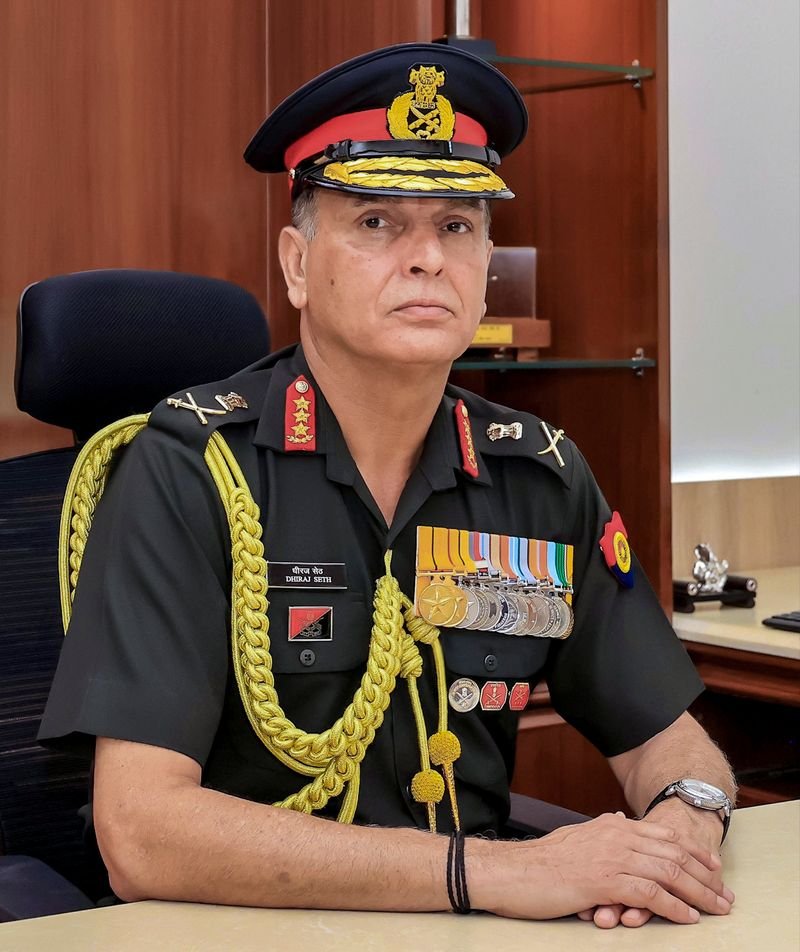
Lt Gen Paramjit Singh

Tribune News Service

Jammu, October 18

Lt Gen Paramjit Singh, General Officer Commanding, White Knight Corps, visited the Surankote sector and the Counter Insurgency Force (Romeo) at Palma on Thursday.

During the visit to the Counter Insurgency Force headquarters, The General was briefed on the prevailing the security situation and the conduct of the recently held urban local bodies elections in the region and the forthcoming panchayat polls.

He was also briefed on the actions being taken to ensure a robust counter-terrorist grid to enable continued peace and stability in the region.

The General complimented the troops for ensuring the situation remains stable and lauded the local population, especially the Gujjar abd Bakerwal community, for their support in bringing peace to the region. He appreciated the civil administration and other security forces for their synergised efforts, which resulted in the successful conduct of the urban local bodies elections.

The General also interacted with soldiers and complimented them for displaying high standard of professionalism. He was appreciative of the measures and the standard operating procedures instituted by the units and formations in their area of responsibility and for the conduct of operations without causing inconvenience to the locals.


IAF team on cleanliness mission

Tribune News Service

Mandi, August 11

An Indian Air Force car-cum-bike rally for Swachh Bharat Abhiyan reached Manali on Saturday.Participants of the rally also distributed dustbins and pamphlets to people to encourage them for cleanliness.The rally is being headed by Air Vice-Marshal AK Singh. He said the rally began from Delhi via Manali to Leh and Thoise on August 10, which will culminate on August 24. During that period, it will cover 2,372-km distance.He said the objective of the rally was to promote the Prime Minister’s noble mission of Swachh Bharat Abhiyan. It aimed at spreading awareness among tourists and locals to maintain cleanliness in the mountain and make these garbage-free zones.The team has planned to collect garbage for its disposal at the designated places. It is also planned to carry out cleanliness campaign at Leh and Thoise.