Sanjha Morcha

What’s New

Click the heading to open detailed news

Current Events :

web counter

Print Media Reproduced Defence Related News

Armoured Corps Day observed

Tribune News Service

Chandigarh, May 1

Armoured Corps Day was observed by the Headquarters Western Command at Chandimandir today. This marks the mechanisation of Indian cavalry regiments. It was on May 1, 1938, when the Scinde Horse became the first regiment to shed its horses and re-equipped with Vickers light tanks and Chevrolet armoured cars.A solemn wreath laying ceremony was held at the Veer Smriti war memorial where Maj Gen AK Sanyal paid floral tributes to the martyrs on behalf of all ranks of the Command. The Corps has acquitted itself with distinction in all wars. The deployment of armour on Zojila Pass in the 1947 Indo-Pakistan War proved to be decisive and the turning point in the conflict. The Indian Armoured Corps gave a sterling performance in the 1965 Indo-Pak War where the sophisticated and advanced Patton Tanks of the Pakistan Army were decimated to form the famous graveyard, “Patton Nagar” near Khemkaran in Punjab. The Corps proved its mettle yet again gloriously in the 1971 war, wherein tanks were at the forefront of action on both western and eastern fronts.

——————————————————————————-

Armour Day is celebrated on May 1 every year to commemorate the commencement of mechanisation of the Indian cavalry regiments. On this date in 1938, the Scinde Horse became the first regiment to shed their horses and to be equipped with tanks. The first such equipment comprised Vickers light tanks and Chevrolet armoured cars.

The Indian Armoured Corps was equipped with comparatively modern Sherman tanks (M4) of American origin in 1943. Regiments so equipped formed the spearhead of the 14th Army during its pursuit of the defeated Japanese in the liberation of Burma. Post-independence, Indian armour lost one third of its units and training establishments to Pakistan with the Indian share being only twelve regiments. It was these regiments which nurtured the Corps and helped expand to the force that it has evolved into today.

Expansion and modernisation of the Armoured Corps was initiated post independence with Centurions Mark VII and AMX-13 light tanks. Since then, the Armoured Corps has operated the indigenous Vijayanta tanks, the Russian T-54 and T-55, T-72 and T-90 tanks and indigenous MBT Arjun.

An ideal man-machine interface led to a sterling performance in the Indo-Pakistan war of 1965 when the sophisticated Pakistani Patton tanks were decimated by own Centurian tanks to form the famous ‘Patton Graveyard, near Khemkaran in Punjab. Lt Col AB Tarapore of ‘The Poona Horse’ was posthumously honoured with the Param Vir Chakra for his gallant action in the Shakargarh Bulge. The Corps proved its mettle yet again gloriously in the 1971 war with Pakistan wherein tanks were at the forefront of action in the plains sector on the Western and Eastern fronts. 2nd Lt Arun Khetrapal fought gallantly and made the supreme sacrifice in the Battle of Basantar River earning for his regiment ‘The Poona Horse’, yet another Param Vir Chakra.

The core ethos of displaying exemplary courage in the face of fearful odds is amply demonstrated by the award of two Param Vir Chakras, 15 Maha Vir Chakras and 60 Vir Chakras amongst a large number of gallantry and distinguished service awards bestowed upon officers and men of the Armoured Corps.

—————————————————————————-

Celebration of Armoured Corps Day begins at Western Command Hqs

Excelsior Correspondent
JAMMU, May 1: The 3-day celebration of Armoured Corps Day to commemorate 77 years of the mechanization of Indian Cavalry Regiments begins today at Headquarters of Western Command.
It was on May 1, 1938 that the Scinde Horse became the first Regiment to shed its horses and was equipped with Vickers Light Tanks and Chevrolet Armoured Cars. This was the beginning of a new era of valour and sacrifice by the tankmen.
Dignity and nostalgia marked the celebrations of the Armoured Corps Day at Headquarters Western Command. First of all a solemn wreath laying ceremony was held this morning at the “Veer Smriti” where Lt Gen KJ Singh Army Commander, Western Command laid the wreath to pay homage to the gallant martyrs who laid down their lives defending the Nation.
The event was also attended by the select veterans from the Armoured Corps including Brig NS Sandhu, MVC (Retired), the war hero of 1971 India Pakistan War.
The Armoured Corps has acquitted itself with distinction in all wars. The deployment of armour on the Zojila Pass in the 1947 Indo Pakistan War proved to be decisive and the turning point of the conflict. The Indian Armoured Corps gave a sterling performance in the 1965 war, wherein the sophisticated and advanced Patton tanks of Pakistan Army were decimated to form the famous graveyard, “Patton Nagar” near Khemkaran in Punjab.
The Corps proved its mettle yet again gloriously in the 1971 war wherein tanks were at the forefront of action on the both Western and Eastern front and infact spearheaded the offensive of ground forces into Dhaka.
Apart from proving its mettle in the domain of conventional operations, the Armoured Corps has contributed substantially and significantly to the Counter Insurgency Operations in J&K and North East. The Corps is also contributing a contingent at United Nation’s mission in Lebanon, apart from individual representations.

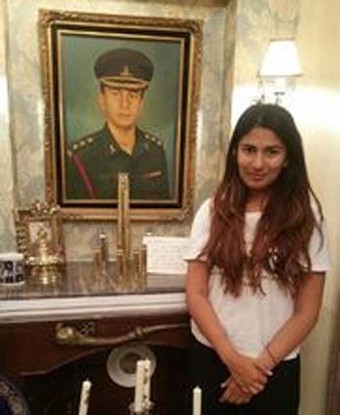
Dad died in Kargil, she wants to make peace

Tribune News Service

Chandigarh/Jalandhar, May 1

Jalandhar teenager Gurmehar Kaur was just two when she lost her father, Captain Mandeep Singh, who made the supreme sacrifice during the 1999 Kargil war. Now, she is telling her story through a four-minute video on YouTube, but without uttering a word. She simply holds up a succession of placards revealing her experiences and conveying her powerful message for peace between India and Pakistan.The video has been produced and shared by Ram Subramanian, the Mumbai-based founder of #ProfileForPeace, a hashtag campaign that has gone viral on social media.In a style reminiscent of silent movies, Gurmehar recalls “how much I hated Pakistan and Pakistanis because they killed my dad. I used to hate Muslims too, because I thought that all Muslims are Pakistanis”.She remembers, “When I was six, I tried to stab a lady in a burqa because for some strange reason I thought she was responsible for my father’s death. My mother (posted as an ETO) held me back and made me understand that Pakistan did not kill my dad, war killed him. It took me a while to know, but today I do, I have learnt to let go of my hate.”Gurmehar goes on to boldly question “the calibre of the leadership of both nations”.”We cannot dream of becoming a first-world country with a third-world leadership. Please pull your socks up, talk to each other and get the job done,” she asserts in a no-nonsense way. The 19-year-old signs off with a wish to live in a world where there are no Gurmehar Kaurs who miss their dads. While Gurmehar, who is a tennis player, is pursuing Plus Two in Commerce, her sister Bani, who was just five months old at the time of Capt Mandeep’s martyrdom, is 17. Lovingly called Gulgul at home, Gurmehar, says her uncle Prof Davinderdeep Singh, who teaches English literature at Nakodar’s DAV College, “is among the rare creed of children who are mature beyond years”.As Jammu and Kashmir CM Mehbooba Mufti put it, if Iran and the US can learn to live in peace, why not India and Pakistan? Gurmehar would agree.

For ‘Muslim haters’, Kargil martyr Capt Mandeep’s daughter shares powerful video

Gurmehar Kaur, daughter of Capt Mandeep has made a video pleading peace between India and Pakistan

Jalandhar: If you too belong to the long list of ‘Muslim Haters’, then a ‘powerful but silent’ video made by the young daughter of a Kargil martyr Capt Mandeep Singh should definitely be watched.

Gurmehar Kaur, the 19-year old daughter of the slain officer hailing from Jalandhar has made a silent but 4 minute video, where she was holding placards with her heart felt emotions on hate against Muslims and war between India and Pakistan. The video made by Ram Subramaniam was widely being shared on the social media platform.

In the video, Gurmehar has strongly highlighted that how she used to hate ‘Muslims’ considering them solely responsible for killing her father in the 1999 Kargil war. The young girl shared that how her thoughts changed for the Muslims, when none other than her mother, Rajwinder Kaur changed her perspective.

Rajwinder Kaur, the widow of Capt Mandeep, Rajwinder Kaur was currently posted as Assistant Excise and Taxation Officer at Ludhiana. At present, Rajwinder was staying with her two daughters at Jalandhar. Capt Mandeep was married for just five years, when the tragedy struck.

Gurmehar was mere two years old, when she lost her father in the Kargil war, which snatched many precious lives of the Indian soldiers. The then Deputy Director District Sainik Board, Col Manmohan Singh (retd) said that Capt Mandeep of 49 Armoured Division Regiment was killed in Kupwara (Jammu and Kashmir) on August 6, 1999 when the terrorists stormed an Army Camp of 4 Rashtriya Rifles.

The message of Gurmehar reads, “This is my Dad Capt Mandeep Singh. My name is Gurmehar Kaur, I am from Jalandhar India. He was killed in the 1999 Kargil war I was two years old, when he died. I have very few memories of him. I have more memories of how it feels to ‘Not have a father’. I also remember how much I used to hate Pakistan and Pakistanis because they killed my dad. I used to hate Muslims too because I thought all Muslims were Pakistanis. When I was six years old, I tried to stab a lady in Burkha because for some strange reason, I thought she was responsible for my father’s death. My mother held me back and made me understand that Pakistan did not kill my dad, war killed him. It took me a while to know but today I do have learnt to let go of my hate. It was not easy but it’s difficult. If I can do it, so can you. Today, I am a soldier too just like my dad. I fight for peace between India and Pakistan because if there was no war between us, my father would still be here.”

Gurmehar has further shared, “I am making this video because I want the government of both the countries to stop pretending and solve the problem. If France and Germany can become friends after two World Wars, if Japan and USA can put their past behind and work towards progress, then why cant we? Majority of regular Indians and Pakistanis want peace, not war. I am questioning the caliber of leadership of both the nations. We cannot dream of becoming a first world country with third world leadership.”

“Enough people have died on both sides of the border. Enough is Enough. I wish to live on a world where there are no Gurmehar Kaurs who miss their dad. I am not alone there are many like me. Profile for peace”, her messages read. Surely, a soul stirring message for Muslim haters and those seeking wars between India and Pakistan!

59268


AgustaWestland VVIP chopper scam: All means to be pursued to bring corrupt to justice, says Defence Ministry

Defence Ministry also said that CBI and Enforcement Directorate are vigorously pursuing all aspects of the investigation, including the arrest and extradition of three alleged middlemen of the AgustaWestland deal.

Manohar ParrikarDefence Ministry said it was the NDA, on July 3, 2014, that had actually put on hold all procurement and acquisition cases in the pipeline of six companies involved in the VVIP chopper scam. (PTI Photo)

Noting that the core issue in the VVIP chopper scam was corruption, the Defence Ministry on Thursday said the government will leave no stone unturned in pursuing all means to bring to justice the corrupt and the wrong-doers in this case.

Refuting the Congress claims that the Anglo-Italian helicopter maker AgustaWestland was blacklisted by the UPA government, it said it was the NDA, on July 3, 2014, that had actually put on hold all procurement and acquisition cases in the pipeline of six companies involved in the VVIP chopper scam.

It also said that CBI and Enforcement Directorate are vigorously pursuing all aspects of the investigation, including the arrest and extradition of three alleged middlemen of the deal — Carlo Gerosa, Guido Haschke Ralph and Christian Michel James.

“Publicly available information on the procurement of AgustaWestland helicopters clearly shows that the core issue in the matter is corruption. The present government has taken effective action to bring out the truth and will leave no stone unturned in pursuing all means to bring to justice the corrupt and the wrong-doers in this case,” a statement released by the ministry said.

It said the time taken is largely because some of the key perpetrators of this “misdeed” are outside the country.

In certain quarters, questions have been raised on certain trivial technicalities, which appear to be intended to distract attention from the core issue of corruption, it said.

The ministry said that the contract for supply of 12 helicopters signed with AgustaWestland International Ltd (AWIL) on February 8, 2010 was terminated with effect from January 1, 2014.

“The main reason was breach of the provisions of the Pre-Contract Integrity Pact and breach of terms of contract by AWIL. However, the company was not debarred by the said order. Various bonds and bank guarantees were invoked.

“It is the present government which through its order dated July 3, 2014, put on hold all procurement/acquisition cases in the pipeline of six companies figuring in the FIR registered by the CBI. No new capital procurement has been made thereafter from these companies in the tenure of the present government,” the statement said.

The said companies are AgustaWestland International Ltd, Finmeccanica, Italy and its group of companies, including subsidiaries and affiliates, IDS, Tunisia, Infotech Design System (IDS), Mauritius, IDS Infotech Ltd, Mohali and Aeromatrix Info Solution Pvt. Ltd, Chandigarh.

On the Congress allegation that the NDA gave clearance to a joint venture involving AgustaWestland through the Foreign Investment Promotion Board, the ministry said this proposal was approved on September 2, 2011 based on an application by Indian Rotorcraft Ltd, a joint venture of Tata Sons with AgustaWestland NV, Netherlands.

“This was later changed to AgustaWestland S.p.A, Italy due to re-organisation within the group. On February 7, 2012, an industrial licence for the manufacture of helicopters was granted by the Department of Industrial Policy and Promotion to Indian Rotorcraft Ltd. However, the validity of the licence has since expired,” it said.

On the “core issue of corruption”, it said the two agencies concerned, namely CBI and Enforcement Directorate, are vigorously pursuing all aspects of the investigation, including the arrests and/or extradition of the three foreign nationals.

“Red Corner Notices were issued in December 2015 and January 2016 through Interpol under Prevention of Money Laundering Act and Prevention of Corruption Act. Extradition request has also been made for Christian Michel James. One of the agencies (Enforcement Directorate) has arrested an Indian national and attached approximately Rs 11 crore of property belonging to Indian nationals and to Christian Michel James,” it said.

Congress had on Tuesday claimed that AgustaWestland was blacklisted by the UPA dispensation but “removed” from the blacklist by the Modi government.

Congress leader and former Union minister Anand Sharma had said, “The chopper deal was scrapped. Action was taken by the UPA government. A K Antony, the then Defence Minister, had made a statement in Parliament and AgustaWestland was blacklisted.”


Our service chiefs may earn more than US generals

NEW DELHI: For the first time, the Indian Army chief and his counterparts in the IAF and the Navy will draw more salary than the top general and equivalent in the US based on purchasing power parity (PPP) terms when the recommendations of the 7th Central Pay Commission are implemented.
A comparison drawn by the Institute for Defence Studies and Analyses (IDSA), a defence ministry think tank, on the pay packets of Army chiefs and equivalent in the US, the UK and India said a general and equivalent in the US was paid $181,500 per annum (in PPP terms). The salary in the UK for similar ranks was $269,868. In India, the three services chiefs, who enjoy pay equivalent to the Cabinet secretary, received $140,520.

If the recommendations of the 7th pay panel are implemented, the Indian Army chief’s annual salary will jump to $189,482 (in PPP terms), almost $8,000 more than what a general and equivalent ranks draw in the US. The huge salary hikes will apply equally to civilian officers too.

The purchasing power parity conversion factor, used worldwide to compare income levels in different countries, is “the number of units of a country’s currency required to buy the same amounts of goods and services in the domestic market as a dollar would buy in the US”.

 The pay panel observed, in light of protests by the three Service chiefs asking for more money and perks, that “defence service officers and JCO/ORs in India, based on 6th CPC pay scales, are placed quite well in terms of pay, even in relation to defence personnel in countries like US and UK, where the GDP per capita in PPP terms for the country as a whole is significantly higher than that of India”.


Top Comment

y should these top grade officers be paid more..? Jawans, JCO’s should be paid more then thses crook bosses who do nothing good for the country other then living royal life.. what is the job securit… Read MorePradeep Singh

These conclusions are, however, equally applicable to civilian employees of the government who are similarly placed. The pay panel’s analysis did not take into account the augmentation of pay being recommended by the 7th CPC.


The IDSA, an autonomous institution funded by the government, was in 2015 commissioned by the Pay Commission to study how well the military and the generals were paid.


Army apprehends two ISI agents in Rajouri

Shyam Sood

Rajouri, April 26

The Army has apprehended two ISI agents in Rajouri district soon after they crossed the Line of Control and entered Indian territory on Sunday.Alert personnel of the Nowshera Brigade apprehended the two ISI agents from the Line of Control in the Lam-Jhangar area.They were identified as 30-year-old S Hassan and 18-year-old H Ali, residents of Sazarkot in the Khuiratta tehsil of Kotli district in PoK.“Both the persons arrested are hardcore agents of the ISI. They were sent to the Lam-Jhangar sector on a recce for a possible infiltration attempt,” said an official source. He added both agents were detected via surveillance equipment and allowed to enter Indian territory they were arrested by the soldiers.During their sustained interrogation, they admitted links with the ISI and reportedly informed the interrogators that they had visited the area in the past as well.Sources added that both agents were testing Indian defence deployment in the area and looking for a possible weak point to push terrorists into the state.Lt Col Manish Mehta, PRO Defence, admitted the Army had apprehended two PoK residents who had trespassed from Nowshera sector and were handed over to the police for further action.“The Army has neither shared information about the arrests of two PoK nationals nor handed them over to us. It is not feasible to share any information at this stage,” said Rajouri SSP Rajeshwar Singh.


China could sidestep LAC mapping in talks

DEFENCE MINISTER MANOHAR PARRIKAR HAD SAID DEMARCATING THE LAC COULD GO A LONG WAY IN REDUCING TENSION ALONG BORDER

BEIJING: China on Tuesday emphasised the importance of dialogue to resolve the longstanding border dispute with India but gave enough indications that it is not up for mapping or demarcating the Line of Actual Control (LAC).

Beijing’s statement came a day before the two sides resume talks on the border issue in the Chinese capital after a gap of a year.

Visiting defence minister Manohar Parrikar raised the issue of demarcating the Line of Actual Control (LAC) during meetings in Beijing on Monday, saying it could go a long way in reducing tension along the border.

On Tuesday, China came as close to a public response to Parrikar’s remarks as possible, and it came hours before national security adviser AK Doval was to arrive in Beijing for the 19th round of talks between ‘Special Representatives’ on the boundary issue.

As it turns out, China is not ready to demarcate the border.

“With regard to Line of Actual Control (LAC), we can have further discussions on that. As for any breakthrough during the 19th session (of talks), I am not sure but I believe both sides have the willingness to continue with friendly discussions on that,” foreign ministry spokesperson Hua Chunying told a regular news briefing.

Hua said after Parrikar’s meetings with Chinese officials and talks on the Line of Actual Control (LAC), it was seen the “two militaries have the common aspiration of enhancing military-to-military exchanges so as to build up mutual trust”.


From anger to violent rage

Disgust with the politics of Hindutva could combine with pan-Islamism to make this the worst summer in Kashmir, writes DAVID DEVADAS

So sharp and enraged were the public agitations in Handwara and Kupwara last week that a lot of people in Kashmir have been talking of a ‘return of 2010.’ Thankfully, things have settled down there, but the signs are worrying. Top police officers have spoken to senior army officers of the possibility that this will be the worst year yet for the forces. Comparisons with 2010 are natural. That was the year when mobs of Kashmiri youth took to the streets with stones and rage. Around 120 young men were killed that summer as the police and the Central Reserve Police Force repeatedly opened fire on belligerent crowds of youth. In early September that year, the Union cabinet was given a very alarming report about the situation. Indeed, so bad was the situation that the then chief minister, Omar Abdullah is said to have indicated to a cabinet committee in New Delhi that he did not want to return to Kashmir.

PTIThe sense that Kashmiris have been wronged by ‘outsiders’ has been boosted by recent events at the National Institute of Technology in Srinagar, at Handwara and Kupwara, and by perceptions that the media coverage of both have been biasedAlready, the portents this year are so worrying that comparisons with 2010 may turn out to be underestimates. Some people in Kashmir have talked excitedly of IndoPakistan and Sino-India tensions. They did not in 2010. Locally too, greater rage and frustration could be manifest than in 2010. A lot of Kashmiris have expressed amazement over the levels of the rage apparent in Kupwara district, which was considered safely dormant for India in the past.

In 2010 too, rage was partly animated by disappointment with the Omar Abdullah-led government, which was formed after the elections that were held in the winter of 2008. In 2016, there is not just disappointment but disgust with the established political process. This disgust and rage focuses on the BJP, which many Kashmiris not only disparage but deeply fear as the face of Hindu Right-wing animosity against Muslims in general and Kashmiris in particular. The PDP-BJP coalition is seen as a betrayal of poll promises; during the 2014 campaign PDP leaders had urged people to vote for the party in order to keep the BJP from coming from power.

Apart from the PDP-BJP tie-up, two other factors make the situation this year more dangerous than 2010. One of these is an increased sense of Islamic identity. This is partly a response to the RSS’s Hindudva ideology. This identity has also been strengthened by global currents emanating from the Gulf and elsewhere. There is greater acceptance of the idea that Muslims are under global siege by dominant powers, including a Christian West, Israel and a Hindu India. The third factor plugs into the second; insider-outsider antipathy has increased greatly since 2010. The sense that Kashmiris have been wronged by ‘outsiders’ has been boosted by recent events at the National Institute of Technology in Srinagar, at Handwara and Kupwara, and by perceptions that the media coverage of both have been biased.

The rage of 2010 was largely animated by anger over specific killings of innocent Kashmiris. The names of Wamiq Farooq, Tufail Mattoo and Zahid Farooq, who were teenagers when they were killed by forces that year — at least one of them was only returning from tuition — still reverberate in Kashmir. Rage increased after the murder of three young men who were lured to an army camp at Machil with the promise of work, killed, defaced, buried and described as Pakistani terrorists. Rewards were claimed by the army men, who were dismissed from service by a court martial in 2014. Many Kashmiris say that that measure of justice was not only too late, it was far too little. They should have been hanged, they say, to give an adequate signal to others who might want to misuse state power to murder innocents for personal gains.

The rage this year is clearly more generalised, and focuses more on what has now come to be widely perceived as an illegitimate establishment. This stems in large measure from the narratives and discourses that have been vigorously circulated over the past few years. A young Kashmiri taxi driver remarked with a sense of triumph that an Indian tourist had told him that Kashmir was illegally occupied. The young man does not know very much about history or geopolitics but is convinced that this must be true since an Indian says so. Sensible voices in the ruling establishment rue the fact that history and world affairs are not taught in school curricula. Orchestrated discourses naturally gain ground.

Partly owing to the recent narratives, there is more intense rage than in 2010. Despite a curfew, unarmed young men attacked an army camp last week. This was unheard of in the past. Students who were part of bands of young ‘stone-pelters’ told me in Old Town Baramulla in June 2010 that they only pelted the CRPF and the police, since these oppressed them. If an army truck came by, they let it pass. Lt Gen Naresh Marwah (retired), who was the Corps Commander in the Kashmir Valley that year, confirms that not a single army vehicle was attacked that year. This was despite the fact that there was anger against the Machil fake encounter and the killing of an elderly beggar who had approached an army camp gate in Kupwara that spring. Nor, adds Marwah, did the army fire a single shot during that summer of unprecedented rebellion with stones. Last week, by contrast, unarmed youth attacked an army camp in Kupwara, something that was unheard of in the past. They have also been attacking police stations and vehicles of both the forces. That is a very sobering indicator of just how bad things could get — and relatively soon.


Odd-Even being applied on Manali-Leh highway

,Monday
The Lahaul-Spiti district of Himachal Pradesh has decided to implement the ‘odd and even’ system on the Manali-Leh highway from Monday. This comes after regular reports of traffic jams on the Manali-Koksar road after the Rohtang Pass was opened. On odd dates, vehicles would be allowed from Manali towards Lahaul-Spiti, while it will be the reverse on even dates.

Indian Army sharpens its proactive war strategy with ‘Shatrujeet’ exercise in Thar desert

Story image for indian army news from Zee News

New Delhi: The Indian Army is conducting a massive exercise ‘Shatrujeet’ in the Thar desert near to the border with Pakistan to fine-tune its proactive war strategy to respond swiftly to any threat to nation’s security.
As per a report in The Times of India, the exercise is being steered by the 1 Corps – one of the three principle `strike corps of the Indian Army` – based in Mathura near Delhi.Several infantry, armoured and artillery fomations are taking part in the operations being conducted under a simulated nuclear, biological, chemical warfare environment. Army Chief General Dalbir Singh Suhag will review the final phase of the exercise.

The exercise is o critical importance for the Indian Army as Pakistan has often flaunted its 60-km Hatf-IX missiles as a counter to India’s conventional military superiority. Shatrujeet aims to fine-tune the strategy to tackle the threat.

The TOI quotes a defence expert as saying, “Pakistan might be foolish enough to talk about tactical nukes as weapons but India’s no-first-use nuclear policy is clear. It warns of a massive and harsh retaliation to any first NBC strike by an adversary, be it tactical or strategic.”

To add teeth to the strategy, the Shatrujeet exercise will also see major airborne operations, including para-dropping of around 3,000 soldiers.


Shopian encounter: Villagers blame Army for vandalising graveyard where militants are buried

Villagers in South Kashmir’s Karimabad and Gudoora are up in arms against the army and blamed them for vandalizing and desecrating the graveyard at Karimabad village

en by Mir Ehsan | Srinagar | Updated: April 10, 2016 1:20 am

J&K encounter, J&K terrorist encounter, Hizbul Mujahideen militants, Hizbul Mujahideen, militants, militants encounter, Jammu and Kashmir encounter, Kashmir protests, Shopian encounter, JK Shopian encounter, india newsA police vehicle was set on fire in Karimabad on Thursday. (Source: AP)

Villagers in South Kashmir’s Karimabad and Gudoora are up in arms against the army and blamed them for vandalizing and desecrating the graveyard at Karimabad village where militants who were killed on Thursday are buried.

Army, however, denied the allegations and termed it as a ploy to malign the image of the army by separatists.

On Thursday after killing two militants at Vehil Shopian, the villagers intercepted the police bulletproof vehicle at Muran chowk in which body of a militant was being carried. The villagers hijacked the vehicle and later set it on fire while the body of militant Naseer Ahmad Pandit who was a former police constable turned militant was buried in the graveyard of his native village Karimabad.

The villagers alleged that the army at night came to the village and took away the damaged vehicle and also vandalized the graveyard and desecrated the graves. “This has been done by the army and their agents who are not happy with the participation of huge number of people in the militant funerals,’’ a villager alleged.

Even some villagers alleged that they (army) also damaged an apple orchard in the neighborhood of the graveyard.

On social networking sites, many people reacted on the desecration of the graveyard and termed it as an inhuman act and circulated the pictures of the graveyard. “After yesterday’s (Friday) massive participation in the funeral of Naseer & Waseem in South Kashmir, the desecration of the martyr’s graveyard perhaps by frustrated Indian army only reiterates that our revolutionaries even after death haunt the Indian army. This growing insecurity of India on Kashmir is encouraging,’’ Khurram Parvez, a human rights activist wrote on the face book.

Army on its part strongly termed these allegations as baseless and said the story has been cooked up by separatists with an obvious intent to malign the fair image of the army.

“The Indian Army, during the Kargil conflict, had given a befitting and honorable military burial to even Pakistani soldiers. Desecrating the ‘graves’ of our own youth even if they are misguided is unimaginable for a disciplined force with a proven track record in displaying due dignity to the adversary during and after combat,’’ the army spokesman said adding that such irresponsible allegations are only indicative of intellectual bankruptcy of ignorant and ill informed minds.

– See more at: http://indianexpress.com/article/india/india-news-india/shopian-encounter-villagers-blame-army-for-vandalising-graveyard-where-militants-are-buried/#sthash.xyaO5hmz.dpuf