

Current Events :





THE CENTRE PLANS TO RENOVATE THE HISTORICAL SITE BY CREATING BETTER INFRASTRUCTURE FOR TOURISTS, INCLUDING 4-D THEATRE, LANDSCAPING, MODERN LIGHTING AND BEAUTIFICATION OF THE MEMORIAL
Amritsar’s Jallianwala Bagh was a desolate piece of land partly used for dumping garbage until British General Reginald Dyer oversaw the massacre of several hundred unarmed people gathered there on April 13, 1919, to protest against a draconian law that allowed internments without trial. The massacre etched Jallianwala Bagh in India’s collective memory and fuelled India’s struggle for complete independence from Britain.
HT ARCHIVE■ An artitst’s impression of the Jallianwala Bagh Massacre.Davinder Pal Singh, a Sikh scholar whose family has been running a shop for decades near Jallianwala Bagh, said the ground was cleaned for the protest against the Rowlatt Act before the massacre. He added the residents would dump garbage at a “sort of abandoned open ground”.
Darbari Lal, a former deputy speaker of Punjab assembly, said Sardar Himmat Singh Jallianwale owned the land. He said Jallianwale was a noble in the court of Maharaja Ranjit Singh (1780-1839), who was from village Jalla in Punjab’s Fatehgarh Sahib.
“In 1919, Jallianwala Bagh was no garden, but a desolate piece of land… of irregular shape… [It was] about 250 yards long and 200 yards wide. Originally, however, it had been laid out as a garden in the middle of the 19th century…,” said Balwinder Singh, a former head of Guru Nanak Dev University’s Guru Ramdas School of Planning in Amritsar. He said it was uneven and a small strip of land near the entrance of Jallianwala Bagh was on a higher level. “…the rest of the land was lower by four to five feet.”
A narrow passage, which General Dyer used to make his way to the ground along with his soldiers, has been left intact with bullet marks on the walls of few structures and a well in the Jallianwala Bagh. Many had jumped into the well in a desperate attempt to save themselves as the soldiers showered bullets at them.
The British wanted to erase signs of the massacre, according to Lal. But national movement leader Madan Mohan Malaviya purchased the Jallianwala Bagh by raising around ~5.60 lakh through donations in August 1923. He led a committee that was formed to build a memorial to those killed in the massacre. The memorial could not be built as long as Britain ruled India until August 1947.
The country’s first president, Rajendra Prasad, inaugurated the memorial, which was built at a cost of over nine lakh, on April 13, 1961, in presence of then Prime Minister Jawaharlal Nehru, according to Sukumar Mukherjee, the secretary of Jallianwala Bagh National Memorial Trust. The trust manages the memorial.
The memorial’s central pylon is 30-feet-high with a four-sided tapering stature of red stone. It stands in the middle of a shallow tank built with 300 slabs with a carved Ashoka Chakra, the national emblem.
A stone lantern stands at each corner of the tank. On all four sides of the pylon the words, “in memory of martyrs, 13 April 1919”, has been inscribed in Hindi, Punjabi, Urdu and English. A semi-circular verandah near Jallianwala Bagh’s main entrance marks the spot, where General Dyer’s soldiers took positions to fire at the gathering.
Rows of poplars and eucalyptus have been planted along the periphery to provide a green wall for isolating the view of the nearby houses.
Mukherjee said a martyrs gallery was established in 1972 under the guidance of Mohinder Singh Randhawa, a writer and former civil servant. A painting of the massacre as well as portraits of the political leaders of the time, too, is on display. In 2000, then Union minister Ram Nayak lighted the Amar Jyoti [Eternal flame] to commemorate those who died.
“Actually, we had the documents [ historical records, rare photographs and newspaper clippings] displayed openly in the room. The visitors used to touch them and spoil them by writing something. We felt this practice was damaging the original and rare documents. Then we displayed scanned formats of the documents in the museum,” said Mukherjee. A light and sound show was introduced in the garden by then defence minister AK Antony in 2010. At the time, Bollywood actor Amitabh Bachchan recorded the voice-over for the 52-minute show, which attracted hordes of visitors in its initial run. But snags developed soon and it has not been functional since 2014.
The area has also undergone several changes. The entry has been given a new look with small bricks through the narrow passage is preserved. Mukherjee said the total area of the Jallianwala Bagh was around six-and-half acres and now it has gone up to seven acres.
Union home minister Rajnath Singh inaugurated a statue of Shaheed Udham Singh at the entrance of Jallianwala Bagh last year. Udham Singh was hanged in July 1940 for killing Michael O’Dwyer, who was Punjab’s lieutenant governor at the time of the massacre.
Rajya Sabha member Shwait Malik said Jallianwala Bagh needs a facelift and added that he has given ~10 lakh from his development fund for improving basic amenities there. He added the tendering process for the Centre’s plans of redeveloping it has started.
Malik said the Centre plans to renovate the historical site by creating better infrastructure for tourists. He added it would involve renovation, up gradation and beautification of the Jallianwala Bagh Memorial.
Malik said a four-dimensional theatre with the sitting capacity of 70-80 people is also being set up for screening documentaries. He added the martyr gallery and the museum will be modernised with air conditioning. Malik said touch control panels would be installed along with LED screens and modern lighting. He added landscaping, too, would be carried out with the installation of and fountains.
FLASHBACK ‘Disgracing the British name’ and ‘Dyer’s dreadful mistakes’ were some of the searing headlines in the Australian newspapers a century ago when they reported the terrible tragedy at Jallianwala Bagh in Amritsar. Manpreet K Singh delved into the old archives to reveal to how the press in Australia, then a British colony like India, audaciously reported the massacre and its aftermath while there was complete censorship imposed on the Indian press then.
MELBOURNE : Today marks the centenary of the Jallianwala Bagh massacre, in which hundreds of unarmed Punjabis were shot down and more than 1,100 were injured during ten minutes of rifle fire from British Indian troops.
The firing was ordered by Colonel Reginald Dyer who came to be known as ‘the butcher of Amritsar’ and was relieved of military duties the year after the massacre.
At the time, Winston Churchill said in the British parliament, “it is an extraordinary event, a monstrous event, an event which stands out in singular and sinister isolation.”
In Australia it was reported as the day of “India’s Re-Birth”, describing the massacre as “Dyer’s dreadful mistake,” while it was later reported in 1927 that General Dyer died after suffering a stroke and being “5 years an invalid.”
The entire episode was extensively reported by Australian newspapers a century ago, despite complete press and mail censorship imposed in Punjab at the time.
By the time Australians heard of the carnage at Amritsar, almost a year had passed. Yet, it made headlines.
Sydney’s The Australian Worker called it an “an orgy of frightfulness in India” which was “disgracing the British name”. The Daily News of Perth reported it as “Dyer’s Dreadful mistake”, and in Melbourne The Age said the impact of the riot and massacre was “the Re-Birth of India”.
The Daily News of Perth republished an article on August, 16, 1920 titled ‘More About Amritsar: Dyer’s Dreadful Mistake’ in which writer Lovat Fraser cited the Battle of Saragarhi and other historical events to acknowledge the long standing relationship that the British enjoyed with Punjabis, especially Sikhs.
Fraser, the then-editor of Times of India, wrote, “General Dyer’s action at Jallianwala Bagh appears to have been entirely indefensible. He acted after open disorder had ceased in the city for two days; he gave no warning on the spot, but began firing within 30 seconds [of arriving]; and he was responsible for grave and unnecessary slaughter. His plea is that he wanted to produce ‘sufficient moral effect’ throughout the Punjab. Such was not his duty and the effect he has really produced is to create, not only in the Punjab, but throughout India, a bitterness that will take years to eradicate.”
ORDERS TO CRAWL, LASHINGS & BOMBING Many Australian newspapers described the harsh cruelties dealt by General Dyer in the few days preceding the Jallianwala Bagh massacre, which also continued well after the bloody Baisakhi.
The Freeman’s Journal published in Sydney on September16, 1920 reported that Punjab, “although disturbed – and for good reason – but was not rebellious.” It drew attention to how Punjabis were treated by saying, “We do not exaggerate when we say that this province, a vital element in the British government of India, and the recruitment of it’s army, was simply trodden under foot.”
Page 7 of Freemans Journal published on 16 September 1920
The crawling order enforced on Punjabis and public lashings were described in greater detail in The Age on February 18, 1921.
Describing what happened on April 10, The Age reported, “One of the most shocking occurrences of that day was the ill-treatment by the mob of Miss Sherwood, a lady missionary, who was knocked off her bicycle on the streets, and brutally beaten with sticks, ultimately being left half dead on the roadway.”
It was on that afternoon that General Dyer arrived in Amritsar with the power to “take whatever steps he thought necessary for the re-establishment of civil control.”
The article describes what transpired in Jallianwala Bagh on April 13 in macabre detail, quoting General Dyer as saying, “This was a horrible duty I had to perform” adding “there could be no question of undue severity.”
“Following the proclamation of martial law at Amritsar, public floggings took place, the ‘curfew’ was instituted, numerous arrests were made, many natives were sentenced to death, and what were termed ‘minor punishments’ were inflicted. Some of these were of a ludicrous character, particularly the order which compelled every native who passed along the street in which Miss Sherwood had been assaulted, to crawl on his stomach.”
“So great was the outburst of indignation throughout India, and, indeed in Great Britain also, that a Commission was appointed in October 1919, to investigate the occurrence.”
Even so, General Dyer had a fair share of supporters and sympathisers, some of whom hailed him as a hero. Even after he was forced to leave the army, many donated funds which quickly reached £4,000, as reported by The Herald in Melbourne on August 14, 1920.
DYER A BROKEN MAN The Telegraph in Brisbane on October 17, 1927 described what happened to General Dyer thereafter. “The punishment inflicted on him as a result of the recommendations of the Hunter Committee was a serious one, as he was compelled to retire from the Army in 1920 and he was not confirmed to the rank of Brigadier General.”
Calling him “a broken man”, the newspaper article said he was “partly a victim of his own temperamental defects, but mainly the victim of lamentable indecision and timidity at Simla (the capital of British Raj at the time), and of gross political expediency at White Hall.”
It added, “The controversy told on General Dyer’s health, and from the time he was officially punished, he was broken in health and a doomed man.”
He died eight years after the Jallianwala massacre on July 24, 1927. His death was reported in many Australian newspapers and Perth’s The Daily News on October 24 ran with the headline “The Broken-hearted man, 5 years an invalid.”
It reported that Dyer “suffered a stroke nearly five years ago and had been an invalid ever since. He had been”unconscious for the last few days”.
MICHAEL O’ DWYER AND UDHAM SINGH’S REVENGE
Another prominent figure in the Jallianwala Bagh saga was Sir Michael O’Dywer, the Lieutenant Governor of Punjab from 1912 till 1919. He was knighted within a year of assuming charge of Punjab and was known to have completely supported and justified Dyer’s actions during the 1919 massacre.
O’Dwyer ordered the bombing of Gujranwala (another city in Punjab), days after the Jallianwala Bagh slaughter and was ultimately dismissed in 1920 for “cruel and barbarous actions.”
O’Dwyer was assassinated on March 13, 1940 by Udham Singh, an Indian freedom fighter, who sought to avenge the Jallianwala Bagh massacre. On March 15 1940, The Newcastle Morning Herald and Miner’s Advocate reported, “Sir Michael O’Dwyer was shot through the heart during a meeting of East India Association at Caxton Hall, Westminster. Six shots were fired by a member of the audience.”
The newspaper also reported that in the same incident, “The Secretary of State of India Lord Zetland, and two other former governors of India, Lord Lamington and Sir Louise Dane were wounded”.
It led to the immediate “arrest of 37-year-old Mohamed Singh Azad (original name Udham Singh) who stated, ‘I made a protest’.”
Udham Singh, was tried and found guilty of murder. It was reported that he said in court of O’Dwyer’s death, “I did it because I had a grudge against him. He deserved it. He was the real culprit. He wanted to crush the spirit of my people, so I have crushed him. For full 21 years, I have been trying to seek vengeance. I am happy that I have done the job.”
Udham Singh, who went by the name Ram Mohamed Singh Azad, was hung to death on 31 July 1940. He is regarded as a hero of India’s freedom movement. His remains are preserved at the Jallianwala Bagh.
For a long form version of the article, log on to: https:// www.sbs.com.au/yourlanguage/punjabi/en/article/2019/04/11/jallianwalabagh-massacre-throughaustralian-lens
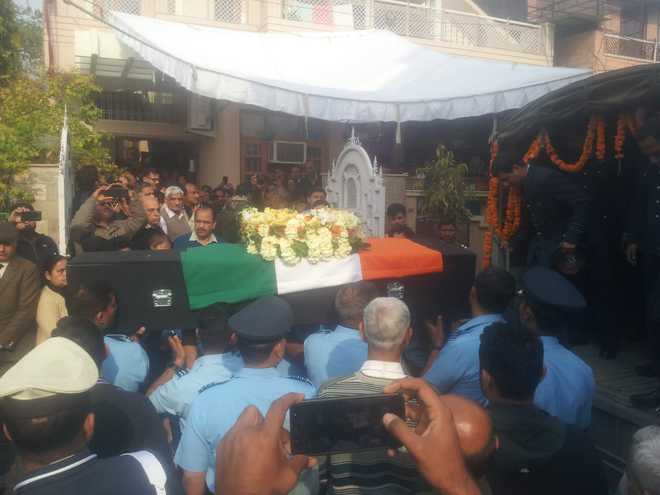
A large number of people attended his last journey. — Tribune photograph
Deepender Deswal
Tribune News Service
Hisar, February 21
The body of the Indian Air Force pilot Wing Commander Sahil Gandhi was cremated with full military honours in his native Hisar town on Thursday.
Gandhi had died during a rehearsal for the Aero Show when two Hawk aircraft of the aerobatic team Surya Kiran collided midair in Bangaluru on Tuesday.
Earlier, his body was taken to Hisar airport from Delhi via helicopter and brought to his home at PLA Sector in the town today morning.
Gandhi is survived by his wife Himani and five-year-old son Riyan.
His father Madan Mohan Gandhi is a retired bank official, while mother Dr Sudesh Gandhi retired recently as a principal scientist from Ch Charan Singh Haryana Agricultural University, Hisar. His elder brother Nitin is an engineer in Sweden.
Sahil joined the NDA after completing his 10+2 from the Campus School at HAU, Hisar, in 2000 and was commissioned in the IAF in 2004.
A large number of people, including local MP Dushyant Chautala, Rajya Sabha MP DP Vats, local MLA Kamal Gupta, IAF officers and district officials, attended his last journey and paid their respects to the departed soul.
Ajay Banerjee
Tribune News Service
New Delhi, April 2
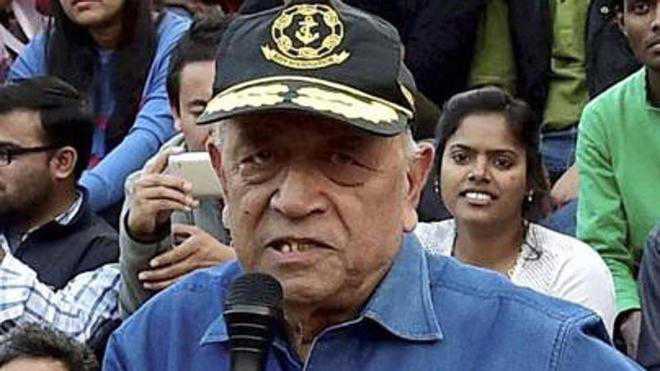
Admiral L Ramdas (retd), a former Navy Chief, has shot off a protest letter to Chief Election Commissioner Sunil Arora against the remark ‘Modi ji ki sena’ (Modi’s Army) by Uttar Pradesh Chief Minister Yogi Adityanath at an election rally on Sunday.
“The armed forces are not a private entity belonging to any individual or political party and, therefore, any suggestion to that effect is completely unacceptable,” Admiral Ramdas said, asking the EC to take suitable action as soon as possible to arrest such irresponsible actions.
Separately, former Haryana IAS officer MG Devasahayam has sent a message to the EC saying: “The integrity of the armed forces is being compromised with to deceive people and secure votes.” He urged the Election Commission to initiate firm steps, including the suspension of the political party concerned.
Admiral Ramdas, who lives in Maharashtra, had some three weeks ago expressed concerns about the growing “politicisation of the armed forces by political parties”. The EC had issued guidelines advising political parties to refrain from using pictures or images of armed forces in their campaigning for the General Election.
At a rally on Sunday, Adityanath, while campaigning for sitting MP and Union minister VK Singh in Ghaziabad, said: “Congress people would feed biryani to terrorists while Modi’s army gives them bullets or bombs.” The remarks have also not gone down well with the military.
“This was exactly the kind of development I was fearing when I wrote to you last month,” said Admiral Ramdas. “As one of the seniormost former Chiefs of the armed forces, I consider it my duty and responsibility to bring to your notice the fact that we, the armed forces of the country, owe our allegiance only to the Constitution of India.”

Remembering driver Jaimal Singh, who was driving the ill fated bus, which was blown up by a suicide bomber in Pulwama on Thursday, Commandant RK Singh from 114 Battalion CRPF, Lidhran Camp, Jalandhar said, “We lost a brave soldier, an energetic and a jolly human being.”
Commandant RK Singh said that the family of Jaimal Singh was residing at CRPF Campus at Sarai Khas, Jalandhar while he was posted in the 76th Battalion in Jammu. “No sooner, the news of this deadliest terror attack on our brave CRPF jawans spread, our officers rushed to support Jaimal Singh’s family. We have fond memories of Jaimal Singh, who was one among the martyrs”, he said, adding that he was recently blessed with a baby boy and his family was in a joyous mood.

Jaimal Singh was a resident of Ghalauti village in Dharamkot sub division of Moga district. He was the driver of the ill fated bus that was blown up after a suicide bomber rammed his explosive laden SUV into the bus on the Srinagar-Jammu highway in Pulwama in Jammu and Kashmir on February 14.
The Commandant shared these heartfelt emotions on the sidelines of a condolence meeting organised by the 114 Battalion CRPF at Jalandhar campus, where tributes were paid to the brave hearts. BSF Punjab Frontier Inspector General (IG) Mahipal Yadav, SSP Jalandhar Rural Navjot Singh Mahal, ITBP Commandant from 30th Battalion Achal Sharma besides other officials from the central para military forces and educational institutions were present.

Talking to Daily Post, Commandant RK Singh from 114 Battalion CRPF, Lidhran Camp, Jalandhar said, “After paying condolences, we informed people about ‘Bharat ke Veer’ app to donate generously for the welfare of the martyrs. The donations could be made directly into the account through this app.”
Commandant RK Singh also shared among the martyrs was Constable Mahesh Yadav and Constable Sukhwinder Singh, who too served under him. “Constable Mahesh Yadav served with me in Chattisgarh. It is a tragic and irreparable loss. The CRPF and the nation was proud of the sacrifice our brave hearts”, he shared.
Tribune News Service
Moga, March 28
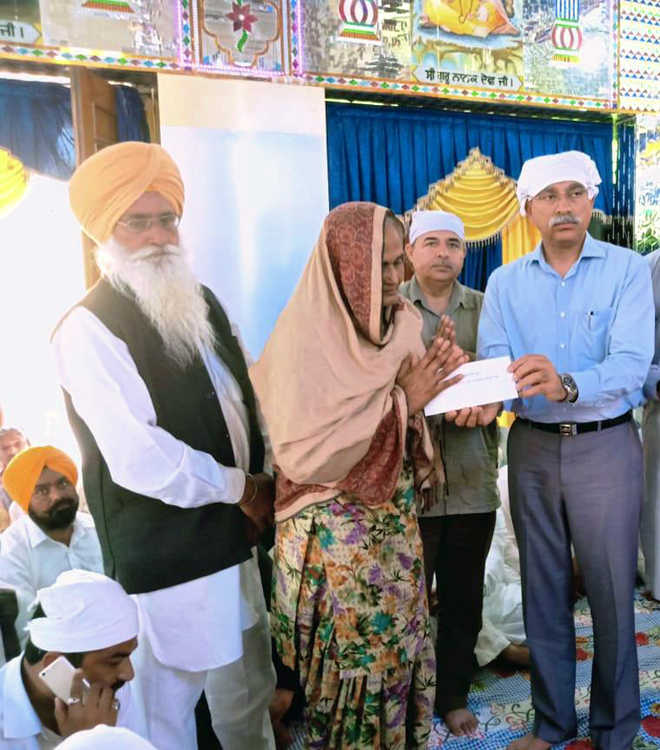
Thousands of people paid tributes to Rifleman Karamjit Singh, 24, on his bhog ceremony held at Janer, his native village, in Dharamkot subdivision of the district on Thursday.
Karamjit of 18 JAK RIF Regiment was seriously injured in an unprovoked firing by Pakistan troops at Rajouri in Jammu and Kashmir on March 18. He later succumbed to the injuries.
He was cremated at his native village on March 19 with state honours.
Deputy Commissioner Sandeep Hans, who attended the bhog ceremony, handed over two cheques for Rs 2.5 lakh each (Rs 5 lakh total) to the martyr’s father Avtar Singh and mother Kulwant Kaur on the behalf of Punjab government.
Karamjit had joined the Army in 2015. Karamjit’s father Avtar Singh is also an ex-serviceman.
None of the local MLAs or any other senior politician of the area attended the bhog ceremony.
Asks who freed terrorists 20 yrs ago; announces Rs 146 cr-projects for Hoshiarpur, Nawanshahr
Tribune News Service
Jalandhar, February 17
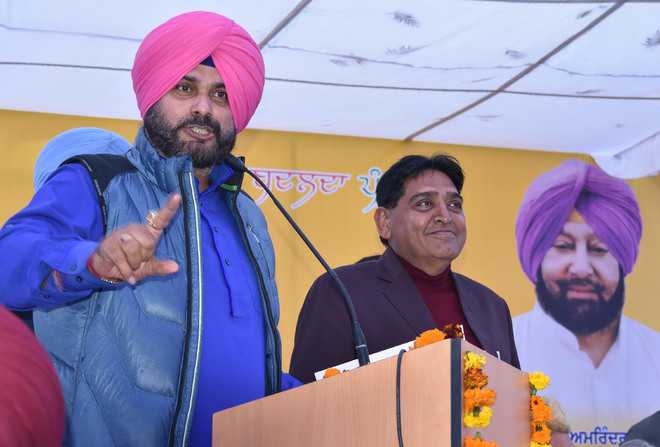
Under fire from the BJP on his statement after the Pulwama terror attack, Local Bodies Minister Navjot Singh Sidhu today while strongly condemning the Pulwama attack, took a jibe while questioning who freed terrorists 20 years ago.
On a state-wide fund-declaration spree ahead of the elections, Sidhu announced projects worth over Rs 145 crore for Hoshiarpur (Rs 101 cr) and Nawanshahr (Rs 45 crore) during his visits to Hoshiapur, Balachaur and Rahom today. Sidhu also made declaration for spending of Rs 550 crore for the upgrade the fire brigade services in the state.
Sidhu had been under condemnation for his statement ‘whether an entire nation could be blamed for a handful of people’ after the gruesome Pulwama attack. Calling for strong action against the perpetrators of the attack, Sidhu questioned the freeing of terrorists 20 years ago (referring to the freeing of three hardcore terrorists Mushtaq Ahmed Zargar, Ahmed Omar Saeed Sheikh and Maulana Masood Azhar following the 1999 Indian airlines hijack in exchange for 155 passengers by the then NDA government).
Addressing a crowd at Dana Mandi in Balachaur, Sidhu said, “The entire country stands against those who have committed a crime. Sidhu also stands with you against this crime. The perpetrators should be punished in such a manner that their five generations tremble at the thought of committing such an act. But I also want to ask those who are raising fingers at me, 20 saal pehlan enhnan nu kaun chad ke aaya si? (who freed them (terrorists) 20 years ago?). I would only ask that politics over the bodies of our soldiers needs to stop.”
Addressing the gathering at the the zila parishad ground in Hoshiarpur, accompanied by Industries Minister, Punjab, Sunder Sham Arora, Sidhu said Rs 5,000 crore would be spent for the development of cities by the state government and Rs 550 crore to improve fire brigade services in the state.
Meanwhile, flanked by Balachaur MLA Chaudhary Darshan Lal and Nawanshahr MLA Angad Singh in Nawanshahr, Sidhu announced a total grant of Rs 45 crore for Nanwanshahr — Rs 23 crore for Balachaur, Rs 13 cr for Nawanshahr and Rs 9 crore for Rahon.
Protesters of the BJP Yuva Morcha (BJYM) holding black flag protests against Sidhu ahead of his address at Hoshiarpur were detained by the police here today. The protest was being led by Nitin Gupta, vice-president, state BJYM, and Ranjit Singh Rana, district president.
The protesting activists were detained by the police before they could reach the venue of Sidhu’s address. They were later freed by the police. The BJYM leaders condemned statements made by Sidhu in the wake of Pulwama attacks and sought that he be booked on the charges of sedition for his comments. Congress workers also held a counter dharna outside the Zila parishad Hoshiarpur office against the BJP, resenting its protest. It was led by Congress Sewa Dal activist Pankaj Kripal.

Saurabh Malik
Tribune News Service
Chandigarh, March 15
Two years after he kidnapped and murdered an Airman, chopping his body into 100 parts and stuffing these into polythene bags, a Bathinda court today awarded the death sentence to IAF Sergeant Sailesh Kumar.
“To be hanged by the neck till he is dead,” Additional Sessions Judge (ASJ) Kanwaljit Singh Bajwa pronounced the sentence. Sergeant Kumar’s wife Anuradha Patel, eight months’ pregnant at the time of the murder, was sentenced to five years’ rigorous imprisonment for destruction of evidence.
The ASJ observed the accused, a member of the armed forces, should have shown courage in some other field, “in place of butchery”. He said: “It would be a mockery of justice and the conscience of society would be shocked, if death penalty was not awarded to him as his act was abhorrent and dastardly.
“This is surely a case which falls within the category of rarest of rare cases.”
According to the prosecution, the victim’s wife told the police that Vipin left house at the Bhissiana Airbase on February 8, 2017, but did not return. She and her father-in-law embarked upon a search. On February 21, they overheard two youngsters saying stench was emanating from the Sergeant’s residential quarters and informed the police.
Evidence regarding the motive behind the murder was, however, not placed before the court.
CRIME MOST FOUL
Sergeant Sailesh Kumar kidnapped and murdered an Airman, chopped his body and stuffed parts into bags
Majid Jahangir
Tribune News Service
Srinagar, February 16
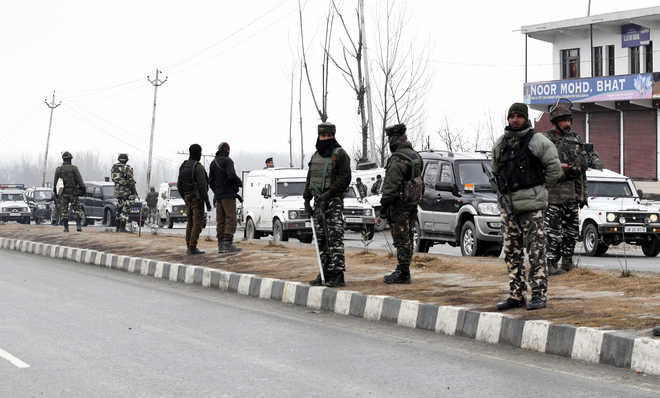
Investigators in the deadly suicide bombing on a Central Reserve Police Force (CRPF) convoy suspect a cross-border link to the explosives used in the attack and have found that the vehicle used in the blast was a Maruti Suzuki Eeco van and not an SUV.
Top sources privy to the preliminary investigations said the explosive used in the blast was mainly RDX that may have been smuggled from Pakistan.
“There are initial leads that suggest that the RDX used in the blast came from across the border in Kathua district. We are working on the leads,” they said.
The sources said over 100 kg of RDX may have been used in the attack which caused the highest number of fatalities in a single militant attack in J&K since the eruption of militancy. In all, 40 CRPF men were killed when a lone suicide bomber of the Jaish-e-Mohammad rammed his vehicle into the CRPF convoy at Lethpora on the Srinagar-Jammu highway.
“It has also been established that the vehicle used was a Maruti Suzuki Eeco van. We are yet to find out the owner of the van. The RDX-laden van may have come through a link road and later joined the convoy before hitting it,” the sources said.
The J&K Police have rounded up some men for questioning and are trying to zero in on the overground workers of the Jaish-e-Mohammad who may have helped in carrying out the attack.
A National Investigation Agency (NIA) team along with forensic experts collected materials at the blast site for evaluation for the second consecutive day.
“The findings will be revealed after the analysis of the material,” an NIA official said.
Maruti van used in Pulwama attack
If everyone is done with the chest-thumping, sloganeering, and point-scoring over recent military actions, I have some sobering thoughts for you.
2019 has gotten off to a terrible start for Indian forces. Though the IAF has redeemed itself through some spectacular air strikes, our losses cannot be shrugged away lightly. It started with the fatal crash of a Mirage 2000 during a test flight at Bengaluru’s old HAL Airport on 14 January 2019. An impromptu wave of anti-HAL/PSU/DRDO sentiment rose into the air along with acrid smoke from the burning debris of Sam and Sid’s fighter jet. Both Sam and Sid, the test crew, died. Overnight, HAL became an ‘enemy’ for many Indians.
Then, Valentine’s Day greeted us with one big blast in Pulwama. 40 CRPF personnel were blown to bits by a suicide bomber, plunging India into deep sorrow with angry cries for retribution. A tripwire, long ignored by a nation that preaches peace in a volatile neighbourhood, was breached. Now Pakistan became ‘Enemy No. 1’.
By the time embers of the Mirage crash and Pulwama cooled, another fireball from midair collision of two Hawk AJTs from Surya Kiran Aerobatics Team (SKAT) rose high into the skies over Yelahanka. Wing Commander Sahil Gandhi soared into blue skies forever on 19 February 2019, doing what he loved the most.
That tragedy was soon overtaken by the glitz of Aero India 2019 which opened next day. I put out a gentle reminder if the show must go on unchecked. Yes, said most. Some called me out for asking stupid questions.
Aero India 2019 ran with great fanfare for the next five days. Hordes of ministers, bureaucrats and officials trooped down to Bengaluru on opening day, logged their presence, made lofty statements, and returned to Delhi like baraatis after a family wedding. Aviation geeks tuned into television, Facebook an Twitter drooled over majestic Rafales, Su-30MKIs and F-16s, little realising that the real thing would soon play out over the skies up north.
Then IAF’s historic air strikes on JeM camps in Balakot, Khyber Pakhtunkhwa happened on 26 February 2019. Sam, Sid, Sahil and their families soon lost national attention to notional gains.
Then Abhinandan happened. A national hero emerged from the unlikely stable of old Mig 21 Bisons that till recently were slandered as ‘widow makers’ and ‘flying coffins’. An F-16D from PAF was shot down by our Bison even as Abhinandan went down in a tight air to air combat.
The very next day (27 February 2019), as an aerial skirmish between IAF and PAF unfolded in the skies over Kashmir, an IAF Mi-17V5 crashed under mysterious circumstances near Budgam in J&K, killing all six crew members onboard. For a nation spoon-fed by media and Twitter handles, this tragedy got but a mention-in-passing, soon disappearing into the vast ’emptiness’ of cyberspace.
Don’t forget their sacrifice, people. Six families were destroyed. We don’t even know how or why yet.
We are a nation with amazing grace and patriotism during the times of crisis but possess a convenient and volatile collective memory during extended periods of peace. That must change. How soon we forgot Mumbai police who fought the 26/11 attackers with batons and 303s! Have we questioned how well the average policeman on the street is kitted up a decade later in 2019?
When Sam and Sid’s Mirage went down inside Bengaluru’s old airport, horrific videos of burning, mortally wounded test pilots surrounded by clueless onlookers and curious first-responders filled our phones. Equally tragic videos of the SKAT crash went viral, while even a basic ‘Police Line. Do Not Cross’ cordon to keep away the trigger-happy public from a crashed aircraft was missing.
Netizens and Twitterati gushed over a ‘hand-in-glove’ photo without asking the real questions – how did this happen? Why did this happen? What should have been our response to such accidents other than taking epic photos? Do our fallen heroes deserve to be paraded like this on social media? Should we not ask for better equipment for our forces, instead?
Have we become a nation full of rabble rousers, Twitter handles and propagandists? You, dear citizens, have to answer that. There’s a price of war. There’s a cost for peace. Are you prepared to foot the bill?
Recall how we caved-in after the IC 814 hijacking in 1999 where families of hostages shouted slogans outside PM Atal Behari Vajpayee’s residence in Delhi. One evening, widow of Sqn Ldr Ajay Ahuja and father of late Lt Vijayant Thapar (both Kargil martyrs) pleaded with them to put national interest over personal. As former aide to PM Vajpayee and writer Kanchan Gupta writes in his chilling account, someone from the crowd heckled Ahuja’s widow with “she has become a widow, now she wants others to become widows. Yeh kahan se aayi (where has she come from)?” Result? We capitulated and brought back the passengers, trading Maulana Masood Azhar (with two other terrorists) who went on to raise the JeM.
When Abhinandan was in enemy territory, you rooted for him. How about rooting for millions of Abhinandans, many of whom never returned home and those who fight with outdated equipment? How about putting your money where your mouth is? You want to pound Pakistan, fine. How many of you asked why the Abhinandans of today have to prostrate themselves in front of a recalcitrant bureaucracy each time to get even basic survival gear? Instead, even educated folks choose to glorify the antiquated Mig-21 Bisons as ‘Falcon Slayer’ and gloss over the substratal lessons.
Political opportunists and keyboard warriors, please wake up and stop twirling your fake moustaches like Amol Palekar in Hrishikesh Mukherjee’s Golmaal (1979). You never bothered when decades of decadence blunted our military edge. You never bothered for two decades after our soldiers fought an impossible war in Kargil. Even without acclimatisation and ECC (extreme climate clothing), our soldiers dislodged Pakistani regulars occupying commanding positions with well-equipped, well-entrenched bunkers.
A Union Minister from the ruling dispensation recently even questioned “what is the Indian Navy doing in Colaba? They should be on the borders”. Now your cronies are putting up these posters in the same corner of Mumbai. This is how low we have stooped.
The collective brunt of all this callousness is borne by the soldiers, sailors and air warriors on the frontline. They deliver the impossible, even after being checkmated over financial minutiae and facing scorn during peacetime.
If you don’t have the appetite for war, don’t pick up the guns. Get the processes in order. Build consensus on what kind of capabilities our armed forces truly require. Then get them that capability without making your ‘10%’ or dancing over their graves. If you cannot do that, keep away from policy making or at least stay silent.
And yes, definitely keep our armed forces out of your political campaigns. Maintain the dignity of our soldiers. You aren’t getting my vote otherwise.
(Capt KP Sanjeev Kumar is a former navy test pilot and blogs at www.kaypius.com. He has flown over 24 types of fixed and rotary wing aircraft and holds a dual ATP rating on the Bell 412 and AW139 helicopters. ‘Kaypius’ as he is widely known in his circles, flies in the offshore oil & gas division of a leading helicopter services company. This is an opinion piece. Views expressed above are the author’s own.The Quint neither endorses nor is responsible for them.)