



Sanjha Morcha

What’s New

Click the heading to open detailed news

Current Events :

web counter

Print Media Reproduced Defence Related News

The Doklam test by Lt-Gen Harwant Singh (retd)

The Doklam test
UNPREPARED: The country is faced with a war-like situation.

Lt-Gen Harwant Singh (retd)

THERE appears to be no early solution to the ongoing standoff on the Doklam plateau. China’s unilateral action to alter the location of the tri-junction between India, Bhutan and China is unexceptionable and violates the 2012 agreement. There is a deeper move in this attempt to build a road on this plateau. It not only aims at posing a serious threat to the Siliguri corridor by crossing the Torsa Nala and occupying the Jhamperi Ridge, but also wean away the only country left in India’s neighbourhood, where it exercises influence and comes in the way of China’s attempt at complete encirclement of India.     China has been assiduously working to encircle India both on land and sea, with the eventual aim of capturing markets and relegating India to a secondary position. Such a move is reminiscent of the gun-boat diplomacy of the seventeen-eighteen centuries by European countries. Building OROB (One Road one Belt) and CPEC (China Pakistan Economic Corridor) is in line with the gun-boat diplomacy of that period, though, through a different format, the sole purpose being to capture markets, in the region and beyond.   China has succeeded in gaining influence and foothold in almost all of India’s immediate neighbourhood, sans Bhutan. This Doklam effort is to draw Bhutan too out of India’s sphere of influence. India’s inability to counter these moves by China bears on our foreign policy and diplomatic skills.While China’s media and government have been making every effort to raise the ante, India’s response has been restrained, muted and mature. The issue that one needs to be addressed is as to why China is spoiling for a fight with a large country of India’s size with equally large defence forces for a minor issue, when seen in the larger context of the region! Perhaps, it is somewhat related to the state of the Indian armed forces. There has been no attempt at modernising the military during the last three decades. Since the Bofors scandal, deficiencies of ammunition and some other essential equipment have been allowed to pile up. The most unusual step of placing thousands of crores of rupees at the disposal of the Vice Chief of the Army to undertake emergency purchases to meet acute shortages of ammunition, both artillery and armour, and a range of other items points to an alarming situation of shortages with the military. All this leads one to conclude that the state of military’s reserves is critical. One need raise the issue as to how this critical situation has come about and who is accountable. Who has been sitting on the Army’s demands for ammunition and a range of critical equipment as well as its modernization? According to some press reports, the country is faced with a war-like situation and desperate attempts are afoot to create reserves of ammunition etc even for a war of duration as short as ten days or so. Though the Army Chief has been talking of a two and a half front war, where is the wherewithal for a conflict of this scale and spread? China has been threatening to enlarge the scope of conflict and may not confine it to the Doklam area, where it is at some tactical disadvantage. There is an inherent drawback in emergency purchases of ammunition and certain critical equipment.  Since none of these are available off the shelf and their supply involves undertaking manufacture on demand, and that takes much time, one may end up picking up substandard or time expired items from the sellers’ military reserves.  While these emergency purchases for the military has in the past resulted in being shortchanged in a number of cases, one need quote just two to highlight the pitfalls in letting a situation develop where there may be no alternative to adopting this course. During the Indian Army’s operations in Sri Lanka, the possibility of employment of parachute brigade came up and it surfaced that while we had a parachute brigade but there were no parachutes! Defence Finance had been sitting tight on the demand for these parachutes for close to six months. Now such items are not available off the shelf, so our military attaches were tasked to explore the possibility of obtaining these from armies of their accredited country. Our military attache in France was able to get these from the French army’s reserve stocks. We paid the money only to discover that these failed the stress tests in India and turned out to be from the Vietnam war period, where many of these parachutes had blood stains. Thus these could not be put to use. The second case relates to tank ammunition. Once we took up the project to up-gun the T-55 gun, the Russians, who did not approve of this, for the first time and out of the blue, offered us APFSDS ammunition for the original 100 milimeter gun of this tank. We purchased 20,000 rounds of this ammunition at a huge cost, which failed two separate sets of trial in India, where I conducted one of these two trials. So such emergency purchases of ammunition and other military equipment without proper trials and care have their own pitfalls.Unfortunately India has never paid much attention to the vital issue of national security. We have had considerable difficulty in finding a suitable Defence Minister. Parrikar would go about inspecting ceremonial guards of honour wearing slippers, with hands in his pockets and went on to inform the nation that since there has been no war for a long time, the public has lost respect for the Army! During his over two years tenure as Defence Minister there is nothing for him to show which can bring him some credit. Now an already over burdened Finance Minister has been given the additional charge of Defence fortfolio. In some manner this also points to the fact that national defence holds low priority in this country, even when we are surrounded on two fronts by hostile neighbours, who are in league with each other. India has never fully understood the inclusive relationship between economics and military power. The country’s long history of subjugation by foreign powers bears testimony to this fact. We do not seem to have learnt much from history and appear to commit the same mistakes related to national security. A strong military is not to wage wars but to secure peace and let conditions prevail where nation building and creating economic muscle can go on unhindered and without outside interference.


No more wars, please Suman Kochhar

No more wars, please

Suman Kochhar

Hearing drawing room discussions about the border situation I am often reminded of my childhood days when I was a witness to two major Indo-Pakistan wars of 1965 and 1971.The Kargil war was much later. Having lived in an important northern cantonment town, a war situation has its own significance for me. It was a unique experience of compassion and caring and provided an insight into the minds and lives of Army families to us as children. Memories of the emotional trauma are still very fresh in my mind. The passing of multitude of tanks, armoured vehicles and scores of military trucks carrying infantry, on a road a few yards from our house, near the main Army supply depot, signalled an imminent war. As children, we would line up with adults on both sides of the road, carrying the small hand-made India flag and felt very important helping elders in handing over refreshments to soldiers in passing vehicles from morning till late evening. It gave us a feeling of camaraderie and responsibility. Songs of patriotism blaring at high volume greeted and blessed the soldiers who were going to the border to protect our country and our lives. It was a similar scenario at the town’s railway station, a major northern railway junction.At home, overseeing that my younger brother got inside the trench in time, during an air raid, was my responsibility. Posters made by us struck on the trench walls and playing cards came very handy in  making  the trenches less intolerable. Dinner was cooked and packed in tiffins by 5 pm, to avoid putting on lights at night during the blackout time. Discussing the latest situation and sharing meals with neighbours in the compound of our block in those cold winter nights provided some succor to our tired and frightened souls.  During daytime we shouldered the responsibility of reporting suspicious strangers to our parents and prided in calling ourselves the ‘young spy detection brigade’.Most of my school batch mates were Army officers’ daughters. At that tender age we were able to feel deep compassion for them and understand  the pain which they suffered when a father or a loved one was killed in the war. Their agony and tears are still engraved in my heart. News of fresh casualties poured in every day. My tender mind refused to accept the immense loss of human life. A teacher of ours lost her husband during an Air Force ‘sortie’. Her heart-rending cries and the nerve-wrecking sound of anti-aircraft guns still ring in my ears and my heart ardently wishes and prays to God that we never have a war again.


Rape-tainted forces get women constables to tackle Red menace

The primary motive for this women’s unit in Bastar is to protect the security forces from the Maoist propaganda of rape charges. DM AWASTHI, Chhattisgarh’s special director general of police (Naxal operations)

RAIPUR: Chhattisgarh police have turned to 32 women to protect their reputation and also take the fight to Maoists lording over pockets of Bastar region.

HTThe 32 women constables underwent rigorous training as commandos in Bijapur district, about 422km south of Raipur.

The 32 are constables who underwent rigorous training as commandos in Bijapur district, about 422km south of state capital Raipur, in Bastar.

They will be the first batch of woman commandos of Chhattisgarh police to be deployed for operations in Bastar, where security forces have lost hundreds of personnel to Maoist ambushes and also faced accusations of rights violations, including sexual violence.

Incidentally, allegations of brutal rights violations in Bijapur district two years ago earned security forces the wrath of the National Human Rights Commission (NHRC).

The rights body stated in a report there was prima facie evidence that security forces raped and sexually assaulted 16 tribal women during a five-day operation in October 2015.

The operation was reportedly carried out by the state police and the Central Reserve Police Force (CRPF).

“The primary motive for this women’s unit in Bastar is to protect the security forces from the Maoist propaganda of rape charges,” DM Awasthi, Chhattisgarh’s special director general of police (Naxal operations), told Hindustan Times.

“Bijapur will be the first district to have women commandos for anti-Maoist operations. Soon, such teams will be formed in all seven districts of Bastar,” he added.

Awasthi said many of the 32 commandos knew the local dialects of tribals and their presence will be reassuring for women of villages during operations.

Police insisted this was not a mere public relations exercise in the fight against Maoists, who are known for letting their women guerrillas lead reconnaissance missions and even ambush operations.

Sunderraj P, deputy inspector general of police, Bastar, said, “This is the first time state police will send women commandos inside jungles to fight Maoists and we are hoping for positive results. I believe it will strengthen our operations in Bastar.”

Though the women commandos for Bastar will be a novelty for the state police, the Central Reserve Police Force (CRPF) stamped its presence in this respect in 2016 when it posted assistant commandant Usha Kiran in the Maoist hotbed.


Govt set to block $1.3-bn Chinese pharma firm Fosun’s takeover of Gland

India is poised to reject Shanghai Fosun Pharmaceutical Group’s proposed $1.3-billion takeover of drugmaker Gland Pharma, according to people familiar with the matter, scuppering the biggest-ever Chinese acquisition in the country.


The Cabinet Committee on Economic Affairs (CCEA), which is chaired by Prime Minister Narendra Modi, has decided to block the Chinese firm’s purchase of an 86 per cent stake in Gland Pharma, according to the people. The companies haven’t been formally notified of the move yet, the people said, asking not to be identified because the information is private.


Tensions between China and India have escalated amid a renewed spat over territory in a remote area of the Himalayas, one of the most serious flare-ups between the two Asian giants since a border war in 1962. A collapse of the acquisition would be a setback for Fosun Pharma, which had sought Gland Pharma’s stable of generic injectable medicines and facilities approved to manufacture products for sale in the US.


Fosun Pharma, backed by Chinese billionaire Guo Guangchang, agreed in July last year to acquire control of Gland Pharma from an investor group, including KKR & Co. The setback highlights the difficulties faced by China’s once-prolific acquirers, who are facing mounting pressure at home and abroad. HNA Group recently scrapped the purchase of an in-flight entertainment provider, while Dalian Wanda Group agreed to sell most of its theme-park assets amid scrutiny from regulators.


The Gland Pharma purchase had already completed Indian antitrust filings and been reviewed by country’s Foreign Investment Promotion Board. Jagdish Thakkar, a spokesman in the Prime Minister’s Office, didn’t return phone calls, while an email sent to Cabinet Secretary Pradeep Kumar Sinha wasn’t answered. Representatives for Gland Pharma and KKR didn’t immediately respond to requests for comment.


A representative for Fosun Pharma declined to comment beyond an exchange statement last week. Fosun Pharma said in a July 27 filing to the Hong Kong bourse that it had obtained relevant approvals from Chinese authorities. The acquisition is still subject to the review and approval of India’s CCEA, so the termination date has been further extended to September 26, the filing shows.


Chinese drugmakers have grown more ambitious in seeking deals that will give them access to the US, the world’s biggest pharmaceutical market. Valeant Pharmaceuticals International this year sold its Dendreon Pharmaceuticals unit to Chinese conglomerate Sanpower Group for $820 million. Humanwell Healthcare Group, a Chinese maker of anesthetics and contraceptives, is part of a consortium that agreed in June to buy US-based RiteDose for about $605 million.


China’s Biggest buy in India in danger


* CCEA, chaired by PM, to block Fosun Pharma’s purchase of 86% in Gland Pharma
* Border spat between India, China have escalated tensions
* Fosun, Gland still to be officially notified, people say
* The Gland Pharma purchase had already completed Indian antitrust filings
* It had been reviewed by India’s FIPB too


In a first, IAF to take part in multi-national Blue Flag exercise in Israel

For the first time , the Indian Air Force (IAF) will take part in the multi-national Blue Flag exercise in Israel scheduled to be held in November this year.

According to a report in Sputnik, this year’s Blue Flag exercise will be the largest multi-national air exercise in Israel in which the US, Italy, France, Germany, Greece, and Poland will also participate.

Around 100 fighter aircraft of eight air forces are expected to conduct advanced sorties involving air-to-air battles, air-to-ground attacks with high-level manoeuvring in this air exercise.

In addition to the eight participating countries including India, around 35 countries are expected to attend as observers to the Blue Flag exercise.


In a clear sign of deepening defence relations between India and Israel, more than 55 Indian defence firms had participated at the ISDEF exhibition in Tel Aviv in June this year.

Narendra Modi visited Israel earlier this month and became the first-ever Indian Prime Minister to pay an official visit to Tel Aviv.


‘Terrorists wear Pathan suits’: How tribunal justified soldiers’ bail

NEWDELHI: Wearing a Pathan suit in Kashmir can be dangerous, so much so that one can be taken for a terrorist and killed by security forces. A military tribunal, which granted bail this week to five army soldiers convicted of killing three people in a staged shooting in Valley’s Macchil sector in 2010, said it believed the dead were terrorists because they wore Pathan suits.

In its bail order, the Armed Forces Tribunal, said, “The fact that the accused persons were terrorists… cannot be ruled out because they were wearing Pathan suits which are worn by terrorists.” The flowing Pathani suit is common men’s clothing in Valley. HT has a copy of the order.

The extra-judicial shooting came to be known as the Machil fake encounter in which three civilians were killed in cold blood by soldiers looking to collect a bounty on militants. Subsequently, an army court sentenced six soldiers, including a colonel, to life in jail but five of them went into appeal before the AFT in New Delhi.

The AFT said they believed the three men killed were not civilians because they had ventured too close to the de facto border between India and Pakistan, which is often used by militants to travel between the two countries. “There was absolutely no justification for a civilian to be present at such a forward formation near LoC, that too during the night when infiltration from across the border was high,” the AFT bench said.


Missile systems deployment pending for five years: CAG

Missile systems deployment pending for five years: CAG
BrahMos weapon system. — PTI file photo

New Delhi, July 28

Missile systems that were to be installed at six locations, apparently along the India-China border between 2013-15, have not yet been installed, a CAG report said on Friday.

(Follow The Tribune on Facebook; and Twitter @thetribunechd)

This revelation comes at a time when a standoff between Indian and Chinese troops continues along the border in the Sikkim sector.

A report of Comptroller and Auditor General, tabled in Parliament on Friday, without naming the sectors or air bases where the missiles were to be installed, pointed at the delay in installing the missile, manufactured by Bharat Electronics Ltd (BEL).

“Based on the threat perception, the Government of India in 2010 had envisaged induction of Strategic missile system for the IAF, in the ‘S’ sector to create deterrence. This deterrence capability was planned to be put in place between June 2013 and December 2015 in a phased manner.

“But till date, even after four years, this urgently needed capability has not been created and the strategic objective remains unachieved. This was primarily due to the abnormal delay in creation of the infrastructure required for installation of the missile systems. About Rs. 4,000 crore has already been spent for the purpose,” said the government auditor’s report.

While the report did not name the missile or the exact area where it was to be deployed, according to sources, the ‘S’ sector is under the Eastern Command of Indian Air Force, which covers the area along India-China border.

The report, referring to the missile system, as a “medium range, supersonic, surface to air missile system with capability to engage a wide variety of aerial threats within a range of ‘X’ km”. It also said that the missile system has been developed by Defence Research and Development Organisation (DRDO) for the Indian Air Force (IAF) and is produced by BEL.

While the IAF refused to comment on which missile system it was, the reference is likely to the Akash missile systems, developed by the DRDO and produced by BEL.

The report said after clearance from the Cabinet Committee on Security, the missile systems were inducted in “A command” and “B command” in October 2014 and March 2015.

In an apparent hint that the sector being referred to is along the China border, the report said in 2009, Indian posture in aS’ sector was changed from ‘Dissuasive’ to ‘Deterrence’, due to build-up of large scale military infrastructure by the adversary.

Around the same time, India moved from policy of ‘dissuasion’ to ‘deterrence’ against China, which was later reflected in the Long Term Integrated Perspective Plan 2012-2027.

The report said that the Cabinet Committee on Security in November 2010 had approved procurement and induction of six squadrons of this “strategic” missile system from BEL to be located at six IAF stations in the ‘C’ Command, at a total cost of Rs 3,619.25 crore, along with approval for creation of necessary infrastructure, like missile preparation and storage facility, ramp structure and workshop at a cost of around Rs 100 crore.

“Though the need for creating deterrence capability in the ‘S’ sector was recognised in 2009 and a contract for procurement of strategic missile system was signed in December 2010, the strategic missile system were not yet inducted at any of the six locations as of March 2017,” the CAG said.

The reasons the report gave for the delays included delay in creation of infrastructure at the site, which includes building for storage, and the work was not complete till October 2016. At two stations which were not named, 85 to 90 percent construction was finished but it was not taken by IAF due to problems in construction.

Site Acceptance Test for the missiles, which is supposed to be completed within 30-60 days of delivery of the system, was done only at three of the six sites, and that too after delays ranging from seven months to one year.

Hence, performance of the missile system supplied was yet to be fully tested and accepted for use, it said, adding that the delay in creation of infrastructure for storage led to detrioration in the missile systems. — IANS


Report: Beijing moves ‘huge military hardware’ into Tibet

Simran Sodhi

Tribune News Service

New Delhi, July 19

China has moved tonnes of military hardware into regions of Tibet, close to the point of the Doklam standoff, according to reports put out by the official mouthpiece of the Chinese Army today.While sources in the Indian establishment were quick to shoot down these reports, their veracity remains a matter of debate.According to the PLA Daily, the official mouthpiece of the Chinese military, China has moved vast amounts of military equipment to a region south of the Kunlun Mountains in northern Tibet by the Western Theatre Command, which oversees the restive regions of Xinjiang and Tibet, and handles border issues with India.The report ups the ante on the India-China standoff. The state-run Chinese media has been regularly running articles warning India of the dire consequences of this ‘illegal trespass’.The PLA report added that the move took place late last month and involved hardware being moved simultaneously by road and rail from across the entire region.National Security Adviser Ajit Doval will be travelling to Beijing next week to attend a BRICS meet. Sources said this would present an opportunity for India to take up the matter with China to discuss steps for de-escalation. Sources also point out that it is difficult to read the Chinese mind and how Doval’s visit pans out will be carefully watched.The India-China standoff in Doklam is nearly a month old now with both sides refusing to step down from their stated positions. China has asked India to withdraw its troops from the area as a pre-condition for any ‘meaningful dialogue’ to begin. India, however, has run a more cautious line and has argued that this is a situation which calls for dialogue and that ‘differences should not be allowed to become disputes’.


China ready to attack India, says Mulayam 

  • Former Defence Minister and Samajwadi Party leader Mulayam Singh Yadav (pic) on Wednesday cautioned the government against China’s ‘ill-designs’
  • Expressing concern at the successive Central governments not addressing threats from China, he said it was India’s responsibility to provide security to Sikkim and Bhutan
  • “China has made preparations for a war with India. It has subjugated Pakistan and gobbled parts of Kashmir in collusion with it… The government should verify and act on a report I have received that China has stockpiled atom bombs underground in Pakistan to be used against India,” he said in the Lok Sabha tns

‘Beijing moved military vehicles, gear to Tibet’

BORDER ROW Equipment shifted by unit that handles border issues, says Chinese media

From page 01 BEIJING: China has transported “tens of thousands of tonnes” of military hardware and army vehicles into the mountainous Tibet region against the backdrop of the standoff with India near the Sikkim border, according to a military newspaper.

GLOBAL TIMES FILEThe PLA troops had carried ‘live­fire’ drills near the Arunachal Pradesh border earlier in the week.The equipment and vehicles were moved simultaneously by road and rail from across the entire region late last month, Hong Kong-based South China Morning Post (SCMP) quoted the People’s Liberation Army (PLA) Daily, the official mouthpiece of China’s military, as saying.

“The vast haul was transported to a region south of the Kunlun Mountains in northern Tibet by the Western Theatre Command – which oversees the restive regions of Xinjiang and Tibet, and handles border issues with India,” the report said.

The standoff between Indian and Chinese troops in the Donglang or Doklam sector began on June 16, when India acted in coordination with Bhutan to oppose the construction of a road by Chinese troops. The PLA Daily’s report suggested the gear was moved after the face-off began.

The reports did not say whether China moved the equipment to support military drills held in Tibet, including in the middle and lower reaches of the Yarlung Zangbo river, close to the border of India’s northeastern states, or for other reasons.

Sources in the security establishment in New Delhi said there was “no unusual military movement” in China during the past two months. The sources also said China had been conducting military exercises in the Tibet region since 2009.

Ni Lexiong, a Shanghai-based military commentator, suggested to SCMP the movement of military equipment was most likely related to the standoff and could have been designed to bring India to the negotiating table. “Diplomatic talks must be backed by military preparation,” he said.

Wang Dehua, from the South Asia Studies Centre at Shanghai Institutes for International Studies, said the scale of the troop and equipment movement showed how much easier it is for China to defend its western borders.

“Military operations are all about logistics,” he told SCMP. “Now there is much better logistics support to the Tibet region.”

Beijing has accused New Delhi of “illegal trespass” in Donglang sector and said the withdrawal of Indian troops is a must for resolving the face-off and opening talks.

Donglang is under Beijing’s control but the area at the strategic tri-junction of India, Bhutan and China is claimed by Thimphu. India has said the road being built by the Chinese troops has security implications and will alter the status quo in the region.

Earlier this week, state-run CCTV beamed footage of PLA troops from a mountain brigade engaged in a military exercise with live ammunition in the Tibet region. The location of the drill was not far from the Donglang and the state-run media reported that troops which were involved were “responsible for frontline combat missions”.

The live-fire drills included the “quick delivery of troops and different military units working together on joint attacks”, the state media reported.

Other media reports said Tibet’s mobile communication agency had conducted a drill in Lhasa on July 10 during which personnel practiced the setting up of a temporary mobile network “to secure communications in an emergency”


A first: Tribunal awards injury pension for WW­II veteran

WAIT ENDS, FINALLY Petitioner had asked whether govt could deny war injury pension to World War II claiming that they were fighting for the British and not for Indian government

AMAR SINGH WAS A SEPOY IN THE BRITISH INDIAN ARMY AND WAS ATTACHED WITH THE KING GEORGE V’S 8TH LIGHT CAVALRY AND WAS INJURED DURING A GRENADE BLAST IN BURMA IN 1944

From page 01 CHANDIGARH : In a landmark order, the Chandigarh bench of the Armed Forces Tribunal (AFT) has granted relief to a 93-year-old World War II veteran by setting aside the ‘differential treatment’ meted out to soldiers injured in pre and post independence wars.

At present, the Centre extends war injury benefits only to those injured in post-independence wars.

The tribunal was hearing a petition filed by 93-year-old Amar Singh, a resident of Bhiwani, Haryana. Singh was a Sepoy in the British Indian Army.

He was attached with the King George V’s 8th Light Cavalry and was injured during a grenade blast in Burma (present day Myanmar) in 1944.

He lost three fingers of his right hand and suffered multiple shoulder injuries in the blast.

CENTRE MUST SHOW MAGNANIMITY

The AFT bench comprising justice Bansi Lal Bhat and Lt Gen Sanjiv Chachra (retd) held that such differential treatment by distinguishing between injuries suffered in different wars is uncalled for.

The bench also directed the Centre to show magnanimity and identify other such soldiers and release the benefits due to them without them being forced to approach the courts.

The concept of war injury pension to those injured in international wars was introduced only in January 1996, vide a letter issued in 2001 with retrospective effect.

However, since Singh retired before 1996, these benefits have not been extended to him. Furthermore, these pensions are applicable only to the injured in post-independence international wars.

Singh, through his lawyer, asked whether the government could deny war injury pension/ benefits to personnel injured in the World War II on the pretext that they were fighting for the British and not for an Indian government?

He added that the action of depriving war injury pensions to the veterans was faulty because World War II was a war of humanity against the Nazi and fascist forces and was not a war for or against a particular nation.

About 26 lakh personnel were recruited from India in the British Indian Army during the war.

CIVILIANS GET BENEFITS, SOLDIERS DON’T

Interestingly, civilian employees injured even in pre-independence international wars, including those of the Central Police Organisations (now known as the Central Armed Police Forces), especially those of the Crown Reserve Police, became eligible for war injury pension since January 1, 1996.

The petitioner argued that only a handful of World War II disabled survivors are alive today.

Furthermore, it seems odd that the government is continuing with such differential practices despite being fully aware that these veterans are extremely old.

The benefits due do not impose huge financial burden on the government, he said.


Heavy shelling in Rajouri, Poonch; soldier, 6-yr-old die Naik from Kashmir’s Tral killed; 16 schools shut indefinitely

Heavy shelling in Rajouri, Poonch; soldier, 6-yr-old die
Naik Muddasar Ahmed

Amir Karim Tantray & Shyam Sood

Tribune News Service

Jammu/Rajouri, July 17

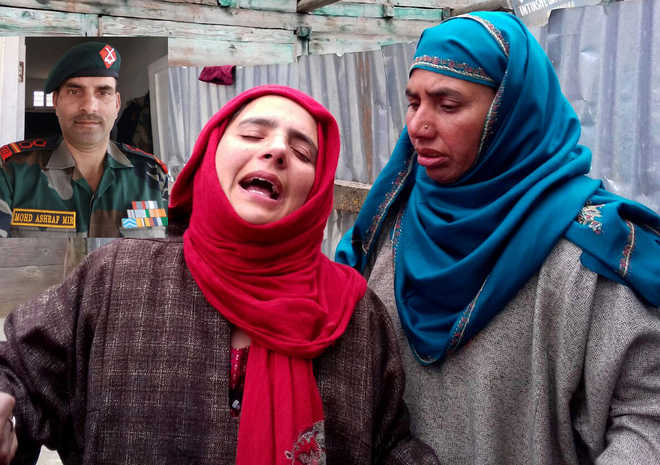
Pakistani troops today resorted to heavy shelling in Balakote and Mankote sectors of Poonch district and also targeted Tarkundi and Manjakote sectors in Rajouri. A soldier and a six-year-old girl were killed in Tarkundi sector. Naik Muddasar Ahmed  belonged to Duchoo village in Tral, Pulwama district, whereas the girl, Sajida Kafeel, was from Barooti Dadiana village in Rajouri district.In Manjakote, Muhammad Sharief and his wife Shah Begum of Panjgrain village were injured in heavy  shelling. Shah Begum’s condition was said to be critical. Defence spokesperson Lt Col Manish Mehta said the Pakistani troops opened unprovoked fire on Indian posts in Rajouri sector at 7.30 am. The Indian Army retaliated strongly and effectively. In the exchange of fire, Naik Muddasar Ahmed (37) was grievously injured when mortar shells landed on his bunker. He later succumbed to his injuries. He is survived by his wife Shaheena Muddasar and two children.(Follow The Tribune on Facebook; and Twitter @thetribunechd)“Naik Muddasar Ahmed was a brave soldier. He loved his job to the core. The nation will remain indebted to him for his supreme sacrifice and devotion to duty,” Lt Col Mehta said.Several villages have been affected by the heavy shelling. The district administration has had to shut at least 16 schools for an indefinite period. At least 120 students trapped inside a school in Panjgrain have been evacuated. Pakistani troops also violated the ceasefire agreement in Bhimber Gali sector of Poonch district. Rajouri DC Shahid Iqbal Choudhary held a meeting with locals at Panjgrain and briefed them on the arrangements made for setting up camps in case of evacuation, ration and medicine supplies.Pakistani troops also resorted to unprovoked firing at three villages in Kamalkote area of Uri in Baramulla later in the day, defence sources said. One soldier was injured. Media reports in Pakistan said four Pakistani soldiers were killed on Sunday when their jeep, hit by a shell, fell into a river.

Reserve right to retaliate: DGMO

  • New Delhi: India’s Director General of Military Operations (DGMO) on Monday made it clear to his Pakistani counterpart that the Indian Army was sincere in maintaining peace along the Line of Control as long as Pakistan reciprocated. However, the Army will retaliate to any firing from across the LoC. DGMO Lt Gen AK Bhatt told Pakistani counterpart Maj Gen Sahir S Mirza over the hotline that the “Indian Army reserved the right to retaliate appropriately to any violation of ceasefire”. Army spokesperson Col Aman Anand said the DGMO pointed out that all violations of the 2003 ceasefire were initiated by the Pakistan army. The Pak DGMO said four soldiers had died in Indian firing in PoK opposite the Keran sector in Kupwara. TNS