Sanjha Morcha

What’s New

Click the heading to open detailed news

Current Events :

web counter

Print Media Reproduced Defence Related News

Well begun A surprise break from past Cong work culture

For long used to slow or non-decisions, and the successive Congress-Akali Dal-BJP governments’ status quoist approach to issues confronting Punjab, it is a pleasant surprise to find a 75-year-old Chief Minister, who once enjoyed a reputation for a laid-back lifestyle, showing such youthful energy and getting through so many welcome decisions at the very first meeting of the state Cabinet with few ifs and buts. From containing the use of the red beacon, pruning security and limiting the annoying VIP culture to the bare minimum to reining in government expenditure, regulating transport, liquor, mining, cable and real estate businesses to proposing “conflict-of-interest” legislation — all are decisions in the right direction. The swiftness with which these have been taken shows a decisive leadership in command.Particularly significant is the proposed law to deny official positions to MLAs with business interests. There are Congressmen who too would be affected and they can scuttle the move. Given the extent of systemic corruption, the annual declaration of assets by those holding official positions is not enough; maybe Punjab needs to consider a Bihar-like law to seize properties of convicted politicians and civil servants. The direct transfer of subsidies will help plug leakages and an end to Inspector Raj, if enforced, would provide relief to industrialists. The abolition of the post of halqa in-charge should save people from police harassment. Depoliticising the police and the bureaucracy, however, should be the next step but would not be easy and would require efforts to make police and administrative reforms happen as outlined by the Supreme Court.There may be a case for the government to buy time by forming a committee to assess farmers’ debt or entrusting another panel the job of identifying unviable boards and corporations, but the decision to continue free power — that too unmetered — to all farmers regardless of their landholdings needs to be revisited since it encourages waste of scarce groundwater and ruinous cultivation of paddy. Farmers can be compensated with cash transfers over and above the MSP. To ensure that Saturday’s decisions are not lost in the bureaucratic maze, rigorous follow-up monitoring and action would be required at the CMO level.


Bachelor CMs’ club gets new entrant

Bachelor CMs’ club gets new entrant
From left: Yogi Adityanath (Uttar Pradesh CM); ML Khattar (Haryana CM); Sarbananda Sonowal (Assam CM); Naveen Patnaik (Odisha CM)

New Delhi, March 19

The club of bachelor chief ministers in the country has just expanded. Priest-turned politician Yogi Adityanath, 44, who was today sworn in as Uttar Pradesh CM, joins ML Khattar, 62 (Haryana), Sarbananda Sonowal, 54, (Assam) and 70-year-old BJD chief Naveen Patnaik (Odisha) in the league of singletons running state governments. Adityanath, the controversial mascot of hardline Hindutva, is also the first male bachelor CM of the country’s most populous state.And by coincidence, barring Patnaik and 62-year-old Trinamool Congress supremo Mamata Banerjee (West Bengal,) all the chief ministers, who are unencumbered by a family, are from the BJP.(Follow The Tribune on Facebook; and Twitter @thetribunechd)Refusing to accept defeat after numerous failures in her quest to dethrone the Left front in West Bengal, Mamata, a spinster, rose like the phoenix and finally succeeded in unseating the Left Front government in 2011. She is now serving her second term.The firebrand TMC leader has often said at public meetings that her life is dedicate to the people of West Bengal.Among the current crop of top politicians, Rahul Gandhi, 46, the scion of the Congress, BSP chief Mayawati, 61 and senior BJP leader Uma Bharti, 57, are single. “I’m of low caste, I’m unmarried, and I’m yours,” Mayawati has often proclaimed at her election rallies.Naveen Patnaik, who has been ruling Odisha since 2000, has often told the electorate that unlike the Congress family, there was no danger of his government indulging in family rule as he was unmarried.Rahul, asked about his singlehood ahead of the 2014 Lok Sabha elections, had replied, “Right now I am engaged in fighting the elections. Unfortunately, I have not been focused on private life.”Among the other chief ministers, Nitish Kumar in Bihar and Manohar Parrikar in Goa, are widowers. Mohan Bhagwat, RSS chief, has not tied the knot either.Atal Bihari Vajpayee, a BJP stalwart, who was Prime Minister thrice, never married. — PTI


Challenges before Team Amarinder

Challenges before Team Amarinder
Party men greet Capt Amarinder Singh as he takes charge of the Chief Minister’s office. — PTI

Capt Amarinder Singh, CM Portfolios: Home; Agriculture; General Administration; Industry and Investment Promotion; and Excise and TaxationChallenges:

Capt Amarinder needs to depoliticise the police force, an issue that contributed to the ouster of the Akali-BJP government. In the agriculture sector, he has to tackle rural indebtedness, which has touched Rs 80,000 crore, and curb increasing incidence of farmer suicides. Ensuring smooth procurement of wheat will be his immediate challenge. Revving up the excise revenue and coming up with a transparent excise policy are among the other challenges.
Brahm Mohindraportfolios:  Health and Family Welfare; Parliamentary AffairsChallenges:
A five-time MLA, he has remained Health Minister earlier. The public sector health system in Punjab is in a shambles. Though the previous government set up infrastructure in the form of hospitals, there was staff shortage in government-run hospitals and health centres. Making healthcare affordable will be among his biggest challenges. In the Parliamentary Affairs Department, he faces a daunting task trying to pull an aggressive Opposition along. Mohindra says he will have a roadmap ready soon and get cracking on improving public healthcare.
Navjot Singh SidhuPortfolios:  Local Govt, Tourism & Cultural AffairsChallenges:
The former BJP MP, who had switched over to the Congress just before the elections, has to first put the Urban Mission, meant to rejuvenate basic amenities in cities, back on track. Getting more funds for the local bodies in order to make these self-sufficient; dealing with the stray cattle menace and setting up more gaushalas are his immediate challenges.
Manpreet Singh BadalPortfolios:  Finance, Planning and Employment GenerationChallenges:
The five-time MLA and former Finance Minister knows he has the most challenging job in the Cabinet. Harsh decisions will have to be taken to curb expenditure and the revenue needs to be revved up to save the state’s fragile economy, he says. The Congress government has inherited a debt of Rs 1.78 lakh crore and there are unpaid bills to the tune of Rs 3,000 crore. About 1.5 lakh new employees are to be recruited. It has to be ensured that the salaries are paid on time and committed liabilities met.
Sadhu Singh DharamsotPortfolios:  Forests; Welfare of Scheduled Castes and Backward ClassesChallenges:
The four-time MLA and second-time minister will have to take major steps to increase the state’s thinning forest cover. Seasonal afforestation drives won’t suffice. In the SC and BC Welfare Department, getting due legal share for SCs in the cultivation of panchayat land, which has been a flashpoint for past several years, will be his biggest task. “I will do as directed by the Chief Minister and work to the best of my ability,” he says
.Tript Rajinder BajwaPortfolios:  Rural Development and Panchayats; Water Supply and SanitationChallenges:
The seniormost Congress leader from Majha and former minister has to clean up the mess left by the previous government while executing the Rural Mission. Many of the 12,500 villages across the state, where roads have been dug up and yet to be relaid, will need his immediate attention. Getting more aid from international agencies for better water supply and sanitation will also be on top of his agenda. “It’s a huge responsibility and I am confident of delivering the results,” he says.


Rana Gurjit SinghPortfolios: Irrigation & Power

Challenges: The lone minister from Doaba says his priority will be to strengthen the age-old irrigation channels and canals and get funds for the same from Central reserves. As Power Minister, he has to come out with a new tariff policy, take decisions regarding cross subsidy to agriculture and ensure that the state-run power generators are put to optimum use.

Charanjit Singh ChanniPortfolios:  Technical Education and Industrial TrainingChallenges:
With employment generation being a key agenda for the Congress government, upgrading technical education institutes and industrial training institutes, by bringing in courses in accordance with the demands of the industry is an immediate task ahead of the former Leader of the Opposition. He will need to coordinate with the industry and seek the latter’s help in framing courses for the youth, especially those seeking employment opportunities in the MSME sector.
Aruna ChaudharyPortfolios: Higher Education and SchoolsChallenges:
Ensuring transparency in postings and transfers of staff in the two departments; setting up higher education institutes in the government sector; taking a call on the sustainability of Adarsh/ meritorious schools; improving standards of teaching and bringing new teaching aids in schools will be her biggest challenges. “I propose to revamp the government education sector,” she says.
Razia SultanaPortfolios: PWD (B&R), Social Security and Development of Women and ChildrenChallenges:
The three-time MLA will have to come out of the shadow of her husband, senior cop Mohammad Mustafa. She has to ensure that work on road infrastructure is completed on time. Despite the cash crunch, social security pension will have to be paid (after effecting the hike promised in the manifesto). Malnutrition in women and children is another area of concern.— Ruchika M Khanna



6,000 Punjab bus permits to go

6,000 Punjab bus permits to go
File photo for representational purpose only.

Ruchika M Khanna

Tribune News Service

Chandigarh, March 15

Transport companies in which former Punjab Deputy CM Sukhbir Singh Badal, his associate Hardeep Singh Dimpy Dhillon and Congress leader Avtar Henry have a stake, are among those whose bus permits are to be cancelled. In all, 6,000 odd bus permits are being cancelled on the orders of the Punjab and Haryana High Court. (Follow The Tribune on Facebook; and Twitter @thetribunechd)While the court orders were only for the cancellation of mini bus permits, a list of all permits/licences issued since 1997 are being reviewed by the Transport Department as recommended by the Advocate General’s office. On March 8, orders were issued to all four Regional Transport Authorities to prepare a list of companies with permits to run mini buses, AC coaches, super integral coaches and HV AC coaches and of transporters plying buses on inter-state routes covering short distances up to 15 km. Sources said while some mini-buses were being run “in collusion” with an officer in the Transport Department (who retired recently), the AC coaches were owned by politicians of Punjab’s two main traditional parties.The sources said the process to cancel the permits of companies plying buses on routes on which only the state transport undertakings are allowed (monopoly routes) have already been initiated. The mini bus operators, who have violated the provisions of permits by extending their routes, will also have to face the music. “Most of them, top politicians or a former Transport Department official, have an indirect stake,” said a senior official tasked with the cancellation of the permits. Directed by the court to revisit the transport policy and cancel permits issued in violation of the transport policy, the department has asked the Regional Transport Authorities to place the permit holders in two categories — those plying buses on monopoly routes and those plying on essential routes in rural areas.”Where there is just one bus operator on a single route, we will cancel the permit at a later stage so as not to inconvenience the public. In case the state transport undertaking is already operating buses on a particular route, permits to private operators will be cancelled immediately,” said a senior official. Already, the state transport undertakings are to launch the rural bus service soon.Though the state government was asked to cancel these permits earlier, the Transport Department had been delaying the cancellation process. Though the HC had pulled up the government in January this year, seeking an action taken report, it was only three days prior to the  declaration of the election results that the process was initiated.


THE ARMY’S GRIEVANCE REDRESS SYSTEM

The Corps of Signals, using the most sophisticated equipment have achieved great success in communications intelligence and electronic warfare

It takes two-three years to produce a piece of equipment but centuries to bring a tradition into being. Such traditions cannot be modified easily without causing harm to institutions. The Army has a robust grievance redressal system dating back to hundreds of years. A soldier can approach his superior, whether a non-commissioned officer, junior commissioned officer or commissioned officer with any sort of complaint regarding service conditions, food, leave, pay, promotion, etc. If his problem is not resolved to his satisfaction, the soldier is free to approach his next higher superior officer without any fear of any comebacks from the officer originally approached.

A unique institution held in high esteem in the Army is the Sainik Sammelan. Originally known as the Durbar until replaced by the more egalitarian term currently used, the custom dates back to medieval times. The British adopted it recognising its usefulness.

In essence, it is a more or less democratic gathering of troops of a unit or formation where everyone is free to air their grievances in front of their commander without fear of disciplinary action. Both these strains of rendering justice are forceful and produce the desired results. They have stood the test of time.

Now with one stroke all this has been undone. The Army Chief has notified a WhatsApp number to which complaints can be sent to him in person.

By making the Chief and his office the focus of imparting justice to over 12 lakh soldiers, this new system bypasses the established hierarchy rendering tens of thousands of leaders at all levels from section to army commander irrelevant. Tomorrow Sepoy Bhoop Singh may as well thumb his nose at Captain Clueless claiming, ‘I’ll send a WhatsApp message to the Chief’. All in all, a rather hasty move with little if any thought given to its ramifications.

SIGNALS INTELLIGENCE

Besides providing the telecommunication to the Army, the Corps of Signals also provides information through communications intercepts, locates enemy humint and insurgents’ radio networks and jams their wireless systems.

To do this, the Corps uses the most sophisticated equipment. A lot of their work involves cryptanalysis and breaking of the enemy’s codes. Traffic analysis is also used to generate information when codes cannot be broken.

I recently interacted with Colonel JS Chandoak, living in Chandigarh who did three tenures in this discipline. During the Bangladesh Campaign, he commanded an ad-hoc intercept company tasked with supporting the operations of XXXIII Corps. Generals ML Thapan and LS Lehl who commanded XXXIII Corps and 20 Division respectively told me that they had complete information about Pakistani orbat and operational orders. General JFR Jacob, who was chief of staff, Eastern Command testified to the effectiveness of signal intelligence in general.

In 1980-81 Chandoak commanded a signals intelligence unit located in the desert sector. The unit’s receivers listened into communications deep within Pakistan. Direction-finding equipment located transmitters of enemy spies.

Their task was to pass strategic information up the chain and feed affiliated formations with tactical intelligence. Chandoak’s last stint was with an electronic warfare group responsible for the northern part of the western theatre. Their equipment was state of the art at the time though it would be obsolete now. The Corps of Signals always lives up to its motto ‘Teevra Chaukas’ (Swift and Sure).


Required Sapper Field Engr

Looking for a sapper fd engr to over see road construction security and logistics of mining operations in Madagascar.
Urgent requirement.
A recently retired Col should fit the bill 
Urgent. Need to deploy end April/ early May.
-Lt Gen Vinay Shankar
Ex DG Arty
WhatsApp No 9811216333
The CV be sent to d Gen at d above WApp No.

A NEW WEAPON FROM DRDO LABS WAS BEING TESTED AT BORDER; PAKIS WERE SO SCARED, THEY STOPPED ARTILLERY FIRING

The Indian Army was handed over Swati – a weapon-locating radar – by the DRDO on Thursday. According to defense minister Manohar Parrikar, this deployment of Swati will help to tackle cross-border artillery firing to a great extent.

According to a Defense Source:

“The radars have been on the LoC for two months now for trials. Artillery fire has gone down.”


Applauding the scientists behind such a creation, Manohar Parrikar said:


“Swati could be a great equipment to ensure adversaries do not use artillery fire. If the LoC is devoid of any artillery fire in the near future, you can be sure Swati radar has gone there.”
Sources further said that the four radars placed along the LoC for trial have already proved their mettle since artillery firing from Pakistan have considerably reduced after their deployment. Thirty more radars have been ordered by the Indian Army.
Pakistani army is now aware of the simple fact that if they resort to shelling, Indian Army will not just retaliate but pinpoint the exact location of where the shells are coming from, and then, unleash hell within seconds.

Swati, the weapon locating radar, has been developed by the Electronic and Radar Development Establishment of DRDO. It provides fast and accurate location of enemy artillery including shells, mortars and rockets. It is also capable of guiding fire from an artillery gun attached to it, thus ensuring the destruction of enemy.

Terming the radar as created out of “passive array”, the minister also suggested the DRDO to develop a radar using “active array” in a couple of years.
He further congratulated DRDO for the successful trial of successful trial of exo-atmospheric Prithvi Defense Vehicle (PDV) interceptor missile and endo-atmospheric Advanced Air Defense missile, and said:
“Last year has been very fruitful for the DRDO. There were around 25 missile tests… usually they get criticism.”
61129 61510

Aircraft carrier INS Viraat decommissioned after 30 years of service

Aircraft carrier INS Viraat decommissioned after 30 years of service
Indian aircraft carrier INS Viraat is docked on its final day as it is decommissioned in Mumbai on March 6, 2017. — AFP

Mumbai, March 6

Aircraft carrier INS Viraat on Monday sailed into sunset, after 30 years with the Indian Navy.The warship was decommissioned this evening, at an impressive ceremony onboard and in the presence of Navy chief Admiral Sunil Lanba and top armed forces officials.

(Follow The Tribune on Facebook; and Twitter @thetribunechd)

INS Viraat was the second centaur-class aircraft carrier which was in service with Indian Navy for 30 years.The aircraft carrier, in its earlier avatar, had won the Falklands War against Argentina in 1982 for the Royal British Navy.It weighs about 27,800 tonnes and served in the British Navy as HMS Hermes from November 1959 to April 1984 and after refurbishment, was commissioned into the Indian Navy.In the late 80s, Indian Navy purchased it at the cost of $65 million and was re-commissioned on May 12, 1987.On its last day in service today, the fate of the aircraft carrier remained unclear as to whether it will be converted into a luxury hotel or head to the scrapyard to be broken up.”We would like to have Viraat as a museum or a diving spot in Mumbai,” the Navy chief told reporters after the ceremony.A senior Navy official told PTI that the Defence Ministry is yet to take a decision on a proposal from the Andhra Pradesh government to convert it into an entertainment hub in Visakhapatnam through a joint venture with the Centre.The Navy is keen on an early decision to avoid INS Viraat meeting the same fate as its predecessor INS Vikrant, which eventually went to the scrapyard.On the AP government’s proposal to convert the decommissioned Viraat into a maritime museum, Lanba said, “We will examine the proposal. But (on) financing it for the conversion, the decision will be taken by the defence ministry.”To a query on whether there was a proposal from two-wheeler manufacturer Bajaj Auto, the navy chief said, “I have not heard of any such proposal.”The question was asked in the context of aircraft carrier INS Vikrant’s parts used by Bajaj Auto for making its limited edition two wheeler, after decommissioning of that warship.The Defence Ministry last wrote to all the coastal states to put forward proposals on INS Viraat, but only Andhra Pradesh proposed to convert it into an offshore luxury hotel and build a Marina along with an entertainment zone around it, a Navy official said. — PTI


Martyr’s widow seeks petrol pump, officer rank in police

Martyr’s widow seeks petrol pump, officer rank in police

Vishal Joshi

Tribune News Service

Kurukshetra, February 26

After a financial assistance of Rs 50 lakh from the state government, martyr Mandeep Singh’s widow today demanded an officer rank in the Haryana Police.Mandeep’s widow Prerna said she had sought an appointment with the Prime Minister to table problems faced by families of martyrs.At a simple ceremony at their house in Anteri village here, Ladwa MLA Pawan Saini and Deputy Commissioner Sumedha Kataria handed over three cheques to the family.Prerna is a constable in the state police and posted at the Shahabad Markanda police station.“I am a postgraduate and I should be promoted as Deputy Superintendent of Police. My promotion will be a tribute to my husband by the state government,” she said.Prerna said the family should also be given dealership of a fuel station or a domestic gas agency.“I hope for an early hearing from PM Narendra Modi. I want the Centre to frame a policy where various announcements by the state and Central governments are materialised on the spot. The policy should ensure that martyrs’ families do not have to run from pillar to post in government offices to get their due,” she said.Meanwhile, official sources said the state government had been working for the welfare of martyrs.“As per rules, the next of the kin of a martyr gets a government job. Though Prerna is already employed in the police department, the case to give job to martyr’s elder brother is being considered,” said a senior functionary.“For distributorship for petroleum products, one has to apply from martyr’s quota,” said an official.


Lt Gen Sandhu: Anxiety in security grid, but situation not worrisome

Lt Gen Sandhu: Anxiety in security grid, but situation not worrisome
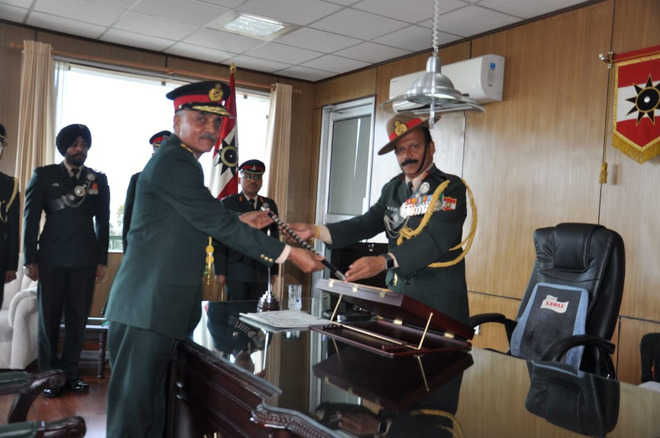
Lt Gen Satish Dua (right) hands over charge of the Srinagar-based 15 Corps to Lt Gen JS Sandhu. Tribune file photo

Majid Jahangir

Tribune News Service

Srinagar, February 26

Says stone-throwing to continue in foreseeable future, Army’s approach balanced

The Army’s topmost officer in Kashmir Lt Gen JS Sandhu has said the approach of the Army in Kashmir was balanced, making it clear that the Army would act if people resorted to stone-throwing during anti-militancy operations.This comes days after Army Chief General Bipin Rawat issued a stern warning to the stone-throwers in Kashmir.“The approach of the Army has largely been very balanced and mature over a period of time. We will continue focusing on our job of (taking on militants) but, simultaneously, we don’t want to antagonise the people. At times, we may have to get into conflict with people at places, where they may get into a stone-throwing situation with mob violence against us. Then we will have to act. So there is no doubt about it,” the General Officer Commanding (GOC) of the Srinagar-based 15 Corps, Lt General Sandhu, said in his first interview after taking over in November last year.The Corps Commander said there was anxiety in the security grid over the situation this year.“There is anxiety but it (the situation) is not too worrisome…. There is a sense among the security forces that we can handle it. There is a confidence that in case the turbulence increases, we will be able to handle it. Though last year it (the situation) escalated a lot, the security forces finally found means and ways to control it. And, it took two months may be. So, some confidence is there keeping in view the last year’s protests,” he said, adding that a large section of people are fed up with protests and would not want it to happen during the 2017 summer.There have been continuous incidents of protests and stone-throwing by locals during anti-militancy operations in the Valley.Sources said that during 80 per cent of the anti-militancy operations this year, in which 19 militants have been killed, forces had faced a law and order situation, resulting in the escape of over a dozen militants, including a topmost commander of the Lashkar-e-Toiba.Lt General Sandhu, who is also the security adviser to Chief Minister Mehbooba Mufti, is of the view that stone-throwing will continue in Kashmir in foreseeable future.“I know for certain that it (stone-throwing) is not something that I can just close. Stone-throwing will happen. But, we can control the magnitude. But as long as the violence levels are kept down, the situation should be okay,” Lt General Sandhu said.Making it clear that all anti-militancy operations in the Valley have not been hampered by protesters, the Corps Commander said various ‘localised’ measures were in place to avoid interference of people during the anti-militancy operations.“Two or three things have been done so far. The civil administration and the police have issued advisories to the people not to gather near the encounter sites. They have imposed Section 144 around encounter sites and people are also being counselled. Now, if it still happens and people act violently, the security forces will react and if the situation doesn’t come under control, they may have to increase the quantum of reaction against stone-throwers,” the Army officer said.The 15 Corps Commander, however, said that each and every situation had its own dynamics and was handled as per the local requirement.“…Every situation has a different reaction and that is what the security agencies have largely worked out. There is no single solution to the problem and we will keep handling the situation as per the local conditions,” he said.The Corps Commander of the most challenging and sensitive Corps of the Army said the forces were launching “targeted specific operations” to flush out the militants and reduce their numbers in Kashmir.“We are not going in for large-scale operations. We just go straight to the place and act against the terrorists. Our focus is on terrorists who are moving around here,” he said.