Sanjha Morcha

What’s New

Click the heading to open detailed news

Current Events :

web counter

Print Media Reproduced Defence Related News

Sharif’s K-dream delusional: Swaraj

Sharif’s K-dream delusional: Swaraj

Tribune News Service

New Delhi, July 23

India today vigorously rejected Pakistan’s ‘despicable design’, emphasising that the country would never be able to realise its dream  of taking over Kashmir and labelled Pakistan as a country seeking to destabilise the region.In one of the most hard-hitting statements in recent times, External Affairs Minister Sushma Swaraj said behind Pakistan’s unabashed embrace and encouragement to terrorism lay its delusional though dangerous dream that “Kashmir will one day become Pakistan”, as stated by Pakistan Prime Minister Sharif yesterday.“The whole of India would like to tell the Prime Minister of Pakistan that this dream will not be realised even at the end of eternity. The whole of Jammu and Kashmir belongs to India. You will never be able to make this heaven on earth a haven for terrorists.” Swaraj said Pakistan, that used fighter planes and artillery guns against its own people, could not pontificate to India on the brave work being done by its security forces.“The country which has used fighter planes and artillery against millions of its own people has no right whatsoever to point a finger at our brave, professional and disciplined police and security forces. Their restraint and respect for fellow citizens is evident in the unusually high number of injured personnel — more than 1,700 — in the violence unleashed with the support from across the border in Jammu and Kashmir,” she said.(Follow The Tribune on Facebook; and Twitter @thetribunechd)India’s reaction came in the backdrop of the developments in Islamabad after the killing of Hizbul militant Burhan Wani, who carried a reward of Rs 10 lakh on his head. Swaraj said what was even more condemnable was the “deplorable attempts from across our border to incite violence and glorify terrorists. These attempts have been undertaken by Pakistan’s state machinery in active partnership with UN-designated terrorist Hafiz Saeed and other leading terrorists belonging to internationally proscribed organisations.


NUCLEAR THREAT Act responsibly: US to Pak

Washington, October 1

The United States has strongly objected to threats of nuclear warfare made by Pakistan against India and has conveyed its displeasure to that country in this regard. “We made that (American objection on nuclear threat) clear to them (Pakistan). Repeatedly,” a senior State Department official said.(Follow The Tribune on Facebook; and Twitter @thetribunechd)The official who spoke on condition of anonymity, however, would not reveal the level at which the message was conveyed to Pakistan.“It is very concerning. It is a serious thing,” the official said when asked about Pakistan Defence Minister Khawaja Asif’s assertions, twice in the last 15 days, that his country could use nuclear weapons against India “We will destroy India if it dares to impose war on us,” Asif had told a Pakistani news channel in his latest interview. “Pakistan army is fully prepared to answer any misadventure of India.” “We have not made atomic device to display in a showcase. If such a situation arises we will use it (nuclear weapons) and eliminate India,” Asif had said. — PTI


A necessary evil Only substitute for pellet guns in Kashmir is talks

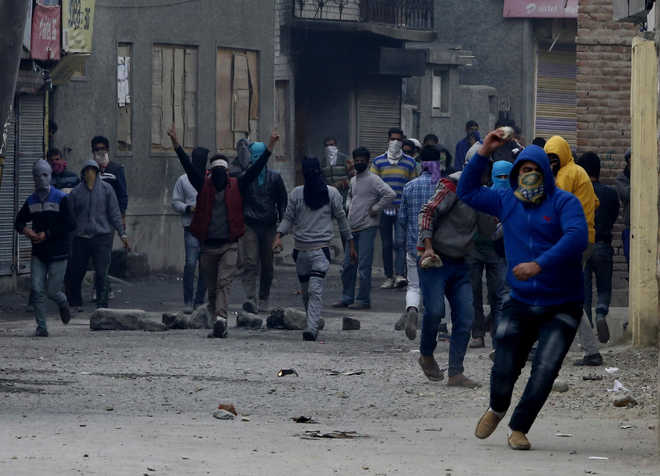
When passions peak, as in the Kashmir Valley after Burhan Wani’s killing, temperance becomes a casualty. The protesting crowds were unmanageable as the pent-up anger over the status quo erupted in the form of attempts to raze army and police installations. Security officers might appear blasé now but they had struggled to control the outpouring of frustration when the protests were at their peak. And in this, they thought the best option was to clear the streets by firing pellet guns rather than heavy ammunition that claims a much heavier toll. The greater use of pellet guns has led to a lower death toll than during the 2010 protests when they were not as widely deployed.But the Valley’s security managers had not accounted for the powerful impact of the social media. Images of children, barely out of teens with bloodshot eyes that may never see again, have obliged the Union Government to announce a committee to suggest effective but less lethal forms of crowd control. The alternatives such as rubber pellets, tear gas and cattle prod guns, were used but in less perilous situations. Kashmiris might also consider themselves better placed than people of tribal Central India and the North East where unruly crowds are still dispersed by the traditional rifle and august bodies such as the United Nations ignore their travails.Pellets do cause more unintended injuries because they don’t follow a definite path and bounce off rocks and trees. This is what caused injuries to people watching the action unfold from their homes. But can pellet guns be the only alternative? Could Wani have been arrested? Even Chief Minister Mehbooba Mufti understands that the alternative forms of crowd control being suggested by human rights advocates won’t work. That is why on becoming Chief Minister, she dropped her opposition on security forces using pellet guns. There seems to be no alternative to this necessary evil unless the political class casts aside its shortsightedness and genuinely attempts a political solution. The only less lethal solution than pellet guns is talks.


Govt no help, villagers fend for themselves

People in vulnerable areas forced to lug around luggage, call up kin for asylum as promise of tents, shelter, transport hasn’t come through

MODE/DAOKE/RORANWALA (ON PAKISTAN BORDER NEAR AMRITSAR): Thousands across India may be celebrating the army’s surgical strikes but villagers near the International Border (IB) are upset with the lack of government support in evacuation and say they fear for the safety of their houses and property.

GURPREET SINGH/HTSatnam Singh (in blue turban) packing up to leave Mullakot, a village 20 metres from the Pakistan border in Amritsar sector, and (below) a migrant labourer left behind spraying pesticide over a field near the zero line on Thursday.

Residents in Punjab’s Attari sector say they feel abandoned by the local administration with little support in getting transportation or choosing possible destination, more than 24 hours after the government announced evacuation of villages in border areas. “No government official has reached the village. Just an announcement was made. I sent my children and wife away and stayed back to keep my house safe,” said Angrej Singh of Daoke, which is metres from the fence. Two-third of the village’s 3,000 people have left.

The evacuation was ordered as relations between New Delhi and Islamabad nosedived following the Indian Army’s announcement of surgical strikes against “terror launchpads” in Pakistanoccupied Kashmir, amid fears of retaliation by the neighbouring country. But people in the most vulnerable regions say they are forced to lug around their luggage and call up relatives for asylum as the local administration’s promises of tents, shelters and transport hasn’t come through.

Many families have sent the women and children away but the men are staying back to ward off thieves, often standing in fields with swords to guard their property. “Anyone can take advantage of the situation. People in border villages are worried about their houses, cattle and crop,” said Saab Singh of Daoke.

“We did not sleep. We stood guard all night with swords in hand,” said Kashmir Kaur of Daoke. Many fear widespread looting if police and officials don’t arrive to direct the evacuation efforts.

“The government says leave but what about our belongings? How much can we carry? Anyone can break into our home and loot,” said Sukhdev Singh of Mode village.

But the administration has rebuffed the allegations, saying they needed some time before informing villagers about the location of shelters and arranging transport. “We are on the job and already places for shelters have been identified and will be operational by Friday evening,” said deputy commissioner Varun Roojam.

“We have hired 20 buses to move villages to safer places. The Shiromani Akali Dal will arrange for langar (community kitchen) to provide food to the evacuees,” he said. Transport has emerged as a major problem and many say people with no relatives in faraway places have nowhere to go.

“People are making their own arrangements to leave. What about those with no relatives in cities? How do they go if they don’t have own transport? Public transport does not reach here,” said Surjit Singh of Mullakot village, which was captured by Pakistan in the 1971 war.

Dyal Singh, who had gone to evacuate his daughter Baljit Kaur from Daoke, said he had arranged everything by himself. The Border Security Force said it was on high alert and didn’t let farmers go near the fence. “We do not know till when this order stays. But till that time, we are asked to stay away from the fence,” said Harjap Singh of Daoke.

1,750 REPORT AT CAMPS IN FEROZEPUR, FAZILKA FEROZEPUR: Mass evacuation of women, children, and the elderly is being reported from border villages in Ferozepur and Fazilka districts.

Nearly 15,000 people of 365 villages along the 85-km border with Pakistan in Ferozepur and 10,000 from 125 border villages in Fazilka district have moved to safer places. The administration has set up 40 rehabilitation camps at Ferozepur and 30 at Fazilka. Nearly 250 people have reported at camps in Ferozepur and 1,500 in Fazilka.


India, China could replicate Sino-Russia protocols to avoid border rows, says expert

BEIJING: India and China could replicate military protocols set up during Sino-Russia border negotiations to minimise conflict as both countries continue protracted talks to resolve their boundary dispute, a top Chinese expert has said.


HT FILETwo military and disarmament protocols implemented by China and Russia could be replicated in the Sino­Indian talks.

There are lessons in avoiding conflict to be learnt from the way China and Russia resolved their boundary issue after negotiating for decades.

“China successfully solved the problem with the Soviet Union despite difficulties such as the collapse of the Soviet Union. All border issues have been solved except the ones with India and Bhutan,” Xing Guangcheng, director general of the Institute of Frontier Science at the influential Chinese Academy of Social Sciences (CASS), told Hindustan Times.

Two military and disarmament protocols implemented by China and Russia in the mid1990s could be replicated in the Sino-Indian talks to settle boundary differences.

From the negotiations, we built mutual trust with Russia and came out with two important protocols – the Border Area Military Trust Protocol in 1996 and the Border Area Disarmament Protocol. I think the protocols can also be applied to the Sino-India border problem,” Xing said.

The negotiations between the Soviet Union and China were not moving forward, he said, till then President Mikhail Gorbachev came to China in 1989.

“After that, the negotiations became more meaningful as both countries started to work pragmatically to settle the border issues. Soon after that in 1992, the Soviet Union collapsed, Russia joined the three countries of Central Asian and continued the negotiation in the ’4+1 pattern’,” he said.

After several rounds of talks and the two protocols to maintain peace along the border, the problem was finally settled, he said.

Xing – an expert on China’s border history and designated “cultural elite” by the government — was in Lhasa to take part in the recently held Tibet Development Forum.

He said India and China currently have good mechanisms for communication but will have to focus on controlling flare-ups.

For one, the two countries have implemented the Border Defence Cooperation Agreement aimed at controlling incidents along the boundary.

There are three disputed regions along the frontier and tension in one can escalate tensions along the entire boundary, Xing said. “Unless completely resolved, the whole border issue would continue to be a sensitive status.


Border residents back armed forces

Border residents back armed forces
Border residents take shelter at a government school in Samba district. A Tribune Photo

Amit Khajuria

Tribune News Service

Jammu, September 30

Extending full support to the armed forces, people residing in border villages have urged the Central government to go for what they termed a one-time and final settlement with Pakistan.After tension gripped the areas near the international border and the Line of Control (LoC), following the Army’s surgical strikes on terror launch pads on Wednesday, authorities have instructed residents of 45 villages in Samba district to shift to safer places near the Jammu-Pathankot national highway.An alert has been sounded in Sadwal, Sujana, Chachwal, Chalatriyan, Mangu Chak, Ragal, Mawa, Bain-Glad, Manga, SM Pura villages and many others. Many families have shifted their elders and children to safer places, but some of the family members are staying in villages during daytime to take care of their crops.Though these villagers are the first victims of the war or cross-firing, they are standing by the forces and urging Narendra Modi-led Central government to settle issues with Pakistan once for all.“We are now fed up with cross-firing and rumours of war, now the forces should be given a free hand by the government to go ahead and finish the things once for all,” said Updesh Kumar, a resident of SM Pura village.“How many times we will move everything to temples, banquet halls and schools located at safer places? After every six-seven months, Pakistan starts shelling and we have to face huge loss of lives and property,” he added.“We are with the Army and will extend full support to our forces. Though we have to evacuate our villages, the forces should be given free hand this time,” said Moti Lal of Glad village.


Urgency to re-engage youth :::Lt Gen Syed Ata Hasnain (retd)

Infuse fresh blood into Kashmir’s bureaucracy

Urgency to re-engage youth
MISSING IDOL : Kashmiri youth have no real heroes to focus on.

THE deluge of writing in the media on the death of Burhan Wani, the young Kashmiri terrorist from Tral, and the subsequent violence that has spewed into the streets in a near 2010-like situation is actually a phenomenon which often occurs. The unfortunate thing is that it does only when such incidents take place. With so much already written, my approach here is to project the usually unknown facts which can only be gleaned once you are there with the Kashmiri people. Has it ever occurred to people in Delhi that the lofty Pir Panjal range is a psychological barrier to all communication to and from Kashmir? It used to hit me very often as I flew out of Srinagar. In Delhi, my thinking would change, returning to its normal Kashmir orientation the moment I flew past the range. It may sound exaggerated, but is the nearest to the truth of a phenomenon most may never understand. What is perceived in Delhi is perceived differently in Srinagar by whosoever he is. For those in Delhi, there has to be a deliberate attempt to understand what happens in Kashmir. The first of the lessons which must dawn on them is that communication is the key to the issue. That is where we fail miserably because everyone here thinks he knows Kashmir; no one is willing to listen and change his mind. This is why I stated during a TV panel discussion that in the last six months, not once have I attended a round-table discussion, or a seminar, on Kashmir. I attend one on diverse subjects almost every other day. No one feels it is important to understand Kashmir and that is the reason why a strategy has failed to evolve. Communication is the core of the desired strategy and the means to execute this cannot be left to a couple of well-meaning bureaucrats, policemen, or Army men. They can all do their bit, but within limits. Where India has failed is the intellectual application of mind to the sponsored proxy conflict in Kashmir. Burhan Wani is only the symptom which helps attract attention when it is flagging. It is the attention which has been lacking and the strategic and intellectual community is very largely to blame for this.How many would actually know that Kashmir’s youth lacks inspiration because it has no heroes to focus on? That is why a Burhan Wani comes along and captures their attention. This generation has grown under the shadow of the gun, in an environment of checkposts, sometimes five in a distance of 50 km. The ills of a conflict zone on the psyche of a population can only be realised once you are there. Angst and alienation is a natural outcome. No one ever steps back to deliberate upon a curious fact. Tral, the village to which Burhan belonged, and one which carries the most negative perception in the eyes of security practitioners, has sent hundreds into the ranks of terrorists. Not known is that it has also sent hundreds into the ranks of the JAK LI, the Indian Army regiment of which one of the highest profile units does service at Rashtrapati Bhavan today. They are all fiercely loyal and patriotic soldiers. A strange phenomenon, indeed. When I set out to examine this fact in 2011, I interacted frequently with almost 500 young, and mostly educated, Kashmiri youth at different places. Given a chance to vent their angst against the nation, against the system and against me, I absorbed their abuse, but when I met them informally over tea, almost everyone of them had only one enquiry — how they could be enabled to join the Indian Army? I often reflect on this experience and deduced that the psyche of the Kashmiri youth has never been studied and acted upon. Suitably engaged with a communication strategy that understands their limitations and empathises with them, gives them the opportunity to speak instead of talking down to them and listens to it all, may work towards drawing them away from the negativity which is a part of their every day lives.The negative psyche has also provided psychological space to extremist religious ideology to set in, against which we need more refined answers than simply cliched responses of counter-radicalisation measures. We knew all along that Islamic radicalism was finding its place in Kashmiri society, but never really concerned ourselves with finding the counter to it. We need to do it more urgently than ever and it’s even more difficult today.It’s not the youth alone that needs engagement, but every segment of Kashmiri society, and that includes the other major stakeholders — the Kashmiri Pandits. We need all Kashmiris together rather than engaging separately because, ultimately, if normalcy has to return, they have to live together. The separate engagement only encourages each to speak against the other and does no good to either cause.Let us get some fresh blood into Kashmir’s bureaucracy and administration. It will be some time before the outstanding young Kashmiri men and women, who have in recent years joined the Indian  Civil Services, come to occupy positions of prominence. I have all praise for the existing senior members, but they need fresh thinking; the approach is too stilted and needs energy and innovation. My simple advice — give Kashmir two comfortable winters in terms of logistics, administration and daily life and see the mindsets change.Lastly, at different places and times I have repeated ad nauseum that solutions to problems seldom come from within the government. The officials remain too busy, have no continuity and are simply too careful about their careers. Solutions come from independent or even semi-independent institutions and from uncluttered minds. They don’t also come from one-off committees such as interlocutors, but from continuous study and monitoring of the situation and institutional memory. Since it is communication, or the lack of it, that we have identified as the major concern not only in the case of Kashmir, but equally of the Northeast, and of the growing problem of radicalism, all this comes under the scope of strategic communication strategy. There is an urgent need for a multi-discipline body at the highest level to evaluate the current problems, suggest ways and oversee implementation. National problems require national-level solutions and a body akin to the UPSC is what I can suggest over any idea of a body such as the Minorities Commission or the National Integration Council.— The writer is a Senior Fellow with the Delhi Policy Group





High on morale, low on machines, short of men

CASH CRUNCH The army is crippled by a lack of basic necessities, shortage of critical weapons and ammunition and bureaucratic tangle holding up purchases

The strike corps is absolutely necessary to upgrade India’s strategy against China… The government must make no compromise with the planned strength and funds required BRIG GURMEET KANWAL (RETD) Army has 3,500 snipers but only a handful of them can pass the standard test of taking a head-shot at 600 metres and a body-shot at 1,000 metres in the first shot… the army’s training is flawed LT GEN HS PANAG (RETD)

NEW DELHI: The army’s surgical strikes against militants at launchpads in Pakistan-occupied Kashmir demonstrated India’s hardened military resolve to the world.


HT FILEUncertainty surrounds two ongoing tenders for 44,600 carbines and 4,097 light machine guns as in both cases, only a lone vendor has met the army’s requirements.

The targeted operations behind enemy lines were carried out by India’s toughest fighting men — commandos from the elite special forces — and the daring move has already won accolades from political leaders and civil society alike.

But dig a little deeper and things aren’t as rosy for the world’s secondlargest army. The country may be surrounded by hostile Pakistan and China but its army is crippled by a lack of basic necessities, shortage of critical weapons and ammunition and bureaucratic tangle holding up purchases.

Forget the big stuff, even the small details are amiss. Sample this: For years, generals have complained that the orange stock and butt of the 5.56mm INSAS (Indian Small Arms System) rifle compromises the camouflage of soldiers. But several attempts to get the rifle’s colour changed have failed.

“The rifle’s orange colour puts soldiers at risk,” says lieutenant general BS Jaswal (retd), a former northern army commander.

He recalls several failed attempts to get the rifle in a combat colour during his stints as director general (infantry) and northern army commander from 2007-10.

That’s not all. In a private conversation, a senior army officer recalls how an infantry unit deployed in the Northeast a few years ago bought sandbags from its own funds to protect soldiers housed in tents.

The men, he says, were vulnerable to night strikes, similar to the one that left 18 soldiers dead in Uri last week: Fourteen of them were burnt alive after incendiary ammunition used by militants set their tents ablaze.

The sandbags and tents reflect critical shortcomings in the army spanning pivotal areas such as assault rifles, ammunition, body armour, night-vision equipment, artillery guns and air defence systems.

“From rifles to artillery guns, the shortcomings have dented the army’s capabilities. On the modernisation front, I reckon we are running 15 years behind,” says Jaswal.

Uncertainty surrounds two ongoing tenders for 44,600 carbines and 4,097 light machine guns as in both cases, only a lone vendor has met the army’s requirements. The tenders may be withdrawn, delaying the projects by at least six years.

“Arms-buying procedures are the biggest villain. It’s shocking that things that should have received highest importance have received least, irrespective of which government has been in power,” says lieutenant general Rajender Singh, a former director general of infantry.

The army is also battling shortage of officers and men. As of 2015, it was short of over 9,100 officers and nearly 31,000 men.

Training of soldiers is a bigger concern than equipment shortage, points out former northern army commander lieutenant general HS Panag (retired).

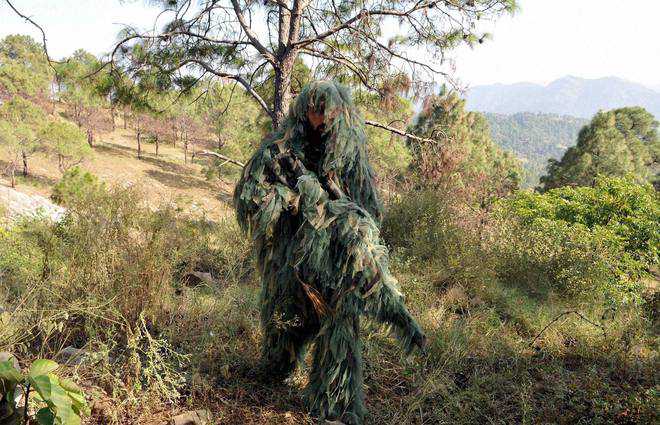
“The army has 3,500 snipers but only a handful of them can pass the standard test of taking a head-shot at 600 metres and a body-shot at 1,000 metres in the first shot. The equipment issue is overplayed…the army’s training is flawed,” says Panag.

But the army says its training standards are among the best globally. “That’s why armies queue up to hold joint drills with us,” a senior army officer insists.

A fruitless 10-year hunt for new assault rifles to replace the flaw-ridden INSAS rifle has returned to the drawing board, with the army on Monday seeking details from prospective vendors. The army plans to buy 65,000 larger calibre 7.62 mm rifles that are more lethal, with another 120,000 to be made in India.

The defence ministry’s acquisition council has given the green light to several projects including 145 ultralight howitzers (M777) for ` 4,600 crore, 420 air defence guns for `16,900 crore, 814 artillery guns for `15,750 crore and 118 Arjun Mk-II tanks for `6,600 crore. The clearance is the first step in a long weapons-buying process and some projects could take at least a decade to materialise.

The army has not inducted a single new artillery gun since the Bofors scandal in 1987.

The homemade Arjun Mk-II tank suffered a major setback two years ago, with a critical Israeli anti-tank missile to be fitted on it failing to meet the army’s needs. The DRDO is still looking for a missile to be fired from the tank’s main gun.

However, the senior officer says the force is “totally prepared” for any kind of military mission. “Most of the modernisation schemes are part of a long-term capability building plan to be implemented by 2027,” he adds.

Officers say the army is running low on ammunition too. Its reserves would barely last 20 days of “intense fighting” against an optimal 40, an audit report revealed last year.

Shortage of ammunition has been addressed to some extent over the last one year, army sources say.

The force requires more than 350,000 new bullet-proof jackets but only 50,000 are on order. The army sought the jackets almost eight years ago.

A cash crunch has forced the government to cut the size and cost of a new mountain strike corps to counter China in the Northeast.The UPA government kicked off the raising of 17 Corps in January 2014 without any separate allocation in the defence budget. “The strike corps is absolutely necessary to upgrade India’s strategy against China from dissuasion to genuine deterrence. The government must make no compromise with the planned strength and funds required,” says strategic affairs expert Brigadier Gurmeet Kanwal (retired).

The army needs to speed up armour modernisation too. “About 1,000 older T-72 tanks and an equal number of infantry combat vehicles have to be upgraded immediately,” says former army vice-chief lieutenant general Philip Campose (retired), who authored a report on review of security of military installations following the Pathankot strike.

Campose says upgrading air defence systems, modernising artillery and improving night-fighting capabilities should also top the army’s priorities.


Beijing loses South China Sea title, cool Tribunal: China has no historic claims

Beijing loses South China Sea title, cool
Chinese vessels are seen around Mischief Reef in the Spratly Islands of the South China Sea. Reuters file photo

Amsterdam/Beijing, July 12

An arbitration court ruled on Tuesday that China has no historic title over the waters of the South China Sea and has breached the Philippines’ sovereign rights with its actions, infuriating Beijing which dismissed the case as a farce.A defiant China, which boycotted the hearings at the Permanent Court of Arbitration in The Hague, vowed again to ignore the ruling and said its armed forces would defend its sovereignty and maritime interests.China’s state-run Xinhua news agency said shortly before the ruling was announced that a Chinese civilian aircraft had successfully tested two new airports in the disputed Spratly Islands. And China’s Defence Ministry said a new guided missile destroyer was formally commissioned at a naval base on the southern island province of Hainan, which has responsibility for South China Sea.The United States, which China has accused of fuelling tensions and militarising the region with patrols and exercises, urged parties to comply with the legally binding ruling and avoid provocations.US officials have previously said they feared China may respond to the ruling by declaring an air defense identification zone in the South China Sea, as it did in the East China Sea in 2013. — Reuters

Ground-breaking ruling

  • The ruling is significant as it is the first time that a legal challenge has been brought in the South China Sea dispute
  • Reflects shifting balance of power in 3.5 mn sq km sea, where China has been expanding presence by building artificial islands, sending patrol boats that keep Philippine fishing vessels away
  • The court has no power of enforcement, but a victory for Philippines could spur Taiwan, Vietnam, Malaysia and Brunei to file cases

Ex-servicemen to resume stir

Chandigarh, September 28

Ex-servicemen have decided to resume their agitation and fast at the Jantar Mantar in New Delhi in protest against the government failing to resolve perceived anomalies in the implementation of “one rank-one pension” (OROP) formula.A statement issued by the Indian Ex-services Movement today said the protest would commence from October 2 in Delhi as well as at other places. — TNS

COMMENTS

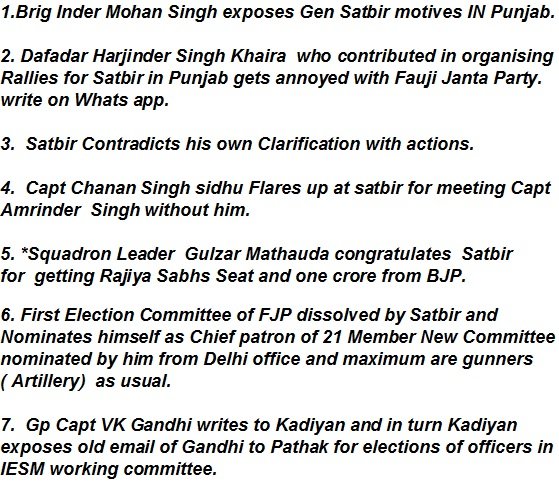
Sole purpose to collect funds over and above already collected in crores at JM and to launch Fauji Janta party a Political out fit a brain child of Maj Gen Satbir Singh.

Till date Maj Gen Satbir has not met Reddy commission but wants Reddy Commission to meet him.

Maj Gen Satbir Singh and his team of Janta  Mantar are misguiding the ESM of the Nation as they have not been invited by any Govt Agency since long.

Veterans can send their comments for uploading of wed site at the following email

sanjhamorcha303@gmail.com