Sanjha Morcha

What’s New

Click the heading to open detailed news

Current Events :

web counter

Print Media Reproduced Defence Related News

Army athletes dominate skiing contest

Srinagar, March 10

Fifteen teams representing different states and organisations participated at the National Winter Nordic X-Country and National Biathlon Championship which was held at Gulmarg in Baramulla district from March 3-7.The championship was inaugurated by Tangmarg MLA Mohammad Abbas Wani and Maj Gen Atul Kaushik, Commandant, High Altitude Warfare School.Srinagar-based defence spokesman Col Rajesh Kalia said the championship was divided into many events.“A total of 95 athletes (75 men and 20 women) from 15 teams representing different states like Jammu and Kashmir, Himachal Pradesh, Uttarakhand, Punjab and Haryana participated in the championship. The results were declared on the final day and medals and certificates were awarded to various position-holders by the chief guest,” the spokesman said. Army athletes dominated most of the events, he added.During the closing ceremony, the chief guest appreciated the spirit and zest among the participants and complimented all the athletes for giving their best and participating in the highest spirit of sportsmanship. — TNS


LAC may see new set of rules Wuhan meet: Coordinated patrol, sticking to mandated protocol likely

LAC may see new set of rules

Ajay Banerjee

Tribune News Service

New Delhi, April 30

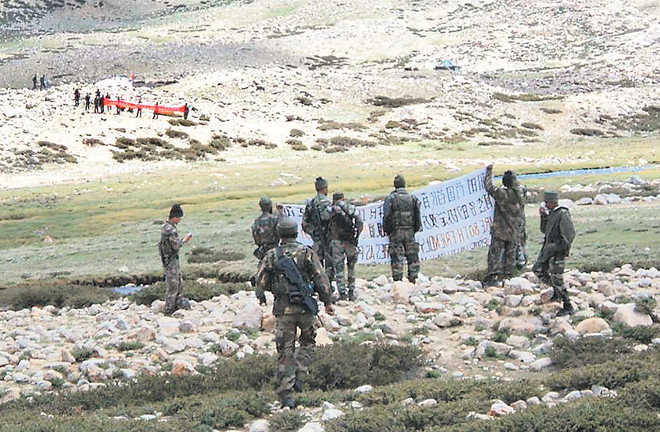
The meeting between Prime Minister Narendra Modi and Chinese President Xi Jinping at Wuhan on April 27-28 could result in “coordinated patrolling” and “sticking to mandated protocol” along the Line of Actual Control (LAC) by troops of either side.Aimed at reducing tension along the LAC, these two steps along with the setting up of a telephonic hotline at the level of Director-General Military Operations (DGMO) could form the new set of rules for troops on either side of the LAC, the de facto boundary along the Himalayan ridgeline.An Indian statement from Wuhan said the two leaders asked the militaries to build “trust” and have a mechanism to “prevent” incidents in the border regions. It further spoke of enhancing predictability and effectiveness in the management of border affairs.A coordinated patrol would mean giving advance information to one another when patrol parties enter disputed areas along the LAC.The LAC is not marked on the ground and troops of either country patrol up to a point which they perceive as the alignment of the LAC. Perceptions vary by a few kilometres in eastern Ladakh and Arunachal Pradesh.The other step could be “sticking to protocol” along the LAC. As of now, whenever either side perceives that a transgression  (entry of troops into a disputed area) has been made, soldiers show a banner to one another citing the 2005 agreement and says there is a need to back off from the present positions of patrolling.The “banner drill” is framed under the “protocol on modalities for implementation of CBMs in the military field along the LAC in the India-China border areas”. It is part of a protocol agreed upon to de-escalate momentary transgressions.The matter of setting up a DGMO-level hotline was revived at a meeting of the Working Mechanism for Consultation and Coordination on India-China Border Affairs in Beijing in November last year. The two sides have coordinated on how to have a Mandarin-to-English translator in India and the reverse of it in China.


Women from region bag top honours at OTA

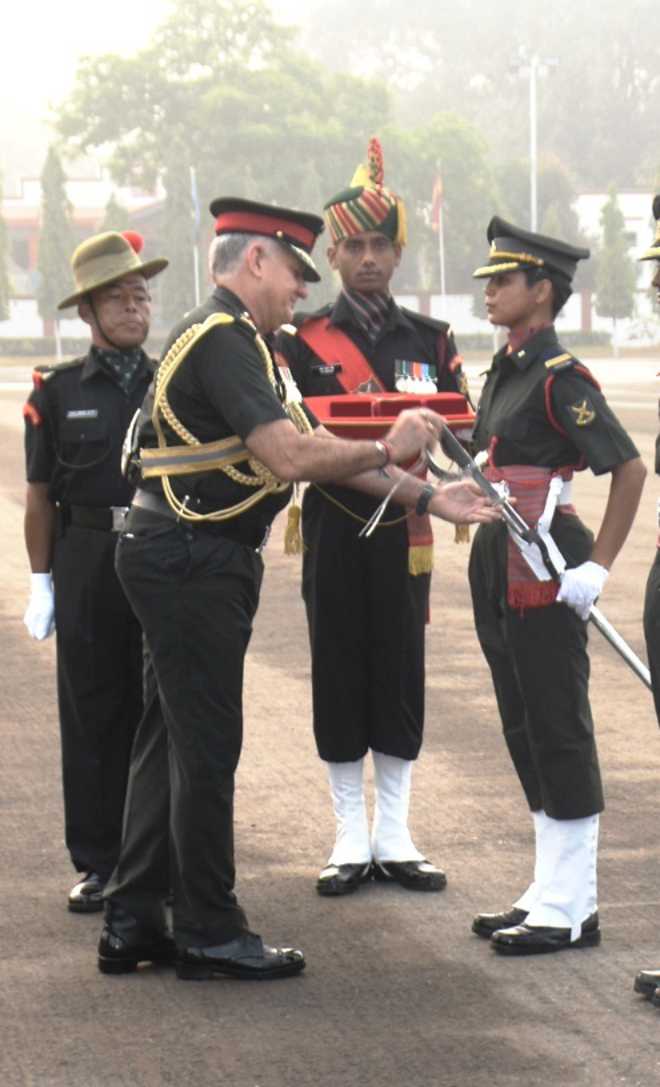
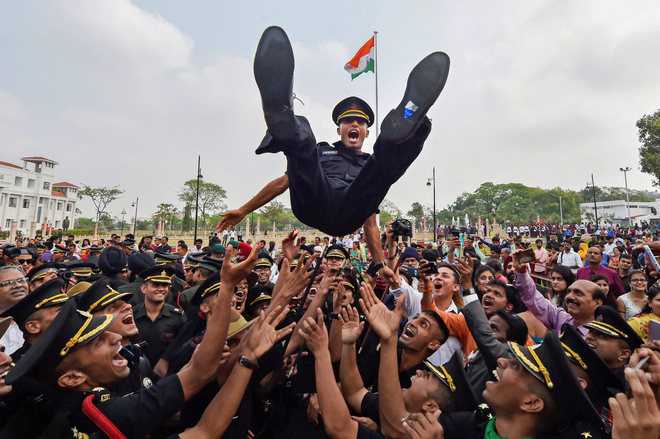
Lt Preeti Chowdhary receives the sword from Lt Gen DR Soni, GOC-in-C, Southern Command. Tribune photo & PTI

Chandigarh cadet first from the city to get Sword of Honour, Haryana’s gets silver medal

Vijay Mohan

Tribune News Service

Chandigarh, March 10

Lt Preeti Choudhary, an NCC cadet from Chandigarh has created a record of sorts by becoming the first woman officer from the city and third in the Officers Training Academy (OTA) since women were inducted in 1992 to be awarded the coveted Sword of Honour for being the best all-round cadet of her course at the academy in Chennai. Another cadet from Haryana, Senior Under Officer Vreeti, was awarded the silver medal. A B.Tech in mechanical engineering, Vreeti quit a highly paid job in Japan as a design engineer before joining OTA as Lady Cadet. Both the cadets scored over more than 200 Gentlemen Cadets to bag the top two honours.(Follow The Tribune on Facebook; and Twitter @thetribunechd)Lt Preeti Choudhary received the sword from Lt Gen DR Soni, General Officer Commanding-in-Chief, Southern Command, who was the reviewing officer of the passing-out parade today. She was among 37 Lady Cadets and 196 Gentlemen Cadets who were commissioned as Lieutenants.She is from the 19th Short Service Commission (Women) Course and she has opted for the Army Air Defence (AAD) corps. As of January 2018, the total strength of women officers in the Army (excluding the medical stream) was 1,561 out of which 63 were in the AAD.Preeti is from the second generation in her family to join the armed forces. Her father, Honorary Captain Inder Singh, served in the Army Medical Corps. Though a native of Haryana, she studied in Chandigarh and graduated from the Government College for Girls, Sector 11. She was also an active NCC air wing cadet.Wg Cdr MR Pandeya, Commanding Officer No. 1 Chandigarh NCC Air Squadron, said Preeti had represented the Punjab, Haryana, Himachal Pradesh and Chandigarh NCC Directorate at the national level and was adjudged as the Second Best Air Wing Girl Cadet across the country in 2016. She trained with the NCC for three years, after which she applied for NCC special entry and cleared the Service Selection Board interview in the first attempt, he added.


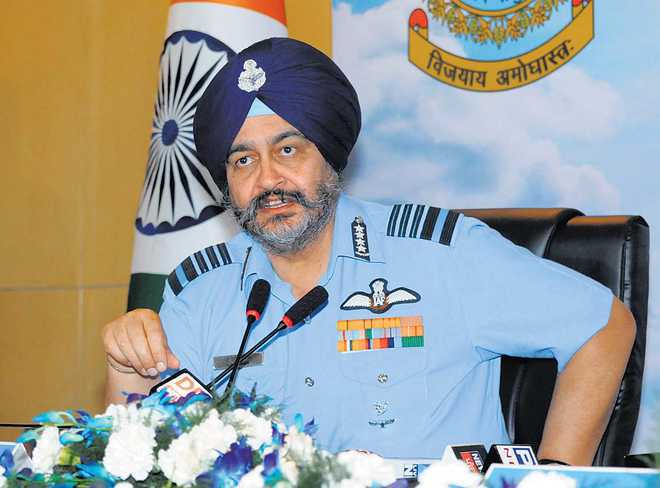
IAF’s mega exercise achieved more than its stated objectives: Dhanoa

IAF’s mega exercise achieved more than its stated objectives: Dhanoa

New Delhi, April 23

The 13-day long mega military exercise by the Indian Air Force achieved more than its stated “objectives”, Air Chief Marshal B S Dhanoa said on Monday, indicating its readiness to deal with a hostile Pakistan and China almost simultaneously.

Two days after curtains came down on Gagan Shakti—the biggest exercise by the IAF in three decades—Air Chief Marshal Dhanoa said over 11,000 sorties were carried out by combat, transport and rotary wing aircraft of the force to test its combat readiness.

“All men and women of the IAF rose to the occasion and achieved things beyond our stated objectives,” the IAF Chief told PTI in an interview.

As part of the massive drill from April 8 to 20, the IAF deployed its entire war waging machinery for the pan-India exercise with fighter jets, equipped with strategic weapons like Brahmos and Harpoon anti-ship missiles, carrying out deep penetration strikes to revalidate its strategic reach.

“We achieved relocation and rebalancing of assets from one sector to another in 48 hours,” Dhanoa said. “The overall objective of Gagan Shakti was fully achieved,” he said without elaborating.

Explaining the significance, a senior IAF official said the objective of the rebalancing and relocation was to quickly flatten the enemy in one front and redeploy the assets in another sector within 48 hours—in a possible two-front war scenario.

Dhanoa said the IAF achieved all parameters of serviceability, surge operations, relocation of resources and joint operations with the Army and Navy during the exercise which were crucial aspects of the war fighting machinery.

The combat drill was carried out at a time when China was increasing its assertiveness along the borders with India and while Pakistan has been continuing its skirmishes along the Line of Control in Jammu and Kashmir.

The exercise covered all terrains including desert, high altitude areas like Ladakh, maritime sphere and almost all possible war scenarios were rehearsed on a real time basis.

“We carried out the exercise thinking as if we are going to fight a war,” said a senior IAF official.

When asked about reports of the IAF having carried out “strikes” in the Malacca Strait, Dhanoa categorically denied it. Officials said the IAF demonstrated its ability to reach maritime targets as far away as 4,000 kilometers in the Malacca Straits but the force stuck to the targets provided by the Indian Navy, none of which were in the waterway around Malaysia, Singapore and Indonesia.

The exercise also focused on flexible use of airspace, joint maritime air operations with the Indian Navy, joint operations with the Indian Army, simulated combat search and rescue for effective extraction of downed aircrew behind enemy lines among others.

Officials said the aim of this exercise was to ensure real time coordination and deployment of air power in a short and intense battle scenario and the objective was fully achieved.

They said the concept of network centric operations and long range missions were tested effectively.

They said Pakistan and China were informed about the mega exercise.

The officials said state-run defence organisations such as Defence Research and Development Organisation, Hindustan Aeronautics Ltd, Ordnance Factory Board etc also provided adequate support. They said Defence Minister Nirmala Sitharaman was impressed by the ordnance efficiency. PTI


Living under shadow of death on border

The Tribune visits homes of soldiers and civilians killed in Pakistani shelling in the Jammu region. In most cases, the state government hasn’t provided succour, monetary or otherwise, to the affected families

The Tribune visits homes of soldiers and civilians who became victims of Pakistani shelling in the Jammu region. In most cases, the state government has not provided succour, monetary or otherwise, to the affected familiesLife on the border in Jammu and Kashmir is like a conflict zone with death staring people in the face 24×7. Dependent on peace between the Indian and Pakistani forces, the residents look towards an uncertain future as there seems no end to the hostility between the two neighbours.Besides the threat to their lives, their livelihood has also been hit as farming and cattle rearing, the two major sources of income for 90 per cent of the border people, have become difficult amid shelling. Their houses have become unsafe for living as mortar shells land any time. When Pakistan rains mortar shells, residents have limited options — to migrate to relief camps established by the government, move in with their relatives in the hinterland or look for bunkers, if any.The state and the Central governments have not constructed many bunkers in border areas. The demand for five-marla plots in safer places, as committed by both governments, has also not been met.Children living in border areas are the worst sufferers as schools in the zero to 5-km radius from the border, are shut at the time of shelling.The situation for the soldiers is no less difficult as they are always in the line of fire. They have to be continuously on guard and ensure that no infiltration takes place.Since January 1, 2018, 21 persons, including nine Army personnel, three BSF men and nine civilians, have lost their lives in shelling and firing on the Line of Control and the International Border.The intensity of border shelling and firing increased following the September 18, 2016, terror attack when Pakistani-sponsored fidayeen attacked a Brigade headquarters in Uri and killed 20 soldiers.

Martyred soldiers

Havildar Roshan Lal, 43, Nichlah village, Samba districtDied in a missile attack on a forward post in the Bhimber Gali sector on February 4, 2018.Incident: Havildar Roshan Lal along with Captain Kapil Kundu and three other soldiers were manning their forward post in the Bhimber Gali sector of Rajouri district when the Pakistan army resorted to small-range anti-tank guided missile attack on their post and killed all four of them. Survived by his ailing father, wife and two children, Havildar Roshan Lal was the sole breadwinner of his family.Compensation: When Havildar Roshan Lal’s mortal remains were brought to his native village on February 5, hundreds of people, including Army officers and soldiers, reached there to pay their last respects to him and cremate the body with full military honours. The very next day, a couple of soldiers from Roshan Lal’s unit visited his house to complete the formalities so that the family would get the compensation from the Army on time. There has, however, been no communication from the government and no minister has visited them to offer support.Rifleman Satish Bhagat, 21, Gurasinghu village, Shamachak, JammuKilled in the Keran sector of north Kashmir’s Kupwara district on July 12, 2017.Incident: Rifleman Satish Bhagat, the only son of Jeet Lal and Kamlesh Kumari who had joined the Army by following in the footsteps of his soldier father, was killed in the Keran sector when the Pakistani army resorted to sniper fire on July 12, 2017. His death shattered the entire family, parents and three sisters, two of whom are married. The younger sister studies in Class II.Compensation: After Rifleman Satish Bhagat’s death, his father Jeet Lal again started to work to support his family. At present, he is in Gujarat to earn a livelihood while his wife and younger daughter are alone in the village. Nobody visits them anymore. A few soldiers from Satish’s unit occasionally come to meet the family. Even after seven months of Rifleman Bhagat’s death, the state government is yet to pay compensation to the family.Subham Singh, 23, Mukandpur Choudharian village, Kathua districtKilled in a Pakistani missile attack in the Bhimber Gali sector of Rajouri on February 4, 2018.Incident: Rifleman Subham Singh became the victim of a Pakistani missile attack on a forward post in the Bhimber Gali sector of Rajouri district on February 4 while he was defending the borders by keeping the enemy at bay. Rifleman Subham Singh along with four other soldiers were given the task not to allow anyone close to the fence. For seven months, they were able to keep the infiltrators at bay. A missile attack by the Pakistani army on February 4 killed Subham Singh. He is survived by his father, a marginal farmer, mother, three sisters, two of whom are unmarried, and a younger brother.Compensation: Two ministers in the state Cabinet are from Kathua district, including Deputy Chief Minister Nirmal Singh, but none of them has visited the family to provide relief or even express condolences. The family lived in a mud house before Rifleman Subham Singh joined the Army. Life had improved but the family has been shattered by Subham’s death. The Army is still completing the documental formalities for the compensation but the government has made no efforts to provide them any relief.Havildar Ravi Paul, 42, Sarwa village, Samba districtKilled on September 18, 2016 during the Uri terror attack.Incident: In one of the deadliest terror attacks on an Army installation in Jammu and Kashmir, fidayeen from Pakistan carried out an attack on the Brigade headquarters at Uri on September 18. Eighteen soldiers were killed in the attack while two soldiers succumbed to their injuries later, taking the toll to 20. Havildar Ravi Paul, who was also killed in the attack, is survived by his wife and two sons.Compensation: When the mortal remains of Havildar Ravi Paul had reached his home in Sarwa village, ministers, local leaders, Army and police officers and officials of the district administration had joined his funeral procession. After Havildar Paul’s death, his wife Geeta Rani got a job at the Deputy Commissioner’s office. The family has received the first instalment of the compensation by the Army.

Helpless civilians

Gopal Dass, 43, Kanachak village, Jammu districtKilled in Pakistani shelling on January 21, 2018, at the Kanachak area along the International Border in Jammu.Incident: Gopal Dass, the binding force of the family, was killed when a mortar shell fired by Pakistan exploded in a lane near his home in Kanachak on January 21 evening when he and his elder brother Ram Dass (46) were returning home. Gopal succumbed to his injuries while being taken to a hospital in Jammu, while Ram Dass is recovering. Gopal is survived by his wife Manju Devi, son Abhimanyu and daughter Akshara.Compensation: After Gopal Dass’s death, local BJP MLA Sukhnandan Choudhary and Jammu-Poonch Lok Sabha MP Jugal Kishore assured full support to the family, which included a job to Manju Devi, admission to Abhimanyu in Sainik School and quality education for Akshara. But even after 17 days of Gopal’s death, they have not received any help. The Red Cross Society donated Rs 1 lakh to the family. Apart from that, the family has not received a single penny from the government. Being a civilian, Gopal Dass’s family will not receive any compensation from the armed forces.Gahar Singh, 50, Bera village, Suchetgarh, Jammu districtKilled in Pakistani shelling on the International Border in the RS Pura sector on January 20, 2018.Incident: Gahar Singh along with his family was at his home when a shell landed inside and he was hit by splinters. He was rushed to a nearby hospital and then to Government Medical College and Hospital, Jammu, where he was declared brought dead. He was the main earning hand in the family and is survived by his wife Sukhanaya Devi and three sons, who have no source of income.Compensation: With the help of villagers, Sukhanaya Devi performed the last rites of her husband at a cremation ground in RS Pura town while she continued to live in a relief camp. Suchetgarh MLA Sham Choudhary, who is a minister in the state government, provided some money to the family for performing the last rites and managing their stay in the relief camp. Apart from that, the family has received no compensation from the state government. Though the district administration has noted down the details, the family has received no relief.Ravinder Kour, 19, Jerda village, SambaKilled in Pakistani shelling on November 1, 2016.Incident: Ravinder Kour from Jerda village of Samba district was cooking at her home when a mortar shell fired by the Pakistan army landed in the kitchen and killed her on the spot. A total of eight persons were killed on that day at various locations on the International Border when the Pakistan Rangers targeted civilian areas. Her house was severely damaged in the incident.Compensation: Ravinder Kour’s father Zorawar Singh has been moving from pillar to post to get compensation to repair his damaged house and Rs 5-lakh ex gratia promised by the state government.Marha Ram, 60, Anju Devi, 29, Rishab, 6, and Abhi, 4, residents of Rangoor Camp and Kairali villageKilled in Pakistani shelling on November 1, 2016, at Rangoor camp village of Samba district’s Ramgarh sector.Incident: On November 1, 2016, Anju Devi, a resident of Kairali village in RS Pura, along with her son Rishab had gone to her maternal home in Rangoor Camp village of Samba to celebrate Bhai Dooj when a shell landed inside the house killing four persons and injuring three others. Anju Devi, her father Marha Ram, son Rishab and nephew Abhi were killed in the incident while her brother, sister-in-law and niece were injured. Villagers were angry with the government and demanded justice.Compensation: The family suffered a huge loss in terms of lives and property. The government has paid them only Rs 5 lakh as ex gratia. Though two members of the family were killed in Pakistani shelling, the administration is yet to give compensation for the other member. Anju Devi’s family has got some ex gratia in RS Pura.Inputs from Amir Karim Tantray in Jammu, Vishal Jasrotia in Samba and Sanjay Pathak in Kathua. Compiled by Amir Karim Tantray)



150-200 terrorists camping along LoC in PoK: Army

Shyam Sood

Rajouri, April 14

Lt Gen Saranjeet Singh, GOC, White Knight Corps, on Friday admitted that a group of four terrorists, who were killed by the Army in an operation near Sunderbani on March 28, had infiltrated into the state by breaching the Line of Control (LoC).Speaking on the sidelines of the Rajouri Day celebrations on Friday, he said maintaining zero infiltration on the LoC was difficult because the fence passed through dense forests, uneven terrain and rivulets.“In Sunderbani, four terrorists managed to intrude to this side of the border, not by cutting the fence but by adopting some other measures which can’t be disclosed,” said the Corps Commander.When asked about the overground workers (OGWs) of militant organisations, he said only a few OGWs were active and they too were under observation.“No crackdown against OGWs is needed at present as the Army is getting support from every section of society,” he said, adding that between 150-200 terrorists were camping along the LoC in Pakistan-occupied Kashmir for infiltration with support from the PoK administration and Pakistan army.“The Army is always ready and capable to give a befitting reply to any misadventure on the LoC by the Pakistan army, including pushing the terrorists under the guise of heavy firing and shelling,” said the GOC, 16 Corps.Replying to a question, he said, “People of India and the Army want peace for development.”


Understanding Maldives by Sandeep Dikshit

Understanding Maldives
GRAB THE MOMENT: China may have extended an olive branch all but in name when it spoke against making Maldives a flashpoint with India.

Sandeep Dikshit

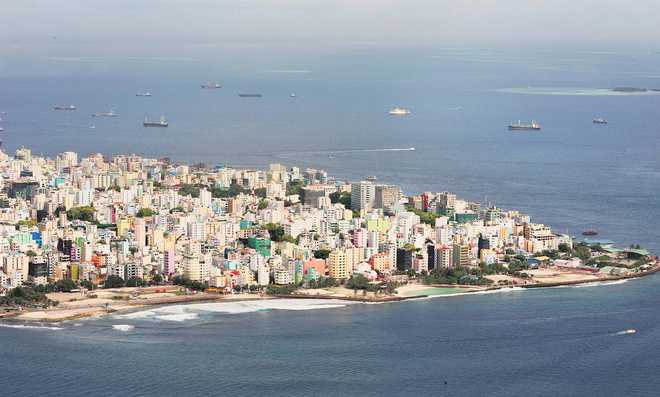
THE state of affairs inside the Maldives does give a bad odour: A President locks up all his political opponents; then goes ahead and arrests the Supreme Court Chief Justice when he tries to set them free. And while the `democracy loving corner’ has itself in a twist, President Yameen caps his indiscretions by shuttering TV stations and imposing a state of emergency.Yameen has a different version where he casts himself as a victim of a willful and spiteful Supreme Court Chief Justice: The order releasing the nine individuals was given in the Chamber and not at a hearing; some of the convicted have exhausted the three tiers of court and a few cases were in appeal; the Chief Justice also tried to remove the President and the Attorney General but was overruled by a majority on both occasions. Despite being a honeymooner’s paradise, Maldives has had a very brief, four-year dalliance, with universal franchise. The fairness of all elections before and after the 2008 polls is a question mark. India saw no competition for Maldives’ affections till five years ago. But the fading years of the first democratically elected headed by Mohamed Nasheed saw him and the opposition bringing other countries into the equation.And today, India is no longer an option for all the parties involved in the scrimmage for power in Maldives. Nasheed, a EU favourite, is India’s designated man after Donald Trump phoned Narendra Modi and made common cause on the Maldives President’s disobedience of the Supreme Court’s orders. Then when South Block refused to host the Special Envoy of the Maldives President, it was clear that India had jettisoned its past tactic of maintaining ambiguity and preserving its options.Maldives, in the eyes of New Delhi-centred military-security experts, has recently turned unruly. But dissonance with almost all of India’s neighbours surfaced within a few months to a few years of emergence of post-colonial nation-states as they sought to resist India’s assumption of being the inheritor of the British colonial mandate for the region.In the early years, India could pull its weight in the region but not because of its military muscle. Barring Pakistan, other neighbours felt a sense of shared destiny with India in overcoming the handicaps of colonialism. Once the concept of nonalignment began losing its lustre, India began finding it difficult to manage its big brother pretensions.But the recent bad blood with so many neighbours has just one precedent. It recalls a similar security-heavy response in the neighbourhood by the Rajiv Gandhi government, another dispensation like the current one that was heady with its parliamentary majority. There was an armed confrontation with China, a simmering defence scandal, hair trigger alert with Pakistan, on the losing side in Afghanistan and more than a finger in a raging militancy in Sri Lanka. All these attempts at donning the hard hat with not much in the cupboard by way of trading muscle or long-range military capabilities to back the pretensions had a catastrophic impact on the country’s social fabric. The economic discontent provided the mobs for the disruptions caused by the Mandal and Ram Janmabhoomi agitations and finally we had the 1991 economic crises. It must be galling for the Indian security-military establishment to adjust itself to a new power discourse because of rise of Chinese influence in a region where mainland Indian civilisation’s historic cultural advantages were overlaid by two centuries of British India’s dominance. But China is increasingly coming into conversations on India’s security-related apprehensions in the neighourhood because the overlap of their strategic space has increased to now cover Afghanistan, and, of late, Maldives and Sri Lanka as well.But instead of focusing on creating dialogue and interaction architectures that support regionalism and economics, the Modi government has opted for the excitement of playing the Great Game against China in concert with mostly extra regional powers. The potential threat from India has not been lost on China. The consequence is that both are attempting a military encirclement of the other. The Indian proclivity to play a new Great Game may be influenced by notions of its influence and size. But it also reflects the Modi Government’s disinterest in reworking the grammar of dealing with neighbours.  Modi hasn’t had a decent conversation with most of the neighbours. While it is imperative to strengthen the bonds of technology, energy and security with distant countries, the Maldives setback should make the PMO think-tank realise that soon the Modi Government will no longer be able to politically gift-wrap tactically bold actions as strategic masterstrokes. The space for presenting tactical symbolism as strategic coherence may be narrowing. One example is the Lok Sabha Speaker calling off a meeting of the Parliamentary Standing Committee on Defence which was to examine the claims made by a retired army officer about irreversible fortification of Chinese army positions on the Doklam plateau. That claim, if proven, will run counter to the Modi Government’s spin that India had emerged with honours intact after last year’s eye- ball to eye- ball security confrontation with China at the same site. China has now declared that Gwadar port in Pakistan will also function as a forward base for its navy. In due course, Hambantota port in Sri Lanka could follow suit. The Modi Government appears more immersed in aligning itself with the military-security objectives of outside powers. On Maldives, South Block was buoyed by the conversation between Trump and Modi. But the Trump administration does not play a zero sum game. On the same day, China’s main pointsman for foreign policy (and the gentleman who holds border talks with NSA Ajit Doval) was in Washington for in-depth discussions with his American counterpart. The Modi Government has been found wanting in making a calculated walk back from foreign policy positions that no longer yield any dividend. An opportunity may have just risen after Beijing offered a thinly disguised olive branch on Maldives. An  inability to change the grammar of dealing with neighbours is preventing us from accumulating the required power to make India tranquil, content, peaceful and happy. 

sandeep4731@gmail.com


DEFEXPO Funds, policy key for defence investments

Funds, policy key for defence investments

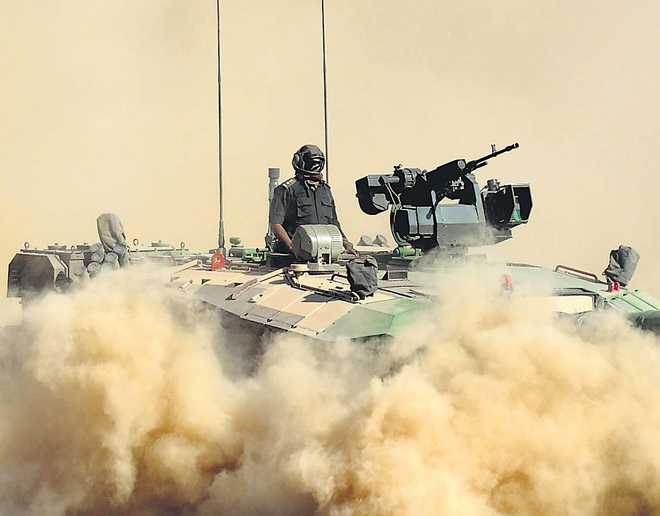
An Arjun Mark II tank drives through sand during display at the DefExpo on the outskirts of Chennai on Wednesday. AFP

Ajay Banerjee

Tribune News Service

Chennai, April 11

When Prime Minister Narendra Modi arrives to formally inaugurate the ‘DefExpo-2018’ on Thursday, he may do well to assure foreign and national investors that New Delhi has the money for a steady flow of investments in the defence-manufacturing sector along with a committed timeline to implement key policy formulations.On the table of the Ministry of Defence is finalisation of the new defence production policy and a proposed amendment and implementation of the strategic partnership model on which hinges India’s military readiness—Tanks, copters, fighter jets and submarines. Speaking at the DefExpo on Wednesday, Defence Secretary Sanjay Mitra said, “There is no shortage of funds. Some 33 per cent of the country’s capital budget is allocated to defence.” He was responding to questions on how the parliamentary standing committee had, in its report on March 13, mentioned that the military budget was “inadequate”, “barely enough” to cater to inflation and “insufficient” for the existing liabilities. Maj Gen BC Khanduri (retd), a BJP MP from Uttarakhand, heads the panel.The MoD has received some 100 suggestions to the draft defence production policy that promises to turn India into an exporter (it currently is the biggest arms importer), increase FDI limit to 74 per cent and augment the domestic production. Ajay Kumar, Secretary, Defence Production, said, “The suggestions are being examined. We will soon come out with the policy following consultations with other ministries.” Defence Secretary Mitra has dismissed any apprehensions about the fighter jet procurement tender: “It will not be a re-run of the scrapped MMRCA (Medium Multi-Role Combat Aircraft) deal.” He was asked whether the fresh tender would be a re-run of the previous process to acquire 126 MMRCA, which started in 2004 and was scrapped in 2015. Last week, India kick-started the process to procure around 110 fighter jets by issuing an RFI (Request for Information) or initial tender for the deal. The Air Force is operating with 31 fighter squadrons as against the authorised strength of 42.Foreign or Indian-made, forces free to choose equipment: Sitharaman  Defence Minister Nirmala Sitharaman said at the DefExpo that the armed forces had been given the choice to choose their equipment — Indian or imported — as per their needs. “I am telling the forces to procure from indigenous sources, but they are free to decide what they need. They are free to choose their equipment. They are using indigenous products may be not as much as we would want. However, there is a fine line. The forces will have to take a call on what they need.” 


Gurgaon captain, 3 soldiers killed in firing along LoC

CASUALTIES ‘Unprovoked’ attack by Pakistan, says army

JAMMU:An army officer and three soldiers were killed and a Border Security Force (BSF) sub-inspector was injured in Pakistani firing along the Line of Control (LoC) in Tarkundi and Sunderbani areas of Rajouri district of Jammu and Kashmir on Sunday evening.

AP FILE■ A border villager holds mortar shells that landed allegedly in firing from the Pakistan side near Pindi in Arnia district of J&K.An officer of the rank of captain was among those killed in “unprovoked and indiscriminate” firing by Pakistan army around 3.30pm, confirmed the army in a statement.

“Indian Army retaliated strongly and effectively and heavy damage has been inflicted on Pakistani Army Posts. However, in the exchange of fire, one officer and three jawans were grievously injured and succumbed to their injuries and attained martyrdom,” the statement added.

“The martyrdom of Indian Army soldiers will not go in vain. The unprovoked action by Pakistani Army will be given a befitting response,” the statement added. Sources said the Pakistan’s border action team (BAT) took part in the attack.

The BAT is an amalgam of Pakistan army commandos and Lashkar-e-Taiba terrorists formed to inflict heavy casualties on Indian patrols along the Indo-Pak borders.

“LoC: One officer and 3 Jawans martyred in Rajouri . Most areas affected due to ceasefire violation,” Rajouri deputy commissioner Shahid Iqbal Choudhary posted on his Twitter account late on Sunday.

Choudhary said that all 84 schools located within 5km of the LoC from Sunderbani to Manjakote will remain closed for the next three days in view of the continuous ceasefire violation by Pakistan.

The deceased have been identified as captain Kapil Kundu from Gurgaon, riflemen Ram Avtar (MP) and Shubam Singh (J&K) and havildar Roshan Lal J&K). BSF lance naik Iqbal Ahmed sustained injuries. Earlier on Sunday, two teenagers and a soldier were injured as Pakistani troops violated ceasefire by targeting forward villages and posts along the LoC in Poonch and Rajouri districts, officials said. The injured were identified as Shahnaz Bano, 15, and Yasin Arif, 14, residents of Islamabad village, official said. Both of them were hospitalised. The firing started around 11am with Pakistani soldiers using small arms, automatics and mortars, the officials said, adding that Indian troops retaliated strongly.

In another ceasefire violation in nearby Rajouri district, six mortars fired by Pakistani forces exploded near Neaka Panjgrain and Tarkundi villages in Manjakote sector in the afternoon, a police official said. Nine security personnel have been killed this year in truce violation by Pakistan whereas 70, including civiliams, have been injured.


Officer with a ‘horrible, dirty’ duty

BUTCHER OF AMRITSAR Was he the wrong man at the wrong place, a soldier following orders, or devil incarnate? We can only speculate, but in 10 minutes Brig­Gen Dyer put India firmly on the path of freedom

From page 01 AMRITSAR : It’s widely believed that there would have been no Jallianwala Bagh massacre had it not been for one man, who decided to teach Indians a lesson for being “wicked”. Ninety-one years after his death, Col Reginald Edward Harry Dyer, also called the butcher of Amritsar, remains an enigma, painted in either black or white.

Few know that Dyer was born and raised in Punjab, or that he was as well-versed in Hindustani as in English or that one of his favourite possessions was the photograph of an unnamed Sikh officer. What is welldocumented is his action at the Jallianwala Bagh, which proved to be as much his undoing as that of the British empire in India. Held guilty by the Hunter Commission, the moustachioed officer was forced to resign and sent home.

DEATH BY DYER

On April 13, 1919, Dyer, 55, was like a man possessed. Giving a first-hand account of the day in “Amritsar: The massacre that ended the Raj” by Alfred Draper, Dyer’s bodyguard Sergeant William Anderson recounted how the crowd seemed to “sink to the ground in a flurry of white garments” as the first volley was fired. The kneeling soldiers selected their targets and made each round tell. When the soldiers had emptied their carbines, Dyer ordered them to reload and direct their fire where the crowd was the densest.

Anderson says he noticed Dyer’s brigade-major Captain Briggs crunching his face as if in pain and clutching at Dyer’s sleeve, but the latter did not notice, and instead directed fire towards the peepul trees where a large number of people were concentrated.

Later, when deposing in front of the eight-member Hunter Commission, he told Chimanlal Setalvad, vice-chancellor of Bombay University: “I did not like the idea of doing it… it was a merciful though horrible act… I thought I would be doing a jolly lot of good and they would realise that they were not to be wicked.”

Later, after his resignation, Dyer told a reporter: “And now, I am told to go for doing my duty — my horrible, dirty duty.” THE BOY WHO STAMMERED

The youngest of six children, Reginald Dyer, fondly called Rex, was born at Murree (now in Rawalpindi district) in undivided Punjab in 1864. His father Edward Dyer, a master brewer who started his first venture at Kasauli in the 1840s, shifted to Shimla soon after Rex turned two so that he could set up another brewery at Solan.

Ian Duncan Colvin, his biographer, says he grew up at Ladyhill House near Bishop Cotton School where he and his elder brother Walter studied until he was 11. Rex, who stammered, was often the butt of ridicule at school. He hated it. Years later, he told the Hunter Commission that had he dispersed the crowds by firing in the air, they would have returned to laugh at him.

Described as sensitive and hot-tempered, Rex ran into more trouble when he and Walter were sent to Middleton College in Ireland, where children mocked him as a “wild Indian”. Eager to return home, every night, he would read Hindustani classics to ensure he didn’t forget the language.

After officer training at Sandhurst—Winston Churchill was some years his junior—Dyer spent two

years in Ireland before joining the 39th Bengal infantry in 1887, where he married Anne Ommaney, daughter of his commanding officer, despite opposition from his mother Mary.

His stints in Burma and Persia, where the natives were brutally suppressed by the British, convinced Dyer that the best way to deal with revolutionaries was “to strike swiftly and to strike hard to forestall greater trouble”.

Mandeep Bajwa, a historian whose grandfather served with Dyer in Peshawar, said he was known for being friendly with his men.

A HERO BACK HOME

Though reviled by the Hunt Commission, Viceroy Chelmsford and the House of Commons, Dyer received a hero’s welcome from the House of Lords and many well-known Britons, including author Rudyard Kipling, in 1920. The Morning Post even started a fundraising drive, which was supported by many British Indian newspapers, including Calcutta Statesman, Rangoon Times and Press, and Madras Mail. Together they raised a princely £28,000.

Amid worsening health, Dyer penned “Raiders of the Sarhad”, an account of his campaign in Persia. Soon he was diagnosed with “arteriosclerosis”. After suffering a series of strokes that prompted the couple to retreat to a quiet cottage in Southampton, Dyer died of cerebral haemorrhage in 1927. On his deathbed, he reportedly said: “So many people who knew the condition of Amritsar say I did right… but so many others say I did wrong. I only want to die and know from my Maker whether I did right or wrong.”

Nigel Collett, the author of “The Butcher of Amritsar: General Reginald Dyer”, says: “What persuaded me that Dyer wasn’t a bloodthirsty bully was the fact that he went to his grave worrying about whether he was right or wrong.”

WHEN AKAL TAKHT HONOURED DYER

The then government-appointed Akal Takht jathedar Giani Arur Singh presented Dyer with a siropa (robe of honour) soon after the Jallianwala Bagh massacre. Ian Colvin, Dyer’s biographer, said when the officer returned to Amritsar, he and his Brigade-Major, Captain Briggs, were summoned to the Golden Temple. Colvin claims, the priests told him: “Sahib you must become a Sikh even as Nikalseyn Sahib (General Nicholson of the mutiny fame) became a Sikh.” When Dyer politely refused, they presented him with a siropa. This act triggered the gurdwara reform movement.

More than 80 years later, Arur Singh’s maternal grandson, Shiromani Akali Dal (Amritsar) chief Simranjit Singh Mann sought an apology from the panth. Calling the presentation of siropa to Dyer as a “panthic mistake”, Mann said his act of seeking apology would give peace to his nana’s soul.