Sanjha Morcha

What’s New

Click the heading to open detailed news

Current Events :

web counter

Print Media Reproduced Defence Related News

India, Pak should make efforts to restart dialogue after May’

'India, Pak should make efforts to restart dialogue after May'

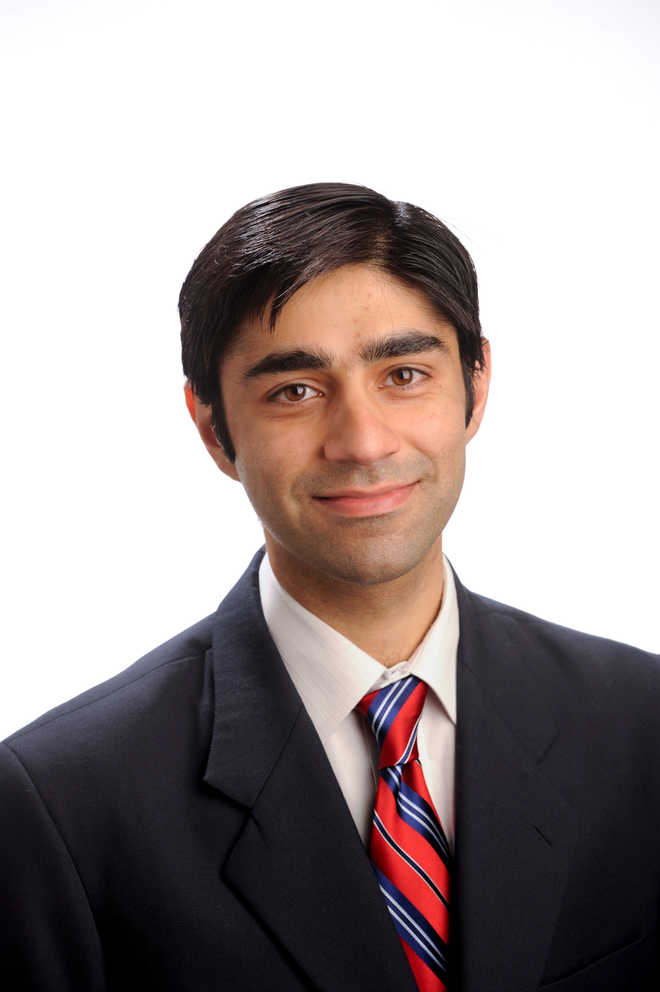
Dr Moeed Yusuf.

New Delhi, January 6

With US troops’ withdrawal from Afghanistan imminent, what is the possible security scenario that South Asia faces? Will India and Pakistan give peace a serious chance this year? And will a second round of Trump-Kim meeting possible in the next few months lead to significant steps towards the Korean peninsular denuclearisation?  Smita Sharma spoke to Dr Moeed Yusuf, Associate Vice President at the United States Institute of Peace in DC and a Pakistani scholar, during his recent India visit.

His latest book ‘Brokering Peace in Nuclear Environments: US Crisis Management in South Asia’ delves into brokered bargaining and third party mediation in the regional Indo-Pak nuclear crisis.

How do you assess news reports about Trump’s plans of troop withdrawal from Afghanistan?

I am not surprised that the White House has denied plans to pull out half of the US troops present in Afghanistan. I don’t think there was ever a cooked plan to this effect. The media hype may have taken this too far.

The so-called announcement though could have either effect: It could send a signal to the Taliban that the US interest in Afghanistan is waning and that they could thus wait the US out rather than negotiating; or the US and others trying to convince the Taliban to end the war could argue that they have publicly indicated their willingness to ultimately leave Afghanistan — this being the principal Taliban demand — and now Taliban need to reciprocate by stating their willingness to agree to a ceasefire to show their sincerity to the process. 

If the withdrawal happens, what will be the major impact in the region?

The conventional wisdom remains that a precipitous US withdrawal risks causing chaos in Afghanistan and undoing some of the gains achieved in the past 17 years. It may also thrust Afghanistan into a free-for-all proxy war, with regional actors jumping in to back their preferred factions. At the same time, sooner or later, a US draw down will take place. President Trump has made this clear. So the Afghan government, the US, and regional actors must work together to agree on a formula for ensuring Afghanistan’s long term security.

Do India and Pak have a serious shot at recalibrating ties post 2019 elections? Will the Pak army back peace overtures, if any, by Imran Khan? 

I will be shocked if India and Pakistan do not make serious efforts to restart some kind of dialogue after May 2019. Pakistan — this includes the civilian and military leadership — has made its desire to engage in a dialogue explicit and my recent discussions in India confirm that India’s reluctance is largely a function of the May 2019 elections.

Otherwise, I think both sides are clear that stalling all communication is not a viable strategy. Yes, it is another question whether they’ll be able to sustain a conversation. I remain pessimistic given the mutual mistrust in the relationship and the ease with which any of the spoilers can derail the process.

Whether nuclear capability is deterrence or not has been long debated. You have discussed the role of third party (US) mediation in Indo-Pak nuclear crisis in your new book. What is the important takeaway? 

Foremost, that the US and other strong third parties play a central role as mediators to de-escalate tensions between India and Pakistan in a crisis situation.These two nuclear powers  have become more, not less, dependent on third parties to bail them out during crises since their nuclear tests.

To be sure, this isn’t to say that there was or is going to be nuclear war in South Asia sans third party mediation. But evidence is unequivocal that we haven’t witnessed purely bilateral crisis management in South Asia as we did during major Cold War crises when the US and Soviet Union were at loggerheads. In some cases, India has been keener than Pakistan to use third party channels to pressure Pakistan to achieve crisis goals.

Vladimir Putin recently said the world is underestimating the probability of a nuclear war. Your views specially in the South Asian context.

The probability of deliberate nuclear launch by either side remains extremely low. Equally, I don’t think either side would go out of their way to test the other’s red lines. As I report in my book, I didn’t pick up anything during the Kargil, 2001-02, and Mumbai 2008 crises that pointed to irrational behaviour on either side. And yet, in no nuclear environment can you ever rule out the possibility of inadvertent or accidental nuclear launch in the fog of war. This risk can’t be ignored — it exists in every nuclear environment and more so in contexts prone to crises.

What is your take on what to expect from the next round of Trump-Kim meeting likely to be held soon on the peninsular nuclear crisis. 

The obvious benefit of the thaw between the two is that the threat of imminent war we witnessed in 2017 has disappeared. But I also don’t expect immediate de-nuclearisation of the Korean peninsula and therefore, I would predict no major breakthroughs. This is an extremely complicated equation and promises to remain so.


Cong demands answers from PM on Parrikar’s purported claim on Rafale file

Cong demands answers from PM on Parrikar’s purported claim on Rafale file

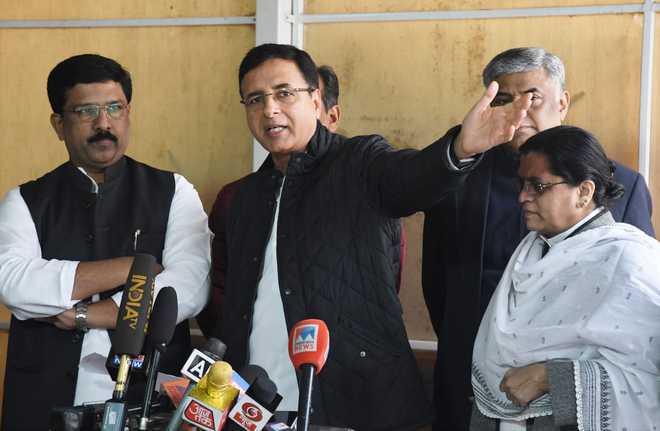
Randeep Singh Surjewala addresses a press conference at Parliament House in New Delhi on Wednesday. Tribune photo: Manas Ranjan Bhui

New Delhi, January 2

The Congress on Wednesday demanded answers from Prime Minister Narendra Modi on Goa Chief Minister Manohar Parrikar’s purported claim that he had a file on Rafale “lying in his bedroom” and asked if this was the reason why a joint parliamentary committee probe was not being ordered.

Congress chief spokesperson Randeep Surjewala came out with a conversation purportedly between Goa minister Vishwajit Rane and another person.

Rane purportedly can be heard saying that during a Goa Cabinet meeting last week, Parrikar stated he had an entire file and all documents relating to the Rafale deal lying in his bedroom, Surjewala claimed, playing the conversation for the media outside Parliament.

He quoted Rane as saying, “The Chief Minister made a very interesting statement, that I have all the information of Rafale in my bedroom…that’s means he is holding them to ransom. He said it is in my bedroom here only in my flat, each and every document on Rafale.”

However, there was no confirmation on whether it was the voice of Rane in the audio. The identity of the other person was also not ascertained.

The BJP has alleged that the Congress is only “peddling lies” on the Rafale issue.

“Now it is clear that the ‘chowkidaar is chor’ (the watchman is a thief),” Surjewala told reporters in an apparent reference to Modi.

“Now the Prime Minister should answer. The country is demanding answers as to what secrets in the Rafale ‘scam’ are lying inside Manohar Parrikar’s flat and bedroom,” he claimed, asking why is the ‘chowkidaar’ fearing Parrikar.

“Now, the Prime Minister has to answer. He only does captive interviews and is not used to answering questions from the media. What is the hitch in making public all the documents,” he asked.

Surjewala claimed the skeletons were tumbling out of the Rafale scam cupboard.

“New evidence busts ‘chowkidar’s’ worst kept secrets. What is Modi government hiding… Is this the reason why a JPC probe is not being ordered,” he asked.

Training his guns on Modi, Surjewala said, “This is a personal charge against you”.

“There was corruption and wrongdoing in the Rafale scam and it is all recorded in the files. Those files are with Mr Parrikar. Why are they being hidden? If Mr Modi has nothing to hide, then why is Mr Parrikar keeping those files in his bedroom and threatening everybody that nobody can do anything against him, for he has the Rafale files,” he alleged.

“Because, secrets are all recorded in the files and the day those files are out, as stated by and threatened by Parrikar himself, then what we have always said will be proved. That Rafale is the biggest scam of India and the person accountable for it is the Prime Minister himself,” he told reporters.

He said it has now become necessary that the files of Rafale with Parrikar need to come out in public domain.

Audio clip ‘doctored’, says Rane

Terming the audio clip, cited by the Congress to attack the Centre on the Rafale issue, as “doctored”, Goa minister Rane told BJP president Amit Shah on Wednesday that he has asked the state government to order an inquiry into the matter.

In a letter to Shah, Rane said he never had any conversation with anyone on the Rafale issue.

According to BJP sources, Rane has said that “I have also sent a letter to Chief Minister Manohar Parrikar asking for an immediate police inquiry and criminal investigation to expose the mischievous elements.”

In his letter to Shah, Rane also said,”…this is a doctored audio and have never had any discussion with this regard on this subject with anyone.”

Desperate bid to fabricate facts: Parrikar

Goa Chief Minister Parrikar on Wednesday termed the audio clip a desperate attempt to fabricate facts after the Supreme Court exposed the “lies” of the Opposition party.

Parrikar’s comments came hours after the Congress quoted him as saying that he had a file on Rafale deal “lying in his bedroom”.PTI

Cong releases purported audio clip; Jaitley hits back with Bond dialogue

New Delhi, January 2

The Congress Wednesday released a purported audio clip of a Goa minister on Chief Minister Manohar Parrikar’s alleged claim of a file on Rafale deal “lying in his bedroom”, igniting a fresh political firestorm as Finance Minister Arun Jaitley crossed swords with its chief Rahul Gandhi.

Jaitley also whipped out a dialogue from a James Bond film to accuse Gandhi of peddling “lies” and “falsehood” in the Lok Sabha after the Congress president made an attempt to play the unverified audio tape purportedly of the minister Vishwajit Rane telling an unidentified person regarding the alleged claim by Parrikar at a Cabinet meeting last week.

Launching a blistering attack on the government, Gandhi targeted Narendra Modi saying he “does not have guts” to face questions in Parliament. He also alleged that Parrikar is “blackmailing” the  prime minister.

The Congress earlier in the day demanded answers from Modi on Parrikar’s purported claim and asked if this was the reason why a joint parliamentary committee (JPC) probe was not being ordered.

Congress chief spokesperson Randeep Surjewala came out with a conversation purportedly between Rane and another person regarding the alleged claim by Parrikar.


Rane purportedly can be heard saying that during a Goa cabinet meeting last week Parrikar allegedly stated he had an entire file and all documents relating to the Rafale deal lying in his bedroom, Surjewala claimed, playing the conversation for the media outside Parliament.

He quoted Rane as saying, “The chief minister made a very interesting statement, that I have all the information of Rafale in my bedroom….that means he is holding them to ransom. He said it is in my bedroom here only in my flat, each and every document on Rafale.”

However, there was no confirmation on whether it was the voice of Rane in the audio.

Parrikar on his part termed the audio clip as a desperate attempt to fabricate facts after the Supreme Court exposed the “lies” of the opposition party.

No such discussion as cited in the audio clip ever came up during the Cabinet or any other meeting, said Parrikar, who was the defence minister when India and France signed a deal for the purchase of fighter aircraft from France.

Rane termed the audio clip as “doctored” and fake and told BJP president Amit Shah that he has asked the state government to order an inquiry into the matter.

Later speaking to reporters, Rahul Gandhi claimed the tape  is “authentic” and that there might be many such “tapes”.

“The Goa minister is saying clearly that Parrikar ji said in a cabinet meeting that he has a complete file on Rafale deal with all details and therefore, he can’t be disturbed. There may be other such audio tapes,” said the Congress president.

“What Parrikar is essentially doing is threatening the prime minister and blackmailing him in a way,” Gandhi alleged. “We have been raising this for a long time. Question is what information is there in Parrikar’s bedroom and what files are there and what could be the impact on Narendra Modi.”

As tempers ran high in the Lok Sabha, Jaitley said the tape is “false and fabricated”, asking the Congress president if he can authenticate it. He also asserted that Gandhi may have to face privilege motion and even expulsion in case the tape turns out to be fabricated.

Following Gandhi’s hard-hitting attack on the government, Jaitley launched a counter-offensive as he referred to alleged defence scams during the Congress rule and said  “conspirators” of past defence scams had the “audacity” to target the Modi dispensation.

He also ruled out a JPC probe — a demand made by most opposition leaders, including Gandhi — saying there was no need for it as the Supreme Court has already satisfied its “conscience” on the issue.

Targeting Gandhi, the BJP leader said he would have played in the lap of ‘Q’, an apparent reference to Ottavio Quattrocchi- allegedly invoved in the Bofors case.

Attacking the Congress president, he said “There are some people who have a natural dislike for truth. Every word spoken for the last six months on this subject, including in this House (by them) are false….He has a legacy of speaking falsehood”.

The House witnessed high drama after Gandhi sought the Speaker’s permission to play the purported audio tape of Rane.

Amid an uproar, which caused brief adjournment of the House proceedings, Gandhi said he would not play it and authenticate it, prompting Jaitley to say that he was “scared” as he knew it was false.

“This man lies and lies repeatedly,” Jaitley said.

Speaker Sumitra Mahajan also disallowed Gandhi’s request to play the clip.

Gandhi claimed BJP members were “terrified” of the clip Rane has already termed the tape “fabricated”, Jaitley said.

In his speech, Gandhi referred to Modi’s comments in an interview telecast yesterday that no personal allegation was levelled against him in the matter and said this was not true as the “entire nation” is asking him a direct question on the contract for purchase of fighter aircraft.

“He (Modi) spoke for 90 minutes in a staged interview but still did not answer questions on the Rafale issue… He does not have the guts to come to Parliament and confront questions (on Rafale) and hides in his room.”

“We demand a JPC probe into matter. There is no reason for BJP leaders to feel afraid. The country will get to know that Modi put Rs 30,000 crore in the pockets of ‘double A’. The contract was snatched from HAL (a government-run unit),” Gandhi said, alleging corruption in the contract.

‘Double A’ was an apparent reference to Anil Ambani, whom Gandhi repeatedly referred to in his speech before Mahajan asked him not to name him as he is not a member of the House.

Hitting back, Jaitley said, “It is a tragedy that the grand old party which was headed by the legends in the past is now headed by a gentleman who doesn’t have basic understanding of combat aircraft.” He then raked up the Bofors, AgustaWestland and National Herald cases. “If there was one case”, he said, “I may have given that family [the Nehru-Gandhi family] the benefit of doubt”.

“Three is a bit two much,” Jaitley and brought up a quote from a James Bond film.

“I am sure Shri Rahul Gandhi, in his earlier days, was seeing the James Bond films,” Jaitley said. “James Bond has said: If it is once, it’s a happenstance, it can happen. If it is twice, it is a coincidence. And if it is thrice, it’s a conspiracy-Congress president is doing the same.” Saugata Roy of the Trinamool Congress was quick to take a dig at Jaitley for what he said was wrongly quoting Bond, saying the movie’s hero had said if it happens for the third time, then it is enemy action, and not conspiracy as the senior BJP leader claimed.

“Jaitley is losing his touch and his memory is failing him,” Roy said. – PTI

Let’s have one-on-one debate over Rafale, Rahul dares PM

Aditi Tandon
Tribune News Service
New Delhi, January 2

Notwithstanding the government’s defence of the Rafale deal in the Lok Sabha today, Congress president Rahul Gandhi appeared in no mood to relent and dared Prime Minister Narendra Modi to a 20-minute debate on the issue.

Moments after Finance Minister Arun Jaitley accused Gandhi of “lying on Rafale”, Gandhi repeated his “watchman-is-a-thief” charge on the PM challenging the latter to a debate, asking why a Rs 526 crore aircraft’s was “inflated” to Rs 1,600 crore aircraft; why HAL was “shunted out” of the Indo-French Government to Government deal and why private industrialist Anil Ambani, with “zero” experience of aircraft manufacturing, was patronized?

Gandhi, flanked by Congress media chief Randeep Surjewala at AICC headquarters here, cited a taped conversation of a Goa minister today to say, “Goa Chief Minister Manohar Parrikar told his Cabinet he has Rafale papers in his bedroom. The Goa CM is blackmailing the PM with this information and is saying no one can touch him. What information does he have on Rafale? And who knows there could be more tapes,” Gandhi said, indicating he was privy to more “incriminating” tapes on the deal’s details.

The claim followed Jaitley’s accusation in the Lok Sabha today that the Congress is “manufacturing” tapes in their “desperation to paint a clean government black”. Asked why he didn’t play the tape in the Lok Sabha today, Gandhi said “because the Speaker Sabha didn’t give permission”.

With Jaitley attacking Gandhi and his family personally, the Congress chief repeated all his old charges steering clear of the Government’s defence that the Apex Court had dismissed all anti-Rafale petitions after “satisfying its conscience on pricing”.

“The SC has said it can’t get into pricing. We are asking why the PM is hiding behind the FM and why is the Defence Minister not answering the debate on Rafale. The PM does not have the courage to face the House. But the truth will reveal itself,” Gandhi said making light of Jaitley’s serial jibes on him in LS today including “Mr Gandhi’s lessons must begin from A, B,C; Mr Gandhi doesn’t even know kindergarten arithmetic and some people have a natural dislike for truth”.

Rahul’s reply to Jaitley was this: “He said the Rafale deal is worth Rs 59000 crore. Divide Rs 59000 crore with 36. What price do you get? Their defence is hollow.”

Tweets ‘open book exam’ 

Tomorrow, the PM faces an Open Book #RafaleDeal Exam in Parliament. Here are the exam questions in advance: Q1. Why 36 aircraft, instead of the 126 the IAF needed? Q2. Why 1,600 Cr instead of 560 Cr per aircraft. Q3. Why AA instead of HAL? Will he show up? Or send a proxy? — Rahul Gandhi, Congress Chief

Congress MPs fly paper jets in Lok Sabha

  • UPA chairperson Sonia Gandhi on Wednesday surprised all by egging on Congress MPs to fly paper jets across the Lok Sabha as Finance Minister Arun Jaitley led the government’s defence of the Rafale aircraft purchase
  • With Jaitley tearing into the Gandhi family alleging its role in Bofors and AgustaWestland scams, a visibly agitated Gandhi tore papers from the LS question and business lists to pass them to party MPs who made paper jets from them

Getting to Grips with India’s Higher Military Organisations Air Marshal AY Tipnis (Retd)

mirage-2000-kargil-war (1)

It is a travesty of India’s intellect, academic as well as military, that solutions to problems Indian are, more often than not, sought on the basis of western philosophies and thought. Indian military analysts rely more on Sun Tzu or Clausewitz and Mahan with little thought to Chanakya’s Arthashasrtra, Shivaji’s strategy against vastly stronger Mughals or Kanhoji Angre’s sea battles against the British, Dutch and the Portuguese.

Our study of WWII, Vietnam war, in fact all recent American and Israeli wars, is deeper and wider than that of Indian wars, including those fought since Independence. The fundamental reason for this lacuna is our reluctance to find fault with ourselves and a propensity for finding scapegoats for own shortcomings, on one hand; and on the other, disdain for our power of thinking against the forcefully propagated western thought.

It is with this background that this article argues against the Indian Army’s and Indian Navy’s incessant clamouring for having a Chief of Defence Staff (CDS) and Integrated Operational Commands. The article also aims to trash the army’s implied claim that air power would be utilised more effectively were it integrated into the existing operational army commands.

CHAIRMAN CHIEFS OF STAFF COMMITTEE vs. CHAIRMAN JOINT CHIEFS OF STAFF

The Indian ‘Chiefs of Staff Committee’ (COSC) is in reality a Joint Chiefs of Staff Committee, for it does comprise of all the chiefs of staff as does the American Joint Chiefs of Staff (JCS), except that the latter has an additional member, the Commandant of the Marine Corps, a combat arm which the Indian military does not have. Also, while the US JCS is headed by an independent chairman, who could be from any of the four arms, the COSC is chaired by one of its members; though, by convention, by the senior-most chief, government could well appoint any member as the chairman. To assist the chairman COSC in his functioning, he has an independent personal staff as well as several joint committees that are formed by staff from the three service headquarters (HQ). So the committee is as well equipped as it needs to be to consider and formulate war strategies. Having an independent arbiter at the apex, as does the US JCS, whom the Indian army and the navy want to ape, questions, so to speak, the very integrity, national loyalty, nonpartisan ethos, rational thinking of the three “wise men”. If indeed there is a need to doubt a service chief’s capability to put the country before his own service, then how does an independent chairman, but again from one of the services, suddenly acquire this nonpartisan quality? Are we forgetting a hallowed military axiom, faith begets faith, doubt leads to disintegration? Organisations do not bring about dependable solutions; it’s people who do! The questions to ask here are: not which sort of organisation will get us the right answer, but how to make existing organisations function as they ought; how do we get ourselves to have inter-service faith; how do we inculcate the confidence to bare open our inadequacies among ourselves; how do we air our doubts; how do we ask for each other’s help without false pretences. We are playing too much hide and seek within ourselves, and then when the chips are down, panic-stricken holler for help!! If we stop posing falsely with each other, confide with confidence, learn to accept own inadequacies and inabilities and ask for solutions and/or assistance from our sister services before the chips are down, we will save ourselves, not only a red-face, but an operational embarrassment.

Having the three service chiefs function equally as a committee has several advantages: An independent chairman “confronting” the government singly may not prove to be as effective in a crunch situation, as would be a committee of three. There have been instances of the US CJCS being “bullied” by his president, secretary of defence and by the cabinet. A quartet (or a trio in our case) would have had/will have a stronger chance of standing its ground. Before finally giving the “ok” to the army chief’s request for air support in the Kargil Operations, the prime minister, along with rest of the CCS (Cabinet Committee on Security), would have preferred the army to manage on its own the eviction of Pakistani intruders; but when the air chief intervened to say air support to the army was inescapable and that the air force was prepared to do so immediately, the PM accepted the request, though somewhat reluctantly.

tiger-hill-story

But there is a flip-side too. The COSC/JCS may have strong difference(s) within itself on professional grounds. It would be a folly to leave the arbitration always with the chairman. A political intervention could become inevitable under certain circumstances; a strongly dissenting chief could be over-ruled by the chairman without the knowledge of the CCS/PM. Such a situation can have serious consequences. Such a situation was in the offing during the Kargil operations. Army HQ wanted Air HQ to provide armed helicopter support without – not only not getting government clearance, but even without keeping the government informed. It had become impossible to persuade Army HQ to understand that given the high terrain, lack of vegetation and the exceedingly good visibility, mere helicopter operations would be suicidal; also, before commencing air operations, it was axiomatic that the air force be prepared for sudden escalation. We had to take cognizance of our 1965 experience: we had used the out-dated vampires against the Pakistani armoured offensive in the Chhamb-Jaurian sector without preparing ourselves for escalation. The inevitable had happened: the Vampires were shot out of the sky and the PAF counter-air attacks on our airfields destroyed several aircraft on ground. Our air support in the Kargil operations did not invite retaliation by the PAF because they realised that it would be a jump from the frying-pan in to the fire! Insistence on using fighters saved us many helicopter casualties. A CJCS could well have over-ruled a dissenting air chief, with disastrous consequences.

A popular misconception doing the rounds among veterans is that the defence secretary (defsecy) lords over the service chiefs. Firstly, such a situation can occur only if a service HQ/chief allows this to happen. Scrutinising service proposals is a legitimate function of MOD; defsecy does this on behalf of the RM (Defence Minister); he has no authority of his own. If there is adequate substance in a service proposal, MOD cannot deny it, though they may delay it. But if the arm-chair free-advising lot think that introduction of the CJCS will remove this “over-lording”, they are sadly mistaken: the defsecy will be upgraded to prindefsecy (principal defence secretary) and there will be a detrimental change in MOD-service HQ working relationship: the service chiefs will not only not get to see the RM, but they will also not be able to approach the prindefsecy!!

Before considering establishment of a CJCS, a comprehensive analysis ought to be done on the benefits or otherwise accrued from the establishment of the Integrated Defence Staff HQ. It is the author’s view that it may not have accrued the benefits that were envisaged, but may have further complicated the interactions between Services’ Headquarters and Ministry of Defence (MOD); also, formulation of joint plans could have become more tenuous. There is also a need to consider the likely increases in defence budget and non-operational manpower. In short: stop fiddling around unnecessarily, function within the existing system and make it work.

INTEGRATED THEATRE COMMANDS

Before man took to the skies, command of territories was dictated by armies and the navies ruled over the seas. But once the warrior got a bird’s eye view, he realised soon enough that if one dominated the skies, land was his to occupy and foresaw that if he soared like the albatross and had the flight endurance of a bar-tailed godwit that flies non-stop from Alaska to New Zealands, he could cross the oceans without a ship. While this gave a warrior without inhibitions and a weighing-down prefix of land or sea, an outlook extending well beyond the horizon, the traditional soldier and sea-warrior saw this as a diminishment of his domain. Just like the Jurassic period terrestrial Tyrannosaurus and the marine Elasmosaurus would not have countenanced the Pterosaurs dominating them from the sky, the modern day armies and navies find it difficult to accept air forces usurping their domains; while the aforesaid words are more in jest, the reality is that the aerial reach and destructive power of air forces could be overwhelmingly greater than that of land or marine forces. While quite appreciative of this, armies and navies would rather have this power under their control, than let the air force take the dominating role.

Even the US military have a difficulty in managing their strength within their allotted budget, though their monetary largesse, as a percentage of the GDP, is more than double that of India and in absolute terms, several times higher; yet India’s difficulty in this determination is many times that of the US. It is a fundamental maxim that one needs to cut his coat according to his cloth. When there is but one piece of cloth and three coats to cut, determining the size of the coats is difficult, but very crucial.

Kargil_IAF

The difficult task of determining the structures and strengths of our military arms could be less complicated, were we to unequivocally state in the preamble to the joint doctrine the prioritisation of our security concerns and gave a broad outline of how we intend to counter them. There should be little debate before concluding that there are two top, uncontested issues: China’s belligerent claim on Indian territory and Pakistan’s incessant claim to Kashmir. How do we prevent Pakistan from encroaching further in to Kashmir and then politically reclaiming POK/militarily evicting Pakistan forces from POK (Pakistan Occupied Kashmir).

In the short term, how do we continue to thwart China’s nibbling our territory; in the long-term, can we contemplate freeing our Chinese-occupied territories? A dispassionate, objective computer-managed war-gaming analysis should give us a fair verdict on our required military strategy and structure. This author’s gut-feeling is that the IAF will have the most crucial role to play in both the scenarios. The size of its “coat” will have to increase substantially, and it would have to be regularly moved from theatre-to-theatre and back. Giving/allotting a fixed air force to any command would be an impossibility, more so if India is to envision a two-front conflict. Thus the concept of an integrated command has no validity when addressing only homeland security. Well in to the future, when India’s influence and trade grow to global proportions, we could contemplate highly mobile integrated task forces; until then protect your own territory(ies), for which we do not require integrated commands.

Despite the above argument against creating integrated home-based commands, should the army continue its clamour for integrated commands, army commanders need to accept that air force commanders are equally, if not more so, fit to head these unnecessary formations. Aerial warfare sophistication is increasing exponentially, and army commanders, who are already hard put to comprehend use of air power, will be even more disadvantaged. It is for this reason that Army is so reluctant to share its in-house studies and reports. Ever ready to trash air support in operations, their actual analytical reports are kept under wraps. The Kargil war report was presented to the RM with much fanfare, but Air HQ was neither requested to participate in its preparation, nor given a copy for its knowledge, if not critique. Air HQ is still to get a whiff of it, despite repeated requests over the years.

IAF has been more successful than most air forces in thwarting armies’ preoccupation with their addiction to have air forces under their grip. Recent writings by PAF veterans are a testimony to their unhappiness to Pakistan Army’s dominance over them. When this author (the first serving chief to do so) visited China, the PLAAF (Chinese AF) chief was ever so keen to know how the IAF does not operate under the supremacy of the army, a suffocating experience for them, which inhibited their balanced growth, training and strategic orientation. Can one imagine a PLAAF chief briefing his IAF counterpart how to “manage” the army commander at Chengdu, in command of the Tibet military region? Well, that’s exactly what happened nearly two decades ago! He was keen to have his delegations visit IAF’s selection centres and training institutions. A PLAAF delegation did visit the AF selection centre at Mysore, but it was not considered appropriate to give them access to our training institutions.

CONCLUSION

It is time that Indian military commanders learnt to trust their own experiences more than those of foreign military commanders. We should have gained sufficient confidence to admit mistakes, wrong decisions, give credit where it is due and not seek it for self-glory. We have to understand there is no single-service operation. Even if there is no actual participation by a service, it needs to evaluate whether it could have chipped-in with advice or actual support. The military must understand that an operation/a failure/a faux pas, howsoever insignificant must be revealed to government; we cannot be disdainful that “these civilians” can never understand; it is our job to make them understand. Let us not fight for self-glory or accruing power. If our motto truly is SERVICE BEFORE SELF, then the motto of even of greater and higher significance has to be NATION BEFORE OWN SERVICE! If we can follow that creed, we will accept that there is neither the need for Chairman Joint Chiefs of Defence Staff, nor the need for Integrated Theatre Commands in the existing Indian scenario.

– The author spearheaded the IAF during the 1999 Kargil War


US ignored Pak nukes in ’70s at China’s insistence: Papers

Washington, December 21

The US acceded to Pakistan’s demand to overlook its secretive nuclear weapons programme following the Soviet invasion of Afghanistan in the late 1970s after Chinese leader Deng Xiaoping convinced Washington to support Islamabad for the “stability” in South Asia, according to latest declassified State Department documents.

The documents reveal that the then Pakistani dictator Gen Zia-ul Haq and Chinese Vice Premier Deng Xiaoping were successful in extracting this price from the US in lieu of Islamabad’s support to America against the Soviet invasion of Afghanistan.

Deng also convinced the US to start giving more military and financial aid to Pakistan, according to the US Foreign Relations 1977-1980 volume on Afghanistan.

The voluminous document indicates that both Zia and Deng successfully convinced the then Jimmy Carter administration that India under Prime Minister Indira Gandhi would be pro-Soviet.

“There are limits on our ability to aid Pakistan because of their nuclear explosive programme. Although we still object to their doing so, we will now set that aside for the time being, to facilitate strengthening Pakistan against potential Soviet action,” the then US Defence Secretary Harold Brown said in a January 8, 1980, meeting with Deng.

“Pakistan has its own arguments, i.e., India has exploded a nuclear device but the world has not seemed to complain about this. So now you have decided to put this aside and solve the question of military and economic aid to Pakistan. We applaud this decision,” said Deng, who later emerged as China’s top leader.

He also convinced the US to not equate India and Pakistan when it comes to giving aid. “Regarding India, we have always felt that the United States should try to cultivate good relations, and this has had a good effect. But India is not a stabilising factor. Perhaps you already know the general election results,” he said. He was referring to the then just-concluded parliamentary elections in which Indira Gandhi came back to power with a majority. Observing that Gandhi had got 70 per cent of the vote, Deng said it was very difficult to judge how India will go. — PTI


Army commemorates Vijay Diwas Celebrations mark India’s victory over Pak in 1971 War

Army commemorates Vijay Diwas

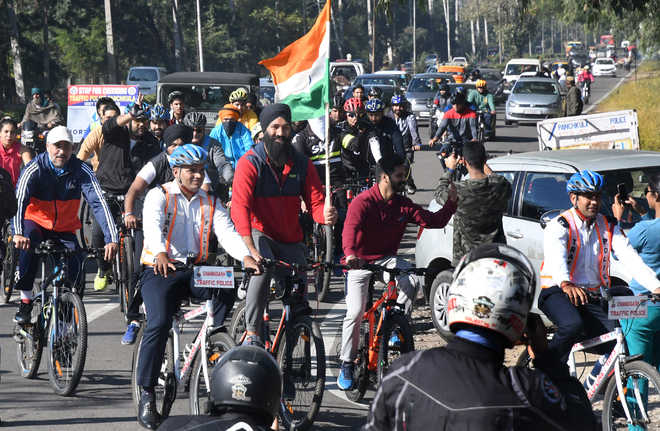
Residents take part in a rally organised to mark Vijay Diwas in Chandigarh on Sunday. The rally was flagged off from Sukhna Lake and ended at the war memorial in Chandimandir. NITIN Mittal

Tribune News Service

Chandigarh, December 16

Vijay Diwas was observed at the headquarters of the Western Command, Chandimandir, to commemorate the victory of the Indian armed forces in the 1971 War against Pakistan, which led to the liberation of Bangladesh.

Over 93,000 Pakistani troops had surrendered before the Indian Army and were taken prisoners of war.

A solemn ceremony was organised at the Veer Smriti war memorial in Chandimandir to pay homage to the martyrs who had made a supreme sacrifice during the war.

A wreath was laid at the memorial by Lt Gen Surinder Singh, General Officer Commanding-in-Chief, Western Command, on behalf of all ranks.

A large number of serving as well as retired officers attended the ceremony at Chandimandir.

On the occasion, the Army Commander exhorted all ranks to rededicate themselves to the service of the nation and be always ready to take to battle on a short notice and be prepared to make any sacrifice.

He said that the Western Command was ever ready not only to defend the nation from its adversaries but also to support the state governments in north India to maintain internal peace, provide humanitarian assistance in case of any disaster and assist military veterans and their families.


Capt hails Pakistan for corridor, Oppn wants project delinked from terror

Capt hails Pakistan for corridor, Oppn wants project delinked from terror

Rajmeet Singh
Tribune News Service
Chandigarh, December 14

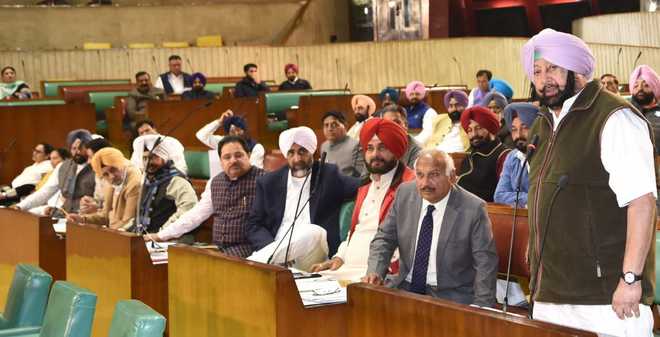
A resolution by Punjab Chief Minister Capt Amarinder Singh, thanking the Centre and Pakistan Prime Minister Imran Khan for the Kartarpur corridor initiative, saw him being advised by the members of Opposition, to not to see the project through the “prism of terrorism”.

While the Chief Minister missed out the name of Navjot Sidhu in the initiative, a Congress MLA praised the Cabinet Minister while at the same time endorsed concerns of the Chief Minister on Pakistan’s bid to revive terrorism.

The Opposition MLAs, including Sukhbir Badal, advised the Chief Minister to be positive and work for the corridor to come through. AAP MLA Kanwar Sandhu said Capt was relying on selective memory while forgetting about the peace initiatives that he had taken when he was the Chief Minister during his previous term.

Sukhbir Badal suggested resolution on swapping land of Kartarpur gurdwara with Pakistan. Minister Sukhjinder Randhawa endorsed the suggestion of Badal.

Amarinder, while appreciating the role of the Narendra Modi government and the initiative by Pakistani premier Imran Khan in paving way for opening of the corridor, warned the Opposition and countrymen to be wary of Pakistan’s designs to revive militancy in Punjab.

He said he would visit Pakistan once peace prevailed between the two countries. He advised Imran Khan to tame his Army in case he wanted peace to prevail.

He did not mention Navjot Sidhu’s name for the efforts put by him in the corridor issue.

Akali MLA Gurpartap Wadala, while speaking on the corridor issue, urged the Chief Minister to be positive on the issue. He appreciated the role of Navjot Sidhu.

In reply, the Chief Minister said while every Sikh was happy on opening of the corridor, politics and evil designs of the Pakistan army should be understood.

In reply, the Chief Minister said while every Sikh were happy on opening of the corridor, politics and evil designs of the Pakistan Army should be understood.

Kartarpur: Reckless throw of the dice

The government has often sacrificed the national interest for short-term, partisan electoral gains

Between 2008 and 2015, there was not a single Khalistani terrorismrelated fatality in Punjab. Each year thereafter has seen multiple fatalities. At the same time, Pakistani mischief in Jammu and Kashmir has been consistently escalating since 2013. India’s overtures, including personal initiatives by Prime Minister Narendra Modi, such as the self invitation to the then Prime Minister Nawaz Sharif’s birthday in December 2016, have been obvious and abject failures.

Each of the terrorist incidents in Punjab over the past years, including two major Islamist terrorist attacks (Gurdaspur and Pathankot), link back to Pakistan. The decision on the Kartarpur Corridor was announced just days after the terrorist attack on the Nirankari Bhawan at Amritsar, in which three persons were killed. State agencies identified Harmeet Singh, aka ‘Phd’, as the ‘mastermind.

Harmeet Singh is known to be sheltered by the Inter Services Intelligence in Pakistan. He is only one of the many Khalistani terrorists who finds safe haven in Pakistan more than two and a half decades after the comprehensive defeat of terrorism in the Punjab. Prominent among those who continue to be hosted by the ISI, and periodically prodded into launching — or attempting to launch — terrorist attacks in Punjab, are Wadhawa Singh of the Babbar Khalsa International, Ranjeet Singh Neeta and Paramjit Singh Panjwar of the Khalistan Commando Force and Gajinder Singh of the Dal Khalsa. Moreover, the ISI’s support to Khalistani extremists in the Sikh diaspora across the world was very visible in the mobilisation for the “London Declaration” in support of the Khalistani “Referendum 2020” campaign at Trafalgar Square on August 12, 2018. Though the Trafalgar Square demonstration was a damp squib, the reality is that Pakistan continues to liberally fund, facilitate and support Khalistani groups across the world.

Crucially, barely four days after the Nirankari Bhawan attack, even as continuous terrorist activity and relentless breaches of the ceasefire along the Line of Control in J&K persisted, there was no evidence whatsoever that Pakistan’s intentions or strategy with regard to the use of terrorism as an instrument of strategic extension in the neighbourhood had altered. In particular, it is well known that Pakistan has long exploited the major Sikh shrines in its territory — including Kartarpur Sahib and Guru Nanak’s birthplace, Nankana Sahib — for attempts to radicalise pilgrims. Indeed, in April 2018, when a jatha (group) of 1,800 pilgrims visited Pakistan, accompanying Indian officials and diplomats were forcibly separated from the group in explicit violation of bilateral protocols. India subsequently lodged a strong diplomatic protest, alleging that the pilgrimage had been used to raise the issue of Khalistan, and that the pilgrims were exposed to inflammatory statements and materials at various shrines they visited.

What, then, was the motivation or compulsion — despite Modi’s repeated declamations that there could be no dialogue with Pakistan till Islamabad ended its support to terrorism in India — for the abrupt agreement on the Kartarpur Corridor? Indeed, what could have provoked the comparisons with the fall of the Berlin Wall and the even more absurd claim that “the corridor will become a symbol of love and peace between both countries”?

Simply put, there are no rational grounds, no dramatic shift in the security situation or the support of Pakistan’s state agencies to terrorist formations targeting India, no conducive atmosphere, which could justify the abrupt fast forwarding of the long pending Kartarpur Corridor project. On the Indian side, the only visible compulsion is the proximity of the general elections in 2019, and the ruling Bharatiya Janata Party’s electoral interests — its bid to woo the conservative Sikh voter in the state. In all other aspects, Modi’s and the BJP’s postures and statements have remained consistently hostile to Pakistan and to any reopening of the peace process. Subsequent statements by Minister of Foreign Affairs Sushma Swaraj have reiterated that “a dialogue cannot start only with the Kartarpur corridor”. On the Pakistan side, this initiative represents an opportunity for further mischief, a continuation of its project to keep the Khalistani movement alive and use Sikh shrines and pilgrimages as opportunities for radicalisation and recruitment.

The ruling dispensation at South Block has displayed, in the decision on the Kartarpur Corridor and, indeed, in its broad approach to terrorism and its Pakistan policy, a disconnect with reality and neglect of facts. The regime has repeatedly sacrificed the national interest to a short term, partisan electoral calculus, and there is not a single reason to believe that this is not the case with regard to the decision on the Kartarpur Corridor. Ajai Sahni is the executive director of Institute for Conflict Management & South Asia Terrorism Portal The views expressed are personal


Remembering heroes of the Great War by Sqn Ldr Rana TS Chhina (retd)

The centenary of World War I has reignited literary and academic interest in the contribution of Indian soldiers

Forgotten heroes: The sacrifices of Indian soldiers in WWI were largely ignored in the writings and books on the subject

Sqn Ldr Rana TS Chhina (retd)

World War I (1914-1918) was undoubtedly one of the defining events of modern world history. The conflict set in motion a chain of events with far reaching consequences. While it is now a century since ‘the guns of August’ finally fell silent, the repercussions of that cataclysmic churning are felt around the world till this day.

In India, the war was initially seen as a means to prove India’s loyalty to imperial Britain. Mainstream political opinion in the country was whole-heartedly in support of the war effort with an intensity that took even the colonial administrators by surprise. The prevalent feeling, summed up by Mahatma Gandhi, was that if India wished to obtain greater political responsibility, it must offer its unconditional support to Britain in her hour of need. The ensuing Indian contribution to the war, both in terms of men and material, far exceeded both expectations and capability. However, the stresses and strains imposed by the wartime economy merely exacerbated the cracks that had already begun to appear in the edifice of imperial solidarity. By the time the war ended, Britain’s relationship with India had changed irrevocably. The contiguous social and political effects only hastened the process that would lead to the end of the British Raj less than three decades later in August 1947.

The Punjab disturbances of 1919 had altered the very meaning of memory in the Indian context of the Great War and in the period after Independence, the war was largely forgotten in India and Pakistan. The sacrifice of India’s soldiers was consigned to the dustbin of history in the post-colonial world. The Indian Army that had served with honour and distinction in France and Flanders, East Africa, Gallipoli, Aden, Egypt, Mesopotamia, Palestine, Transcaspia, Persia, and even China, was itself divided between the newly independent states of India and Pakistan. Although both these armies retained an institutional memory of the war in their battle honour days and regimental histories, the new States viewed it as a colonial conflict of little or no relevance to their history.

However, the centenary of the outbreak of the World War I gave global impetus to numerous commemorative activities, research, and public discourse that have all contributed significantly towards our understanding of the conflict and its legacies.

The centenary also generated wider interest in the role played by India in the conflict and gave fresh momentum to commemoration in India and abroad. Within India, the United Service Institution of India (USI) took the lead and spearheaded ‘India and the Great War’ centenary commemoration project with support of the Ministry of External Affairs (MEA), who supported it as a public diplomacy initiative. The project used the centenary commemoration as a medium to examine the involvement of India and its Army in the war effort as well as the political, social and economic effects of the war on India. It undertook and supported a number of commemorative activities, academic research and community engagement projects, all of which have combined to influence the manner in which the war, with its colonial roots and postcolonial legacies, is viewed and understood within India.

Similar commemorative projects were initiated by Indian diaspora communities in the UK, Europe, Australia, and Canada. Many of these projects overlapped, or formed part of, the framework of national commemorative activities of the diaspora’s host countries. The response and rationale for diaspora commemoration was varied, from adopting a uni-dimensional white-washed and sanitised narrative aimed solely at inclusion, to viewing commemoration within the matrix of institutional and individual racism, both contemporary and historical.

The ‘India and the Great War’ centenary commemoration project engaged with a wide spectrum of partners, from governments down to individuals, including descendants of veterans of the Great War both in India and Pakistan. For many, it was the first time in living memory that the contribution of their forebears was being recognised or remembered.

One of the longer lasting legacies of the centenary commemoration is the number of publications now available that shed new light on various aspects of India’s involvement with the Great War.

Apart from the literary and academic interest that it generated, the centenary also gave a fillip to remembrance. The USI’s ‘India Remembers’ project mooted the proposal to have the marigold as a uniquely Indian flower of remembrance. The Government of India, through the USI, has also built a national memorial in France. This memorial, located at Villers-Guislain, near the site of Lance-Dafadar Gobind Singh’s death-defying ride in December 1917, is distinct from the Indian Memorial at Neuve Chapple. It was inaugurated by the Vice-President of India on November 10, 2018, and is the second Indian national memorial overseas, the other being at the Menin Gate in Belgium.

The writer is a Secretary and editor, centre for armed forces historical research

Bookshelf

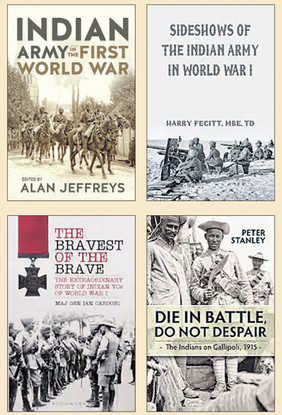
Honour and Fidelity: India’s Military Contribution to the Great War 1914-18, Amarinder Singh, Roli Books, 2014

Sowars and Sepoys in the Great War 1914-1918, Cavalry and Infantry Regiments of the Indian Army; Ashok Nath; Nathfoundations, Sweden, 2014,

The Indian Empire At War: From Jihad to Victory, The Untold Story of the Indian Army in the First World War, George ;Little, Brown Book Group; 2018

Sepoys in the Trenches: The Indian Corps on the Western Front 1914-15; Gordon Corrigan; The History Press; Reissue edition, 2015

The Great War: Indian Writings on the First World War; Rakhshanda Jalil; Bloomsbury India, 2018.

Les Hindous – The Indian Army on the Western Front ; Rana Chhina; USI CAFHR: 2016

India, Empire, and First World War Culture: Writings, Images, and Songs; Santanu Das; Cambridge University Press, 2018

Indian Troops in Europe: 1914-1918; Santanu Das; Mapin, 2017

The Indian Corps on the Western Front: A Handbook and Battlefield Guide; Tom Donovan and Simon Doherty; Tom Donovan Editions, 2014.


Refurbished ALGs, a boost to IAF along China border

Sources in the IAF’s eastern air command based in Shillong told DH that seven ALGs at Tuting, Mechuka, Along, Wallong, Ziro, Tawang and Pasighat have been upgraded and are ready for use for military purposes while work at another ALG in Vijaynagar was under way. (Photo credit: Taku Chatung, Ziro)

Sources in the IAF’s eastern air command based in Shillong told DH that seven ALGs at Tuting, Mechuka, Along, Wallong, Ziro, Tawang and Pasighat have been upgraded and are ready for use for military purposes while work at another ALG in Vijaynagar wa…

Read more at: https://www.deccanherald.com/national/refurbished-algs-boost-iaf-706161.html


Difference narrows

t is the “strength” of public support that is the power behind every bullet the soldier fires. Loose talk, catering to a limited audience, can ultimately prove enfeebling. Can the nation afford that?

Defence, General Bipin Rawat, Pakistan, Islamic state, Navjot Singh Sidhu, Sushma Swaraj, Nirmala Sitharaman

Defence and diplomacy are often said to be opposite sides of the same coin: with the uniforms adding that they are often tasked with clearing up the mess created by incompetent foreign offices. Yet it has been a sterling feature of India’s democracy that unlike what obtains across its western border, a healthy distinction has been maintained between those two facets of governance.

Until now at least. General Bipin Rawat, not for the first time, has turned established norms on their head by contending that Pakistan and India could never enjoy a cordial relationship until Islamabad revokes its status as an Islamic state. There has never been a dearth of Pakistan-bashers in the country (the Navjot Singh Sidhu’s and Mani Shankar Aiyar’s are maverick exceptions) but not even the most Nagpur-oriented of them has never gone as far as the Chief of Staff of an Army that took immense pride in its secular, apolitical credentials.

Not that Pakistan is the only Islamic nation on the planet, are they all to be slammed as pariahs? Does India not have excellent ties many with of them, are remittances from Gulf-based NRIs not a critical component of India’s foreign-exchange reserves? Gen Rawat could undermine the several successes of the MEA in general, Mrs Sushma Swaraj in particular. Not to mention under-cutting the essays of Gen VK Singh. And in a larger context, are Hindu and Muslim intrinsically incompatible?


The “simple soldier” alibi will just not work: Rawat could not have been unaware of the developments over Kartarpur, who authorised him to “take on” Imran Khan? Worse, he stepped out of line at a function at which the focus was on young, impressionable, military cadets.

Was this not a case of nurturing an equivalent of the Hate-India campaign for which we consistently condemn Pakistan? What if other countries cite cow vigilantes running amuck, desecration of churches etc to question India’s secular status? Lambasting Pakistan for its sponsorship of terrorism in J&K is one thing, questioning that nation’s religious status is something else.

And if Sushma Swaraj is unable to ensure that the General refrains from exceeding his brief the MEA risks international embarrassment. Do his “brother generals” endorse his politically-loaded line? The efficiency of a military force is established by its showing in the field, even if the politicians seek to capitalise on surgical strikes etc.

The apex court’s latest order/observations on the Army’s use of excessive force in Manipur, and its rejection of the government’s argument serve as a stark reminder that in public perception the image of the Army is losing its aura. And it is the “strength” of public support that is the power behind every bullet the soldier fires. Loose talk, catering to a limited audience can ultimately prove enfeebling. Can the nation afford that? Nirmala Sitharaman has to answer the query.


Govt approves military procurement worth Rs 3,000 crore

Govt approves military procurement worth Rs 3,000 crore

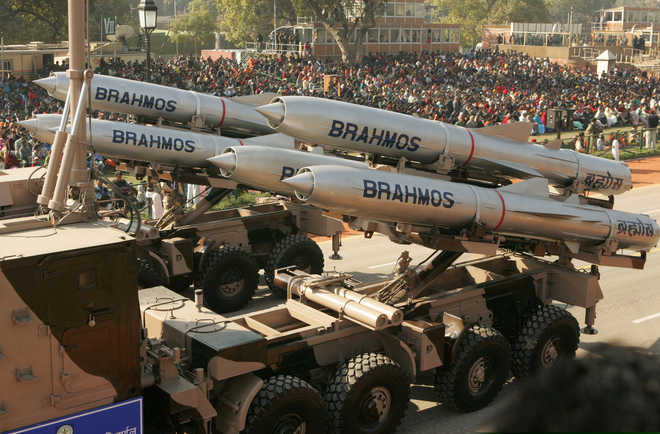
he indigenously designed BrahMos missile is a tested and proven supersonic cruise missile and will form the primary weapon on-board these ships, said the official.

New Delhi, December 1

The Defence Ministry on Saturday approved military procurement worth Rs 3,000 crore, including BrahMos supersonic cruise missiles for Navy’s two stealth frigates and armoured recovery vehicles for the Army’s Arjun main battle tanks, a senior official said.

The go-ahead for both acquisitions was given by the Defence Acquisition Council (DAC), the ministry’s highest decision-making body on procurement, the senior military official said.

“The DAC chaired by Defence Minister Nirmala Sitharaman accorded approval for acquisition of defence equipment worth about Rs 3,000 crore,” he said.

India is procuring two stealth frigates at a cost of USD 1 billion and both the ships will be equipped with indigenously developed BrahMos missiles.

“The indigenously designed BrahMos missile is a tested and proven supersonic cruise missile and will form the primary weapon on-board these ships,” said the official.

The DAC also approved the procurement of Armoured Recovery Vehicles (ARVs) for the Indian Army’s main battle tank, Arjun. The ARVs are designed and developed by the DRDO and would be manufactured by defence public sector undertaking BEML, the official said. PTI