Sanjha Morcha

What’s New

Click the heading to open detailed news

Current Events :

web counter

Print Media Reproduced Defence Related News

Second Five Gorkhas by Maj Gen Ashok K Mehta (Retd)

Maj Gen Ashok K Mehta (Retd)

OF the many epic infantry battles in history, Porkchop Hill, battle of Imjin, Saragarhi, Rorke’s Drift, Basha Hills, Mortar Bluff and Water Picquet are some. The raw courage and tenacity displayed in close quarter battle is conspicuous when compared with contemporary stand-off attacks or drone attacks, which delete human qualities of valour and courage. Three such battles were fought during the first and second Burma Campaigns of World War II by Second Fifth Gorkha Rifles (Frontier Force), earning it three Victoria Crosses, two in one single action — in less than 24 hours. These small unit infantry actions prevented the Japanese from reaching Imphal in 1943-44.

The battles were fought astride Tiddimpur-Bishenpur-Imphal road after the battalion had suffered a terrible mauling while retreating across the Sittang river in February 1942, as the bridge was prematurely blown off in the fog of war, reducing the unit’s strength during the fighting withdrawal to half its original. The first Victoria Cross was won by Havaldar Gaje Ghale on May 26, 1943 for capturing Basha Hill occupied by the Japanese. Ghale led a platoon of raw soldiers when neither had been under fire. The approach to Basha Hill was along a narrow ledge devoid of foliage, covered by a dozen machine guns and subjected to artillery and mortar fire. Entering this killing zone and leading his men through it twice unscathed was a miracle. Crossing it a third time, he suffered multiple wounds but charged the Japanese positions shouting ‘Ayo Gorkhali’. He stormed enemy fortifications, refusing to be evacuated. This inspired his men to press the assault, forcing the Japanese to flee.

The next two Victoria Cross actions were fought around Bishenpur on June 25/26, 1944, where the Japanese were attempting to outflank defences astride the road to Imphal and also dominate the track to Silchar. This happened after the Japanese had been repulsed in Kohima and Japanese 15 Army then turned to Imphal. On June 25, Second Fifth was ordered to take hill features Water Picquet, Mortar Bluff and BP Picquet. Subedar Netra Bahadur Thapa led a reinforced platoon of 41 men and occupied Mortar Bluff.

The Japanese started their first assault on Mortar Bluff in overwhelming strength, but were beaten back. Heavier attacks led to their gaining a foothold near the post. Two machine guns going out of action and depletion of ammunition among the defenders led to a dangerous situation. Six ammunition reinforcement couriers were hit but Thapa personally retrieved the ammunition. Two of his posts were overrun but Thapa rallied his men to fight back. They held on even as he was mortally wounded. His body was found the next day, khukri in one hand and the head of a Japanese soldier nearby.

After Mortar Bluff came the epic battle for Water Picquet. It entailed first recapturing Mortar Bluff and then taking Water Picquet. Naik Agan Singh Rai’s section was the first to reach the barbed wire but they were pinned down by machine guns. Rai instantly charged and silenced the machine gun, which inspired his men to advance and capture Mortar Bluff, which was under fire from a 37-mm anti-tank gun from the nearby Water Picquet. Without waiting, Rai and Charlie Company charged towards Water Picquet and destroyed the gun emplacement. So stunning was the action and so resolute the spirit of his company that Water Picquet was seized. The recapture of Mortar Bluff followed so swiftly after its epic defence as to make it one historic battle and in less than 24 hours.

In 2015, 70 years after its two VC actions, Second Fifth returned to Bishenpur to Mortar Bluff and Water Picquet, this time, chasing Nagas and Kukis and occasionally paying homage to the Japanese war memorial nearby. Now, at Dehradun, veterans from India and Nepal have joined to remember the three winners of the Victoria Cross and other brave Bahadurs, who collectively have made Second Five a name to reckon with.


Mr Rajnath Singh, take a leap of faith by Maj Gen Ashok Mehta (retd

Maj Gen Ashok Mehta (retd)

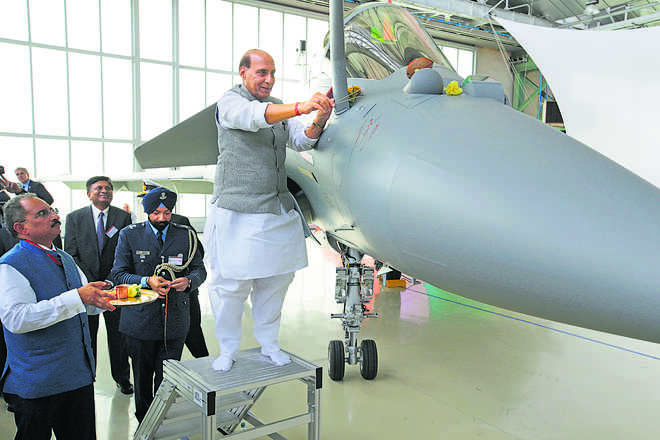
Rajnath Singh erred by transforming what is traditionally a simple domestic military ceremony in the IAF into a political and religious one with all the trappings of a single religion abroad. Singh does not represent a single-service faith. He is the Defence Minister of a multi-faith military which is secular, apolitical and professional.

Mr Rajnath Singh, take a leap of faith

eifying Rafale: In the military, it’s best not to mix religion with superstition or politics.

Maj Gen Ashok Mehta (retd)
Military Commentator

The images of India’s third most powerful leader — Defence Minister Rajnath Singh — in a flying suit with Rayban glasses after flying in the Rafale and in dhoti-kurta performing shastra puja before the flight — are two contrasting visuals of India’s state of defence equipment: from the legacy Russian MiG variants still flying to the fourth generation French Rafale fighter in the pipeline.

It is also a reflection of Singh’s conviction in religion, superstition and personal faith which he displayed on the 87th Air Force Day and Dasehra while performing the traditional shastra puja in France on receipt of the first Rafale aircraft from his French counterpart. The deification of the Rafale was very elaborate. The Ambassador to France was asked to arrange for a pandit.  Singh cracked a coconut, placed flowers, tied mouli, applied the Om tilak, all behind the cockpit while tying chillies and lemons to the wheels of the aircraft — the ritual watched by a bemused French audience. In this puja, Singh was assisted by an Indian priest and Air Commodore-rank military air attache to France.

As a soldier, I have witnessed and performed the shastra puja in my battalion for six decades on Vijayadashami, a ritual which is strictly in the domain of three persons: the Commanding Officer, the unit priest and the seniormost non-officer rank officer, the Subedar Major. All weapons are symbolically worshipped before they are returned to the Quarter Guard. One has never known an outsider perform this ceremony even if he is the Defence Minister of India. 

The Rafale belongs to the IAF, which has never performed a religious ceremony abroad while receiving a new imported aircraft. At an election rally in Haryana, Singh had announced that he wrote Om on the Rafale, ‘as per our tradition’. After Bofors, Rafale has proven to be politically volatile, especially the procedure followed in its acquisition on which the Supreme Court has reserved its judgment, even as the ruling party showcased it electorally before its operationalisation. Applying the tilak on an aircraft is not an IAF tradition.

Singh’s actions and his self-defence have attracted criticism from the opposition, many calling it theatrics and puja politics. NCP chief and former Defence Minister Sharad Pawar mocked Singh for tying chillies and lemons to ward off evil as truck drivers do. Singh’s colleague, Finance Minister and former Defence Minister Nirmala Sitharaman, whose main contribution to defence was the defence of Prime Minister Narendra Modi on the purchase of Rafale, both inside and outside Parliament, said: “Those who had faith had the right to conduct rituals because he is no ordinary citizen but Defence Minister of India.” She compared his shastra puja with Indian diplomats/politicians launching ships abroad by cracking a coconut (used to be a bottle of champagne). But no Om was emblazoned on the ship. A letter to the editor of The Pioneer newspaper read: ‘Politicians wedded to Hindutva ideology are adept at converting every event into an opportunity.’ He suggested that chillies and lemons should have been attached to Chandrayaan-II. 

In the military, it is best not to mix religion with superstition or politics.

Singh’s final statement was defiant: ‘I did what I thought was right and will continue to do so. This is our faith, that there is a super power, and I have believed it since childhood.’ Never to be left out of India’s internal affairs, Maj Gen Asif Ghafoor, head of Pakistan’s ISPR (Inter-Services Public Relations), chipped in: ‘Nothing wrong in Rafale puja as it goes by the religion and that must be respected. It is not machine alone which matters, but competence, passion and resolve of the men behind the machine. Proud of Pakistan Air Force Shaheens.’

Singh erred by transforming what is traditionally and essentially a simple domestic military ceremony in the domain of the IAF into a political and religious one with all the trappings of a single religion, abroad. Singh does not represent a single-service faith. He is the Defence Minister of a multi-faith military which is secular, apolitical and professional. In all-India caste Army regiments, the prayer room contains multi-faith areas where soldiers of different denominations worship their God. Although Singh has asserted he will do what he did in France, again, for the sake of the Indian armed forces, he should take a leap of faith and avoid doing it.

As Defence Minister, Singh has done great things: sending powerful signals of India’s rise as a great power; raking up the issues of No-First Use after visiting Pokhran and retaking PoK in the aftermath of the parliamentary resolution of 1994; opening up Siachen to tourism and generally boosting the morale of the armed forces. At his election rally in Satara, Maharashtra, PM Modi had said his government had brought India’s armed forces on a par with those of other countries and provided the three services with modern weapons.

Judging from the sparse funding for capital account of the defence budget in the last five years, Modi’s claim is an exaggeration. Singh’s real contribution to the military would be in getting at least Rs 50,000 crore annually for capital spending, over and above the existing liabilities during the remaining term of this government in order to catch up with China. Deterring Pakistan has largely been achieved. The government has shown recently how it can loosen its purse-strings. When there is a will, there is a way.


Naval Commanders conference

Defence Minister Rajnath Singh is greeted as he arrives for the Naval Commanders conference, in New Delhi, on Tuesday. Also seen is Indian Navy Chief Admiral Karambir Singh. PTI



Siachen open for tourists: Rajnath

Union defence minister Rajnath Singh inaugurates the ‘Colonel Chewang Rinchen Bridge’ at Shyok River in Ladakh on Monday. PTI

Press Trust of India

letters@hindustantimes.com

Leh : Government on Monday announced its decision to open Siachen area, the world’s highest battlefield, to tourists.

Defence minister Rajnath Singh said the government has decided to open the entire area from Siachen base camp to Kumar Post for tourism purposes.

The step has been taken to give people a window to appreciate the tough work done by Army jawans and engineers in extreme weather and inhospitable terrains, he said.

Singh was addressing a function in eastern Ladakh to inaugurate Col Chewang Rinchin Bridge on Shyok River, located about 45 km from the county’s border with China.

“The Ladakh MP in his address, mentioned about opening this area to tourism. And, I am happy to share that the government has decided to open a route from Siachen Base Camp to Kumar Post for tourists,” the minister said. “This step will make them appreciate the efforts put in by jawans, engineers and other workers,” he said.

Singh later tweeted, “The Siachen area is now open for tourists and Tourism. From Siachen Base to Kumar Post, the entire area has been opened for Tourism purposes”.

At the bridge inauguration, he said, only steel and concrete have not gone into its making, but “sweat and valour” of the engineers and workers of the Border Roads Organisation (BRO) too.

They have toiled hard and people should know their stories, Singh said.

The 1400-ft long bridge is the highest altitude permanent bridge that will connect Durbuk and Daulat Beg Oldi and reduce travel time by about half.

Singh also warned Pakistan to stop its terror activities to destabilise India or face befitting reply.

“Our soldiers never launch offensive against Pakistan. The other side is doing activities to destablise India (by sponsoring terrorism and resorting to shelling, Singh said at a function in the inauguration of 1,400-ft bridge across the Shyok River near the Line of Actual Control (LAC) with China in Leh district of Ladakh. “If this is not stopped or controlled, we will continue to give befitting reply,” Singh said.


The Navy’s New Torpedo Will Send Russian and Chinese Subs Running

ey point: As more countries build submarines, anti-submarine warfare will become a bigger deal.

 The U.S. Navy is now engineering a new, longer range and more lethal submarine-launched heavyweight Mk 48 that can better destroy enemy ships, subs and incoming weapons at longer ranges, service officials said.

Many details of the new weapon, which include newer propulsion mechanisms and multiple kinds of warheads, are secret and not publically available. However, senior Navy leaders have previously talked to Scout Warrior about the development of the weapon in a general sense.

Naturally, having a functional and more high-tech lethal torpedo affords the Navy an opportunity to hit enemies at further standoff ranges and better compete with more fully emerging undersea rivals such as Russia and China.

Progress with new torpedo technologies is happening alongside a concurrent effort to upgrade the existing arsenal and re-start production of the Mk 48, which had been on hiatus for several years.

 Navy officials did add that some of the improvements to the torpedo relate to letting more water into the bottom of the torpedo as opposed to letting air out the top.

The earlier version, the Mk 48 Mod 6, has been operational since 1997 – and the more recent Mod 7 has been in service since 2006.

Lockheed has been working on upgrades to the Mk 48 torpedo Mod 6 and Mod 7 – which consists of adjustments to the guidance control box, broadband sonar acoustic receiver and amplifier components.

Lockheed developers told Scout Warrior last year that Lockheed is now delivering 20-upgrade kits per month to the Navy.

Part of the effort, which involves a five-year deal between the Navy and Lockheed, includes upgrading existing Mod 6 torpedoes to Mod 7 as well as buying brand new Mod 7 guidance control sections.

The new Mod 7 is also resistant to advanced enemy countermeasures.

Modifications to the weapon improves the acoustic receiver, replaces the guidance-and-control hardware with updated technology, increases memory, and improves processor throughput to handle the expanded software demands required to improve torpedo performance against evolving threats, according to Navy information on the weapon.The Mod also provides a significant reduction in torpedo radiated-noise signatures, a Navy statement said.Alongside Lockheed’s work to upgrade the guidance technology on the torpedo, the Navy is also preparing to to build new Mk 48s.

Upgrades to the guidance control section in includes the integration of a system called Common Broadband Advanced Sonar System, or CBASS – electronics to go into the nose of the weapon as part of the guidance section, Lockheed developers explained.

This technology provides streamlined targeting and allows the torpedo to transmit and receive over a wider frequency band, Lockheed engineers said.

The new technology involves adjustments to the electronic circuitry in order to make the acoustic signals that are received from the system that allow the torpedo to better operate in its undersea environment.

Upgrades also consist of movement to what’s called an “Otto fuel propulsion system,” Lockheed officials added.

Lockheed will deliver about 250 torpedoes over the next five years. The Mk 48, which is a heavy weapon launched under the surface, is quite different than surface launched, lightweight Mk 54 torpedo fired from helicopters, aircraft and surface ships.

The Navy’s Mk 48 torpedo is also in service with Australia, Canada, Brazil and The Netherlands.

A Mk 48 torpedo is 21 inches in diameter and weighs 3,520 pounds; it can destroy targets at ranges out to five miles and travels at speeds greater than 28 knots. The weapon can operate at depths greater than 1,200 feet and fires a 650-pound high-explosive warhead.


India will not allow water to flow to Pakistan: Modi at Charkhi Dadri

Prime Minister Narendra Modi on Tuesday said India would not allow its water to flow to Pakistan.

“For 70 years, the water which belongs to India and the farmers of Haryana flowed to Pakistan. Modi will stop this water (from flowing into Pakistan) and bring to your houses,” the Prime Minister said at an election meeting, the second in two days, here.

He said the farmers of Haryana and Rajasthan had the right over the water that is flowing to Pakistan and was not being stopped by the earlier Indian governments.

“Modi aapki ladai ladega (Modi will fight your battle),” he assured the people at the rally.

The Prime Minister said Chinese President Xi Jinping during their informal summit in Mahabalipuram, Tamil Nadu, told him that he had watched the Aamir Khan-starrer ‘Dangal’ “which showcased excellent performance of daughters of India”.

“I felt really proud of Haryana on hearing this,” he added.

Praising Chief Minister Manohar Lal Khattar, Modi said: “‘Beti Bachao Beti Padhao’ campaign would not have been effective without the support of Haryana villages.”

He slammed Congress leaders for “spreading lies” over Article 370. IANS


-K admn releases 3 politicians from detention

J-K admn releases 3 politicians from detention

Many leaders had been detained in the Valley in light of the abrogation of Article 370. File photo

Srinagar, October 10

The Jammu and Kashmir Administration on Thursday released three politicians who had been under detention since August 5 when the Centre abrogated the special status granted to the state under the Constitution, officials said.

Yawar Mir, Noor Mohammed and Shoiab Lone were released on separate grounds, the officials said.

While Mir is a former PDA MLA from the Rafiabad Assembly seat, Lone contested unsuccessfully on a Congress ticket from North Kashmir and later resigned as district president of the party.

Noor Mohammed is a National Conference worker who has been managing the party’s show in the militancy-infested Batmaloo area of the Srinagar city.

Before his release, he will be signing a bond to maintain peace and good behaviour, the officials had said on Wednesday night.

The Governor Administration had earlier released Imran Ansari of the People’s Conference and Syed Akhoon on health grounds on September 21.

More than a thousand people, including politicians, separatists, activists and lawyers, were detained after the August 5 move of the Central Government to abrogate the state’s special status.

The detainees include three former chief ministers Farooq Abdullah, Omar Abdullah and Mehbooba Mufti.

Over 250 people were sent to the jails outside Jammu and Kashmir. Farooq was subsequently detained under the stringent Public Safety Act, while other politicians were mostly detained under different sections of the criminal procedure code. PTI


Drones spotted in Punjab’s Hussainiwala sector by BSF

Drones spotted in Punjab's Hussainiwala sector by BSF

Photo for representation only.

Anirudh Gupta
Ferozepur, October 8

The BSF on Tuesday sighted two high-flying drones along Punjab’s Hussainiwala sector, days after police recovered Pakistani drones used to airdrop arms and ammunition in border areas of the state.

The security forces went into a tizzy as the BSF troops spotted at least five sorties by drones originating from Pakistani side along the Hussaniwala border.

The development comes following confirmed reports about eight earlier sorties by drones used by Pakistan-based terror groups to airdrop almost 80 kg of sophisticated arms and ammunition to foment trouble in Punjab.

As per information, the BSF troops posted here spotted high-flying drones five times between 10 pm to 10:40 pm last night.

Sources said that while four times, the drone was spotted on Pakistani side, however, once the BSF troops belonging to 136 battalion sighted the drone venturing almost a kilometre inside the Indian territory near border outpost HK Tower close to Hussainiwala, around nine kilometres from district headquarters.

Later on, the BSF troops spotted the drone going back towards the Pakistani side but midway its light and sound went off and it could not be tracked further and vanished within no time.

Besides the BOP HK Tower, the BSF troops spotted a drone near border outpost Basti Ram Lal also at 12:25 am which was on Pakistani side.

Later, the BSF troops with assistance of Punjab Police conducted a search operation in the entire area, however, nothing suspicious was found.

“Ferozepur is well guarded by the BSF, besides there is an Army formation. The Pakistani agencies might be conducting aerial surveillance or they might be up to some mischief,” said an official, on condition of anonymity.

Sources said the drone-like objects were flying high with light appearing from them.

“Had they come to drop something, they would have been flying low and moreover, there would have been buzzing sound due to the bearing load,” said another official, while adding that nothing can be said or denied at the moment.

“The information has been shared with concerned authorities and an alert has been sounded,” he said.

On September 24, the BSF/STF had seized huge quantity of sophisticated arms, including five AK-47 rifles, ten magazines, 200 rounds, 1 Austria-made Glock pistol, 22 magazines and 20 rounds, from Mamdot in this area the source of which still remains unknown.

Sources said that following abrogation of Article 370 in Kashmir, the Pakistan’s spy agency Inter-Services Intelligence (ISI) was pushing the Pakistan-based Khalistani terrorists to carry out an attack of 26/11 magnitude in religious places in Punjab.

On September 22, the police had busted a terrorist module being run with the active support of terrorist groups from Pakistan and Germany and had recovered huge cache of arms, including five AK-47 rifles, four Chinese-made .30 bore pistols, nine hand grenades, five satellite phones, which the police claimed had been dropped by a drone.

On September 12, another consignment was seized from a truck at Lakhanpur (Kathua) which included four AK-56 rifles, two AK-47 rifles besides over 10,000 bullets.

Sources said the troops have been asked to keep a hawk’s eye on all such developments and air intrusions.

Meanwhile, the BSF has also started sensitising the residents along the border to immediately inform the police or BSF authorities if they spot anything unusual near the zero line.