Sanjha Morcha

What’s New

Click the heading to open detailed news

Current Events :

web counter

Print Media Reproduced Defence Related News

Cong, BJP spar over surgical strikes Stop playing politics on soldiers’ blood: Surjewala

Cong, BJP spar over surgical strikes

Capt Amarinder Singh, Punjab Chief Minister

Tribune News Service

New Delhi, June 28

Accusing the BJP government of playing politics on the blood of soldiers, the Congress on Thursday said the sacrifice of soldiers was a matter of pride, not politics.Reacting to the release of a video on the September 2016 surgical strikes on terrorist launch pads in Pakistan, the Congress said the “BJP was in a habit of using the valour of Army personnel for electoral benefits”.“Our forces have given a befitting reply to every challenge to India’s integrity, both internal and external. Decisive demolition of the terror infrastructure has been a hallmark of the untiring mettle of our armed forces. Conducting strategic ‘surgical strikes’ with utmost precision and effective penetration at different times in last two decades has been characteristic of the grit and determination of our forces,” Randeep Surjewala said, seeking to underscore the point that these strikes are not new.To drive home his point, Surjewala cited the following surgical strikes of the past – January 21, 2000 (Nadala Enclave across the Neelam River); September 18, 2003 (Baroh Sector, Poonch); June 19, 2008 (Bhattal Sector, Poonch); Aug 30 to September 1, 2011 (Sharda Sector, across Neelam River Valley in Kel); January 6, 2013 (Sawan Patra Checkpost); July 27, 28, 2013 (Nazapir Sector); August 6, 2013 (Neelam Valley); January 14, 2014 and September 28, 29 2016.The Congress said the BJP “shamelessly politicised the 2016 surgical strikes for the March 2017 Uttar Pradesh Assembly elections and went to the extent of organising “samman samaroh” of then Defence Minister Manohar Parrikar in Agra besides running a high voltage publicity campaign by pasting posters and hoardings giving credit of the strikes to the PM”.“BJP trashed every tradition of restraint by belligerent chest thumping to claim credit of surgical strike with an eye on political and electoral gain. BJP president Amit Shah went to the extent of claiming in October 2016 that the Army had crossed the LoC for the first time in 68 years,” Surjewala said, asking the BJP to restore benefits to Army personnel that it had cut over the past, including rations.Surjewala also drew attention of the BJP to the poor defence preparedness due to cuts in defence Budget allocations.


Army Major made 3,300 calls in 6 months to fellow officer’s wife he killed

Shailza Dwivedi, wife of Major Amit Dwivedi, was found at the Delhi cantonment area on Saturday with her throat slit and signs of being run over. (Facebook Screengrab | Shailza, Mrs India EARTH MoSt Creative)

New Delhi: Indian Army Major Nikhil Handa exchanged 3,300 calls and 1,500 text messages with wife of a fellow officer he is accused of murdering since January, it was revealed in court on Monday.

Shailza Dwivedi, wife of Major Amit Dwivedi, was found dead at the Delhi cantonment area on Saturday with her throat slit and signs of being run over.

The court has sent Major Handa, arrested on Sunday from Meerut in Uttar Pradesh, to four-day police remand.

When Shailza Dwivedi, one of the finalists of Mrs India-Earth 2017, refused Major Handa’s marriage proposal, he allegedly attacked her with a knife, threw her out of the car and ran her over to make it look like a hit-and-run, the police suspect.

He was obsessed with her and wanted to marry her.

“Judging by the number of calls he made, he was too possessive about her,” said police officer Vijay Kumar.

Read: Army Major ‘obsessed’ with officer’s wife, killed her for rejecting him

The murder weapon has not been found.

According to police, Major Handa had fought with his wife over his relationship with Shailza Dwivedi the night before he murdered Shailza Dwivedi. On Saturday, he had called Shailza and arranged to meet with her.

After the murder, he reportedly took his Honda City car for a thorough cleaning but forensic experts were still able to detect traces of blood.

“We have fingerprints and Shailza’s hair from the car. Handa also deleted many apps from his and her phones. We are trying to retrieve them,” said a police officer.

The police say Major Handa also tried to get rid of Shailza’s phone by breaking it to pieces and dumping it in a trash can near his home, but it was found.

Also Read: For murdered Army Major’s wife, women safety was cause close to heart

CCTV footage from outside the Army Base Hospital in the cantonment area showed Dwidevi getting into a car. Her body was found in the area half-an hour later. She was run over, but the police found that her throat was slit before that.

Major Handa and 30-year-old Shailza Dwivedi had met in 2015 in Nagaland when her husband was posted there. They kept in touch even when she came to Delhi along with her husband who was transferred to the capital.

Major Handa, currently posted in Nagaland’s Dimapur, was arrested after Major Dwivedi revealed his suspicion to the police and subsequent investigations were made.


Gen Rawat, Guv discuss Valley’s security situation

Tribune News Service

Srinagar, June 23

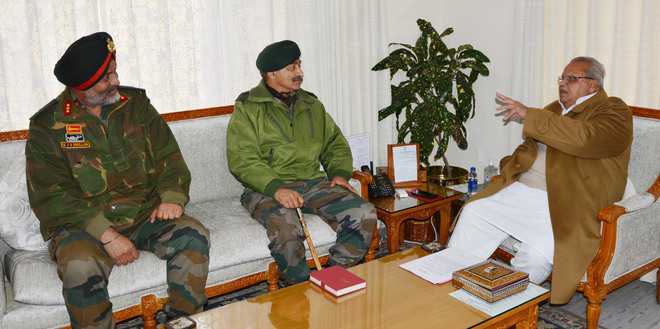
Chief of Army Staff General Bipin Rawat met Governor NN Vohra here on Saturday evening after reviewing the security situation along the Line of Control (LoC) and the hinterland.During their extended discussions, the Governor and the Army Chief discussed issues relating to the external security environment, challenges of counter-terrorist operations in the hinterland and the arrangements for the safe conduct of forthcoming Amarnath yatra.They also discussed the steps required to be taken for assuring a stable and bright future for the youth of the state. Earlier, General Rawat visited the Valley and reviewed the prevailing security situation along the LoC and hinterland.Accompanied by Northern Command chief Lt Gen Ranbir Singh and Chinar Corps Commander Lt Gen AK Bhatt, the Army Chief visited forward posts along the LoC in the frontier districts of Kupwara and Baramulla where he was briefed on all aspects of operational and logistical preparedness.The Army Chief was appreciative of the measures and Standard Operating Procedures instituted by the units and formations to meet the challenges posed by the inimical elements.Commending the performance of the troops in the recent successful operations, the Army Chief stressed the need to maintain the extra vigil to defeat the evil designs of hostile forces.Ops in hinterland

  • The Governor and the Army Chief discussed issues relating to the external security environment, challenges of counter-terrorist operations in the hinterland and the arrangements for the safe conduct of forthcoming Amarnath yatra
  • They also discussed the steps required to be taken for assuring a stable and bright future for the youth of the state

Cantonment Roads: Two Wrongs Do Not Make a Right

The MoD’s decision to open cantonment roads to the public appears to violate the existing law governing cantonments.

Cantonment Roads

On May 22, roads within cantonment areas were opened to the general public through an order issued by the Ministry of Defence. The Army was thus instructed to dismantle all road blocks and barricades. The issue with this decision is that it flies in the face of the Official Secrets Act, 1923, the Cantonments Act, 2006, the Cantonment Land Administration Rules, 1937 (CLAR), as well as a decision of the Hyderabad High Court. The decision to open the roads to the general public was taken ostensibly by keeping in mind the inconvenience caused to the public due to being denied thoroughfare through the cantonment roads. Another reason cited by the Ministry of Defence on May 28, 2018 was that the good public schools exist within the cantonment areas, and it would not be fair to deny public the access to these schools. On June 5, the Defence Minister Nirmala Sitharaman stated that the decision was taken since the local military authorities (LMA) had not followed the procedure laid down in section 258 of the Cantonments Act.

Section 258 of the Cantonments Act lays down the procedures for opening or closing roads. Under this section, a Cantonment Board can open any road for public use. However, to close a road, the Board has to take prior permission of the General Officer Commanding in Chief, or the Principal Director. Further, the decision to close a road to the public can only be for security reasons and must be preceded by a public notification inviting objections and suggestions from the public.

On the face of it, it appears that the Cantonment Boards are in almost absolute control of the roads within cantonment areas. However, when one looks at the law laid down under the CLAR, this is not the case. Rule 4 of the CLAR provides for classifying land in the cantonment areas. The land is classified as Class A land, Class B land and Class C land. Class A land is further divided into Class A (1) land on which barracks, ammunition dumps, rifle ranges and other allied military installations exist. Class A (2) land is the land, which is land not actually occupied by the military, but the military wishes to keep it vacant for specific reasons. Class B land is also divided under Rule 6 into Class B (1) land, which consists of ecclesiastical structures and cemeteries. Class B (2) land is the land which is occupied or used by any department of the “provincial government”. Class B (3) land is the land held by a private person on grant. Class B (4) land is the land, which is not included in any other class. 

Rule 9 lays down which authority controls each class of the land. Classes A (1), A (2), B (3) and B (4) land is managed by the Military Estates Officer or in the present case, the Directorate General of Defence Estates (DGDE), provided that the Union Government has not specifically placed the Class A (1) land under the control of the LMAs. Class B (1) land is managed with the department in possession of the land. Class B (2) land is managed by the “provincial government” in possession of the land. Class C land is solely managed by the Cantonment Board. Rule 14 further states that the DGDE has control over the Class A lands only to the extent of maintenance activities.

Under the Official Secrets Act, section 2(8) defines a ‘prohibited place’, in essence, as any installation belonging to or occupied by any branch of the defence forces. Unauthorised entry into them as well as possessing maps and plans of these protected areas is punishable under sections 3 and 5 of the Official Secrets Act. Sections 7 and 8 indirectly empower the armed forces to administer prohibited places. Section 7 prohibits people from interfering with police officers or members of the armed forces in discharging their duties in and around prohibited places. Section 8 makes it mandatory for people to furnish information regarding the commission, abetment or incitement of espionage when demanded to do so by the police or the armed forces. Thus, under the Official Secrets Act, since no unauthorised person may enter a prohibited area, the administration of the prohibited area lies with the armed forces, or the Union Government as the case may be. Thus, the Class A land may be considered a prohibited area under the Official Secrets Act.

Thus, even if a Cantonment Board wishes to open a particular road, if the road traverses through Class A land or Class B land vested with the LMA, then the Board can have no say in the matter.

In 2014, a decision of the Andhra Pradesh High Court dealt with very similar issues. The case, Mani Enclave Residents Welfare Association v. Union of Indiaconcerned a series of petitions seeking to quash the decision of the LMAs to close several roads passing through the cantonment areas of Hyderabad and Secuderabad. The petitioners had stated that closing the roads to the public would cause great inconvenience to them, and further complicate their daily commutes. The Army, however, argued that closing the roads was done in accordance to intelligence inputs, and in the interest of security of the defence installations within the cantonment. To support this, the Army provided the Judge with the relevant reports, which were not disclosed in the Judgement. The Army further displayed that the roads through the cantonment would in fact be more circuitous and that the civilian roads would provide a shorter route to destinations on either side of the cantonment area. The petitioners claimed that since they had been using the roads prior to the army’s decision to close them, the roads could not be said to constitute a part of Class A (1) land. This contention was dismissed as the Judge, Justice P. Naveen Rao, stated that merely because civilians were using a particular road would not change the nature of the land on which it was constructed. He further mentioned in his Judgement that security concerns cannot be jeopardised due to the civilian authorities failing to maintain the alternate roads. Thus, the Judgement went in the favour of the Army.

Considering the decision of the Andhra Pradesh High Court, it appears that the current legal position is that civilians can be restricted at any time from passing through Class A (1) land. This arises from reading section 258 of the Cantonments Act while applying the restrictions imposed by the CLAR. Thus, the spheres of control over defence land is laid clear. The LMAs have absolute authority over Class A land, the DGDE has control over Class B land, and the Cantonment Boards have control over Class C land. By imposing an order to open all roads, the MoD appears to have ridden roughshod over the established existing procedure, while stating that section 258 of the Cantonments Act was not adhered to.


Soldier abducted, body found

Soldier abducted, body found

Aurangzeb belonged to 4 Jammu and Kashmir Light Infantry. — ANI

Majid Jahangir

Tribune News Service

Srinagar, June 14

A 24-year-old Army jawan, on his way home in Poonch for Eid, was abducted by suspected militants in south Kashmir’s Pulwama district on Thursday morning. After a search, his body was found late in the evening.  Aurangzeb of 44 Rashtriya Rifles (RR), posted at Shadimarg camp in Pulwama, was travelling in a private car when the militants reportedly stopped the vehicle,  2 km from the camp at Kalampora.Pulwama SSP Mohammad Aslam said, “his  (Aurangzeb’s) bullet-riddled body was found in Gusoo village, 12 km from where he was abducted… The mutilated body had multiple bullet wounds.”Aurangzeb had joined the Army in 2012. Earlier in the day, defence sources had said the soldier was abducted by terrorists in a Maruti car, “three of them possibly armed”. But local sources claimed a soldier posted at Shadimarg  had stopped a car and requested that a man in civvies be dropped at Shopian. “This vehicle was later intercepted by  militants and the soldier abducted.” In Srinagar, Col Rajesh Kalia too confirmed the incident. The 44 Rashtriya Rifles has  carried out several successful operations in Pulwama this year, leaving more than 12 militants dead.Former Chief Minister Omar Abdullah termed the incident as “a very worrying development”. 


Ceasefire in tatters as four BSF men killed in Pak firing

Asst commandant from Rajasthan among those dead in Samba attack

JAMMU: Four Border Security Force men, including an assistant commandant, were killed and three seriously injured in firing by Pakistan Rangers along the International Border near the famous Chamliyal shrine in Ramgarh sub-sector of Samba district, a BSF officer said on Wednesday.

PTIBSF men pay tributes to their four colleagues at a wreath­laying ceremony in Jammu.

The BSF accused Pakistan of betraying the Indian side by not honouring its truce commitment made at the recent DGMO- level talks on May 29 that was followed by a sector commander -level flag meeting earlier this month.

“They first fired two mortars that landed on our party followed by firing. It happened around 9.45 pm on Tuesday night. We have retaliated and other action is in the pipeline,” said BSF Jammu frontier inspector general Ram Awtar. “Four BSF men have made supreme sacrifices in the line of duty,” he said.

Those men killed in the attack were identified as assistant commandant Jitendra Singh, assistant sub-inspector Ramniwas and constable Hansraj, all from Rajasthan, and sub-inspector Rajneesh Kumar, a resident of Etah in Uttar Pradesh.

Eleven BSF troops have been killed in cross-border firing incidents along border in the state this year, the most losses the border guard has suffered in a year since 2013, latest data reveals.

Chief minister Mehbooba Mufti expressed anguish over the deaths of the four BSF personnel, and reiterated her demand for cessation of hostilities along the borders to protect lives and properties of border people. CEASEFIRE CALL TODAY A final decision on the commencement of counter-insurgency operations in J&K is likely to be taken by the Centre during a security meeting held at the ministry of home affairs on Thursday, senior government officials said.


Much awaited policy for Housing Allowance of Ranks other than Commissioned Officers issued

Vide much awaited orders, the Government has finally notified new housing allowance rates for Ranks other than Commissioned Officers thereby replacing the existing ‘Compensation in lieu of Quarters’ (CILQ), as well as Family Accommodation Allowance (FAA) and Single in lieu of Quarters (SNLQ).

The rates would now be determined as follows:

If the concerned employee has dependents:

In field postings, he/she will be paid full House Rent Allowance (HRA) as paid to other employees at the Selected Place of Residence of his dependents. However if Government accommodation is available at the said place, then the HRA would not be paid.

In case of non-field postings, if the soldier is staying in the barracks due to functional requirements, the HRA would be paid at a rate reduced by 5% at the Selected Place of Residence of the dependents. In case the soldier is not staying in barracks, then full HRA shall be paid if Government accommodation is not available.

If the concerned employee has no dependents:

In case of field postings, full HRA as admissible to Class Z cities shall be admissible.

In case of non-field postings, if the soldier is staying in barracks, HRA would be paid at a rate reduced by 5% as applicable to the station of posting. In case the soldier is not staying in barracks, then full HRA would be admissible if Government accommodation is not available.

A soldier with dependents during his field posting or who is being made to stay in barracks during non-field postings due to functional requirements, shall remain eligible for accommodation for his dependents anywhere in India.

The above instructions are as per recommendations of the Seventh Central Pay Commission rendered in Paragraph 8.7.26.


Meeting Sehmat: Story behind the story

Calling Sehmat was an attempt to bring an unsung warrior’s story to the Indian people, says the author

Harinder Sikka

My journey with Calling Sehmat, the book, began at the Kargil battle theatre where I had gone as a freelance journalist with due permission from the then Adjutant-General, Lt-Gen SS Grewal. I had retired from the Indian Navy prematurely as Lt-Commander in June, 1993, and joined the Piramal Group in 1994 as the head of its operations in Delhi where I was working when I decided to cover the war.What I encountered there filled me with rage — the kind of attack our soldiers faced showed a high level of preparedness by the Pakistani forces. What had our intelligence been doing? How could they miss such vital signs of an imminent attack? This frustration made me lash out in anger in the presence of some soldiers around me. One of them turned around and calmly said, “Not everybody is a traitor. My mother wasn’t.”This was the first time I heard about Sehmat. Till now, I had decidedly been considering myself a brave man, leaving my family and a corporate job behind to go to Kargil and write about soldiers. But when I learnt her story, it punctured my ego. Here was a woman, a Kashmiri Muslim, whose courage and bravery were matchless. This is what triggered my search for Sehmat. I wanted to bring this unsung warrior’s story to the Indian people.My search took me to all those places, including in Pakistan, where she had lived. Her love for the country and belief in her karma made her undertake all those acts, including killing, which were against her very nature.When I first went to meet her at Malerkotla, she stepped out and said, “I don’t want to meet you.” She shut the door on my face and went inside. It was 10 am. She was very firm and sure about not talking to me. And I was very sure that I would talk to her. I decided to sit outside her house. Finally, at around 5 in the evening, she relented and said “come in.”These simple words were the start of a long and arduous journey. However, it helped change my whole perspective on life, thanks to this wonderful, saintly woman.She was a miracle in my life. I am not a filmmaker but she asked me to make a film on Guru Nanak. Nanak Shah Fakir won three national awards, and was greatly appreciated at various film festivals, including Cannes. A R Rahman compared its scale to Lawrence of Arabia.Calling Sehmat was initially printed in 2008 by a small publisher (Konark). A decade later it was picked up by Penguin and subsequently made a successful film. Meeting Sehmat was definitely the biggest blessing of my life.Sehmat’s father, Hidayatullah, a businessman, was a diehard patriot. He had extensive trading links in Pakistan. He was also working for the Indian intelligence agencies obtaining information about the plans of the Pakistani army which was preparing to launch an offensive on India. Before the 1971 war, he was diagnosed with cancer.Brigadier Sayeed was Hidayatullah’s friend and contact in Pakistan. They were also related to each other. When cancer-ridden Hidayatullah realised he had little time, he sought Sayeed son’s hand in marriage for Sehmat, to carry out what he might not finish with a war looming over the country. Both Sayeed and his son accepted immediately, as Sehmat was quite beautiful.In an ultimate sacrifice, barely-trained Sehmat was planted as a spy in Brigadier Sayeed household. She was strictly advised to just listen and observe things. She was given basic training to install and relay SOS messages using Morse code, in case of an emergency.Soon Sehmat won everybody’s confidence and rapidly infiltrated the inner circle of Pakistani defence. It speaks volumes about her initiative, confidence, guts and risk-taking capabilities. She also began teaching at an army school where children and grandchildren of the Pakistani army top brass studied, including Gen Yahya Khan’s grandchildren.Her influence helped Brigadier Sayeed gain top ranks within the crucial Pakistani intelligence network. It was at this juncture that Sehmat found about Pakistan’s plans to attack Indian warships. She passed crucial information about positioning of Pakistani submarines at the Bombay and Visakhapatnam harbours. This information matched with the intelligence in possession of the Indian Navy. As a consequence, the Pakistani submarine Ghazi was sunk at the mouth of Visakhapatnam harbour with all hands on board. The other two, Hangor and Mangrol escaped but not before launching a deadly attack on INS Khukri.Sehmat’s story is one of raw courage. Her information saved thousands of lives. India emerged victorious yet again. But both sides paid a heavy price for the Pakistani jingoism and misadventure. In the wake were also left two destroyed families and Sehmat who was brought back from Pakistan in a state of deep depression.It took many years and the divine healing of a saint that enabled Sehmat to return to a life of normalcy. But it led her to live the life of a recluse, a life she chose after all that she had been through and lost. During my interactions with Sehmat over the years, I found her strong yet compassionate. She had an air of such gentleness around her that it was difficult to imagine her capable of harming a squirrel, let alone cold-bloodedly killing a human being.Yet, what Sehmat accomplished should be an eye opener to anyone who questions the patriotism of Kashmiri Muslims.Meghna Gulzar as the director and Alia Bhatt in the protagonist’s role have done full justice to Sehmat’s story. As Mahesh Bhatt rightly said in his tweet, “We are as good as the stories we tell. Thank you for sharing with us the incredible story of an incredible woman — Sehmat”.I hope this message finds an echo in the hearts of the new generation, especially in Kashmir, the land which gave birth to Sehmat. Amen to more Sehmats and not Burhan Wanis.— Sikka is the author of Calling Sehmat. Meghna Gulzar’s film Raazi is based on the book, reviewed on page 6


The borders are quiet, but for how long? by Lt-Gen Syed Ata Hasnain (retd)

A workable beginning is to hold DGMO-level talks to consolidate the ceasefire and take it to agreed rules of engagement.

The borders are quiet, but for how long?

Lt-Gen Syed Ata Hasnain (retd)

8

India and Pakistan have decided to go back to the 2003 unwritten announcement of the ceasefire at the Line of Control (LoC) and abide by it. The LoC between India and Pakistan and the International Border (IB) in Jammu & Kashmir are witnessing peace after a long time, although a major part was not afflicted by the ceasefire violations. The Siachen and Kargil sectors have been quiet for as long as one can remember in the last 15 years. The LoC in the Kashmir segment too, although continuing to witness efforts at infiltration, has seen only limited violations. It is primarily in the areas of the LoC and the IB south of the Pir Panjal range that exchanges of fire had become a norm and many reasons can be ascribed to that. With the guns now silent, there are still misgivings among many in India as there were in the case of the decision to bring about a Ramzan-based cessation of operations in the hinterland, now in place for a little over two weeks. Their perception has to be respected too because of historical backstabbing by Pakistan. Yet, a case for peace needs to be made and supported to ameliorate the privations of the border people in the Jammu region. It will also allow stabilisation of the hinterland to calm the environment and reduce the vitriol which is always associated with ongoing violence.  There is need to examine the ceasefire and the cessation of operations in tandem with each other. The latter because of the latest very authoritative report by an intelligence agency which reveals that in the last three years, for every local terrorist neutralised in Kashmir, two have been produced through local recruitment from the vicinity of the area to which that terrorist belonged. The question most Indians are asking – how far and for how long can Pakistan be trusted, especially since the announcement by the two DGMOs of India and Pakistan makes no mention of Pakistan’s intent or otherwise of not allowing its territory to be used for targeting India?In as complex an issue as J&K and there is no gain trying to seek perfect solutions. There will be many imperfect proposals which will need to be progressively converted to workable and acceptable ones. The trust deficit with Pakistan is so huge that, perhaps, a couple of generations with prevailing normalcy will probably lead to any restoration. In this imperfect environment can India and Pakistan hope to restore some peace with steps such as implementation of ceasefire at the LoC and IB? If the 2003 ceasefire could partially succeed without any written agreement, can the latest be expected to last some time to allow peace initiatives to take shape?India needs to be clear that Pakistan’s initiative (as it is being reported) is not out of a newfound neighbourly love but borne out of compulsions. The compulsions are many; they include the upcoming Financial Action Task Force (FATF) review, grey-listing of Pakistan to see whether it has fulfilled obligations to prevent terror financing, the precarious condition of its economy which has forced devaluation of the Pakistan currency and borrowing of $1 billion from China to bolster its forex reserve which has fallen from $18 billion to $10.5 billion. Given its financial stress, Pakistan could not have sustained an escalated battle of attrition with India in LoC and IB exchanges. Yet, it had to display bravado at the IB as it did at the end. That could have backfired badly had India decided not to accept the ceasefire and in fact escalate the exchanges. Those monitoring Pakistan’s internal situation in the run-up to the elections in July 2018 would have sensed that ground was slowly being yielded. The Bajwa Doctrine was couched in vagueness to give the brokering for peace a semblance of dignity. Back channel talks were in place and the suspended Neemrana Dialogue was brought to life. The National Security Advisers (NSAs) of both countries appear to have been in touch more than the reported number of times, and for good measure. The Indian decision on cessation of operations in the hinterland did not receive a battering in Pakistani strategic circles as is the practice for most internal initiatives. A ceasefire at the LoC was on the cards. Pakistan will want this to be converted into a serious political dialogue and its diplomacy will aim at projecting itself as the promoter and initiator of peace. However, with the bitter record of Pakistan’s past deceit, the Indian government would be at odds to reinitiate anything at the political level unless certain conditions are met; it will take a fair amount of time to create those conditions. First, Pakistan’s internal polity has to be outside the ambit of uncertainty; not before late July 2018 will that happen, if at all. Second, Pakistan has to come clean on its support to terrorism by demonstrating a will to curb India-focused terror related activities on its soil or in PoK.  An indicator of any seriousness in this will be in the domain of infiltration. Third, it should display a will to bring to book those involved with the Mumbai terror attack of 26/11. This has become a sticking point, but with recent admissions of former Prime Minister Nawaz Sharif, it is a futile course which Pakistan has followed, defending the indefensible.  India, as always, will be prepared to meet Pakistan more than half way provided there is sincerity displayed. Thus, any vision of an immediate commencement of dialogue can only be premature, but the build-up towards that direction can be ensured, provided J&K remains relatively free of violence. A workable start point is to hold DGMO talks with a proper agenda either in New Delhi or Islamabad. These should be used to flesh out the ceasefire and take it to mutually agreed rules of engagement and installation of such measures which will build confidence and trust. Lower-level communication links across the LoC in identified areas can help in putting a lid on potentially explosive situations through local contacts. However, given the history of mistrust, India should remain circumspect and continue all work at the LoC and IB to ameliorate the problems of the locally afflicted people. A constitutional body tasked with the welfare of border communities in conflict-ridden zones could be a way towards giving continuity to efforts. Construction of family bunkers was also undertaken in 2003, but the then ceasefire effectively led to the shelving of the project. National security cannot be mired in personal and political interests. Everything there has a long-term perspective, with little catering to a moment in time.





Armed with doctorate, they are picking up arms

In recent years, several highly qualified youth joined militancy in Kashmir; few survived

Armed with doctorate, they are picking up arms

Rafi Ahmad Bhat

Azhar Qadri

Tribune News Service

Srinagar, May 27

When a young man from north Kashmir disappeared into the militant underground in the first week of the year, a signature announcement followed. His photograph was released on a social media site showing him armed with an assault rifle and with a detailed description of his identity.Organisation: Hizbul Mujahideen, name: Manaan Wani, qualification: MPhil, PhD in applied geology (AMU, Aligarh). It also had Wani’s militant name, Hamzah Bhai.In the subsequent weeks of the year, the recruitment of many new militants was announced in a similar fashion and some of them stood out for their educational backgrounds.Wani was the third doctorate student to join militant ranks in recent years and also the most prominent of its educated faces as a completely new generation of ultras — nearly all of them born after the eruption of militancy in the region — took over the rank and file of insurgency.Three months after Wani’s militant picture appeared on the social media, another young man disappeared. Within days, his picture in the signature style made the bold announcement. Junaid Ashraf Sehrai, son of separatist leader Mohammad Ashraf Sehrai, was assigned the code name Ammar Bhai. The details on his militant photograph had his qualification noted, ‘MBA from University of Kashmir’.The addition of education qualifications has been acknowledged by the militant groups in most of the photographic announcements adding to their information blitz and also providing a new perspective to insurgency.The insurgency in Kashmir will complete three decades next year and its various phases include periods of shock introduction, decline, indifference and current stage of immense popularity. A senior police official said the education qualifications of new militants were in consonance with the overall increase in the literacy of society and with the increase in the number of Kashmiri youth opting for graduate and postgraduate courses. “It is alarming that educated youth are becoming militants but it is not entirely unexplainable. There is an increase in the educational standards of society and what is happening on the militancy scene is a reflection of that,” the police official said.The inclusion of highly educated youth into militant ranks first surfaced immediately after the 2010 unrest in the region, when thousands of youth participated in months of protests. The first significant case emerged of Masiullah Khan of south Kashmir’s Tral sub-district who had completed Bachelors in Technology in mechanical engineering before becoming a militant sometime in 2010 and was killed in a gunfight a year later. Khan’s joining and death had passed off unnoticed at that time. However, soon, a trickle of youth with distinctive qualifications began to disappear and appeared in militant ranks. In recent years, at least eight engineering students have joined militant ranks and six of them have been killed. The six slain militants who had studied engineering include Tral’s Masiullah Khan and Saifullah Ahangar, Srinagar’s Eisa Fazili and Kokernag’s Syed Owais who were killed in March this year, Bijbehara’s Basit Dar who was killed in December 2016 and Pulwama’s Musavir Wani who was killed last month. The recruitment of Mohammad Rafi Bhat, an assistant professor at the University of Kashmir, to the militant ranks, however, was the defining addition to the new-age insurgency. Bhat, who survived less than two days as a militant, had a doctorate in sociology and was teaching at the university on the day he disappeared. He was killed in a gunfight later.