









Sanjha Morcha

What’s New

Click the heading to open detailed news

Current Events :

web counter

Print Media Reproduced Defence Related News

How Amarinder Singh’s response to Operation Bluestar made him a political icon in Punjab

How Amarinder Singh’s response to Operation Bluestar made him a political icon in Punjab

The two men who would eventually take charge of Punjab’s destiny in later years –Amarinder Singh and Parkash Singh Badal – were not in the state when Operation Bluestar was being executed. Amarinder Singh was near Shimla, playing a round of golf when the news about the army operation broke. His attention was distracted by the crackling sound of a radio in the vicinity of the golf course, which carried three key words: army, Bhindranwale and Golden Temple.

“I immediately walked up to the house [in which the radio was on] and requested the owner if he would let me in and listen to the bulletin.” The owner acceded to the request.

Amarinder’s worst fears had come true.

He promptly called off his golf game and returned to Shimla to ponder over and execute his next line of action. It had to be strategised carefully because it could have serious personal as well as financial repercussions. He called upon his colleague (Mrs) Rajinder Kaur Bhattal, who was also holidaying in Shimla, to inform her about what had happened at Amritsar.

Senior Congress leaders from Punjab, such as Gurdarshan Singh (from Nabha), Beant Singh (from village Kotli in Ludhiana), Sukhbans Kaur Bhinder (from Gurdaspur), Rajinder Kaur Bhattal (from Sangrur), Amarjit Kaur (from Patiala) and Amarinder, had decided that in the event of the Centre sending forces into the Golden Temple, they would all strongly lodge their dissent by going to New Delhi and maybe tender their resignation from the party as a sign of protest. In Amarinder’s case, he would have to resign from Parliament as well as from the Congress party.

As it turned out, none of the others resigned and some did not even reach New Delhi, citing one reason or the other. According to Amarinder, Rajinder Kaur Bhattal excused herself as one of her children was suffering from severe diarrhoea. Sukhbans Kaur Bhinder exempted herself because she had other commitments to fulfil. Beant Singh and Amarjit Kaur also managed to avoid going to the national capital with him. The only other person who lived up to his word was Gurdarshan Singh. He accompanied Amarinder to New Delhi, a tough journey under the prevailing circumstances.

From Shimla, Amarinder drove to his house in Chail from where he contacted the army commander for assistance to enter Punjab. Once all arrangements were in place, he drove to Chandimandir (a military station close to Chandigarh) where he met and lunched with the army commander.

Assured of a safe passage through Punjab, Amarinder then informed Gurdarshan Singh and both Congress leaders set off for New Delhi in their luxury cars to air their grievances to the Congress high command, a euphemism for the party president: Prime Minister Indira Gandhi. On reaching New Delhi, Amarinder met Indira Gandhi at her residence and handed her his resignation.

Amarinder’s ensuing conversation with Indira Gandhi was very candid and emotional.

The prime minister, who had evidently not taken Amarinder’s earlier assertions of quitting seriously, demanded his reasons for resigning from Parliament and the party. He reminded her of their previous conversation and emphasised the very strong association of the Patiala family with the Sikh religion and its related history. She then asked him to rethink. “This was reason enough for me to not reconsider my decision,” affirms Amarinder.

Not used to hearing a “no”, Indira Gandhi got up from her chair and stormed out of the room, leaving Amarinder on his own. Torn between his religion, political future and close association with the Gandhi family, Amarinder left his resignation on her table and walked out of the room soon after.


Since the Congress high command was now worried about the growing dissent amongst senior Sikh leaders, it evoked its crisis management “mantra”. Veteran Surjit Singh Majithia from Amritsar, a former deputy defence minister and a close relative of Gurdarshan Singh, had been requisitioned to dissuade the latter from tendering his resignation. Surjit Singh Majithia was successful in his mission.

It was none other than his childhood friend Rajiv Gandhi who attempted to placate Amarinder and convince him to change his mind, as his decision would politically bring down the Congress further in Sikh esteem.

However, Amarinder stood his ground and refused to oblige. He had already stated his position and anxiety to Rajiv Gandhi earlier. To avoid the pressure from his schoolmate and senior party colleagues, Amarinder went into hiding. On 10 June 1984, he finally approached BBC’s India correspondent, Sir Mark Tully, and went public with his resignation. BBC was the first news service to announce Amarinder Singh’s quitting from Parliament and the Congress party.

The same day, Amarinder Singh also released a press note about his move and the reasons behind it. The Tribune (a widely read Chandigarh-based newspaper) reported: “Mr Amarinder Singh of the Congress (I) today resigned from Parliament in protest against what he called ‘“entry of the army into the Akal Takht’”. In a signed statement, Mr Amarinder Singh said he was also resigning from the Congress. [He also declared]: “I shall now endeavour to bring about normalcy in the state and re-establish the cordial relations between the Sikhs and the Hindus.”


A couple of days later, Devinder Singh Garcha, Congress MP from Ludhiana, also resigned from Parliament and the Congress party. Elsewhere in the country, in the aftermath of Operation Bluestar, a large number of Sikhs deserted the armed forces and Khushwant Singh, the eminent writer and journalist, returned the Padma Bhushan, the third highest civilian award of the country, conferred on him in 1974. However, he did not resign from Parliament, which he represented through the Rajya Sabha (1980 to 1986).

Why did most other Punjab Sikh Congress leaders not resign and what made Amarinder stick to his resolve?

The answer to this question can perhaps be found in history through this excerpt from The Rajas of the Punjab: “The village Mehraj…in the modern Bathinda district was founded [by Amarinder’s ancestors] on the advice of Guru Hargobind [the sixth Guru], who had built the Akal Takht [early in the seventeenth century].”

Amarinder further clarifies: “Guru Gobind Singh had sent my ancestors a hukumnama [literally meaning a letter of command to preserve the religion]. There was no way that I could turn back from my decision.”

If it was an emotional decision taken to demonstrate his protest against the use of the army in the Sikhs’ holiest shrine, Amarinder Singh’s decision could also be hailed as a very astute political move, though it had its share of repercussions including long- term harm to financial interests.

The Congress upped its ante against Amarinder. There were a series of press releases condemning the erstwhile scion of Patiala’s decision. Several Congress leaders hailed the army action and met Rajiv Gandhi to show their support for Indira Gandhi. About twenty MLAs, including Dr Kewal Krishan, Sajjan Kumar Jakhar, Lal Singh and Jagdev Singh Jassowal, termed Amarinder’s resignation from Parliament as a complete “betrayal” of the faith reposed in him by the people. In a joint statement, they declared that the resignation was a “direct encouragement” to anti-national and communal forces. They also asserted that at a juncture “when the forces of disruption and disintegration were striking against secular forces, this step of Amarinder Singh’s was nothing short of a stab in the back of national interest and unity”.

The resignation, which clearly was an outcome of a combination of many factors, elevated, among a majority of the Sikhs, the position of the Patiala scion, who till then could only win in his home constituency. It catapulted him to a position of “persona grata” in Punjab’s politics.

The resignation can easily be referred to as his first major political manoeuvre in the complicated political chessboard of Punjab.

It was high on emotional connect, strong on religious resonance and shrewd on political wisdom. It was the hallmark of a statesman in the making, whose patriotism was never in doubt.

The decision also helped the Patiala family members in absolving themselves of an enormous ignominy, which could be attributed to the founder Ala Singh. In March 1762, Ala Singh had accepted the title of raja from the Afghan invader Ahmad Shah Abdali. Abdali was responsible for plundering of the Golden Temple twice besides killing thousands of pilgrims and filling the sacred pool with human bodies and carcasses of cattle. The founder of Patiala, Ala Singh, in Sikh history has appeared as a tainted figure, who, to attain and keep his power, had sided with the Afghan ruler Ahmad Shah Abdali during his invasions of India.

Even though Amarinder continues to maintain that his resignation had nothing to do with politics, this step ushered in another key contender in Sikh politics. Amarinder justifies his move: “Our association with the Gurus and the Sikh faith is beyond politics. Politics is nothing. I have no regrets whatsoever,” claims Amarinder.

Excerpted with permission from Captain Amarinder Singh: The People’s Maharaja – An Authorized Biography, Khushwant Singh, Hay House.


Nod to Barak missile for Navy

New Delhi, April 3

The government today approved procurement of a fresh batch of Barak surface-to-air missiles for naval warships from Israel to enhance India’s maritime capability.   A meeting of the Defence Acquisition Council (DAC) approved capital acquisition proposals totalling over Rs 860 crore, including for the purchase of Barak missiles.(Follow The Tribune on Facebook; and Twitter @thetribunechd)The clearance to procure Barak missiles  at around Rs 500 crore comes ahead of Prime Minister Narendra Modi’s expected visit to the country. — PTI


Four senior posts in Army fall vacant

Tribune News Service

New Delhi, April 1

Four senior posts in the Army fell vacant yesterday and there have been no appointments to replace them. Among the vacant posts are that of the Director General Military Intelligence (DGMI), and the Adjutant General (AG).

Four Lieutenant General-rank officers retired yesterday, leaving a void. The Ministry of Defence is yet to take a decision on their replacement or take a call on the pending promotions of Major Generals to Lt Generals — the promotion boards are pending approval for the past four months.Among the retirees were Deputy Chief of Army Staff (DCOAS) Lt Gen Subrata Saha, Director General (DG) Rashtriya Rifles Lt Gen GS Chandel, DG Military Training Lt Gen AL Chavan and the Adjutant General Lt Gen RK Sharma.Lt Gen SK Patyal, the DGMI, has been moved as the new Deputy Chief, replacing Lt Gen Saha.

There has been no officer appointed as DGMI, leaving a vacancy. Lt Gen Patyal was Commander of the Leh-based 14 Corps before taking over as the DGMI.Other than the appointment of Lt Gen Patyal, no other replacement has been announced. Apart from the four Lt Generals, 11 Maj General-rank officers have also retired.Sources said the promotions of Maj Generals will ensure movement and appointments. In the armed forces, the top vacancies are few and all ranks of Colonel, Brigadier, Maj General and Lt General are selection posts. Those not selected for the next ranks retire as per the age-level fixed for the rank, hence leaving very little choice.


Snow hampers Manali-Leh road clearance

Tribune News Service

Mandi, May 21

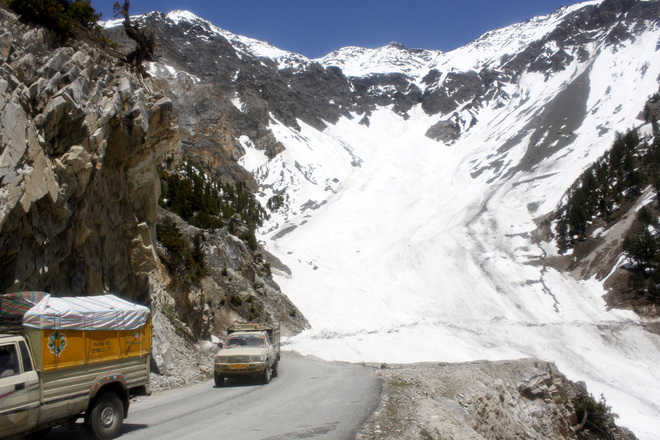
Inclement weather has hampered the snow-clearing work on the Manali-Leh National Highway till Sarchu Pass (14,500 feet), the border of the state and Jammu and Kashmir, where the Border Roads Organisation (BRO) is struggling hard to open the route.The highway is strategically important in the region which is used by the Army to supply goods to its forces in Leh and Ladakh.According to a BRO official, the workforce has reached near Baralacha Pass (16,043 feet) where heaps of snow were observed and it was struggling hard to move ahead towards Sarchu Pass.Earlier, the BRO was hopeful to clear the highway till Sarchu Pass by May 25 but the inclement weather has marred the hope of accomplishing the task in a stipulated time.BRO Commander Mayank Mehta said, “Due to bad weather in last two days, there was snowing in the region, however, our workforce continued in the snow clearance operation.”“We have reached Baralacha Pass where heaps of snow was observed and it will take more than one week to clear the route up to Sarchu,” he added.

Tourists throng Manali

Manali: To beat the scorching heat of the plains, a large number of tourists are visiting Manali every day. Tourist vehicles are allowed up to Marhi, 35 km from here, on the Manali-Rohtang road.Marhi and Beas Nullah, which is known as the snowpoint, has turned into an attraction for tourists.Marhi, about 15 km short of the Rohtang Pass, lies one of the most picturesque places in the region.A large number of tourists were also seen thronging the nearby tourists places like Hidimba Devi temple, Manu temple, Buddhist monasteries and Vashisht hot water springs. — OCHighway  strategically important

  • The Manali-Leh National Highway is strategically important in the region as it is used by the Army to supply goods to its forces in Leh and Ladakh.
  • Earlier, the BRO was hopeful to clear the highway till the Sarchu Pass by May 25, but the inclement weather has marred the hope of accomplishing the task in a stipulated time.


Why this tunnel will become Jammu and Kashmir’s lifeline

Prime Minister Narendra Modi will dedicate to the nation Asia’s longest bi-directional road tunnel on the Jammu-Srinagar National Highway on Sunday (April 2). The Chenani-Nashri all-weather tunnel has been built at a cost of over Rs 2,500 crore in about five years.

Built at an altitude of 1,200 meters, the 10.89 km tunnel would cut the travel distance between Jammu and Srinagar by about 40 kilometres, and is expected to save passengers over 2 hours in travel time as it will bypass snow- and landslide-prone Kud, Patnitop and Batote on National Highway 44. According to estimates, it also promises fuel savings of over Rs 27 lakh per day and will also provide better connectivity to people in Kishtwar, Doda and Bhaderwah in the Jammu region.

The work on the twin-tube tunnel, which is part of National Highway Authority of India’s (NHAI’s) 286-km-long four-lane project on the highway, started on May 23, 2011, in the lower Himalayan mountain range. The project forms part of the proposed widening of NH-44 (old NH-1A) from Jammu to Srinagar.

Hailed as an engineering marvel, this marks significant roadbuilding firsts in India, including an unprecedented stress on user safety. Amongst its host of intelligent road tunnel features are:

Integrated traffic control system
Entrance Detection Control System
Active Firefighting System
Electronic Surveillance System
Evacuative Broadcast System
Tunnel Ventilation System

http://

http://

http://


Situation untenable: Basit Pak envoy says from J&K to terrorism, Islamabad ready to discuss all

Situation untenable: Basit

Simran Sodhi

tribune news service

New Delhi, May 19

The present India-Pakistan situation is “untenable”’ and “pre-conditions” to talks don’t work, Abdul Basit, Pakistan’s High Commissioner to India, told The Tribune today.Pointing to the Kulbhushan Jadhav case, he said: “Pakistan as a responsible country, never flip flops on principles to cater for temporary benefits. And like all other states, we do not compromise on issues related to national security.”(Follow The Tribune on Facebook; and Twitter @thetribunechd)Reiterating Pakistan was willing for a “meaningful engagement with India,” he emphasised the only way forward was dialogue. On India’s contention that “talks and terror can’t go together”, Basit said sooner or later, Pakistan and India would have to come to the negotiating table, “either now or five years down the lane.The envoy urged India to return to the 2009 Sharam al Sheikh Statement wherein the two countries had decided to keep the issues of terrorism and talks apart. “We need to revert to that statement,” he said, stressing Pakistan was willing to discuss all issues, from Jammu and Kashmir to terrorism.Consistently referring to Jadhav as “Commander Jadhav,” he spoke of the “limited reprieve given to India”  by the  International Court of Justice (ICJ) while giving a stay on Jadhav’s execution, which the envoy pointed out was of no consequence as “he (Jadhav) was not being executed yesterday.” He was non-committal on whether the ICJ verdict was legally binding on Pakistan “I don’t see how Commander Jadhav can be executed over the next month. There is a process which will take its course.”On consular access/ visas to Jadhav’s family, the envoy said these would have to be decided on merit. “Pakistan is not really worried; we believe that as far as Commander Jadhav is concerned, Pakistan is on terra firma (solid ground). The case is also a testimony to the fact that terrorism in Pakistan is not without external dimensions.”Referring to the lack of progress in the Mumbai and Pathankot trials, Basit stuck to his earlier argument that progress could not be achieved till the two countries talked to each other.   “On Pathankot, how can you achieve results without cooperation? We agreed to send our investigators, we extended full cooperation. It is important to retain the spirit of cooperation.”On the speculation that Narendra Modi and Nawaz Sharif might meet on the sidelines of the Shanghai meeting in June, Basit said there was no such proposal yet from either the Indian or the Pakistani side.“Pakistan’s stand has always been that back-channel diplomacy without front-channel diplomacy is irrelevant,” he added. 

clip

clip

clip

clip


Kashmir shuts down over Budgam killings

Kashmir shuts down over Budgam killings
The deserted Lal Chowk in Srinagar on Wednesday. Tribune Photo

Ishfaq Tantry

Tribune News Service

Srinagar, March 29

The normal life in Kashmir was disrupted today due to a shutdown call by the separatists to protest the killings of three youths in Budgam district.Apprehending trouble, the authorities today imposed restrictions in parts of Srinagar city besides suspending the rail services on the Banihal-Baramulla route.To maintain law and order situation, the authorities had deployed additional forces in the volatile parts of the city and other major towns even as clashes were reported from Palhalan in north Kashmir and several parts of Srinagar city.The joint call for a “complete shutdown” was given by three separatist leaders — Syed Ali Geelani, Mirwaiz Umar Farooq and Muhammad Yasin Malik, who have also warned of mass protests if the “targeted killings of civilian protesters” near the encounter sites is not stopped by the authorities.Three youths — Zahid Rashid, Aamir Fayaz and Ishfaq Ahmad — were killed and more than 24 persons were injured when the security forces opened fire on protesters in the Chadoora area of Budgam in central Kashmir near an encounter site, which ended with the killing of a Hizb militant. The protesters, hurling stones, tried to move towards the encounter site to help the holed-up militant inside a three-storey house.Owing to the call for shutdown, shops, business establishments, banks and educational institutions remained closed in Srinagar even as public transport was also off the roads. The courts also remained closed as the lawyers boycotted the proceedings in protests.Early morning clashes between the protesting youths and security forces were witnessed in the Rawalpora area in uptown Srinagar as one of the three slain youths, Ishfaq Ahmad, hailed from the adjoining Rangreth locality.There were similar reports of complete shutdown from other district headquarters with inter-district transport services also getting disrupted.In north Kashmir, the security forces were deployed in the volatile Palhalan, Pattan and Sopore areas to maintain law and order situation.In the wake of the shutdown, the authorities also suspended the daily rail services between Banihal and Baramulla stations, as the railway line passes through several potential hotpots in the Valley.On the other hand, all examinations scheduled to be held today were postponed by Kashmir University, Central University, and the Islamic University of Science and Technology, Awantipora, in the wake of the shutdown.Militants attack police station in Kulgam  Srinagar: Militants on Wednesday opened fire on a police station in south Kashmir’s Kulgam district but no one was hurt in the attack, the police said. The gunmen fired five to six rounds towards the police station at Yaripora in the district at around 5.50 pm, a police official said. He said the militants fled from the spot, mingling with protesters who were demonstrating against the killing of three civilians in security forces’ firing in the Chadoora area of Budgam district on Tuesday. There were no reports of anyone getting hurt in the firing incident, he added. — PTI 

Hundreds attend slain ultra’s funeral

Suhail A Shah

Kulgam, March 29

Amid a complete shutdown over the civilian killings at Chadoora in Budgam district on Tuesday, hundreds attended the funeral prayers of slain Hizbul Mujahideen militant Tawseef Wagay in the Yaripora area of Kulgam district on Wednesday.Wagay was killed in a day-long encounter with security forces in Budgam on Tuesday. Three civilians were also shot dead allegedly by security forces as clashes erupted around the encounter site. The joint separatist leadership had called for a shutdown against the civilian killings.In the wake of a huge gathering, five separate, back-to-back, funeral prayers were held. Hurriyat Conference chairman Syed Ali Shah Geelani addressed the gathering over the phone and urged people “to remain steadfast in our struggle to attain freedom”. “We, our children, our resources and our honour, nothing is secure unless we get freedom. Our youth should hold the freedom struggle dearer than anything else,” Geelani said in his telephonic address.Following the funerals and the burial, amid pro-freedom and anti-India sloganeering, intense clashes rocked the area and continued for most part of the day. Youth from the area threw stones at security personnel who used tear-smoke shells to quell protests. Several people were injured during the clashes. The rest of south Kashmir remained calm.


Jaitley reviews J&K security

Jaitley reviews J&K security
A girl carries stones during a clash with police outside a college in Srinagar. PTI

Srinagar, May 17

Amid a spurt in ceasefire violations along the Line of Control, Defence Minister Arun Jaitley and Army Chief Gen Bipin Rawat held a security review here today and discussed measures for countering the street violence in the Valley as well as militancy.Jaitley, who also holds Finance portfolio, is on his first visit to Kashmir after taking over the additional charge from Manohar Parrikar. “The Defence Minister was apprised of measures to strengthen the robust counter-infiltration grid along the LoC. He was briefed on the close coordination among all agencies towards bringing back normalcy in the region,” defence spokesperson Col Rajesh Kalia said. (Follow The Tribune on Facebook; and Twitter @thetribunechd)Also at the security review meeting were Sanjay Mitra, Defence Secretary-designate,  and top Army officers. Lauding the valour, sacrifice and patriotic fervour of soldiers, Jaitley urged them to ensure safety of the innocent. — TNS


From Akali blues to festive hues in new House

OATH­TAKING The joy on Day 1 was marked by warm hugs, handshakes, and the unmistakable festive colours of the ‘pagris’ sported by Sikh assembly members

CHANDIGARH: From an assembly awash with the Akali blue for 10 long years, the 15th Vidhan Sabha on Friday sprang up with all festive hues as the ‘Congress 77’ settled themselves on the treasury benches. Many dressed in spotless white kurtapyjama, the joy was marked by warm hugs, handshakes, and the unmistakable festive colours of the ‘pagris’ sported by the Sikh members.

PHOTOS: KESHAV SINGH/HT(From right) Punjab chief minister Capt Amarinder Singh with cabinet ministers Brahm Mohindra, Navjot Singh Sidhu and other Congress legislators occupying the treasury benches on the first day of the 15th Vidhan Sabha in Chandigarh on Friday.

Congress MLAs have long given up the tradition of wearing white ‘pagris’ and on Friday they had chosen more “sacred” colours for their headgear. Chief minister Captain Amarinder Singh wore a beige ‘pagri’, a shift from his favourite light pink or light blue. There were others who completed the palette — Sukhjinder Randhawa chose light peach, Rana Gurmeet Sodhi chose bright pink, Pargat Singh donned dark purple and Balbir Sidhu chose magenta. Charanjit Channi sported a red ‘pagri’ and some even wore orange.

Cabinet minister Navjot Singh Sidhu dressed to the tee in a suit, wore a rust shirt with a matching ‘pagri’. Manpreet Badal wore his blue blazer today (he is mostly seen in either a white one or a school uniform blue) over his shirt-pant combination sporting a white ‘pagri’. The most colourful of Congressmen, Rana Gurjeet Singh, was dressed as expected, white kurta-pyjama, yellow jacket and purple ‘pagri’

Most of the youngsters had chosen to don kurta-pyjama, giving the true politician look but some wanted to look more fashionable. Amrinder Singh Raja Warring looked strapping in a blue blazer-shirt-pant combination, and newbie AAP MLA from Barnala Meet Hayer following suit.

Most of the Sikh Aam Aadmi Party (AAP) MLAs chose to wear ‘Basanti’ (bright yellow) turbans, the party’s campaign colour, symbolic of revolution, with Sunam MLA Aman Arora having found a jacket of the same colour. Leader of opposition, HS Phoolka, stuck to his usual blue. Most of the Akali MLAs too stuck to blue or black (two of three colours emblematic of Sikhism), only Parminder Dhindsa wearing his favourite light yellow.

Acutely missing from the new assembly was the glam quotient visible in the last House, thanks to its women members. Ministers Aruna Chaudhry and Razia Sultana wore subtle shades of white and beige, not wanting to stand out, lending a graceful tinge to the treasury benches. All six women MLAs kept their heads covered with ‘dupattas’.

UNUSUAL BONHOMIE, HUMILITY MARKS DAY

Lok Insaaf Party’s Simarjeet Singh Bains, allied with the Aam Aadmi Party, shared a warm hug with Navjot Sidhu Sidhu, reliving the bonhomie of the Awaaz-e-Punjab days before the group split to support different parties.


Bikram Singh Majithia, the Congress’ and AAP’s bugbear, shook hands with chief minister Captain Amarinder Singh and leader of opposition HS Phoolka after taking oath. Many legislators also bent to touch the floor of the House on their way to taking oath.

clip

clip

Capt govt to push CPS bill on last day of assembly session

WILL CHALLENGE GOVERNMENT MOVE, STATE LAW CANNOT MAKE APPOINTMENTS LEGAL, SAYS FORMER PETITIONER

CHANDIGARH: A sleek nine-member cabinet may not be enough to meet the aspirations of the 77 Congress MLAs. Punjab chief minister Captain Amarinder Singh has hinted at expansion of his cabinet after the budget session in June. But his government is readying to push a legislation on the last day of the current session (March 29) to get the appointment of chief parliamentary secretaries (CPSes) passed by the House.

Government sources contend the appointment of CPS, per se, is not unconstitutional. “The Punjab and Haryana High Court had stuck down the appointments in Punjab, holding that there was no law to mandate it. Once the assembly ratifies a law, the appointments should not face any legal hurdle,” government sources added.

The previous SAD-BJP government had appointed 23 CPSes without passing any law in the state assembly. The Congress government is likely to ensure that it keeps the appointments on a par with the 15% ceiling on size of the cabinet. In the 117member Punjab assembly, the cabinet can have not more than 18 ministers. So, the number of CPSes to be appointed also would be restricted to the figure of 18 under the state legislation.

Other than Amarinder loyalists, young turks of Congress vice-president Rahul Gandhi could be appointed as CPS to “groom” them for the future. Neighbouring Himachal, too, is bringing a law to appoint CPSes.

But advocate HC Arora, petitioner in the case before the Punjab and Haryana high court, said any new state legislation on the matter will be challenged. “The constitutional mandate is of appointing ministers, which should not be more than 15% of the total number of MLAs. A state legislation cannot make the appointments legal as it will be against the constitutional mandate,” he said.

“There can’t be anybody else between the minister and administrative secretary of the department, through whom files can be routed. If a CPS comes in between, the oath of secrecy by minister goes. The HC had also pointed out that they were acting like junior ministers, which is against the law,” Arora said. “We shall definitely challenge the government move. We won’t let go the battle, which we have won after years of efforts put in by a large number of people,” Arora said.

The HC had quashed all the CPS appointments made by the previous Parkash Singh Badal government on August 12, 2016, along with six others made later. The state government had moved the Supreme Court but it had refused to stay the high court order. The HC bench had decided the matter on two petitions filed in 2012.

‘Fine if CM keeps urban development ministry’

CHANDIGARH : Local bodies minister Navjot Singh Sidhu on Friday toned down his demand for housing and urban development ministry when he said it was fine with him if chief minister Amarinder Singh continues to hold the portfolio and he only wants to be involved in discussion and decision-making process.

“I have no problem if CM keeps the housing department,” said Sidhu while talking to a select group of journalists after taking oath as an MLA in the 15th Punjab Vidhan Sabha. His comments came a day after a clean chit from the government that he can continue to be a part of “The Kapil Sharma Show”.

Last week, Amarinder had raised apprehension that in case of conflict of interest, Sidhu’s portfolio (tourism and cultural affairs) could be changed. On Thursday, advocate general Atul Nanda made it clear that Sidhu “faces no legal bar in continuing with his work on the show”.

Sidhu had been demanding housing and urban development department along with the local bodies assigned to him saying all the issues related to urban development are in control of one department.

“My request is to call me periodically to discuss the issues, so there is coordination in all development works in state,” he said, reiterating that the development had to a joint effort of the two departments. Many programmes run by the Centre have involvement of both housing and urban development and local bodies department of the states, he said.


Militant leader quits Hizb after war of words

SRINAGAR: Radical militant leader Zakir Musa on Saturday severed ties with the Hizbul Mujahideen, hours after the outfit trashed his threat to behead separatist Hurriyat leaders, a development which could potentially impact militancy in Kashmir.

BURHAAN KINU / HTPeople hold a candlelight vigil for slain army officer Lt Ummer Fayaz at India Gate in New Delhi on Saturday. >>P8

In a separate incident, at least two civilians including a minor girl were killed when Pakistani troops rained mortars on 35 villages and Indian posts along the Line of Control (LoC) in Jammu and Kashmir’s Rajouri district on Saturday. Nine other people, including four Indian Army personnel, were injured.

India’s blames Pakistan of stoking militancy in Kashmir but Musa’s decision signalled serious differences among homegrown militants in the valley and the outfit’s leadership, based in Pakistan-occupied Kashmir.

Musa said the armed insurgency was aimed at creation of an “Islamic Kashmir”. “…If Hizbul Mujahideen doesn’t represent me, then I also don’t represent them. From today onwards, I have no association with Hizbul Mujahideen,” Musa said in an statement on Saturday.

IG GILANI SHUNTED OUT

Kashmir range insepctor general SJM Gilani was shunted out on Saturday amidst ongoing incidents of violence in parts of the Valley. He has been replaced by Muneer Khan.