



Sanjha Morcha

What’s New

Click the heading to open detailed news

Current Events :

web counter

Print Media Reproduced Defence Related News

Russia offers next-gen jet with new engine, design India was unhappy with fifth generation aircraft specifications

Russia offers next-gen jet with new engine, design
IAF’s Light Combat Helicopter Rudra flies past the Akash missiles at Yelahanka airbase in Bengaluru. PTI

Ajay Banerjee

Tribune News Service

Bengaluru, February 16

Russia has upgraded its offer to India on reviving the stalled fifth generation fighter aircraft (FGFA) project by putting on table joint design and development of a brand new fighter jet with a new engine.Viktor N Kladov, Director International Cooperation and Regional Policy, Rostec, speaking to a select group of mediapersons on the sidelines of the ongoing 11th Aero-India here, said: “We are talking of new design and jointly developed fifth generation fighter jet. It will have a new engine with fifth generation features.”“We are not talking about the PAK-FA (a Russian built prototype of the FGFA),” Kladov clarified. At present the Russians are flying a plane called the ‘T-50’ built under the PAK-FA (Prospective Airborne Complex of Frontline Aviation) programme. India had some issues with the engine of the T-50. The project has been stalled for the past two years despite India having paid $295 million for a preliminary design.Kladov said: “We have met Defence Minister Manohar Parrikar yesterday in Bangalore and he has promised to resume negotiations soon.”Parrrikar had on February 14 said the ministry had constituted a team to look into various aspects of the FGFA and it was likely to submit its report within a month. Kladov said the engine being used on the PAK-FA (T-50) was not fifth generation, adding the new jet will not be copy of the T-50.The IAF was not happy with the AL-41F1 engines being used on the existing T-50. New Delhi had told Russia in 2016 it wanted a new engine and the plane must have super-cruise ability, a 360-degree radar ability, added stealth features among 40-odd other modifications.


All clear for US parts on GripenSweden says has it an initial clearance from the US for selling its Gripen fighter jet to India with American-built general electric (GE) engines, said Jan Salestrand, State Secretary in the Ministry of Defence. Manohar Parrikar had earlier said foreign firms competing for deals under “Make in India” need to get clearances from respective governments to set up manufacturing units in India.

Dassault-Reliance JV

French Company Dassault Aviation has tied up with Reliance to form the Dassault Reliance Aerospace Limited (DRAL), a joint venture for the Rafale fighter jet programme. Eric Trappier, chairman of Dassault Aviation France, will be its chairman and Anil Ambani will be the co-chairman of DRAL.

Helicopter ambulance

Airbus has unveiled its dedicated helicopter-ambulance, fully kitted with specialised emergency medical care equipment. The helicopter can be put to use for medical missions only and has specialised equipment for emergency transportation of patients, organs, neonatal and other time critical medical missions. It can accommodate a stretcher and seat three attendants or para-medical staff in the cabin.DG flies HAL copterDirector General Army Aviation Corps Lt Gen Kanwal Kumar flew the Light Combat Helicopter at the Aero India. The LCH is indigenously developed by the Hindustan Aeronautics Limited and 114 such copters are to be inducted into the Army.


Mounting Casualties In J&K: Diligence, Change Of Tactics And Info Operations Needed Right Now by Lt Gen Syed Ata Husnain

Mounting Casualties In J&K: Diligence, Change Of Tactics and Info Operations Needed Right Now

SNAPSHOT

The separatist elements seem to have invented a new strategy to fight Indian security forces in Kashmir, and as a result, the casualty figures for the Indian Army have increases recently.

Can the Army come up with a comprehensive plan to counter them?

The one thing that the Indian Army always prides itself on is the ratio of terrorists neutralized to its own fatal casualties. There were times when it went as high as 8:1 in fatalities but at most times it hovered around 5:1. Statistics are not always a reflection of efficiency but a means of discerning indicators which tell us if things are right or wrong as far as drills are concerned.

However, drills may be perfect but yet there could be imponderables which apply and factors well outside the army’s control which add to enhanced casualty rates and increasing frustration. Improvement of drills and training may recapture the essence of the past statistics but there are factors beyond, that need a more nuanced application of mind.

In two days of February 2017 we have had eight terrorists neutralized in three encounters at the cost of six brave hearts of the Army. The injured, are many more. A brave CRPF Commanding Officer has been seriously wounded. Available videography only shows the vengeful attempt on part of stone throwing mobs and immense patience of the Security Forces (SF). The SF have the lethal weapons with them and with mortal remains of their comrades in sight it is sufficient emotion to trigger negative passions which could lead to a bloodbath. Yet, as always discipline, patience and forbearance have prevailed. It may not go on forever.

(STRAFP/Getty Images)

It’s important to know in general why casualty ratios have got skewed in recent months.

2016 saw one of the worst phases of terrorism and militancy in the Valley. Fedayeen (or suicide attack squads) re-emerged after 2003-4. Terror groups started seeking contact by targeting the Army’s main vulnerability, the convoys. They were emboldened by the resistance in the streets and stone throwing. Casualty figures of the security forces increased due to deliberate acts by the terror groups. The phenomenon most responsible for this is the adoption of a methodology by locals to generate collection of flash mobs at encounter sites the moment an encounter between terrorists and the security forces is imminent. This does three things to the situation: prevents the Army from closing on the target hideout, obviates CRPF from being effective in the cordon, and diverts attention from focus of operations. It makes an already difficult situation far more challenging. Momentary loss of focus leads to casualties as exposure from cover is liable to make troops easier targets. There is more on this phenomenon a little later in this essay.

There are other possible reasons for high casualties but they do not all apply to every situation.

First is the ‘two minute’ syndrome. Most casualties take place in the first two minutes of the actual encounter which primarily means from the moment the troops start closing in. The initiative being with terrorists; they being under cover and troops under movement, renders soldiers vulnerable. Every single soldier involved in these operations is equipped with a bullet proof jacket (BPJ) and a bullet proof patka much unlike what is perceived by some in public circles. BPJs do not provide hundred percent protection; sides, neck and below waist areas on a soldier’s body remain vulnerable. There is no restriction also on the employment of the 84 mm Rocket Launcher (RL) and the Automatic Grenade Launcher (AGL). There is disinformation that restrictions have been placed on these weapons. They help in destroying a hideout and the terrorists holed up within, and make it easier for the troops to close in and eliminate the final resistance.

It needs to be clarified that the master of the situation is usually the Commanding Officer (CO) who decides what weapons he wishes to employ and what tactics are to be followed. In recent years the emphasis was on minimal collateral damage and more precision in neutralizing terrorists. One could bludgeon resistance at such places by employment of all kinds of lethal wherewithal such as air power but the collateral would be immense. This dilemma is the challenge of COs and their superior commanders. How to employ the right mix of weapons and tactics for maximum effect, least casualties to troops and minimal collateral damage? Not an easy situation to be in, especially when mobs are attempting to cow you down.

The one equipment the Rashtriya Rifles (RR) would demand in greater numbers is the Mine Protected Vehicle (MPV) which has floor and side protection. It helps immensely in approaching the target area and can even break boundary walls and mow down wire fences. It should be available in greater numbers to the troops. The employment of snipers also needs much more emphasis. Problems of sniper ammunition restrict this and it should be another priority area for higher security managers.

It is necessary now to return to the challenging issue of mobs at encounter sites.

This came to the fore in 2015. Separatist networks are well established. Their intelligence travels faster on these networks, what with them being unstructured. There are paid rabble rousers in different villages who will exploit the mosque’s public address system and social media messaging to generate a flash mob in minutes. What our officers and troops find disquieting is that community members who pose as friends and supporters in everyday meetings suddenly turn out to be members of a mob. There is no black and no white in these situations.

Kashmiri Muslims attend the funeral of two slain terrorists, February 12, 2017. (/AFP/Getty Images) 

When the CRPF used slightly harsher methods there were pellet injuries galore. While there was sympathy for the victims, THOSE WHO FORM part of terrorist supporting activity by participating in mob actions are not held responsible for their own fate. Their actions are now leading to casualties among troops tackling terrorists. For the members of the mobs, that is akin to making themselves open for action by the SFs who need to facilitate their own (SF) security and ensure neutralization of the holed up terrorists. That is the message which needs to be conveyed clearly and unambiguously. The SFs cannot be expected to remain vulnerable without ensuring retaliatory security measures. If this aspect is not taken effectively and soon enough the already demotivating effect on junior ranks and pressure on field commanders will mount to unacceptable levels. The Army Chief has correctly said that those supporting such terrorists should be treated as over ground workers (OGWs).

To make them legally secure and beat back the information game which the separatists will invariably play when some casualties do occur among mobs, the Army, CRPF and JK Police must be smart in their own information handling.

This needs coordination at the Unified Command level. Enough video footage of previous encounters and those taking place in the future must be available for public relations managers to convert to media campaigns so that all those who target the SFs for their handling of rights are pre-empted and explained what the challenges are. While following the principle of ‘minimum force’, it needs to be ensured that soldiers and policemen are sensitized even more than ever before. The license to be proactively stronger against interfering mobs cannot be taken as a sanction for undisciplined handling of situations and imposition of random casualties. This also needs some deft advice from competent legal luminaries because many in the public will tend to be misled by separatist propaganda.

Clearly, the separatists think they have the upper hand in these encounters and with more casualties to the security forces they will encourage the further employment of these tactics. They lose nothing and gain everything by having a couple of young people injured or even killed in such violence, which is their aim. The State, SFs and all who care for the future of J&K must not give them this leeway and yet prevent the presence of mobs at encounter sites.

For public consumption, it is important to know that such negative situations of poor ratios in terrorists killed versus own fatal losses have occurred temporarily in the past too. The Indian Army and its associate forces have the will, the military intellect and the competence to turn the tide once again; it is just a matter of time.


I Didn’t Know Other Soldiers Testified That Gold Was Seized’

Armed Forces Tribunal has questioned the then Lt Gen Zaki for being unable to investigate the case of missing gold biscuits in Shatrughan Singh Chauhan’s case.

‘I Didn’t Know Other Soldiers Testified That Gold Was Seized’

Lt Gen Mohammad Ahmed Zaki stepped down as the head of the Indian Military Academy and took charge as an advisor to the Governor of J&K in 1991 because of his decade-long service in the state during a ‘difficult time’. Overturning Shatrughan Singh Chauhan’s court martial, the Armed Forces Tribunal has questioned his role in the second lieutenant’s persecution as well as for being unable to investigate the case of missing gold biscuits. Zaki, who is the chancellor of the Jamia Milia University in Delhi, responds to Ushinor Majumdar on the phone with his recollection of what happened back then.

The AFT has delivered a judgment in favour of Chauhan, overturning a deci­sion of a court martial that had given him 7 years of rigorous imprisonment and cashiered him from service. They believe that there were indeed 147 gold biscuits that went missing. Were/ are you convinced that Chauhan was wrong?

“I didn’t initiate proceedings (in the attempt to murder Chauhan) because I was later told he shot at himself in the leg. I didn’t know he was assaulted earlier.”

I have only read a brief news report of the judgement. Chauhan was totally wrong about the accusations he made. I was told by (Jamil) Quraishi, the then advi­sor to the J&K governor and an ex-IPS officer, that an officer had picked up Rs 150 during a search and seizure. I asked the officers to investigate and later the intelligence officer brought Chauhan to me as the person responsible. A court of inquiry was ordered and Chauhan ran away without leave. He was brought back by the guard, and he ran away again. He was brought back a second time and he ran again from the hospital. While the court martial against Chauhan was in progress, I had accommodated Chauhan’s father with another battalion because he too had served as a subedar major from the same battalion. After I had moved out, I read that he had been sentenced to seven years and discharged

Chauhan says that he met you in 1990, but you were unsympathetic to his charges of corruption against the Col K.R.S. Panwar. Several soldiers who were present at the raid also testified to having seen the gold and Col Panwar taking it away. Didn’t other officers convey the same to you?

Col Panwar was an honest officer.  It is totally wrong to accuse him. After the court martial, I read a news report accusing me of taking the gold biscuits, but it died down. It is news to me that soldiers testified that gold was indeed seized. I was not aware of it. The inquiry was at a lower level and it didn’t come up to the corps command, and it was a very busy time for the command at the time in that sector.

Why didn’t you initiate proceedings in the attempt to murder on Chauhan or the first assault?

I didn’t need to because I was told later that he fired at himself and shot himself in the leg. I didn’t know that he had been assaulted earlier.

The AFT has also pointed out many procedural lapses (under your signature) during the court martial. Such as making the proceedings a summary court martial, not naming the accused or the charges against him, turning a court martial against a soldier accused of stealing into a court martial against Chauhan that too for desertion and changing a member of the bench who had objected to Chauhan not having counsel. Documents have exposed his immediate superiors trying to do eve­rything possible to persecute including an attempt to murder. Some officers saw through it. What about you?

When a court martial is convened, it is sent to the adjutant general’s branch for scrutiny and then put to the corps commander. The corps command was busy in those days because of the situation in J&K. I had a very fine set of advi­sors and had full confidence in them. So, I followed their advice and beyond that I don’t know.

The AFT has said that there may have been extraneous circumstances guiding you. Were you under any pressure?

Not at all. I commanded the corps under the most difficult of times between 1989 and ’95. If there were any extraneous circumstances, I wouldn’t have been made advisor to the governor twice. After commanding the corps, I was commandant of the Indian Military Academy. Within four months of taking charge at the IMA, I was called to the advisor’s post. The second time I was called back again in “national interest” and that’s why I even refused any pay because I am not a mercenary. After a while I quit because I had served in J&K for a long time, since 1986, and requested the PM to excuse me.



Did you investigate the charges made by Chauhan? If no, what was your impression that led you to not initiate a probe? If yes, what was your finding that the AFT (even after so many years) is convinced?

No I didn’t have to because the governor’s advisor had informed me of the theft by an officer during the search ope­ration conducted by the 6th Rajput off­icer. The officers investigated and then procedure kicked in.


Avalanche tragedy: SASE had issued medium danger warning

Avalanche tragedy: SASE had issued medium danger warning
An area in Gurez struck by an avalanche. Tribune file photo

Majid Jahangir

Tribune News Service

Srinagar, February 9

While the Army is examining whether enough precautions were taken to avoid casualties due to the recent snow avalanches in Kashmir, the initial findings have revealed that there was already “a medium danger avalanche warning” for the Gurez sector but it was generic and covered a distance of about 40 km.As the snow broke the decades-old record this year, avalanches left 26 persons, including 20 soldiers, dead.A total of 15 soldiers, including an officer, were killed in avalanches along the Line of Control (LoC) in the Gurez sector of north Kashmir and Sonamarg in central Kashmir on January 25. Five soldiers were killed after a snow track caved in at Machil in Kupwara district.Sources said the Snow and Avalanche Study Establishment (SASE), the premier institution for avalanche studies in the country, had issued a medium range avalanche warning for 24 hours for the Gurez sector from 5 pm on January 24.Both avalanches in remote Gurez sector — one on an Army post and another at a patrol party — hit around 5 pm on January 25.In the first incident, three soldiers were killed when their post along the LoC near the Mahazgund Gurez valley was struck by an avalanche. Six soldiers were rescued by the Army and locals at the post. In another incident, a patrol of one Junior Commissioned Officer and 10 other ranks were caught in a massive avalanche near Niru in Gurez in which all 11 soldiers were killed.“The medium danger warning was issued by SASE for the eastern Gurez valley, covering a distance of about 40 km. In such warnings, the Army movement is permitted with precautions. Besides, there had been no avalanches on the Army post near Niru, which was buried under snow, in the last more than a decade,” said a senior Army officer.“While acknowledging the stellar efforts of SASE, we must also realise that their warnings are generic covering vast valleys. SASE says that it cannot predict when and where exactly an avalanche may strike, but it is able to predict areas and the likelihood of their occurrence.”The officer said that though the loss of lives was sad, the Army troops stayed in the rugged mountains near the border for the security of the nation.“These are high-risk areas during heavy snowfall and they (Army men) work there as part of their duty. They do take precautions, but at times Mother Nature gets the better of them,” the officer said.

2,000 CRPF jawans stuck in Jammu

  • New Delhi: About 2,000 Central Reserve Police Force (CRPF) jawans are stuck in Jammu for the past three days due to poor weather. The CRPF has sought the help of the Indian Air Force to airlift jawans, who had gathered in Jammu after completing their leave and other deployments. They were waiting to report back to their respective units in the Valley. There are around 45 units of the CRPF deployed in Kashmir on counter-insurgency and counter-terrorism operations. — ANI

We must walk the talk on defence matters by Maj Gen (retd) Ashok Mehta

Surgical strikes were bandied about to score political brownie points. However, the defence budget did not reflect the government’s seriousness about equipping the soldiers with gear and latest wherewithal. It is time that the Prime Minister and the Defence Minister got down to the serious business of defence reforms and increased capital funding.

We must walk the talk on defence matters
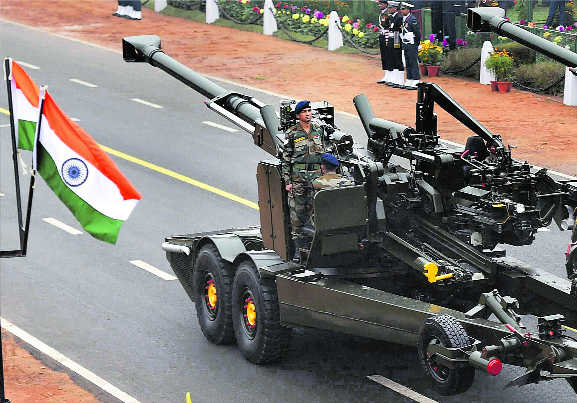
SHRINKING budget: DRDO”s Advance Towed Artillery Gun System (ATAGS) being displayed on Rajpath during the 68th Republic Day Parade in New Delhi. PTI

PRIME Minister Narendra Modi spoke passionately about the surgical strikes in the Lok Sabha recently, saying the country could never repay its soldiers for it. During the 2017-18 budget presentation, the defence budget took care of the salary bills of the soldiers but neglected to equip them with the latest wherewithal to carry out deeper surgical strikes.A country’s defence budget represents its man-machine mix and the statement of intent to combat the internal and external challenges facing it. India’s latest defence allocation of Rs 3.9 lakh crore (including defence pensions) has been described as “flat”. In terms of capacity accretion, the capital funding is concave. In real terms, according to Shane Mason of the US Stimson Centre, the capital account of Rs 86,488 crore represents a 5 per cent decrease from last year’s, of Rs 86,189 crore. This is about $10.5 bn of a total budget of $51 bn. Mason adds that key budget accounts within procurement are also cut, like shipbuilding shrunk by 30 per cent and aircraft modernisation cut by 6 per cent. This will hit capability accretion badly in uncertain times and growing security challenges. What is worse is that last year’s capital budget went underutilised by nearly Rs 7000 crore, hitting modernisation adversely. So with the new capital budget flat and negative, capability enhancement would be standstill. While the allocation would service carryover liabilities such as Rafael fighters and M 777 howitzers, the infantryman who bears the brunt of day-to-day counter-insurgency operations will remain without a frontline rifle and personal gear. Why does modernisation have to take repeated hits due to under-allocation and under-utilisation of funds? The defence budget is overwhelmed by legitimate and soaring salary bills and rising pensions due to                                                                                                                                                                                                             The cumulative effect of OROP (only 90 per cent realised) and the Seventh Pay Commission (only partly implemented). Of the Rs 3.59 lakh crore budget, only Rs 86,000 crore account for weapons acquisition. The rising manpower costs have severely undermined the machine upgrade. Manpower expenses will continue to increase and unless more funds are made available for modernisation the stagnation in capability build-up will stay. Fulfilling the commitments made to ex-servicemen on OROP  by the government was a political imperative. Meeting challenges of defence and security are in national interest but lower priority. Winning elections is the highest political objective of the ruling party. Resolving the competing demands of manpower costs and modernisation is also a key objective of the government.Finance Minister Arun Jaitley, who earlier doubled as Defence Minister, explained the interlinked dilemmas of shrinking funds for capital spending and the apparent inability of the defence forces to spend the monies allotted for modernisation on time. Answering former Editor of Business Standard, AK Bhattacharya’s question on Doordarshan that there is criticism that you have not done enough for defence, Mr Jaitley replied “If the Defence Ministry can speed up its acquisition mechanism they can get as much money as they want. Budgetary allocations are only indicators. Defence gets the highest priority. The amount indicated in the budget plus the pension is a large amount”. Clearly two things are evident from these comments. Increase or decrease in defence budget except salaries is directly related to provisions on modernisation  in capital and revenue heads of acquisition, upgrade and maintenance of defence inventories. Experience over the last two decades has shown that capital allocation especially in case of the army, has not been able to be spent on time due to hassles in procurement procedures.There is another plausible reason for non-utilisation which is that North Block officials towards November/December of the year place an informal embargo on any new contracts ensuring that earmarked funds lapse on 31 March. The government must enable Defence forces to utilise in full the capital account for modernisation Is defence really a high priority for the government as stated by Mr Jaitley ? The answer is a resounding ‘no’. The bureaucrats and political class have convinced themselves there will be no war. Gen Bipin Rawat, within hours of taking over as Army Chief told the media that the army was prepared for a two-front war and the Cold Start doctrine (never formally acknowledged by the government) would be its fulcrum against Pakistan. Given the current operational preparedness levels of the armed forces (recall Gen VK Singh’s hollowness in critical capabilities cry in 2012) it is not only not possible to deter cross-border terrorism emanating from Pakistan but also catching up with China’s overwhelming conventional nuclear and terrain superiority is a far cry.At Kozhikode, during the BJP conclave last year soon after the terrorist strike in Uri, Jaitley pledged to increase the defence budget which he has not done. Modi does not miss any political opportunity of praising the Army’s surgical strikes and commending Defence Minister Parrikar for them. Parrikar attributes the Army’s success to his RSS training. Both bask in reflected glory. On Budget day in the numerous TV debates, not one word was uttered on the inadequacies in defence allocation despite the GDP growth rate being 7 per cent. Politicians who sang surgical strikes in chorus were mum.Three trends can be noticed in the defence budget. First that defence expenditure in the last decade as percentage of GDP has been declining steadily from 2.19 per cent to 1.71 per cent to 1.65 per cent today which is lowest since 1962. Further, in the last two years, the revised estimate (RE) has been less than the budget estimate when the government has claimed higher RE in all other sectors. Second, defence budgets are flattening with capital accounts stagnating for the last 8 years resulting in accumulated obsolescence. What good are 85 projects worth Rs 1.50 lakh crore cleared by Defence Acquisition Council when the Defence Procurement Procedures, despite one dozen upgrades, does not foot the bill? Third, manpower costs continue to undermine modernisation. While the manpower heavy army is able to spend just 18 per cent of its budget on modernisation, the equipment intensive Navy and Air Force do better with 52 per cent and 59 per cent utilised for modernisation.The Lt Gen Shekatkar report on streamlining manpower is really a band- aid solution. India needs a comprehensive defence and security review. The latest suggestion is to establish a Defence Capital Acquisition Authority to fast-track defence contracts sans kickbacks. In 1988,  a suggestion was made for the formation of a Defence Acquisition Command and a Plans Programmes Budgeting System for evaluating equivalent capabilities of different weapons platforms to rationalize the defence budget.Evaluating the latest defence budget, the Stimson Centre says that from “a strategic perspective, India’s mismanagement of the defence budget will prevent the military from releasing its full potential…”. In December 2015 at the Combined Commanders Conference Modi had declared that reforms in senior defence management was an area of priority for him. Only Mr Modi can walk the talk. But is he interested in defence?The writer is a founder-member of the Defence Planning Staff, the forerunner of the Integrated Defence Staff.


Forces Tribunal set to get teeth Amendment Bill to arm it with powers to get orders implemented

Forces Tribunal set to get teeth

Vijay Mohan

Tribune News Service

Chandigarh, February 3

About a decade after the Armed Forces Tribunal Act, 2007, was passed by Parliament, the judicial body is finally set to be armed with powers to get its judgments and orders implemented.The Armed Forces Tribunal (Amendment) Bill is listed for consideration and passage before Parliament in the Budget Session, sources said.  Besides providing powers of civil contempt, it enhances the retirement age of AFT members and abrogates the system of re-appointment.This gives some hope to defence litigants in whose favour decisions have been passed by the AFT, but the orders were not being implemented by the defence services or the Ministry of Defence (MoD).Though the AFT possesses powers of criminal contempt — empowering it to take action against any misbehaviour by an individual — it was not vested with civil contempt powers due to which its orders were not implemented.The amendment, initiated in 2012, was referred to a Parliamentary Committee, where it was opposed by the Army.The amendment Bill also proposes to enhance the retirement age of the AFT chairperson and judicial members to 67 years from 65. The period of appointment has also been enhanced to five years from four.Advocate Maj Navdeep Singh — on whose PIL the Punjab and Haryana High Court had earlier directed the Tribunal to take coercive action against authorities for non-compliance of its decisions — said if enacted, the Bill would provide security of tenure and more stability to members since officers against whom AFT orders are to be passed form part of the re-appointment selection committee.The Chandigarh Bench of AFT has been without any judicial member since the retirement of Justice Surinder Singh Thakur in September last year, bringing all judicial work to a standstill.


19,000 candidates take CDS exam

19,000 candidates take CDS exam
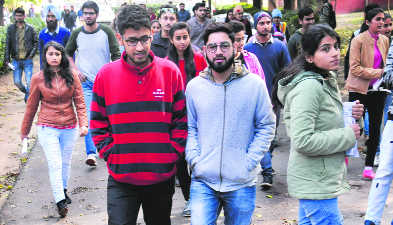
Candidates coming out of an exam centre in Chandigarh on Sunday. Tribune Photo: Pradeep Tewari

Tribune News Service

Chandigarh, February 5

Over 19,000 candidates attempted the CDS-I (Combined Defence Services) examination conducted by the Union Public Service Commission (UPSC) on Sunday at more than 30 centres in Chandigarh which is the only centre in Punjab and Haryana.The written exam consisted of three papers – English, General Knowledge, and Elementary Mathematics. The candidates who had applied for the Officers’ Training Academy (OTA) were required to take only first two papers, while all the other candidates had to appear for three papers. Each paper carried 100 marks and the candidates were given 2 hours for each paper.“The paper was not very difficult but candidates from science background certainly had an upper hand,” said Ruchir, candidate from Ambala.Another candidate Himanshu from Rewari said the paper was overall simple. “There was nothing unexpected. I think all candidates have a fair chance,” he said.Analysing the paper, city-based UPSC exam expert Kunal Singh said the mathematics paper was easy, English paper was conventional and general studies questions were repeated.“The exam was easy and scoring as compared to the last two years exam. Even as the paper was similar in terms of weightage assigned, there was a shift in the type of questions asked in science as well as economics which were different from conventional CDS papers,” he said. Singh said, “26 questions were repeated from the previous UPSC papers which will definitely raise the cut-off this time.”Notably, the UPSC had announced that the CDS-2017 exam date in November and accordingly the applications were invited. The CDS exam is the first part of the selection process – written exam. The Commission would recommend selected candidates to the Service Selection Board (SSB). The Board then would conduct intelligence and personality test for shortlisted candidates.The exam was held for around 463 seats in Defence Academies in Indian Military Academy, Dehradun; Indian Naval Academy, Ezhimala; Air Force Academy, Hyderabad, and Officers’ Training Academy, Chennai, for the courses commencing in January 2018.


Alarming arms race among Pakistan, India and China

The ballistic missile defense (BMD) – a country’s ability to shoot down an incoming projectile – in Asia is challenging the deterrence equilibrium not only between India and Pakistan but also with China.

With Delhi being pivotal in Washington’s long-term policy of containing domination of Beijing, the calculus of threat-perception has become awfully complex. Former US President Barack Obama not only anomalously amplified China as a threat while submitting to Russia’s advances but also authorised development of space-based weapon systems known as Strategic Defence Initiative (or Star Wars) in Reagan years. For a layman, Strategic Defence Initiative is an interplay of a series of satellites and ground-based missiles that were then meant to shoot down incoming missiles from the Soviet Union and other nations. The nuclearisation of space aims to undermine the ballistic missile defence. China, which may surpass America in space research by 2030, will soon follow the suit. India will react too, prompting Pakistan to consider its options.

In the eventful month of January, Pakistan laid bare its submarine-launched cruise missile, Babur III, followed by testing of medium range ballistic missile Ababeel boasting 2,200-kilometer range. Not only does the last tested offensive projectile covers much of India but also adds Islamabad to exclusive club of countries – United States, Russia and China – to have multiple independently-launched vehicles. After the development and deployment of Ababeel, Pakistan will be able to launch a space-skimming missile with multiple nuclear warheads, which can target designated locations, seriously outdoing India’s missile defences. The joke is on Delhi now!

The fresh arms race scudded by Obama’s White House has already enabled India to declare extension in range of BrahMos ballistic missile to 600 kilometres, which was not possible without her joining the Missile Technology Control Regime. Moreover, India has close cooperation in defence sector especially anti-ballistic missile development. The US ally has been working on its ‘multiple independently targetable re-entry vehicle’ (MIRV) missiles too, which are likely to be based on Agni V. Until the “pivot of Asia” stirred up things, China was not considering modernising its nuclear and missile arsenal as urgently as now seems the case.

For a strategic thinker, the Cold War model has limited significance considering triangular nature of deterrence. From threat-perception analysis to doctrinal evaluation, and development of weapon systems to actual deployment, Pakistan-India-China nuclear balance of power is mindboggling.

As for the existing capabilities, China can attack anywhere in India. A matching capability rests with Delhi, which obviously covers much smaller Pakistan too. Islamabad’s Shaheen III leaves India pretty much vulnerable. China emerges the most advanced when it comes to missile defence while Pakistan being the least. In a real world, there is a greater probability of an India-Pakistan war than Sino-India. Notwithstanding efficacy issues of any missile defence systems, India is better shielded than its western neighbour. Thus, Islamabad’s development of MIRVs was necessitated to maintain mutual vulnerability or deterrence.

While it was India, which initiated arms race in the realm of tactical nuclear weapons by testing one at Pokhran in May 1998, Pakistan has steadfastly focused in perfecting its short-range Nasr missile meant to deliver low-yield payload.

The next problem relates to Ababeel and India’s Cold Start doctrine, which aims to deny Pakistan justification to resort to its nuclear first-use option by inflicting rapid, fatal and limited attacks. With the MIRVs, Islamabad will have a choice as to whether to use tactical nuclear weapons on advancing India columns of tanks and infantry on its own soil or direct the punitive action behind the enemy lines in a more telling manner, demoralising the invasive troops.

Nonetheless, Pakistan has merely showcased a strategic option of delivering multiple warheads; the system requires resources and time to reach full maturity. Besides the size of the Ababeel arsenal, the released warhead’s capability to hit the target accurately will need painstaking research and investment.

India’s response to new developments has been mostly of disbelief and denial. Given its rampant over-confidence, Delhi is more prone to take chances in the event of a war. Its larger dilemma is the presence of nuclear extremists and anarchists at the helm of security establishment led by Narendra Modi. The aggressive ideologues are already having a difficult time holding back on declaration of first-use policy. Even if it does not pronounce, deployment pattern of its nuclear-capable missiles will provide a hint as to where it stands on declared policy of no-first use vis-à-vis Pakistan and China.

China, India and Pakistan need a customised version of Strategic Arms Limitation Treaty that existed between US and the USSR. Though there’s little room for limiting anti-ballistic missile systems, the vulnerability of failing to protect the citizens in the event of a nuclear war is mutual. None of the three countries have the resources as well as priority to secure the population against nuclear fallout. What to talk of building bunkers, there has been no minimal training in civil defence in the wake of a conventional war. Though it is a horrifyingly risky undertaking, yet prospect of annihilation brings forth a humanitarian deterrent against use of nuclear weapons. Paradoxically, there’s no active, common confidence-building mechanism amongst the trio.

The Indian side often mocks Pakistan’s position of maintaining minimum credible deterrence. The strategic analysts there tend to ignore that Pakistan’s aim of credible minimum deterrence does not exist in isolation. If India keeps on importing fissile material and foreign expertise besides displaying more sophisticated delivery systems, the threshold of credible minimum deterrence will either increase or bluntly put be trashed. To clear another misconception, the MIRVs are meant to replenish and upgrade Pakistan’s deference capability and not upset it out-rightly which is neither intended nor realistic.

– – – – – – – – – – – – – – –
Naveed Ahmad is a Pakistani investigative journalist and academic with extensive reporting experience in the Middle East and North Africa. He is based in Doha and Istanbul and tweets @naveed360


NCC directorate, Madras Sappers, CISF bag R-Day awards

NCC directorate, Madras Sappers, CISF bag R-Day awards
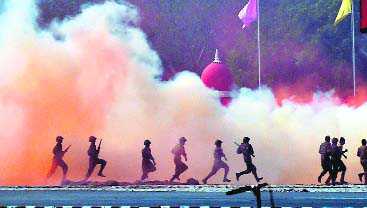
Cadets perform during the PM’s NCC Rally 2017 in New Delhi on Saturday. PTI
  • The Punjab, Haryana, Himachal Pradesh and Chandigarh NCC Directorate has bagged the top position for the third time consecutively in the national-level Republic Day Camp held at New Delhi
  • The Directorate was presented the championship banner by PM Narendra Modi during the PM’s rally in the Capital on Saturday
  • As many as 2,068 cadets from 17 NCC directorates across the country attended the month-long camp
  • The Madras Engineer Group (Madras Sappers) has been adjudged the best marching contingent at the Republic Day parade while the Central Industrial Security Force (CISF) has been adjudged the best in the category of paramilitary forces and other auxiliary marching contingents. In the tableau category, the Arunachal Pradesh tableau, which depicted a yak dance of the Mahayana sect of Buddhist tribes, has won the top spot. TNS

AFT reinstates 2/Lt after 25 yrs :::THE GOLD BISCUITS

Slaps Rs 5-cr fine on Ministry of Defence; asks for promotion up to Lt Col

Shahira Naim

Tribune News Service

Lucknow, January 20

The Armed Forces Tribunal (AFT) has reinstated Second Lieutenant Shatrughan Singh Chauhan after 25 years, restoring his seniority and promotions as well as imposing a fine of Rs 5 crore on the Ministry of Defence.The matter, which came up before AFT’s Justice DP Singh and Air Marshal Anil Chopra yesterday, is about Mainpuri native Second Lt SS Chauhan, who had been serving in the Sixth Rajput Battalion when he was court martialled on November 4, 1991, which sacked him and awarded him seven-year imprisonment.(Follow The Tribune on Facebook; and Twitter @thetribunechd) The order was later confirmed by the then General Officer Commanding-in-Chief, Udhampur. In a major indictment of his seniors, the AFT observed that his senior officers had purposely implicated the young officer in a false case to ensure that the gold he had recovered during a search operation could be concealed from the government.The AFT order quashing Chauhan’s sacking order has directed the Defence Ministry to provide him promotional avenues up to the stage of Lieutenant Colonel for the purpose of arrears of salary pension benefits and rank.The ministry is also to pay Rs 4 crore to Chauhan and another Rs 1 crore has to be deposited in the Army Central Welfare Fund within four months.The case goes back to April 11, 1990, when during the peak days of militancy during a search operation in Srinagar, Chauhan in the presence of other soldiers had recovered 147 gold biscuits weighing around 27.5 kg.The CO, Colonel KRS Panwar allegedly put pressure on Chauhan not to mention the gold in the documents. The other senior officers also remained silent.The gold biscuits were allegedly embezzled by the senior army officers. The officer took the matter to Parliament’s Committee of Petitions. The Army headquarters ordered a separate inquiry.It was during the inquiry that some army officers covering him with a blanket attacked Chauhan while he was sleeping in a tent.In 1991, the court martial cut short Chauhan’s career sentencing him to seven-year jail on charges of being a deserter and mentally unstable.

Court-martialled officer reinstated after 26 years

LUCKNOW: The Armed Forces Tribunal (AFT) has restored the services of a second lieutenant, who was court-martialled in 1991, and imposed a fine of ₹5 crore on the ministry of defence.

SS Chauhan, who was a second lieutenant in the Indian Army’s Sixth Rajput Battalion, was posted in Srinagar when he was court-martialled on various charges, declared a deserter and mentally unstable.

The rank of a second lieutenant is no longer in use in the army and all new officers are commissioned as lieutenants.

Passing the judgment on Thursday, justice DP Singh and air marshal Anil Chopra quashed Chauhan’s court-martial.

They also ordered the defence ministry to reinstate the officer as well as provide him promotional avenues up to the stage of lieutenant colonel for the purpose of arrears of salary, pension benefits and rank.

The tribunal also ordered the ministry of defence to pay ₹4 crore to Chauhan and deposit ₹1 crore with the Army Central Welfare Fund within a period of four months.

Chauhan, a native of Uttar Pradesh’s Mainpuri district, was court-martialled on November 4, 1991, and the order was approved by the then General Officer Commanding-in-Chief, Srinagar.

The officer’s ordeal began when he recovered 147 gold biscuits weighing around 27.5kg during a search operation in Srinagar on April 11, 1990.

In his petition, Chauhan pointed out that the gold biscuits were recovered from a house in the presence of other soldiers and were handed over to the then Colonel KRS Pawar and then Lt General Zaki Mohammad Ahmad.

The gold biscuits were allegedly ‘embezzled’ by the senior army officers.

During the trial, the tribunal observed that Chauhan’s senior officers implicated him in false cases to ensure that the recovery of gold could be concealed from the government.

Justice Singh and Air Marshal Chopra directed the chief of the army staff to look into the matter and ensure that appropriate action is taken against those who were instrumental in persecuting Chauhan and complete the inquiry in four months.