Sanjha Morcha

What’s New

Click the heading to open detailed news

Current Events :

web counter

Print Media Reproduced Defence Related News

IAF ready to fight at short notice, if need arises: Air Force Chief

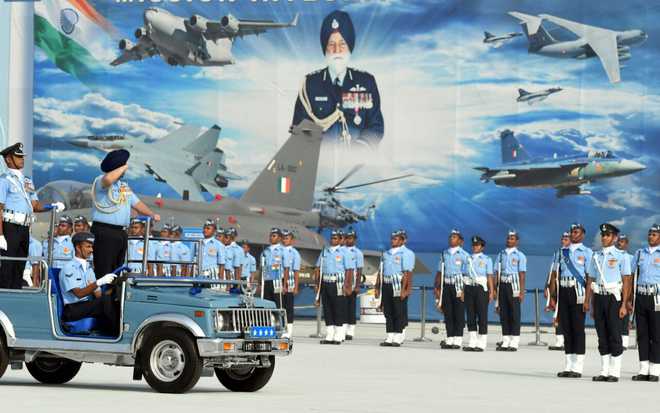
Air Chief Marshal BS Dhanoa inspecting guard of honour on the occasion of 85th Air Force Day at Hindon, Ghaziabad, on Sunday. Tribune photo: Manas Ranjan Bhui

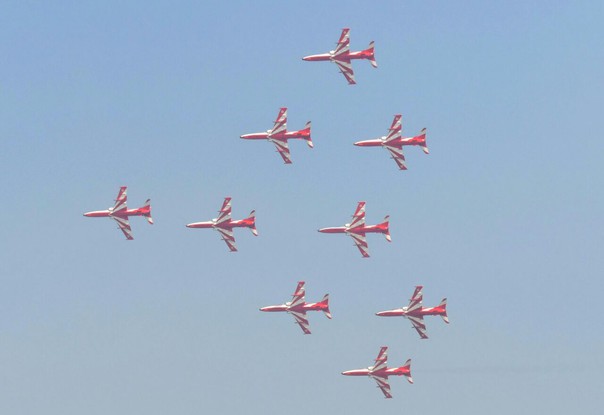
IAF’s Suryakiran jet trainers perform on the occasion of 85th Air Force Day Parade at the Air Force Station, Hindon, in Ghaziabad  on Sunday. Tribune photo: Manas Ranjan Bhui

Ajay Banerjee

Tribune News Service

Hindon (Western UP), October 8The Indian Air Force is ready to fight at a short notice, if the need arises, said IAF Chief Air Chief Marshal BS Dhanoa on Sunday morning.(Follow The Tribune on Facebook; and Twitter @thetribunechd)He was speaking at the Air Force Day parade at Hindon air base located east of the national capital.He paid homage to the seven military personnel who died in a helicopter crash near Tawang on October 6.The IAF Chief, talking to mediapersons, said the copter crash in Tawang on October 6 was prima facie caused as the copter’s tail rotor was dis-engaged.“The exact cause will be known latter. Will not speak more on the issue as the court of inquiry is on,” he said. The Mi-17 v5 copter, like the one that crashed, is flying.On being asked about the role of the women fighter pilots, the IAF chief said, “We intend to put women on MiG 21 jets as these are the best to hone your skills.”Addressing the issue of fighter jets, the IAF Chief said an early decision on the Make in India project (for some 120 single-engine jets) will help matters. The IAF, he said, was progressively reaching network-centric warfare. “We have maintained operational readiness by way of exercises.”He also said the Air Force was acquiring multi-spectrum strategic capabilities and remained committed to building a “joint manship” with the Indian Army and the Navy.Dhanoa said security of all Air Force stations have been enhanced to combat any threat, including sub-conventional threats, after the terrorist attack on the IAF base station in Pathankot last year.In January last year, terrorists sneaked in from across the border and attacked the air base. The attack claimed the lives of seven security personnel while four terrorists were killed. — With agencies


Not in a fauji’s name….by Brig Gurinder Singh (Retd)

A fauji finds himself being used as a symbol of misplaced patriotism whereas his concerns relating to pay and pension, welfare and other facilities are not being resolved.

Not in a fauji’s name....
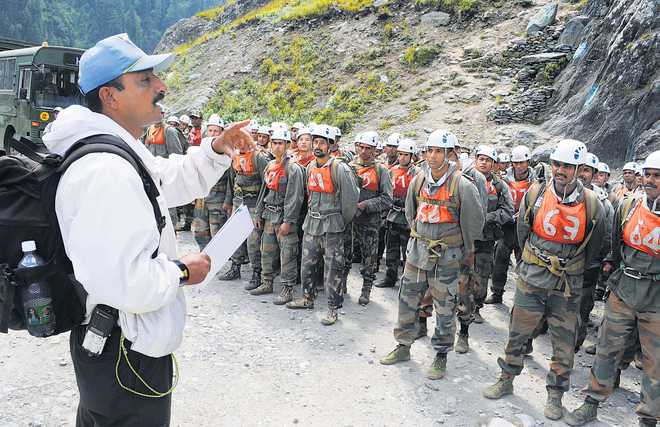
CLEAR OPERATIONAL PROCEDURES: In this file photo, an Army officer instructs jawans during combat training at the High Altitude Warfare School at Sonamarg in Ganderbal, J&K. Mohd Amin War

Brig Gurinder Singh (Retd)

LAST month, when a friend posted a few photographs about the death of 10 safai karamcharis in Delhi on his Facebook page, he received a strange counter-argument, “So what? Aren’t the soldiers dying on the border?” That happened around August 15, when Indians are usually charged up with seasonal patriotic fervor, which this year was compounded by the Doklam crisis and the security situation in Kashmir. But it is quite distressing to note that the death of fellow citizens at the lowest rung of society, entirely due to callous and negligent contractors and officials, is trivialised by such insensitive references to the faujis. There is a growing trend of using soldiers as a shield to justify everything, invariably by those who have no knowledge of the structure, organisation, working ethos and culture of the defence forces.

Misconception in public

Code of conduct: There is a misconception in the public, especially after ‘surgical strikes’, that the day-to-day functioning of the Army is controlled/monitored/guided by the political leadership. In my four tenures (all before 2014) on the Line of Control in J&K in different capacities, including command of a brigade, I do not recall any incident where there was ever any ambiguity in the approach or condoning of any softness or lack of aggression by anyone. There has never been any doubt about the operational procedures and code of conduct, nor was there any looking back for the orders. But Sharmaji, our grocerywala, thinks that the Army has only recently been given permission to act aggressively (khuli chhoot) against infiltrators and terrorists. The utterances of Manohar Parrikar as Raksha Mantri, “The esteem of the Defence Services is lowered in the public as there has been no war in last so many years”, left one wondering about his understanding of security matters. His act of crediting the ‘Surgical Strikes’ to his own RSS training undermined the credibility of the armed forces.TV debates: To use border tension with Pakistan and China to whip up misplaced patriotic passion in TV debates is not a virtuous thought. It is okay for military officers to be taking part in such debates as defence analysts purely on military/security matters. But when they get drawn into noisy debates on nationalism, they do not enhance the reputation of the armed forces. At times, they are seen in such debates for their military demeanour as a symbol of nationalism, rather than their domain expertise. Then there is another category of self-proclaimed nationalists and well-wishers and spokespersons of the military, who have taken this pro-fauji discourse on TV and social media to altogether absurd levels. Do we need to belittle a businessman, an IT professional or a policeman by telling him that his contribution is nothing compared to that of a fauji? A soldier carries out his task because he is trained and conditioned that way and without any external considerations. Bollywood portrayal: Akshay Kumar, the film actor, recently displayed public pity on soldiers and the families of martyrs by giving a few lakhs in charity while promoting his film. Do we need to run the defence forces or the welfare of the families of the martyred soldiers on charity? This is because the public perception is largely based on inaccurate, fictitious and often larger-than-life portrayal of military men in our movies. Bollywood would serve the defence forces better if the nuances of military culture, warfare and the context are adequately researched before depicting a fauji character or theme in the movies. In this regard, our film industry should learn from Hollywood.This new-found fauji overdrive has been exploited by the advertisement industry, too. Though there is nothing wrong in exploiting the pro-military public sentiment for commercial gains, the depiction of soldiers/soldiering in such advertisements is nowhere near the real-life soldiering.  A soldier deployed at the Line of Control or other operational areas is neither a Rambo nor Robot. He detests inaccurate representation of his hardships or sacrifices being used for electoral or commercial purposes.

Defence minister’s post

Since May 2014, the post of Defence Minister has been held as an additional charge or by someone who always preferred Goan fish curry to Delhi butter chicken. With 20 months to go, the nation may have finally got a ‘full time’ Raksha Mantri. The new Defence Minister is entitled to be photographed in the cockpit of the fighter jet and on board a ship or a submarine. But the ‘full time’ minister should now address these long-pending issues concerning the uniformed personnel of the defence forces. 

Address soldiers’ issues

The soldiers will be better served if the issues related to their pay and pension are addressed, if the anomalies of the 6th and 7th pay commissions were tackled and the One Rank One Pension (OROP) was implemented in its entirety. The Reddy commission report to look into the shortcomings of OROP continues to lie in cold storage since November 16, while the faujis’ agitation at Jantar Mantar continues for more than two years. The misconceptions relating to free rations in peace stations, canteen facilities, buddy (sahayak) system must be seen in proper perspective. When the grant of Non Functional Upgradation (NFU) to defence officers is being contested by the government in the Supreme Court, even after a tribunal headed by a retired high court judge ruled in favour of defence officers, the faujis have reason to be angry. Inaction and indifference of previous governments to these matters cannot be an alibi or justification to defer or deny the soldiers their dues.  A fauji finds himself being used as a symbol of misplaced patriotism while his concerns relating to pay and pension, welfare and other facilities are not being resolved. Therefore, he has reason to be upset and angry. The saying goes, ‘new broom sweeps the corners clean’. Military cantonments are much cleaner than civil areas in the true spirit of Swachh Bharat Abhiyaan. Some broom-wielding is needed in the Ministry of Defence, too.The JNU-educated minister must make the right choice; resolve pending issues pertaining to defence personnel and focus on delivery on promises to soothe the ruffled feathers. She also must see how this unnecessary and unwarranted discourse of hyper-nationalism in the name of faujis can be stopped. 


Infiltration bid foiled along Line of Control in Tangdhar sector

Infiltration bid foiled along Line of Control in Tangdhar sector
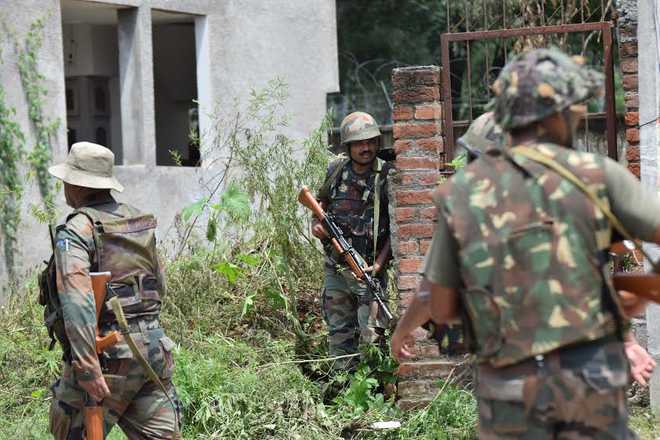
He said the soldiers noticed suspicious movement near the LoC and challenged the suspects. Tribune file

Srinagar, October 2

The Army on Monday foiled an infiltration bid along the Line of Control (LoC) in Tangdhar sector of Jammu and Kashmir.“An infiltration bid was foiled on Monday by alert soldiers along the LoC in Tangdhar sector in north Kashmir,” an Army official said.He said the soldiers noticed suspicious movement near the LoC and challenged the suspects.“An exchange of fire took place between the sides,” he said, adding that a search operation was launched soon after the gunfire stopped.Further details are awaited. PTI


The Constitutional Status of Defense Forces

The Present one dealing with aspects like what does “apolitical” means in terms of law and “Coup Proofing Vs Coup Phobia” and third one on “What Rots Indian Military within”? This is an attempt to answer ‘Frequently Asked Questions’ on issues of military. The questions answers given are not a complete set and shall be kept updated time to time. 

 
Question No 1. Military veterans seems to be always agitated on issues like pay, pension and allowances. Why is it? Are they depressed or greedy? 
 
Answer. Military veterans vocal on electronic, print and social media or agitating on Jantar Mantar airing their concerns on many issues concerning military, are neither depressed nor greedy. Soldiers of Indian army give more preference to service to nation and democracy than money. There are certain pressure points which Govts after Govts have not only ignored since 1973, but are creating more reasons for agitations. As for as public is concerned, in independent India it is happening for the first time, that in last 5-6 years military veterans have taken the course of agitation on key issues in public domain creating ripples in minds of common man creating such false impressions. The issues are pending with govt since 1973 and now the patience of soldiers is at breaking point.
 
Question No 2. But why shall Govt show such apathetic attitude towards soldiers? Soldiers defend nation and render great service and politicians, babus and govt are surely aware of it? 
 
Answer. It puzzles soldiers too. Why such apathetic attitude towards soldiers? Serving soldiers do not have unions or lobbies like civilians. They always had blind trust in govt but in 1973 they were delivered a serious blow when their status, pay, pensions and allowances were reduced drastically by 3rd pay commission and that of civilians raised.  It created serious imbalance and that too once soldiers had delivered an unprecedented and historic military victory in 1971 war.  Instead of award, soldiers were punished. It never happens like that. It is a sure way of killing the high moral of a victorious army setting a wrong precedence.   
Soldiers have a system of reporting their problems to their commanding officers, who then report the matter to services HQ at Delhi. Military Chiefs then take up matter with the govt. Soldiers followed the same system and had trust in the ability of their chiefs and Govt. Naturally such serious imbalance created by 3rd pay commission were reported to Govt through proper channels. Then PM Indra Gandhi assured Military Chiefs of resolution of their problems but it never happened. Since 1973. chiefs after chiefs have kept reporting the matter to Govt. Govts after Govts have kept assuring soldiers about resolution of their problems but without any solution in sight. Rather various political parties have used frustration of soldiers for petty vote bank politics. It has now created a situation wherein soldiers have lost trust in ability of military chiefs to get solution and started doubting the intentions and seriousness of Govts to deliver justice forcing them to came on street and social media bringing matters into the notice of public. After in all in democracy people are supreme. It is surely not a healthy sign for the democracy. It has also created problem within military where abilities of top leaderships to effectively communicate with govt are now being questioned?  
 
Question 3. Still why is Govt not serious? Soldiers on street in democracy is a frightening scene? 
 
Answer. It is surprising for soldiers too. Why is govt not serious? Why are political parties only interested in using frustration of soldiers for votes? Ignoring the problem without giving any justification is like adding the fuel to fire. Unfortunately, such apathy is creating impressions that corrupt politician- babu nexus has no time for serious issues of the nation and soldiers demand for justice is no exception. Look around, justice system has collapsed, govt administration is totally rusted, corruption rules everywhere, parliament has become defunct, proxy Govts rule, no political party has internal democracy, funding channels are kept secret, banking is overburdened with NPAs, gap between poor and rich are widening, farmers are committing suicide. A situation of hopelessness exists. It looks politics has become a profession of employment for failed people who are only interested in loot and plunder. Babus, banks, judiciary, some crony businessmen and temple priests, have joined hands with corrupt politicians to create a mafia. Naturally such mafia has no time and sensitivity for soldiers and justice or what else could be the reason?  Indian soldiers are sensitive, committed to constitution and responsible people. Soldiers know that in the given situation of hopelessness, if they also come on street, as it happens in other countries, it will deliver a death blow to the nation. Naturally so, military veterans have taken the responsibility to communicate with “we the people” who are supreme in democracy, keeping the threshold of agitation well below acceptable limits so that the situation doesn’t explode.
 
Questions 4. What are the major demands of soldiers? 
 
Answer. The major demands of soldiers are:
1. Status of soldiers as given in the “Constitution” be respected. 
2. Accordingly, serious imbalances and disparities between compensation model of soldiers and other govt civil employees be removed based on best HR practices taking into account the average career earnings including pension  benefits.
 
Question 5. What are the constitutional provisions for the executive authority of the military? 
 
Answer.Constitutional military executive authority of the soldiers comes out of the following articles:
 
1. Article 18;– respects the “Title of Ranks” of Soldiers even after his death. Soldiers never retire. Title of Ranks never die. 
 
2. Article 34:- Gives military a political executive authority to intervene by declaring martial law only to restore democracy.  In India parliamentary democracy is supreme. This article makes Indian military as soldiers totally committed to democracy and “we the people”. There may be situation where state fails to govern as per constitution or parliament is unable to function due to any reasons or rise of a civilian dictator endangers democracy or external/ internal aggression endangers it . In such situations constitution makes obligatory on military authorities to intervene to protect and restore democracy. Baba Saheb Ambedkar was a very wise man. He could sense that in independent India, probability of rise of civilian dictators are more than rise of a military dictator. He therefore under this article, entrusted military a role of silent and invisible custodian of Indian democracy.  History of independent India is testimony to the fact that Baba Saheb was right. Military has been loyal to constitution and we the people whereas Indra tried to become dictator declaring unconstitutional emergency. Military did play its role to protect democracy, when then Army Chief cautioned Indra to remain within limits of constitution. In fact emergency was lifted as all three chiefs wrote a top secret letter to Indra Gandhi advising her to lift emergency and call for elections. Probably this is right time the content of this letter shall be disclosed to public. 
 
3. Article 52 read clubbed with Article 74:– The sovereign authority of govt is vested in the President who wears two distinct hats. One of being head of civil political govt and other of supreme commander of defense forces. These two roles of the president are independent. Under this article the hard and soft national powers are identified and constitutionally divided. While the democracy under the pre-dominance of soft power functions under the leadership of Prime Minister and his cabinet, the total command authority over the hard power of military is denied to him/her. Baba Saheb was a visionary and had deep knowledge of Indian history. He wisely so separated national hard power from the national soft power. Baba Saheb knew if PM or defense minister are given total command authority over military it will give rise to many civilian dictators.  Therefore under this article if read clubbed with article 74, the political direction to military comes from cabinet headed by PM, administrative support comes from ministry of defense and military retains the authority and freedom to take military executive decisions and that is the reason precisely military is an attached organisation to the political govt. Constitutionally, military can not be subordinate to PM and his cabinet as President who is senior to PM is its head and also PM is not given command of military. In Indian democracy where PM exercises executive political authority and President is constitutional head of military, services HQ can only be integrated with civil govt and can not be merged as is the case in USA.  
 
4. Co-relation of Article 34 on Article 52 and 74. Articles 52 and 74 do not take away the authority as vested in supreme commander of defense forces and military commanders as Silent and Invisible Custodians of Indian Democracy. There could be situation where advice of PM (aspiring to become a dictator) and his cabinet to President could be detrimental to democracy. Under article 52 and article 74, president is left with no choice except to accept their advice after one review however under article 34 supreme commander of defense forces or military commanders can exercise military authority as vested in them only to defend constitution and democracy.

Question 6. Constitutionally, what are the roles of the Defense Forces? 

Answer. If seen in the backdrop of above constitutional provisions, the roles of Indian Defense Forces are:

1. Primary Role. To defend Indian Constitution and Democracy against any of the following threats:

a. Any external aggression or threat in any form on the Geo-political and economic interests of India, territories under the political control of Indian Govt and Indian constitution. The external threat may not be always in form of military invasions. It may appear in form of externally abetted political assassinations,  cyber or economic wars, threatening Geo-political alliances or posturing etc. 
b. Any internal threat endangering functioning of the constitution and democracy which may be in forms of armed rebellion or political takeover by a civilian dictator. 

2. Secondary Role. To assist civil administration in maintenance of law and order and in case of natural calamities, disasters and disturbances only when requisitioned. Please note that defenses forces can act in their secondary roles only when requisitioned. However for preforming their primary roles, no such orders or requisition are required. However as long as an elected political govt under parliamentary democracy is functioning, defense forces will always seek their political directions before any action. In case such govt seize to exist or nuke attacks have obliterated such govt or a civilian dictator has taken over violating constitution or any state govt has rebelled or any armed rebellion has seized any part of territory/ govt administration, defense forces will act under the military authority as vested in them to protect constitution and shall not wait for any political directions.
 
Question 7. What are the constitutional provisions for the status and service conditions of the Defense Forces?
Answer. Chapter 14 of the constitution deals with “Services of the Union and States”. Though defense forces are created under articles 34 and 52, but their service conditions are constitutionally governed under this chapter. Relevant article are as under:
 
1. Article 309 empowers parliament to make legislation for the service conditions of various public services including defense forces.
2. Article 310 Makes provisions for the tenure of all commissioned officers of the defense forces personals and civilian gazetted officers to be at pleasure of president. This article mentions various govt services in order of their seniority in terms of constitutional status. Officers of the defense forces are first in the seniority even ahead of civil services of the union (discontinued after independence) and All India Services (IAS, IPS, IRS, IFS etc).
3.Articles 311- 323 under the chapter deal with various safeguards provided to civil services and forming of Public Service Commissions.
Legal provisions for withdrawal of Pleasure of President in respect to officers of the  defense forces differ from the civil officers which  for defenses forces are further given in respective services acts, rules and also regulations.
4.Under article 309, various civil services acts for giving various service conditions in details like IAS acts and rules or IPS acts and rules have been framed. However in relation to defense services Govt and Parliament has chosen to remain silent and adhocism has been created. Absence of act and rules for service conditions of defense forces in detail as mandated under article 309, is the root cause of soldiers grievances. Present Defense Acts and Rules deal more with the discipline aspect of forces. The defense regulations are customs of Monarchy. India is a democracy and defense forces shall not be administered under adhoc regulations.
 
Question 8.  How are officers in Defense Forces appointed and how does their oath differ from a civil servant?
 
Answer. Officers of the Defense Forces in addition to being gazetted, are also commissioned officers. The word “commission” is mentioned in the parchment given to them at the time of their commissioning wherein they take oath of allegiance not only to the constitution as taken by civil officers but also to obey lawful command of their superior officer up in the chain of command after due observations to it being a lawful in accordance with laws of regular army.Under this observed obedience of lawful command, duty to defend the constitution is inherent. Civilians including PM and Govt Ministers take oath of allegiance to the constitution and not to defend constitution? Few key aspect which shall be noted in appointments of defense officers are :1. The parchment of commission is given under the printed signatures of the President authenticated by a Military General and not by any civil officer. 
 
2. In parchment of commission, the President uses the word “ME” and not “MY GOVT” as he uses in Parliament, because the authority of military command is absolute in nature and is vested in him as supreme commander of the defense forces. Such power legally can not be delegated to any other authority. Provisions of article 74, therefore do not apply on military authority and chain of command. Army laws make nature of command legally very clear.  In case of confusion of political directions for military between President and PM, defense forces are obliged to follow orders of supreme commanders of defense forces and not PM. 
 
3. Officers of defense forces take oath to serve anywhere in world and space, where ever they could be send by land, air and sea beyond the territories of India and where even the Indian laws do not apply? They enforce the sovereign authority of the state not only within national territories but beyond. 
 
4. Officers are suppose to follow such orders of command which are lawful in nature. Legal validity of orders are decided by officer himself interpreting these under the law. Commissioned officers are therefore expected to use their judgment to decide legality of the orders and all illegal orders he is expected to disobey. In case commissioned officers obey illegal orders, they carry liability of criminal prosecution.  
 
5. Officers of the defense forces by virtue of being commissioned officers, are vested with following powers
a. Military executive authority not only to impose its will using military force on any entity but also to the extend of forming govts. Military Govt in India were formed in Hyderabad, Goa and Junagarh once these were liberated and also in Bangaldesh and Jaffna Sri Lanka.  
b. Judicial powers to not only give punishments to the extend of death sentence, but in certain situations confirm and execute it without any reference to any court, govt and president. 
c. Powers of Magistrates are exercised by defense forces in aid to civil authority. Officers of the rank of NCOs and above  exercise such powers. Whereas in case of civil these are not below gazetted officers. 
d Military Authority to command troops. Military functions based on unique concept of command. 
e. Administrative powers like any civilian officers. 
It could be seen from above that all functions of state for which a civil govt has different organs, in case of military are vested in commissioned officers.  
 
Question 9. It seems somewhat confusing? General Impressions are that constitutionally IAS officers are Masters of Indian Destiny and they are even superior than other sister services like IPS, IRS and IFS? 

Answer. If seen in backdrop of article 310, that is not correct. Over a period of time IAS officers have taken advantage of their certain appointments and closeness to politicians. Corrupt, greedy and insecure politicians have obliged them, as in elections IAS officers are appointed returning officers responsible to check validity of their nomination papers, their election canvassing activities and spending of funds. In fact it is this appointment which makes them a kind of masters of Indian Elections. It is the IAS officer as DM, who announces results of vote counting. When in multi corner elections where victory margins are thin, such officers naturally can oblige politicians. It is this relationship between politicians and IAS officers which has given unjustified advantage to IAS. In most of the democracy. No civil servant is given the responsibility of being a returning officer.  In US, civil servants only oversee checks over political spending, in Pakistan, these are judicial officers who are nominated as returning officers. The present practice is harmful to Indian Democracy and parliament must take note of it? 

Nevertheless constitutionally, following shall answer the question about the correct position on the standing of officers of defense forces with officers of IAS and other All India Services :

Comparison of Constitutional Status of Defense Officers and IAS including Officers  of All India Services

1. Sovereign Executive Military Authority is an exclusive domain of military officers exercised through powers and chain of command. Under such authority nations are destroyed or made. Political directions for military actions at macro levels are given by elected govt in a functional democracy. Under article 34 defense forces have been made silent and invisible custodian of Indian democracy with a responsibility to keep it intact. No such powers in civil domain to any civil officer.

2. Authority to form political Govt is an exclusive domain of political civil Govt in a functional democracy on mandate of ‘we the people’. However in certain situations with approval of elected civil political authorities and if it doesn’t exist then own its own, officers of the defense officers form a political govt in any external captured territory and anywhere within the country. Examples are when military formed Govts in Hyderabad, Goa and Junagarh within the country and in Bangladesh and Jaffna; Sri Lanka abroad. Such Govt can be led by any military officer or any other person so authorized by responsible military commander.  Adjutant General of the Army HQ is responsible for the subject. Only officers of the rank of Brigadier and above are authorized to declare formation of such Govt. That is the reason, rank of Brigadier was and should be equated with the appointment of secretary of Govt of India. Same is the practice world over in most democracies. No such authority is vested in any of the officers of all India services. All civil officers serve under the command of military commanders whenever/where ever Military Govts are formed.

3. Judicial Powers. Any commissioned officer can be nominated to the military court as a Judge. Military officers of the rank of Captain and above exercise judicial powers of a session judge and can give death sentences.  In case of SGCM, an officer of the rank of Captain and above can nominate himself as judge and can give death sentence in a summary trial. He in this case can also confirm the sentence given by himself on behalf of President and give orders for its execution without reference to any court and civil authority. No right of appeal is given to the accused. Military Laws can be made applicable to civilians either by notification by central govt or under martial laws. Legal validity of the courts formed under martial laws has the sanction of Supreme Court. No such powers or authority is held by any officer of the all India services.

4. Powers of a Magistrate. Powers of magistrate is more of a civilian concept when a civilian officer is given part of executive authority of the state by virtue of he/her holding an appointment or given for a period. Military works on the concept of command where executive powers of state are inherent in powers of command of Military officers by virtue of holding commission or authority to exercise such powers. In case of military, powers of command are given down to NCO levels. In aid to civil authority military Non Commissioned Officers, has the powers to order fire.  Such orders in case of civil can only be given by a Civil magistrate. These powers are not inherent as is the case of military officers. IAS officers exercise powers of magistrate as returning officers for an election. It is this appointment which gives advantage to them to illegally oblige politicians and makes them powerful over others.

5. Administrative Powers. Exercised as authorized by Defense Officers as well as officers of all India services. Please note, IAS officers or other officers of all India services exercise executive powers of State only when they have powers of magistrate or holding a specified appointment where as executive authority of the State are inherent to all commissioned officers by virtue of they holding  commission on behalf of the President. Nature of job of officers of all India services is more as administrative whereas in case of defense officers it is pre-dominantly executive. That is the reason article 310, puts officers of defense forces in senior most order than officers of all India services and other civil services. Yes, it is also true constitutionally that IAS officer have no legal standing to claim seniority or preference over IPS, IRS or IFS. Their present superior status is illegal and has been created with the help of politicians as they are the only one who can become returning officers to conduct elections.

Question 10. The word defending the constitution are neither mentioned in Oath and Nor in commission parchment, then how are officers of the defense forces responsible for the “defending the constitution”?
 
Answer. Oath of President of India has two key words. One “upholding the constitution” and other “defending it”?  President takes the oath to defend constitution as supreme commander of the defense forces and the only means to defend constitution, he has, are the defense forces. He therefore passes his authority to officers of the defense forces in form of commission. It is through this commission the officers of defense forces become responsible for defending the constitution by military force following lawful command. Article 34 also makes it obligatory on part of the defense forces to defend constitution. 
 
Question 11. Civil Political Govt has authority and freedom to decide what shall be status of the defense officers and how shall they be paid? Why shall defense officers and soldiers crib?
 
Answer. Govt of the day is formed and functions under the broad constitutional framework. No govt or babu is above constitution and they are expected to work within the space as provided. Since 1973 govt are taking certain unconstitutional decisions and downgrading status and compensations of the the defense forces. The same is highly objectionable. Defense forces have been so far maintaining the decorum and trying to argue reason with the govt. Unfortunately the same is not yielding the result and no answers are coming from the govt?  That is main reason military veterans have taken to social media and streets. 
 
Question 12. Why shall Govt give answers to the military? It is communicating its decisions? Where is the problem in it? 
 
Answer. India is a democracy and not autocracy. Govts are answerable to the people and parliament. In case of military they need to explain reasons as by law military is not expected to obey unlawful orders. Soldiers have certain of their fundamental rights restricted it doesn’t mean they lose all other rights of a being Indian citizens? Govt carry a responsibility to reason out their grievances? It is demand of democracy. 
 
Question 13. Why is military not going to court? After all it is an attached organisation to the govt and maintains its own identity? 
 
Answer. Defense forces surly have such options open but not exercising showing respect to democracy and hoping  that some day wisdom will prevail. After all military going against an elected govt in court might cause serious problems to the democracy. Yes some serving officers and military veterans are taking some lead but the same is also not a healthy sign. 
 
Question 14. What are the main grievances? Can same be elaborated? 
 
Answer. Same were explained above in answer to question 4. The same is again elaborated here:
 
1. Considering various articles 18, 34, 52, 309 and 310 of the constitution and their authority, powers of command, roles and functions, officers of defense forces have a constitutional status and the same is superior to the senior most civil services that is IAS. Article 310 makes it very clear. Equating commissioned officers inferior to police and higher than homewards is surely humiliating. Since 1973 defense forces are actually under systematic motivated attacks from political establishment for marginalizing them. The same is likely to create a serious imbalance in power structure of the country in total violation of constitution which is fraught with serious consequences like creating space for rise of civilian dictators. 
2. On the eve of Independence, first Govt under PM Nehru in fact had realized the problem and on recommendations of a committee, respecting constitutional status of the defense officers, certain principle of parity were laid down. The same were:
a. The status of officers of defense forces will be superior to civil services; IAS. 
b. Seniority protocol between commissioned officers and IAS shall be decided based on length of service and not on the basis of rank of defense officers. 
c. Compensation packages in terms of total average career take home including pension of defense forces shall be higher than civil. In case of defense officers more than IAS. 
3. The above thumb rule as made under Nehru govt, respected the constitution. It was in 1973, in lust to be a dictator, Indra Gandhi tweaked above policy and cut their status and compensation drastically. The process which she started is still continuing? Now the situation is that in terms of status, defense forces are being equated to Grade B civil officers and their average career take homes are less than police and above home guard? 
4. The real unrest is not OROP or some allowances here or there. Real issue is question of disparity and serious imbalances in total disregard to constitutional status of the soldiers. If a MP is respected as MP, if president is respected as president, if judges are respected as judges all as per status given in constitution than why are soldiers not being respected their constitutional status? Degrading soldiers in total disregards to constitution is nothing but direct attack on Constitution.  
 
Question 15. PM Modi seems to be serious in resolving the issues, then why are soldiers still agitating?
 
Answer. Soldiers had lots of hope in Sh N Modi as he looked sincere but actions of his govt doesn’t speak the same story. Following may please be noted:
1. BJP promised a white paper on the problems and also formation of a military commission. In last 2 years nothing has happened on it? 
2. After BJP formed govt, their defense minister clearly said “OROP” can not be given. Soldiers are asking salary for life. That triggered agitation. Then their Home Minister tried to break the agitation using force. A RSS leader in their first ever political darbar in Delhi, in fact as reported passed instructions to present Defense Minister in a very derogatory manner “Give them something and make them quite’?   It further aggravated problem. 
3. Govt has accepted recommendations of the VII pay commission which has given a very humiliating treatment to soldiers, cutting them further in status and compensations. There are issue pending since IV, V and VI pay commissions. Nothing was addressed, rather more cuts have been implemented. It has happened for the second time, while the civilians have been given their dues, soldiers are still struggling. It is the first time in the history of India, where three services chiefs have polity declined implementation of VII pay commission till major anomalies are resolved.  
4. On issue of disability govt has created yet another controversy. 
5. Now fresh controversy over status parity has erupted in MOD, where civil officers of the Grade B are being treated much superior than commissioned officers.   
6. On all these issues, one can notice deliberate leaks and motivated article  to defame soldiers? In VII pay commission report, an attempt has been made to put down soldiers and show them as greedy.
7. A new fund has been created for public to donate money giving and impression that as govt has no money for soldiers as nation is poor, public must pitch in donations. 
 
Question 16. India is poor country surly she cant not pay soldiers lavishly? 
 
Answer. Who is asking that? India is a poor country then why to pay civilian govt employees so lavishly? Soldiers are asking to remove imbalances and restore their status maintaining the principle of parity in line  of constitutional status. Nehru Govt did make the rules. 
 
Question 17. If govt doesn’t address the problem as seen by soldiers and tries to resolve its own way then what are the consequences? 
 
Answer. At first place govt shall not do that. The constitution is supreme. If govt still wishes to go ahead then better amend constitution. Make defense minister as supreme commander of defense forces, abolish article 34 and article 52 II. Amend article 310 to make defense forces junior to police forces. Make NSA as Chief of Defense Staff and stop giving commission to defense officers. Where is the problem? We live in a democracy where Constitution and “will of people” are supreme. But if not done, then respect the present Constitution. In any case, since independence a situation has been created now where trust of soldiers in govt as the its lowest. It is a dangerous situation. A soldier who is low in his self esteem and doesn’t trust govt will have no trust in cause of his mission and moreover he will be more worried about future, safety and security of his family? Such soldiers can only deliver defeat.  Choice is of the govt and we the people. 
 
Question 18. What is the way out? 
 
Answer. Well the way out is known to the Govt. BJP did promise a white paper and standing military commission. In fact Supreme Court has been suggesting same to the Govt. Twice it has happened that SC has ordered Govt to form a standing commission but later withdrew its orders on promise of the Govt. Let this commission first publish a white paper and then take a comprehensive approach to restructure the whole model keeping constitution in mind. The real issues are only two. 1. Treating soldiers as per their constitutional status and/or 2. accordingly structuring a compensation model.
 
Author is ex-army Colonel and corporate leader presently seeding first Chamber of Commerce of Ex Servicemen


FAREWELL, MARSHAL IAF’s grand leader

Marshal Arjan Singh effortlessly transcended stereotypes. This teetotaller dapper fighter pilot was a soldier’s General and also a successful diplomat.

Marshal Arjan Singh was the only officer of the IAF to be promoted to a five-star rank.

Then Prime Minister Indira Gandhi with the then Chief of Air Staff, Air Chief Marshal Arjan Singh, during the late 1960s.

Celebrating togetherness Marshal of the Indian Air Force Arjan Singh with his wife Teji, who left for her heavenly abode in 2011.

Marshal Arjan Singh deboards a MiG 21. file photos

Roopinder Singh

India has lost a great man. The Indian Air Force’s only 5-star officer — a towering personality in all respects — Arjan Singh, DFC Marshal of the Indian Air Force, was a gentleman, soldier, and a diplomat. Above all, he was a leader who led from the front—in peace, war and even in philanthropy.Arjan Singh effortlessly transcended stereotypes. This teetotaller dapper fighter pilot was a soldier’s General and also a successful diplomat. His ramrod posture and piercing gaze gave him a commanding presence, but he had the knack of making people feel at ease while he was talking to them. I was a diffident college student when I first introduced myself to him, but he made me comfortable. Decades later, when I requested his permission to write his biography, he started off by saying that there was not much that could be written about him. He was truly modest, with not much to be modest about.(Follow The Tribune on Facebook; and Twitter @thetribunechd)MIAF Arjan Singh DFC passed away at 98. Risaldar-Major Bhagwan Singh’s grandson Arjan Singh was born to Kishan Singh and Kartar Kaur on April 15, 1919, at Kohali village in Lyallpur, now in Pakistan. Soon after the birth of his son, Kishan Singh went to Edinburgh University to study engineering and then worked with Ceylon Railways. Arjan Singh studied in Government School, Montgomery, and then at Government College, Lahore. He was in his fourth year when he was selected for the Indian Air Force. He trained in England and later joined No. 1 Squadron at Ambala in January 1940. He flew a Hawker Audax, which was shot down in the NWFP by the Pathans later that year. His gunner was injured in the crash.Squadron Leader Arjan Singh was in Delhi for a meeting in 1943 when he met the pretty, young and petite Teji. The rest, as they say, is history. The two married in 1948 in Delhi at the Janpath house of Sir Sobha Singh, father of noted writer Khushwant Singh. Promotions and postings followed. Arjan Singh was awarded the Distinguished Flying Cross (DFC) in June, 1944 by Lord Louis Mountbatten, Supreme Allied Commander of South-East Asia during World War II, for his bravery in defending the Imphal Valley.After Independence, Arjan Singh built up the Indian Air Force virtually from scratch and was a key force in all the three major wars. He was the first Air Chief Marshal of the Indian Air Force when, in recognition of the Air Force’s contribution in the 1965 war, the rank of the Chief of Air Staff was upgraded to that of Air Chief Marshal. He was also conferred the Padma Vibhushan that year.  He retired as Air Chief Marshal in 1969.Two years later, he was appointed Indian Ambassador to Switzerland and the Vatican. In 1974, he was appointed High Commissioner to Kenya. He was Member of the Minorities Commission in 1980 and served as Lt. Governor of Delhi in 1989. He was conferred the rank of Marshal of the Indian Air Force on Independence Day in 2002. He was pleased that the adjunct Retd. would no longer be used with his name, ever. Field Marshal is a life-long appointment. Two years later, I got a call from Arjan Singh Aulakh. “I am no longer a Jat as you said in the book, I have no land now,” he said. I had written in his biography that the Jat in him was kept alive by the farm. “I discussed it with Teji and my children, and we sold the farm to set up The Marshal of Air Force and Mrs Arjan Singh Trust to provide finances for ex-IAF personnel and their dependents in need of help.” The couple had three children. Son Arvind teaches in a university in America, elder daughter died in a car accident in 1999 and is survived by her husband and two children and youngest Asha lives in Delhi. It was in 2011 that Arjan Singh lost his wife Teji, his partner in all his endeavours and the wind beneath his wings.After her, he continued to soldier on strongly as ever, making his presence felt on all important occasions, national and those connected with the Indian Air Force. His 97th birthday was celebrated in great style by the IAF and the Panagarh (West Bengal) air base was named after him. Today a heart attack sent him to hospital and eventually, as the Marshal of the Indian Air Force soared to meet his maker, he would certainly have looked back at the fulfilling sorties in a life well lived.


5 Cs ‘to see Valley through’ Green shoots of peace are visible on dry trees, says Rajnath

5 Cs ‘to see Valley through’
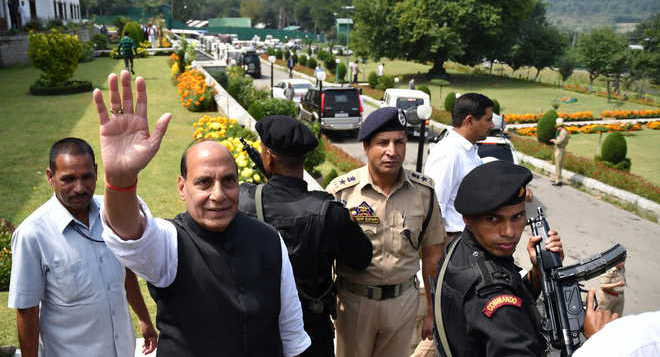
Home Minister Rajnath Singh in Srinagar on Monday. Amin War

Ehsan Fazili

Tribune News Service

Srinagar, September 11

Union Home Minister Rajnath Singh today said there was “much improvement” in the situation in strife-torn Kashmir compared to last year and that the Centre had devised a strategy based on “five Cs” to resolve the crisis.Before leaving for Jammu as part of his four-day visit to the state, Rajnath said the “five Cs” stood for “compassion, communication, co-existence, confidence-building and consistency”. (Follow The Tribune on Facebook; and Twitter @thetribunechd)During his visit, Rajnath reviewed the security situation as well as implementation of the Prime Minister’s development package. He interacted with leaders of various political parties and other stakeholders. “What I have observed is that the tree of peace has not dried up in Kashmir. Green shoots of peace are visible on dry trees,” said the Home Minister, who is expected to follow the same schedule in Jammu. Rajnath said his visit was in the backdrop of PM Narendra Modi’s Independence Day remarks wherein he called for “hugging Kashmiris”. “That’s why I have come with an open heart to talk to all stakeholders.”On talks with separatists, he said there was no question of a formal or informal invitation as the government was “ready to talk to any stakeholder who wanted to talk for restoring peace in Kashmir”. About “abrogating” Article 35A, he said the Centre would not go against the sentiments of the Kashmiris. On Pakistan, Rajnath said the neighbouring nation must stop “terror infiltration” and respond positively to the peace moves initiated by New Delhi. “PM Modi has walked the extra mile to improve relations. Terrorism has destroyed many generations, but the government will not allow the future generations to get harmed,” he said.  Appealing to outsiders to visit the Valley for tourism as well as business, Rajnath said a wrong message had gone out that Kashmir was unsafe to travel.

HM: Don’t send youngsters under 18 to jail

  • Home Minister Rajnath Singh has directed the state not to treat youngsters below 18 years as criminals as “they may have been misled by wrong elements”. He said action should only be taken under the juvenile Act. “They should not be sent to jails but to juvenile homes. I have suggested to CM Mehbooba Mufti to counsel the youngsters properly.” Rajnath also directed the security forces “not to take excessive action at any place”.

India and China should sign a new boundary convention in the Sikkim sector : Chinese scholars

Beijing: Notwithstanding the Doklam standoff, Chinese military analysts say that India and China should sign a new boundary convention in the Sikkim sector to replace the 1890 Great Britain-China agreement and make it more contemporary.

“For China early harvest means, we want to have a new agreement with India, because the 1890 convention was signed between Great Britain and China,” Senior Colonel Zhao Xiaozhou, Director at the Centre on China-America Defence Relations of the Academy of Military Science, told an Indian media delegation here yesterday.

“At that time, it was not the People’s Republic of China, (PRC). India became independent in 1947. It is better we change the signatures of the convention, that is what I mean early harvest,” he said.

“It is very essential because there are territorial disputes in the eastern, central and western sectors of the India-China border. Only in the Sikkim section we have the fixed border. So, we want to start from the easiest, that is what we call early harvest,” he added.

The Chinese Foreign Ministry too in its August 2 fact- sheet on Doklam standoff referred to Beijing’s expectations of an “early harvest” in the Sikkim sector.

“The Chinese and Indian sides have been in discussion on making the boundary in the Sikkim Sector an ‘early harvest’ in the settlement of the entire boundary question during the meetings between the Special Representatives on the China- India Boundary Question,” it had said, referring to the 1890 convention.

“The boundary in the Sikkim sector has long been delimited by the 1890 Convention, which was signed between then China and Great Britain. China and India ought to sign a new boundary convention in their own names to replace the 1890 Convention. This, however, in no way alters the nature of the boundary in the Sikkim sector as having already been delimited,” it had said.

On the Sikkim part of the boundary, India’s Ministry of External Affairs (MEA) in its June 30 statement on the Doklam standoff had said, “Where the boundary in the Sikkim sector is concerned, India and China had reached an understanding also in 2012 reconfirming their mutual agreement on the ‘basis of the alignment’. Further discussions regarding finalisation of the boundary have been taking place under the Special Representatives framework.”

Therefore “it is essential that all parties concerned display utmost restraint and abide by their respective bilateral understandings not to change the status quo unilaterally. It is also important that the consensus reached between India and China through the Special Representatives process is scrupulously respected by both sides,” the MEA had said.

Of the 3,488-km-long India-China border from Jammu and Kashmir to Arunachal Pradesh, a 220-km section falls in Sikkim.

India and China have been locked in a face-off in the Doklam area of the Sikkim sector for the last 50 days after Indian troops stopped the Chinese People’s Liberation Army from building a road in the area.

China claimed that it was constructing the road within its territory and has been demanding immediate pull-out of the Indian troops from Doklam. Bhutan says Doklam belongs to it but China claims sovereignty over the area. China also claims that Thimphu has no dispute with Beijing over Doklam.


Pakistan feels the sting by Vivek Katju

Pakistan feels the sting
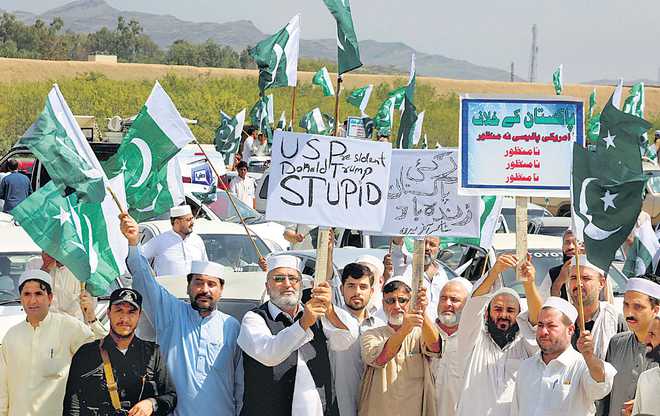
MIFFED: Pakistan has reacted sharply, suspending high-level contact with the US.

Vivek Katju

PAKISTAN’S security and foreign policy managers have faced a very difficult period beginning with President Donald Trump’s August 21 Afghanistan and South Asia policy address and stretching to the Xiamen BRICS Summit declaration on September 4. The two statements, so different in origin, struck blows, in different ways, against Pakistan’s policy objectives in Afghanistan and the region in three areas that the country considers vital to its core interests. First, Pakistan’s reliance on non-official elements in many cases ideologically obscurantist and wedded to violence to act, as directed, in the neighbourhood. Second, the maintenance of the Chinese shield. Third, the reduction, if not the elimination, of India’s presence in Afghanistan.Trump directly accused Pakistan of pursuing a duplicitous policy in Afghanistan and peremptorily demanded that it close down the safe havens for the Afghan Taliban. He virtually threatened that a failure to do so would invite unspecified consequences. The Americans have known, in the past, that Pakistan was taking vast sums of their money and at the same time allowing the Taliban to operate against their forces in Afghanistan, killing around 2,500 US service personnel since 2003. However, whereas Obama and Bush were obviously willing to overlook Pakistani conduct for larger geopolitical reasons, Trump is not ready to do so. His generals have told him the key to clear up the Afghan mess is to militarily degrade the Taliban and for that purpose the safe havens must end. He has gone along with that view. Pakistan reacted with fury at Trump’s plain speaking. Both the National Assembly and the Senate adopted resolutions condemning Trump’s comments. Going beyond words, Pakistan suspended high-level contact with the US, including putting on hold foreign minister Khawaja Asif’s official visit to the US. Pakistan also looked to China for support which came quickly. Predictably, the ‘all-weather friend’ repeated the Pakistani narrative: few countries have done as much and suffered as much in fighting terrorism as Pakistan has.In this background, the Xiamen declaration caused dismay in Pakistan for China agreed, for the first time, to include foreign-oriented Pakistan-based terrorist groups — Jaish-e-Mohammad (JeM), Lashkar-e-Taiba (LeT), the Afghan Taliban and the Haqqani Network — in a BRICS document, and that too, at the summit level. China joined other countries, including India, in expressing concern at the violence caused by these groups. While doing so, the Chinese sought to provide Pakistan cover by mentioning the Tehreek-e-Taliban-e-Pakistan (TTP) which is fighting the Pakistan state and also because the LeT and JeM are formally banned in Pakistan.  A perception that China had let go of the shield, if only momentarily, on Pakistani double standards on the jihadi tanzeems, caused a jolt. This was exhibited in the dissonance in Pakistani reactions. While defence minister Khurram Dastagir and the foreign ministry formally rejected the BRICS’ declaration, Khawaja Asif told a private Pakistani TV channel that Pakistan cannot test friends forever and must note the changed international environment. Asif travelled to China and sought reassurance of Chinese steadfastness which has come through Chinese commitment to seek to work for normalising Pakistan’s ties with Afghanistan. It is noteworthy that it has not said anything on the JeM or the LeT. Arguably, what Pakistan found most unacceptable in Trump’s South Asia policy was the US desire that India should play a more active role in Afghanistan, even if he signalled only the economic sector for this purpose. It has been Pakistan’s historic desire that Indian influence be curtailed in Afghanistan. In the 1980s, as Pakistan became the base of Afghan jihad, it became more ambitious. It wanted India to be shut out of Afghanistan so that it could get “strategic depth” against it on Afghan territory.Generally the West, especially the US, has pandered to Pakistan’s obsession with India’s presence and position in Afghanistan. It has given a sympathetic ear to Pakistan’s fears of Indian encirclement through Afghanistan. This has been on account of its need for Pakistan in the Afghan context during the anti-Soviet jihad and since 9/11. To satisfy Pakistan, the West designed international diplomatic mechanisms for peace making in Afghanistan which ensured that India was kept out. It is no secret that it tried its best to put India at the periphery at the Bonn conference in 2001 which mapped out the country’s future after the Taliban was ousted from Kabul.The US also counselled successive Afghan governments till a few years ago to exclude India from the security sector and generally balance their relations with India and Pakistan. While shades of change in this approach had come in closing years of the Obama administration, Trump has abandoned US reticence altogether and moved in the other direction. Naturally, Pakistan has poured venom on this US decision and also against India. Pakistan has always lost the plot in Afghanistan for pursuing the aim of acquiring a controlling voice in the country’s India policy. Hardly any Afghan Government has been or would be willing to accept this demand. Only the Taliban played ball but it too was not averse to open up with India. It is this objective which led Pakistan to reject the overtures of both Presidents, Hamid Karzai and Ashraf Ghani. The latter went to the extent of visiting the Pakistan army chief at GHQ, Rawalpindi, to indicate a willingness to exclude India from the security area and build ties in this sector as well as undertake cooperation between the Afghan and Pakistani intelligence agencies. However, even he could not meet the Pakistan’s unbending maximalist demand. As Pakistan deals with Trump and Afghanistan what should India do? While naturally keeping a keen focus on the terrorist groups in Pakistan,  India should seek to maintain its assistance programme. It should respond to Afghan requests, including in the security sector, without ever seeking to be prescriptive. In the defence area, India should increase the training of Afghan personnel in India, provide such equipment and stores as it can without taking Pakistani sensitivities into consideration. From time to time, some Indian security experts urge that India should be willing to send combat troops to Afghanistan. A couple of months ago, a section of the media reported a rumour that India was willing to send 15,000 soldiers to Afghanistan. The rumour soon died down for it was obviously without foundation. In any event, India must not ever think of sending troops to Afghanistan. That would provide Pakistan a historic opportunity to turn Afghan sentiment against India.Thoughtful voices in Pakistan are urging the country to give up its dual approach on fighting terrorism. But they are still in the wilderness.  The writer is a former Secretary, Ministry of External Affairs






New rules clipping tribunal wings come under HC lens

New rules clipping tribunal wings come under HC lens

Vijay Mohan

Tribune News Service

Chandigarh, August 5

New rules for various tribunals notified by the Centre recently have come under the judicial scanner. The rules purportedly undermine the independence of the quasi-judicial bodies and place them under the control of the very ministries that are respondents in cases filed against themTaking up a petition filed by an ex-serviceman and ex-president of Armed Forces Tribunal (AFT) Bar Association, a Division Bench of the Punjab and Haryana High Court comprising Justice Mahesh Grover and Justice Raj Shekhar Attri has issued a notice to the Centre.(Follow The Tribune on Facebook; and Twitter @thetribunechd)Averring that the new rules were in contravention of those laid down by the Supreme Court in the cases of Madras Bar Association and R Gandhi and of the High Court in Navdeep Singh versus Union of India, the petitioner, Surinder Sheoran, contended the government’s action threatened the basic fabric of independence of the tribunals in many ways.The petition states that insofar the AFT is concerned, the government has provided that the tribunal shall function under the Ministry of Defence and that the Defence Secretary, who is the first opposite party in every litigation, shall be a part of the committee for recruiting and re-appointing members of the AFT. He would also be responsible for removal and any inquiry against the members, which was specifically barred by the Supreme Court in Madras Bar Association’s case and by the High Court in Navdeep Singh’s case.Till now, an SC Judge could hold an inquiry against members, but the new rules provide that even absence of a representative of the judiciary in the selection process will not make the appointments invalid. It has also been stated that while the SC had directed a tenure of five to seven years for members to ensure stability, the new rules have decreased it from existing four to three years.The rules have also introduced a new clause wherein any person with experience in business, economics, commerce, finance, accountancy, etc can be an AFT member.What legal experts say

  • New rules contravene concept of separation of powers and judicial independence
  • Make tribunals, their members subservient to Union secretaries against whom orders are to be passed
  • Wrong to reintroduce clauses that have been repeatedly quashed by HCs and SC in a number of cases


Army recruitment rally::PUNJAB

Keeping in view tensed condition in the state, an army recruitment rally that was to be held from August 26 to September 6 was postponed. The rally is now being held from August 30 to September 10 at the Ferozepur cantonment. Aspirants from Bathinda, Muktsar, Ferozepur, Fazilka, Faridkot, Hoshiarpur, Jalandhar, Kapurthala and SBS Nagar can appear at the rally for recruitment. Giving this information, the Director, Recruitment, Surinder Heran, said the rally that was to be held on August 26 would now be held in September 3. Similarly, the rally that was to be held on August 27 will now be held on September 4, the recruitment that was to be held on August 28 will now be held on September 5 and the schedule for August 29 will be carried out on September 6. He added that no changes had been made to the rally that was scheduled from August 30 to September 2. He said only those candidates could participate in the rally who had registered online earlier.Aspirants throng job fairAs many as eight companies recruited candidates at the mega job fair being held at Maharaja Ranjit Singh Punjab Technical University. Approximately 1,100 candidates participated in the job fair on Thursday. More than 130 candidates were shortlisted by the evening. The transportation facility from the MRSPTU to the Bathinda bus stand was also provided to the candidates. The job fair was extended by two days and would continue till September 2. The recruitment process takes the applicants through many stages like aptitude test, pre-placement talk, seminar, group discussion and written test followed by an interview. The selected candidates will be intimated soon.