Sanjha Morcha

What’s New

Click the heading to open detailed news

Current Events :

web counter

Print Media Reproduced Defence Related News

Blow to Beijing: Bangladesh blacklists Chinese infrastructure firm

An infrastructure project completed by Chinese firm CHEC
A project executed by CHEC in the Middle East. Picture used for representational purposes | Facebook page of CHEC Middle East

Dhaka’s move hurts China’s strategic play in South Asia & underscores the frustration among smaller countries over China’s strong-arm project financing methods.

New Delhi: In what is perhaps the first major blow to Chinese strategic investments in South Asia, the Sheikh Hasina government in Bangladesh blacklisted Wednesday the Chinese company which helped build key ports in Pakistan and Sri Lanka.

China Harbour and Engineering Company (CHEC) was blacklisted for alleged attempts to bribe Bangladeshi government officials. The company, which was involved in the expansion of the Dhaka-Sylhet highway, will now be disqualified from participating in any contract in Bangladesh.

Informed sources, however, told ThePrint that the nub of the issue lay in a discord over China apparently changing goalposts in the commercial negotiations with Bangladesh.

Dhaka, it’s learnt, was of the impression that this project was to be a government-to-government deal under the mega $21.5 billion soft loan Chinese package for 26 projects agreed during Chinese President Xi Jinping’s 2016 visit.

Beijing, however, is believed to have changed tack when negotiations for specific projects like the Dhaka-Sylhet highway expansion proposal started. At that point, sources said, CHEC as the nominated company from Beijing estimated a cost that was double of what had initially been built into the package.

This discord had been building over the past few months with Bangladesh even conveying this resentment officially to China. But matters came to a head when Beijing took the line that it had only assured ‘considering’ a G-to-G model but never committed to one.

CHEC has had a long presence in Bangladesh and was involved in an alleged bribery scandal in the past involving Arafat Rahman Koko, the son of former Bangladeshi PM Khaleda Zia.

But of late, CHEC has been known for its massive dredging and port operations in Gwadar port of Pakistan and Hambantota in Sri Lanka. The Sri Lankan government too faced a viability problem in Hambantota as traffic and recovery estimates were way lower than assumed. They were forced to lease the port to China in order to walk out of a bad debt trap.

In Bangladesh, China’s soft loans come with a 2 per cent interest rate, which is substantially higher than what India offers.

China gives a 15-year repayment schedule while India provides a 20-year schedule. Also, China has a fixed commitment and management fee while India only takes a commitment fee.

But the real catch is China’s condition that the contract has to mandatorily go to a Beijing-nominated company. Here, countries like India, ask Bangladesh to float a tender among Indian companies and choose accordingly.

The nomination model, thus, does not allow for a proper price discovery to take place, which is where the dispute starts as other costs get built into project estimates. This, sources said, also lay at the core of the problem in Wednesday’s blacklisting.

China, under its ‘One Belt, One Road’ programme, has planned for a major push for strategic connectivity projects in its neighbourhood and South Asia.

In that context, Wednesday’s blacklisting by Bangladesh was a move against the run of China’s strategic play in South Asia, underscoring the frustration among smaller countries over China’s strong-arm project financing methods.

India, the US and Japan, have agreed to work together to pool in resources to offer alternative financing mechanisms to developing countries in South Asia.


Locals protest Army move to occupy playfield in Anantnag

Suhail A Shah

Anantnag, January 18

The Army’s plans to set up a camp in a playground in Sahmsipora village of Anantnag district, triggered protests by locals.The issue was also taken up by the lawmaker of the constituency (Home-Shalibugh), Abdul Majeed Bhat in the Assembly today.Bhat asked law and parliamentary affairs minister Abdul Rehman Veeri to issue a statement in this regard.Hundreds of people from the Shamsipora area reached the Anantnag Deputy Commissioner’s office on Thursday afternoon and demanded intervention by the district administration.“This morning dozens of Army vehicles reached the local playfield and started taking measurements for setting up a camp. When we intervened, the Army men threatened to shoot at us if we did not disperse,” the protesting locals alleged.They said that the Army men asked them to go and meet the DC and talk to him.“We don’t understand why do they want to use a playfield for their camp and that too when the state government has shown keen interest in developing sports infrastructure in the Valley,” the locals said.Anantnag DC MYMalik assured the locals that the issue would be resolved soon. “I have talked to the DIG, south Kashmir, and the Army officers concerned. Hopefully, the issue will be resolved soon,” he said.


House panel for engagement with Pak

Smita Sharma

Tribune News Service

New Delhi, January 7

The Standing Committee on External Affairs, in its report submitted last week to Parliament, has sought an incremental approach towards the revival of dialogue with Pakistan, while acknowledging the Pakistan army’s hostility as big obstacle to peace.The report says, “The committee, headed by Shashi Tharoor, was of the opinion that peace process should not be held hostage to terror acts and both countries must keep the channels of communication open, even during the worst of crises and not let non-state actors and their state sponsors derail or dictate the foreign policy objectives of sovereign nations. It believed that the engagement between neighbours cannot be stopped indefinitely.”  It further adds, “The committee would recommend an incremental approach to such a resumption of the dialogue process by starting with less-contentious issues.”The government, in its response, said it was committed to resolving “all outstanding issues bilaterally through peaceful means in accordance with Simla Agreement and Lahore Declaration”, but added this could only be achieved in “environment free from terror, hostility and violence”. Underlining that there can be no compromise on cross-border terrorism, the ministry, in its reply, has said, “The government has maintained the channels of communications open with Pakistan, including through respective diplomatic missions and regular contacts between the border-guarding forces on both sides.” The committee has called regrettable the lack of a National Security Framework for outlining a broad doctrine, response mechanism and standard operating procedures on all-possible aspects of national security concerns. It seeks establishing a joint coordination mechanism of the Army, Navy and Air Force and border-guarding forces. It advocates pursuing a proactive and assertive position on India’s rightful claims to Pakistan-occupied Kashmir.“In view of the fact that India is currently occupying strategic heights and advantage at Siachen, it was Pakistan’s agenda to push for demilitarisation of the glacier. Moreover, the committee observed that the present cooperation between China and Pakistan has assumed worrying proportions,” says the report.“The committee would also desire the government to continue making concerted efforts through diplomatic outreach to sensitise China about the manner in which the CPEC and the non-listing of Masood Azhar on the UN sanction list impinges on our sovereignty and security interests,” says the report.


This armyman has donated blood 121 times

Tribune News Service

Jalandhar, January 1

Having donated blood 121 times and platelets 93 times, Subedar Major Suresh Saini became a motivational figure for people to donate blood. In a blood donation camp organised by a Jalandhar-based NGO, The Blood Association (Team Baaj) Saini said, “Donating blood is one of the most supreme social causes through which one can contribute towards society.”This was the 50th huge blood donation camp organised by the NGO. The vice-president of the team, Amanjot singh said for the past three years, they have been organising blood donation camps on every first day of the year so as to inspire the people to begin new year by doing something meaningful for society. Various teams of ‘Association of Blood Donors’ societies of Punjab had reached Maqsudan chowk to be the part of the camp. The Blood Donation Camp not only focused on collecting blood for 25 children suffering from Thalassemia but also strived to clarify the misconceptions about blood donation. A total of 480 units of blood were collected in the camp.Also present at the camp was Dr Gurvinder Singh of a private hospital. Suffering from spinal cord injury and sitting on a wheelchair, he still donates blood once every three months. He was a great motivation drive at the camp and advised people to contribute towards donating blood. He also said people should drive safely to avoid meeting with any accident. It was better to donate the blood rather than drain it in accidents, he said.


457 Indian prisoners lodged in Pakistan jails

457 Indian prisoners lodged in Pakistan jails
For representation only. The Foreign Office said the India would also hand over the list of Pakistani prisoners to Pakistan High Commission in New Delhi.

Tribune News Service
New Delhi/Islamabad, January 1

A total of 457 Indian prisoners—including 399 fishermen—are languishing in various Pakistani jails, according to a list the Pakistan government handed over to the Indian High Commission on Monday.

The Foreign Office said that the step of giving the list of prisoners was consistent with the provisions of the Consular Access Agreement between Pakistan and India, signed on May 21, 2008.

(Follow The Tribune on Facebook; and Twitter @thetribunechd)

Under the agreement, both countries are required to exchange lists of prisoners in each other’s custody twice a year, on January 1 and July 1.

“Pakistan today handed over a list of 457 Indian prisoners—58 civil prisoners and 399 fishermen—in Pakistan, to the High Commission of India in Islamabad,” it said.

It further said that Pakistan would release 146 fishermen on January 8.

The Foreign Office said the India would also hand over the list of Pakistani prisoners to Pakistan High Commission in New Delhi.

Fishermen from Pakistan and India are frequently detained for illegally fishing in each other’s territorial waters since the Arabian Sea does not have a clearly defined marine border and the wooden boats lack the technology to avoid being drifting away. With PTI


A precious lesson from Pakistan by Sharat Sabharwal

Pakistan has remained dysfunctional due to its civil-military discord, its adversarial posture towards India and its growing sectarian divide. Its misfortune offers a lesson to India which is also witnessing rising intolerance.

A precious lesson from Pakistan
Protesters from a religious group shout slogans during a protest in Pakistan. AFP

Sharat Sabharwal

A former diplomat

SPEAKING to an audience in Islamabad in 2010 as High Commissioner of India, I assailed Pakistan’s policy of holding lucrative trade and economic linkages with India hostage to progress on the resolution of intractable issues such as J&K and Siachen. To bolster my point, I said that gone were the days of ideological orientation of foreign policies, which were increasingly shaped by economic considerations. During the question and answer session, someone asked me how Pakistan could abandon its founding ideology of the two-nation theory. I replied that they were welcome to hold on to the two-nation theory if it gave them some solace, but they would know that it was belied by a large number of Muslims having chosen to make India their home in 1947 and it had been finally put to rest with the creation of Bangladesh in 1971. Seven years later, I wonder whether I overstated my case in claiming that the two-nation theory had been put to rest, for the hatred and intolerance that underpinned it have survived and continue to thrive not only in Pakistan but also in India. Speaking to the Constituent Assembly of Pakistan on August 11, 1947, Jinnah said, “You are free; you are free to go to your temples, you are free to go to your mosques or any other place of worship in this State of Pakistan. You may belong to any religion, caste or creed — that has nothing to do with the business of the State.” Having created Pakistan on the basis of religion, he should have known better. He did not live long enough to steer the course of the new state, but I have no doubt that even if he had, the result would not have been very different from what we see today. Within six months of his death, the Pakistan Constituent Assembly adopted an Objectives Resolution which provided, inter alia, that sovereignty over the entire universe belonged to “Allah Almighty above” and the authority which He had delegated to the state of Pakistan, through its people for being exercised within the limits prescribed by Him was a sacred trust. It also provided that the Muslims would be enabled to order their lives in accordance with the teachings and requirements of Islam “as set out in the Holy Quran and Sunnah.” These provisions, however, failed to build a lasting consensus in Pakistan because as the country moved forward, it became increasingly contentious to define the branch or school of Islam that would govern Pakistan.  Having relegated religious minorities to the status of second class citizens by declaring Islam as the state religion, the Pakistani state failed to keep its Muslims together. Zulfiqar Bhutto succumbed to religious extremists in getting a resolution passed by the Parliament in 1974 to declare Ahmadis as ‘non-Muslim’. Another faultline to emerge was the traditional Shia-Sunni divide, which got accentuated after the Iranian revolution and the tussle between Iran and Saudi Arabia for the loyalty of Muslims the world over. The state under Zia turning increasingly to Wahabi Islam also placed the Shias at a disadvantage. With free availability of arms and ammunition in Pakistan because of the ‘Afghan jihad’, the Shia-Sunni rift has resulted in widespread sectarian killings from time to time. The violence, initially perpetrated from both sides of the divide, has gradually turned into a one-sided killing of Shias by Sunnis, with the former getting increasingly marginalised. The process of division eventually engulfed the Sunnis by aggravating the fault-line between Deobandis and Barelvis. The latter, though the majority among Sunnis, were for a long time at the receiving end of the violence perpetrated by the Deobandis, who were recipients of large-scale funds from Arab countries and more prone to picking up the gun. Shrines frequented by Barelvis were attacked by the adherents of Deobandi/Wahabi Islam. However, Barelvis have not been immune to extremism. A former Pakistan Punjab Governor, Salman Taseer, was assassinated by his Barelvi bodyguard because he had spoken in favour of a Christian woman accused of blasphemy. More recently, the ‘Tehreek-e-Labaik Ya Rasool Allah’, a Barelvi extremist organisation, laid a prolonged siege to the Pakistani capital and left only following intervention by the army. The Pakistani state has remained dysfunctional as a result of the civil-military discord and the stranglehold of the army, its obsession with and adversarial posture towards the much bigger neighbour — India — and the growing sectarian divide and religious extremism. The last factor is the consequence of the hatred and intolerance that laid the foundation of the Pakistani state through the two-nation theory. The above state of affairs in Pakistan is well known and extensively written about in India. Because of our anger at Pakistan’s hostility, we look at the dysfunctionality and the resultant misfortunes of Pakistan with a degree of schadenfreude, but fail to draw the precious lesson that the Pakistani experience offers. It is that intolerance and hatred, once let loose in the name of ‘us’ vs ‘them’, know no bounds and invariably rip apart the most cohesive-looking ‘us’ groups, leaving violence and misery in their trail, which eventually afflict not only the originally targeted ‘them’ group, but also those targeting them. The lesson is particularly valuable for a multi-religious, multi-cultural and multi-lingual country like India. Having been the victim of the hatred and intolerance underlying the two-nation theory once, we ignore this lesson at our own peril. Who says there is no advantage to having Pakistan as our neighbour!

Views are personal


Revisiting Kashmir: How Security Forces Counter Proxy War Under Hostile Winter Conditions by Syed Ata Hasnai

A security forces personnel patrolling the International border in Kashmir during a foggy winter night.  (Nitin Kanotra/Hindustan Times via Getty Images) 

Snapshot
  • Many think that winter in Kashmir is a quiet time and one for the terrorists to withhold activities. It is actually the time when the army goes into higher drive.

    Here’s a look at three distinct dimensions of military operations in Jammu and Kashmir.

In Jammu and Kashmir (J&K), military operations have three distinct dimensions. First, there is the Line of Control (LoC) to be secured with assurance against any transgression, its ‘sanctity to be maintained’ as they say in military language. This is the segment, which also handles trans-LoC firing which, as is known, has been continuing for better part of the year in some pockets. The second is counter infiltration in which there are troops deployed on the LoC and others located at tiers in depth to prevent the entry of aliens, terrorists and anti-nationals from Pakistan-occupied Kashmir (PoK) as also any contraband and military wherewithal. The third is the widespread counter terror (CT) grid in the hinterland on both sides of the Pir Panjal range, extending right up to Udhampur and Jammu.

The first two domains are purely of the Indian Army with some deployment of the Border Security Force (BSF) to assist the army to, very importantly, allow it some leeway in its turnover of troops. It is an important aspect that the BSF chips in here because many even in the army do not realise that their field tenures would otherwise be inordinately extended. Each deployment has its distinct characteristics. I shall explain the LoC and counter infiltration grids in a separate essay for public knowledge. This essay is also for public information about the ways of the counter proxy war related to the hinterland CT grid. As we are already in winter there are misnomers, which need to be rested but before that a brief review of the situation at the end of 2017 is in order.

It was good that the Gujarat and Himachal Pradesh elections temporarily took away the focus from J&K, which needs a little reprieve from national public gaze. In that period and more specifically on 17 November 2017 the J&K government moved from Srinagar to Jammu bringing an end to its six-month stay at the summer capital. It was a period characterised by some good achievements and a few failures. The commendable part was that development activity picked up despite the higher quantum of military operations, although tourism remained very low. The freedom given to the security forces (SF), the coordination between them and the non-interference from the political side made for some good operational success.

Beginning the season with an abysmal ratio between own soldiers martyred and terrorists killed, the same was recovered but not to the much more favourable ratio five years ago. In terms of numbers the figure of over 200 terrorists killed was obviously not anywhere near the high mark of 2,020 killed in 2001.

However, considering that the militancy in Kashmir has been largely controlled and the number of terrorists is much lower, it is the fluctuation in the ‘last mile’ operations that has led to the highest figure of terrorists eliminated in six years; a job extremely well done. The ‘last mile’ mentioned here refers only to the military domain and not to the comprehensive counter proxy war/hybrid war campaign that the nation is involved in. It always needs reiteration that this is not the battle of the army and the other SF alone.

There is a multitude of agencies involved in the creation of peace in J&K. Just a case in point to understand this better; in South Kashmir, where local ‘militancy’ is rife, by October 2017 85 terrorists had been neutralised but a little over 90 had been recruited. This should give a better idea of the challenges before the SF and the multiple agencies involved in the conflict. It is not known what the state of cross LoC infiltration has been but the high quantum of encounters (could well be based on better intelligence) indicates that it could be a reasonably high number. If that be so, the good achievements of the SF would already have been neutralised through numbers; the number of terrorists virtually remains the same.

What additionally remains a challenge is civil strife, including flash mob intervention in SF anti-terror operations; as demonstrated in Kelar near Shopiyan on 19 December 2017 where a woman was killed in firing. Stone throwing incidents, although reduced, continue sporadically to demonstrate public resentment. Social media displays the evidence of extreme alienation driven partially by Friday prayers and largely by the spewing venom emerging from loudspeakers. The domain for which the government can claim much credit is the focused way in which the financial networks appear to have been marginalised. Finances are the greatest enabler of a separatist movement, especially a sponsored proxy one, which uses violence to continue its effort to remain relevant. This was long in the making and has delivered at last, although the networks are deep rooted and dispersed which will require sustained efforts to prize out.

It is alienation which continues to persist. Since it is historical and extremely deep even a minor difference is not easy to perceive. If we continue to believe that it is only a handful of people from a small segment of districts who are alienated then we must also believe in their power to set the agenda; it is always a minority of people who become the biggest rabble rousers.

Many think that winter in Kashmir is a quiet time and one for the terrorists to withhold activities. It is actually the time when the army goes into higher drive. For the terrorists, it is difficult to survive long in the mountain and jungle dugouts beyond a few days. Anyone who doubts that should try being in a mud splattered hideout in minus 12 degrees Celsius. Sustained snowfall makes it difficult to move and immediately after fresh snow, movement is suicidal because the army’s wide area surveillance and observation helicopter flights can spot footprints in way out areas and alert lurking army patrols, which then home on to the hideouts. Forced into villages and small towns in safe houses they are vulnerable to intelligence sources of the police whose information dragnet extends into almost every village. Night movement to change location is difficult in the absence of foliage on the trees and no undergrowth. By day, multiple SF checkpoints appear on the roads with their ‘spotters’ carefully camouflaged. Transportation of weapons by day is almost impossible except by way out routes, which take extremely long to traverse.

The importance of checkpoints in winter gets enhanced. Manning a check point professionally is one of the most demanding things. The focus has to be undivided, security of soldiers has to be foolproof and the rights and dignity of innocent people who pass through have to be guaranteed. Otherwise, the effect of a check point is neutralised. The hundreds of check points of this type remain under terrorist surveillance through over ground workers (OGWs), who assess the effectiveness and efficiency before advising on movement of stores or even an odd leader in disguise. Professionals will never be harsh on innocents but discerning who is innocent and who is not is the challenge. The separatists and terrorists are the happiest with indiscriminate check points manned by poorly-trained troops, who are unsuccessful in spotting and in maintaining dignity of the populace.

The other threat comes from the ‘ferans’ (loose overcoats) worn by the local people in winter with ‘kangris’ (baskets with embers of coal in an earthern pot) which are used for warming. Weapons, grenades or explosives can easily be hidden in these.

For troops, winter is also uncomfortable time. Physically, being in ambush or in cordon by night in minus 6 degrees Celsius is sheer discomfort. It needs to be remembered that for a hundred ambushes or even cordons there may be one success. The psychological conditioning of soldiers is so essential to accept disappointment in operations day after day but the domination achieved by the sheer presence is the less recognised achievement.

Unmanned aerial vehicle (UAV) flights and helicopter sorties for surveillance create much psychological pressure on terrorists, who are still in hideouts. After a fresh snowfall wide surveillance of the lower mountains gives out telltale signs, which are checked out by patrols.

The recent killing of a Sumo driver, who was apparently innocent and probably became the victim of a mistaken shooting was an unfortunate case. This happens when innocent people forget the rules of night movement. Offices of deputy commissioners notify a warning every three months that after dark all movement must be made with positive identification. This essentially means that any citizen who needs to move out of his residence needs to carry a torch or lantern and must halt if challenged. People pay little heed to this, particularly in winter. If challenged by an ambush or patrol if they are without a light they tend to run giving indication to the army that they are terrorists. That is when the army resorts to firing. Such mistaken shootings lead to a loss of trust and offer triggers to separatist leaders to create more alienation through agitation and bandhs. Such situations again need to be handled sensitively.

Colder nights mean more discomfort for sentries and therefore correspondingly higher chances of sneak actions by desperate terrorists in suicide mode. The most secure establishment will always be that which does not depend for it security on sentries but on patrols operating outside its periphery. The more a garrison dominates beyond its periphery the greater will be its security.

Weather constraints offer tremendous scope for the army’s hearts and minds programme, beyond the structured Sadbhavana. Snow conditions inevitably lead to passengers getting stuck with vehicle breakdowns and roads becoming impassable. The army is the first out to assist because soldiers have the zest, energy and initiative to deliver. The state machinery has resources but slow responses. But the medical evacuation of women in the family way from remote mountain villages is an act akin to Florence Nightingale. Young officers can always be trusted to lead a few soldiers and hardy local porters to perform such acts.

When Kashmir is blanketed by heavy snow, remote public health services become extinct. It is this which the state government must reinvigorate and it needs proactive administrators of the Kashmir Civil Service who need to show their commitment. Otherwise, the way is left for the army’s medical patrols to quickly swing into action. I do remember the black marketing of mobile charging when long power breakdowns occurred in winter due to breaks in power lines. Each charge through a generator set cost Rs 75. The army put an end to it by fabricating multiple port chargers and mounting them on vehicles with generator sets. These were parked at city and village centres to ensure free mobile charging.

The inevitable question which arises is that with the quantum of assistance the army renders to the community at large why its popularity graph in summer points south. It is because the separatists and the OGWs are proactive in painting a negative image about it and creating alienation. In other words, the alienation efforts of the separatists overshadow the popularity efforts of the army. The incumbent commanders need to introspect more on this. They have to overcome their reluctance to use soft power that goes beyond Sadbhavana. It has to be well understood that their military professionalism has to include soft power, which is a part of all concepts of counter hybrid warfare operations.

The public all over India is happy to see a higher degree of military domination in Kashmir during later part of 2017 than that existed in 2016. There is a hurry to declare the end of the problem and withdraw interest. It must be remembered that absence of violence is never considered normalcy in pure military professional terms. There has to be a sustained period of such a phenomenon to make a difference and it has to be accompanied by perceptible change in the social environment. That cannot happen without a deliberate effort. The interlocutor appointed by the government of India is seeking the means and the parameters which can bring that perceptible change. Hopefully spring will bring with it greater hopes for peace and stability.



Soldier killed in north Kashmir avalanche cremated

Jammu, December 18

Army jawan Koushal Singh, 19, who died in an avalanche along the LoC in north Kashmir, was cremated with full military honours at his native village in Samba district of Jammu and Kashmir on Monday.

Hundreds of people poured in from different villages of the district to give a tearful adieu to the soldier, who belonged to the 33 Rashtriya Rifles.

Singh was one of the five soldiers who had gone missing during the two avalanches on December 13.

Two soldiers slipped down a mountain slope in Naugam sector of Kupwara district, while three others went missing from a forward post in Kanzalwan sub-sector of Gurez in Bandipora district during heavy snowfall on December 13.

While Singh’s body was traced, rescue operations are underway to find the remaining jawans.

At least 22 Army soldiers died due to snow furry in Gurez and Sonmarg areas of north Kashmir in January alone.

Singh’s coffin draped in tricolour was brought to his hometown in the presence of senior Army officials, who paid floral tributes to him.

A gun salute was also given to the soldier by a contingent of the Army. PTI


1967 batch ex-Army officers relive old days at IMA

1967 batch ex-Army officers relive old days at IMA
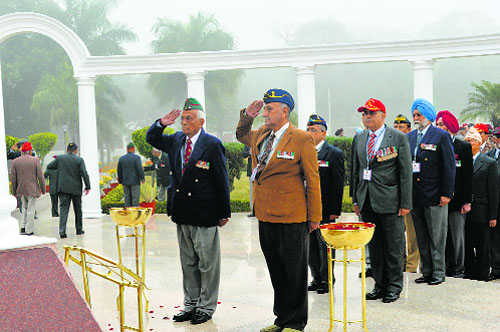
Ex-Army officers pay tributes at the war memorial at IMA in Dehradun. tribune photo

Jotirmay Thapliyal

Tribune News Service

Dehradun, December 15

Over 200 ex-Army officers along with their spouses gathered at the Indian Military Academy to celebrate the Golden Jubilee of their passing out as officers from the Academy on December 16, 1967. The occasion was all the more special as the passing out course that included 40th regular and 24th technical entry course was one of the illustrious batches awarded for gallantry. Capt Devender Singh Ahlawat was awarded Maha Vir Chakra, posthumously. Members of the batch were awarded two Veer Chakras, two Shaurya Chakras and six Sena Medals. The course further has the distinction of fielding nine Lt Gen rank Officers, of which one was the Chief of Integrated Defence Staff, one Vice Chief of Army Staff, three Army Commanders, one Deputy Chief of Army Staff and three Director Generals of their departments. One of the batch members, Gen KS Rao, was the first Indian to circumnavigate in his yatch around the globe. Major Kiran Inder Kumar, a mountaineer, lost his life in an attempt to conquer Mount Everest. Col Pavan Nair has had the distinction of constructing the first Indian Base “The Dakshin Gangotri” in the Antartica and Col SD Umalkar captained the Services Cricket Team in Ranji Trophy matches.There was an air of great cheer and optimism at the gathering. Several formal and informal events were organised to celebrate the historic occasion. The functions commenced with the course mates and the ladies paying homage to the 42 departed comrades and to other bravehearts at the IMA memorial. Welcoming the course, IMA Commandant Lt Gen SK Jha spoke about the present day- to-day activities at the Indian Military Academy. He said it was an honour for Indian Military Academy to host such an event. Briefing the course on its post-commissioning activities and achievements, Col Atul Mehra gave a presentation with an interlude of interesting slides from the training period at Indian Military Academy. Former Army Commander Gen KS Jamwal, who was also the winner of the Sword of Honour and also gold medal awardee offered a vote of thanks to the staff of Indian Military Academy and all the participants. 


487 cadets pass out of IMA

487 cadets pass out of IMA
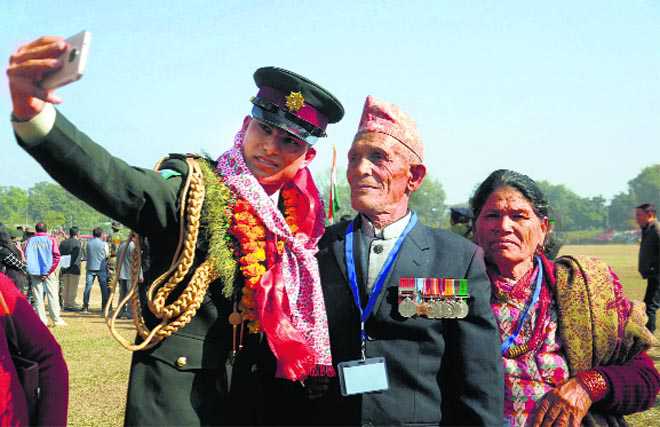
An officer takes a selfie with his family after the passing-out parade at the Indian Military Academy in Dehradun on Saturday. PTI

Tribune News Service

Dehradun, December 9

As many as 487 Gentlemen Cadets of regular course, technical graduate course and university entry scheme course, including 78 foreign Gentlemen Cadets from seven friendly countries, passed out of the Indian Military Academy, Dehradun, today. Bangladesh Army Staff Gen Abu Belal Muhammad Shafiul Huq reviewed the parade. He congratulated the Gentlemen Cadets on the successful completion of their training at the IMA. He also acknowledged the commitment of instructors and the staff of the IMA and their dedication to the Gentlemen Cadets. “The IMA’s world-class reputation and achievements of its officers are attributed to the outstanding quality of its instructors and the staff,” he said.As the reviewing officer, he presented the Sword of Honour and gold medal to academy Cadet Adjutant Chandrakant Acharya. The silver medal for the Gentleman Cadet was presented to academy under officer Amarpreet Singh Dhatt while the bronze medal was presented to the battalion under officer Sourav Das. The silver medal for the Gentleman Cadet standing first in the order of merit from foreign GCs was presented to junior under officer Alexander Simonaitis. The Chief of the Army Staff banner was awarded to Naushera for standing overall first among 16 companies for the Autumn Term 2017.The GOC-in-C, ARTRAC, Lt Gen MM Naravane and IMA Commandant Lt Gen SK Jha were present on the occasion.