








Sanjha Morcha

What’s New

Click the heading to open detailed news

Current Events :

web counter

Print Media Reproduced Defence Related News

India is ‘right-sizing’ its military as part of a plan to make defence spending more efficient

Four strategic studies are being carried out by the government to pinpoint ways to optimise the size of the military forces.
– As part of the restructuring of the army, overlapping divisions will be cut down while a host of new positions will be created.
– In August last year, the government approved the reform programme – which involves the redeployment of 57,000 officers, merger of garrisons and the shutdown of redundant military support units and farms.
– Personnel costs are a significant drain on the army’s operating budget, accounting for 63% of costs while the modernisation of equipment accounts for only 14%.

At the end of last month, the Indian government continued work on one of the largest reform programmes of its defence forces in its history as a independent country.

In fact, four separate assessments – which were given by a greenlight by the Army Commanders’ Conference in the second week of October – are being carried out by the government to pinpoint ways to “right-size” its military, with reforms being implemented gradually over the next couple of years.

The individual studies will each focus on separate issues — reducing the size and organisational structure of the Army Headquarters and optimising the number of junior commissioned officers and other ranks of officers.

As part of the restructuring of the army, overlapping divisions will be cut down while a host of new positions will be created, according to a Hindu report citing sources. These include a new Deputy Chief of Army Staff, in addition to two existing deputy chiefs that handle planning and intelligence systems, and a new Director for Strategic Communications, which will report the third Deputy Chief.

The goal is to increase the army’s teeth-to-tail ratio, which refers to the amount of combat-ready soldiers that can be supported by one military support officer.

The government approved the reform exercise in August last year. At the time, it was reported that 57,000 junior officers would be redeployed to functions where their skill sets were better suited. In addition to this, the reform exercise involves the merger of military units and the closure of redundant logistics units like signal operators as well as the military farm service and postal departments.

Military farms, which were established during colonial times, are tasked with supplying milk to military units across the country. Once all 39 military farms are shut, the land will be given back to the defence ministry, which will then re-allocate them to military units.

The reform exercise is part of a larger plan to optimise defence spending by redirecting it from personnel expenses to equipment procurement. This has been evident in the slew of big-ticket military deals closed this year so far.

In May this year, it was reported that India had broken into the ranks of the world’s top five countries by military expenditure, overtaking France. The country’s defence costs rose by nearly 6% to $63.9 billion in 2017 owing to higher salaries and pensions for army personnel and weapon imports.

Personnel costs are a significant drain on the army’s operating budget, accounting for 63% of costs while the modernisation of equipment accounts for only 14%. This is why the reorganisation and “right-sizing” of the military forces has become an urgent priority.

Separately, in recognition of the high cost of importing weapons, India’s Prime Minister Narendra Modi has also encouraged the domestic production of military equipment under the “Make in India” programme. However, the foreign investment in the defence industry has been meagre in recent years.
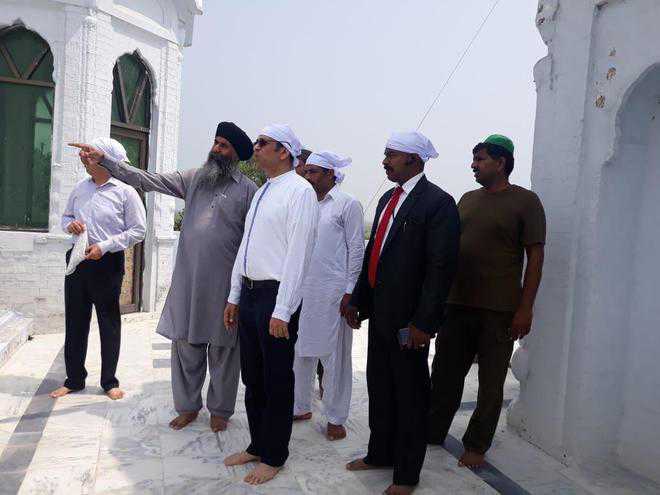

Corridor hope as Indian envoy visits Kartarpur Explores possibility of bringing 4-km project to fruition

Corridor hope as Indian envoy visits Kartarpur

ndian High Commissioner to Islamabad Ajay Bisaria at Kartarpur Sahib Gurdwara.

Smita Sharma

Tribune News Service

New Delhi, August 29

Indian High Commissioner to Islamabad Ajay Bisaria on Wednesday visited Kartarpur Sahib Gurdwara in Pakistan’s Narowal, bordering Gurdaspur in Punjab.

This comes just days after Punjab minister Navjot Sidhu visited Pakistan to attend the oath ceremony of Prime Minister Imran Khan. Sidhu had later mentioned that Pakistan army chief Qamar Javed Bajwa suggested that they were considering opening up the Kartarpur corridor to celebrate the 550th birth anniversary of Guru Nanak Dev next year.The 4-km corridor, if opened, would connect Kartarpur Sahib, where Guru Nanak Dev spent 18 years, to Dera Baba Nanak Dev in Gurdaspur on the Indian side.

According to sources in Pakistan, the envoy during his visit looked towards the Indian border visible from the gurdwara rooftop, interacted with caretakers and  explored the possibility of the corridor. “We hope to bring this longstanding proposal to fruition with focused follow up and coordination with the Pakistan side. This corridor will have a special appeal and significance for devotees as we celebrate 550 years of Guru Nanak Dev’s birth next year,” Bisaria told The Tribune.

The proposal of the corridor first came up during the Musharraf era, but was never actively followed up.

Sikh pilgrims from India visiting Pakistan have been provided access to Kartarpur Sahib over the years through Wagah and Lahore.

However, a direct corridor from Punjab would be very different. “Kartarpur Sahib was the resting place for Guru Nanak Dev for several years. It will be an important gesture from Pakistan for the pilgrims if it happens. It will be significant for devotees,” said Sarat Sabharwal, former Indian High Commissioner to Pakistan.

There is no clarity yet on the modalities and logistics under discussion and if the corridor could be opened for a few days next year or for the long term.

Meanwhile, Bisaria who was stopped by the Pakistan authorities from entering gurdwaras, including Nankana Sahib, during recent visits, was accorded a warm welcome at Kartarpur. However, he was not presented a robe of honour (siropa), as per sources.


Big Blow To The US – India-Russia Banks to discuss Rouble-Rupee trade today

Representatives of atleast three Russian banks operating in India, including Vnesheconombank, Sberbank and VTB, will meet executives from top Indian banks in Mumbai on Monday to discuss rupee-rouble settlements between businesses of the two countries.

According to sources close to the development, the meeting being organised by the Indian Banks’ Association (IBA) will also see participation from the RBI and Russia’s central bank representatives.

India and Russia have been trying to establish mechanisms for trade in national currencies, bypassing the US dollar, for about a decade, but there has been little progress on the ground.

The need for rupee-rouble trade has increased in the past one year as Russia continues to face pressure of US sanctions. India-Russia bilateral trade is highly dominated by defence deals and several Russian defence majors contracted by the Indian government are currently under US sanctions. Since the beginning of this year, Indian banks have halted defence-related payments worth several billion US dollars.

The issue was raised during the 24th meeting of Indo-Russian working group on banking and financial matters held in August in the Russian city of Tula chaired by Ksenia Yudaeva, first Deputy Governor of the Central bank of Russia, and Bibhu Prasad Kanungo, Deputy Governor of the Reserve Bank of India. According to the minutes of the meeting reviewed by BusinessLine, the infrastructure for such settlements is in place, but banks need to make further progress to start transactions.

The Indian side expressed concern over negative implications of the US sanctions against Russia while the Russian side said these challenges “can be addressed through a more accurate interpretation by Indian banks of the unilateral restrictions imposed against Russia by third countries”. The Russian side said it will provide the Indian side with regular updates on the sanctions regime which would then be communicated by the RBI to Indian banks. Experts believe the current volume of trade between India and Russia, which is around $10 billion, is too less to move to settlements in national currencies, and for the beginning the countries could start with agreement on currency swap.

“The trade volumes should go up by at least 30-50 per cent for the entire ecosystem to be interested,” an analyst with a Moscow-based brokerage said. “The rupee-rouble settlements could be more expensive and time consuming, at least in the initial phase. Hence, for business participating in this the governments and regulators of both countries should ensure they create a favourable environment,” he added.

Analysts said that the launch of rupee/dollar futures by the Moscow Exchange last month is a favourable step. Although technically it does not pave the way for settlement in national currencies, it could popularise the rupee in the Russian market.


Army appoints new medical chief, matter in SC over seniority

Vijay Mohan

Tribune News Service

Chandigarh, August 20

Barely three weeks after the Supreme Court quashed the appointment of the Director General Medical Services (Army), the post has again come under judicial scanner with a Lieutenant General moving the apex court against the appointment of another officer as the new head of the Army’s medical branch.After the Supreme Court’s order on August 1, the Ministry of Defence posted Air Marshal Rajvir Singh, DGMS (Air Force) as the DGMS (Army) on August 10 in the rank of Lieutenant General.In his petition, Lt Gen Manomoy Ganguly has averred that he is one promotion batch senior to Rajvir Singh and also has a higher professional qualification and career profile. Ganguly, according to the petition that is expected to come up for hearing on August 27, is the second senior-most Lieutenant General after the Director General Armed Forces Medical Services, an Army Commander equivalent who heads the medical establishment of all three services.Although the Appointments Committee of the Cabinet notified Ganguly’s promotion to the rank of Lieutenant General on January 19, 2018, he is still posted as the head of the medical branch at Southern Command, a post tenable by a Major General.Earlier, Ganguly had moved the Armed Forces Tribunal for promotion to the rank of Lieutenant General. The tribunal allowed his petition, but it was challenged by the government in the Supreme Court. Upholding the tribunal’s judgment in its order of August 1, the apex court observed that there had been some attempt to deny Ganguly his promotion.

Petitioner’s argument

  • Post SC order, the Ministry of Defence posted Air Marshal Rajvir Singh, Director General Medical Services (Air Force), as the DGMS (Army) on August 10
  • In his plea, Lt Gen Manomoy Ganguly has averred that he is one promotion batch senior to Rajvir Singh and also has higher professional qualification and better career profile

Make in India hits Russian tech transfer hurdle

One of the government’s plans to kick-start defence manufacturing in the country as part of its ambitious Make in India programme has run into a stumbling block on account of constraints on sharing original design details and drawings of Russian equipment and curbs on exporting these, documents reviewed by Hindustan Times show.

The specific case involves parts that go into the T-72, T-90 tanks and amphibious armoured troop carriers.

Ordnance Factories Avadi, a defence public sector unit, manufactures the tanks under a licence arrangement. It isn’t financially viable for the factory to make all parts for these and the plans to outsource more to Indian private sector firms.

Hence, it wants to share the original Russian designs with the private sector.

The government was also of the view that this would boost the manufacturing of defence equipment in India, especially by the private sector, one of Prime Minister’s articulated objectives.

India imported about $ 41 billion worth defence equipment last year despite the government push to make some of that in India. It also sees export opportunities in doing this.

The Russian origin T-90 and T-72 tanks are the mainstay battle tanks for India. India bought about 124 T-90 tanks directly from Russia and contracted to make another 1,375 tanks in India by December 2018.

“As regards items of Russian designs, namely for tanks T-72, T-90 and ICV BMP-II, (armoured troop carriers), it has been mentioned that all three contracts have clauses governing maintenance of secrecy with regard to Russian ToT (Transfer of Technology) documentation…While procuring items of Russian ToT from indigenous sources (OFB), factories have to prepare their own drawings/specifications based upon absorption of ToT and share the same for purpose of indigenous sourcing,” the joint secretary (land systems) in the department of defence production wrote in August in response to a query whether designs can be shared with Indian manufacturers.

Put otherwise, this means the original details and drawings can’t be shared; only those made by the ordnance factory can.

And even these cannot be used to make equipment for export. Nor can the manufacturers make derivative products from these drawings.

The ministry of defence spokesperson did not respond to queries seeking comment.

Dr Ajay Kumar, secretary, defence production, said in response to an e-mail that his department is “examining the issue”. “No final conclusions have been arrived at. Any solution will have to be within the framework of our existing agreements.”

“MoD has been pushing very hard. They are reaching out to vendors on both sides at various platforms. And, at the military industrial conferences between India and Russia, several agreements to share technology were signed to address this issue.

“Also, Russia has now agreed to certify components and spare-parts made in India which is a great help. Importantly, Russia is also open to working with the private sector, including the small and medium sectors. A good beginning has been made, things will change soon,” said Lieutenant General Subrata Saha (retd), the former deputy chief of Indian Army and founding DG of Society of Indian Defence Manufacturers.

Russia has now agreed to certify components and spare-parts made in India which is a great help. Importantly, Russia is also open to working with the private sector, including the small and medium sectors.


The Afghanistan endgame by Vivek Katju

The Afghanistan endgame

ONCE MORE: The ceasefire over Eid-ul-Fitr is being proclaimed as a sign of ‘brotherhood’.

Vivek Katju
Ex-secretary, Ministry of External AffairsOn August 21, 2017, President Trump enunciated his Afghanistan and South Asia policy. One year on, it lies in tatters. Its basic objective of bringing a semblance of normalcy to Afghanistan lies unmet. With that, beginning an end to America’s longest war remains a distant prospect. What has gone wrong?Afghanistan’s continuing turmoil can be cumulatively attributed to many factors but the main reason is its possession of havens and sanctuaries in Pakistan. It has had unimpeded access to these secure places beyond the reach of the Afghan security forces. On its part, the US has chosen all through these years, and at the cost of over 2,500 military fatalities, not to cross the Durand Line to take out Taliban bases. It has relied on cajoling Pakistan to persuade the Taliban to negotiate a power-sharing agreement with the Afghan government. Till now, the Taliban has not shown a real willingness to do so despite some tentative attempts on its part to show a new and softer face to Afghan civilians. In fact, the Taliban has steadfastly focused on armed and terrorist action instead of efforts at peace-making.The essential new elements in Trump’s policy were the absence of putting a timeline on troop withdrawal, publicly calling on Pakistan to close the Taliban havens or risk America’s wrath, and an open, if ungracious, signal to India to increase its economic involvement in Afghanistan. All this initially shook Pakistan for it had become used to America’s soft persuasions backed by financial assistance to bring the Taliban to the path of reconciliation. Pakistan’s concerns increased when US officials signalled that its duplicity — simultaneously sharing intelligence on the Taliban and warning them — would no longer be tolerated. It seemed not only to Pakistan, but also outside observers that Trump’s policy marked a decisive break from earlier approaches, in that it had identified that Pakistan held the key to Afghanistan’s peace and stability and its willingness to do what was necessary to make it desist from continuing to destabilise its western neighbour. Without making any changes on the ground, Pakistan engaged US officials to complain of terrorist attacks from the Pakistan Taliban holed up in the ungoverned areas of Afghanistan. It also softened up to Afghan President Ashraf Ghani, whose outreach it had spurned leading to his sharp criticism of Pakistani interference in his country’s affairs. Eager to see the infrastructure of Taliban support wound up in Pakistan, the Americans initially were not taken in. This New Year’s Day, Trump tweeted, ‘The United States has foolishly given Pakistan more than $33 billion in aid over the past 15 years, and they have given us nothing but lies and deceit thinking of our leaders as fools. They give safe haven to the terrorists we hunt in Afghanistan, with little help. No more!’ A stronger threat cannot be imagined. Publicly, Pakistan rejected the charges. It pointed to its cooperation in giving land and air access, military bases and intelligence cooperation. However, in order to rule out any possibility of effective American action on the ground, it privately decided to step up its engagement with the Afghanistan government. It also decided not to impede ‘behind the scenes’ contact between the Taliban and Kabul, while ensuring that the Taliban armed and terrorist actions would strongly go on. Pakistan contends that the Taliban takes its own decisions and is not under its control. It also argues that it has enjoyed wide support in Afghanistan. That it has adherents, especially among the Pashtuns, is a fact. It now has links in Iran and contacts with Russia and China, but the truth is also that without Pakistani cover it could not have became the potent force it became.Over the past months, American officials have been in constant contact with Pakistan to ensure that the project to push the Taliban towards negotiations moves ahead. While economic pressure is being maintained through the FATF and the IMF and American links with the army are allowed to sag a bit, America has really abandoned coercion and is only seeking to persuade Pakistan. Even Trump is now mute on Pakistan. On its part, Pakistan is taking American economic garrotting in its stride. It has the Chinese and the traditional options to strengthen its foreign exchange reserves. It also knows that the possession of nuclear weapons ensures that the international community has a stake in its stability. An elaborate Afghanistan-Pakistan dialogue structure has been set up under the Afghan-Pakistan Action Plan for Peace and Solidarity (APAPPS). The armies of the two countries are in contact, as are the intelligence agencies, both being the principal players in the bilateral equation. Acrimonious rhetoric is being shunned and claims of brotherhood are being made. The Taliban ceasefire over Eid-ul-Fitr is being proclaimed as a sign of it and Pakistan moving in the right direction. There is a possibility of another brief ceasefire on Bakr-eid. It is also being said the Taliban is showing flexibility by not insisting that the withdrawal of foreign troops is a condition precedent for peace but is now willing to allow their gradual withdrawal. The current round of terrorist attacks is being attributed to its desire to shore up its position prior to peace talks!It is futile to think that the ongoing contacts have shored up the possibilities of peace and stability in Afghanistan. That will remain elusive even if Pakistan allows the Taliban to begin some open contacts with the Afghan authorities. Only if the US is willing to take all measures, including ground action across the Durand Line, to make Pakistan change its Afghan policy will it allow the Afghan nightmare to begin to end.


UK Sikh charity organisation comes to Kerala’s rescue

UK Sikh charity organisation comes to Kerala’s rescue

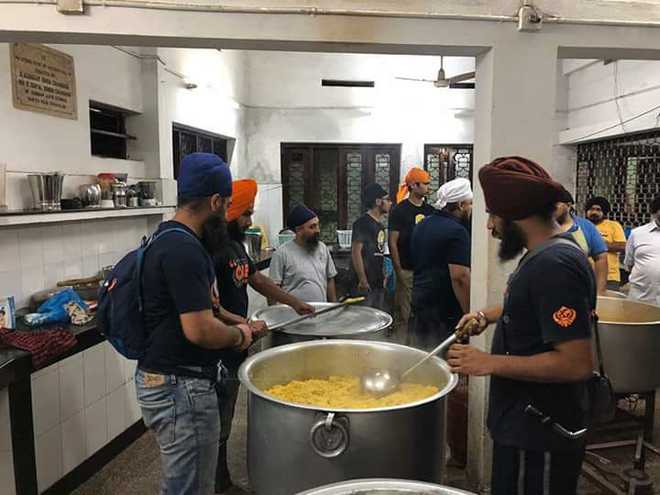
Khalsa Aid supporters cook food at Gurdwara Shri Guru Singh Sabha in Kochi, Kerala. Photo: Twitter

Tribune Web Desk
Chandigarh, August 18

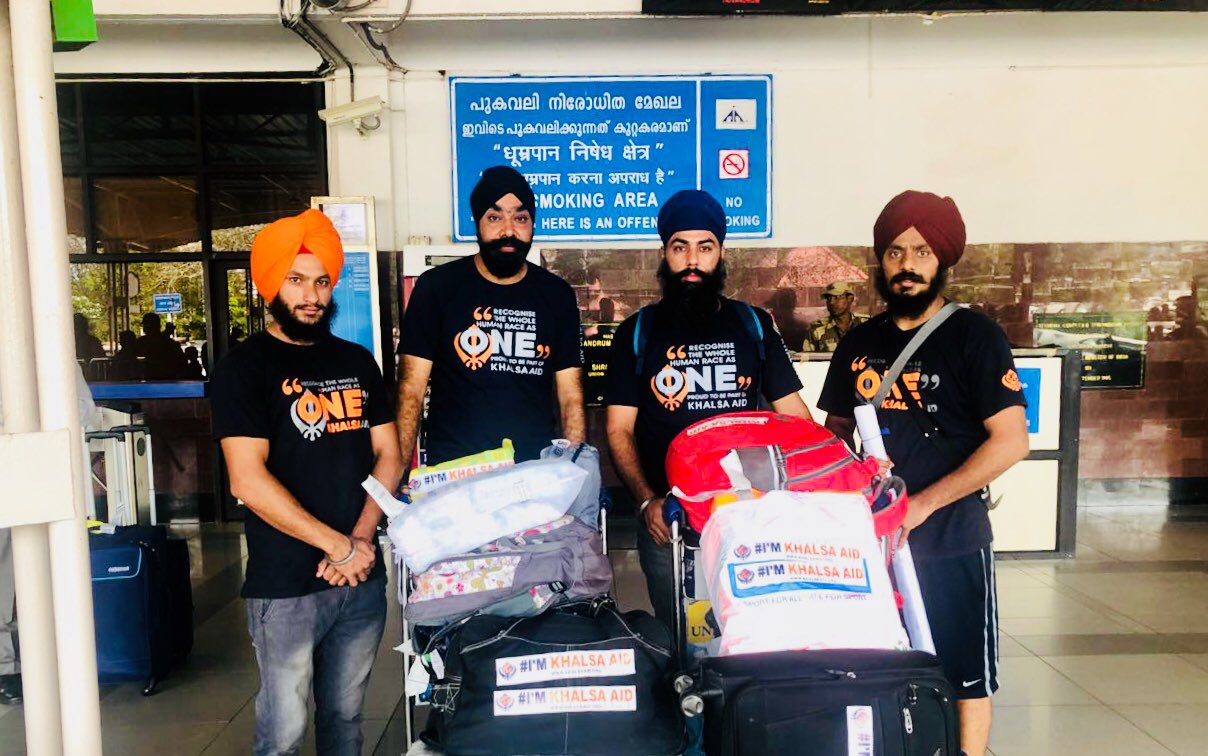
Help continues to pour into Kerala as the state battles unprecedented flood. Among those volunteering is a UK-based Sikh philanthropist organisation.

Photos and videos posted on Facebook show the Khalsa Aid International serving flood victims at the Gurdwara Shri Guru Singh Sabha in Kochi, Kerala. Photos and videos posted by the organisation quickly went viral, drawing unanimous praises.


Army mulls hybrid vehicles for high-altitude areas

Vijay Mohan

Tribune News Service

Chandigarh, October 30

After decades of sustained deployment in some of the highest operational areas in the world, the Army is now exploring the feasibility of developing hybrid vehicles for use in high altitude areas to overcome the problems of degraded performance and high attrition that combustion engines face due to extreme cold and rarified air.

Army Design Bureau (ADB), the nodal agency dealing with the project, has flagged the issue for urgent redressal by the industry or research institutes as there is effective means to mitigate the problem as yet. ADB is the repository of all technical know-how for the Army and is the interface between government and private establishments for design, development and innovations.

At present, special grade fuel and oil is being used in high altitude areas, but these are not very effective during peak winters from November to March, often leading to vehicles becoming off-road.

Many areas where the Army is deployed — Ladakh, Kargil, Lahaul and Spiti, Sikkim and Arunachal Pradesh — experience sub-zero temperatures for several months in a year.

The engine horse power of conventional vehicles drops considerably in high altitude areas due to lack of air density and pressure. Further, due to extreme low temperature fuel and oil freeze or their viscosity increase, thereby affecting flow through the engine hoses or blocking injectors and filters increasing the risk of seizure, according to an Army engineer. Lubrication of engines and other moving parts is also affected, leading to frequent change of parts.

Hybrid vehicles with dual power source can overcome such problems as electric drive achieves greater efficiency in stop and go mission profiles as compared to conventional engines. The regenerative braking resources stores power as electrical energy resulting in greater fuel efficiency and an electric motor can generate instantaneous power for better off road maneuvering, engineers said.

Hybrid vehicles are a relatively new concept in India that is available in some passenger cars, but it is restricted to start and stop functions rather than drive power. The US Army is also said to be developing hybrid vehicles.


Don’t add more numbers, forces told

Don’t add more numbers, forces told

Ajay Banerjee

Tribune News Service

New Delhi, August 12

In an important signal on optimum use of available funds, the armed forces have been asked to avoid fresh accretions — adding any more numbers to the existing strength — while continuing with right-sizing of the Army, Navy and the Air Force.The matter of force numbers, the resultant man-power costs and redundancy caused due to technological upgrades was raised by a top government official at the two-day Unified Commanders’ Conference held in New Delhi on July 30 and July 31, sources confirmed to The Tribune. The matter of not increasing numbers was referred to and the rising costs were discussed, a functionary confirmed about the meeting.The Ministry of Defence (MoD) is clear: “Addition of new equipment (modernisation) does not mean a corresponding rise in the strength of men,” said sources. The foundation of this was laid by Prime Minister Narendra Modi very early into his tenure. In his address at one such conference in December 2015, Modi said: “Modernisation and expansion of forces at the same time is a difficult and unnecessary goal.” Over the last decade, the armed forces have absorbed a fair amount of technological developments, including communications and digitisation, which means some of the troops can be redeployed.The high-powered Defence Planning Council (DPC), at its first meeting in May this year, asked for “leaner, meaner and restructured armed forces ready for future wars enabled by proper use of budgetary allocations”. Army Chief General Bipin Rawat had ordered restructuring of the Army on June 12 this year.The Army, the biggest of the three armed forces, about 1.3-million strong, has been asked to improve its teeth-to-tail ratio. In simple words, it means have more fighting units and reduce non-fighting numbers. Last year, the MoD announced a major change as 57,000 officers and soldiers were to be redeployed to have more combat-oriented roles by 2019.It was an outcome of a committee headed by Lt Gen DB Shekatkar (retd), which suggested 99 points for structural changes in the Army, among them being cutting down flab and reducing revenue (maintenance) expenditure. Of these, the MoD has accepted 65 suggestions.Focus on right-sizing

  • In this year’s budget ending March 31, 2019, salaries of the three services and civilians work out to Rs 1,18,966 crore
  • Another Rs 1.08 lakh crore is the pension bill—both salaries and pensions account for 40 per cent of the entire budget
  • More money had to be earmarked for salaries and pensions than for modernisation (Rs 99,563 crore)