Sanjha Morcha

What’s New

Click the heading to open detailed news

Current Events :

web counter

Print Media Reproduced Defence Related News

Lt Gen JS Nain is Rising Star Corps Commander

Lt Gen JS Nain is Rising Star Corps Commander

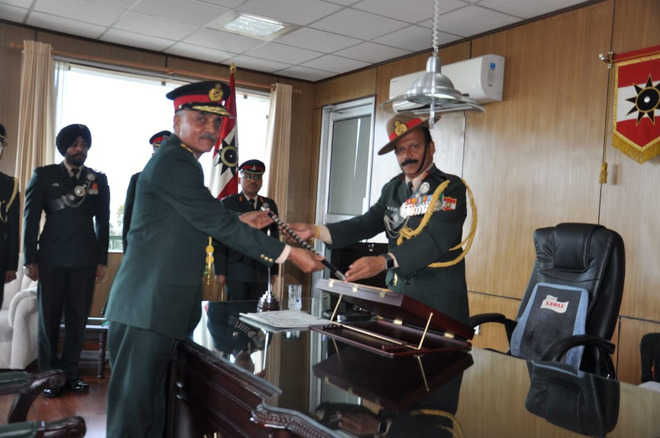
Lt Gen JS Nain takes over from Lt Gen YVK Mohan as the 14th Corps Commander of the strategic Rising Star Corps in Dharamsala on Saturday.

Tribune News Service

Dharamsala, January 12

Lt Gen JS Nain on Saturday took over as the 14th Corps Commander of the strategic Rising Star Corps.

He took over from Lt Gen YVK Mohan, SM, VSM. A decorated soldier, Lt Gen JS Nain, an alumnus of the National Defence Academy, was commissioned into ‘The Second Battalion of the Dogra Regiment in June 1983. The General has commanded his Battalion on the Line of Control in the high attitude area, a mountain brigade in the eastern sector and an infantry division along the Line of Control in Kashmir Valley.

His staff experiences include tenanting the appointment of Brigade Major of an Independent Mechanised Brigade Group, an Instructor at the Infantry School and many other key appointments at various headquarters.

He has excelled in various professional courses during his service and has many achievements to his credit. He is a graduate of the Defence Services Staff College, Wellington, the College of Defence Management, Secunderabad and National Defence College, Dhaka.

He has the distinction of holding masters degree in defence and strategic studies and masters of management studies. After a successful and illustrious tenure, Lt Gen YVK Mohan, SM, VSM has been appointed as the Commandant of the Defence Services Staff College at Wellington.


HAL Officials Meet Defence Minister Nirmala Sitharaman Today To Address Cash Crunch

HAL Chairman R Madhavan and other board members left Bengaluru on Tuesday for the meeting, likely to be attended by many important officials from the army, navy and defence ministry.

HAL Officials Meet Defence Minister Nirmala Sitharaman Today To Address Cash Crunch

BENGALURU: 

Officials of the Bengaluru-based Hindustan Aeronautics Limited (HAL) are likely to meet Defence Minister Nirmala Sitharaman and top government officials on Wednesday to discuss ways to resolve the cash crunch faced by the aerospace firm.

According to HAL Employees Union General Secretary Surya Devra Chandrashekhar, the firm had to take a loan of Rs. 1,000 crore to pay salaries to its 30,000 employees despite giving away Rs. 9,000 crore — including Rs. 5,000 crore in dividends — to the defence ministry over the last four years. The HAL Staff Union has also expressed disappointment over the defence ministry’s decision to overlook the firm for the Rafale aircraft deal, and its alleged reluctance to clear Rs. 15,700 crore in dues. All this has led to the present financial crisis, it says.

HAL Chairman R Madhavan and other board members left Bengaluru on Tuesday for the meeting, likely to be attended by many important officials from the army, navy and defence ministry.

“We request the defence minister to release the work order because nearly a lakh of our families have been suffering. Although we have taken a loan to pay the salaries, we are not in a position to give allowances,” HAL Employees Union President R Srinivasan told NDTV.

HAL employees believe that the firm can make Rs. 50,000 crore if the defence ministry clears a project for manufacturing 83 light combat aircraft, and the Air Force pays dues amounting to Rs. 16,000 crore. “We are capable of delivering orders worth Rs. 2 lakh crore over the next 10 years,” said Mr Chandrashekhar.

Key functionaries in the union questioned the reasoning behind taking the Rafale contract away from HAL when it has successfully produced Jaguar and Hawks in the past. “We met every expectation of the defence ministry and the Air Force chief, but the defence ministry suddenly raised doubts about our capabilities,” said Mr Srinivasan.

The Congress alleges that the Narendra Modi government has shown favouritism by taking HAL out of the multi-crore Rafale aircraft deal in favour of Anil Ambani’s Reliance Industries.


Rush for the Afghan pie by G Parthasarathy

Bigger challenges are emerging with Trump firm on troop pullout

Rush for the Afghan pie

EXIT MODE: US plans to scale down its military presence have made allies nervous.

G Parthasarathy
Former Diplomat

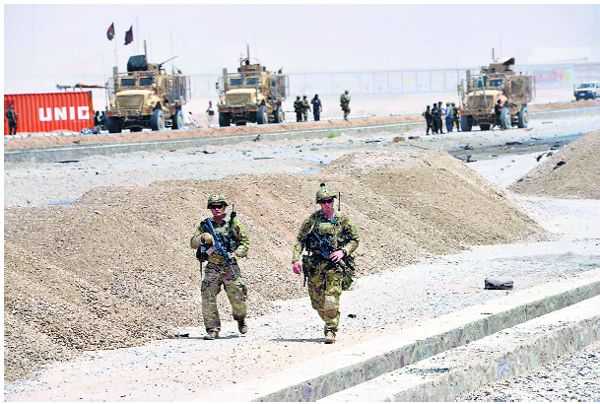
Given his distaste for military interventions abroad, President Trump has announced his decision to expedite withdrawal of US forces from Syria and Afghanistan. His critics say this would amount to betrayal of US allies. Despite criticism, it now appears clear that the US intends to progressively reduce and end military land operations in Afghanistan. It has already reduced its military presence to 14,000 troops, with plans to halve the number in a short period.  A swift military takeover by the Taliban would raise security concerns in India, given the past Taliban role in colluding with the hijackers of IC 814. The Taliban has also provided training facilities and bases for groups like the Jaish-e-Mohammed, which was responsible for the attack on India’s Parliament.

Pakistan continues to provide the Taliban military and intelligence support, together with bases on its soil.  Taliban vice-president Sirajuddin Haqqani resides in and operates from Pakistan. An economically vulnerable Pakistan, whose foreign exchange reserves have dwindled to $6 billion, however, faces huge international pressure, from friends and foes alike, to end this support. The Financial Action Task Force is turning the screws on Pakistan, to end its support for terrorism, or face sanctions. Saudi Arabia and the UAE have offered to provide financial support to Pakistan, amounting to around $6 billion for oil imports. But Pakistan realises that its economy would collapse, without US-backed IMF assistance. The US has linked such assistance to the ISI ending support to terrorism.

China may claim to be generous, but across Pakistan, there is a growing feeling, similar to that in countries like Sri Lanka, Myanmar, Malaysia and Kenya, that China leads every ‘aid’ recipient into a ‘debt trap’. 

It is crucial for New Delhi to continuously assess how diplomacy surrounding the ‘endgame’ of American withdrawal from Afghanistan plays out. The withdrawal will inevitably lead to a greater role for the Taliban in Afghanistan’s national life. The Afghan government is concerned that Trump’s instinctive and ill-advised ‘Tweet Diplomacy’ can have disastrous results in Afghanistan and its neighbourhood.

 The Taliban now controls, or actively contests, the government’s control in around 45% of Afghanistan’s territory. The Afghan security forces are taking heavy casualties, losing on an average 30-40 members every day. Important urban centres like Ghazni have been taken over by the Taliban for days. Presidential elections in Afghanistan have been postponed, following US pressure. President Ghani responded strongly on December 26, with the appointment of two former intelligence chiefs, firm opponents of ISI-sponsored terror, to key positions. Amrollah Saleh, a Tajik and erstwhile Ahmed Shah Masood loyalist, has been appointed interior minister; and Asadullah Khalid, a Pashtun, who was seriously wounded in a Taliban attack, is the new defence minister. This is an important move, reiterating the government’s resolve, evidently with US backing, to take on the Taliban strongly.

These developments have been accompanied by frenetic diplomatic activity by Pakistan’s foreign minister Shah Mehmood Qureishi, purporting to demonstrate that Pakistan is making every effort to involve major powers — notably, the US, Russia and China — in a quest for peace and stability in Afghanistan. This has accompanied the appointment of Zalmay Khalilzad, an Afghan-American, with vast experience of Pakistani machinations in Afghanistan, as Trump’s envoy, to coordinate American contacts with external powers and all major parties in Afghanistan, including the Taliban. External powers are, however, treading on one another’s toes in this effort. A conference convened in Moscow by Russian foreign minister Sergei Lavrov, without any senior official American participation, saw formal participation by the Taliban, Pakistan, China and Central Asian republics. India made common cause with the Afghan government and was not represented at the conference by serving government officials, but by former diplomats. India made it clear that it will not formally endorse any initiative that equates a constitutionally-elected government in Afghanistan, with a medievalist, armed insurgent group.

There are now several countries with a finger in the Afghan pie. The Taliban has an ‘office’ in Qatar, set up with US blessings. Teheran has been having a secretive ‘dialogue’ with the Taliban. These Iranian contacts with the Taliban, undertaken with Pakistan’s ‘approval’ and  ‘facilitation’, gathered momentum after the death of Taliban founder Mullah Omar. A Taliban delegation visited Iran last month for formal discussions with Iranian leaders. In the meantime, the US has brought in Saudi Arabia and the UAE to facilitate talks with the Taliban. The first round of talks involving representatives of the US, Saudi Arabia, the UAE, Pakistan and the Taliban were held in Abu Dhabi in December. The US has evidently decided that the UAE and Saudi Arabia are more useful in such talks than Qatar, which hosts a Taliban ‘office’.

Rivalries between Russia, China and the US have spread across the Islamic world, pitting countries like the UAE and Saudi Arabia on the one side, with Turkey, Iran and Qatar on the other. Uncertainties in Afghanistan’s neighbourhood are set to make the Afghanistan-Pakistan region even more volatile, especially given the persecution of Muslims in China’s neighbouring Xinjiang province. A growingly bankrupt Pakistan, now persuaded that its economy could collapse without an IMF bailout, is trying to balance contradictions between its support for the Taliban and other radical groups on the one hand, and its desperate need for assistance from the US, Saudi Arabia and the UAE on the other.

New Delhi, in turn, will have to not only deal with rivalries between Islamic countries across its western neighbourhood, but also deal with the pressures arising from policies of the US, Russia and China.


MPLADS Term at fag end, Kirron’s 65% works still not done:: Haqd won with support of Veterans being daughter of ESM

Term at fag end, Kirron’s 65% works still not done

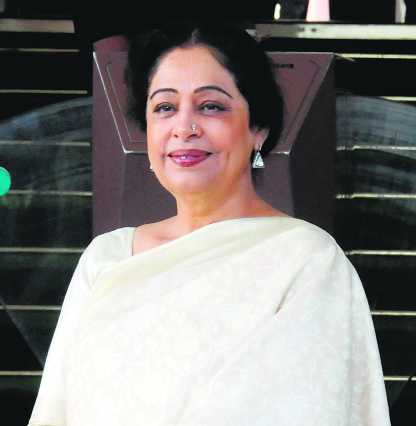
Kirron Kher, City MP

Sandeep Rana

Tribune News Service

Chandigarh, January 5

Even as the five-year term of local MP Kirron Kher is nearing an end, about 65 per cent of the development works she recommended under the Member of Parliament Local Area Development Scheme (MPLADS) are either pending or have been dropped.

As per figures provided by the MP’s office, Kirron had recommended a total of 315 works to the UT Deputy Commissioner (DC), the nodal officer, since she assumed the office in 2014.

However, only 113 works could be completed till date. A total of 174 works are said to be under progress and 28 recommended works were dropped due to various issues, including viability and approval. 

Speaking to Chandigarh Tribune today, Kirron Kher said, “I recommended a number of projects, but some of them were dropped by the DC. I was given reasons like unavailability of land or approval.”

“However, I have been able to get roads built at places like Deep Complex at Hallo Majra, Makhan Majra, Mani Majra, Bhelana and Daria. Some stretches at these places were in the need of roads for the last several years. I also got paver blocks laid wherever required. Besides, I spent on community centre buildings, renovation of crematorium, open air gyms, mast lights, development of parks and societies of southern sectors,” the MP said.

Officials said development works take time. First, the proposal has to be sent to the department concerned after getting due approvals. Then, the department concerned floats tenders and the works are allotted.

Deputy Commissioner Mandeep Singh Brar did not respond to phone calls made to him for his comments.

Released Rs 20 cr for works

According to the figures procured from Kirron Kher’s office, the MP had got Rs 22.5 crore from the Central government under the MPLADS. Of this, Rs 20 crore had been released by her for various works.

Besides, she exhausted the unspent fund of Rs 4 crore pertaining to the tenure of her predecessor Pawan Kumar Bansal.

“The pending amount was meant for a planetarium to be constructed at Panjab University. However, the matter got stuck in the Senate meeting,” said the former Congress MP.

Bansal said, “Whether it is related to the UT Administration or the Municipal Corporation, these works really take time. In such a scenario, one should recommend works early so that these could be processed quickly. As far as I am concerned, I used to take one meeting with officers in a month or two.”

Slamming the slow pace of work, RK Garg, president, Second Innings Association, a body of senior citizens, commented, “This depicts the negative approach of the DC office and the Administration. When funds are available, why are officers not executing development works?”


How MPLADS funds are spent

Each year, an MP gets Rs 5 crore from the Centre under the MPLADS to be spent in his/her constituency. Unutilised funds are carried forward. The MP sends the work demand to the nodal officer i.e. the DC. The officer prepares the plan as per the norms and sends it to the MP, who gives approval as per the availability of funds.


Defence spend up in absolute terms, down percentage-wise

Defence spend up in absolute terms, down percentage-wise

Tribune News Service

New Delhi, January 1

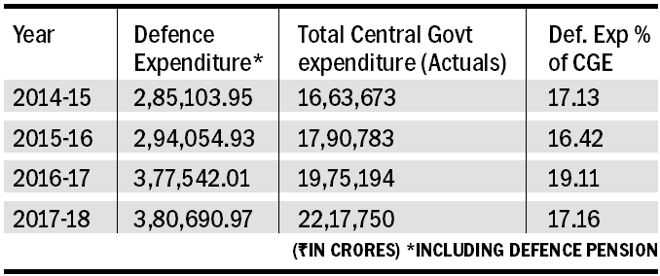
Giving numbers in Parliament on budgetary spending, the Ministry of Defence has admitted that the defence expenditure, as per percentage of the central government expenditure, has fallen, although it has gone up in absolute terms.

The defence expenditure, including pension, is budgeted at Rs 3,80,690 crore for the current fiscal. This is 17.16 per cent of the Central Government expenditure for the year. There has been a drop over the last year’s figure when defence consumed 19.11 per cent of all expenses and was budgeted at Rs 3,77,542 crore. In other words, the government added in rupee-terms for this year’s budget, but the ratio vis-à-vis total expenditure is down by 2 per cent.In a written reply in the Rajya Sabha yesterday, Minister of State for Defence Subhash Bhambre said “projections made by the Services are forwarded to the Ministry of Finance. Based on the overall resource position, funds are allocated”.

The MoD also informed that Capital Expenditure—meant for new projects—had gone up in absolute terms over the past few years.Defence Capital expenditure is maintained around 34 per cent of the total allocations under the Defence Services estimates, which are Rs 2,79,305 crore (this figures is minus the pensions) for the current fiscal.

The allocated Capital budget has been fully utilised since 2016-17, reversing the previous trend, Defence Minister Nirmala Sitharaman said in a written reply to a question in the Rajya Sabha.


2nd batch of Afghan women officers undergo training at OTA

2nd batch of Afghan women officers undergo training at OTA

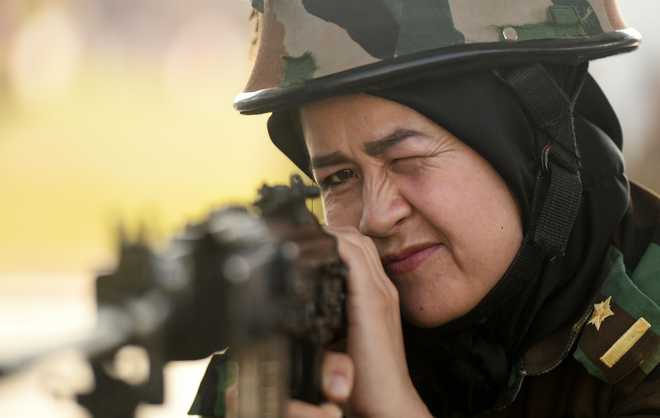
An Afghan woman army cadet shoots a target during a practice session in Chennai on December 19. AFP

Chennai, December 19

Head scarf-clad Zuhra Nabizada showed no traces of emotion as she handled the machine gun with the ease of a professional during a training session at the shooting range of the Officers Training Academy here.

She is part of a group of 19 women from the Afghanistan Armed forces honing their skills at the Academy.

Wiping the sweat off her sunburnt face, Afghan Air Force’s Second Lieutenant Nabizada said this is her second visit to India.

“The first visit was in 2014 to Dehradun to take part in a Taekwondo match,” she said.

India’s only academy to impart training to women cadets and officers, OTA is hosting women officers from the Afghanistan Armed Forces for the second time, the first being last year with 20 women.

Afghanistan Army’s Liaison Officer Captain Sirajulhaq Safi told PTI that this time officers from the country’s Air Force have also joined the programme.

“Compared to last year, the team this year comprises many young officers,” Safi said, adding that his country sees the exercise as a knowledge-sharing experience.

The month-long training that began on November 26, includes weapons training and drill besides others.

Indian Army’s Major Ritu Jaswal said the officers were focused and showed keen interest in what was being taught.

“Each country has a different weapon system… Most of the time they use MI-16 assault rifles, here they get the opportunity to learn to use the Indian Small Arms System — light machine guns,” she said.

“However, weather is the major hurdle they face here, as the present temperature in their country is below 5 degree Celsius.”

December is the time when Chennai experiences cooler climes, Jaswal, who acted as an interpreter for a majority of the women officers who knew only Pashto and Dari, added.

Nabizada, a trainee pilot, said it was not just about weapons, but the session also fostered her leadership skills and boosted her self-confidence.

She is the only one of her nine other siblings to have chosen a career in the armed forces.

The squad has mostly women below 30 years, while a 50-year-old officer is the senior-most.

About changes made to the training curriculum since last year, an officer said the duration has been extended to four weeks from three weeks last year.

“This has given us more time to teach the officers about everything that is happening in OTA. They also consider it as a lifetime experience,” the officer said.

According to OTA officials, the officers also visited various places in the city during the training period which will end on December 26.

Media personnel were allowed to witness a training session in which the women officers showcased their skills in handling light machine guns at the OTA shooting range, abutting Chennai Airport. — PTI


Nation celebrates Vijay Diwas to commemorate India’s victory over Pakistan in 1971 war

The nation today celebrated Vijay Diwas to commemorate India’s victory over Pakistan in 1971 war. Rich tributes are being paid to the Martyrs who laid down their lives during the war.

President Ram Nath Kovind, Vice President M. Venkaiah Naidu and Prime Minister Narendra Modi also paid tributes to the soldiers who sacrificed their lives for the nation during the war. In a tweet, Mr Kovind said, the nation remembers with gratitude the Armed Forces who defended the nation and upheld universal values of human liberty in 1971.

Mr Naidu also remembered the courage of the brave soldiers and their selfless sacrifices. Mr Modi said, the unwavering courage and patriotism of the soldiers ensured that the country is safe and that their service will always inspire every Indian.

On this day in 1971, the chief of the Pakistani forces, General Amir Abdullah Khan Niazi, along with 93 thousand troops, had surrendered unconditionally to the allied forces consisting of Indian Army and Mukti Bahini, led by Lieutenant General Jagjit Singh Aurora in Dhaka after their defeat in the Liberation war. This historic victory led to creation of Bangladesh.

This year’s celebration marks the 47th anniversary of India’s victory over its neighbour. Defence Minister Nirmala Sitharaman along with Navy Chief Admiral Sunil Lanba, Air Force Chief Air Chief Marshal Birender Singh Dhanoa and Vice Chief of Army Lieutenant General Devraj Anbu paid tributes to the Martyrs at Amar Jawan Jyoti on Sunday morning.


Ex-servicemen vow to oppose BJP nominees

Tribune News Service

Rohtak, December 8

Former defence officials associated with the Haryana Ex-Services League (HESL), a body of ex-servicemen, have decided to work for the defeat of the BJP nominees in the mayoral and municipal elections across the state.

This was stated by Col RS Malik (retd), a former president of the league, who was accompanied by Col KS Sansanwal (retd), Col RS Budhwar (retd), Col Jai Singh Kadian (retd), Capt Shamsher Singh Malik (retd) and Sub RK Ahlawat (retd), while addressing a news conference here today.

The former defence officers supported the candidature of Dr Jagmati Sangwan, the CPM’s mayoral nominee for Rohtak.

Col Malik alleged that the state government had hijacked the League and some functionaries government were interfering in its affairs.

The former HESL president maintained that the BJP regime at the Centre had made the surgical strikes a political tool, whereas it was a routine military exercise and no government had ever tried to seek credit or political mileage for it.

He alleged multifarious irregularities in the functioning of the League under the government-appointed administrator and an advisory committee constituted by him.

Jat samiti to campaign against BJP in Hisar

The All India Jat Arakshan Sangharsh Samiti will oppose the BJP candidates in the municipal corporation polls in five towns of Haryana. The samiti spokesperson Rambhagat Malik said at a meeting in Hansi town of the district that they would start campaign among electorate to vote against the BJP candidates in the MC polls. He said the state government had backstabbed the Jat community on the issue of reservation.


1962 – A case of Chinese whispers

Time for India to get scholars to write unbiased books on the India-China War as conflicting versions abound
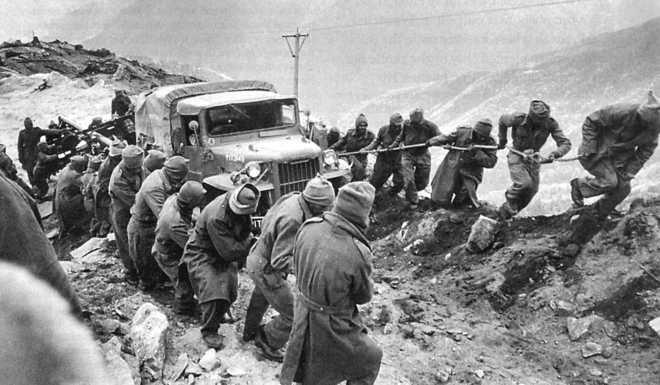
Line of Conflict: Blame game over India’s debacle in the 1962 War continues in the books that chronicle and analyse it
Ajay Banerjee

In the absence of an authentic public account, events leading to the month-long India-China war in 1962 have diametrically opposite and rather ‘conflicting versions’. Some blame India for being the aggressor, others blame China for having prepared for a war since 1959 and for being the aggressor.

Adding to the cauldron of conflicting versions are books written by key players of those times. B.N Mullick, the director Intelligence Bureau, wrote Chinese Betrayal: My Years with Nehru;  Lt Gen B.M Kaul, the then commander of the Tezpur-based IV Corps, wrote The Untold Story;  Brig DK Palit, the then Director Military Operations, penned the War in High Himalaya: The Indian Army in Crisis, 1962;  Brig J.P Dalvi, the then Commander of the Army’s 7th Brigade, has his version of events  Himalayan Blunder: The Curtain-Raiser to the Sino-Indian War of 1962.

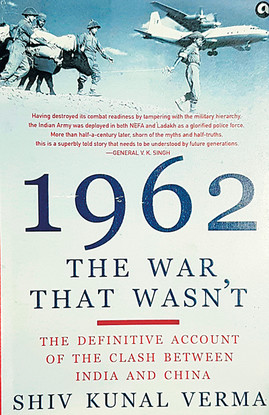
All have looked at their own specific roles and are autobiographical accounts. In 2016, Shiv Kunal Verma, son of an Army Captain who fought the Sino-India war, wrote  1962: The War That Wasn’t. He pieced together yet another account that discusses the battle-scape and also the political scene.

Conflicting versions

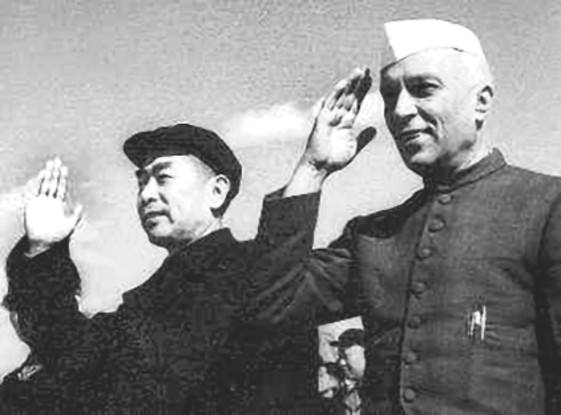
A 1971 book India’s China War  by Australia-based  author Neville Maxwell kicked off the blame game by maintaining that Indian Prime Minister Jawaharlal Nehru had unleashed a ‘forward policy’ that ‘provoked’ China into a war (Oct 20, 1962 to Nov 23, 1962). Maxwell’s theory propagated in his book reinforces the thought that China was only defending its territory. British author Sir Alistar Lamb, who has authored three books, also presents a case against India.

Two other books have a diametrically opposite view maintaining that it was China, and not India that ‘provoked’ the war. Swedish Journalist Bertil Lintner’s China’s India War-Collision Course on the Roof of the World, and History of the Conflict with China — 1962, released for ‘restricted’ circulation by the Ministry of Defence (MoD) in March 1993, puncture the Maxwell-Lamb theory that has cast a shadow on the post-Independence thinking on the Sino-Indian conflict.

At the launch of his book in New Delhi in December last year Lintner had said, “Maxwell may have misjudged and most people do make that mistake”. His book goes on to detail that the decision to go to war with India had been taken in 1959 — the year Dalai Lama had arrived in India.

The MoD book, rebuts the Maxwell claim an a aggressive ‘forward policy’ — a decision taken by India in November 1961 — saying it was to restrict the Chinese to their claim-line of 1956 and stop claims over the new territory in 1960. Beijing had expanded its claim on another 5,100 sq km of territory in eastern Ladakh. It was to “prevent further infiltration into unoccupied areas of Ladakh”, says the book possessed by a miniscule number of Indians, but the same is again not in public domain being classified as ‘restricted’.

India and China have an un-demarcated boundary. Five attempts by the British between 1847 and 1914 did not yield results. At present the India-China special representatives are charged to tackle the boundary question.

Need to correct misperception of disgrace 

The MoD book also debunks the ‘popular belief’ that India was totally ‘disgraced’ in the 1962 India-China War. It accepts the shortcomings, but tells how Indian troops held on in Ladakh, most notably at Rezang La in eastern Ladakh, just 5 km south-east of the hamlet of Chusul. “The Indian soldier was defeated but not disgraced in Ladakh,” it says, dispelling the notion.

Notably, the Chinese officially admit to 2,419 casualties (722 dead and 1,697 wounded). The figure is quite stunning given the situation in which each Indian position was asked to fight.

Henderson Brooks-Bhagat report apportions blames on Generals  

A report on the war by Lt Gen Henderson Brooks and Brig (later Lt Gen) Prem Bhagat is classified even as Neville Maxwell put out portions of it on a website. New Delhi did not rebut him for this nor had it done in 1971 by a scholarly rebuttal of his earlier book hence allowing Maxwell’s one-sided interpretation to flourish.

The portions put out in public reveal that the government wanted a ‘forward policy’, but left the implementation to the generals. Gen B.M Kaul, overruled valid cautions presented by Lt Gen Daulet Singh, the Western Army Commander who had insisted that a forward move must have adequate troop numbers, combat support and logistics.

The belief that pushing forward would not encounter Chinese resistance came from the Intelligence Bureau. The Army’s earlier stated view that “the Chinese would resist by force any attempts to take back territory held by them,” was countered by B.N Mullick thus: “The Chinese would not react to our establishing new posts and that they were not likely to use force against any of our posts even if they were in a position to do so”.

The Army Headquarters had a wrong assessment of troops. It argued that China could not muster more than 5,000 troops facing eastern Ladakh even as Lt Gen Daulat Singh warned (correctly) on August 17, 1962 that Beijing had 15,000 troops.

Hindrance in accessing records

The Public Record Act 1993 does not entail automatic declassification of military records, and exemptions under the Right to Information Act 2005 are a deterrent for researchers. A war history cell at the Centre for Land Warfare Studies (CLAWS) produced a paper in 2016 titled A Historiographic Analysis of the Military History of  Post-Independent India. Authored by Jaideep Chanda, it is candid: “An analysis of the military historical literature in India will primarily find personal accounts mostly written by retired Army officers”.



ONE STEP CLOSER TO THEIR DREAMS

As many as 28 students from Mohali cleared the written test of National Defence Academy (NDA).

HT PHOTO■ Twenty-eight cadets, who have cleared the written test of National Defence Academy, all smiles during a press conference at Shemrock Senior Secondary School, Sector 69, in Mohali on Wednesday.

The students, who are enrolled at Shemrock Senior Secondary School, Sector 69, Mohali, were trained at Maharaja Ranjit Singh Armed Forces Preparatory Institute, Sector 77, Mohali.

Institute director Major General Baljit Singh Grewal (retd) said, “Cadet GS Gosal and Cadet Shashank topped India. Cadet Armandeep Singh made it to the all India merit.”

School principal Prineet Sohal said, “Out of the total 339 seats, 28 students were selected from Maharaja Ranjit Singh Armed Forces Preparatory Institute and Shemrock Senior Secondary School.” The written exam was conducted on September 9, 2018. Candidates, who qualified the exam, will now appear for interview.