Sanjha Morcha

What’s New

Click the heading to open detailed news

Current Events :

web counter

Print Media Reproduced Defence Related News

‘Just one slap from army man rattled Jaish chief Masood Azhar’

'Just one slap from army man rattled Jaish chief Masood Azhar'

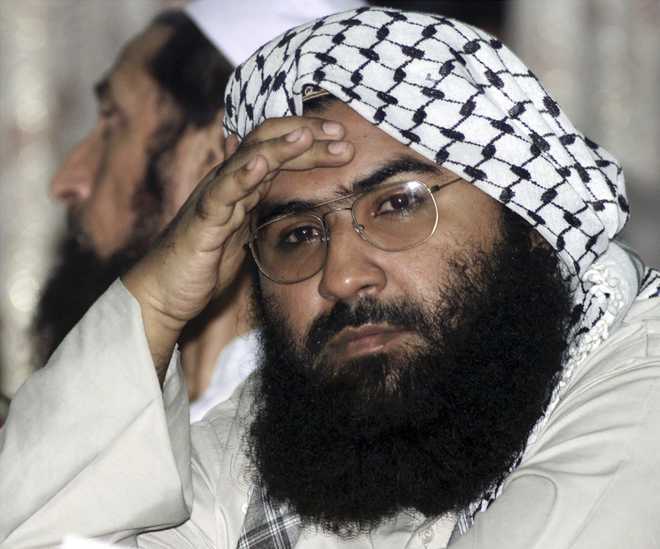
Masood Azhar. — File photo

New Delhi, February 18

Maulana Masood Azhar, the dreaded architect of some of India’s biggest terror attacks, was an “easy man” to handle in custody with one slap enough to make him blurt out details of his movements, says a former police officer who interrogated him several times.

Azhar, who used a Portuguese passport to enter India through Bangladesh and reach Kashmir, was arrested in February 1994 in Anantnag in South Kashmir.

In custody, intelligence agencies did not have to use “coercive method” against Azhar to extract information as he started speaking after the “first slap” from an army officer and gave deep insights into the functioning of terror groups operating from Pakistan, the officer said.

“He was an easy man to handle and a slap from an army officer shook him completely,” former Director General of Sikkim Police Avinash Mohananey, who interrogated Azhar many times during his two-decade tenure in the Intelligence Bureau, told PTI.

After his release in exchange of passengers of hijacked IC-814 flight of Indian Airlines in 1999 by the then BJP government, Azhar formed Jaish-e-Mohammed and scripted many audacious terror strikes in India, including on Parliament House, Pathankot air force base, army camps in Jammu and Uri, and the latest suicide attack on CRPF in Pulwama which claimed the lives of 40 personnel.

While in custody, Azhar, in his early 50s now, shared information about recruitment process and functioning of terror groups in Pakistan at a time when the intelligence agencies were still grappling to understand the proxy-war unleashed by Pakistan’s espionage agency ISI, said Mohananey, a 1985-batch IPS officer who headed the Kashmir desk in the agency at that time.

“There were several occasions when I met him in Kot Balwal jail and interrogated him for hours together. We did not have to use any coercive method as information flowed consistently from him,” he said.

Azhar gave the Indian agencies vital insights into diversion of Afghan terrorists into Kashmir Valley and merger of Harkat-ul-Mujahideen and Harkat-ul-Jehad-e-Islami (HuJI) into Harkat-ul-Ansar, represented by him as its general secretary, the officer said.

After his arrival in India from Bangladesh in 1994, Azhar travelled to Saharanpur before reaching Kashmir where he held meetings of warring factions of HuM and HuJI to formulate a common policy, Mohananey said.

“I came on a forged Portuguese passport for ensuring that HuM and HuJI are together in the valley. It was not possible for me to cross the Line of Control on foot,” the police officer recalled Azhar telling them.

A man of mannerism and etiquette during interrogation sessions, Azhar used to give detailed answer to any question that was asked to him, he said.

The Jaish chief, during his stint as a journalist with ‘Sada-e-Mujahid’, a tabloid published from Karachi, had in 1993 travelled with a group of Pakistani scribes to some countries, drumming up support for “Kashmir cause’, he said.

Mohananey recalled that Azhar would often boast that police could not be able to keep him in custody for long as he was important for Pakistan and the ISI.

“You are underestimating my popularity. The ISI would ensure that I am back in Pakistan,” the police officer recalled him as saying.

Surprisingly, some foreigners were kidnapped from Delhi 10 months after his arrest in February 1994 and the kidnappers had demanded his release.

The plan failed with the arrest of Omar Sheikh, who was also released in the 1999 exchange, and was later involved in the gruesome beheading of Wall Street Journal reporter Daniel Pearl in Pakistan.

Another attempt to free him was made by a shadow group of Harkat-ul-Ansar, Al-Faran, which demanded his release in exchange of five foreigners kidnapped in Kashmir in July 1995.

Before shifting out to another posting, the officer said, “I met him again in 1997 when he was in the same jail. I informed him that I was proceeding to a new posting to which he wished me good luck.”

“I was at new posting when I heard about his release on December 31, 1999 in exchange for passengers of IC-814. He really meant it when he said that we would not be able to keep him for long,” he said.

The JeM chief is now believed to be in his native Bahawalpur in Pakistan’s Punjab province.

The then BJP-led NDA government had released Azhar, along with Omar Sheikh and Mushtaq Ahmed Zargar alias ‘Latram’, in exchange of passengers of Indian Airlines flight IC-814 from Kathmandu to New Delhi which was taken to Kandahar in Afghanistan.

After the negotiations failed with hijackers, the government succumbed to their demands and the then external affairs minister Jaswant Singh took the three terrorists to Kandahar in Afghanistan in a special plane to ensure the release of passengers of the hijacked plane. — PTI
Pulwama martyr laid to rest with state honours in Rajouri

Pulwama martyr laid to rest with state honours in Rajouri

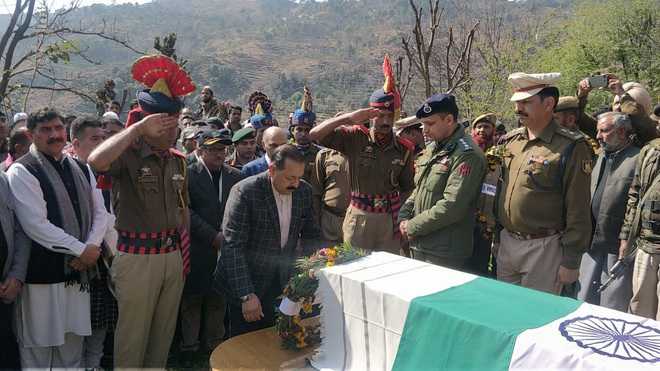
Jitendra Singh pays tributes to CRPF Head Constable Nasir Ahmed at Dodassan Bala village in Rajouri on Saturday. Tribune photo

Shyam Sood

Rajouri, February 16

Head Constable of the Central Reserve Police Force (CRPF) Nasir Ahmed, who was killed in a suicide attack in Pulwama district on Thursday, was laid to rest with full state honours at his native Dodassan Bala village in Rajouri district on Saturday.

Themartyr was posted in Jammu and was deputed as the commander of the CRPF convoy, which had left Jammu for Kashmir on Thursday.

Minister of State in the PMOJitendra Singh, former Deputy CM Nirmal Singh, state BJP president Ravinder Raina, MP Jugal Kishore, CRPF IG B Chouhan, CRPF DIG Nitu Bhatacharya, Rajouri DC MA Asad, Rajouri SSPYougal Manhas and senior Army officers paid homage to Head Constable Nasir at his village.

Thousands of people had gathered in the village to pay their last respects to the martyr.

The coffin draped in a Tricolour was brought in a procession about 12.30 pm and the martyr was laid to rest in the presence family members, relatives and dignitaries.

Jitendra expressed his condolences to the family of the martyr, who is survived by wife, minor daughter and a son.

The minister also interacted with Sehraj-ud-Din, elder brother of the martyr, who is a head constable in the J&K Police and at present posted in Jammu. He directed the senior officers to get him posted in Rajouri, if he wanted, so that he could take care of the family.

“The CRPF will always stand by the side of Nasir’s family and we are thankful to the entire nation for showing solidarity with the family,” said CRPF DIG Nitu Bhatacharya.

‘Establish school in Nasir’s name’

  • Thousands of people had gathered in Dodassan Bala village of Rajouri district to pay their last respects to Head Constable Nasir Ahmed
  • Minister of State in the PMO Jitendra Singh paid tributes to the martyr in the village. He also met the family and expressed his condolences to them. He asked the Rajouri Deputy Commissioner to establish a school in the name of martyr


Army ranks ::History

The Genesis of Army Ranks*
*Field Marshal*
http://www.alanharding.com/Military/ranks/field_marsh.gif
The rank evolved from the title of marescalci (masters of the horse) of the early Frankish kings. The importance of cavalry in medieval warfare led to the marshalship being associated with a command position.
The modern military title of field marshal was introduced into the British army in 1736 by King George II, who imported it from Germany. In Britain the rank came to be bestowed only upon a few senior army officers, notably the chief of Britain’s Imperial General Staff.
*General*
http://www.alanharding.com/Military/ranks/gen.gif
The King would be the commander but he might appoint a Captain General to command in his name – the first being George Monck appointed by Charles II in 1660. Later, when the title of Colonel became popular some Kings called their commanders Colonel General. The British Army stopped using the Captain part of the title by the Eighteenth Century leaving just General as the top commander. Lat. generalis “something pertaining to a whole unit of anything rather than just to a part”. Before the Sixteenth Century armies were usually formed only when needed for a war or campaign

*Lieutenant General*
http://www.alanharding.com/Military/ranks/lieu_gen.gif
The king or his Captain General would often be away from the army since they had interests elsewhere so the job of actually running the army fell to the Captain General’s assistant – his lieutenant – the Lieutenant General. This was not a permanent rank until the Seventeenth Century, before which one of the Colonels might be appointed Lieutenant General for a particular campaign or war but he would still command his own regiment.
*Major General*
http://www.alanharding.com/Military/ranks/maj_gen.gif
The army’s chief administrative officer was the Sergeant Major General. He would be an experienced soldier, possibly a commoner, who served as chief of staff. For much of his administrative work he dealt with the regimental Sergeant Majors, thus his title meant “overall” or “chief” Sergeant Major. His duties included such things as supply, organization, and forming the army for battle or march.
As the General ranks became fixed during the Seventeenth Century the Sergeant portion fell away leaving the title as Major General. This happened in England in 1655 when its Lord Protector Oliver Cromwell organized the country into eleven military districts each commanded by a Major General.
*Brigadier*
http://www.alanharding.com/Military/ranks/brig.gif
Commander of a Brigade, in some armies later known as a Brigadier General. The Lieutenant General and Sergeant Major General dealt directly with the Colonels who lead the regiments making up the army. When there got to be too many regiments for the two generals to handle effectively they organized Brigades, usually composed of three or more Regiments. During the nineteenth century and before the “rank” of Brigadier was actually established, a local or temporary appointment granted (typically) to a full Colonel when commanding a Brigade.
The Brigadier General was the lowest-ranking general officer but was abolished when the Brigade was abolished after World War I, being replaced by Colonels Commandant.. The rank of Brigadier appeared in 1928
*Colonel*
http://www.alanharding.com/Military/ranks/col.gif
The Spanish Army was organised into twenty units called colunelas or columns. These comprised1000 to 1250 men further organized into companies. The commander was the cabo de colunela, head of the column, or Colonel. Since the colunelas were royal or “crown” units they were also called coronelias and their commanders coronels.
The French developed Regiments from the colunela, keeping the title of Colonel and pronounced it the way it looks. The British copied the French. They also borrowed the Colonel from the French but adopted the Spanish pronunciation of coronel.
*Lieutenant Colonel*
http://www.alanharding.com/Military/ranks/lieu_col.gif
The Colonel’s assistants – their Lieutenants – took over at such times and any other times the Colonels were gone. The Colonel’s lieutenants, of course, soon became the Lieutenant Colonels.
*Major*
http://www.alanharding.com/Military/ranks/major.gif
A Major was originally the Sergeant Major third in command to a Colonel in a traditional Regiment. Later, like a Lieutenant Colonel, a Major might command his own Battalion. Lat. maior is simply Latin for “greater”.
*Captain*
http://www.alanharding.com/Military/ranks/capt.gif
Originally Captain-Lieutenant, becoming Captain in 1772. Lat. capitaneus “chieftain”, from Lat. caput “head”. Chieftain or head of a unit. As armies evolved his post came to be at the head of a company, which by the Sixteenth Century was usually 100 to 200 men. That seemed to be the number one man could manage in battle.
*Lieutenant*
http://www.alanharding.com/Military/ranks/lieu.gif
French lieu (place) tenant (holder). The Lieutenant normally commands a small tactical unit such as a platoon. A Lieutenant often takes the place of a superior officer when that officer is absent.
*Second Lieutenant*
http://www.alanharding.com/Military/ranks/sec_lieu.gif
The lowest rank of commissioned officer. Note that a Subaltern is a term applied to any officer below the rank of captain, especially a second lieutenant. Derivation from Latin related to the word for alternate.
Until 1871 the lowest commissioned rank was the Ensign in the Infantry and Cornet in the Cavalry – both names derived from French words signifying standard bearers. The Fusilier regiments, having no company colours, had First and Second Lieutenants anyway. The Fusiliers abolished the rank of Second Lieutenant in 1834. Between 1871-1877 the lowest was the Sub Lieutenant, after which today’s Second Lieutenant rank was established.
*Warrant Officer*
http://www.alanharding.com/Military/ranks/warrant_c1.gifhttp://www.alanharding.com/Military/ranks/warrant_c2a.gif
Introduced into the British Army in 1879, the military grade of Warrant Officer dates back to the early years of the Royal Navy. These experienced soldiers, often have specialist appointments. They hold a Royal Warrant from Her Majesty The Queen. There are currently two classes of Warrant Officer, First Class and Second Class.
*Staff Sergeant*
http://www.alanharding.com/Military/ranks/staff_serg.gif
A rank senior to sergeant.
*Sergeant*
http://www.alanharding.com/Military/ranks/sergeant.gif
Lat. serviens servant to a knight in medieval times. The English borrowed the word sergeant from the French in about the Thirteenth Century. Meaning “non-commissioned military officer” first recorded 1548. Originally a much more important rank than presently.
*Corporal*
http://www.alanharding.com/Military/ranks/corporal.gif
Originally referred to a reliable veteran called the capo de’squadra or head of the square.
The title changed to caporale by the Sixteenth Century and meant the leader of a small body of soldiers. The French picked up the term in about the Sixteenth Century and pronounced it in various ways, one of them being corporal, which indicates a mixing with the Latin word corpus or French corps (body).
The British adopted corporal in the Seventeenth or Eighteenth Century and it has been a part of the army ever since. The British gave the Corporal his two stripes when they started using chevrons in 1803.
*Lance Corporal*
http://www.alanharding.com/Military/ranks/lance_cor.gif
Appointment and not a rank. Junior to a Corporal. From lancepesade “officer of lowest rank, from obsolete French lancepessade, from Old Italian lancia spezzata, superior soldier, literally “broken lance”. Originally referred to as a “chosen man” who would take control of the section if the Corporal was to be killed or wounded


Proud of brave son, says martyr’s father Gloom descends on Karnal village of slain Havildar

Proud of brave son, says martyr’s father

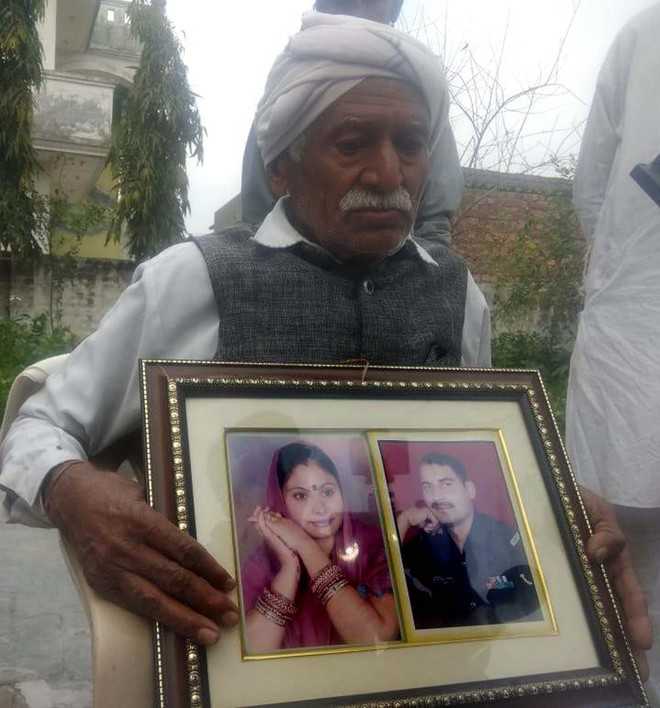
The grieving Kishan Chand with the wedding photograph of his son Havildar Baljit Singh in Karnal on Tuesday. Tribune photo

Parveen Arora
Tribune News Service
Karnal, February 12

A pall of gloom descended on Dinger Majra village in the district on Tuesday following the death of Havildar Baljeet Singh (35) in a gunfight in Jammu and Kashmir.

The gunfight broke out when joint teams of security forces launched an anti-militancy operation in the Ratnipora area of Pulwama district. One militant was also killed in the gunfight.

A soldier of the 50 Rashtriya Rifles, Baljeet had joined the Army in January 2002. He talked to his wife and children over phone on Monday night. He told them that he would come home for a vacation, but destiny had something else in store for him. He is survived by his wife Aruna, father Kishan Chand (75), daughter Jannat (7) and son Arnav (3).

As per family members, his mortal remains would reach the village on Wednesday and the last rites would begin around 9:30 am.

As the news reached the village, hundreds of people thronged his house to console the grieving family and express grief. Several youths of the village were serving the armed forces.

“Officials informed us about Baljeet’s martyrdom this morning. We were informed that before laying down his life, he killed one militant. We are proud of his sacrifice,” said Dilbag Singh, Baljeet’s cousin.

He had served as NSG commando in VVIP duties between 2015 and 2017. Aruna said he had come home on Diwali and talked to them on Monday night.

“Baljeet was a brave man and great son. I am proud of my son,” said the martyr’s father. Gharaunda MLA Harvinder Kalyan said the government would extend help to the family as per its policy.


First 4 Chinooks arrive in Gujarat

o be based at Chandigarh, the existing home of the 126 Helicopter Unit

First 4 Chinooks arrive in Gujarat

Tribune News Service

New Delhi, February 10

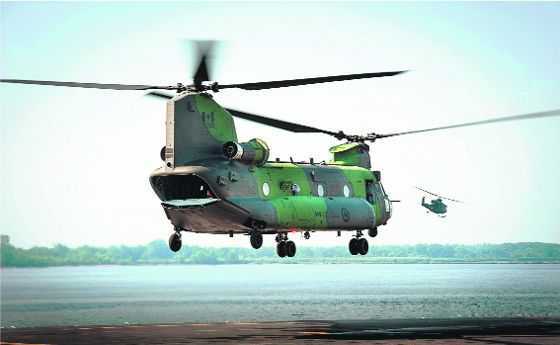
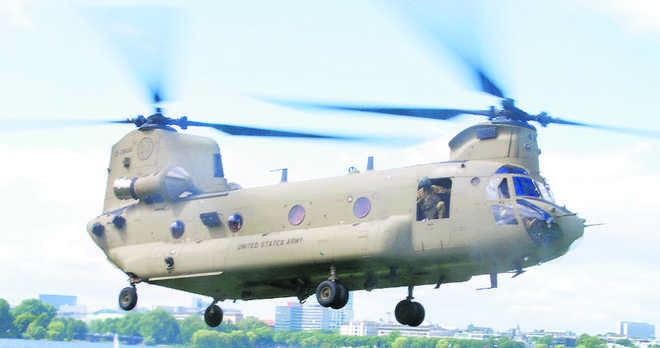
In what will augment the capabilities of the Indian Air Force and enable rapid deployment of troops, the first lot of four CH-47F Chinook helicopters arrived in India on Sunday at a port in Gujarat.

These helicopters will be based at Chandigarh, the existing home of the 126 Helicopter Unit, which holds the Soviet-origin heavy lift copters Mi-26. “The Chinooks will be ferried to Chandigarh where a formal induction is scheduled later this year,” manufacturer Boeing said in statement.

India and the US had signed a deal for 15 Chinook copters in September 2015. The first four are part of that delivery and the next lots will arrive in batches. The four Chinooks arrived at Gujarat on board a ship.

Boeing delivers first four Chinook helicopters for IAF

The Chinook is a multi-mission helicopter that features a fully integrated, digital cockpit management system and a common aviation architecture cockpit. The massive helicopter can carry 9.6 tonne of cargo, including heavy machinery, artillery guns and even light-armoured vehicles to high-altitude areas. It is also used for transport of troops, equipment and fuel. It is also used for humanitarian and disaster-relief operations, in missions such as transportation of relief supplies and mass evacuation of refugees.

The last time a set of Chinooks flew over Chandigarh was in 2015 when the UK’s Royal Air Force sent a few of the Chinooks for assistance during the Nepal earthquake. The copters were then assembled at the Chandigarh base. The city being a supply base for Ladakh, Kargil and Siachen, it also has a base repair depot.


Army questions 3 jawans over kidnapping, killing of J&K soldier Aurangzeb

Army questions 3 jawans over kidnapping, killing of J&K soldier Aurangzeb

Aurangzeb was abducted and killed by militants in Pulwama on June 14. File photo

Ishfaq Tantry
Tribune News Service
Srinagar, February 6

The Army has been questioning  three soldiers over their possible involvement in leaking information about the movement of their colleague Aurangzeb, a rifleman with 44 Rashtriya Rifles, who was kidnapped and killed by militants in south Kashmir on June 14.

The three soldiers are being quizzed on suspicion that they might have knowingly or unknowingly leaked information about Aurangzeb’s movements.

Aurangzeb, who was proceeding on leave for Eid on 14 June, 2018, was kidnapped and later shot in the head and neck.

His body was found by a team of police and Army officials at Gussu village, about 10 km from Kalampora, in Pulwama district, from where he was abducted.

Aurangzeb had taken lift from a private vehicle outside his camp in Shopian, but was being tracked by militants, who stopped the car and abducted him a few kilometres away.

Aurangzeb, who was close to an Army officer who had gunned down Hizbul Mujahideen commander Sameer Tiger in Kashmir in April, 2018, was killed by the militants in Pulwama last year.

The three soldiers, all locals and belonging to the 44 Rashtriya Rifles, have been identified as Abid Hussain Wani, Tajamul Ahmed and Adil Wani.

Though the Army is tightlipped about the questioning of the three soldiers in Aurangzeb killing, an official on condition of anonymity disclosed that “the three soldiers are with them and an Inquiry to ascertain their role is currently underway”. He did not elaborate further.

One of the soldiers under the scanner is brother of Abid Tauseef Wani — who was allegedly tortured by an Army officer in Shadimarg camp — where Aurangzeb was posted.

Wani is currently undergoing treatment at SMHS hospital here.

“Abid, originally working with JAKLI. He was posted with 44 Rashtriya Rifles, when he was detained in June. Since then, we have not heard about him. The Army is not telling us anything. The Army on Monday also took his younger brother Towseef and tortured him under custody, who is now admitted in SMHS Hospital in Srinagar,” a relative of Abid told The Tribune.

“Apart from Abid, the Army has also detained two other soldiers namely Adil and Tajamul,” the relative said.

3 security men suspected of leaking info  

  • An Army officer on the condition of anonymity said “the three soldiers are with them and an inquiry to ascertain their role is currently underway.
  • It is suspected that the detained soldiers might have leaked information about the movement of Rifleman Aurangzeb (in pic) to the militants.

Marching to patriotic beat

Marching to patriotic beat

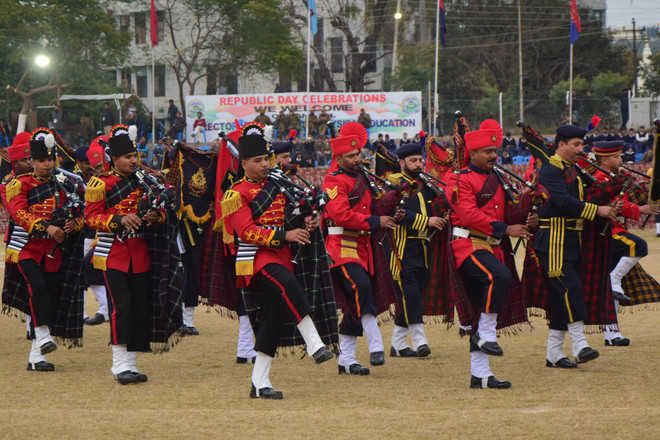
  • The Beating Retreat ceremony, held at the sports stadium of the University of Jammu on Tuesday, marked the grand finale of this year’s Republic Day celebrations.
  • The event was witnessed by Governor Satya Pal Malik; Haji Inayat Ali, chairman, Legislative Council; Dilbag Singh, DGP; senior civil, police, Army and CAPF officers, and other dignitaries.
  • Scintillating pipe drum and brass bands of the Army, BSF and J&K Police, on the slow and quick march, played enchanting tunes and received applause.
  • Malik gave away prizes to various brass band pipes and drum contingents for their outstanding display.
  • He also presented awards to Lord Shiva Day Boarding School Ghou, (Girls), Manhasan, Government SRML Higher Secondary School (Boys), Jammu, for the best march-past; and Sainik School Manasbal (Boys) for the best band contingent.
  • The spectacular fireworks added colour to the ceremony. The function concluded with patriotic song ‘sare jahan se achha’ and National Anthem.

Ashok Chakra for Kashmiri militant who turned soldier

NEW DELHI: Lance Naik Nazir Ahmad Wani, a surrendered militant who became a soldier, will be posthumously awarded India’s highest peacetime gallantry award, the Ashok Chakra, on Republic Day for his courage during a fierce encounter in which six terrorists were killed in Kashmir last November.

Wani belonged to an army unit raised 15 years ago with surrendered militants as an experiment to rewrite the rules of counterterror operations in Kashmir.

President Ram Nath Kovind will present the award to Wani’s wife, Mahajabeen Wani, at the 70th Republic Day parade, the army said on Thursday. Wani, who was 38 when he died, will be the first soldier from Kashmir to be awarded the Ashok Chakra. Thus far, 88 individuals have been awarded the Ashok Chakra; of these 68 have been awarded posthumously.

Exactly two months ago, on November 25, 2018, the army received intelligence on the presence of six heavily-armed terrorists at Hirapur village in south Kashmir’s Shopian district.

Wani and his squad were asked to block the terrorists’ most likely escape route, a standard drill during such operations.

The soldiers closed in on the target house and positioned themselves to engage the terrorists at close range.

“Sensing danger, the terrorists attempted breaching the inner cordon, firing indiscriminately and lobbing grenades. Undeterred by the situation, L/Nk Nazir held ground and eliminated one hard core terrorist [a district commander of LeT] in a fierce exchange at close range,” said a notification issued by the President’s secretariat on Wednesday.

Nazir’s second kill followed a few minutes later when he fearlessly stormed into the house, amid bullets and grenades flying around him.

“Seeing the foreign terrorist escaping from the window, he [Wani] encountered him in a hand to hand combat situation. Despite being severely wounded, L/Nk Nazir eliminated the terrorist,” the notification added.

In the ensuing gun battle, Wani was hit multiple times, and took a shot to the head, army officials said. Bleeding heavily, the soldier continued to engage the remaining terrorists and injured a third one at close range. His action helped his squad kill the remaining terrorists. Wani even helped evacuate his wounded colleagues before succumbing to his injuries. This was not the first time Wani demonstrated courage in combat, according to army officials. He was twice decorated with the Sena Medal.

‘Under hail of bullets, Lance Naik Wani eliminated Lashkar dist commander’

RINAGAR : The day Lance Naik Nazir Ahmad Wani was killed in a gunfight with militants, he had managed to eliminate two terrorists including a Pakistani, in a fist fight. For his bravery, Wani, who was earlier associated with Ikhwan (a group of militants who turned counter insurgents in mid 1990s) before joining the Indian Army, is the first Kashmiri to get the Ashok Chakra–India’s highest peace time gallantry award, posthumously.

“President Ram Nath Kovind will present the award to Wani’s wife Mahajabeen on the Republic Day in New Delhi,” army spokesperson Colonel Rajesh Kalia said.

A neighbour of his family in south Kashmir’s Kulgam said Wani’s family had left for New Delhi a few days ago to receive the award.

Wani was killed in a fierce gun battle with militants on November 25, 2018 in Shopian district ,in which six militants were also killed including three district commanders – two of Hizbul Mujahideen and one of Lashkare-Taiba.

“Under intense hail of bullets from the terrorists Wani eliminated the district commander of the LeT and one foreign terrorist in a very daring display of raw courage,” Colonel Kalia said, while describing Wani as “Kashmir’s seasoned warrior”.

Wani sustained bullet injuries during the encounter and was provided immediate first aid and evacuated to 92 Base Hospital, but unfortunately succumbed to his injuries.

Wani joined the Indian Army’s 162 Infantry Battalion Jammu and Kashmir Light Infantry, in 2004. He was operating with 36 RR when he lost his life in the encounter. A press release from the President’s Secretariat said that the award was approved for Wani for his act of “most conspicuous gallantry”. It stated how “swiftly” he moved with his team and eliminated a militant who was “firing indiscriminately and lobbing grenades” while attempting to “breach the inner cordon”.

Wani further closed in towards the target house under heavy fire and hurled grenades. “Seeing the foreign terrorist escaping from the window, he encountered him in a hand to hand combat situation. Despite being severely wounded, Wani eliminated the terrorist,” the communiqué from the secretariat said.

Wani was 38 and belonged to Cheki Ashmuji village of Kulgam Tehsil. He was a highly decorated soldier who was awarded Sena Medal twice. “The 2018 Sena Medal was given for eliminating a terrorist from a very close distance.…To fight the onslaught of Pakistan supported terrorist outfits, he operated with Rashtriya Rifles units in Kashmir. He always willingly faced grave potential threats ,” Kalia said.

“He was mindful of the problems of his village and surrounding areas. He had also done acts of selfless service in the area he belonged to. His heroic efforts during operations will be a beacon of light for the youth of Kashmir,” he said.


3 air surveillance squadrons for Navy Naval Air Station Shibpur to be commissioned as INS Kohassa

3 air surveillance squadrons for Navy

Tribune News Service

New Delhi, January 18

The Indian Navy will get three new air squadrons to ramp up maritime surveillance around Gujarat and Tamil Nadu with the government giving its sanction.

A total of 12 Dornier aircraft have been procured and deliveries commence this month. This is a substantial contract for the indigenous HAL-built maritime surveillance version of the Dornier 228 aircraft.  The new aircraft being delivered under this contract are fitted with improved state-of-the-art sensors and equipment, which includes glass cockpit, advanced surveillance radar, optical sensors and networking features.

The aircraft will enhance maritime awareness of the Navy through round-the-clock sensor-based surveillance and provide targeting data in areas of operation to ward off terror and other threats from sea.

The government has also sanctioned manpower towards manning additional aircraft in existing Dornier surveillance squadrons in Kerala and Andaman Islands.

Separately, the Navy today said a new Naval Air Station (NAS) Shibpur will be commissioned as INS Kohassa on January 24. INS Kohassa has been named after white-bellied sea eagle, which is a large bird of prey endemic to Andaman and Nicobar Islands.

NAS Shibpur was established in 2001 as a Forward Operating Air Base for surveillance in North Andaman. With the addition of this airfield, the Andaman and Nicobar Command (ANC) will have the ability to operate independently.


5 dead, 5 feared trapped as avalanche hits Khardung La in Ladakh

http://

Arteev Sharma
Tribune News Service
Jammu, January 18  

Five persons were killed and five others were missing after their truck came under an avalanche in the Khardung La area of the Ladakh region of Jammu and Kashmir on Friday, officials said.

The avalanche hit the truck carrying 10 persons at the Khardung La pass in the Ladakh region at 7 am, an official of the Border Roads Organisation (BRO) said.

The BRO pressed into service its men and machinery to rescue the passengers of the truck, who were believed to be trapped under the debris, he added.

The police, Army and State Disaster Response Force (SDRF) personnel had also reached the spot, the BRO official said.

“So far, the bodies of five persons have been recovered from the avalanche site, while a search is on for the other missing persons,” he added.

A bulldozer driver posted at the Khardung La Pass said two tippers and a Scorpio vehicle carrying about 12 persons left towards K-top area early morning to load snow to Leh.

“One tipper was already loaded with snow. However, the mishap occurred when they were loading another vehicle. Suddenly, an avalanche hit them and 10 people in a tipper were buried under the snow,” he said.

A senior police official said, “At least 10-12 people were trapped under the snow and a body of a local resident from Leh has been recovered from the area. Fresh snowfall took place in the area on Thursday and they had gone to collect snow in a vehicle.”

Rescue teams of police, Border Roads Organisation and Jammu and Kashmir Disaster Management Force have reached the spot.

A high alert for avalanche was sounded on Thursday by the administration following adverse weather advisory by the Met department.