Sanjha Morcha

What’s New

Click the heading to open detailed news

Current Events :

web counter

Print Media Reproduced Defence Related News

Despite ban, free access to Pak channels in J&K 34 Pak channels are banned in J&K for airing fake news

Despite ban, free access to Pak channels in J&K

Amit Khajuria

Tribune News Service

Jammu, September 22

Despite ban on most Pakistan channels, residents of Jammu and Kashmir are receiving all such channels on a free-to-air dish available easily in the market.

Ever since the abrogation of Article 370, demand for the dish has grown manifold as the authorities have imposed restrictions on local cable operators from transmitting certain channels allegedly spreading vicious propaganda to instigate people. A free-to-air dish launched last year had been popular among subscribers as they received all Indian channels, excluding few paid channels, on one-time payment. However, a bigger dish launched a few months ago has been lapped up by subscribers in the Valley and Muslim-dominated districts of Jammu region as it beams Pakistan channels.

“There is little demand in Jammu city, but people from Doda, Bhaderwah, Kishtwar, Poonch and Rajouri come looking for the dish, as it is in short supply in their area. Dealers from these districts and the Valley procure it directly from Delhi,” said a Jammu dealer.


When the Dragon hides its shine and bides its time by Lt General K J Singh

China recently released a white paper titled “China’s national defence in the new era”, which sets the template and vision for her strategic architecture. The basic thrust is to create modernized People’s Liberation Army (PLA) by 2035 and establish global presence (implying dominance). Considering our geopolitical realities, paper surprisingly has not evoked adequate analysis and debate. While the paper makes only passing and even reassuring references to India, suggesting carrying forward experiences gained in resolution of Doklam crisis to other contentious issues.

The dynamics of unresolved border dispute with continued transgressions, trade war and impending visit of Chinese President Xi Jinping mandate objective and detailed appraisal of document. Paper is in keeping with articulation of ‘aggressively rising China’ and confirms jettisoning of Deng’s approach of ‘hide your shine, bide your time’.

It seeks to upscale and give global context to limited wars under conditions of informationalization (Chinese formulation for high-tech conditions), which was initially spelt out in ‘war zone concept’ in 2004. Leveraging of Belt Road Initiative (BRI) is envisaged to extend footprint to bases like Djibouti and Gwadar, thereby giving PLA capability to manage localized regional environments, in faraway lands. This outreach includes cyber dimension through ‘digital silk road’, backbone architecture of digital and convergence technologies with clear cut aim to achieve spectrum domination. It also places heavy reliance on technology and in specific on non-kinetic cyber warfare, artificial intelligence, quantum convergence technologies among others. At the same time, kinetic delivery means like hypersonic missiles and rocket force continue to provide hard under pinning.

Considerable share of resources is planned to be re-appropriated for Navy to make it truly blue navy. Consequently, only credible official reaction came from Chief of Naval Staff, “We will have to watch China carefully”. The need for dispassionate and thorough analysis is also warranted as psychological warfare is an essential part of ‘three warfares’ mandate of newly configured PLA Strategic Support Force. The exercise will indeed be painstaking one as war zone concept that generated much hype and even some panic till we realized limitations of translation from Mandarin to English. It is also pertinent that many technologies are yet to be operationalized and applied. Most importantly, performance of Chinese troops in low-grade conflicts, even in relatively benign UN deployment, raises its own set of concerns and cynicism. Similarly, sceptics may cite BRI overstretch and fatigue, but Dragon has tentacles firmly in place in relevant places. While we cannot allow ourselves to be psyched or intimidated, yet complacency will be suicidal. The abiding reality is that China is prosecuting long term strategy, which may include some hype but is essentially ‘on course’.

The obvious question is how do we cope with the second largest spender PLA, which, according to Stockholm International Peace Research Institute (SIPRI), has increased its military expenditure by 5% to $250 billion in 2018 against our measly $66.5 billion? It is interesting that China maintains that it is reducing its defence spending as share of GDP. In a burgeoning economy and with high current GDP share, both are indeed possible. Coping, in our context is limited to bare essentials, which are, building ‘credible dissuasive deterrence’ and retaining ‘strategic autonomy’ in our immediate neighbourhood and core areas of interest like energy.

The foremost requirement is to reset strategic compass and, borrowing Admiral Raja Menon’s expression, “Defining our Strategic Environment”, especially with projected aspirations to become $5 trillion economy by 2030. Analytical exercise obviously cannot be driven by gut feelings, hunches and impulses, which appear to be the current trend. This presumption is based on the fact that very limited information on security dialogue is being disseminated by official agencies. It is possible that secrecy is partially driven by urge to build ambiguity and keep others guessing. Ambiguity is normally applied by stronger power against weaker one, but it has its inherent limitations specially when not backed by will and capability. Weaker nations like Iran in standoff with USA and Pakistan have nuanced irrationality to their advantage. We certainly are not aspiring to join this league. It has dangerous implications in exchanges among nuclear powered adversaries and, above all, can even confuse own forces. Hence, it will be in order if we have more inclusive dialogue and apply quantified net assessment and operational research techniques, which currently seem to be on back burner, to forecast and validate.

The dialogue should aim to build national policy after consultations with all parties and political consensus on key parameters. The role of bordering states is also catalytic as progress on key irritants like sharing of river waters as also economic co-operation needs to be driven by states concerned. Our efforts in the past have been stymied by lack of capability and infrastructure, both requiring considerable financial outlay.

Without creating capability for envisaged role of regional security and disaster relief provider, our endeavours even in immediate neighbourhood will remain contingent on friendly governments in power. It is heartening that issue of finding money, including non-lapsing funds for defence capital expenditure has been referred to Seventh Finance Commission. It is hoped that correctives will be applied on priority as with lapsing of time, another election will loom large adding to compulsion for populist measures like subsidies. The stability and political capital of current government should also be leveraged to push down reforms like CDS, theatre commands, National Defence University and genuine integration in MOD.


AirAsia starts Delhi flight

AirAsia starts Delhi flight

Tribune News Service

Mohali, August 1

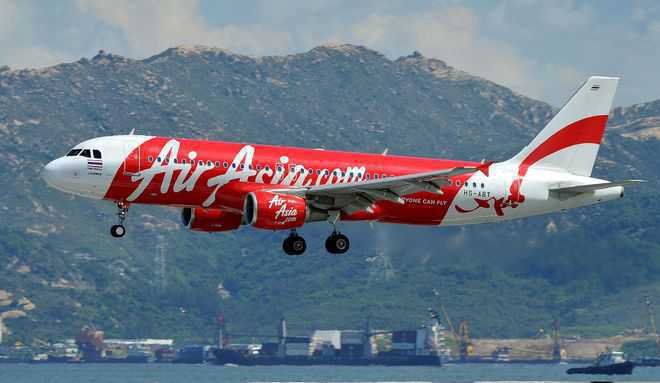
Low-cost carrier AirAsia started its Chandigarh-Delhi-Chandigarh flight operations from the Chandigarh international airport at Mohali today.

The airline’s Chandigarh-Delhi flight took off from here at 12.50 pm and reached Delhi at 1.55 pm. The launch fare of the flight has been set at Rs 1,365 per passenger.

The airline is already operating its Chandigarh-Bengaluru flight from here. The response to the low-cost flight is said to be encouraging.


PM shares pictures of visit to Kargil during war

PM shares pictures of visit to Kargil during war

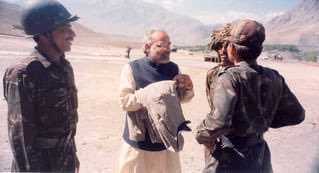
Photo tweeted by Prime Minister Narendra Modi.

New Delhi, July 26

As the nation observes the 20th anniversary of the Kargil war, Prime Minister Narendra Modi on Friday shared pictures of his visit to the area during the conflict and his interaction with the soldiers.

“During the Kargil War in 1999, I had the opportunity to go to Kargil and show solidarity with our brave soldiers,” he said on Twitter.


The prime minister said that in 1999, he was working for the BJP in Jammu and Kashmir and Himachal Pradesh.

“The visit to Kargil and interactions with soldiers are unforgettable,” Modi said.

In the photographs, he is seen interacting with army men and meeting wounded soldiers. PTI


Run for Martyrs’ marks Kargil Vijay Diwas

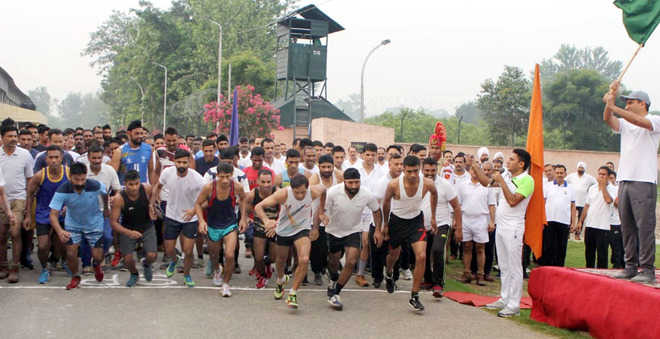
BSF and Army jawans take part in the ‘Run For Martyrs’ to mark the ‘Kargil Vijay Diwas’ in Jalandhar on Wednesday. Photo: Sarabjit Singh

Jalandhar, July 24

As a part of the week-long programme started by the BSF, Jalandhar Frontier, a five-km race, ‘Run for Martyrs’, was organised at the BSF headquarters here this morning to commemorate the 20th anniversary of the ‘Kargil Vijay Diwas’ and to pay tributes to martyrs of the Kargil War.

Mahipal Yadav, Inspector-General, BSF, Punjab, flagged off the race by waiving the green flag.

The run commenced from Ashwani Stadium via BSF Gate No 3 and reached the Army Mill Road, (main road Jalandhar to Ludhiana) and concluded at the Ashwani Stadium.

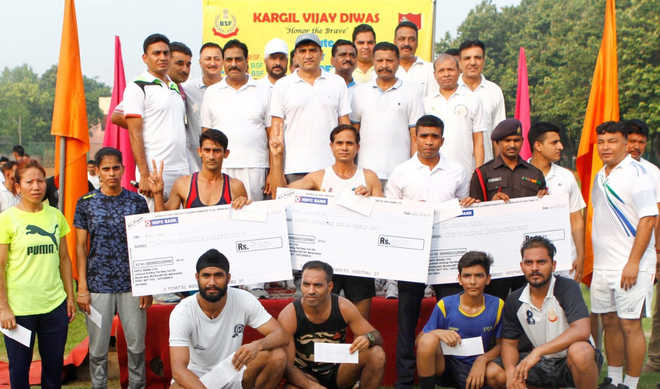
As many as 350 BSF personnel’s and soldiers of the Indian Army participated in the run. The winners were awarded by Mahipal Yadav.

Arakshak Babu Lal (BSF, Punjab) won the first positions and was given Rs 3,100. Arakshak Rajmal (BSF, Punjab ) remaind second. Sepoy Suman Sen (Indian Army, core camp) bagged the third position.


Major Shankla’s statue unveiled in Panchkula

Major Shankla’s statue unveiled in Panchkula

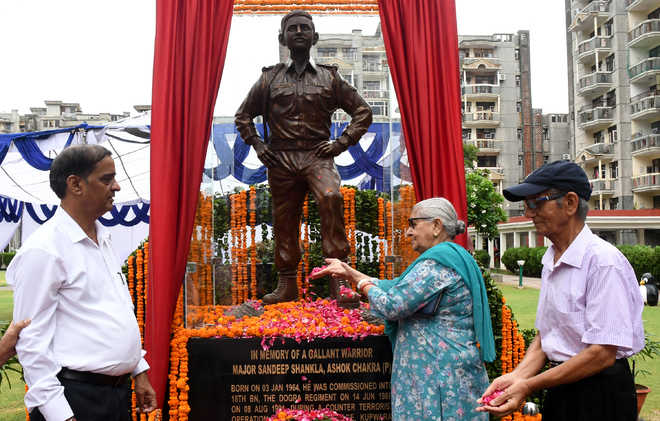
Major Sandeep Shankla’s father Lt Col JS Kanwar (retd) and mother Manju Kanwar pay floral tributes at his statue unveiled at the AWHO Society in Sector 20, Panchkula, on Tuesday. TRIBUNE PHOTO: RAVI KUMAR

Tribune News Service
Panchkula, July 9

Panchkula MLA Gian Chand Gupta unveiled the statue of Major Sandeep Shankla at AWHO Society in Sector 20 here today.

The statue has been set up by the Panchkula Municipal Corporation in memory of the martyr, who died fighting for the unity and integrity of the country.

It is pertinent to mention here that on August 8, 1991, Major Shankla’s battalion, 18 Dogra, carried out a search and cordon operation at Zafarkhani village in Kupwara district. A soldier was injured in the crossfire with terrorists and Major Shankla, unmindful of the enemy fire, crawled out to drag him to safety, killing a terrorist. The terrorists then lobbed two grenades at the officer, of which one he hurled back at them, sustaining splinter and bullet injuries in the process. But he kept fighting till he lost consciousness.

The operation had resulted in the elimination of nine terrorists and apprehension of 22. He was posthumously awarded with the Ashok Chakra, the highest peacetime gallantry award.

Addressing the gathering of Army officers and their families, Gian Chand Gupta said by setting up the statue, the Municipal Corporation had paid tributes to the martyr who made the city proud by sacrificing his life in the line of duty. Major Sandeep Shankla was a resident of Panchkula and he had laid down his life for the unity and integrity of the country.


20 yrs later, Luv journeys to ‘meet’ twin Kush

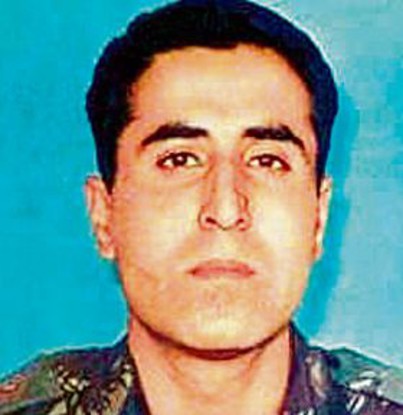
Capt Vikram Batra

Ajay Banerjee

Tribune News Service

New Delhi, July 6

It will be a journey for which Luv has waited for 20 years, to be at the same spot where his identical twin Kush sacrificed his life for the country — atop a 16,000-foot-high Himalayan massif along the Line of Control.
On Sunday, it will be exactly 20 years when Kush, Capt Vikram Batra, a resident of Palampur, Himachal Pradesh, sacrificed his life during the Kargil war (May-July 1999).

Vishal Batra, known in his family as Luv, will be there to mark his brother’s death anniversary. “I am going to ‘meet’ my brother, up there,” Vishal said just hours before he boarded a flight en route to Drass at the base of the peak in Jammu and Kashmir.
Vishal will be heli-dropped to reach Point 4875 (altitude of the peak in metres), now known as ‘Batra top’. “I had the option of climbing the peak, but the Army advised acclimatisation of at least one week, which was not possible due to time constraints,” says Vishal, who is a banker in Chandigarh.

At Point 4875, Capt Batra had led the assault by his ‘paltan’, 13 JAKRIF, to get it vacated from Pakistan army’s illegal occupation. In September this year, Capt Batra, a Param Vir Chakra recipient, would have turned 45.

Gen VP Malik, in his book ‘Kargil: From Surprise to Victory’, describes Capt Batra, who after killing four Pakistani soldiers in a hand-to-hand fight and capture of Point 5140 called his Commanding Officer and radioed the victory code: Yeh Dil Mange More…

A popular advertising jingle of the 1990s, the code was selected by Capt Batra during the pre-assault briefing by the CO, Lt Col YK Joshi (now Lt General). Point 5140, the highest occupied point on Tololing ridge, was captured on June 20. Lt Gen Joshi, awarded the Vir Chakra, will be on Batra top with Vishal. A climbing expedition of 13 JAKRIF will reach the same day.


What India must do to promote national security

It will need to restructure the armed forces to deter Pakistan and China, while gradually building its potential

Wit ht he din of elections over, there could not be a more opportune time for the new dispensation to ensure that important pointers from transborder actions like Balakot do not get obliterated but are acted upon.

HINDUSTAN TIMES■ Politicisation of the armed forces has grave ramifications. It distorts the apolitical fibre of our armed forces and is a dangerous portent for national securityFirst, while it was heartening to see everyone praise the Indian Air Force after Ba lakot, the chest-thumping and credit capturing between political parties that followed, with some even questioning whether the strike had taken place at all, was most unfortunate. Such events do prop el security dialogue to the forefront, but military operations remain the preserve of the government for ordering them and the armed forces for carrying them out. Such politic is at ion distorts the a political fib re of our armed forces and is a dangerous portent for national security.

Second, while the government’ s decision to strike and effectively combat Pakistan retaliation was the right one, between 2015 and 2018, many terror attacks went without a response and accountability. Is there an institutionalised decision making mechanism in place at all? India is perhaps the only major democracy where the armed forces headquarters are outside the apex governmental structure and, therefore, not institutionally part of the decision making process. It is imperative that we have an Act of Parliament which man dates the creation of a permanent Chief of Defence Staff (CDS), thereby making the armed forces apart of the decision making mechanism for cogent single point military advice to the government. The Defence Planning Committee recently created under the chairmanship of National Security Adviser (NSA) has been

established through an administrative order and thus remains unaccountable to Parliament. But it cannot replace the idea of a permanent CDS created by statute.

Third, the 2019 elections pushed national security to the fore, if rhetoric and party manifest os were anything togo by. Political parties must note that having spelt out big ticket plans, public discourse is going to gets harper. If their manifestos offer to “speed up purchase of outstanding defence equipment and weapons or ensure defence spending is increased to meet the requirement of the armed forces,” then questions regarding the time plot for implementation and budgetary support cannot be faulted. On the other hand, if they promise to “establish the office of CDS to act as the principal adviser to the government on defence matters or provide statutory basis to the National Security Council and the office of NSA, with both being accountable to the Parliament ,” they will have to be showcased with a timebound plan for execution; or else the intent could rightly be questioned. Against the back drop of India fielding an aging Mi G 21 Bis onto combat a modern Pak F–16, they ’ll be justified in asking for modernisation to be expedited with reasons for delay, enlarging the query to: Are the defence forces properly equipped and organised? Are they being looked after? Is it well honed? It is good that national security has become an electoral issue, but if the concern does not endure after votes are won, it will be the last time one will seethe issue at centrestage. That will jeopardise the nation’s security.

Fourth, Pakistan’s nuclear bluff has been called, but has catapulted India such that it can no longer be seen as a soft State. For this perception to last, India must equip, modernise and restructure the armed forces posthaste for 21st century warfare to deter Pakistan and dissuade China from aggression, while gradually building its potential.


US-China trade spat, Iran tensions to dominate weighty G20

US-China trade spat, Iran tensions to dominate weighty G20

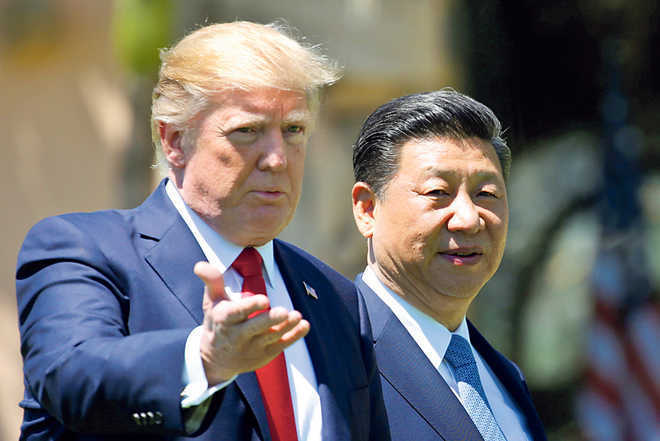
Donald Trump and Xi Jinping. File photo

Osaka, June 26

The trade battle between the US and China, and fears that spiralling tensions with Iran could erupt into conflict are poised to dominate a high-stakes G20 summit from Friday.

With hotspots North Korea and Venezuela and a slowing world economy also high on the agenda, the two-day gathering of leaders from the world’s group of 20 leading nations in Osaka, Japan, could be one of the most pivotal in years, analysts say.

Trump last week sparked hopes for a detente in the long-running trade war when he said he would hold “extended” talks with Xi after a “very good telephone conversation”.

For his part, Xi told Trump that “China and the US will both gain by cooperating and lose by fighting”, according to Chinese state media.

The two sides were close to a deal when talks broke down abruptly last month and markets are hoping the leaders’ first face-to-face talks since December, when they met at the last G20 in Argentina, can break the deadlock. has hit $200 billion of Chinese imports with levies and has threatened to impose them on an additional $300 billion, which would hurt China’s already slowing economy and spread the gloom worldwide.

Observers said a decisive breakthrough was possible at the talks, which are expected on Saturday, but was not the most likely scenario given the complexity of the issues.

“President Trump likes deals, so he might agree to something,” noted Matthew Goodman, an economics expert at the US-based Centre for Strategic and International Studies.

“More likely is that they will agree to a truce and to restart talks and…try to come to some sort of deal within three months,” added Goodman.

Trump could also threaten to raise tariffs to 40 per cent if talks fail, he warned, adding: “It’s not going to solve the immediate problems.”

Economists and markets are hoping some sort of pact can be agreed as the stuttering global economy can ill-afford further trade tensions between its two biggest players.

“This is bad for everyone…it’s a no-win situation,” said Denis Hew, director of the Policy Support Unit for APEC (Asia-Pacific Economic Cooperation).

Alice Ekman, head of China Research at the French Institute of International Relations, said the world should brace for a lengthy period of frosty relations as Washington and Beijing also scrapped over technological domination.

“The tensions are such that even if we get to a deal…this (the trade war) will leave its mark, and we are now engaged in a long-term rivalry,” she told AFP.

The other topic likely to dominate the meeting is North Korea’s nuclear programme and here again the meeting between Xi and Trump is likely to be key.

Trump will travel to South Korea after the G20, with talks between Washington and Pyongyang stalled after February’s failed summit in Hanoi.

But Trump and North Korean leader Kim Jong Un have been exchanging personal letters, with Kim vowing to “seriously contemplate” the “excellent content” in the recent missive from Washington, while the US leader hailed a “beautiful letter” from Pyongyang.

The G20 comes days after Xi wrapped up a highly symbolic visit to the isolated state and a recent defector from North Korea said the Chinese leader would likely come bearing an offer to the US side.

“They want to use President Xi as a mediator in the G20,” Thae Yong Ho told reporters in Tokyo.

Iran will also loom large after Trump called off a planned military strike but then imposed sanctions against its supreme leader Ayatollah Ali Khamenei and threatened the country with “obliteration” if it sought war.

Aware that attention is likely to focus on the US-China trade talks, the Japanese hosts are trying to focus on their priority areas, including the fight against ocean plastic and the challenges faced by ageing populations.

“There has been over a year’s worth of preparation and very dedicated hard work gone into this…So I hope the media also pays attention to the other aspects that will be discussed at the G20,” pleaded Masatsugu Asakawa, Japan’s top finance diplomat. AFP