




Sanjha Morcha

What’s New

Click the heading to open detailed news

Current Events :

web counter

Print Media Reproduced Defence Related News

Of winged foot-soldiers by Lt Gen Baljit Singh (Retd)

Lt Gen Baljit Singh (Retd)

Lt Gen Baljit Singh (Retd)

AS I  watched the proud and dignified ceremony of ‘Colour Presentation’ to the Army Aviation Corps (AAC) by the President on October 10 on the TV screen, my mind wandered both to the charismatic Army Chief who had created this new entity 33 years ago, as also to the intrepid four gentlemen officers who on August 14, 1947 had clandestinely created its nucleus.

A few days after the Government announced Gen K Sundarji as the COAS designate, he took a 14-day sabbatical with an Army establishment at Panjim, locked himself inside their guest suite, dictated to his stenographer and refined an 80-odd pages document titled ‘Army Vision 2020’. And the first demonstrable fruition of that vision was the inauguration of the AAC in 1986, an attribute which had its origin in the French army during WW I.

However, AAC’s legacy in the Indian Army is embedded in a charming act of daring piracy! During the fading days of WW II in the Burma theatre, it was decided to train Artillery officers to fly slower aircraft, enabling them to direct fire of their guns beyond the ‘contact battle zone’ to disrupt movement of enemy reinforcements and logistics chain; they were given the designation ‘Air Observation Post (AOP)’ and by December 1946, five officers had been trained in the UK and posted to the only AOP squadron in mainland Asia, at Lahore.Four among that nucleus, Captains Butalia, Govind Singh, Sridhar Mansingh and Sen, had a premonition that at the midnight hour of August 13, 1947, Pakistan would assign all assets of the AOP squadron to itself. So, taking the law into their hands, they flew out at the crack of dawn on August 14 in four Tiger Moths, landed at Amritsar, flagging the de facto and de jure creation of Independent India’s Army AOP establishment! Quite inexplicably, Butalia was inducted into the newly created Indian Frontier Service but fortunately, another trainee, Major Sahane, would fill the vacant slot.

Come October 1947, the AOP would be baptised by fire on the battlefield all through the J&K war. The very first assignment they performed was of great historical significance when on October 27, Prime Minister Nehru deputed Baldev Singh, the Defence Minister, and Maj Gen KS Thimayya, DSO, to witness the signing of the ‘Instrument of Accession’ by Maharaja Hari Singh and they would be flown to Srinagar and back by Sridhar Mansingh.It became an obsession with this new breed of foot-soldiers to spot and silence enemy guns, unmindful of hostile anti-aircraft gunfire. Maj Sahane would disable or silence several Pakistani guns in the Rajouri sector and would receive the AOP’s first VrC for gallantry. Similarly, unfazed by the intensity of mortar and gunfire at Naushera, Mansingh would land and evacuate to Jammu the fatally wounded Brig Mohamad Usman, MVC. In due course, Mansingh too would be awarded the VrC for conspicuous gallantry.

Perhaps the maverick among these pioneers was Govind Singh. A quintessential episode which this veteran recounted is the stuff of legends. When his flying instructor in the UK declared him as ‘lacking flying aptitude’, Govind would confront him with his inimical earthy logic thus: “Sir, I come from a village in Garhwal where no one has seen a bicycle yet, much less ride one. So how do you expect me to fly solo in the same time-frame as your countrymen?” Govind won the much-deserved reprieve!

Govind as a flyer would become the toast of the AOP. When dared, he landed on a hockey field. And on another occasion, he flew under the bridge spanning the Darna river (Deolali, Maharashtra) and then performed a steep side-turn to clinch the wager! Happily, the progenitors of those pioneers, now in the avatar of AAC, are a true reflection of AOP’s magnificent credo: ‘Unarmed and Fearless into Battle’.

Inside the Navy’s Plans to Fight China’s Submarines

An art learned in two World Wars.

by Charlie Gao

Key point: The Navy has a wide variety of modern weapons to find and destroy enemy submarines.

With things heating up in the South China Sea (SCS), much attention has been paid to the ships and submarines that could potentially square off against each other in the region. This ignores a key asset of most navies that is already on the “front lines” and shaping military interactions—Maritime Patrol Aircraft (MPA). Skillful use of these aircraft may determine how an engagement plays out, or it could prevent one from happening in the first place.

MPA have been around almost as long as combat aircraft. Navies quickly realized the potential of aircraft when it came to patrolling the sea, as they could move far more quickly than boats and had the significant advantage of altitude.

But modern MPA use advanced sensors to detect to see far more than what can be seen with the naked eye—Magnetic Anomaly Detectors (MADs) can detect underwater submarines, and radar systems are used to detect ships that might just be specks on the horizon. Infrared/thermographic cameras allow MPA to identify vessels even at night.

MPA can also deploy sonobuoys, floating sensors that either detect noises or send out pings to find submarines. ELINT sensors can detect the radar emissions of enemy MPA or ships. All of these sensors means that MPA are incredibly useful in peacetime as well as wartime.

Michael Zehaf-Bibeau attacks the Parliament of Canada in Ottawa, Ontario, Canada, killing a soldier and injuring three other people.

Sponsored

Advertisement

Sponsored

Advertisement

One way they could deter potential escalation is through detecting potential violations of EEZ or civilian ships in contested waters ahead of time through the use of radar and infrared. Since modern MPA have all-weather detection capability, they can watch for fishing vessels day and night, and give a navy an advanced warning of such violations so they can be headed off before a more violent encounter up close.

MPA also can provide critical information in tracking enemy submarine posture. While this is a more intensive and not “guaranteed” way to track submarines—as the battle between submarine stealth and submarine detection is ongoing—determining the patrol routes and positions of enemy submarines is critical information. Such intelligence may allow nations to avoid potential losses to convoy raiding (if it occurs) and set up anti-submarine warfare plans before the event of war.

In their traditional role in the detection of surface ships, MPA are critically important in the SCS region. Due to the relatively short distances between islands, MPA flying out of Japan or Taiwan could potentially track the movement of ships from base to base in China.

Basic MPA surveillance radars like the Seaspray 5000 have publicized ranges of around 200 nm. The more advanced AN/APS-115 and AN/APS-137D(V)5s mounted on Japan, and Taiwan’s P-3C MPA undoubtedly have better performance. Even with a 200 nm range, an MPA flying over the East China Sea could easily track ships moving south along China’s coast.

This could yield significant strategic intelligence on the development and deployment of Beijing’s People’s Liberation Army Navy (PLAN). In addition, the ELINT suite onboard these aircraft could provide insight into the capabilities of Chinese radars.

Recommended: Imagine a U.S. Air Force That Never Built the B-52 Bomber

Recommended: Russia’s Next Big Military Sale – To Mexico?

Recommended: Would China Really Invade Taiwan?


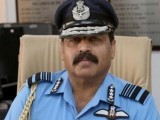
Bhadauria: IAF needs pilots, not coconuts

PHOTO: FILE

Indian Air Force (IAF), Air Marshal Rakesh Kumar Bhadauria. PHOTO: IAF

When Air Chief Marshal Rakesh Kumar Singh Bhadauria took over the Indian Air Force (IAF), we were wondering how time passes so quickly. As part of the family of a Pakistani army officer deputed for the Staff Course at the Defence Services Staff College Mirpur (in now Bangladesh), we had the opportunity to interact with the Bhadauria family as Rakesh Kumar was a Wing Commander doing a staff course at Mirpur, Dhaka. Our experience with Indian officers was that they were sharp, wily and hardworking, but had a complex about Pakistan which became more visible as time passed.

Coming back into present times, we have found the same complex about Pakistan, but more pronounced due to the Sanghi rule in India. RSS Bhakts and neo-Nazis have turned every ministry and department into the Sangh Parivar (family). Professionalism is taking a back seat and the Modi cult is the ultimate recipe to fix everything bad in India, whether it’s the downturn in economy, crash of Indian rupee, loss of millions of jobs or the Balakot tree strike; “Modi Hai to Mumkin Hai” (with Modi it is possible).

The February 27 counterstrike by the Pakistan Air Force (PAF), which shot down two IAF intruders, including Wing Commander Abhinandan (some social media activists call him “Abhi none done”), shattered many myths regarding the Indian armed forces and the false aura they had created in the past 20 years.

With the Balakot tree strike, which killed a brave Pakistani crow and injured 10 trees, Indian politico leadership started a blitz of lies and deceits and as “Abhi none done” was “undone” by the PAF and was escorted across the Wagha border in shame, this charade of lies and deceit became a shameless cover-up. Unlike a head of any professional force, former IAF chief Dhanoa was forced to become the face of this cover-up. Despite all the twists and fake stories telling the brave intrusion of Abhinandan and shooting down of a PAF F-16, the international experts on air warfare did not buy the Indian charade of lies and Dhanoa had to do a catwalk with Abhinandan till the last day to keep up the IAF’s morale.

Bhadauria, like a true Rajput, did acknowledge part of the truth that the IAF air defence system had shot down their own helicopter right at the Srinagar Air Base and that a military court would sort out those responsible. Our advice would be to put ex-chief Dhanoa into a lie detecting test and maybe Bhadauria will have to court-martial a lot of the top brass of the IAF for covering up this blatant lie. Unfortunately, the Modi-Amit-Doval circus won’t allow that, as accountability of the military would mean accountability of the political decision makers who wanted to take advantage of the clouds to hide their radar signature.

If one looks at the PR media campaign of the Indian military after February 27, one can see a deliberate attempt on giving more space to the IAF. This campaign has four major facets.

The façade of bravado and fakery to cover up the faux pas of the Balakot incident; project IAF’s technological and numerical superiority by advertising the latest procurements on an almost daily basis; conveying to the PAF that India has taken a head lead over Pakistan in acquiring modern hardware; and lastly, showing political pooja paat as essential element of military power and use of nimboo narial and laddus (lemon, coconuts and sweets) to justify the Shastra Pooja.

Maintain the bogey of limited conventional war under nuclear overhang.

But there are sane and serious voices in India, who are cautioning the politico military leadership. Pravin Sawhney has been regularly commenting on why Pakistan is not a walkover and the fact that Chinese military has marched ahead of India in almost every field and this illusion of machismo and false bravado was of no use.

Although Balakot tree strike and the PAF counter-strike lasted for few hours, the PAF’s aggressive response sent some very strong strategic signals across the globe. Pakistan conveyed to the world that it can display a sure footed response based on political intent and was ready to climb the escalation ladder in a nuclear overhang, when it comes to territorial integrity and honour of the nation. The PAF proved that Indian technological and numerical superiority was a myth and the PAF could dominate the skies over South Asia by displaying superiority over the IAF in technical, technological, training and operational domains. The PAF also displayed unwavering faith in Allah Almighty and the cause of Pakistan.

Pakistan also re-established nuclear deterrence by a quick and bold conventional response, the mere fact that Indian politico military leadership did not venture across the LoC or the international border after 27th February proves that India chickened out in this brinkmanship.

Pakistan’s defence forces displayed that a battle-hardened force can compensate for technological or numerical asymmetry, and there is no alternative to experience.

This takes us to our last part of the paper, an advice to Air Chief Marshall Bhadauria: It’s the spirit and real force which fights in battle. The US-led coalition has the best weapon systems, smart bombs and even nuclear power, but they still failed in achieving their objectives in Afghanistan. Induction of modern weapon system is a common feature in all defence forces, but the Indian military is reminding the hapless people of India that next time they will overpower Pakistani military through numbers and technology. Is this advertisement born out of fear?

Dhanoa, the ex-IAF chief, had a peculiar habit of answering every question with the word ‘No’ and he kept lying through his teeth to convince a Bollywood Zombified audience of more than a billion people that Balakot tree strike was real and ‘Abhi Non Done’ really hit an F-16 before going down. Rakesh Bhadauria should avoid that.

The IAF has the worst air safety records in South Asia and they have lost more than a dozen aircraft in the past one year. When Modi said that he wished Rafale was there on February 27th, it was a slap on the face of the largest air force in the region. This statement by Modi points out that the IAF was unfit for war without new inductions. Should Dhanoa and his team be made accountable for this admission? While we congratulate Mrs Asha Bhadauria on becoming the Chief Parton of AFWWA (Air Force Wives Welfare Association), there is a need to control AFWAA Sazi (Fake news in Urdu) in IAF. The new IAF chief should try enroll some real pilots: Coconuts won’t work in war.

Published in The Express Tribune, October 19th, 2019.

Like Opinion & Editorial on Facebook, follow @ETOpEd on Twitter to receive all updates on all our daily pieces.


Why Arm Lobbyist seemed rattled after New IAF Chief backed Indigenous programs

Air Chief Marshal Rakesh Kumar Singh Bhadauria while interacting with media for the first time very bluntly refused to place additional orders for 36 Dassault Rafale and instantly also killed any speculation of India buying Russian developed Su-57E Stealth fighter jet and for the first time in decades its seems IAF got chief who had clear cut vision for Indigenous airforce and it seems to have dubbed badly on some so-called Defence analysts in the country who have attacked both MWF-Mk2 and AMCA programs off late. IAF is on verge of placing fresh orders for 83 Tejas Mk1A by end of this year and has backed the development of 200 Medium Weight Fighter program (MWF) and also India’s lone 5th generation AMCA fighter jet program, which leaves little space for induction of new jets in the coming decade rather then what already has been planned out earlier. IAF Chief has called for the induction of 114 new fighter jets under MMRCA Tender along with additional orders for the 21 Mig-29 and 12 Su-30Mk1 but out rightly rejected any further orders for additional 36 Dassault Rafale and has also backed away from buying 100+ FGFA fighter jet from Russia, which means that MMRCA tender for 114 units might be last foreign fighter jet type inducted into IAF if for some reason Dassault Rafale is not chosen by India. With little or no scope for any new import of fighter jets, MWF-Mk2 and AMCA programs have come under intense attack in India even before the program has lifted off the drawing board. The MWF-Mk2 program has been attacked for being a 4.5 generation fighter jet program even when air force around the world is making a gradual shift towards 5th generation fighter jets and country is investing in 4.5 gen technology. The second lobby has attacked the AMCA fighter jet program since according to this experts India doesn’t have any technical expertise in undertaking such complex project and others have criticized it timeline which they believe will be difficult to fulfill due to constant delays which we saw in past with LCA-Tejas program.  Two front attacks on countries two upcoming fighter jet programs suggest that new IAF Chief has rattled Arms Lobbyist who see clear backing of the Indigenous programs who can sense that future programs will revolve around Indigenous programs with little or no chance of any imports any further.  Disclaimer : Articles published under ” MY TAKE ” are articles written by Guest Writers and Opinions expressed within this article are the personal opinions of the author. IDRW.ORG is not responsible for the accuracy, completeness, suitability, or validity of any information on this article. All information is provided on an as-is basis. The information, facts or opinions appearing in the article do not reflect the views of IDRW.ORG and IDRW.ORG does not assume any responsibility or liability for the same. article is for information purposes only and not intended to constitute professional advice .

idrw.org .Read more at India No 1 Defence News Website https://idrw.org/why-arm-lobbyist-seemed-rattled-after-new-iaf-chief-backed-indigenous-programs/ .


Postpaid mobiles active in Valley, no Net for now

http://

Tribune News Service

Srinagar, October 14

After 70 days of communication blockade, postpaid mobile services were restored in the Valley today. People were seen calling up friends and relatives as the service was reactivated around 11.45 am.

“I finally managed to call my sister in Delhi after 70 days. She broke down on hearing my voice,” said Imtiyaz Ahmad, a local.

Chaos was witnessed at offices of mobile operators where people queued up for new connections or clearing bills. On October 12, government spokesperson Rohit Kansal had said services would resume on Monday noon, adding there were 40 lakh postpaid subscribers.

There is, however, no word on restoration of prepaid services. The Internet blockade imposed on August 5 remains.


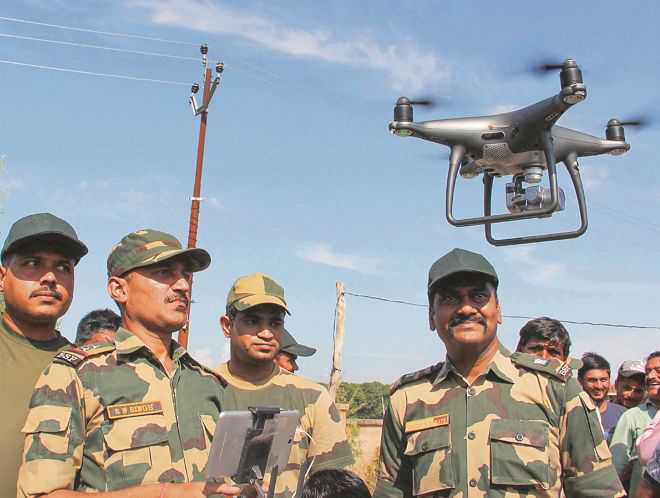
To tackle UAV threat, BSF to buy anti-drone system

To tackle UAV threat, BSF to buy anti-drone system

The BSF has started sensitising the border residents about the need to identify drones.

Anirudh Gupta

Ferozepur, October 14

In order to combat the threat posed by unmanned air vehicles (UAVs) from across the border, the BSF will soon purchase a ground-based anti-drone system with a 360-degree surveillance mode equipped with radio frequency receiver, electronic-optical sensor and a jammer.

Sources said the tenders for the system would be floated soon. The easily deployable anti-drone equipment will be able to work day and night and able to detect multiple drones simultaneously.

In addition to procuring the state-of-the-art system, the BSF has also stepped up vigil and devised several other counter measures to deal with air intrusions in future.

“We had fired on the drones when these were sighted last time. Since then, no drone has been seen,” said a BSF official, adding that the troops manning the border had been directed to scan the skies regularly.

Rubbishing recent reports of the force ‘getting a nod’ to bring down the drones, the official said the option of opening fire in any such exigency was already available to them and was being exercised.

The sources said in places like Ferozepur and Amritsar where the cantonment was located close to the border, the drones were also used for tactical surveillance.

Apart from boosting its technological prowess, the BSF has also started sensitising the border residents about the need to identify drones or flying objects.

According to information, the Central and state security and intelligence agencies have also evolved a joint strategy to deal with any such misadventure along the border.

Though there have been no sightings of drones in the past few days, the security agencies are working out a strategy to prevent any possibility of arms and drug smuggling through the UAVs.

Last week, Punjab DGP Dinkar Gupta had also convened a meeting of various security establishments, including the Air Force, Military Intelligence, BSF, Intelligence Bureau, NIA besides other intelligence agencies.

The meeting was called following the seizure of a huge cache of arms, satellite phones and grenades from the modules backed by Pakistan-based handlers of Khalistan Zindabad Force which were dropped by drones.


Uneasy over lynchings RSS needs to take unequivocal stand on hate crimes

IN his customary address at the Vijayadashami function of the Rashtriya Swayamsevak Sangh (RSS), its chief Mohan Bhagwat tried, in vain, to kill several birds with one stone. He claimed that the term ‘lynching’ was a western construct that was being used to defame India as well as Hindus. He also attempted to dissociate the Sangh from any kind of mob violence and denied charges of Islamophobia against the right-wing outfit. Bhagwat only ended up displaying selective amnesia.

With apologies to Shakespeare, a lynching by any other name would be as heinous. In July last year, the Supreme Court had told the Union and state governments that ‘horrific acts of mobocracy’ could not be allowed to become the new normal, while underscoring the urgency to protect India’s ‘pluralist social fabric’ from bloodthirsty mobs. Five months later, Manipur had become the first state to pass a law against lynching. The fact that a government, and that too BJP-ruled, promulgated the Protection from Mob Violence Ordinance, flies in the face of Bhagwat’s ‘alien concept’ theory.

In most cases of lynchings in recent years, the role of cow vigilantes or religious fanatics has come to light. The chilling murder of Pehlu Khan, a dairy farmer, at Alwar in 2017 and other such hate crimes prompted the Rajasthan Assembly to follow in Manipur’s footsteps. In June this year, Jharkhand’s Tabrez Ansari had died after he was beaten up with rods while tied to a pole and forced to chant ‘Jai Shri Ram’ over an alleged theft. These incidents have largely been the handiwork of elements emboldened by the Sangh Parivar’s Hindutva push amid the BJP’s pan-India hegemony. The RSS has been generally loath to condemn violence directed at the minorities and has made little or no effort to allay their fears. Hate-mongers like Pragya Thakur and Sakshi Maharaj have been allowed to spew venom. The sincerity or otherwise of Bhagwat’s message of maintaining harmony and upholding the rule of law would be demonstrated by how RSS workers and supporters acquit themselves on the ground.


US panel urges India to lift communication blackout in Kashmir

US panel urges India to lift communication blackout in Kashmir

The Asia-Pacific and Non-Proliferation Subcommittee of the House Foreign Affairs Committee has scheduled a hearing on Human Rights in Kashmir and other parts of South Asia on October 22. File photo

Washington, October 8

A powerful US Congressional Committee has urged India to lift the communication blackout in Kashmir, saying it is impacting the lives of the people in the state.

“India’s communication blackout in Kashmir is having a devastating impact on the lives and welfare of everyday Kashmiris,” the powerful House Foreign Affairs Committee said in a tweet on Monday.

“It’s time for India to lift these restrictions and afford Kashmiris the same rights and privileges as any other Indian citizen,” it said.Restrictions were imposed when New Delhi on August 5 scrapped the special status of Jammu and Kashmir under Article 370 of the Constitution and bifurcated it into Union Territories–Jammu and Kashmir, and Ladakh.

Asserting that the abrogation of Article 370 to withdraw Jammu and Kashmir’s special status was its “internal matter”, India has defended imposition of restrictions in the Kashmir Valley on the grounds that they were put to prevent Pakistan from creating more mischief through proxies and terrorists.The Asia-Pacific and Non-Proliferation Subcommittee of the House Foreign Affairs Committee has scheduled a hearing on Human Rights in Kashmir and other parts of South Asia on October 22.

The stand by the House committee comes nearly a month after Indian-American lawmaker Pramila Jayapal, along with 13 other US Congressmen, had urged Prime Minister Narendra Modi to address concerns over the human rights situation in Kashmir and lift the communications blackout. PTI


Silent coup? Imran Khan snubbed as Pakistan Army chief takes charge to revive flagging economy

By:  | 

Published: October 4, 2019 10:56:37 AM

In the closed-door meetings with businessmen, the army chief discussed the country’s current account deficit, the problem of corruption and slowing foreign direct investment, the people familiar with the interactions said.

At the meetings, arranged through mutual contacts, Bajwa asked business leaders how to fix the economy and what would lead them to make investments, said the people, who asked not to be identified. (File photo)

At the meetings, arranged through mutual contacts, Bajwa asked business leaders how to fix the economy and what would lead them to make investments, said the people, who asked not to be identified. (File photo)

Pakistan’s already powerful military is taking an even greater role in running the country as the economy stumbles. Army chief Qamar Javed Bajwa has privately met top business leaders to find ways to bolster the economy, according to people familiar with the matter. The three meetings Bloomberg is aware of took place this year at heavily guarded military offices in Karachi, the financial capital, and Rawalpindi, a northern town that houses the army’s headquarters.

At the meetings, arranged through mutual contacts, Bajwa asked business leaders how to fix the economy and what would lead them to make investments, said the people, who asked not to be identified. Some of the meetings resulted in prompt decisions including sending instructions to top government officials, the people said, without giving any specific examples. They said the general was concerned about restoring confidence among the business community.

An army spokesman declined to comment when asked about the meetings, however on Thursday the military issued a statement after Bajwa hosted a gathering of government economic officials and business leaders on Wednesday.

“National security is intimately linked to economy while prosperity is function of balance in security needs and economic growth,” Bajwa said in the statement.

The military, which has staged numerous coups since Pakistan’s founding in 1947, has seen a direct impact from the economic slowdown: Defense spending was frozen in the 2020 fiscal year budget for the first time in more than a decade. That comes as soldiers are on high alert against terrorists based in Afghanistan and conventional forces in arch-rival India, which has put the disputed area of Kashmir under lockdown.

Many business leaders and economic analysts in Pakistan actually welcome a greater role for the generals. They view Prime Minister Imran Khan’s party — less than halfway through its first term in office — as inexperienced compared with the military, which is the country’s most respected and powerful institution.

But others are concerned about what an ever-increasing role for the military means for Pakistan’s democracy and the future of civilian institutions that haven’t been given the space to develop.

“The growing role of the military in the economy’s management in addition to its traditional dominance of the security matters is nothing but a soft coup that is a setback for the democratic process,” said Yousuf Nazar, a former Citigroup Inc. banker and author of a book on Pakistan’s economy. “This will have far reaching repercussions,” he said, adding generally that strong-arm methods for management will not work for basic economic and social issues.

Standing With Khan
The finance ministry downplayed the extent to which the army influences economic policy. While the army chief may have ideas about the economy, “we haven’t seen any kind of process interference,” Finance Ministry spokesman Omar Hamid Khan said. “They have their own scope of activities and civilian government has their own.”

Pakistan is going through an unusual period in which the democratically elected government and the army appear to be working in sync. The army has ruled the country for almost half its 72-year-old history, leading to persistent worries among civilian leaders about a potential coup.

Khan has publicly stated his government and the army have a comfortable working relationship. He gave the 58-year-old Bajwa a three-year extension as army chief in August — only the second time that’s happened in nearly a decade — amid heightened tensions with India over Kashmir. Bajwa was initially reluctant to accept the extension but his personal ties with several top government leaders across the world made the prime minister press him to stay in office, according to army spokesman Asif Ghafoor.

“This is the first government with which the army is standing,” Khan said in a television interview in July. “Historically, the army and the government worked separately. Right now, all institutions are standing with me.”

Economic Managers
The government estimates economic growth in Pakistan at the slowest pace in over a decade — at 2.4% in the year started July. Pakistan secured a $6 billion loan in May from the International Monetary Fund to help stabilize the economy after a deficit blowout.

The nation’s budget deficit rose to 8.9% of gross domestic product in the year ended June, the highest in almost three decades, while record imports about two years ago had left foreign reserves dwindling. Companies across the board, from Toyota’s local unit to Power Cement Ltd. have reduced production while many others, including Nestle SA’s Pakistan unit, have cut their workforce.

In the closed-door meetings with businessmen, the army chief discussed the country’s current account deficit, the problem of corruption and slowing foreign direct investment, the people familiar with the interactions said.

“We need generals looking after every aspect of Pakistan’s economy,” said Faizan Ahmed, research head at Karachi-based Optimus Capital Management Pvt. “The army is the most professionally organized and well-run institution in Pakistan.”

A Gallup Pakistan opinion poll released in 2017 — the most recent data available — showed the vast majority of Pakistanis trust the military more than other institutions even while backing democracy as the best system of governance. The business leaders saw the meetings with Bajwa, who has a reputation for getting things done, as beneficial to them given the military’s power and decision-making clout.

Surprise Move
The army itself has a substantial stake in the private sector. It runs the Fauji Foundation, Pakistan’s second largest conglomerate, with interests in everything from food to power.

Yet despite its business interests and all-pervading presence in most aspects of Pakistani life, the move to seek an active role in shaping economic policy has still surprised many observers.

“While the military has historically played a key role in foreign and national security policy, its role in the economy has mostly been limited,” Uzair Younus, a South Asia director at Washington-based consultancy Albright Stonebridge Group LLC. “However, with the economy slowing down, the stakes have been raised as a persistently weak economy risks defense budget allocations.”

Freeze
Pakistan’s defense budget unchanged for the first time in at least a decade.

Bajwa has been named a member of the high-powered National Development Council, put in place in July to set the country’s long-term economic policy. A member of the army’s Inter-Service Intelligence has also been nominated to a government committee set up to monitor the energy sector.

The nation is looking to avoiding tough financial sanctions to meet global anti-money laundering and counter-terrorism financing standards and has also appointed a high-level committee that includes at least two senior military officials.

The army is stepping into its new economic role at a time when the slowdown has hurt Khan’s ratings.


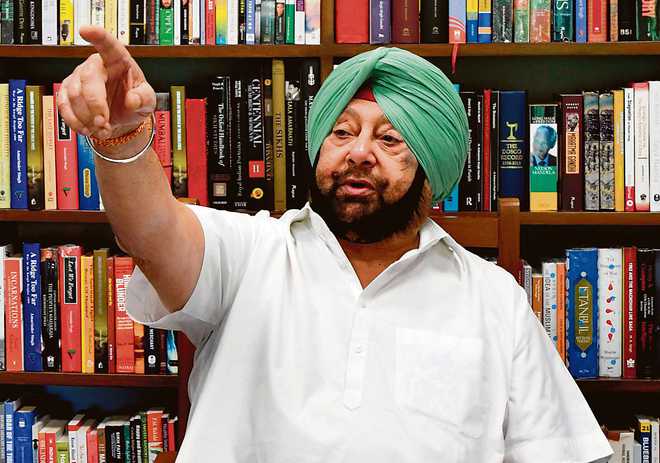
Drug supply chain smashed, final assault is on’

Capt says won’t quit politics till Punjab restored to its number one position and is cured of all ills

‘Drug supply chain smashed, final assault is on’

CAPT AMARINDER SINGH, PUNJAB CHIEF MINISTER

As the Congress regime in Punjab completes two and a half years in office, The Tribune correspondent Sanjeev Singh Bariana talks to Chief Minister Capt Amarinder Singh on a host of issues, including the promises that have been fulfilled and what are the government’s priorities for the remaining term.

You had promised to wipe out the drug menace within four weeks, but the state is still grappling with it.

I had said I will break the backbone of the drug business within a few weeks and I have done that. This is evident from the data available in public domain. Our special investigation team (SIT) has filed 31,081 cases against drug suppliers and 38,117 persons have been arrested so far. Over 12,000 have been put behind bars and our teams have secured at least 3,600 convictions. Efforts are on to root out the problem completely.

Halfway into the current term, drugs continue to be the biggest problem afflicting Punjab. 

Punjab continues to be a big market for drugs and alarmingly, the drug habits of youth have changed too. Instead of traditional ‘bhang’ and opium, youth are now hooked to synthetic drugs. There are several supply lines, including from Pakistan and neighbouring states of Haryana, Himachal Pradesh, Rajasthan and Jammu and Kashmir, which has compounded the problem. Then there is supply from other countries too.

Do you think the drug menace can ever be rooted out?

At the 29th Northern Zonal Council meeting earlier this month, we asked Union Home Minister Amit Shah to immediately formulate a national drug policy. In the earlier meeting of the Chief Ministers in July, we had agreed upon to set up a joint group to eradicate the menace. We are moving ahead… Also, as pointed out earlier, before curbing the supply, we must cure addiction.

Sacrilege of religious text during the previous SAD-BJP regime in 2015 continues to be the Achilles’ heel of your government. Why was the CBI asked to re-probe the case when the SIT was already on the job?

There is no confusion in our commitment to unravel the truth. The Punjab Assembly decided to take back the case from the CBI after it couldn’t make any headway for three years after being assigned the probe by the previous SAD-BJP regime. We constituted a SIT and it took up related cases, including those involving officers. After we heard about the CBI closure report being taken up in the court, we realised the case may be closed in case the court accepted the report. So, the Director of Bureau of Investigation Parbodh Kumar filed the letter showing inadequacy in the CBI report, which forced the central agency to say it will reinvestigate the cases.

It is said that the illegal sand and liquor mafia continues to rule the roost despite change in regime. There are also reports of some Congress leaders being involved.

I am aware about the involvement of politicians, some even from our own party. I don’t deny the existence of sand mafia and am also apprised of the collection of ‘goonda’ tax. We are faced with the problem of liquor mafia sending their supplies from adjoining states. We are actively working on these issues. Following a clearance in a case stuck up in the court, we were recently able to auction sand mines worth Rs 306 crore (compared to Rs 5 crore earlier). So, we are hopeful things will improve drastically once people get easier sand supply.

Teams are being deployed on supply routes of liquor from adjoining states to check smuggling.

Punjabis can’t ride on government luxury buses on important routes, including the one to Indira Gandhi International Airport, as the routes are dominated by private transporters.

I am aware about the problem. I am also aware of the allegations against our government that it is purposely ignoring illegal transport businesses, particularly those owned by the Badal family. The allegations are baseless. The matter is pending in the Punjab and Haryana and High Court. We won the case once, but the affected parties immediately approached the court again and were granted stay. The tragedy is that we cannot have a timetable on certain routes under the current situation. The court, probably, needs to have a hurried look into the crucial issue facing the state so that we can act.

You recently said that the state government had fulfilled 60 per cent of its pre-poll promises. But the Opposition disagrees. 

We have been able to deliver on a majority of promises concerning good governance. We have given loan waivers worth Rs 4,600 crore to farmers. Our job fairs have been a major success and around seven lakh youth have got employment. Around 40,000 have got government jobs and another 19,000 will be recruited soon.

What about the remaining issues?

We inherited empty coffers from the SAD-BJP government. Our share of taxes through the GST is also not coming in regularly. Instead of scheduled three months, we get it after four months. If the money inflow is right, a lot of problems concerning public welfare can be taken care of.

How do you see the ‘Howdy, Modi’ programme in the US? 

I got to know from newspapers about the good response that Prime Minister Narendra Modi received in the US.

How are your government’s relations with the Centre? 

Despite former Finance Minister Arun Jaitley being my opponent during the last Lok Sabha election (2014), I had very good working ties with him. Whenever we approached him with any problem facing the state,

he would always help. The Centre does hear us out.

Will you contest the next elections?

As I have said earlier, I cannot think of quitting as long as Punjab people need me. When I took over as the Chief Minister for my second term in 2017, I promised to wipe tears from the eyes of each and every person in the state. And I will not give up till I have done that. Punjab and its people suffered for 10 years under the SAD-BJP rule. It is my commitment that I will wipe even the memories of those dark years and restore the state’s No. 1 position. If that means contesting the next Assembly polls and leading the state for another term (maybe even more), so be it, as long as I have the physical and mental capabilities to work for the people.