Sanjha Morcha

What’s New

Click the heading to open detailed news

Current Events :

web counter

Print Media Reproduced Defence Related News

File returns till Aug 5, link PAN, Aadhaar by 31st

SBI cuts savings interest rate from 4% to 3.5% up to Rs 1 cr | LPG cylinder to cost Rs 4 more every month

File returns till Aug 5, link PAN, Aadhaar by 31st

New Delhi, July 31

In a last-minute decision, the government today extended the deadline for filing income tax returns (ITRs) till August 5, while taxpayers can now link Aadhaar with Permanent Account Number (PAN) by August 31.The Central Board of Direct Taxes said the dates were extended following complaints from “some taxpayers” that they were unable to log on to the Income Tax Department’s e-filing website. The CBDT said there were also complaints that the assessees were unable to link Aadhaar with PAN as their names were mentioned differently in the database.(Follow The Tribune on Facebook; and Twitter @thetribunechd)The government had made the linking of the two databases mandatory for filing ITRs from July this year.The Income Tax Department till yesterday had maintained that no extension would be given as already over two crore returns had been received and no major glitches had been detected. Meanwhile, the State Bank of India (SBI) today cut from 4 per cent to 3.5 per cent the interest rate on savings account on balance up to Rs 1 crore. Those having balance above Rs 1 crore would continue to earn interest at 4 per cent per annum.Rajnish Kumar, Managing Director, National Banking Group, SBI, said the reduction was an important aspect as it was difficult to maintain MCLR (marginal cost of fund-based lending) rates at the current level.In the Lok Sabha, Oil Minister Dharmendra Pradhan today said that state-run oil companies had been ordered to raise subsidised cooking gas (LPG) prices by Rs 4 per cylinder every month to eliminate all the subsidies by March next year.The government had previously asked IOC, BPCL and HPCL to raise rates of subsidised domestic LPG by Rs 2 per 14.2-kg cylinder per month (excluding VAT).Now, the quantum had been doubled so as to bring down the subsidy to nil, he said.Every household is entitled to 12 cylinders of 14.2-kg each at subsidised rates in a year. Any extra requirement is to be bought at market price.“The companies were authorised to hike the price of subsidised domestic LPG cylinder by Rs 2 per cylinder per month (excluding VAT) with effect from July 1, 2016,” he said. Oil companies had hiked LPG rates on 10 occasions since that go-ahead.“The government has again authorised them to continue to increase the effective price of subsidised domestic LPG by Rs 4 per cylinder effective from June 1, 2017, per month (excluding VAT) till the reduction of government subsidy to ‘nil’, or till March 2018, or till further orders,” he said.Oil companies have raised rates twice since, the last being on July 1 when rates were up by a steep Rs 32.  — TNS/PTI


Indian Army rejects Pak military’s claim of killing four soldiers

Indian Army rejects Pak military's claim of killing four soldiers
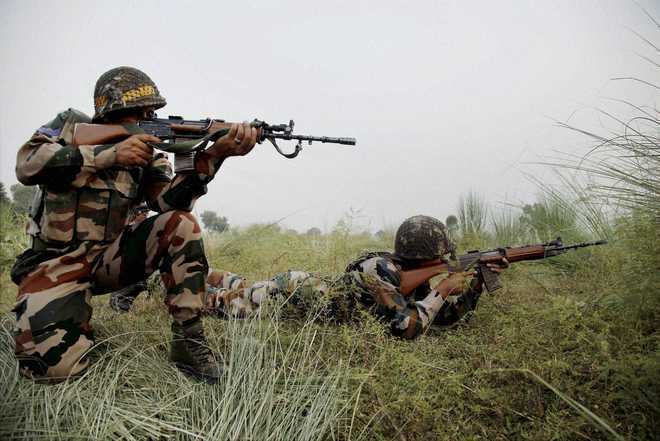
The Indian Army response came after the Pakistani military claimed that it had killed four Indian soldiers and destroyed two Indian checkposts being used to target civilians. File photo

Islamabad/New Delhi, July 10

The Indian Army on Monday denied Pakistan military’s claims that it killed four Indian soldiers in cross-border firing on Monday.

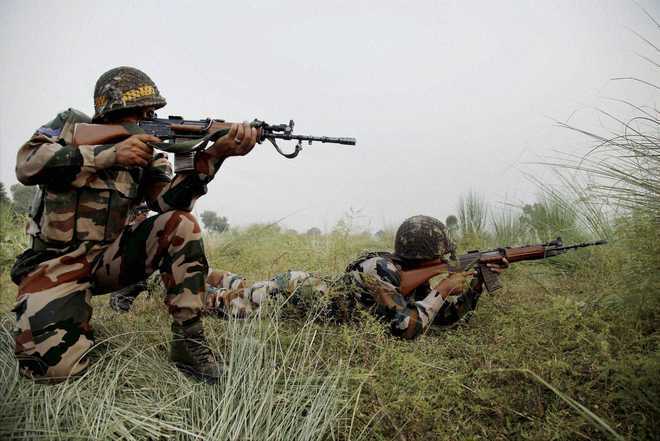
“Pakistan Army has been violating the ceasefire on a regular basis. It has deliberately targeted civilian areas during these across the Line of Control firing incidents,” an Indian Army spokesperson said in New Delhi, adding that the Indian Army did not suffer any casualties this month.

(Follow The Tribune on Facebook; and Twitter @thetribunechd)

“As a mature and accountable institution, the Indian Army keeps the public informed of casualties suffered through an established and transparent system. In case of occurrence of fatal casualties, tribute is paid to the soldier through the official Twitter handle and Facebook page. State funeral is also organised as a mark of respect,” the official said.

The Indian Army, however, said in one such incident of targeted and unprovoked shelling of civilian areas by Pakistan on Saturday, Havildar Md Shaukat, a serving soldier, and his wife died while he was at his home during leave.

The Indian Army response came after the Pakistani military claimed that it had killed four Indian soldiers and destroyed two Indian checkposts being used to target civilians.

The Pakistan Army claimed that its firing came in response to alleged “unprovoked firing” by India on Monday, “targeting innocent civilians”.

It claimed that the Indian firing resulted in the death of five of its citizens.

The Pakistan Army also released a video dated July 9 to substantiate its claim.

“Pakistan Army befittingly responded on July 9, causing substantial losses to men and material. Two Indian Army posts firing on innocent civilians have been destroyed. Four Indian soldiers killed,” Army Spokesman Maj Gen Asif Ghafoor tweeted, while sharing the video.

The Pakistan Army will continue to protect civilians from “unprovoked Indian aggression” at all costs, he said. — PTI


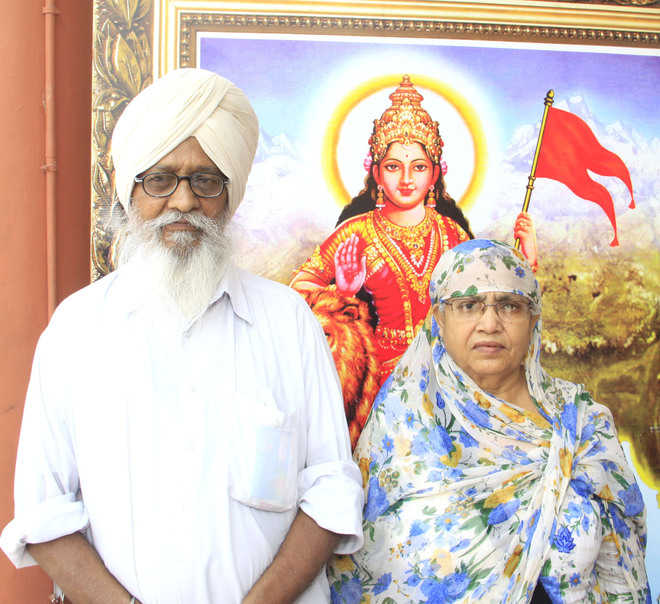
Battle over, but martyrs’ families wage war in life

Parents remember their children who sacrificed their lives for the nation at an event dedicated

Aakanksha N Bhardwaj

Tribune News Service

Jalandhar, July 26

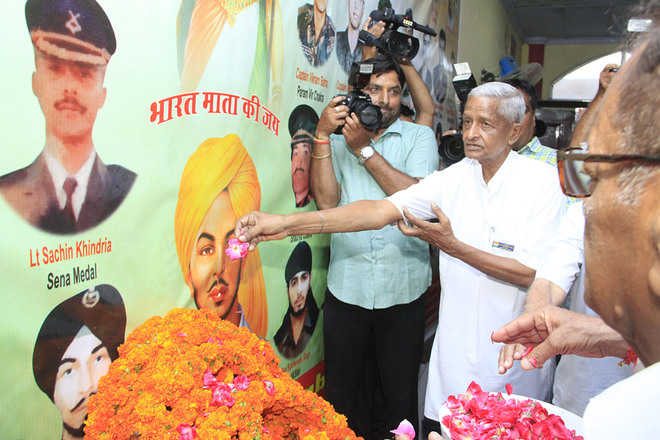
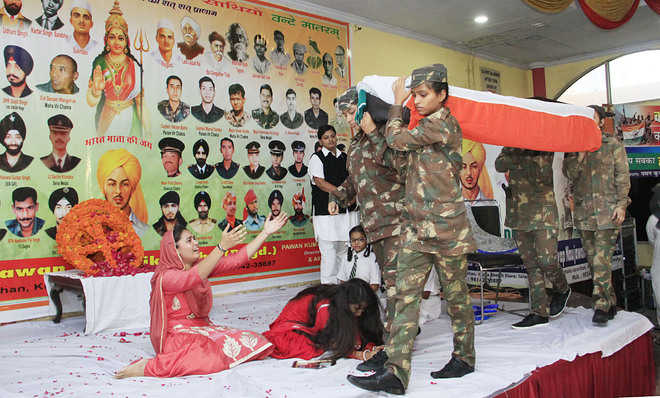
Their eyes were fixed on the projector showcasing a documentary made on the war heroes, who sacrificed their lives for the country. They did not want to blink their eyes as they did not want to miss even a single scene. The emotions could not be controlled and the pain of losing their young children got out through their eyes. They were the parents of the martyrs who sacrificed their lives for the nation.Families of the martyrs were present at a function, which was dedicated to war heroes. A special wall containing pictures of martyrs attracted the attention of the families.Jalandhar Tribune Talked to the families and found that they have been fighting their own battle for the past 18 years.Father of martyr waiting to dieMohan Lal, a lean looking elderly man, was sitting alone on a chair. He was looking sad. While talking to Jalandhar Tribune, he said, “I attend the function every year to remember my son who got martyred in 1999 in Bandipora district in Jammu and Kashmir.”“I feel this is the only day when my son gets importance otherwise who talks about me or my son’s sacrifice. Nobody knows what I have seen or faced through these 18 years,” the father said in a quivering voice.His son Mohinder Lal was posted as Deputy Commandant with the Border Security Force (BSF) and got martyred at the age of 30. “Not even a day passes when I don’t miss my son,” he said while getting emotional.“I don’t know why he joined the force. He was doing well here as a lecturer at a college but he had a wish to serve the nation. He told me after joining the force,” he said and wiped off his tears.“And see now, a father of a martyr himself wants to die. I have no source of income and my elder daughter who is married helps me in everything. Even my wife is not well and I am not able to provide her proper treatment due to lack of money,” Mohal added.“I have also sought help from the governments, pr koi kuch nahee krta, kaun parvaah krta hai ki kisne kis k lie jaan di. Ab main isi intzar mein hu ki mar jaau (Nobody does anything, who cares if someone sacrificed his life for the nation. Now, I am waiting for the day when I will die).”After sharing his grudge, Lal moved forward and again sat on the chair.He fights to get boards bearing his son’s name reinstalledKirpal Singh, 70, was listening to the announcers, who were praising the sacrifices of the martyrs. Kirpal, who is a granthi, said these words always make him proud.His son Daljit Singh got martyred in Dras, a town in Kargil district of Jammu and Kashmir, in 1999. His wife Kanwaljit Kaur, who had accompanied him, could not utter a word. Her eyes were filled with tears while remembering her son, who joined the Army.  She, along with her family, never wanted to see her son joining the Army. They are now fighting a battle to get boards bearing his son’s photos reinstalled at Rama Mandi Chowk and Johal Chowk.  He said the boards containing information of his son were installed at these chowks but these were removed due to some project. Thereafter, nobody bothered to reinstall the boards, he added.


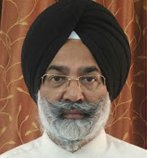
In Iraq, VK Singh on rescue mission

In Iraq, VK Singh on rescue mission
VK Singh

Simran Sodhi

Tribune News Service

New Delhi, July 10

India today said it is making efforts to secure the release of 39 Indians, mostly from Punjab, who have been in IS captivity in Mosul since 2014. External Affairs Minister Sushma Swaraj spoke to Punjab Chief Minister Capt Amarinder Singh and assured him of making all efforts to secure their release.Punjab page: Iraq action rekindles their hopesWith Iraqi forces freeing Mosul from Islamic State control, India has stepped up efforts to locate and facilitate the return of its nationals. Minister of State for External Affairs General VK Singh (retd) is flying to Iraq’s Erbil to coordinate with the government there for the return of stranded Indians.The Ministry of External Affairs said Air India officials had been instructed to assist with their return, and that the government had activated all channels to locate the missing nationals. The MEA added that the Iraqi government has promised all help in locating the 39 Indians.(Follow The Tribune on Facebook; and Twitter @thetribunechd)The official spokesperson for the MEA said: “As soon as the announcement of liberation of Mosul was made by the Prime Minister of Iraq Haider al-Abadi, the government activated various channels to locate those Indians. Iraqi authorities have conveyed that all cooperation would be extended in this regard and instructions have been issued by them to all relevant Iraqi agencies for the same.”The 39 Indians were taken hostage by the IS on June 11, 2014, in Mosul. However, confusion prevails over the fate of the abducted Indians. Harjit Masih, a Punjab resident who escaped from IS captivity in June 2014, had claimed that the 39 had been killed. However, the MEA has maintained that it has no information confirming that the Indians are dead.


Yet another soldier killed in LoC firing

Yet another soldier killed in LoC firing
File photo

Jammu, July 21

A jawan was killed after the Pakistan army opened unprovoked firing on Indian Army posts in the Sunderbani sector around 6.05 pm today.Rifleman Jayadrath Singh, 28, was grievously injured in the firing and later succumbed to his injuries. The Army retaliated strongly and effectively to the Pakistan firing.(Follow The Tribune on Facebook; and Twitter @thetribunechd)The rifleman belonged to Bhagwanpur village in Saharanpur district of Uttar Pradesh. He is survived by his wife Mamta Devi.“Rifleman Jayadrath Singh was a brave and sincere soldier. The nation will always remain indebted to him for the supreme sacrifice and devotion to duty,” an Army spokesman said. Meanwhile, there were reports of ceasefire violations in the Naugam sector as well as Kupwara’s Keran sector. Eleven persons, including nine soldiers, have been killed in 18 ceasefire violations by Pakistan this month. — TNS


Separatism stays a step ahead on social media

ONLINE WAR Viral videos that capture militants at leisure, videos of alleged rights excesses by forces and frequent gags on internet are bringing a paradigm shift in the narrative of the Valley’s conflict

The PDP­BJP government is the most unpopular government Kashmir has seen in the last decade. So even if the government tries to reach out to people through social media, it won’t make much of a difference for its public relations …. IRFAN MEHRAJ, an activist with the Jammu Kashmir Coalition of Civil Society

A few days after the killing of Hizbul Mujahideen militant Burhan Wani on July 8 last year, a video surfaced on social media showing Wani and an accomplice tapping their rifles and humming a Kashmiri folk song playing in the background. The lyrics of the song in the video went: “You will miss me, o mother, when I will be buried under the earth…”

That video touched a chord with many in Kashmir where militants enjoy wide public support. “Any Kashmiri will cry, the video touches you,” a 40-year-old woman from old Srinagar said.

Viral videos that capture militants at play and leisure, shocking videos of alleged rights excesses committed by security forces on Kashmiri civilians, the alleged use of instant messaging platforms to mobilise stone pelters and recruit foot soldiers for militants and the frequent gags on internet are bringing a paradigm shift in the narrative of the Valley’s conflict. But the government seems to be losing the online war, with the militants and separatists seemingly always a step ahead. The week-long protest calendar by separatists to mark Wani’s first death anniversary calls for a “Kashmir Awareness” campaign on social media.

“The PDP-BJP government is the most unpopular government Kashmir has seen in the last decade. So even if the government tries to reach out to people through social media, it won’t make much of a difference for its public relations because I think it will face similar kind of criticism on social media to the one it faces on ground,” says Irfan Mehraj, an activist with the Jammu Kashmir Coalition of Civil Society (JKCCS) and editor of e-magazine Wande.

Militants are no longer faceless. They wear military fatigues, strap ammunition across their chests and smile at you from forests. Given how successfully Wani struck a chord with people through social media and attracted youngsters, newer militants are trying out the same.

Police sources say although they check and analyse all latest militant videos, they are not dependant on them for gathering information on insurgents who are already profiled by police intelligence. But Kashmir watchers, like senior journalist and former Kashmir bureau chief of Reuters Sheikh Mushtaq, point out that militant videos play a “huge role” in humanising the insurgents to the common population and putting forward their viewpoint. “You see them and get to know them through these videos. They penetrate your computers and mobile phones. This is quite different from the militancy of the 1990s, when there were no such technologies.”

Stone-pelting protesters now shoot videos of clashes and upload them onto social media almost in real time. Many such videos were shared widely after a clash near an encounter site in Kulgam in February. With commentary on how forces were allegedly shooting at protesters and “killing Kashmiris”, the videos captured disturbing visuals from the clashes.

Director general of state police, SP Vaid, says police is successfully putting a check on all sorts of militancy propaganda on social media, but videos capturing atrocities and human rights violations of Kashmiris have dominated the narrative this year and proved to be a major headache for the administration.

In April, a video emerged of a group of Kashmiri youth heckling CRPF jawans returning from duty on the day of Srinagar bypolls on April 9 and resulted in a national outrage. What followed, however, was a torrent of videos showing security forces committing atrocities and human rights excesses on civilians, including using a “human shield” by the army and the targeted shooting of a teenage stone pelter on the day of the bypoll.

Army Major Leetul Gogoi tied Kashmiri shawl weaver, Farooq Dar, to the bonnet of a jeep as a ‘human shield’ and drove him around for five hours across 17 villages over 28km on April 9. A video of the act, which surfaced a few days later and was shared by many. including former chief minister Omar Abdullah. had put the spotlight on the now infamous act. Soon after these videos went viral, the administration on April 17 snapped highspeed mobile internet services and on April 26, banned 22 social media sites, including Facebook, Twitter and WhatsApp, for a month.

INTERNET GAGS CHECK VIOLENCE OR CURB DISSENT?

The security establishment tries to keep pace through its cyber cells but the government’s main response is to snap mobile internet services, like it did after Wani was killed. Post-paid mobile internet services were restored in mid-November, while pre-paid services were restored on January 30 this year — making the blackout period the longest in Kashmir till now.

The blackout did not stop youth from mobilising in large number and organising stone pelting protests. The unrest that began after Wani’s death left over 90 people dead last year. The idea that without internet there would be no street protests was also debunked when both broadband and mobile internet services were snapped across Kashmir for the bypolls in Srinagar constituency — eight civilian protesters were gunned down by forces that day. Senior police officers, however, argue that with functioning internet, the scale of violence would have been higher.

The suspension of 3G and 4G services in April was to curb the uploading of multimedia content that could provoke violence, while letting users access the basic minimum internet on their phones.

Similarly, the April 26 order by state home secretary RK Goyal to ban 22 sites said the step was taken because the government felt that “continued misuse of social networking sites and instant messaging services is likely to be detrimental to the interests of peace and tranquility in the state”. The social media ban turned out to be a colossal failure. Most Kashmiri users switched on to Virtual Private Network (VPN) apps to overcome the ban and what came as a real surprise was that the Who’s Who of Kashmir were all leading a busy social media life throughout the ban.

This year, internet services were completely or partially snapped at least seven times in Kashmir. But activists say the administration is clueless about how to control the space, which is being increasingly used for dissent, and hence gags it.

“Kashmiris chose dissent online, because the offline real world democracy wasn’t working. Even then they were pushed to the wall. The ban on social media was the peaking of an authoritarian state that can’t tolerate dissent. The state has lost both the battles offline and online. Now it’s just brutalisation that works in reality and virtually,” says Srinagar-based blogger Muhammad Faysal, who has over 15,000 followers on Twitter.

According to data since 2012 provided by internet shutdowns.in, a project by the Software Freedom Law Centre (SFLC), Jammu and Kashmir has recorded 35 instances of complete or partial internet shutdowns, the highest among states.

‘GOVT TALKS ONLY OF DEVELOPMENTAL WORK’

CM Mehbooba Mufti has a verified Twitter account with around 21 thousand followers, but is yet to write her first tweet. On the other hand, the leader of opposition, former CM Omar Abdullah, is a Twitter star with 1.88 million followers and a tweet on almost every topic relevant to Kashmiris.

The PDP’s official Twitter handle is mostly focused on promoting the developmental work of the government. Mehbooba’s verified Facebook page is a collection of videos of her public appearances and short press statements.

“The ruling dispensation’s engagement on social media is mostly related to sharing news about development work and success stories. That’s their mandate. They do not go beyond that. If they express anguish over civilian killings or injuries, they will face tough questions by social media users,” said Moazum Mohammad, a journalist with English daily Kashmir Reader.



Pentagon urges India, China to reduce tension through direct dialogue

Pentagon urges India, China to reduce tension through direct dialogue
The standoff in the Sikkim sector is seen as part of Chinese coercive tactics to change status quo on border. File

Washington, July 22

The Pentagon has encouraged India and China to engage in a direct dialogue free of any “coercive aspects”.

“We encourage India and China to engage in direct dialogue aimed at reducing tensions and free of any coercive aspects,” Gary Ross, a Defence Department spokesman said.

(Follow The Tribune on Facebook; and Twitter @thetribunechd)

Over the past week, the US State Department too have been making similar statements, but Pentagon has sought direct dialogue between India and China on reducing tension “free of any coercive aspects”.

Notably, in recent past few years, almost all the Chinese neighbours have been accusing Beijing of coercive tactics to settle border disputes.

Read: China justifies construction of road in Sikkim sector

China trying to change status quo on border, says India

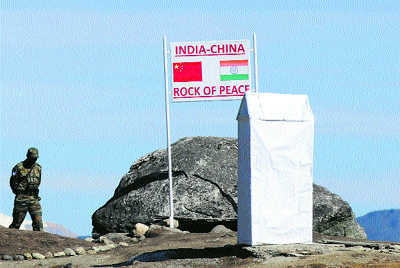
The month-long India-China border standoff in the Sikkim sector is seen as part of same Chinese coercive tactics to change the status quo. India has taken a strong stand against such a Chinese move.

National Security Adviser Ajit Doval heads to Beijing to attend a meeting of BRICS later this month. During his visit, Doval is expected to talk with his Chinese counterpart on this issue.

Responding to questions, the Pentagon refused to take sides on the issue.

“We refer you to the Governments of India and China for further information. We encourage India and China to engage in direct dialogue aimed at reducing tensions. We are not going to speculate on such matters,” Ross said when asked if the Pentagon fears escalation of tension between India and China.

Early this week, a top Pentagon Commander told lawmakers that China is exploiting its economic leverage as a way to its regional political objectives.

“The Chinese have shown their willingness to exploit their economic leverage as a way to advance their regional political objectives. As China’s military modernisation continues, the United States and its allies and partners will continue to be challenged to balance China’s influence,” General Paul Selva, USAF, said in written response to questions to the Senate Armed Services Committee for his nominee for reconfirmation as Vice Chairman of the Joint Chiefs of Staff.

Selva said deterring war is an exercise in influencing China’s decision calculus, making diplomacy preferable to conflict and managing crises in such a manner that they do not unintentionally escalate.

“To do this, the Joint Force will engage with the Chinese military within Congressionally mandated limits, build alliance capacity through close cooperation, and uphold international law through appropriate operations,” he said in written response to the questions. PTI


Chinese warships, subs on the prowl in Indian Ocean

NEW DELHI: Chinese presence in the Indian Ocean has recorded a significant increase ahead of the Malabar naval exercise involving India, the United States and Japan.

The Indian Navy has sighted more than a dozen Chinese warships, including submarines, destroyers and intelligence-gathering vessels, in the Indian Ocean during the last two months, government sources said.

The 10-day naval drills will begin in north Indian Ocean on July 10. More than 20 warships will take part in the exercise, including US Navy aircraft carrier USS Nimitz, Indian carrier INS Vikramaditya and Japanese Izumo-class helicopter carrier.

The naval drill will be bigger and more complex than all previous editions. China has been suspicious of the trilateral engagement and has even lodged protests over Japan’s participation in the past.

A Chinese intelligence gathering ship, Haiwingxing, is understood to have sailed into the ocean in June-end. Strategic experts linked the Haiwingxing’s deployment to the forthcoming naval exercise. The navy’s satellites, surveillance planes and surface warships have also sighted Luyang III class destroyers, hydrographic research vessels and tankers. The presence of a submarine in the region has been confirmed by the presence of Chongmingdao, a Chinese navy submarine support vessel, the sources said.

Anti-piracy patrols and freedom of navigation are the reasons cited by China for its increased presence in the Indian Ocean, forcing New Delhi to tighten surveillance of the strategic waters, government officials said.

The deployment is being closely monitored by the Indian Navy. “Chinese activity in the Indian Ocean has touched a new high in recent months. We are using our surveillance assets quite extensively to monitor their movement,” a navy source said.

The sightings assume significance as the two militaries are in a three-week-long standoff at an India-China-Bhutan tri-junction close to the Sikkim border.

The Chinese deployment in the pirate-infested Gulf of Aden, one of the world’s most important shipping routes, accounts for four to five warships at any time.

The periodic rotation of these units gave the Chinese navy the opportunity to deploy a variety of assets in the region, officials said.

The Indian Navy has been present in the Gulf of Aden since October 2008 and so far, 64 warships have been involved in antipiracy operations. India has one warship in the area at any given time. Navy data shows that Indian warships have so far made 41 interventions and escorted 3,765 ships, including 394 Indian-flagged vessels.


Wait on for soldier’s body

Wait on for soldier’s body
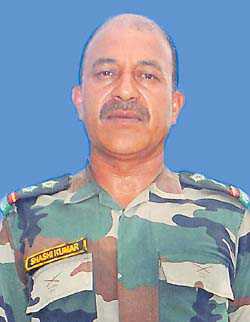
Martyr Shashi Sharma

Our Correspondent

Hamirpur, July 20

Hundreds of people that arrived at Galol village in Nadaun were kept waiting for the arrival of mortal remains of martyr Shashi Sharma who sacrificed his life in Jammu and Kashmir while responding to a cross-border firing on the Line of Control (LOC).It was intimated to the members of the martyr that the body would be airlifted from the Udhampur Army base to Sujanpur near here but later it was reported that the chopper could not take off due to bad weather at Udhampur.Relatives were also kept waiting at Sujanpur which was 35 kilometers away from the village. People were seen more angry for choosing a distant location for landing the chopper. The father of the martyr Prithvi Chand said the body could be brought by road as it only takes 6 hours to arrive from Udhampur.A communication from the Army confirmed that the body would be brought to the village by road tomorrow morning. The delay had harassed people, especially the wife and children of the martyr who were unable to eat and drink in the hour of grief.

Braveheart’s death mourned

Solan, July 20

Chief Minister Virbhadra Singh today mourned the death of rifleman Vimal Sinjali of 14 Gorkha Training Centre, Subathu, who was killed in a sniper fire from across the LoC in Jammu and Kashmir on July 18.The Chief Minister said his sacrifice would not go in vain and it would always inspire the security forces to serve the motherland with valour. DC Rakesh Kanwar said the deceased soldier would be cremated with full state honours at the 14 GTC, Subathu, tomorrow, after the arrival of his family from Nepal. — TNS



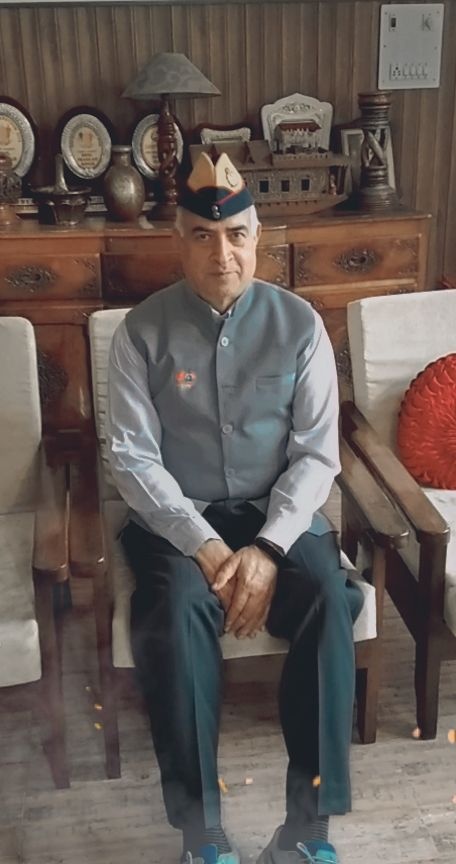
Modi in Israel, redefines ties by Lt Gen Syed Ata Hasnain (retd)

Prime Minister Narendra Modi’s much-hyped, historic visit to Israel marks an end to uncertainty and tentativeness in Indo-Israeli relations. It seems the hyphenation of Israel and Palestine is finally over even in the mind of India, one of Palestine’s major supporters.

Modi in Israel, redefines ties
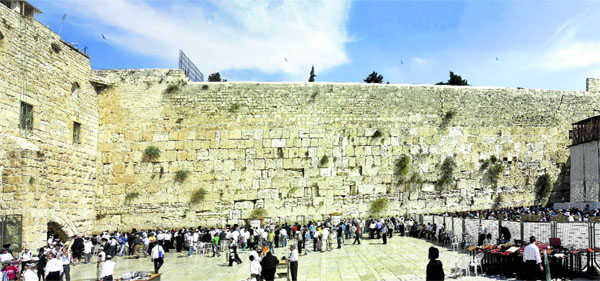
ANCIENT CRY: Jerusalem’s Wailing Wall, or Western Wall as it is known in Hebrew, is one of the holiest sites in the world, today. It is the only remnant of the holy edifice that stood on the Temple Mount.

PRIME Minister Narendra Modi is in Israel for his maiden visit to that country. It is, in fact, the maiden visit of an Indian Prime Minister to Israel. Ever since the end of the Cold War, when the compulsion to support and take sides in the dispute over Palestine finally came to an end, India has steered mid-course, remaining a friend and supporter of the Palestinians,virtual strategic partner of Israel and continuing excellent ties with the Arab countries. A striking similarity of both countries was the timing of India’s Independence and Israel’s creation in 1947-48. Both countries fought wars right at their inception and the problems related to those wars continue even now, in both cases. In India’s case, Jammu and Kashmir-based separatism and terrorism  and in Israel’s domain Hamas and Hezbollah-led activities with political backing from regular nations remain the challenge. Whereas Israel’s threats have comparatively reduced over the years due to its proactive military dominance in its region, India’s have multiplied manifold. The regional dynamics are different no doubt but both nations are located in potential cauldrons of wide-ranging conflicts with unpredictable triggers.My personal take on Israel has always been one of admiration. It has given outstanding models of strategic thought, intelligence, governance and technology to punch much above its weight. Among the major reasons for its strategic confidence are the backing and support from US and its own ability to take decisions and proactive action against adversaries without much concern for international opinion. I had the good fortune of visiting Israel some years ago as part of an international study group which had access at very high levels. The visit took me through Tel Aviv, Jerusalem, West Bank and Ramallah, Nazareth, Galilee, the Lebanon border and finally Haifa. There were visits to some fascinating hi-tech research facilities and defence establishments with focus on micro drones and night-surveillance devices. Keeping a strategic overview, I absorbed everything which makes Israel what it is in terms of its strategic national security. It was obvious that constraints of real estate played on the Israeli mind   and drove much of its security thinking. It could not afford risk and therefore proactivity was the essence. Loss of territory was just not acceptable and to give itself depth Israel had taken some bold decisions in 1967. Although these decisions promoted its physical security also brought it lasting enmity. What I observed in all the briefings was the high level of clarity in thinking and virtual political consensus on matters of security. I realised this was a huge plus in planning and execution of national security. The other very noticeable aspect in Israel’s outlook towards security was the absence of rancour in the media. Having fought multiple conventional conflicts and experienced irregular threats almost from its foundation, very little social antipathy was expressed in the media although professionally there was no dilution in attitude towards anyone. It’s in the geopolitical and security domains that the major commonalties of Indian and Israeli interests lie. However, one cannot but appreciate the fact that Israel’s proclivity towards hi-tech research in the field of agriculture, metallurgy and even nuclear science is of great interest to India. Besides that, a small nation with high threats always innovates and Israel is probably the most outstanding example of that dictum. Institutional exchanges on education in design, research and development and startups will always be to mutual advantage.In the purely geopolitical domain, Israel has over time appreciated India’s problems of extending unequivocal support to its cause. There were compulsions of policies adopted by India in the past. Even after 1991, Israel was aware that India was still walking a tightrope. Its energy needs came from the Arab world. Prime Minister Modi’s earlier visits to the UAE and Saudi Arabia finally helped cement an equation with the Gulf which opened the way for an equally, if not more, transformational relationship with Israel. Geopolitically, there is another way of looking at this. As Iran’s antipathy towards Israel increased, especially during the time of Ahmadinejad, and its nuclear ambitions started becoming evident it was clear that the relationship between Israel and Saudi Arabia, backed by the US, would improve. This appeared to have an overall positive effect on Israel’s relationships with the Arab world, except with those elements supported by Iran. It opened a window for India without risk to its relationship with the Arabs. Iran already being under sanctions gave little scope for enhancing Indo-Iran relations. The overall effect of the dynamics of this emerging situation was a flow of positive energy through Indo-Israeli relations. The only casualty appeared to be Palestine which till as late as President Pranab Mukherjee’s visit in 2015 was on the tour map which took him to Israel, Palestine and Jordan. The dwindling importance of Palestine could be considered a momentary phenomenon. However, it seems the hyphenation of Israel and Palestine is finally over even in the mind of India one of Palestine’s major supporters in the heyday. The one aspect which can in a stroke drastically reduce threats in West Asia is a potential improvement in the relationship between Iran and Israel. Unfortunately, there are complex equations in this and is unlikely to see the light of day in the current set-up. Notwithstanding the Iranian Grand Ayatollah’s recent support to the Kashmiri separatists, which appeared more tactical than anything else, India is one country which can be a potential interlocutor, the moment for which is yet far.While the intelligence and military-to-military relationship continues to thrive, the visit of Prime Minister Modi and the manner of his reception and conduct should finally place the last nail in the coffin of uncertainty and tentativeness in Indo-Israeli relations. From now onwards, this should take the shape of a transformational relationship, especially since there is so much that the two nations have yet to achieve for their people.The writer, a former GOC of the Srinagar-based 15 Corps, is now associated with the Vivekanand International  Foundation & the Institute of Peace and Conflict Studies.