Sanjha Morcha

What’s New

Click the heading to open detailed news

Current Events :

web counter

Print Media Reproduced Defence Related News

Gr8 achievements by sportsmen of Army Sports Institute Pune in CWG 2018 at Gold Coast, Australia


Image may contain: 2 people, people smiling, text

.1.Sub Neeraj Chopra won first ever  Gold Medal in Javelin throw with season best 86.47M ,

2. Nb Sub Amit won Silver Medal in Boxing 49 kg,

3. Nb Sub Gaurav Solanki won Gold Medal in Boxing 52 kg,

4.Nb Sub Manish Kaushik won Silver Medal in Boxing 60 kg,

5.Nb Sub M Hassumudeen won Bronze Medal in Boxing 56 kg,

6.Sub Satish won Silver Medal in Boxing  +91kg,

7.Nb Sub Deepak Lather won Bronze Medal in Wtlifting.

8.Sub Jinson Jonson came 5th in 1500M n broke 23 yrs Indian National Record.

Image may contain: text

Total…… 02 Gold Medals, 03 Silver Medals n 02 Bronze Medals.

Sportsmen of ASI Pune have created history by winning 07 medals in any CWG. Regards

http://


Pakistan violates ceasefire in J&K’s Rajouri

Pakistan violates ceasefire in J&K’s Rajouri

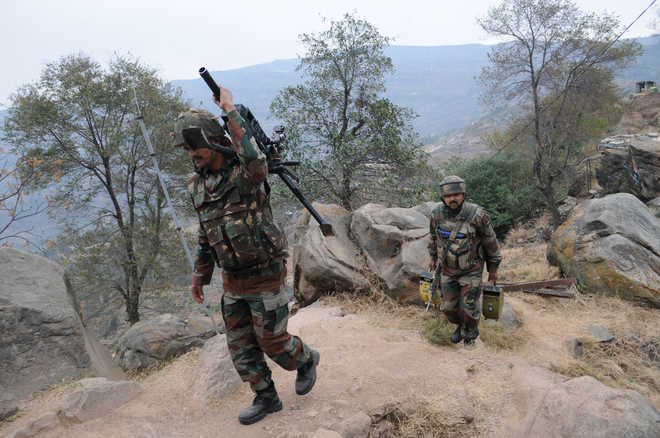
There has been spurt in the ceasefire violations along the LoC this year. Tribune file

Jammu, April 14

Pakistani troops on Saturday violated the ceasefire by resorting to unprovoked and indiscriminate firing along the Line of Control (LoC) in Jammu and Kashmir’s Rajouri district, prompting retaliation from the Indian side, officials said.

A defence spokesperson said there was no report of any casualty in the skirmishes, which continued for several hours.

Pakistani troops started the unprovoked and indiscriminate firing from across the border in Nowshera sector around 8.30 am, the spokesperson said.

A police official said the Bhawani area was targeted by the Pakistani troops with small and medium weapons and mortar guns, causing panic among the residents.

There has been spurt in the ceasefire violations along the LoC and the International Border (IB) in Jammu and Kashmir this year, resulting in the death of 29 persons, including 15 security personnel, in over 650 such incidents. PTI


Subsidies and morality Punjab’s hope for free-power surrender on weak ground

Subsidies and morality

Punjab has told the Punjab and Haryana High Court that it does not intend to withdraw the power subsidy from farmers of any size. Instead, it has appealed to “rich” farmers that they surrender the subsidy voluntarily. This is very much in line with the larger campaign of the NDA government at the Centre that is urging the well-off to avoid taking various subsidies, starting with LPG. Even though the success of that appeal is yet to be detremined, there is no gainsaying it does raise a fundamental question of the morality of precious public resources going to those who don’t really need them when all needy have not yet been served.India has had a tradition of giving in the name of God, a significant part of which does reach the poor. However, the spirit has not been evident when it comes to scientific philanthropy, in which specific areas of need, such as education or health, may be identified to enable high-net-worth individuals to make contributions. There is need for charity to move beyond personal or spiritual satisfaction, where the giver wants to personally see the exact beneficiary and end use to draw a certain fulfilment. To be fair to the rich, there is a trust gap when it comes to charitable organisations. It is only natural for a person to demand that his money be put to good use. That is where the “give it up” initiatives of governments can fill the gap by providing planned and organised channels of “charity”.The power subsidy situation in Punjab, however, may be slightly different. That is because the definition of a “rich farmer” is debatable. The number of those rich purely on farm income would be very small as there exists a limit on the amount of land a person can hold. Then there are those, including politicians, who have income from land as well as other sources. Sadly, their preparedness to give up may be gauged from the fact that thus far in Punjab only Chief Minister Capt Amarinder Singh and Leader of the Opposition Sukhpal Khaira have taken the step.


Civilian deaths: Kashmiri students clash with forces

SRINAGAR: Students clashed with security personnel in Kashmir on Thursday after authorities reopened educational institutions after a shutdown following the death of 13 militants, five civilians and three soldiers in gunbattles earlier this week.

REUTERSA policeman throws a teargas shell towards protesters outside a college in Srinagar.Students took on security personnel at different institutes in Srinagar, protesting the five civilian deaths. Scores of female students were among the protesters in the commercial hub of Lal Chowk.

The Associated Press reported that security personnel fired tear gas to stop students from marching at several colleges. Clashes also erupted in other parts of Kashmir as students hurled rocks at police and paramilitary soldiers. They also burned a police bunker in Srinagar, the news agency reported.

Thursday’s student protests were reminiscent of similar agitation a year ago when sporadic clashes between students and security personnel spread across the Valley after alleged police excess in dealing with students at the Degree College in Pulwama.

The protests came even as chief minister Mehbooba Mufti visited the house of 23-year-old Gowhar Ahmad Rather, who died on Tuesday after being injured in clashes with security forces in Kangan town of Ganderbal district.

“The chief minister assured the family members that the guilty found involved in excessive use of force in the incident would be brought to book. She also conveyed her sympathies with the bereaved family,” an official press statement said.

Jammu and Kashmir police on Wednesday suspended a constable and ordered as a departmental and magisterial inquiry into Rather’s death.


MS Dhoni receives Padma Bhushan, impresses all in army uniform

As MS Dhoni’s name was announced, the ex-Indian cricket team captain marched past the dignitaries present at the Rashtrapathi Bhavan before receiving Padma Bhushan award from President Ram Nath K

MS Dhoni, ex-Indian cricket team captain, during the Padma Awards 2018 at Rashtrapati Bhavan in New Delhi on Monday.

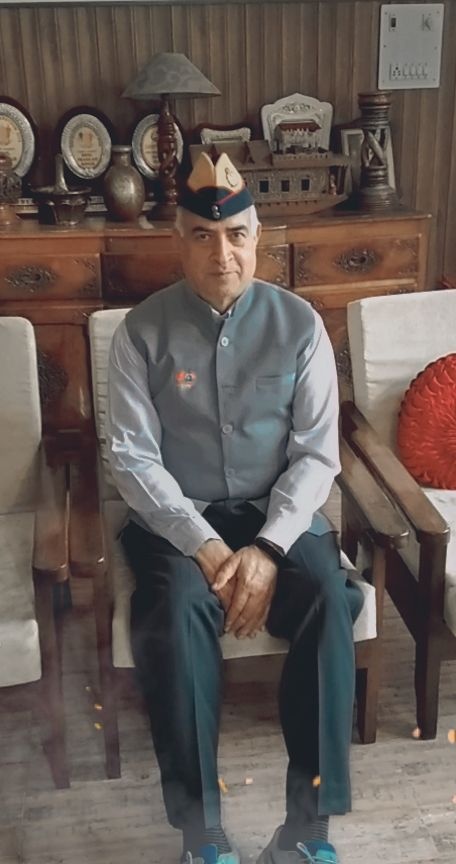
Exactly seven years after lighting up the Mumbai skyline with an unforgettable six, MS Dhoni again became the cynosure of all eyes as the honorary Lieutenant Colonel received the Padma Bhushan Award, dressed in an army uniform.

It was a happy coincidence for Dhoni as he was conferred with the prestigious civilian honour on the seventh anniversary of their famous World Cup triumph.

The Indian Territorial Army had conferred the honorary rank of Lieutenant Colonel to Dhoni on November 1, 2011, months after the country lifted its second World Cup under his leadership.

The 37-year-old Dhoni is the second Indian cricketer after Kapil Dev to receive this honour.

Dhoni has been the recipient of many awards, including the ICC ODI Player of the Year award in 2008 and 2009 (the first player to win the award twice), the Rajiv Gandhi Khel Ratna award in 2007 and the Padma Shri, India’s fourth highest civilian honour in 2009.

Making up with Pakistan by Sandeep Dikshit

Making up with Pakistan

Sandeep Dikshit

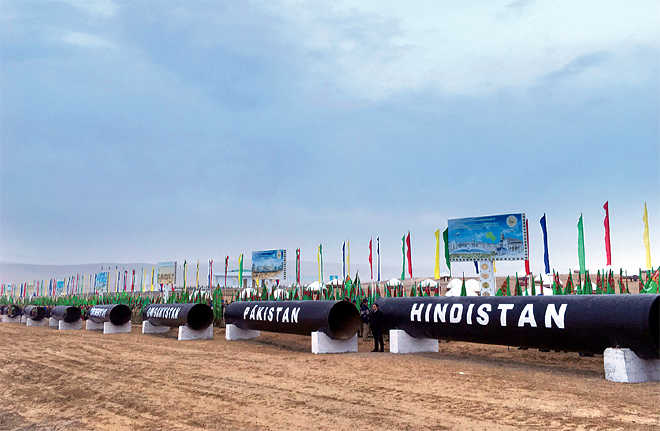
PAKISTAN High Commissioner Sohail Mehmood’s sulk over the harassment of his diplomatic colleagues in New Delhi lasted for just one short week. That is a surprisingly short period in the annals of Indo-Pak ties where estrangement lasts for years. The reason may lie in Pakistan Foreign Office’s desire not to be a spoilsport. Contrary signals would have gone out had Sohail Mehmood stayed put in Islamabad and missed his New Delhi mission’s observance of Pakistan Republic Day on March 23. India too seems to be playing ball. The Foreign Office was restrained, describing Mehmood’s departure as normal. But his return to New Delhi without a resolution of the issue of harassment of diplomats suggests that either South Block has given quiet assurances or was he carrying a message from South Block for the Pakistani leadership.At stake is India’s offer for an ice breaker. Pakistan’s initial response has gone beyond India’s offer of releasing each other’s prisoners on humanitarian grounds. While accepting India’s offer, Pakistan foreign minister Khwaja Mohammed Asif went on to hope that both countries would embark on the road to a comprehensive dialogue and make an effort to de-escalate the “extremely vitiated current environment and the situation on the border”. The significance of India and Pakistan agreeing to reactivate the Joint Judicial Committee of eight retired judges for releasing the prisoners should rank as a major effort in PM Modi’s record of limited breakthroughs in the immediate neighbourhood. The last visit of such a committee had taken place over four years ago; in other words, except for keeping alive the channel of NSAs, both sides have no formal or informal structure to understand each other.Pakistan’s more-than-hearty reciprocation to the Indian offer may not have come at a better time. The mantra of surgical strikes has stopped resonating among people who are now questioning the attrition rate of soldiers and Pakistan’s undiminished appetite for what passes off as Indian punishment for dispatching militants into the Kashmir Valley. The muscularity and tough speak by security forces in the Valley have also given way to implementation of the Kashmir Interlocutor’s recommendations to prepare the ground for a dialogue.  This may be the perfect opportunity for PM Modi to attempt an inspiring moon shot in foreign relations despite the failures of his earlier attempts with both nettlesome neighbours: Pakistan and China. For a person who lays claim for bold and iconic strokes on the foreign policy palette, he is yet to translate the effort into an engaging portrait. Headway on perennial irritants like terrorism, demilitarising Siachen or resolving the Sir Creek dispute will either be politically perilous in an election year or yield meager results because of the frigidity in their respective positions. As a person responsible for giving more momentum to the transport corridors being built by India in the region — Iran to Afghanistan and Assam to Vietnam via Myanmar and Thailand — PM Modi would be aware that this is one area where he could establish his stamp. The breakthrough could be a boon for North India that has found itself increasingly boxed-in because of escalation in Indo-Pak hostility. A community whose ingenuity and adventurous spirit had resonated as far off as the bazaars of Tehran and Astrakhan had the freedom of uninhibited trade and travel after Partition. The 1965 war turned the screws further by scrapping the joint India-Pakistan passport for frequent travellers. The final nail in flexible borders was struck by the Punjab militancy and Pakistan’s deep involvement in the J&K unrest. The subsequent PM braved public opprobrium because of bomb blasts in Indian cities to restore trade but incremental progress has been glacial.The elephant in the room is Pakistani military that has been a spoilsport to all civilian attempts to normalise trade with India. But the situation has changed from a decade back. The Pakistan army’s brains trust in Rawalpindi should feel inclined to loosen their veto on trade ties with India in view of the challenge to Pakistan’s exclusive control over land routes to Afghanistan by two rival transport corridors. There may come a day when the corridors from Pakistan may not find any outside takers and Rawalpindi will lose a bargaining chip with the US over Afghanistan. The time for a course correction may have come especially because despite the revolving door policy for critical advisers and ministers, US President Trump is firm on a closure to the war in Afghanistan. The Pakistan army may not just want to be on his right side but also needs India’s grudging acceptance for its proxies to share power in Kabul.The sticking point will be Pakistan army’s patronisation of militant outfits. Of great interest will be the way India reacts to the integration of the Haqqani network. The clan pulls considerable weight on both sides of the Pakistan-Afghan border. New Delhi holds the Haqqani network culpable for the considerable Indian blood spilt in Afghanistan, including the deaths of several Army officers and a diplomat. The US attempt at a makeover in Kabul should be salutary lesson for both India and Pakistan who hold on to tales rooted in old grudges.  The US is making the peace overture with Taliban that has accounted for a much greater toll of American lives than the militancy in JK. India’s other nemesis Hafiz Saeed’s dive into legitimate political activity may in fact be a blessing in disguise. Saeed and his cadres are bound to be sucked in by the intensity of political processes as well as be forced to drop their gun-wielding instincts to increase their acceptability base. They also would have realised that the battlefield has tilted because of the sharp step up in Indian surveillance and location finding abilities. Infiltrators from across the border have sometimes extracted a high body count of soldiers, but they have been unable to inflict high value damage for several years now.India and Pakistan’s overtures towards trade may also please the US. Its Permanent Ruling Class has tried to persuade Central Asian states to sell their oil to Asia and Europe instead of rivals Russia and China. They were unsuccessful for the last quarter of a century, in part because of Pakistan army’s obduracy. Now a project once mentored by Reagan’s Secretary of State Alexander Haig has come alive. This proposes to bring oil and gas from the derricks of Turkmenistan to the energy-hungry Afghanistan, Pakistan and India. This TAPI (Turkmenistan-Afghanistan-Pakistan-India ) pipeline may become the harbinger for a relook at the trade routes that have turned frigid because of hostility.Pakistan may also need to dilute the impression that China has complete ownership over the CPEC by involving India, Iran and Russia. China is Pakistan’s Santa Claus for its strategic and elite circles. But incidents of targeted killing of Chinese citizens in Pakistan suggest toxicity in domestic opinion about the unusual Chinese proximity. This has the potential to turn the political tide against the project. The safest course will be to make it an international project. Faith in the government declines when the economy falters and Trump is well on the way to spark a trade war. Economic realities dictate a change of course by both India and Pakistan. The core issues will still remain on the table. But instead of being the director of change, PM Modi will be able to settle for a middling report card.

sandeep4731@gmail.com


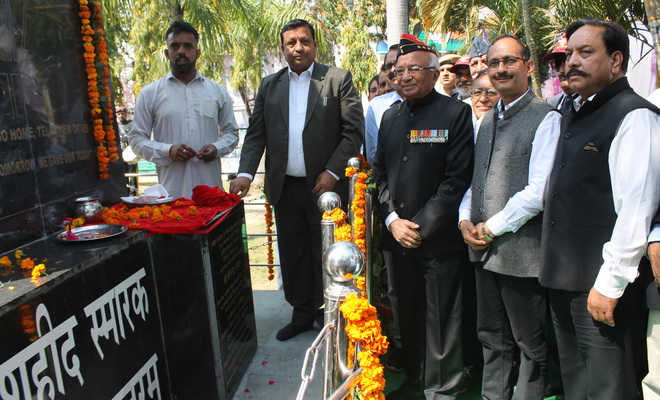
War memorial opened in Una

War memorial opened in Una
Rural Development Minister Virender Kanwar inaugurates the war memorial in Una on Friday. Photo: Rajesh Sharma

Our Correspondent

Una, March 23

A war memorial, depicting the names of 87 defence personnel from Una district, who laid down their lives for the country, was inaugurated on Friday at the Municipal Park in Una town by Rural Development Minister Virender Kanwar.The memorial was constructed by the Una district unit of the Ex-Servicemen Service Council. Lt Gen VM Patil (Retd), national chairman of the council, and BJP state president Satpal Singh Satti were also present. After paying homage to the martyrs at the memorial, he said after coming to power, the BJP government in the state had revived the financial benefits to ex-servicemen, which were stopped by the previous Congress government. He said while the state government provided jobs to one person from the family of a soldier who died fighting for the country, the facility was now being extended to dependents of paramilitary officials also who had been martyred. Kanwar said there would be village honour boards which would describe the names and achievements of the distinguished persons of the panchayat.


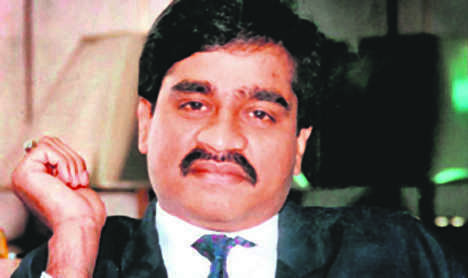
Pak-based D-company has diversified, US lawmakers told

Pak-based D-company has diversified, US lawmakers told
Dawood Ibrahim

Washington, March 23

Pakistan-based Dawood Ibrahim-led terrorist group D-company has diversified in many other fields and built a powerful transnational crime-terror organisation in part from drug proceeds, US lawmakers were told on Friday.

Indian underworld don Dawood, wanted in India for a number of terrorist attacks, is now based in Karachi, according to the US and Indian officials. However, Pakistan has denied his presence in the country.

“Pakistan-based crime-terror group D-company, whose origins lie in India, expanded Karachi’s historic role as a drug transhipment point, and built a powerful transnational crime-terror organisation in part from drug proceeds,” Dr Louise Shelley, Professor at Schar School of Policy and Government at the George Mason University told lawmakers.

Shelley claimed that the D-company has diversified.

“D-company, like Mexican drug organisations, has diversified. They traffic weapons, counterfeit DVDs and provide financial services through their extensive system of hawala operators,” he said during a Congressional hearing organised by the Committee on House Financial Services Subcommittee on Terrorism and Illicit Finance.

India’s sustained campaign against Dawood was finally acknowledged by America in 2003 when the US declared him a global terrorist having links with al-Qaeda. He also faces sanctions from the UN under its anti-terror resolution.

Vindicating India’s position that Pakistan has been sheltering Dawood, the US had said that he was in Karachi and possessed a Pakistani passport under the individual category.

Testifying before the same Congressional sub-committee, Celina B Realuyo, Professor of Practice, William J Perry Centre for Hemispheric Defence Studies, National Defence University, said a number of recent attacks in Kabul were planned and launched from safe havens in Pakistan.

The year 2018 has already witnessed many deadly attacks.

On January 20, at least 22 persons, including four Americans, were killed during a 12-hour standoff with security forces after gunmen dressed as Army men raided a hotel in Kabul, frequented by many foreigners, he said.

On January 27, an attacker detonated explosives in an ambulance in Kabul, killing over 100 people and injuring some 158, according to Afghan officials.

Taliban spokesman Zabiullah Mojahid claimed responsibility for the attack, one week after the attack on the Kabul hotel attack, Realuyo added.

In June last year during Prime Minister Narendra Modi’s visit to the US, India and the US, in a joint statement after talks between Modi and President Donald Trump, vowed to strengthen cooperation against terror outfits like Jaish-e-Mohammad, Lashkar-e-Toiba and D-Company. PTI



More of Bharat joins in The wages of accumulated rural distress

More of Bharat joins in

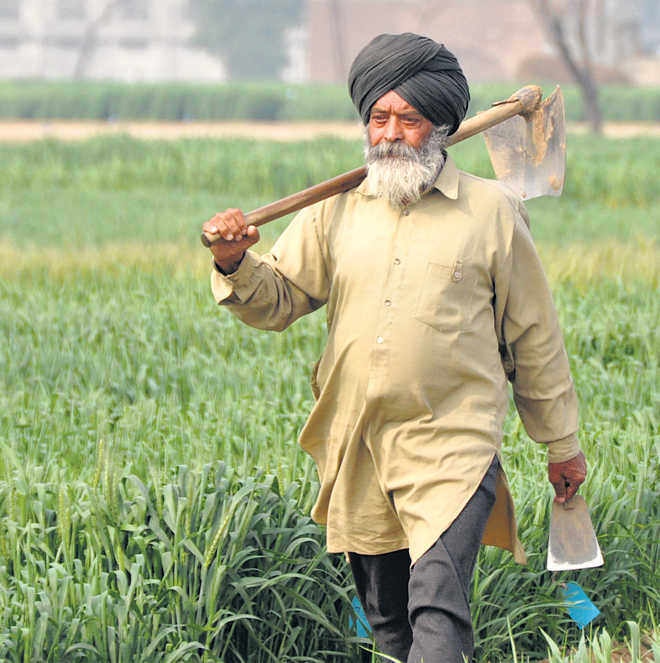
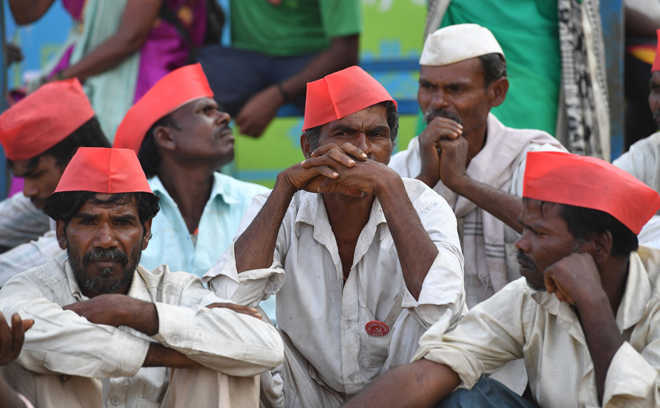
The huge phalanx of protesting farmers has won over Mumbaikars with their self-discipline and compassion. Incredulous urbanites have watched a spectacle of exemplary fortitude as the salt of the earth — the tribal, the landless and the marginal farmer — braved the scorching sun and roofless nights as they silently walked hundreds of kilometres from their farmsteads to the state’s political and financial capital to seek their due. Social media has posted amazing pictures of a sea of farmers walking past populated areas at the break of dawn so as not to inconvenience children during exam time. CM Fadnavis was “technically” correct but  came off looking insensitive and extremely condescending when he said the sea of agitating rural India was “technically” not farmers. Many of the feet are bare, calloused and bruised. This was not merely the tractor-crowd whose sole focus is personal aggrandisement in the form of debt waivers and high crop purchase prices. These sons of the soil seek not just immediate respite from farm distress, but also devolution of the rights-based promises made to rural India by successive ruling arrangements, especially the Forests Act and land rights to the tiller. Another principal communitarian demand relates to the apprehensions triggered by river interlinking projects. Rural India is not asking for the unattainable. It simply seeks an assurance against being left out or being made the victims of the New Delhi’s model of vikas. The massive “Long March” is not the only manifestation of rural India’s resentment over the short shrift given to its fears, suspicions and aspirations. From Tamil Nadu to Madhya Pradesh, people in villages are up in arms against a non-existent public delivery system and denial of a rights-based existence. The discipline displayed by the marchers exemplifies the legendary forbearance of the Indian peasantry. But it is being tested. Successive protests are gathering more and more adherents; the previous edition pales in comparison to the numbers who participated in the current march. The governments at the Centre and the states can ignore these storm clouds only at their peril.


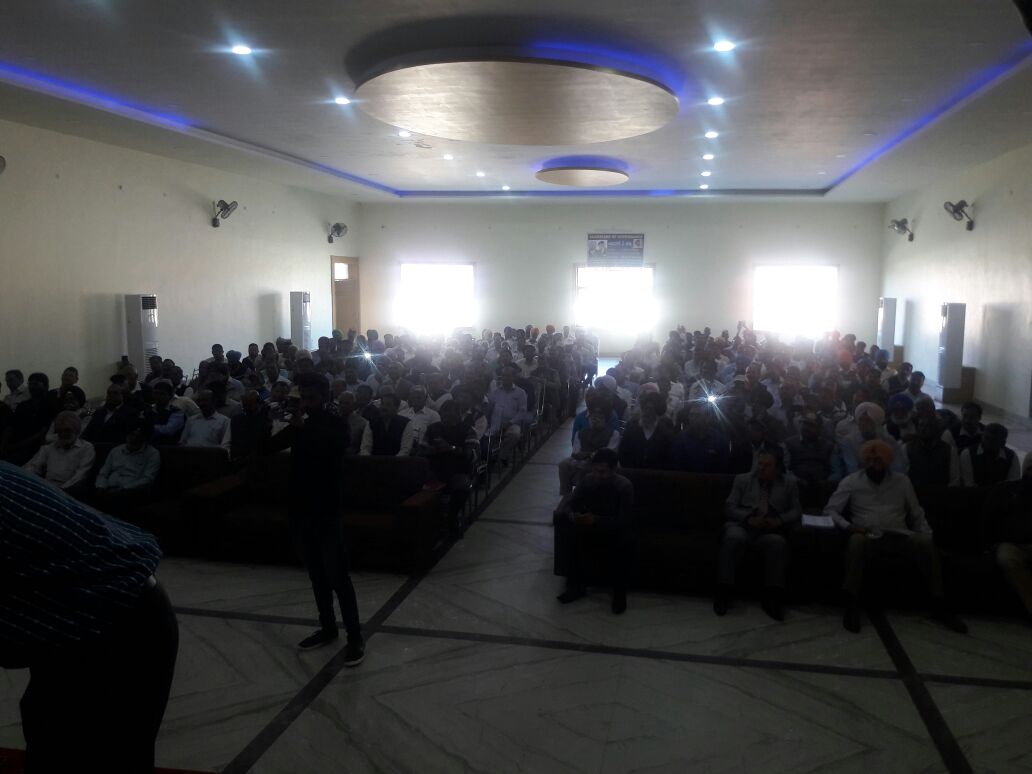
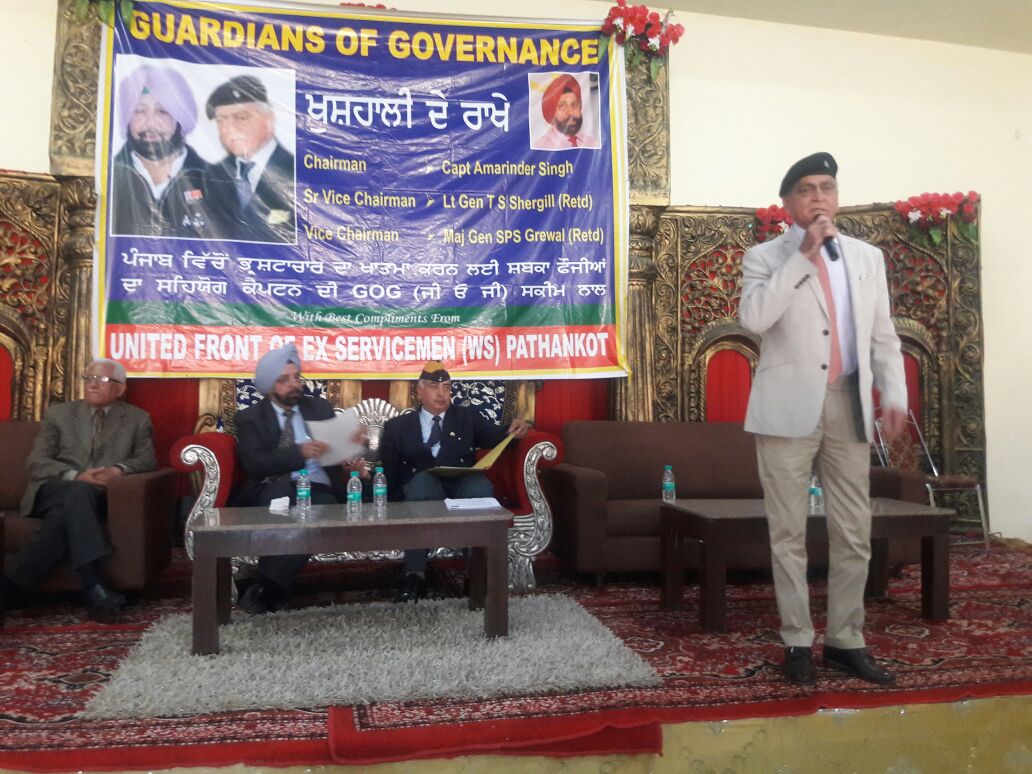
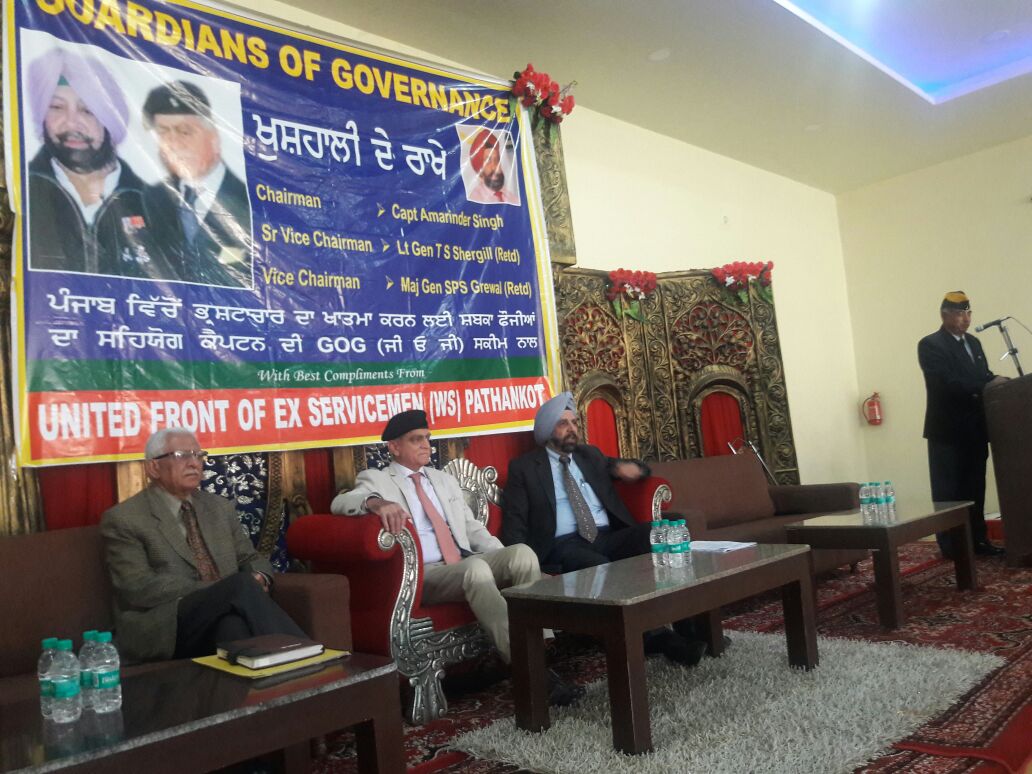
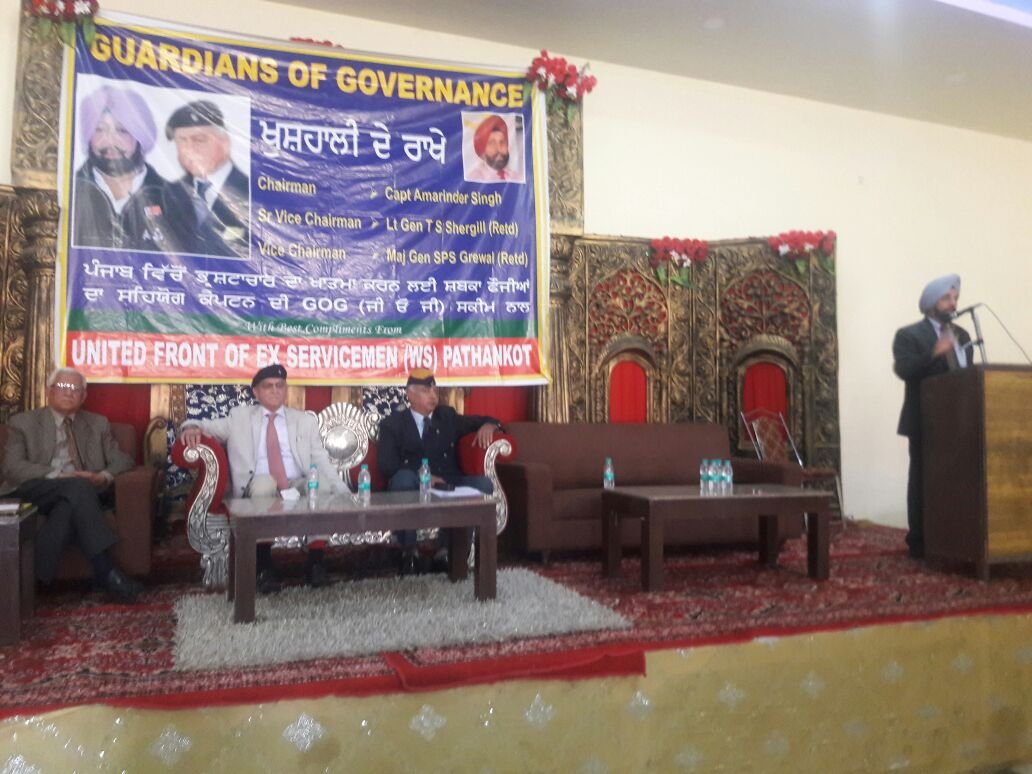
GOG REVIEW MEETING AT PATHANKOT:::08 MARCH 2018

IMG-20180308-WA0060


IMG-20180308-WA0061IMG-20180308-WA0065IMG-20180308-WA0063IMG-20180308-WA0062


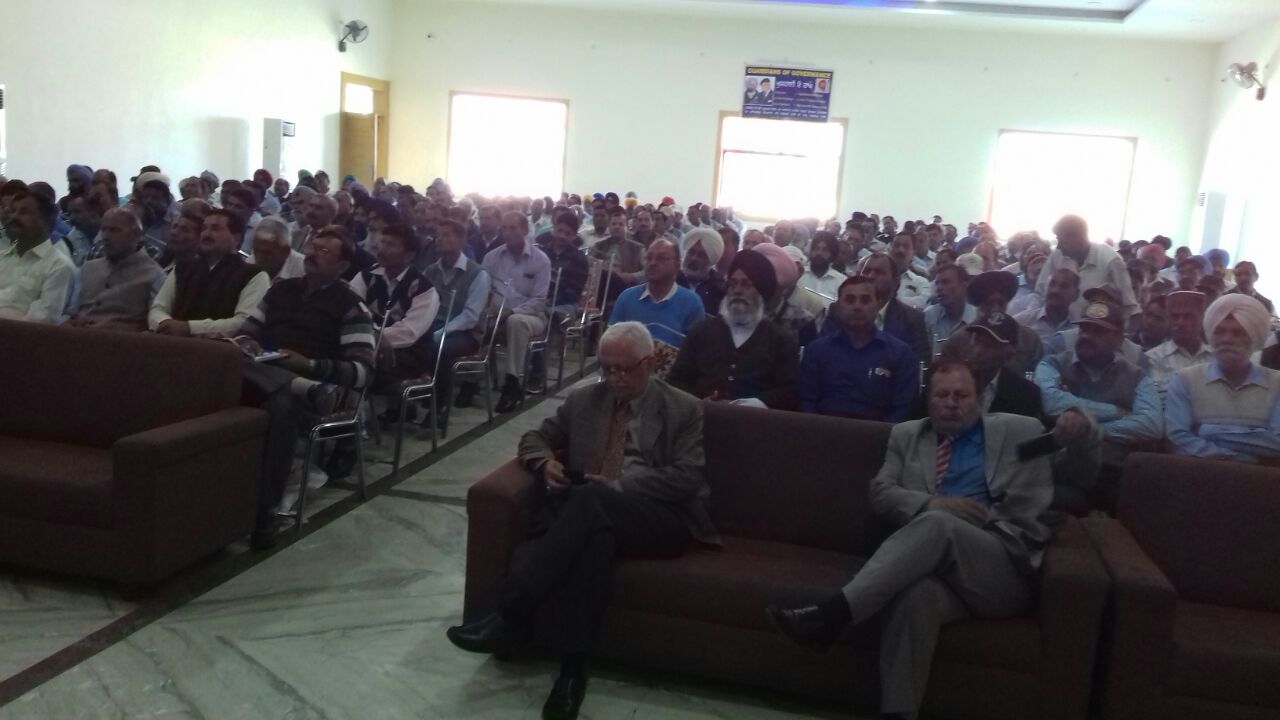
REVIEW MEETING OF GOG WAS ORGANISED AT PATHANKOT BY BRIG PRAHALAD SINGH ON 08 MARCH 2018.

ALL THE GOD OF DISTT  WERE BRIEFED BY LT GEN TS SHERGILL,PVSM ,SENIOR VICE CHAIRMAN GOG CUM Sr ADVISOR OF CM ,PUNJAB

AND

MAJ GEN SPS GREWAL VICE-CHAIRMAN OF GOG CUM CMD PESCO ALSO BRIEFED THE CONSTRUCTIVE AND POSITIVE ROLE THE GOG HAS TO PLAY FOR PUNJAB ADMINISTRATION.