Sanjha Morcha

What’s New

Click the heading to open detailed news

Current Events :

web counter

Print Media Reproduced Defence Related News

Pakistan to give greater authority to PoK, Gilgit-Baltistan

Pakistan to give greater authority to PoK, Gilgit-Baltistan

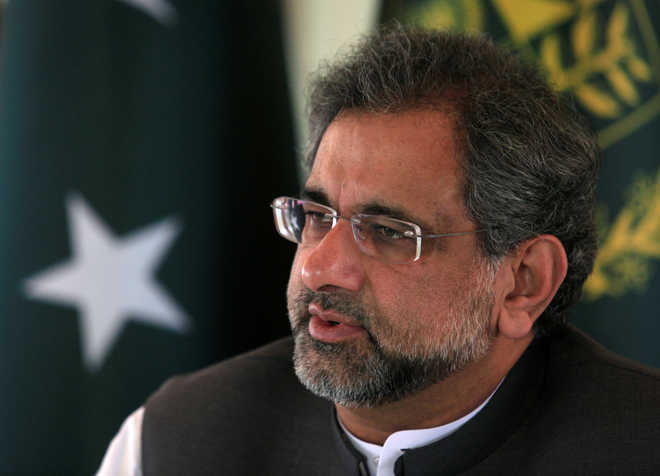
The meeting was chaired by Pakistan PM Shahid Khaqan Abbasi.

Islamabad, May 20

Pakistan’s top civil and military leaders have decided to give greater administrative and financial authority to Pakistan-occupied Kashmir and Gilgit-Baltistan, the region through which the controversial $50 billion China-Pakistan Economic Corridor (CPEC) passes.During a meeting of the National Security Committee (NSC) — the top civil and military body—Sartaj Aziz, Deputy Chairman Planning Commission and the Ministry of Kashmir Affairs & Gilgit-Baltistan, yesterday briefed the Committee on the PoK and Gilgit-Baltistan reform proposals, an official statement said.The meeting chaired by Prime Minister Shahid Khaqan Abbasi reviewed these proposals and after detailed deliberations a consensus was reached on the “devolution of greater administrative authority and financial powers” to the PoK government and the Gilgit-Baltistan government, according to the statement.The details of administrative and financial reform have not been shared so far.However, there was also consensus over retention of the PoK and Gilgit-Baltistan Councils as advisory bodies; and the grant of a five-year tax holiday to Gilgit-Baltistan so as to create adequate incentives for the development of the region and bring it at par with the other areas of Pakistan.Gilgit-Baltistan is treated as a separate geographical entity by Pakistan. Balochistan, Khyber-Pakhtunkhwa, Punjab and Sindh are four provinces of Pakistan.India has termed as “entirely unacceptable” any possible attempt by Pakistan to declare the Gilgit-Baltistan region, bordering the disputed Pakistan-occupied Kashmir, as the fifth province. India has protested to China over the CPEC which goes through Gilgit-Baltistan region.It is believed that China’s concerns about the unsettled status of Gilgit-Baltistan prompted Pakistan to change its status.Earlier media reports had said Pakistan plans to elevate the constitutional status of the region to provide legal cover to the CPEC.The NSC also endorsed that FATA shall be merged with Khyber Pakhtunkhwa along with the introduction of the administrative and judicial institutional structures and laws of Khyber Pakhtunkhwa, the statement said.The Committee directed the ministries concerned to work out the constitutional, legal and administrative modalities for the merger in consultation with all parties in the Parliament.The meeting was attended by Interior Minister Ahsan Iqbal, Minister for Defence & Foreign Affairs Khurram Dastgir Khan, Chairman Joint Chiefs of Staff Committee Gen Zubair Mahmood Hayat, Army chief Gen Qamar Javed Bajwa, Chief of Naval and Air forces, ISI chief and other senior civil and military officials. — PTI


Recruitment rally for Gorkha Regiment

Una: A recruitment rally for entry to the Gorkha Regiment as general duty and professional duty soldiers will be held at the 14 Gorkha Training Centre, Subathu, in Shimla district on June 4 and 5.  According to an official press release, candidates should be either Indian citizens or Indian citizens with Nepalese origin  . OC


North Korea threatens to cancel US summit: KCNA

North Korea threatens to cancel US summit: KCNA

Seoul, May 16

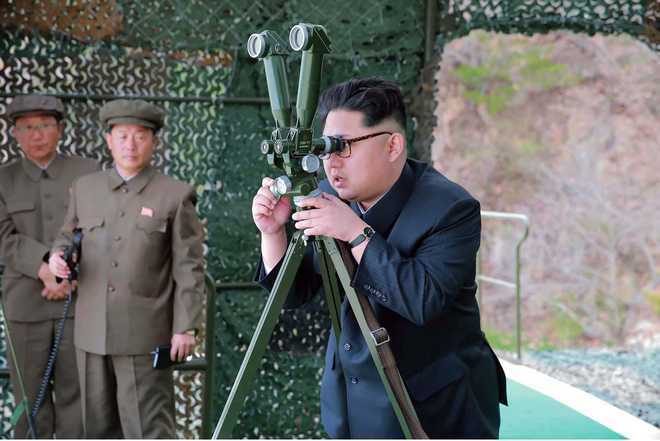
North Korea threatened on Wednesday to cancel the forthcoming summit between leader Kim Jong-un and President Donald Trump if Washington sought to push Pyongyang into giving up its nuclear arsenal.If the Trump administration “corners us and unilaterally demands we give up nuclear weapons we will no longer have an interest in talks and will have to reconsider whether we will accept the upcoming DPRK-US summit”, first vice foreign minister Kim Kye Gwan said in a statement carried by the official KCNA news agency.Washington is pressing for Pyongyang’s complete, verifiable and irreversible denuclearisation. But so far the North has not given any public indication of what concessions it is offering.At a summit with the South’s President Moon Jae-in last month, Kim Jong-un reaffirmed his commitment to the denuclearisation of the Korean peninsula.But the phrase is a diplomatic euphemism open to interpretation on both sides.“We already expressed our willingness for a denuclearised Korean peninsula and repeatedly declared that the US must end its hostile DPRK policy and nuclear threats as preconditions,” minister Kim said.In the past, Pyongyang has demanded the withdrawal of the US troops stationed in the South to protect it from its neighbour, and an end to Washington’s nuclear umbrella over its security ally.Kim Kye Gwan also blasted US National Security Adviser John Bolton, who has spoken of a ‘Libyan model’ for North Korean denuclearisation.It was a “highly sinister attempt to enforce the fate of Libya and Iraq upon the DPRK,” Kim said.“I cannot suppress anger over this US move and it is doubtful whether the US really wants to improve ties with the DPRK through dialogue and negotiation.”The North has long said it needs nuclear weapons to protect itself against a US invasion. After giving up his atomic programme, Libyan leader Moamer Khadafi was killed in an uprising backed by NATO bombing. AFP


Martyr cremated with honours

Martyr cremated with honours

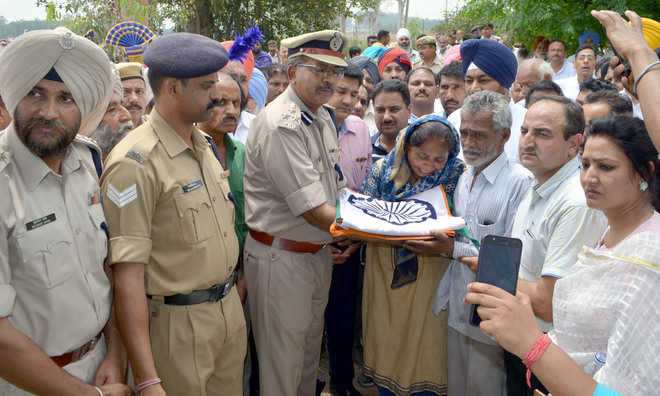
A CRPF officer hands over Tricolour to martyr Mandeep Kumar’s mother before it was placed on his coffin at Khudadpur village, near Gurdaspur, on Friday. Tribune photo

Tribune News Service

Gurdaspur, May 13

The mortal remains of Mandeep Kumar (27), a CRPF jawan who was killed in an encounter with militants in Pulwama (J&K) on Friday, were consigned to flames at his native Khudadpur village, near here, on Sunday.Senior CRPF and district administration officers were present. A contingent of the CRPF reversed arms and fired shots in the air as a mark of respect to the deceased.Mandeep Kumar, who was deployed in the valley with the 182nd battalion, was the sole breadwinner of his family.SDM Sakatar Singh Bal laid a wreath on behalf of the state government. CRPF officers said Mandeep faced militants bravely during the gunfight.


Assam Rifles jawan from Gurdaspur ‘commits suicide’ in Guwahati

Assam Rifles jawan from Gurdaspur 'commits suicide' in Guwahati

Bijay Sankar Bora

Tribune News Service

Guwahati, May 11

A jawan of Assam Rifles, identified as Rajinder Singh from Gurdaspur in Punjab, allegedly committed suicide by firing at his head from his 9 mm service pistol.His body was recovered in the wee hours of Friday by the city police from a Scorpio of the Assam Rifles which was parked on the road near the Assam Rifles transit camp in the city.The Officer-in-Charge of Dispur Police Station in the city, Hamangshu Das, said the jawan aged 36 was employed as a driver-constable in the force and used to drive the Scorpio vehicle assigned to a Deputy Inspector General of the paramilitary force.The police officer said it was suspected to be a case of suicide and there was bullet injury mark on the right side of the head of the jawan. Further investigation is on.


जीओजी युवाओं को दे रही निशुल्क आर्मी भर्ती ट्रेनिंग::: GOG PROVIDING FREE TRAINING TO YOUTHS FOR BSF/CRPF RECRUITMENT

clip

सुजानपुर/पठानकोट| गार्जियन ऑफ गवर्नेंस (जीओजी) जिला पठानकोट के प्रधान ब्रिगेडियर प्रह्लाद सिंह के नेतृत्व में टीम सुजानपुर में युवाओं को सेना, बीएसएफ व सीआरपीएफ में भर्ती के लिए निशुल्क में ट्रेनिंग देकर प्रशिक्षित कर रही है। ब्रिगेडियर प्रहलाद सिंह ने बताया कि युवाओं को प्रशिक्षित करने का मुख्य उद्देश्य युवाओं को भर्ती दौरान किसी प्रकार की परेशानी न हो। उनकी ओर से यह ट्रेनिंग कैंप लगभग एक माह से शुरू किया गया है ओर इस कैंप में कोई भी बच्चा सुबह 5 से 6 बजे तक बाग वाली माता रोड़ पर स्थित पुल नंबर-10 के समीप आकर उनके साथ संपर्क कर ट्रेनिंग ले सकता है। 


AFSPA essential for Army: Gen Malik

AFSPA essential for Army: Gen Malik

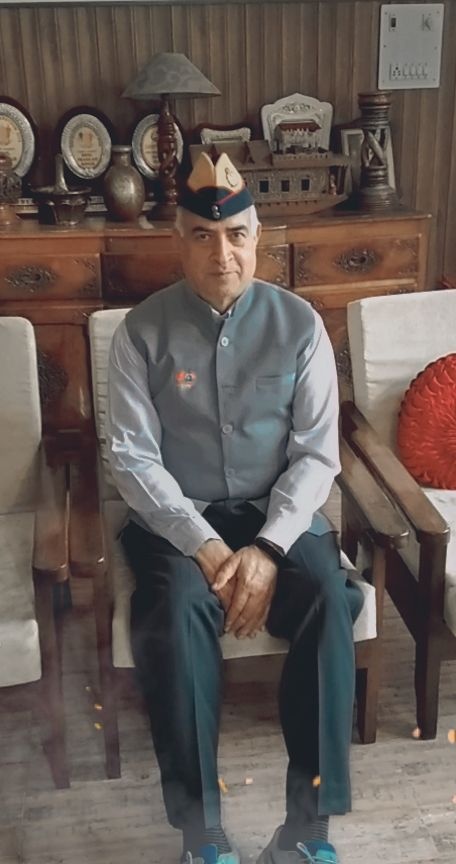
Gen VP Malik (Retd)

Jupinderjit Singh

Tribune News Service

Chandigarh, April 30

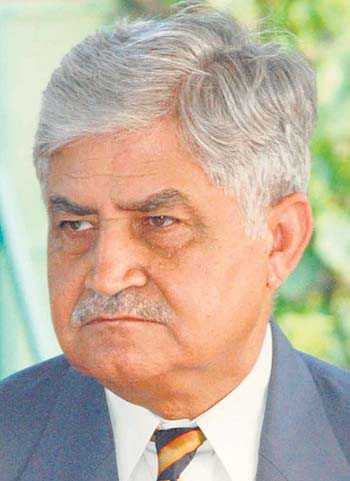
Joining the debate on the AFSPA, after its full and partial removal from two states, former Army Chief VP Malik stressed that the Armed Forces Special Powers Act (AFSPA) is essential for the Army, which is put in a combat position in terrorism-hit areas.He was delivering a keynote address at a symposium on Daisaku Ikeda’s 2018 peace proposal, ‘Towards an era of human rights: Building a people’s movement’, organised by the Bharat Soka Gakkai here on Monday evening.Referring to the recent removal of the Act from Meghalaya and almost half of the Arunachal Pradesh, Gen VP Malik (Retd) said: “The Act is grossly misunderstood as it does not give the Army any liberty to indulge in violence. Believe me, the Army has its own mechanism to handle aberrations of violence, but without AFSPA, the Army will have no legal sanctity and constitutional protection to function in a strife-torn area.”Defending the soldiers, Malik called for the need to understand the human rights and self-defence rights of a soldier. “Recently in Kashmir, a Junior Commissioned Officer (JCO) of the Army was booked for firing at a mob of stone-pelters. No one bothered to talk about the human rights of the soldier and his right to defend himself from a mob,” he said.Malik said people must understand that peace comes in pieces and not as one whole package.As care for the elderly is an important part of the 2018 peace process, Malik said it was important for the elderly to have financial independence and to keep themselves busy.Earlier, Navraj Sandhu, Additional Chief Secretary with the Haryana government, spoke on the importance of women empowerment as a necessary tool for world peace.Inspirational speaker and former IAS officer Vivek Atray talked about the need to have peace within ourselves to attain world peace. He stressed that the education and empowerment of the girl child was a must for a healthy society, but upbringing of the boys as sensitive human beings where they respect women is also a necessity.Vishesh Gupta, Chairperson, Bharat Soka Gakkai, said the peace movement was the way forward to make the world free of violence.


Statue of martyr damaged in Hisar

Statue of martyr damaged in Hisar

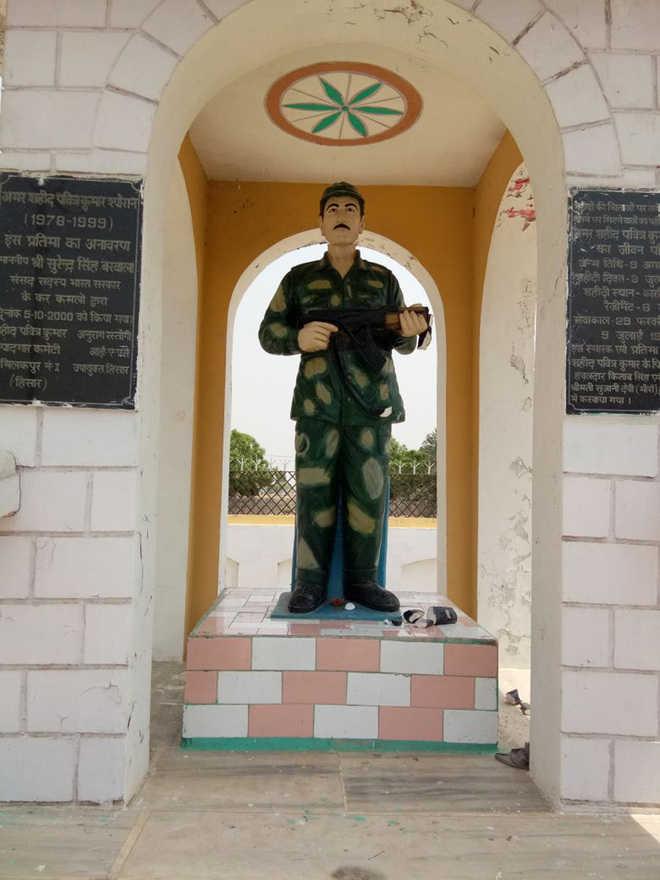
The statue of Kargil martyr Paviter Kumar damaged in Milakpur village of Hisar district. Tribune photo

Tribune News Service

Hisar, April 30

The statue of Kargil martyr Paviter Kumar was damaged by unidentified persons in Milakpur village of the district on Sunday night.The police said damage to the statue was noticed by Savitra Kumar, brother of the martyr. SHO Sadhu Ram said an FIR was registered in this connection .A police team inspected the site and started investigation.Paviter Kumar ha been recruited in the Jat Regiment. He died on July 9, 1999, during the Kargil War. His family members installed the statue in his memory in the village on October 5, 2000.


As Modi & Xi re-engage, what’s on China’s mind by Lt Gen Syed Ata Hasnain

Prime Minister Narendra Modi (right) and Chinese President Xi Jinping. (Photo: File/AP)

Prime Minister Narendra Modi is visiting China and will meet President Xi Jinping on April 27-28 in an informal summit at Wuhan.

Prime Minister Narendra Modi (right) and Chinese President Xi Jinping. (Photo: File/AP)

Prime Minister Narendra Modi is visiting China and will meet President Xi Jinping on April 27-28 in an informal summit at Wuhan. They will again meet in June this year when he travels for the Shanghai Cooperation Organisation (SCO) summit. After the low point to which Sino-Indian relations had sunk in the wake of the Doklam standoff in June-August last year, and repeated Chinese transgressions of the Line of Actual Control (LAC) over the past many years, one could never be certain what China’s approach to “friendship and cooperation” was going to be. The continuous efforts by China to prevent India’s entry into the Nuclear Suppliers Group and its unrelenting determination to prevent Masood Azhar be declared an international terrorist by the UN Security Council would forebode no happy tidings from the coming encounter. Yet China can be the strangest country to deal with. After all, in 1962, after roundly defeating us on the battlefield, it withdrew behind its claimed lines, leaving the so-called disputed territory to be reoccupied by India. There is no reason for an Indian sulk in 2018 as that would be counterproductive, and the Modi government has done well to re-engage.

What can then reasonably be expected from the situation at this juncture of Sino-Indian ties and what will dictate it. China knows that it is destined for big things, the eventual leadership of the world. However, it is in no hurry to reach that stage prematurely. In Chinese philosophy, anything premature is bound to create uncertainty, and the certainty of its rise and ultimate dominance is China’s vision. Thus, the status of Sino-Indian relations needs to be examined from this angle. The perception that China is tempted to go to war with India at a stage when it finds India still militarily weak and unprepared could be inherently flawed. The discussions at the 19th congress of the Chinese Communist Party (CPC) made it amply clear that China retained the wisdom of the ancients and had the patience to await its turn to assume the leadership of the world. The interim is all about China working towards maintaining relationships with major powers that it sees as potential competitors and yet setting the stage for their eclipse at its hands. There is no doubt that India falls within the ambit of that perception, that demands from China strategic patience and just sufficient coercion to retain an upper hand in the bilateral relationship. President Xi Jinping’s new status, with leadership for life, and the statements of the 19th congress made it reasonably clear that he is no longer bound by the limits of tenure to achieve what he perceives he is destined to. The new vision surely cannot begin with conflict.

The $85 billion (and growing) trade between India and China is one of the drivers of China’s need for India — the growth was 18 per cent year on year in 2017, in spite of Doklam and other irritants; and the imbalance remains in China’s favour. In the face of a dwindling economy and with threats of trade wars with the United States, the idea of a lucrative trade relationship going bust may not sound tempting. Yet, for all this, China will still not put curbs on its coercion at the border, specially the disputed areas. That provides the scope to put India in its place and project it as unable to stand up to China’s military power. This has continued for a fairly long time, while cooperation in other domains also remained firm. The extent of this strategy was clear even in 2014 when Xi Jinping sat with Narendra Modi on the banks of the Sabarmati, even as the PLA blatantly carried out a transgression of the LAC in eastern Ladakh. But then Doklam happened, and that upset the carefully crafted strategy. India did not cow down, it held its own militarily and diplomatically, and even more importantly psychologically. China’s attempts at information and psychological warfare to browbeat India did not succeed and India handled its media well enough to neither intimidate nor escalate the conflict. A reset was therefore imminent.

The reset that China seeks is perhaps a marginal tweak of the original policy of simultaneous intimidation and engagement. India’s resistance to BRI and its refusal to show up for the grand BRI conference did not go down well with Beijing. The reset now probably includes an adjustment to bring India into the ambit less the CPEC, which crosses India’s claimed area of Pakistan-occupied Kashmir. Some alternatives could be in the offing, to include a China-Nepal-India Trilateral Economic Corridor extendable to Bangladesh, a China-Bhutan-India Corridor or a relook at the Bangladesh-India-Myanmar-China Corridor (BIMC). The signing of MOUs would be in the offing but the materialisation of these would be contingent upon what China has in store as far as the border is concerned. Putting that in the freezer is unlikely after years of experience in brinkmanship through walk-in operations. Leaving Doklam unavenged may also not be a tempting proposition as ego still dictates China’s self-perception. Analysts have been prophesying that limited coercion at the border accompanied by massive doses of deniable cyberattacks, along with a refurbished information strategy, could be in the offing even as India’s leadership is engaged in talks. That is the Chinese way, with the aim that India will wilt under the combined pressure and yield strategic space. The game being played over the Maldives is another prong of this strategy, a game which does include temporary yielding of space to send positive signals. In the recent past, China displayed this at FATF, where after initial reluctance it agreed upon placing Pakistan on the warning list for its financial terror links. By being willing to engage, India is not wilting but displaying pragmatism. When a nation has neglected its comprehensive national power to meet its threats, some pragmatic compromise is inevitable. Hopefully, over the next decade or so it will pay more attention towards this weakness and acquire a position to resist Chinese coercion, even as the two remain engaged in many other domains of cooperation.

Syed Ata Hasnain, a retired lieutenant-general, is a former commander of the Srinagar-based 15 Corps. He is also associated with the Vivekananda International Foundation and the Institute of Peace and Conflict Studies.


India, US, Japan ready for war drill in Pacific

Chinese aircraft carrier Liaoning and its associated fleet have been practising in the same area recently

Ajay Banerjee

Tribune News Service

New Delhi, April 25

Even as China takes forward its military expansion into the island territories of western Pacific Ocean, India, US and Japan will conduct their annual Malabar exercise at sea off the coast of Guam, a US-controlled military base in the western Pacific Ocean.Chinese aircraft carrier Liaoning and its associated fleet have been practising in the same area recently even as Vanuatu, another island close to Australia, is being eyed by Beijing for a possible Naval base. Beijing’s moves could lead to a rejig of plans of the newly formed quadrilateral—US, India, Japan and Australia. The nine-day Malabar exercise will commence on June 7. India will set sail its three warships — INS Shayadri, INS Kamorta and a fleet tanker—in the third week of May. These will be joined in by long range maritime recognisance aircraft, the Boeing P8-I. The US is expected to have one of its carriers in the exercise.The Malabar is conducted annually, the last time India hosted it in the Bay of Bengal. This included high-end war-fighting skill set, subject matter experts, combined carrier strike group operations, maritime patrol and reconnaissance operations, surface and anti-submarine warfare, medical operations, damage control, special forces, explosive ordnance disposal (EOD), helicopter operations, and visit board search and seizure (VBSS) operations. In 2016, the exercise was hosted by Japan with the “sea phase” taking place in the Philippine Sea. China has recently increased its air and naval excursions in the western Pacific in what is being seen as a quest to expand its military presence. Beijing has a policy of ‘open seas protection’, which includes warships, nuclear-powered attack submarines and aircraft carriers.