Sanjha Morcha

What’s New

Click the heading to open detailed news

Current Events :

web counter

Print Media Reproduced Defence Related News

MARSHAL ARJAN SINGH MEMORIAL HOCKEY TOURNAMENT IAF, Punjab Police in final Punjab Police beat Indian Navy; IAF oust SC Railway in semis

IAF, Punjab Police in final

Tribune News Service

Chandigarh, May 11

Indian Air Force will face Punjab Police in the final of the inaugural Marshal Arjan Singh Memorial Hockey Tournament here on Saturday.In the semifinals played here on Friday, Punjab Police registered a 6-3 win over Indian Navy, while IAF overcame South Central (SC) Railway 2 -1. Gurvinder Singh Chandi scored the opening goal for Punjab Police in the 8th minute of the match, but Indian Navy restored the parity just two later through Parteek Singh. Punjab Police regained the lead in the 22nd minute with a Gurbaj Singh strike before Karanbir Singh made it 3-1 for the side in the 34th minute. Indian Navy tried their best to make a comeback into the match and finally succeeded in reducing the deficit when Mohit Singh struck for the side in the 53rd minute. However, back-to-back goals by Dharmvir Singh (55th and 58th minute) dented their hopes of revival. Rana Pratap scored a goal for the side in the 59th minute but it was never going to be sufficient as Jasjit Singh Khullar struck for Punjab police in the 68th minute to seal an easy 6-3 win for the team. Dharmavir was adjudged the Best Player of the match.In the second semifinal, Sukhdev Singh scored a brace to help the hosts IAF beat South Central Railway. Sukhdev netted the first goal in the 18th minute and completed a brace in the 44th minute to put IAF 2-0 ahead.MG Poonacha reduced the deficit in the 49th but the IAF held on to the slender lead for the remaining part of the game to set up the title clash with Punjab Police.  IAF goalkeeper Pooanna PE was named the Best Player of the match.


Kim visits China again

BEIJING: China’s President Xi Jinping and North Korean leader Kim Jong Un held talks over two days in the northeastern Chinese coastal city of Dalian, state media reported on Tuesday.

AP■ Kim Jong Un (left) and Xi Jinping in Dalian.

This was the second summit between the two leaders in about 40 days, with Kim having travelled to Beijing for a secret meeting in March ahead of a summit between the leaders of North and South Korea.

The meeting on May 7 and 8 was unannounced as well, with confirmation coming only when China’s state media announced it and published a photo of Xi and Kim taking a stroll on a beach.

The meeting was held days after Kim and South Korean President Moon Jae-in met for a historic summit in Panmunjom in April and ahead of the much anticipated meeting between Kim and US President Donald Trump, expected in the coming weeks.

Kim’s visit to Beijing in March was his first international trip after he assumed power, sending out a signal that China remained a crucial player in the Korean peninsula. The second meeting cements that notion further.

Though it wasn’t described as such, the reports in the state media suggested the meeting between Kim and Xi was apparently “informal” in nature.

This is only the third time that Xi has travelled outside Beijing to meet a leader. The only two one-on-one meetings with a leader outside the national capital were with Prime Minister Narendra Modi in Xian and Wuhan.

The official Xinhua news agency quoted Xi as having said: “After the first meeting between me and Comrade Chairman, both China-DPRK relations and the Korean Peninsula situation have made positive progress. I feel happy about it.”

Kim was quoted as saying that bilateral ties and the situation on the Korean Peninsula had undergone meaningful progress since March. “These are the positive outcomes of the historic meeting between me and Comrade General Secretary,” he said.


Footprints of India and China’s economies Pritam Singh

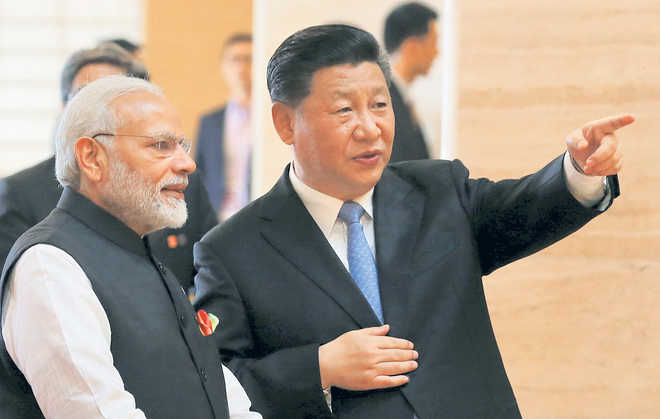
The economic growth of India and China, the world’s leading producers of carbon dioxide emissions, has scary environmental implications. However, India is way below the West in terms of per capita emissions and cannot achieve a simplistic trade-off between growth and emissions.
Footprints of India and China’s economies

Pritam Singh

Professor of Economics, Oxford Brookes University, UKIn terms of per capita income, China and India are still in the category of developing economies, but in view of their increasing share in the global GDP, they are now major economic powers. China replaced the USA as the world’s biggest manufacturer in 2010 and overtook it as the top economy in 2014 in terms of its GDP at purchasing power parity. India overtook Japan in 2011 as the third largest economy in the world. China and India together, with 2.7 billion people, encompass 36 per cent of the world’s population. Given this, even if their per capita incomes are lower than the advanced economies, the size of their GDPs means a massive environmental footprint of their economies nationally as well as globally. China and India can no longer hide their national and global environmental responsibilities under the pretext which was perhaps partially valid a few decades ago: that they needed to develop and, therefore, protecting planet Earth from the harmful consequences of global climate change was their lesser concern. China’s share of global GDP was as low as 2.3 per cent in 1980, even lower than India’s at that time, but it jumped to a record 18.3 per cent in 2017. According to an estimate, if the current Sino-Indian growth rates persist, by 2050, they would be the dominant global suppliers of manufactured goods and services, respectively.

Scary environmental implications

The impressive looking economic growth scenario has scary environmental implications. China and India are now among the top producers of carbon dioxide emissions whose implications for pollution and global warming are most serious. In absolute terms, China current carbon dioxoide emissions are more than that of the USA. In fact, China’s carbon dioxide emissions are more than those of the USA and the European Union combined. After China, the USA and the EU, India is the fourth largest carbon dioxide emitter followed closely by Russia. One of the largest concerns is the rise in global warming which is defined as the rise in average temperature of the earth’s atmosphere in comparison with the pre-industrial levels. It is leading to unpredictable weather changes, rising sea levels, floods and droughts, and global agricultural and energy crisis.China has had phenomenal manufacturing growth due to low labour costs in international comparative terms. The full environmental implications of that growth are now manifesting themselves in a vicious manner. Pollution in China’s urban manufacturing centres has risen to threatening levels. According to one study done on 74 cities in China, around a third of the deaths in these cities were smog related and the total number has reached 3 million. On the worst days, the  government makes it mandatory for residents to stay indoors and this has happened several times in Beijing. Delhi faced a somewhat similar situation last summer. Environmental change does not recognise any boundaries. With this smog travelling with the wind, it affects neighbouring countries too.

China’s environmental initiatives

China seems to be showing some awareness of the dangers involved. Some of its environmental initiatives are worth noting and emulating by India. China now is one of the largest pioneers in the renewable energy sector and aims to have 20 per cent of energy coming from renewables by 2030. Another project to help reverse the effects of climate change relates to creating large areas of forest, which were previously used for mining and factories. China announced this January that it is planning to plant a forest of 6.6 million hectares, roughly the size of Ireland, and aims to make 25 per cent of China a forest by 2020, compared to the current 21.7 per cent. Also, with China’s manufacturing sector being so strong, it has invested heavily in the production of solar cells, becoming the largest shareholder for solar heating. As a result of the cost-effective production, it has been able to make the electricity produced by the solar panels competitive with the cost of electricity produced by fossil fuels such as oil and gas. Also, it is now the world’s largest producer of hydroelectric power which, of course, is environmentally a contested form of power, especially if based on large dams.These environmental initiatives are challenged by the fact that China accounts for half of the global consumption of coal. Coal is the dirtiest of all fossil fuels and its consumption has to be cut drastically. This holds true for India, too.

India’s progress

India has made some good progress with renewables, mainly wind and solar. Wind farms are now producing 30 per cent of the global production of wind energy. India started looking into wind energy in the 1960s. It now accounts for up to 50 per cent of India’s renewables, with solar close behind. But India has still a lot to learn from China’s environmental initiatives and experiences, and this is one area of fruitful collaboration between the two global giants along with the aims of reducing extreme inequalities and degrading poverty. The project of reducing inequalities is closely intertwined with environmental protection because the worst sufferers of environmental degradation are the poor, especially those dependent on agriculture and forests or living in urban slums.The global environmental responsibilities of India and China have assumed greater significance because the USA, the other global economic power, is abandoning, under the Trump presidency, the climate change negotiation framework aimed at curbing global warmin



SC raps MoD for careless litigation

Vijay Mohan

Tribune News Service

Chandigarh, April 26

Coming down heavily on the Ministry of Defence (MoD) for indulging in excessive litigation in settled matters, the Supreme Court had asked the government to wake up to its duties and responsibilities to the justice delivery system.“The couldn’t-care-less and insouciant attitude of the Union of India with regard to litigation, particularly in the Supreme Court, has gone a little too far,” a Division Bench comprising Justice Madan B. Lokur and Justice Deepak Gupta ruled on April 24 while imposing a fine of Rs 1 lakh on the government for a second time within a few weeks.Dismissing an appeal filed by the MoD in a disability related case of Prithwi Singh, a resident of Bhiwani in Haryana who had been granted relief by the Chandigarh Bench of the Armed Forces Tribunal, the Bench observed that several similar matters had been disposed of by the top court earlier and even a fine of Rs 1 lakh had been imposed last month to ensure the Union of India was far more circumspect.“The Union of India must appreciate that by pursuing frivolous or infructuous cases, it is adding to the burden of this court and collaterally harming other litigants by delaying hearing of their cases through the sheer volume of numbers,” the Bench said.To make matters worse, the Bench pointed out, 10 lawyers, including an additional solicitor general and a senior advocate, were engaged in this case. “The Union of India has created a huge financial liability by engaging so many lawyers for an appeal whose fate can be easily imagined on the basis of existing orders of dismissal in similar cases. Yet the Union of India is increasing its liability and asking the taxpayers to bear an avoidable financial burden for the misadventure,” the Bench ruled.The Bench observed that the government’s own action plan, which has been hanging fire for several years, mentions among others, steps to avoid unnecessary filing of appeals in routine matters and that vexatious litigation should be immediately withdrawn. It hoped that someday some sense will prevail on the Union of India with regard to the formulation of a realistic and meaningful National Litigation Policy.



Army pays tributes to Pulwama martyr

Army pays tributes to Pulwama martyr

Tribune News Service

Srinagar, April 25

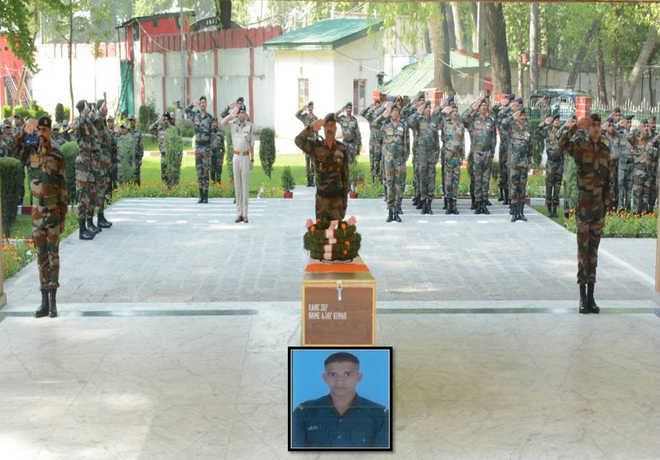
The Army on Wednesday paid tributes to Sepoy Ajay Kumar, who was killed during a counter-insurgency operation on Tuesday in south Kashmir’s Tral sub-district.“In a solemn ceremony at BB Cantt, Lt Gen AK Bhatt, Chinar Corps Commander, paid homage to the martyr on behalf of the country,” the Army said in a statement. “In a show of solidarity, representatives from other security agencies also joined in to pay their last respects to the martyr,” it said.Kumar had sustained a bullet injury during the fierce gunfight in the Laam forest in Tral and succumbed to injuries at the 92 Base Hospital here.The slain soldier was 25 years old and had joined the Army in 2013. He belonged to Panjola village of Sirmaur district in Himachal Pradesh and is survived by his parents and a brother.Four militants affiliated with the Jaish-e-Mohammad and a policeman were also killed in the gun battle on Tuesday.


Capt opposes MHA move to mergeUT cadre DSPs

Chandigarh, April 22

Chief Minister Capt Amarinder Singh has opposed the move of the Ministry of Home Affairs (MHA) to merge the Chandigarh cadre DSPs with those of all union territories, including Delhi.He has demanded that status quo be maintained till the dispute over Chandigarh between Punjab and Haryana was settled.The CM has directed the Chief Secretary to prepare a formal proposal on setting up a special cell in the General Administration to deal with Chandigarh-related issues in order to protect the interests of Punjab and bring it in the next Cabinet meeting.In a statement issued here, the CM said any move to erode the state’s stake in Chandigarh was not acceptable to Punjab. Capt said any such move would limit the avenues for the career progression of senior Punjab officers in line for promotion.The proposal of the MHA would lead to merger of all sanctioned posts of DSP of Chandigarh with the entry grade of the combined cadre of Delhi and other UTs, which would allow their transfer/posting in any UT, the CM pointed out. — TNS


Cops on alert after ‘carjacking’ near International border

Cops on alert after ‘carjacking’ near International border

Tribune News Service

Pathankot, April 16

Police in border districts of Pathankot, Gurdaspur and Batala are on a high alert after reports of ‘carjacking’ near the International border late Sunday night. IG (Border) Surinder Pal Singh Parmar confirmed the incident and added that a massive manhunt had been launched after the questioning of the car owner Gujjar Maskin Ali. The car owner told the police that two unidentified armed fled with his car after threatening him.Pathankot SSP Vivek Sheel Soni received a call from the control room around 11 pm about the incident. After making initial inquiries from the SHO Narot Jaimal Singh police station, the SSP sensed that the threat was “indeed real” and immediately put his force into action. Within two hours all vital installations in the city, including the road leading to the civil airport, Air Force station, Mamun cantonment and the ammunition dump — considered to be one of the biggest army storage facility in North India — were secured.By the time morning walkers hit the streets, the city had been converted into an impregnable fortress with the cops also establishing a dozen check posts on the strategic Jammu-Pathankot national highway.


Lockheed hails India’s procurement initiative for fighter jets

Lockheed hails India’s procurement initiative for fighter jets

At least 85 per cent of the aircraft will have to be made in India while 15 per cent of them can be in a flyaway condition. File photo

Washington, April 7

American aerospace and defence major Lockheed Martin has welcomed India’s mega procurement initiative for fighter jets worth over USD 15 billion and said that it looked forward to responding to the initial tender.India on Friday began the process to acquire a fleet of around 110 fighter jets in one of the biggest such procurements in recent years globally which could be worth over USD 15 billion.At least 85 per cent of the aircraft will have to be made in India while 15 per cent of them can be in a flyaway condition.An RFI (Request for Information) or initial tender for the mega deal was issued by the Indian Air Force and the procurement will be in sync with the government’s ‘Make in India’ initiative in the defence sector, officials said.“Lockheed Martin welcomes India’s fighter aircraft Request for Information (RFI) and we look forward to responding to it,” said Dr Vivek Lall, vice president, strategy and business development at Lockheed Martin.“The F-16 remains the only aircraft programme in this competition with the proven performance and industrial scale to meet India’s operational needs and ‘Make in India’ priorities, including unmatched export opportunities,” he said.Indian-American Lall was last year instrumental in the decision of the Trump administration to sell top-of-the-line unarmed drones from General Atomics.Lockheed Martin has positioned the newest Block 70 variant of its F-16 aircraft for the Indian Air Force, while Boeing has offered its F/A-18 Super Hornet Block III for the Indian Navy.“The two aircraft have been positioned complementarily, and the purchase of the pair is an interesting proposition for policymakers from both countries,” US-based think-tank Atlantic Council said in a report released in New Delhi on Friday.In the report, ‘India’s Quest for Fighter Jets: Make in India vs Make America Great Again’, it said China’s bellicose incursions in the Indo-Pacific region are challenging US geostrategic supremacy in the region.Consequently, improving India’s capacity to play a stronger role in the region would play a critical role in the US grand strategy, the think-tank said.While offshoring both the F-16 and F/A-18 assembly lines would appear to contradict Trump’s promise to create more manufacturing jobs in the US, nuances in that policy could open a window of opportunity, Atlantic Council said.The F-16s and the F/A-18 Super Hornets manufactured in India would not be sold to the US, it said.The F-16 production line will be used to service the orders from the Indian Air Force, as well as any follow-on international orders.Noting that the US Air Force has not bought an F-16 since 1999, and is transitioning its multi-role fighter force to the F-35, the think-tank said that any additional F-16 orders would be for non-US customers. An India partnership presents a way to sustain F-16 production, with all the economic and strategic benefits that result, it said.Similarly, the F/A-18 Super Hornet production line would also be used to service orders for the Indian Navy, with all US orders manufactured in the US.Despite the shift of production lines, there is a considerable work-share component in the proposals by Lockheed Martin and Boeing, which would present a reasonable case for setting up production lines in India, despite the obvious hindrances that such an operation would ordinarily pose for a foreign investor, the think-tank added.India’s latest hunt for over 100 fighter jets is the first mega procurement initiative for fighter jets after the government scrapped the process to acquire 126 Medium Multi-Role Combat Aircraft (MMRCA) for the IAF around five years ago.The IAF has been pressing for expediting the process to acquire the aircraft citing declining strength of its fighter squadron as some of the ageing jets are being phased out.Currently, the IAF has 31 fighter squadrons as against authorised strength of 42 squadrons. PTI


*Patriot* anchored by *Maj Gaurav Arya* on Republic TV, covering activities of ASC College and Centre.

Pleased to announce telecast of two episodes of *Patriot* anchored by *Maj Gaurav Arya* on Republic TV, covering activities of ASC College and Centre.
The first one hr episode will be telecast at 1930 hr this Saturday (31 Mar) and repeated this Sunday (01 Apr) at 1430 and 2030 hr.
The second one-hr episode will be telecast at 1930 hr next Saturday (07 Apr) with repeat telecast at 1430 and 2030 hr next Sunday (08 Apr).
Promo enclosed.