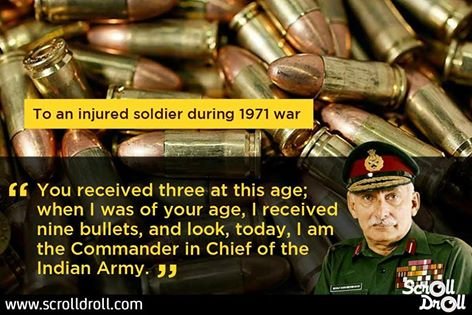
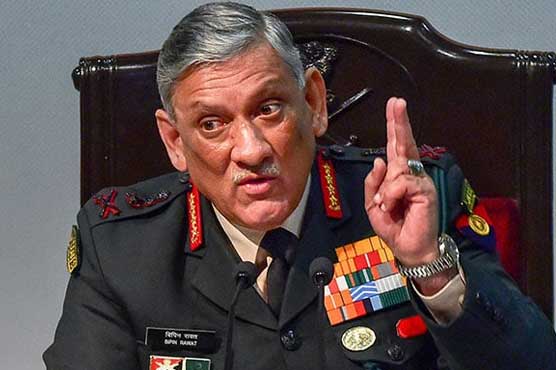
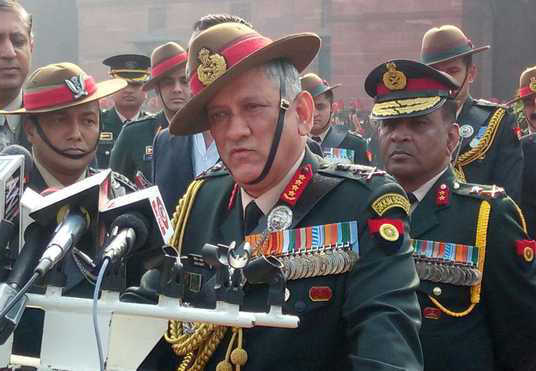
ISLAMABAD (Dunya News) – Indian Army Chief Bipin Rawat’s statement of attacking alleged camps in control areas of Azad Kashmir has been mocked around the world including by the Indian media.
Journalist Snehesh Alex Philip wrote in an article that the remarks of the Army Chief were surprising because this is a first in recent times when an Indian Army Chief was giving out speculative figures, making India a joke around the world.
“The security forces usually give out official details only after recovering the bodies as proof or after proper verification”, he asserted adding that political leaders, election strategists, journalists and people at large had started joking about the his ridiculous statement and how it happened just ahead of the polling day.
Snehesh went on to say that the Army sent out multiple messages asking everyone not to speculate and even issued a formal statement to journalists on the beat without giving out any casualty figures but within a few hours, the Indian Army Chief surprised everyone by making a statement contrary to the facts.
“The Indian Army should remember that it is not only important for it to be apolitical but also to be seen as being apolitical,” he maintained.
On Oct. 22, Pakistan arranged the visit of the diplomatic corps in Islamabad alongwith media, including foreign media, by helicopter to the site of recent Indian ceasefire violations which resulted in the shahadats of five innocent civilians on the Pakistani side and injuries to six others, Foreign Office said in a statement.
After the baseless and fallacious statement of the Indian Army Chief alleging that recent Indian ceasefire violations were targeting ‘launch pads/terrorist camps’ on the Pakistani side of the LoC, Pakistan requested the Indian High Commission in Islamabad to share details, including longitudes and latitudes of the alleged location to back the Indian allegations. No response has been received so far from India, the statement said.
It added that the diplomatic corps and media were taken to the LoC, including Jura to witness firsthand the fallacy of the Indian claims.
The Indian High Commission officials in Islamabad were also invited but did not show up.
The irresponsible allegations of the Indian Army Chief and the lack of response from India when asked to back its hollow assertions with details of the alleged “launch pads/ camps” not only expose the lies and deceit being employed as state policy and Indian aggressive posture which is a growing threat to regional peace and stability.
The visit further exposed the Indian falsehood to the international community and the desperate attempts being resorted by India to divert international attention from the humanitarian nightmare in IOJ&K.
Pakistan does not harbor any aggressive designs but our armed forces and people remain ready to defend the country against any acts of aggression, the statement concluded.
In a first, envoys from 85 countries pay obeisance at Golden Temple
For the first time, a delegation of Resident Foreign Heads of Missions from nearly 85 countries paid obeisance at the Golden Temple dedicated to 550th birth anniversary of Guru Nanak Dev.
Originally, 91 envoys, sans the participation of Pakistan and China, were part of this trip. The visit was initiated by Indian Council of Cultural Relations (ICCR) head Dr Vinay Sahasrabuddhe and led by Union Minister for Civil Aviation Hardeep Singh Puri. ICCR director general Akhilesh Mishra also accompanied them.
The high profile delegation reached holy city through a chartered flight and was received by SGPC president Gobind Singh Longowal, MP Gurjeet Singh Aujla, Cabinet minister Sukhbinder Singh Sarkaria, DC Shiv Dular Singh and Police Commissioner Sukhchain Singh Gill.Puri said this programme with envoys from almost whole world to the Golden Temple together was a befitting mark of respect to Sri Guru Nanak Dev who spread the eternal universal message of peace and oneness of humanity.
“A history of the sort was in the making today with ambassadors of so many countries together paid obeisance at the Sanctum Sanctorum of this holiest Sikh Shrine. I am thankful to ICCR head who made it possible at a short notice of three-four days. This programme was dedicated to 550th birth anniversary of Guru Nanak Dev to give an opportunity to dignitaries about Sikh religion and culture,” he said.Puri, when asked about absence of representatives of Pakistan and China, said, “Invitation was extended to diplomats of various countries, but some could not make it, might be, due to their prior commitments,” he said.
Pertaining to the Centre’s programmes chalked out for Guru Nanak Dev’s parkash purb, he told that the cabinet had approved various programmes recommended by a dedicated committee under leadership of Union minister Rajnath Singh on November 22, 2018 meeting. This includes series of programmes, which included the opening of corridor leading to Gurdwara Kartarpur Sahib from Dera Baba Nanak on November 9.
When questioned about Pakistan’s insistence of imposing entry fee of $20 for Indian pilgrims, he said though this subject was out of his jurisdiction, yet as a Sikh devotee, he believed, that there should be no entry fee to visit Sikh holy shrines where every task is executed with ‘sewa’ (volunteer service). “But, it was for the Pakistan to decide upon,” he said.
Nonetheless, the visiting dignitaries partook of ‘langar’ at Sri Guru Ram Dass Jee Hall while sitting on the floor with ‘sangat’ (congregation) and ‘pangat’ (in a same row) concept founded by Guru Nanak Dev.
SGPC honoured the visitors by presenting them with Golden Temple model and ‘siropa’ (robe of honour) and literature concerning philosophy and teachings of Guru Nanak Dev’s universal brotherhood and harmony.
Earlier on arrival at Sri Guru Ram Dass Jee Airport, they were welcomed with traditional Punjabi style on bhangra beats and gidha. As the delegation reached Dharam Singh Market, they covered the distance to Golden Temple on foot through heritage street.
Children from International Fateh Academy mesmerised them with their Gatka (Sikh traditional martial art) skills. The delegation also watched the 50-minute show at interpretation centre at the basement of Golden Temple plaza, depicting the history of Golden Temple, Sikh principles, culture and Guru Granth Sahib ‘maryada’ (tenets).
SGPC president Gobind Singh Longowal told that all were overwhelmed with the spirituality and solace of the Shrine. “We had organised the programme in such a manner that they should all be well apprised about Sikh principles, religion and tenets. They were also thrilled sitting and eating together in the same row in Guru-ka-langar,” he said.
Later in the evening, DC Shiv Dular Singh apprised the visitors about Amritsar, Punjab and Invest Punjab programme, before they returned in the evening.
Why Russia’s Navy Is Becoming a Smaller, Regional Force
by David Axe Follow @daxe on TwitterL
Key point: Without the resources to fund a global navy, Moscow is focusing on ships that are smaller but modernized.
The Russian navy on Aug. 14, 2019 completed a key test of an upgraded missile corvette. The trial underscores the evolution of the Russian fleet from a force dominated by a few large vessels to one with a larger number of smaller ships.
The upgraded missile corvette Smerch conducted a live-fire exercise in the Sea of Japan, Russia’s state-run news agency TASS reported, citing the press office of Russia’s Pacific fleet.
“Today, in accordance with the plan of shipbuilders’ trials, the modernized small missile ship Smerch has held a series of missile firings against a naval and an air target,” the press office told TASS.
Smerch, a Nanuchka III-class corvette, displaces around 500 tons of water. Smerch launched in 1984.
After recent upgrades, Smerch boasts 30-millimeter and 76-millimeter guns, a battery of small surface-to-air missiles and Uran anti-ship missiles, which are equivalent to the U.S. Navy’s own Harpoon anti-ship missile.
Smerch is one of around 150 corvettes, patrol boats and mine-warfare ships in the Russian fleet. Each displaces just a few thousand or few hundred tons of water. The Russian navy operates fewer than 30 large, oceangoing frigates, destroyers and cruisers.
The U.S. Navy by contrast operates just a couple dozen small surface combatants and more than 100 large ones. The American and Russian fleets are opposites, each reflecting their country’s strategy, history, industry and geography.
The U.S. fleet, backed by a powerful, high-tech industry, favors large ships for their ability to deploy long distances in support of an interventionist foreign policy.
The Russian fleet, on the other hand, relies on outdated shipyards that reliably can produce only small vessels. Fortunately for Moscow, smaller ships are appropriate for Russia’s strategic focus on destabilizing, and occasionally invading, rivals just a short distance away along its own periphery.
The Russian navy’s transformation into a small-ship fleet has been accelerating. More large ships are decommissioning and smaller vessels — both new and upgraded — are taking their place, reshaping what was once a major global force into a new kind of regional fleet.
In April 2019 the Kremlin decided to dismantle rather than revamp two Cold War-vintage Kirov-class battlecruisers. Moscow likewise considered scrapping its sole aircraft carrier Admiral Kuznetsov rather than pay for maintenance and upgrades.
The accidental sinking of the PD-50 drydock in October 2018 weighed on the decision. PD-50 was the only drydock in northern Russia that could accommodate Kuznetsov. The Kremlin in mid-2019 signaled it will attempt to repair the aging carrier after combining two smaller drydocks to accommodate the vessel.
The new ships Russia is acquiring generally are missile corvettes displacing no more than 5,000 tons of water. An American destroyer, by contrast, displaces 9,000 tons.
The Kremlin bought just four new warships in 2018, all corvettes. While small, these vessels pack serious firepower. In recent years, corvettes from the Caspian Sea fleet have fired long-range Kalibr cruise missiles at targets in Syria — all without ever leaving Russian waters.
But the numbers are telling. As it transforms, the Russian navy by most metrics is falling behind the U.S. and Chinese navies. In 2019 the Russian fleet has 360 ships, according to U.S. Navy commander Keith Patton, writing for the Center for International Maritime Security. The Chinese fleet, by contrast, possesses 624 warships.
The American fleet at the same time has just 333 “battle force” ships. But the American ships on average are much bigger than Chinese and Russian ships are. The U.S. fleet in total displaces 4.6 million tons of water. The Chinese fleet displaces 1.8 million tons. The Russian fleet displaces just 1.2 million tons.
Perhaps most tellingly, the U.S. fleet can carry around 12,000 offensive missiles. Chinese ships in total can carry 5,200 missiles. Russia’s fleet, despite upgrades like those to Smerch, packs no more than 3,300. And that number could fall as more large, old warships decommission and smaller ships take their place.
David Axe serves as Defense Editor of the National Interest. He is the author of the graphic novels War Fix,War Is Boring and Machete Squad. This first appeared in August 2019.
Pak Army rejects India’s claim of destroying terror camps in PoK
The Pakistan military has rejected as “false” the Indian Army’s assertion that it targeted at least three terror camps in the PoK and said India is welcome to take any foreign diplomat or media to the site to “prove” its claim on ground.
Indian Army chief General Bipin Rawat said on Sunday that six to 10 Pakistan Army personnel were killed and three terror camps destroyed in a retaliatory action by the Indian Army opposite the Tangdhar and Keran sectors in Jammu and Kashmir.
Responding to Rawat’s claim, Pakistan’s military spokesman Maj Gen Asif Ghafoor in a midnight tweet expressed disappointment at the assertions by the Indian Army chief.
“There are no camps let alone targeting those. Indian Embassy in Pakistan is welcome to take any foreign diplomat/media to ‘prove’ it on ground,” Ghafoor said.
He said the “propensity of false claims by senior Indian military leadership especially since Pulwama incident is detrimental to peace in the region.”
“Such false claims by the Indian Army are being made to suit vested domestic interests. This is against professional military ethos,” Ghafoor said. PTI
No visa, but passport must to visit Kartarpur via corridor
PWD Minister Vijay Inder Singla at the corridor site on Tuesday.
Ravi Dhaliwal
Tribune News Service
Dera Baba Nanak, October 15
After weeks of confusion, clarity has finally emerged on the subject of passport and visa for pilgrims desirous of visiting Kartarpur through the corridor with government officials stating that a passport will definitely be needed, but it will not be stamped with Pakistani visas.
This decision was keenly awaited because it is common knowledge that if a person’s passport has a Pakistani visa, his or her visa application to the US, Australia and European countries is compromised.
Cabinet Minister Sukhjinder Singh Randhawa, who visited the site today, said the Pakistan government had recently conveyed this decision to Indian officials.
“This was confirmed by Ajay Bhalla, Union Home Secretary, after a meeting held with him and other Central officials at the zero-line yesterday. A passport will be needed just for identification purposes. There was a lot of uncertainty on this issue because under normal circumstances, a person travelling to Pakistan by air, sea or road needs to have a visa stamped from the Pakistan High Commission in New Delhi. However, if anybody wants to use the corridor, he will not be requiring a visa,” said Randhawa.
CM Capt Amarinder Singh has been a strong votary of the corridor being both passport and visa-free. He had also taken up the issue with the ministers concerned in Delhi, but met with partial success because the government still insists upon having a passport.
Randhawa said to ensure a level-playing field, the Centre was mulling over a proposal to allow a pilgrim to cross over not more than one time a year.
“Repeated visits by those who can financially afford to go will mar the chances of other devotees. Such a rule should be put in place at least for the first year of the corridor’s inception,” he said.
Meanwhile, the CM dispatched PWD Minister Vijay Inder Singla to the corridor site today. “All four roads leading to the ICP are being recarpeted and widened. The government has already sanctioned grants. The passages which are being strengthened are the ones leading to Dera Baba Nanak from Fatehgarh Churian, Ramdas, Batala and Gurdaspur,” said Singla
Way forward: Competitive politics is the only antidote to extremist violence. The sooner it is rung in, the better for all.
Rajesh Ramachandran
No visit is ever pleasant when Srinagar is under the shadow of the gun. This time around, after two months of the lockdown, there was an eerie normalcy in the Valley. It was indeed ‘abnormally normal’, as a senior officer put it while talking about the bustling Sunday market last week. J&K as a whole and the Valley in particular are in the throes of transformation. But unlike in the past, there are only a few visible signs of this transition. There are no protests, no restrictions on movement, at least in Srinagar city, and life appears to run its calm, serene course. But the glowing autumn sun doesn’t deceive the sense of defeat in the air.
Most Kashmiris are yet to give expression to their response to the abrogation of Article 370 and the decision to turn the state into a UT. Ordinary folks say they are still in shock, separatists want weapons to fight the Indian State, even more radical ones are looking at the possibility of an Indo-Pak war — but they all believe that there is no point in pelting stones to invite bullets. This, in a way, is a turning point in the lives of the Kashmiris. There is, probably for the first time, a feeling of futility in inviting repression and a great fear of the unknown, which has triggered the technique of protest by shopkeepers to open their shops early, shut them during the official working hours, and open them, if needed, again in the evening. A lot of shopkeepers have taken their wares to the pavements to the Sunday market, which is now almost a week-long affair in the capital city.
Is it a spontaneous shutdown by shopkeepers or are they being threatened by overground workers of militant groups? Well, the truth in the Valley is always somewhere in between. There are reports of overground militants identifying certain shops by putting a mark on them, and also a whisper campaign about the ‘advisory’ of timings to open and shut the shops. But the people are also willing to sacrifice a portion of their income to make a statement. There are orchard owners and apple farmers, even among cops, who are willing to let their apples rot to register their passive protest. There is unreserved, popular anger over the communications clampdown. When the most basic need to remain connected with the rest of the world is hit so completely, that too in the era of OTPs (one-time passwords) and mobile authentication for any kind of transaction, there is no debate on Article 370; there is only angst and anxiety over getting punished by New Delhi. That to a large extent explains the queer quietude.
The worst aspect of the lockdown is that this fear has gripped everyone, including the huge pro-India constituency. The detention of former chief ministers Farooq Abdullah and Omar Abdullah, the greatest champions of the Indian State, has deepened the despair among those who have fought the separatists all through — serving and retired officials and political activists. The Abdullahs’ detention has made their position untenable and uncertain. And some of the so-called grassroots workers who are now being projected as the next line of political leadership — after being picked up from the panchayats — are allegedly holed up in hotels in Srinagar, scared of returning to their villages. These panchayat-level, hand-picked novices cannot fill the political vacuum. And every passing day of detention of the top political leaders of the state is a day lost in repairing the umbilical cord and assuaging the hurt of the Kashmiris.
Thus, the greatest threat to the Indian State now is the possibility of losing its most important constituency in the Valley and it seems counterproductive to create new leaders, marginalising or attacking the legitimate ones. The very approach of slamming this leadership as corrupt or status-quoist, which has to be wholly uprooted, appears terribly misconceived. They have been the elected representatives of the Kashmiris for a very long time and their detention only discredits mainstream politics and Indian democracy.
From the security point of view, the detentions, transfer of inmates to jails outside the state, massive deployment of forces and the proactive approach on the LoC to neutralise infiltrators pushed across by Pakistan have yielded spectacular results, with this summer being one of the calmest in recent times. The security forces have done their best to ensure that violence doesn’t erupt, but this calm could be deceptive as there is widespread apprehension of escalation of violence amongst Srinagar’s residents. This thinking is partly promoted by the separatists and their handlers across the borders, but is also the result of a vacuum in political activism.
A two-year-long delimitation process without an elected government — if it happens, as people fear —will be a godsend for the Pakistan deep state and the Islamist secessionists. Every day without a legitimate, elected government is an open invitation to the militants to dominate the mindscape of the people. It further gives the Islamists an opportunity to convince the people that the entire exercise of scrapping Article 370 was to do away with Article 35-A and thereby turn Kashmir into a Muslim-minority region. The retelling of these fears will assume proportions of a new sub-national narrative, which will eat into the innards of sanity, leaving society crippled against the criminals within. Competitive, mainstream politics is the only antidote to extremist violence and the sooner it is rung in, the better for all stakeholders. Till then, the Kashmiris should not be blamed if they don’t feel they too are Indian citizens.
Homage to sandeep Dhaliwal ,DSP of Police : India needs to learn
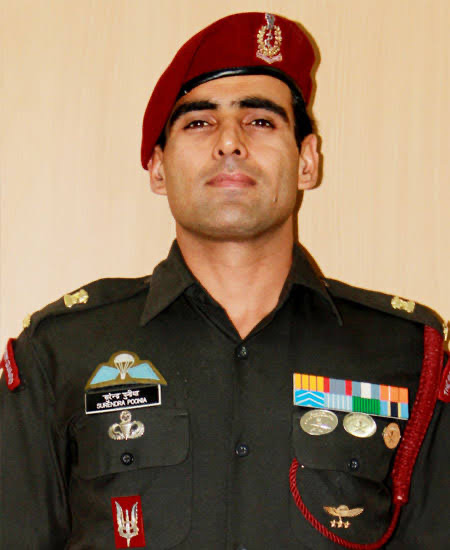
With Indian Prime Minister Narendra Modi announcing the Fit India campaign, former Special Forces officer, doctor and renowned international athlete, Major Surendra Poonia, VSM, moved by the prime minister’s initiative has decided to use his decade’s worth of combined military, sporting and medical experience to promote a spirit of fitness throughout the country, launching his flagship initiative, FitBharat. Speaking exclusively to SSBCrack, the renowned Para Special Forces Officer, who has served in the famed President’s Bodyguard proudly says, “Being a Special Forces veteran and a medical professional, I believe it is my soldierly duty to continue to serve the country by promoting an environment of health and fitness.” Major Poonia like a dutiful soldier, is on a mission to counter the country’s most significant national threat, the silent killer known as lifestyle diseases.
Major Surendra Poonia in his Special Forces Uniform
The root causes of these disorders have been linked with a lack of regular exercise and today’s sleep-deprived corporate culture. Being a former military man, the Ex-Special Forces Major came to the conversation armed to the teeth, this time with facts! The officer explains that “Lifestyle diseases such as obesity, diabetes, cardiovascular diseases, poor nutrition and improper sleep cycles are some of the leading causes of health-related ailments in India.” Elaborating on this, he says “7.1 per cent of the adult population in India are suffering from diabetes. There were an estimated 69.1 million cases of diabetes in India in the year 2015, and it has exceeded to around 70 million as of 2019! By 2030, almost 100 million of my fellow countrymen will suffer from diabetes.” The former Special Forces Commando says this with fiery conviction!
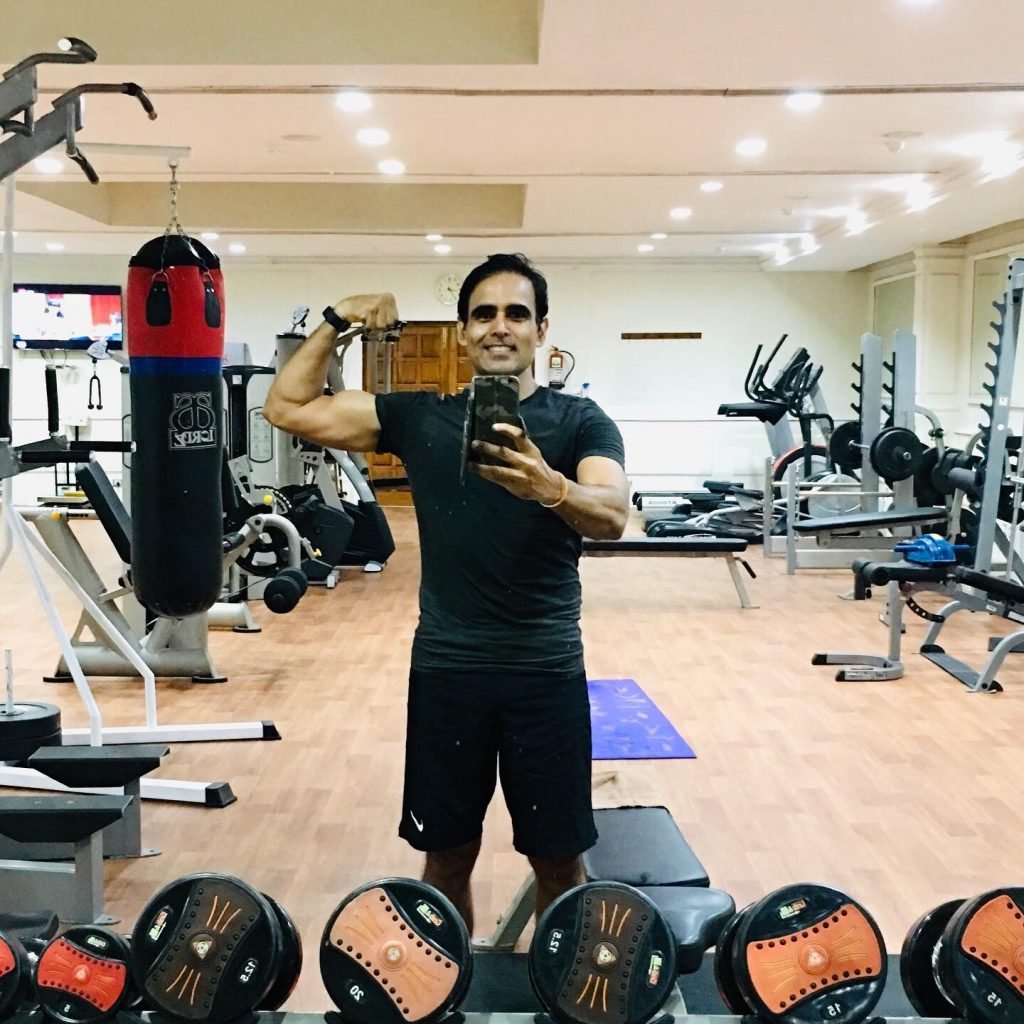
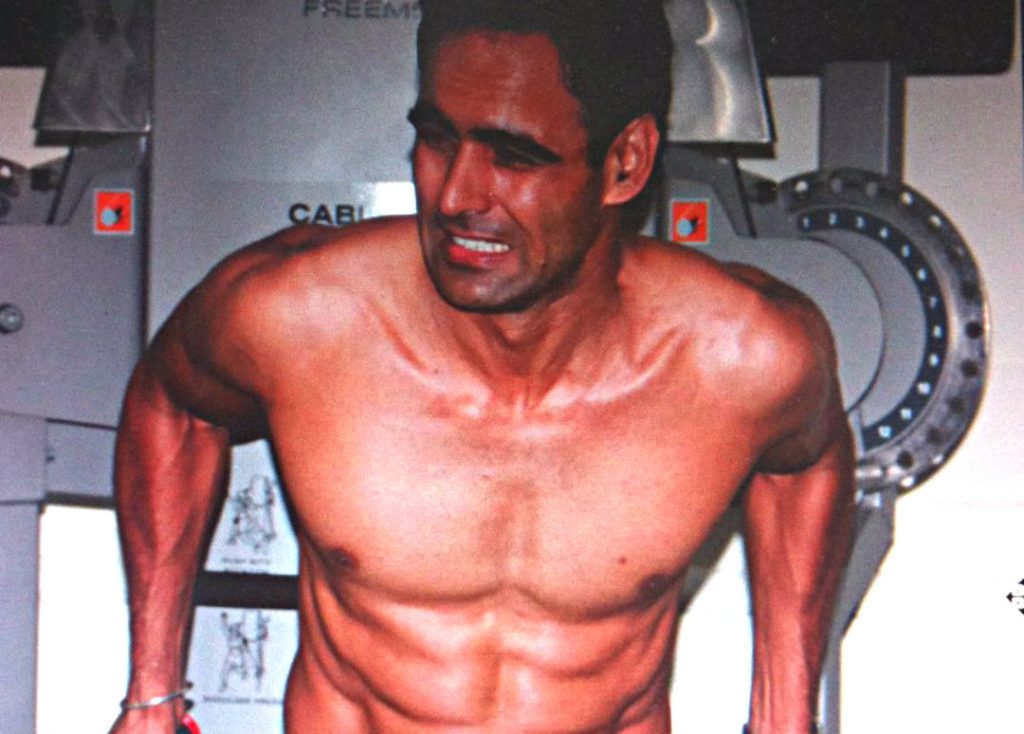
Major Poonia hitting the gym early in the morning!
Speaking about widespread obesity, Major Poonia says, “Obesity has become one of the leading health epidemics in the 21st century, with morbid obesity affecting approximately five per cent of the national population! This means over 6.8 million Indians suffer from morbid obesity. Being a sportsman it truly pains me to have to acknowledge that over 13.5 crore Indians are morbidly obese!” According to several research papers shared by Major Poonia to SSBCrack, it has been ascertained that obesity in the country has doubled in the past ten years. Going by the research presented by the retired officer, it has been found that the urban population and states with higher income groups have a higher rate of obesity.
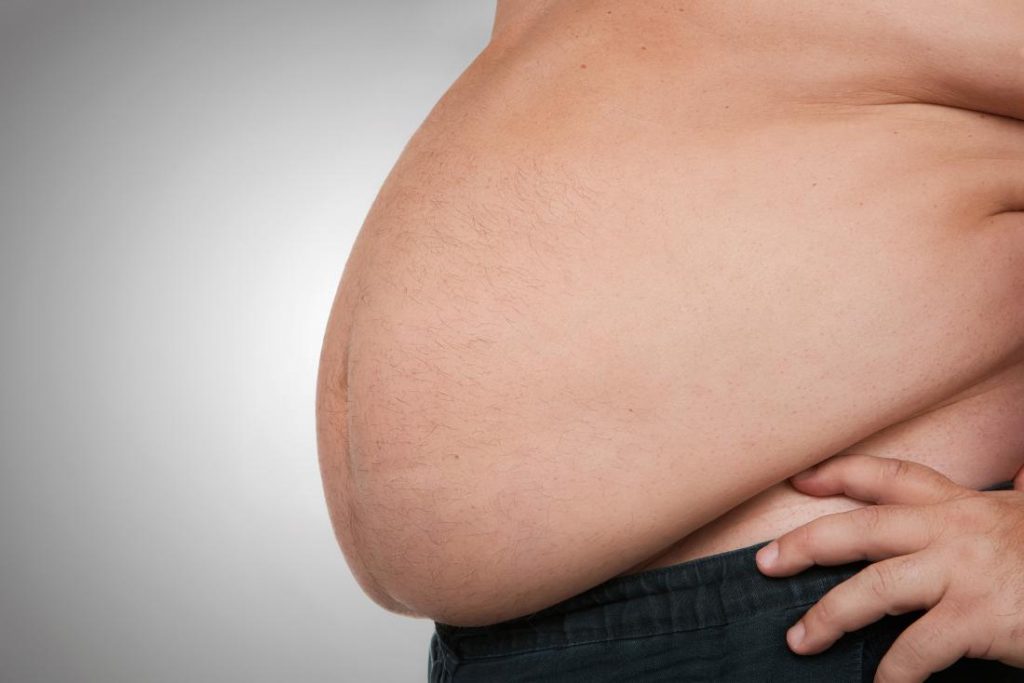
Obesity leads to lower energy levels and, is a major contributor to cardiovascular diseases in India
While conversing with SSBCrack, Major Poonia shared his observations, splitting the anatomy of the leading causes of obesity and its implications on productivity, self-esteem, mental health and youth development. The former military medical professional spoke extensively, about the surge of junk food, appealing advertisements promoting unhealthy food choices, mobile games such as PUBG and Fortnite and their effects on the youth. “These mobile games have confined the youth in their rooms and have trapped them in a vicious cycle of unhealthy life choices”, he declares enraged! “A lack of importance given to sports and fitness in educational institutions is disheartening and a cause of grave concern,” says Major Poonia with a sense of genuine concern.
The Ex-Special Forces commando is still fighting fit!
During one of SSBCrack’s in-depth conversations with the former Special Forces doctor, he stressed on the vital role educational institutions have to play in promoting a spirit of fitness, among young school-going students. Major Poonia cited his discontent towards the syllabus of physical education in Indian schools. He says “Even physical education is taught through textbooks, and is evaluated through written exams! How is this physical fitness?”, the commando asks rhetorically. “This neglect,” he says “results in a generation of academically burdened youth with no outlet to vent their burdens.” Furthermore, they “lose out on so many benefits of taking part in sporting endeavours such as problem solving, teamwork, purpose, camaraderie, overcoming obstacles. This criminal neglect at an early stage follows them throughout their lives!” says the commando with great passion.
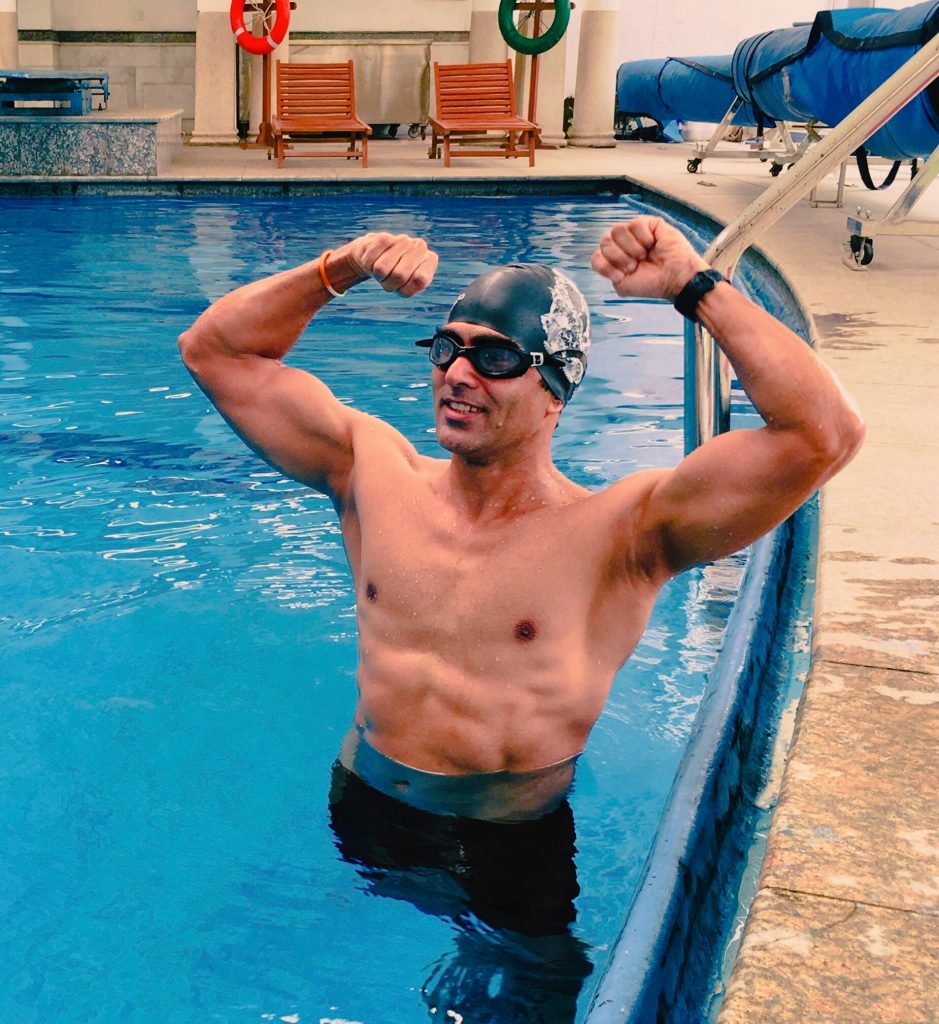
Major Poonia flexing after a tough swim!
Touching more on this, he says, “The lack of fitness being imbibed in young children at an early age haunts them when they become working professionals. The increasingly exploitative corporate work environment has resulted in significant health problems.” Putting out another chilling statistic, the former president’s bodyguard says, “63 per cent corporate professionals are overweight. This leads to heart conditions leading to death as aforementioned. It results in “lowered productivity, leading to stalled career progression, ultimately making an employee feel dejected and stressed.” This “stress,” the officer says, “results in poor sleep patterns, improper nutrition and host of mood swings affecting one’s mental and spiritual well being. It is an interconnected vicious cycle.”
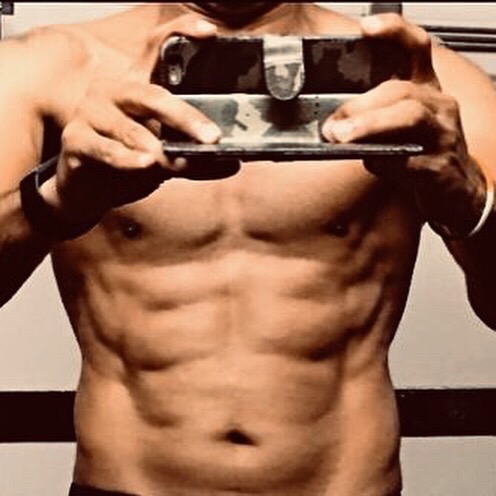
The former special forces doctor indulging himself in a strenuous workout regime
Major Poonia keeps on reinforcing passionately, the need for regular, sustained exercise and healthy eating. “Being an athlete and a soldier serving in the elite special forces, I was fortunate to be in an environment where fitness was prioritised…Soldiering is a high stress a high-risk job, however, what I experienced was that the rigorous fitness regimen we were subjected to, significantly alleviated the stress which came from such a hazardous profession!” Drawing from his personal observations, the Special Forces doctor empathises the plight of corporate professionals, saying, “Corporate professionals play a crucial part in our nation-building process. They are the ones who provide us with essential services, design the softwares and infrastructure required to make our lives easier, and put our country on the world stage. They work tirelessly in the pursuit of nation-building, yet do not get the time or encouragement to give time to their own health!”
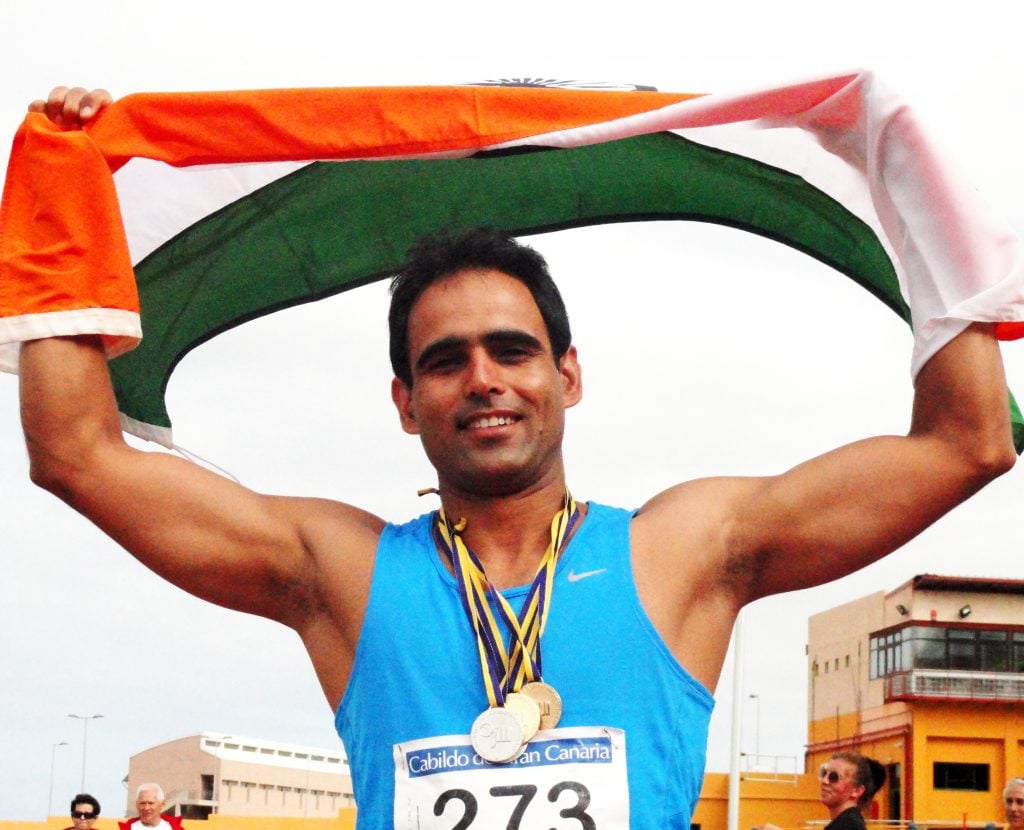
Winning accolades for India
Answering SSBCrack’squestions on what FitBharat hopes to achieve, the ex-commando says, “FitBharat, aims to imbibe a sense of physical fitness not only to our youth who are our future but even working professionals who are building our nation’s present.” Major Poonia stresses on the benefits of exercise on increased productivity at the workplace. “Focusing on personal health will undoubtedly help in enhanced mood and energy levels, resulting in better workplace productivity.” Efficient productivity, he says, “leads to superior output resulting in higher national growth!” The former army man says, “I believe that if we are physically fit as individuals, we can grow as a community, for me, fitness itself is a major national service!”
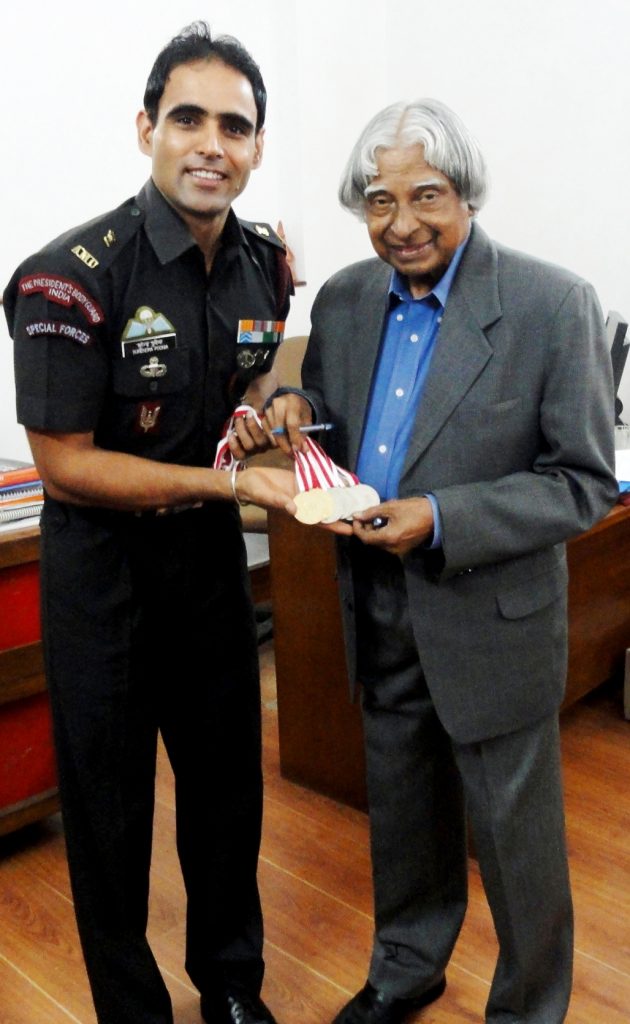
Serving under President Abdul Kalam
Ending the conversation with SSBCrack on a positive note, Major Poonia maintains an optimistic mindset towards the success ofFitBharat. He speaks about the gradual but increasing trend towards health and fitness in the country, and how more and more people are “indeed putting efforts towards their well being.” When asked on how he aims to promote the message of FitBharat to his target audience, he replied saying “We have already started with the Soldierathon, which is a marathon organised once a year, and it has received a nationwide response. Going on further we aim to tie up with several sporting brands to highlight youth inspiring messages, in order to promote our young guns to take the first step. We shall also partner with sports regulatory bodies and organise inter-college and university sporting events.” He stresses on the reach of social media platforms and portals like SSBCrack to further the message, saying, “In today’s day and age, social media and youth-based websites are a potent tool, through which we can advocate fitness, give health and nutrition advice to bridge the knowledge gap!” FitBharat intends to come out with hashtag based challenges, creating a supportive online community dedicated to one another’s growth!
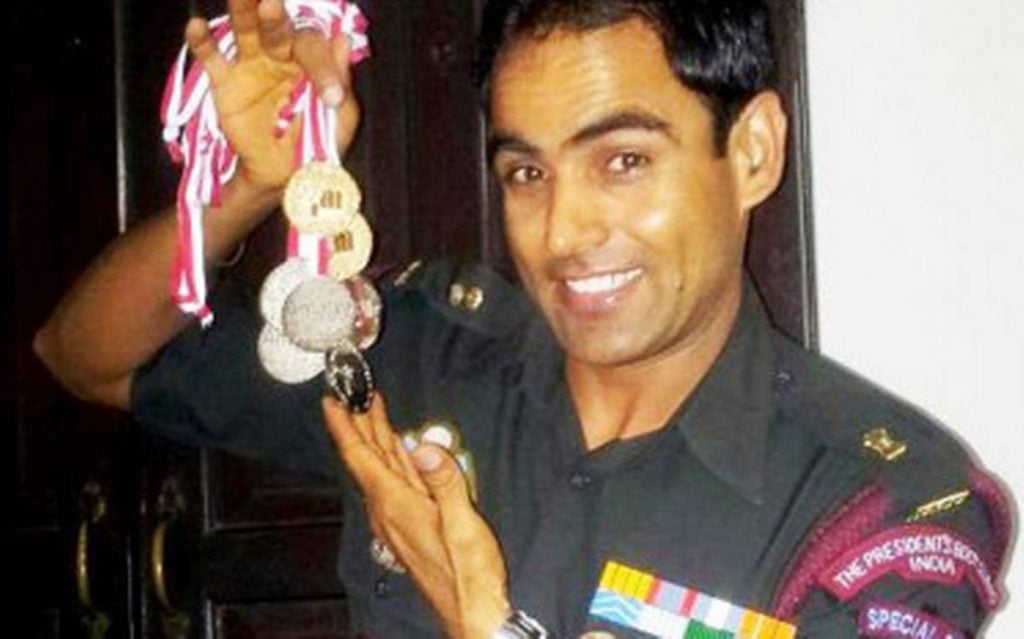
Major Poonia showcasing his sports medals
Speaking about his roadmap for the long run, the fit commando says “Over time, we shall work with the Ministry of Human Resource Development, to develop state of the art sporting facilities in schools and educational institutions to inculcate sports and fitness at a much younger age.” Major Poonia being a battle-hardened commando is hopeful but remains a pragmatist, acknowledging the challenges for the road ahead. “See it will not happen overnight, it is not simple to change attitudes and I recognise it will take time and a lot of effort however I am satisfied beyond any doubt that we shall succeed, there is now a tremendous internal drive towards fitness, and this is something that will continue to increase and can be channelised for the betterment of society and the nation at large!”
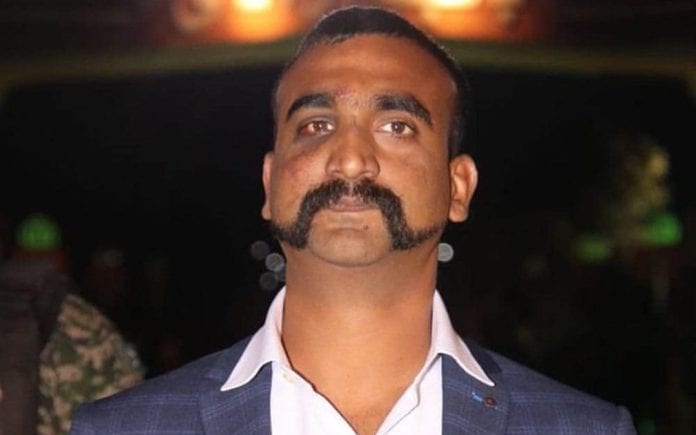
Abhinandan Varthaman’s squadron to be awarded for foiling Pak attack
The award ceremony is scheduled for October 8 and the citation will be received by commanding officer Group Captain Satish Pawar | Twitter
Wing Commander Abhinandan Varthaman’s 51 Squadron is all set to receive a unit citation by Chief Air Marshal RKS Bhadauria for thwarting Pakistan aerial attack and shooting down a Pakistani F-16 jet on February 27, 2019, according to ANI. The number 9 squadron whose Mirage 2000 fighter aircraft carried out the Balakot aerial strikes on February 26 will also be conferred a unit citation, added ANI.
Along with the units which carried out Balakot strike, Squadron leader Minty Agarwal’s 601 Signal Unit will also be awarded unit citation for their role in the same.
The award ceremony is scheduled for October 8 and the citation will be received by commanding officer Group Captain Satish Pawar.
The Balakot air strike was carried out by India in retaliation to Pakistan’s Pulwama attack, which killed over 40 CRPF personnel on February 14 this year.
During Pakistan’s counter-attack, in response to the Balakot air strike, Abhinandan Varthaman flew a MiG-21 Bison fighter jet into Pakistan-occupied Kashmir (PoK), which was shot down by a Pakistan Air Force’s F-16. He too was caught but was released by the Pakistanis due to the pressure exerted on it by India and the international community.
He was also conferred with the third-highest wartime gallantry award, Vir Chakra on the 73rd Independence Day.
BSF seizes two Pak fishing boats abandoned near Kutch
A team of BSF jawans, patrolling the area, found the boats at Lakshman Point in Sir Creek, an estuary along the Indo-Pak border, around 8.25 am, the official said. File photo
Bhuj, October 5
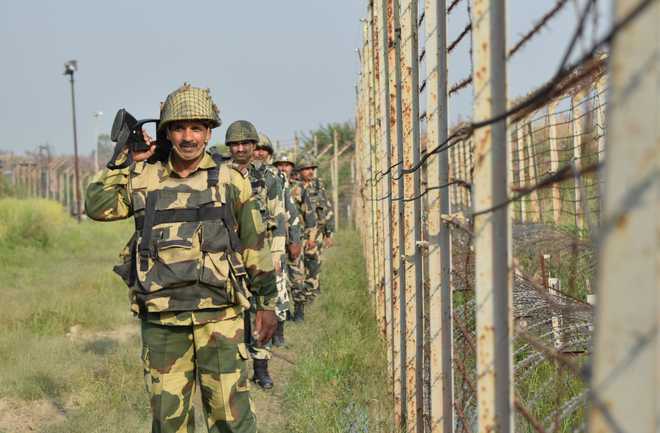
The Border Security Force (BSF) seized two Pakistani fishing boats abandoned in Sir Creek area near Kutch district in Gujarat on Saturday morning, an official said.
A team of BSF jawans, patrolling the area, found the boats at Lakshman Point in Sir Creek, an estuary along the Indo-Pak border, around 8.25 am, the official said.
The boats were carrying fishing equipment, but nobody was found on board, the official added.
Following the seizure, the BSF launched a search operation along the border area, he said, adding that nothing suspicious was found.
In a release, the BSF said, “A thorough search operation of the area has been launched. It is still under way, but so far nothing suspicious has been recovered from the area.”
Security agencies have reported several cases of Pakistani fishing boats lying abandoned in the area in the past couple of months. PTI
State Stalwarts
DEFENCES FORCES RANKS
ARMY, NAVY, AIRFORCE RANKS
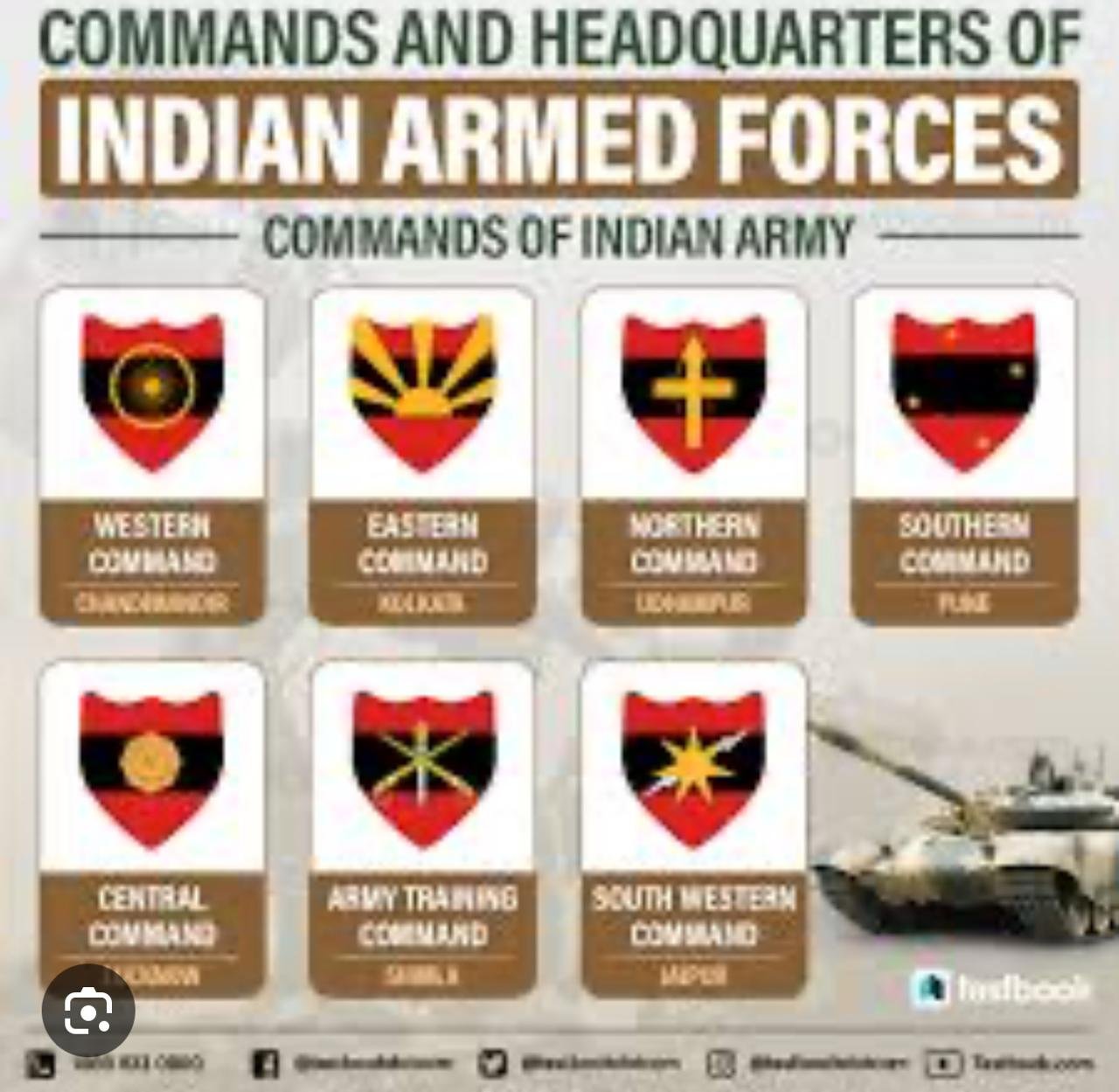
FORMATION SIGNS
FORMATION SIGNS
ALL HUMANS ARE ONE CREATED BY GOD
HINDUS,MUSLIMS,SIKHS.ISAI SAB HAI BHAI BHAI
CHIEF PATRON ALL INDIA SANJHA MORCHA
LT GEN JASBIR SINGH DHALIWAL, DOGRA
SENIOR PATRON ALL INDIA SANJHA MORCHA
MAJOR GEN HARVIJAY SINGH, SENA MEDAL ,corps of signals
.
.
PATRON ALL INDIA SANJHA MORCHA
MAJ GEN RAMINDER GORAYA , CORPS OF
sanjhamorcha303@gmail.com
PRESIDENT HARAYANA STATE CUM COORDINATOR ESM
BRIG DALJIT THUKRAL ,BENGAL SAPPERS
PRESIDENT TRICITY
COL B S BRAR (BHUPI BRAR)
PRESIDENT CHANDIGARH ZONE
COL SHANJIT SINGH BHULLAR
.
.
PRESIDENT PANCHKULA ZONE AND ZIRAKPUR
COL SWARAN SINGH
PRESIDENT SAS NAGAR (MOHALI)
COL BALBIR SINGH , ARTY
INDIAN DEFENCE FORCES
DEFENCE FORCES INTEGRATED LOGO
FORCES FLAGS
15 Th PRESIDENT OF INDIA SUPREME COMMANDER ARMED FORCES
Droupadi Murmu
DEFENCE MINISTER
Minister Rajnath Singh
CHIEF OF DEFENCE STAFF (2nd)
General Anil Chauhan PVSM UYSM AVSM SM VSM
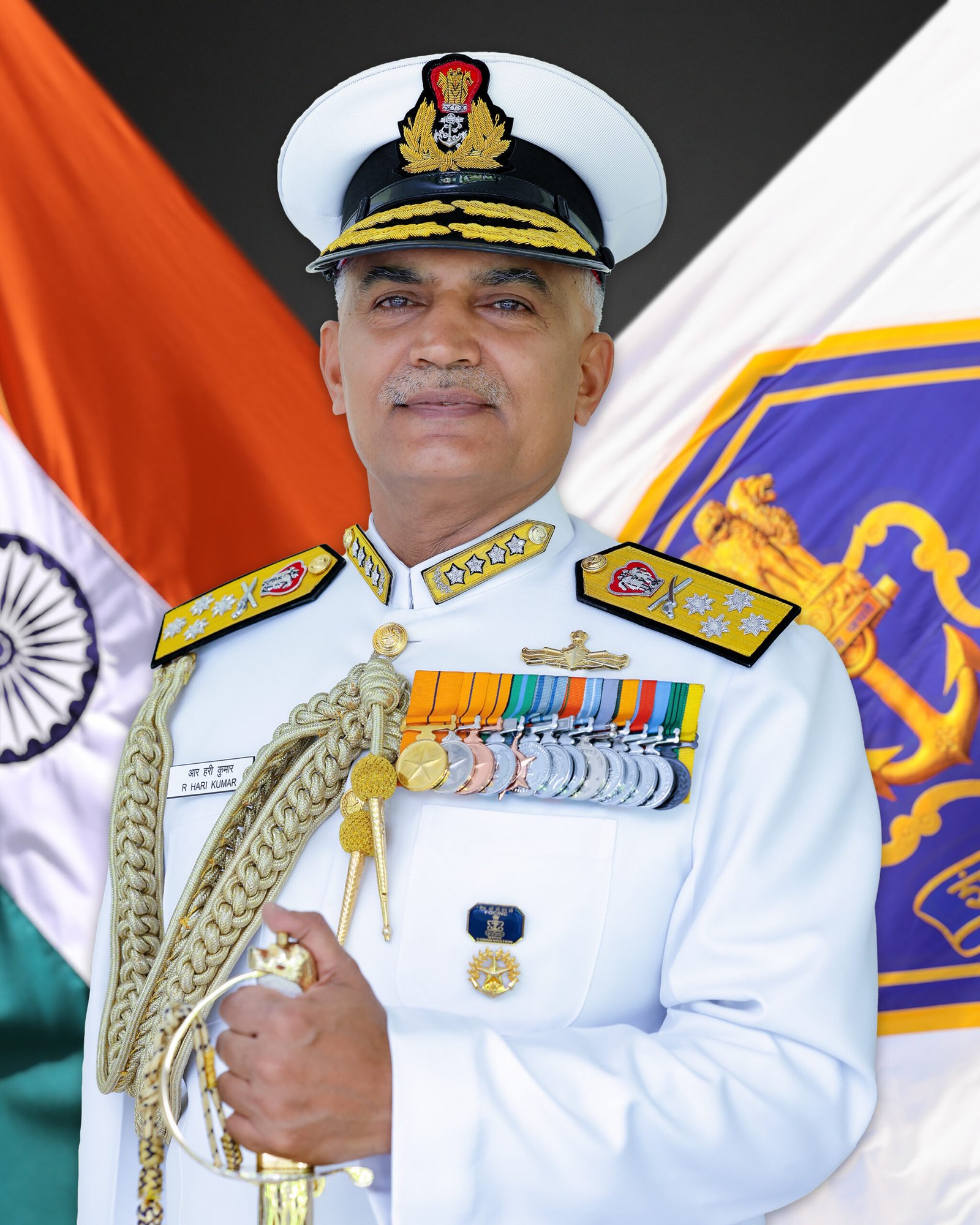
INDIAN FORCES CHIEFS
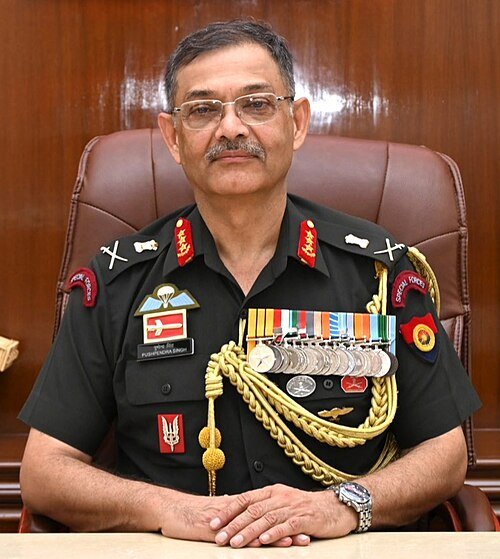
CHIEF OF ARMY STAFF(29th)
General Upendra Dwivedi, PVSM, AVSM (30 Jun 2024 to Till Date)