Sanjha Morcha

What’s New

Click the heading to open detailed news

Current Events :

web counter

Print Media Reproduced Defence Related News

Army steps up surveillance along NH in south Kashmir

Suhail A Shah

Anantnag, April 13

The Army has stepped up surveillance system, both on technical and human intelligence gathering fronts, in many parts of south Kashmir, particularly along the Jammu-Srinagar national highway.CCTV cameras have been installed at many important places along the highway, besides an elaborate survey of major concrete buildings along the highway is being carried out by the Army, sources said.The sources said the steps were being taken after militants carried out attacks along the national highway, particularly the Srinagar-Khannabal stretch, in recent months.The attack on the Entrepreneurship Development Institute (EDI) in February this year, in which three Army men were killed during a 48-hour-long gunfight, is being considered as the wake-up call.Three militants, believed to be of Pakistani origin, used the EDI building to their advantage to inflict damages on the Army.To pre-empt any such attacks in future, the Army has asked for site maps and other architectural details of almost all major concrete buildings in the area.“We were asked to provide the blueprint, site map and other details of our shopping complex,” said a businessman from Bijbehara town. He said the Army had asked him the details of every shop in the complex.“Moreover, information on the number of people working in the complex along with their identities was also sought by the Army,” he said.Many other establishments and owners of private buildings have been summoned by the Army and sought such details.“We were asked to provide details such as the exact number of entry and exit points in the building, number of rooms, location of the rooms and every minute detail and we have provided the details,” a school administrator said.Defence spokesperson Col NN Joshi said he was not privy to the operational details and would not be able to comment on the nature of the surveillance measures.

CCTV cameras installed

  • The Army is installing CCTV cameras at many important places along the Jammu-Srinagar national highway in south Kashmir
  • It is carrying out an elaborate survey of major concrete buildings along the sensitive highway, asking owners for site maps and other architectural details
India eyes 40 US drones

New Delhi, April 8

India eyes 40 US drones

India is in talks with the US to purchase 40 Predator surveillance drones, officials said, a possible first step towards acquiring the armed version of the aircraft and a development likely to annoy Pakistan.India is trying to equip the military with more unmanned technologies to gather intelligence as well as boost its firepower along the vast land borders with Pakistan and China. It also wants a closer eye on the Indian Ocean.New Delhi has already acquired surveillance drones from Israel to monitor the mountains of Kashmir, a region disputed by the nuclear-armed South Asian rivals and the cause of two of their three wars.As defence ties deepen with the US, which sees India as a counterweight to China in the region, India has asked the US for the Predator series of unmanned planes built by privately held General Atomics, military officials said. “We are aware of Predator interest from the Indian Navy. However, it is a government-to-government discussion,” Vivek Lall, chief executive of US and International Strategic Development at San Diego-based General Atomics, said.The US government late last year cleared General Atomics’ proposal to market the unarmed Predator XP in India. It was not clear when the delivery of the drones would take place.  — Reuters


Rajnath holdsreview meeting

  • Home Minister Rajnath Singh on Friday chaired a meeting with NSA Ajit Doval and chiefs of security agencies in view of developments following Pakistan’s refusal to allow a National Investigation Agency team to visit that country in connection with the Pathankot terror attack probe.
  • US for India-Pak talks
  • Our longstanding position is that we believe India and Pakistan stand to benefit from normalisation of relations and practical cooperation. We encourage India and Pakistan to engage in direct dialogue aimed at reducing tension. —Mark Toner, dy spokesman of US state dept

Living on in death by Wg Cdr JS Bhalla (retd)

MY father-in-law, a product of Dufferin, joined merchant navy before the Partition. Later, he shifted to Calcutta Port Trust where he spent his formative years before retiring as engineering superintendent. After six decades in Calcutta, he decided to shift to his house in Chandigarh.The anusashan which he acquired during training has become a part of his life. He is a voracious reader and spends four-five hours reading on Kindle. His day starts at 0400hrs with path-puja and rigid meal timings. “What is the need of getting up so early and disturbing everyone in the house?” I asked once. “It gives me pleasure,” he replied. One day, all of a sudden, he was hospitalised with high temperature and uncontrollable shivering. His condition, though critical, was stable. His granddaughter, a doctor in the US, would guide us and regulate the treatment. She paid a flying visit to the city to rejuvenate the morale of the family. Gradually, his condition stabilised and he was sent back home to continue the medication. One day when his condition improved significantly, he came out with a wish that stunned everyone. He desired that his body be pledged after his death, giving the go-by to normal rituals. There was unusual silence in the house. The proposal, on the face of it, was turned down by a majority vote, but he was unwilling to relent. I, for one, however, was inclined to his decision and supported the idea. The skin of dead animals is used for making leather products, the worth of a dead elephant is more than the living one, it is only the human body which is not put to any use after death, I argued. We pondered over the issue, and ultimately, with a heavy heart, decided to accede to his wish. The spade work for pledging the body was initiated, forms were filled and documents submitted to hospital. The day he received the donor’s card from the hospital authorities, he felt content and heaved a sigh of relief. Now, he was certain that his last wish would be fulfilled.The other day, we celebrated his 94th birthday with fun and frolic. I thought it would be a befitting gesture to pledge our bodies on the occasion of his birthday, but there were no takers for my proposal. But I have decided to donate my body. It will contribute immensely to the education and training of medical students. Let the human body be put to some use after  death. A meaningful life can go beyond one’s death. As conscious individuals, we should all pledge to donate our body/organs to society.


Army forces admn to stop all works near LAC in Ladakh

QUOTE: “The Army has not been allowing us to undertake development works in Chumar village. Last week, we started work on the construction of a road towards a village located close to the LAC, where the local grazers of our side go along with their cattle, but soldiers forced the contractor to abandon the project. Local Army officers had given a lame excuse that they had been directed by their higher-ups not to allow any kind of development work in the area,” Sonam Dawa Lonpo, CEC, LAHDC

Arteev Sharma

Tribune News Service

Jammu, March 13

In a major standoff, the Army has forced the civil administration to stop all development works near the Line of Actual Control (LAC) in the Chumar area of the Ladakh region for “unspecified” reasons.Enraged over the development, the Ladakh Autonomous Hill Development Council (LAHDC), Leh, which governs the district politically, has shot off a correspondence to the Defence Ministry, besides lodging a protest with local Army officers.This is the second major strategic area along the LAC where the Army has forced the civil administration to stop all development works. Last year in September, the Army had reportedly disallowed the administration to undertake development works in Demchok village after Chinese grazers had put up tents in a common grazing ground along the LAC.The Ladakh region has 225-km-long Line of Control and 955-km-long LAC that includes some portion of the international border and 122-km-long Actual Ground Position Line with China.A senior official of the district administration, who wished not to be named, said local Army officers had also approached the District Magistrate, Leh, seeking early stoppage of development works in the area.“The Army has not been allowing us to undertake development works in Chumar village. Last week, we started work on the construction of a road towards a village located close to the LAC, where the local grazers of our side go along with their cattle, but soldiers forced the contractor to abandon the project. Local Army officers had given a lame excuse that they had been directed by their higher-ups not to allow any kind of development work in the area,” said Sonam Dawa Lonpo, Chief Executive Councillor (CEC), LAHDC, Leh.The CEC said the development works in the area were being executed under the Border Area Development Programme and the Mahatma Gandhi National Rural Employment Guarantee Act scheme.“It is quite illogical that aggressive China has resorted to rampant development works and construction of roads on the other side of the LAC while the Indian Army has stopped us from undertaking development works for basic amenities to the people,” he said.He said they had taken up the matter with local Army officers and lodged a protest. “We have dispatched a letter to the Defence Ministry, requesting it to immediately solve the issue,” the CEC said.


BSF finds it hard to handle rush at Retreat ceremony

BSF finds it hard to handle rush at Retreat ceremony
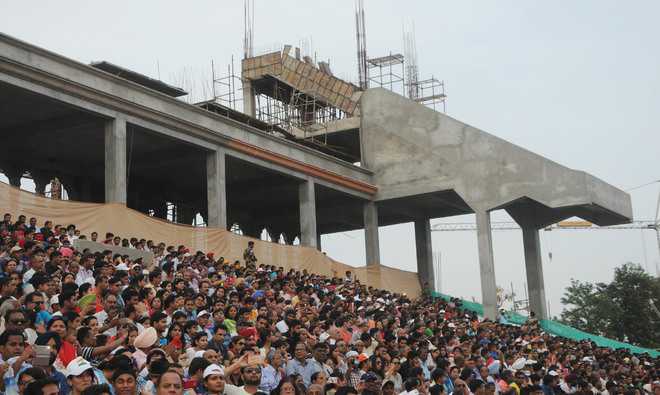
The spectators’ gallery at Attari-Wagah check post. photo: vishal kumar

GS Paul

Tribune News Service

Attari, April 3

The Border Security Force (BSF) is having a tough time accommodating the unprecedented rush that turns up to watch the Beating the Retreat Ceremony at the Attari-Wagah Joint Check Post (JCP) every evening.The reason is that the existing gallery is still under renovation. It will take at least one more year to come up in its expanded ‘avatar’.The existing gallery — inaugurated in 1999 — was conceptualised to accommodate 5,000 people, but today, over 10,000 tourists visit the JCP daily.On weekends or on special occasions like Republic Day, Independence Day, Holi or Diwali when special programmes are organised at the JCP with Pakistan Rangers, this crowd tends to cross the 20,000 mark. No surprise, a large number of tourists return without witnessing the ceremony.The CPWD wing, which has undertaken the project, had set the March 31, 2017 deadline to complete the job. But the BSF intends to dedicate it to the public on Republic Day 2017. Deputy Inspector General, Amritsar, Sumer Singh said, “We aim to dedicate the new gallery on January 26 next. We have urged the CPWD to expedite the work. At present, we face space crunch to accommodate the heavy rush of enthusiasts,” he said.


Army was misled, say Chhawani Colony residents

Army was misled, say Chhawani Colony residents
Former DGP Prakash Singh interacts with victims at the Chhawani Colony in Jhajjar. tribune photo

Ravinder Saini

Tribune News Service

Jhajjar, March 14

The Army was also misled about the location of the violence-hit Chhawani Colony when the unruly mob was setting the houses on fire and attacking residents with firearms and sharp weapons during the Jat stir on February 21. This made the Army take at least three hours to reach the colony for the protection of the residents.This was stated by Chhawani Colony residents during an interaction with Prakash Singh, former DGP, who was in the colony to inspect the damaged properties. He is probing the role of administrative and police officials in the violence and arson during the stir.“On the fateful day, district administrative and police officials along with Army personnel reached our colony in the afternoon. An Army officer said they had received information about the violence, but were misled about the location of the colony, which led to inordinate delay in arrival,” residents told the DGP.They also demanded that the officials who deliberately misguided the Army and sent them in the wrong direction should be traced. They also sought action against the Jhajjar DC and SP for their failure to protect people and their property.Earlier, Prakash Singh accompanied by Vijay Vardhan Singh, Additional Chief Secretary; KP Singh, DGP (Crime), and Chander Prakash, Rohtak Division Commissioner, inspected the damaged Bank of Patiala, Chhotu Ram Dharamshala and shops near the bus stand here.He interacted with the victims Chhawani Colony and also inspected the spot where two men were murdered by the mob.


Defence procurement policy unveiled

Defence procurement policy unveiled
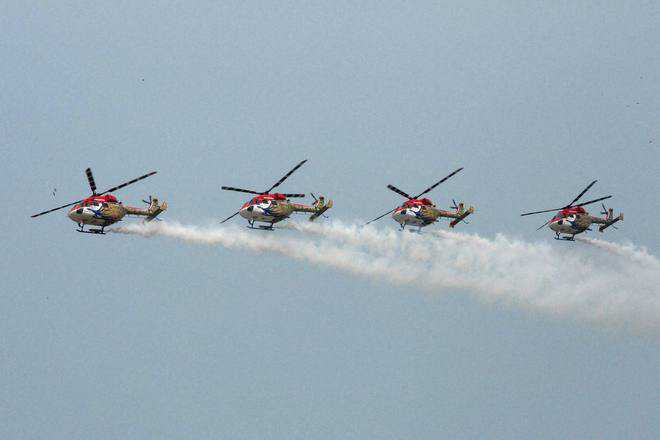
Sarang helicopters maneuvre their skill at the inauguration of the 9th edition of Defexpo in Panaji, Goa, on Monday. PTI

Quepem (Goa), March 28

After a delay of over a year, the much-awaited new defence procurement policy was unveiled by the government today with an aim to ensure transparency, fast-track acquisitions and to lend a push to the “Make in India” initiative.The Defence Procurement Procedure (DPP)-2016 announced by Defence Minister Manohar Parrikar, however, did not contain a key chapter on the proposed strategic partnership. Parrikar said it would take another 2-3 months to finalise the model.To be applicable from April, the procurement policy lays the roadmap on how India, the world’s largest arms importer, will acquire defence equipment in future.The announcement was made at the inaugural ceremony of the Defence Expo (Defexpo)-2016 at Quepem town, about 50 km from Panaji. The new DPP has included a new category to acquire weapons—IDDM (indigenously designed, developed and manufactured). The IDDM will be the first preferred category.Parrikar said a review of the new DPP would be undertaken after six months. “I do not say the document is foolproof. Let us take a review after six months. Nothing is perfect, but we are taking it to perfection,” he said.He said the DPP could push the agenda of “Make in India” and country’s target of achieving defence industry network. With the new DPP, it would be ensured that there was greater transparency and faster clearances, he said.The DPP has been loaded online on the Defence Ministry’s website and will be made available in hard copy format after 15 days.Parrikar said certain concerns of foreign companies would be addressed through this policy over 3-4 months. The new policy also allows the Defence Acquisition Council to take a “fast-track” route to acquire weapons, something which was limited to only the armed forces till now.In a bid to cut down on the time taken for acquisition process, it mandates that all AONs (acceptance of necessity) of a particular platform will be valid for only six months as against the 12-month deadline now.Also, no AON will be notified until it is accompanied by a finalised RFP (request for proposal or tender). This means the time taken for an RFP has been cut down drastically.Parrikar said defence export clearances were to be granted online. He said the policy would also include “Start-up India” initiative.Parrikar had earlier said the new blacklisting policy would also be issued separately next month and made it clear that there would be “no relaxation” for those already blacklisted. “Bribe givers” would be punished, he said.However, the existing blacklisted firms would be allowed to appeal before a vigilance committee of the Defence Ministry for delisting under the new policy. — PTI

Speeding up acquisitions

  • The new policy is aimed at fast-tracking acquisitions and lending a push to the ‘Make in India’ initiative
  • It introduces a new category to acquire weapons-IDDM (indigenously designed, developed and manufactured)
  • It allows the Defence Acquisition Council to take a ‘fast-track’ route to acquire weapons, which was limited to the armed forces till now
  • It will be reviewed after six months and the effort will be to ensure greater transparency and faster clearances, Defence Minister Manohar Parrikar said

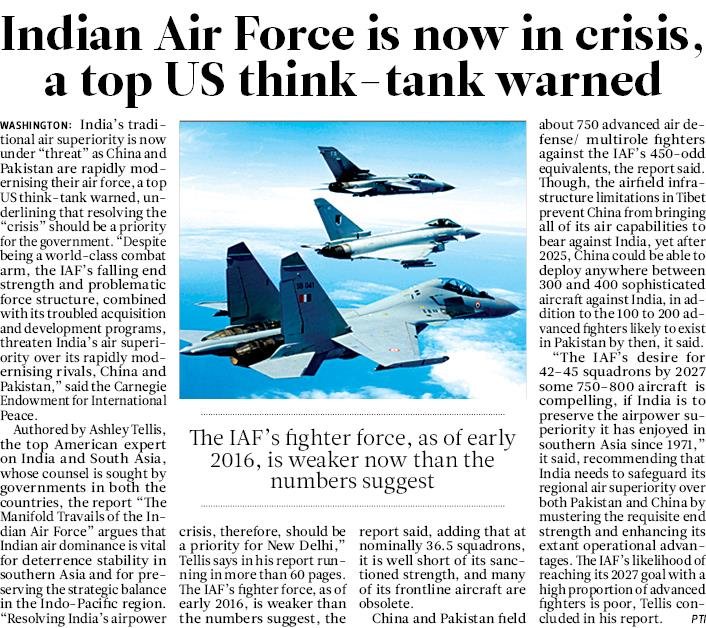
IAF in crisis, says US think-tank

  • India’s traditional air superiority is under ‘threat’ as China and Pakistan are rapidly modernising their air force, a top US think-tank warned on Monday
  • “The IAF’s falling end strength and problematic force structure, combined with its troubled acquisition and development programmes, threaten India’s air superiority over its rapidly modernising rivals, China and Pakistan,” said the Carnegie Endowment for International Peace

6239257364


63667


‘Territorial aggression’ in PoK’s Gilgit-Baltistan raises eyebrows

New Delhi, March 14

A large chunk of the Gilgit-Baltistan area, part of Pakistan-occupied Kashmir (PoK), has been allegedly occupied by neighbouring North-West Frontier Province, triggering protests in the Shia-dominated region, also claimed by India as part of the disputed Jammu and Kashmir state.Large contingents of Pakistan paramilitary troopers have been deployed in the apprehension of trouble brewing in the occupied 25 km border area that connects divided Gilgit-Baltistan with the Khyber Pakthtunkhwa province, says a news report in “Baad-e-Shimaal”, an Urdu daily in PoK.“And the Gilgit-Baltistan government is watching like a mute spectator,” the daily said in its cover of the Monday edition.“The provincial government has deployed Chitral forces in the area after illegally taking over and including the occupied mineral-rich chunk of land in its territory.” A lawmaker, Sarfaraz Shah, has reportedly written a letter in protest against the “territorial aggression” to the government of the frontier province asking it to vacate the land.But the government has denied the allegation and dismissed the lawmaker’s protest, saying it was part of land forms and “deploying paramilitary Chitral forces is our right”, the daily said.The report came after alarm bells rang in the Indian security establishment following Chinese People’s Liberation Army (PLA) troops being spotted at forward posts along the Line of Control (LoC) along PoK where the Chinese government is building a Jhelum-Neelam 970 MW Hydel power project. —IANS

N-W Frontier Province takes chunk of territory

  • Shia-dominated region Gilgit-Baltistan, which falls in PoK, is claimed by India as part of the disputed territory
  • A chunk of the area has allegedly been occupied by Pakistan’s North-West Frontier Province
  • Pak troopers have been deployed in the occupied 25-km border area fearing trouble, says a newspaper report
  • .

Operational readiness always top priority: Parrikar

Operational readiness always top priority: Parrikar
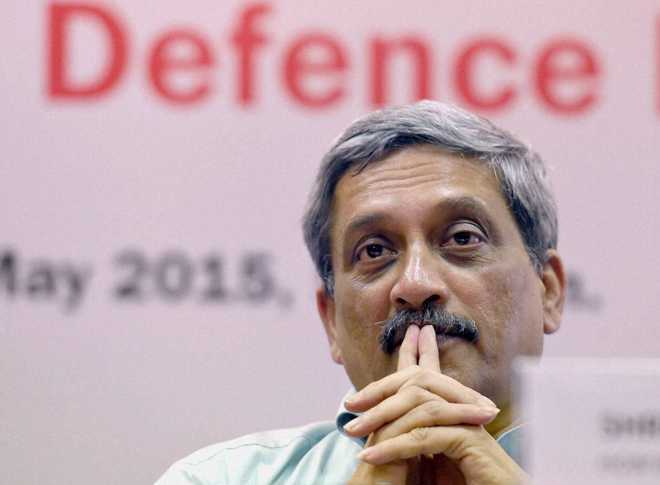
Defence Minister Manohar Parrikar

Roorkee, March 19

The ‘Make in India’ vision is a priority for defence procurement but “operational readiness” is the military’s primary task as “we don’t want people to look at us with big eyes”, Defence Minister Manohar Parrikar has said.

“We need adequate equipment and that cannot change. Make in India is in its place, our military preparedness is paramount,” he said speaking at a panel discussion on Make in India initiative in the defence sector on the opening day of the three-day technical festival – Cognisance 2016 – of IIT Roorkee yesterday.

“I would like to make it clear…Make in India is our priority for defence procurement…but the first priority cannot be forgotten, the primary task of our military, which is operational readiness…in view of our neighbours…so that no one can look at us with big eyes,” he said.

There have been calls for stepping up the country’s defence preparedness after the terror attack on the Pathankot Air base and in Gudsaspur.

Opposition Congress had in Parliament recently criticised the government for its handling of the Pathankot incident in which seven security personnel were killed. — PTI


India, US must collaborate on S China Sea

The Cold War between the US and China on the South China Sea dispute is becoming hot. Last month, it was reported that the US and India have held talks about conducting joint naval patrols that could include the disputed South China Sea. The US and India were quick to dismiss the report.

Even though it seems that the US and India are not ready for joint patrols, the trial balloon is indicative of the evolving Indian position on one of the key disputes in the Asian strategic landscape. A number of factors are forcing India’s hand. The US itself has been forced to adopt a more robust posture in the Indo-Pacific. The dramatic acceleration in American military commitment to the region is a function of the astonishing rise of China, which is becoming a serious regional military power.

Since most of China’s territorial conflicts are spread across the East and South China Seas, naval force projection has gained uncharacteristic momentum for a country that, for most of its history, had a continental mind-set. China’s maritime strategy and its increasing capabilities may overwhelm the smaller powers in the region. Its singular objective is to deny them any operational space in its oceanic sphere of influence. US President Barack Obama’s ‘pivot’ towards Asia represents an attempt to warn China away from using heavy-handed tactics against its neighbours and provide confidence to other Asia-Pacific countries that want to resist pressure from Beijing.

Maritime security cooperation between India and the US has become a strategic necessity. American strategy, according to some in the US, should focus on supporting Indian pre-eminence in the Indian Ocean and closer US-India strategic cooperation.

India has to respond to this burden of growing expectations and it has its own reasons for challenging China. China’s anti-piracy operations in the Gulf of Aden have raised hackles with some in the Indian Navy questioning the need for the People’s Liberation Army Navy’s (PLAN’s) deployment of two frontline warships and a tanker. If, for China, the Indian Ocean is not an Indian lake, New Delhi’s imperative is to contest impressions in Beijing that the waters east of Malacca automatically fall under the latter’s sphere of influence. India’s naval engagement in the East, therefore, is also a reaction to China’s expansion in the Indian Ocean. The turf war between the two navies, as both nations seek greater roles in regional dynamics, is set to grow.

Indian naval officials and maritime strategists seem to favour a ‘naval forward strategy’ that could extend eastward. India’s engagements with Japan, Vietnam and the Philippines have become more serious.

Joint patrols with the US or not, India is conceiving a more ambitious role for itself in East Asia and India-US interests in the region are converging at an unprecedented rate. It is now up to New Delhi and Washington to take full advantage of these developments.

Harsh V Pant is professor of International Relations at King’s College London The views expressed are personal

China says religious extremism, violence down in restive Xinjiang

The situation in Xinjiang is becoming ever more stable. Local authorities have strengthened their ability to prevent and fight terrorist activity. ZHANG CHUNXIAN, chief, Communist Party of China

BEIJING: Religious extremism is on the wane in the remote and often restive region of Xinjiang, a political adviser claimed on Sunday as Chinese leaders continue to say that development is the key to controlling ethnic tension in the province, the country’s largest.

“Religious extremism has weakened remarkably in the Xinjiang Uyghur Autonomous Region(XU AR),” Nurl an Abdumankin, political adviser attending the ongoing session of Chinese People’s Political Consultative Conference (CPPCC) said.

The region over the last few years has seen violence between the Uyghur community and local authorities including the police including large-scale riots. The government tightly controls information coming from the region. Uyghur rights groups say the government’s hardline policies have alienated the community, triggering violence. Many are angry at Beijing’s apparent efforts to stamp-out the unique cultural identities of the Muslim Uyghur community, which has close cultural and language affinity to central Asian states.

Beijing, on the other hand, claims foreign-trained separatists are to blame for the riots and are trying to separate the region from China.

But according to Abdumankin, the situation has changed.

Ethnic unity and religious harmony have been significantly promoted in the region, he said.

He added that the “…central government should further strengthen coordination between Xinjiang and inland provinces in cracking down on extremism and illegal religious activities”.

“The situation in Xinjiang is becoming ever more stable. Local authorities have strengthened their ability to prevent and fight terrorist activity,” said Zhang Chunxian, the Communist Party of China (CPC) chief at the National People’ s Congress’ China’s rubber-stamp Parliament, session.

“However, Zhang warned that Xinjiang still faces a tough task to maintain stability. The local government will maintain pressure on terrorists, the official news agency, Xinhua said in a report.

The government’s efforts has been to show that it is doing all it can to promote development in the region – and that it is bearing fruit.