Sanjha Morcha

What’s New

Click the heading to open detailed news

Current Events :

web counter

Print Media Reproduced Defence Related News

BrahMos: The bolt from the blue

DRDO scientists are developing its more lethal versions, BrahMos-NG and BrahMos-II

article_Author
Air Marshal Amit Tiwari Retd

AIR power pioneers asserted during the Great War years that aerial power is inherently offensive and should be independent; control of air is essential for victory; bombers would always penetrate defences and the enemy’s will could be broken through strategic bombing. Recently, the Indian Air Force, with the combination of air-launched BrahMos and Su-30 MKI, reaffirmed that these tenets still hold true, forcing Pakistan to request a ceasefire.

In 1983, the Government of India formed the Integrated Guided Missile Development Programme. Initially, it was focussed on ballistic missiles. But the devastating effect of US ship- and air-launched Tomahawk cruise missiles on Iraqi air defence systems during the 1991 Gulf war inspired India. In 1998, Dr APJ Abdul Kalam signed a pact with his Russian counterpart, establishing the BrahMos Aerospace joint venture. In 2001, the first test launch of BrahMos was conducted.

BrahMos is a two-stage cruise missile with a solid-propellant booster in the first stage that accelerates the missile to supersonic speeds. Once separated, a liquid-fuelled ramjet engine takes over, propelling it to a cruising speed of Mach 3. It operates at altitudes of 15 km to 10 m and has a range of 300-800 km. It carries a 200-300 kg conventional warhead and operates on the fire-and-forget principle. After firing, it autonomously navigates to its target, using inertial navigation, satellite guidance and terrain contour-matching, achieving accuracy of less than one metre.

The air-to-surface version was launched in 2017 and inducted into 222 Squadron, Tigersharks, in 2020. Its speed, accuracy and kinetic impact makes BrahMos one of the deadliest conventional cruise missiles. A direct hit from BrahMos can destroy reinforced bunkers, warships or command centres through its momentum. Its kinetic energy is 32 times of the US Tomahawk missile.

As ground-based air defence systems have become more accurate and lethal, the operational freedom once enjoyed by aerial platforms has diminished. The Ukraine-Russia war is a live example. After suffering heavy losses in the early stages, both sides avoided overflying contested areas and relied on long-range standoff weapons.

A similar approach was observed in the recent India-Pakistan conflict, when neither Indian nor Pakistani aircraft crossed the border. Pakistan relied on Turkish-made drones. Most of them were intercepted. Pakistan also used the ‘Fateh’ ballistic missile. Ballistic missiles have large-radar cross-section and follow a predictable, high-altitude parabolic trajectory. It makes them vulnerable to interception. Sure enough, India intercepted all missiles. In contrast, India launched BrahMos missiles from Su-30 MKIs to destroy targets with pinpoint accuracy. Though detailed results remain classified, the operational impact was undeniable. These missiles ensured minimal risk to pilots while achieving precision strike objectives. Due to its low-altitude, supersonic cruise profile, BrahMos is virtually impossible to intercept with existing air defence systems.

Indian scientists are already developing a future, more lethal version, BrahMos-NG (Next Generation). This will be smaller and lighter, enabling integration with platforms such as Tejas, Mirage and Rafale. Importantly, there will be no compromise on speed, range, lethality or stealth. Equipped with Active Electronically Scanned Array radar, it will offer enhanced precision. Simultaneously, a hypersonic version, known as BrahMos-II, inspired by the Russian Zircon missile, is being developed. It will be powered by scramjet to have a speed of more than 8 Mach and range of over 1,500 km. It will be impossible to intercept. This missile could be a true game-changer.

Arms exports play a vital role in enhancing a nation’s strategic influence. India has promoted BrahMos, with the Philippines becoming the first customer in 2022. Vietnam and Indonesia have expressed interest. Given concerns over China’s growing presence in the South China Sea, the acquisition of BrahMos by ASEAN nations could bolster regional deterrence. India’s entry into this niche market will enhance its strategic and economic ties across Asia.

The BrahMos showcased success of the government’s push for ‘Atmanirbhar Bharat’. The missile has more than 70 per cent Indian components. Its success is likely to catalyse collaboration between DRDO, Indian industries and academia and boost innovation.

The success of BrahMos is a testament to the changing nature of the battlefield, shifting from tactics to technologically-driven warfare, particularly the rise of precision-guided munitions like cruise missiles. BrahMos is poised to be a tactical asset and strategic game-changer for the security landscape.

Air Marshal Amit Tiwari (Retd) is former AOC-in-C, Central air command.


Trump Administration bars Harvard University from enroling foreign students

Harvard calls move unlawful, pledges support for foreign students

US President Donald Trump’s Administration revoked Harvard University’s ability to enroll international students on Thursday, and is forcing current foreign students to transfer to other schools or lose their legal status, while also threatening to expand the crackdown to other colleges.

Homeland Security Secretary Kristi Noem ordered the department to terminate Harvard University’s Student and Exchange Visitor Program certification effective for the 2025-2026 school year, the department said in a statement.

Noem accused the university of “fostering violence, antisemitism, and coordinating with the Chinese Communist Party.”

Harvard said the move by the Trump administration – which affects thousands of students – was illegal and amounted to retaliation.

The decision marked a significant escalation of the Trump administration’s campaign against the elite Ivy League university in Cambridge, Massachusetts, which has emerged as one of Trump’s most prominent institutional targets. The move came after Harvard refused to provide information that Noem demanded about some foreign student visa holders at Harvard, the department said.

Harvard enrolled nearly 6,800 international students in the 2024-2025 school year, amounting to 27% of its total enrollment, according to university statistics.

In 2022, Chinese nationals were the biggest group of foreign students at 1,016, university figures showed. After that were students from Canada, India, South Korea, Britain, Germany, Australia, Singapore and Japan.

The Chinese Embassy in Washington did not immediately respond to a request for comment.

“It is a privilege, not a right, for universities to enroll foreign students and benefit from their higher tuition payments to help pad their multibillion-dollar endowments,” Noem said in a statement.

In a letter to the university, Noem gave Harvard “the opportunity” to regain its certification by turning over within 72 hours a raft of records about foreign students, including any video or audio of their protest activity in the past five years.

Harvard called the government’s action “unlawful” and said it was “fully committed” to educating foreign students.

“This retaliatory action threatens serious harm to the Harvard community and our country, and undermines Harvard’s academic and research mission,” the university said in a statement.

Congressional Democrats denounced the revocation, with US Representative Jaime Raskin calling it an “intolerable attack on Harvard’s independence and academic freedom” and saying it was government retaliation for Harvard’s previous resistance to Trump.

Trump has already frozen some $3 billion in federal grants to Harvard in recent weeks, leading the university to sue to restore the funding.

In a separate lawsuit related to Trump’s efforts to terminate the legal status of hundreds of foreign students across the U.S., a federal judge ruled on Thursday that the administration could not end their status without following proper regulatory procedures. It was not immediately clear how that ruling would affect the action against Harvard.

During an interview with Fox News’ “The Story with Martha MacCallum,” Noem was asked if she was considering similar moves at other universities, including Columbia University in New York.

“Absolutely, we are,” Noem said. “This should be a warning to every other university to get your act together.”

RUMP TARGETS UNIVERSITIES

Trump, a Republican, took office in January pledging a wide-ranging immigration crackdown. His administration has tried to revoke student visas and green cards of foreign students who participated in pro-Palestinian protests.

He has undertaken an extraordinary effort to revamp private colleges and schools across the U.S., claiming they foster anti-American, Marxist and “radical left” ideologies. He has criticized Harvard for hiring prominent Democrats for teaching or leadership positions.

The U.S. Department of Health and Human Services said on Monday that it was terminating a further $60 million in federal grants to Harvard because it failed to address antisemitic harassment and ethnic discrimination.

In a legal complaint filed earlier this month, Harvard said it was committed to combating antisemitism and had taken steps to ensure its campus is safe and welcoming to Jewish and Israeli students.

Aaron Reichlin-Melnick, a senior fellow with the American Immigration Council, a pro-immigration advocacy group, said the action against Harvard’s student visa program “needlessly punishes thousands of innocent students.” “None of them have done anything wrong, they’re just collateral damage to Trump,” he said on the social media site Bluesky. Reuters


Ties built on sensitivities: India on China, Turkiye backing Pak with logistics, arms

In first diplomatic response since conflict, New Delhi draws a red line on cross-border terror

article_Author
Ajay Banerjee Tribune News Service

In the first official response to China and Turkiye, both of which had backed Pakistan in the recent skirmish, India reminded the two countries that “trust” and “sensitivities” must be kept in mind for relations to function effectively.

Randhir Jaiswal, spokesperson, Ministry of External Affairs, when asked whether India had conveyed a message to China during Operation Sindoor (May 7-10), said National Security Adviser Ajit Doval had spoken with the Chinese Foreign Minister and Special Representative on the boundary issue on May 10.

Jaiswal said, “The NSA conveyed India’s resolute stance against cross-border terrorism emanating from Pakistan… The Chinese side is aware that mutual trust, mutual respect and mutual sensitivity remain the basis of India-China relations.” Though Jaiswal did not explicitly mention it, the remark appeared to allude to assessments within the strategic affairs community suggesting that Beijing had provided real-time satellite imagery to Pakistan for launching attacks on Indian assets. Besides, media reports have emerged indicating that China, following Operation Sindoor, offered Pakistan its fifth-generation stealth fighter jet, the J-20.

On Turkiye-Pakistan relations, Jaiswal said India expected Turkiye to strongly urge Pakistan to end its support for cross-border terrorism and take credible, verifiable action against the terror ecosystem it had harboured for decades. He delivered a clear message to Turkiye, saying “relations are built on the basis of sensitivities to each other’s concerns.”

Turkiye had backed Pakistan with logistical support. Indian security agencies estimated that over 350 drones and Turkish military operatives assisted Pakistan during its four-day hostilities with India. This assistance included operational coordination and drone warfare tactics, marking a direct military role by Turkiye in the clashes.

Pakistan launched drone attacks following India’s May 7 strikes, which targeted terror camps deep inside Pakistani territory in response to the April 22 Pahalgam massacre. Islamabad deployed Bayraktar TB2 and YIHA drones in its retaliatory strikes, using them for surveillance, target marking, and, in some cases, kamikaze-style attacks against Indian forward positions and military convoys.

Turkiye’s defence cooperation with Pakistan has intensified in recent years. According to a report by the Stockholm International Peace Research Institute (SIPRI) titled “Trends in International Arms Transfers-2024”, 10 per cent of all Turkish arms exports between 2020 and 2024 were sent to Pakistan. During the same period, 63 per cent of all Chinese arms exports went to Pakistan. The report noted that Beijing is the fourth-largest arms exporter globally after the US, France and Russia.


Hand over wanted terrorists, EAM tells Pak

Says while ceasefire has halted military action for now, there will be consequences if terror attacks from Pakistan continue

article_Author
Ajay Banerjee a

India on Thursday called on Pakistan to hand over terrorists named in the list previously shared with Islamabad even as External Affairs Minister S Jaishankar, during his Europe tour, accused the Pakistani government and its army of actively supporting terrorism.

Informed Pak after strikes: MEA

MEA spokesperson Randhir Jaiswal rejected Opposition’s charge that EAM S Jaishankar had informed Pakistan at the start of Operation Sindoor. “We told them that we had exercised our right to respond after the retaliatory strikes were carried out,” he said.

In an interview with Dutch publication “De Volkskrant”, Jaishankar reiterated India’s demand for a permanent end to terrorism, warning that while the ceasefire has halted military action for now, there would be consequences if terror attacks from Pakistan continued.

The minister said it was erroneous to go along with the narrative that Pakistan “doesn’t know what is going on”. “The most notorious terrorists on the UN sanctions list are all in Pakistan. Let’s not pretend Pakistan is not involved. The state is involved. The army is up to its neck in it.” His remarks came ahead of an all-party Indian delegation’s visit to Europe from May 25. The delegation will travel to France, Italy, Denmark, the UK, Belgium and Germany where the leaders will reinforce India’s stance that all terror links, direct and indirect, trace back to Pakistan.

The minister rejected any justification for terrorism, calling it an “unacceptable international crime”. On Kashmir, he reiterated India’s position that Pakistan must vacate illegally occupied territories and said, “Our position is clear. The illegal occupiers (Pakistan) must return what belongs to India. No third-party intervention is acceptable. This is a bilateral issue.”

In New Delhi, Ministry of External Affairs (MEA) spokesperson Randhir Jaiswal echoed Jaishankar’s message. “Talks and terror cannot go together. We remain open to discussing the extradition of wanted terrorists whose list was provided to Pakistan some years ago,” he said. Regarding any future dialogue on J&K, Jaiswal said, “Discussions will only proceed if Pakistan vacates illegally occupied Indian territory.”

On the Indus Waters Treaty, Jaiswal said it would remain suspended until Pakistan “credibly and irrevocably” ended cross-border terrorism. He quoted PM Narendra Modi’s warning that “water and blood cannot flow together”.

On Opposition’s allegations that Jaishankar admitted that India informed Pakistan about the retaliatory strikes “at the start”, Jaiswal said, “We informed Pakistan after the May 7 action.”


Pak rejected IndiGo pilot’s request amid turbulence

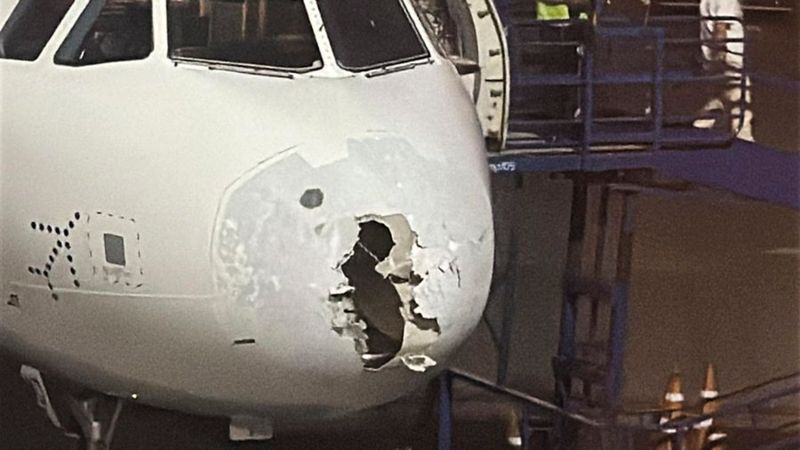
An IndiGo pilot operating the Delhi-Srinagar flight, which encountered a sudden hailstorm on Wednesday, initially sought Lahore air traffic control’s permission to briefly use the Pakistan airspace to avoid the turbulence, but the request was rejected, sources said on Thursday….

An IndiGo pilot operating the Delhi-Srinagar flight, which encountered a sudden hailstorm on Wednesday, initially sought Lahore air traffic control’s permission to briefly use the Pakistan airspace to avoid the turbulence, but the request was rejected, sources said on Thursday.

The incident of flight 6E 2142 encountering severe turbulence is being probed by the Directorate General of Civil Aviation (DGCA), the sources said.

The flight, carrying more than 220 people, including Trinamool Congress MPs, encountered a sudden hailstorm, and the pilot reported the “emergency” to air traffic control at Srinagar airport. The flight had landed safely on Wednesday.

When the aircraft was overflying Amritsar, the pilot noticed turbulence and sought Lahore ATC permission to take a deviation through the Pakistan airspace. The request was made in order to avoid the turbulence, but it was rejected by the Lahore ATC, the sources said.

As a result, the aircraft operated on the original flight path, where it encountered severe turbulence, they added.


Portion of under-construction bridge on Kiratpur-Manali highway collapses

A portion of an under-construction bridge near Sambal on the Mandi-Pandoh section of the Kiratpur-Manali four-lane highway project in Mandi district collapsed last night while concretisation work was underway. Officials concerned confirmed that the main structure of the bridge was…

A portion of an under-construction bridge near Sambal on the Mandi-Pandoh section of the Kiratpur-Manali four-lane highway project in Mandi district collapsed last night while concretisation work was underway. Officials concerned confirmed that the main structure of the bridge was completely safe and unaffected.

According to initial reports, the incident occurred while 10-foot-wide cantilever footpaths were being constructed on both sides of the bridge. One of the shuttering support on the side gave way during welding, causing partial collapse of the bridge. Fortunately, no one was injured and the foundation and the core structure of the bridge was still intact.

An official said, “The damage was caused due to the failure of a welding support in the shuttering and immediate steps are being taken to rectify it. The remaining bridge is entirely secure and the construction work is proceeding in accordance with the standards.”

Varun Chari, Project Director of the Kiratpur-Manali Four-Lane Highway Project, said, “The bridge is structurally safe. The damage has been limited to one support weld. Instructions have been issued to address the issue immediately. The project is progressing well and is expected to be completed on schedule.”


UAE, Japan express solidarity with India in war against terror

Delegation led by Shinde hold talks with UAE Minister of Tolerance Sheikh Nahyan bin Mubarak Al Nahyan, while the group of parliamentarians, led by Sanjay Jha, interacted with Japan’s Foreign Minister Takeshi Iwaya and other leaders in Tokyo

The UAE and Japan today expressed solidarity with India in its war against terrorism as all-party delegations’ diplomatic outreach commenced today to sensitise global leadership about terror emanating from Pakistan.

A delegation led by Shiv Sena MP Shrikant Eknath Shinde held talks in the UAE. It will also travel to Congo, Sierra Leone and Liberia. Another delegation, headed by Janata Dal (United) leader Sanjay Kumar Jha, is currently in Japan and is scheduled to visit South Korea, Singapore, Indonesia and Malaysia. In Japan, the delegation met Foreign Minister Takeshi Iwaya, who expressed heartfelt condolences to the victims of the recent Pahalgam terror attack and extended sympathies to those injured.

‘Bharat is confident’

Bharat is confident and bold. PM Narendra Modi has sent a message, not only to our difficult neighbours but to the entire global community, that terrorism will not just not be tolerated. Jagdeep Dhankhar, Vice-President

The Japanese Foreign Minister reiterated Japan’s support to India’s fight against terrorism and expressed appreciation for the restraint shown by the Indian side, a statement by the Indian Embassy in Tokyo said.

The delegation also met former PM of Japan Yoshihide Suga, who is the Vice President of Liberal Democratic Party and chairman of Japan-India Association. Jha told the Japanese leaders, “India has zero tolerance for terrorism and that it does not differentiate between terrorists and those supporting them.”

The delegation sought Japan’s support in the fight against terrorism and, in this context, called for giving effect to the UN Security Council Press Statement of April 25, 2025, that underlined the need to hold perpetrators, organisers, financiers and sponsors of this reprehensible act of terrorism accountable and to bring them to justice.

Meanwhile, Shinde held talks with UAE Minister of Tolerance Sheikh Nahyan bin Mubarak Al Nahyan, Chairman of the Defence Committee Ali Al Nuaimi and other leaders in Abu Dhabi.

“Terrorism is a threat not just to a single nation or region, but it is a global threat. We believe that we, as an international community, should come together, especially the Members of Parliament, to work on putting plans and strategies and engage in creating a better future for all humanity,” Al Nuaimi told mediapersons in Abu Dhabi.

Excluding Tharoor an insult: Kerala leader

Thiruvananthapuram: Former Kerala Pradesh Congress Committee chief K Sudhakaran on Thursday questioned the party’s decision to exclude the name of Congress MP from Thiruvananthapuram, Shashi Tharoor, from the list of persons to lead the Centre’s delegations on Operation Sindoor and said it was akin to “insulting” him. Sudhakaran said Tharoor was a competent leader and a loyal member of the party and, therefore, in his view, it was not right to sideline the Thiruvananthapuram MP. PTI


Entire CIA team of Phagwara caught taking bribe of Rs 2.5 lakh to let smuggler go free

The team included CIA in-charge Bisman Singh Mahi, ASI Nirmal Kumar, ASI Jaswinder Singh, and Constable Jagroop Singh.

The police have arrested the entire CIA team of Phagwara, including the CIA in-charge Bisman Singh Mahi, ASI Nirmal Kumar, ASI Jaswinder Singh, and Constable Jagroop Singh.

They were caught taking a bribe of Rs 2.5 lakh to let a smuggler named Hani go free.

The arrest happened early this morning.

DIG Naveen Singla, who is in charge of the Jalandhar Range, confirmed the arrests.

He said that corruption would not be allowed in the police department.The arrested accused would be medically examined and will produce before judicial magistrate Phagwara. A case under the Prevention of Corruption Act has been registered at the Sadar Police Station in Phagwara.


HEADLINES 22 MAY 2025

Border talks with India and Bhutan advancing, says China’s white paper on security

EXCLUSIVE: How Op Sindoor exposed Pakistan terror links & called nuke bluff, says Gen Manoj Katiyar

450 benefit from Army medical camp in Uri villages

EXCLUSIVE @ 6 pm : How Op Sindoor called Pak nuclear bluff : Gen Manoj Katiyar

PM Modi ‘failed’ to build political narrative after armed forces ‘excellent job’: Congress

Whole of Pakistan within our range…they will have to find deep hole: Top Army Air Defence officer on Pak Army’s plans to relocate headquarters

Indo-Pak conflict: Sindoor turned into barood, says PM Modi; lauds Armed Forces

Month after Pahalgam: Difficult terrain, change in militant strategy hamper hunt for attackers

Indo-Pak conflict: The nuclear bogey is here to stay

As Voltaire said, ‘The (Pak) army has a nation’

8 villages transferred from Patiala to Mohali in bid to boost land prices

From threat to punishment, message to Pak loud and clear: General Katiyar

ED crossing all limits: Supreme Court slams probe agency over TASMAC raids

Soldier killed in encounter with terrorists in J-K’s Kishtwar

Jaishankar counters Trump’s claim, reveals what led to India-Pakistan ceasefire


Border talks with India and Bhutan advancing, says China’s white paper on security

Highlights internal, external threats

Talks to resolve border issue with India and Bhutan “continue to advance”, a new white paper on China’s national security has said, identifying a host of internal and external threats faced by the country and its one-party political system.

The 23-page security paper released recently in Mandarin has outlined a host of threats and challenges faced by China.

China has settled boundary issues with 12 of its 14 land neighbours and the negotiations with India and Bhutan continue to advance to resolve the border disputes, said the white paper titled ‘China’s National Security in the New Era’.

Beijing has completed the demarcation of the Beibu Gulf waters between China and Vietnam, signed border defence cooperation agreements with nine neighbouring countries, established border defence talks and meetings mechanisms with 12 countries, and regularly carried out friendly visits, working talks, joint patrols, and joint cross-border crime drills, the paper said.

While China’s border disputes with India and Bhutan remain to be resolved, the country has a maritime dispute with several countries, including Japan in the East China Sea, and the Philippines, Vietnam, Malaysia, Brunei and Taiwan in the South China Sea.

India and China have held 23 rounds of Special Representatives-level talks to resolve the border disputes spanning 3,488 km along the Line of Actual Control (LAC).

China and Bhutan held 25 rounds of talks to resolve about 400 km of the boundary issue.