

Current Events :







Chandigarh, Updated At : 09:22 AM Jan 26, 2026 IST
Lt Gen Puneet Ahuja
Lieutenant General Puneet Ahuja, Chief of Staff (CoS) Western Command, has been conferred the Ati Vashisht Seva Medal for distinguished service, on the eve of the Republic Day, 2026.
An alumnus of the National Defence Academy, he was commissioned into the Brigade of The Guards and was served as the Major General General Staff (Operations), Western Command, during Operation Sindoor last year. He assumed the appointment of CoS in October 2025 on promotion to the rank of Lieutenant General.
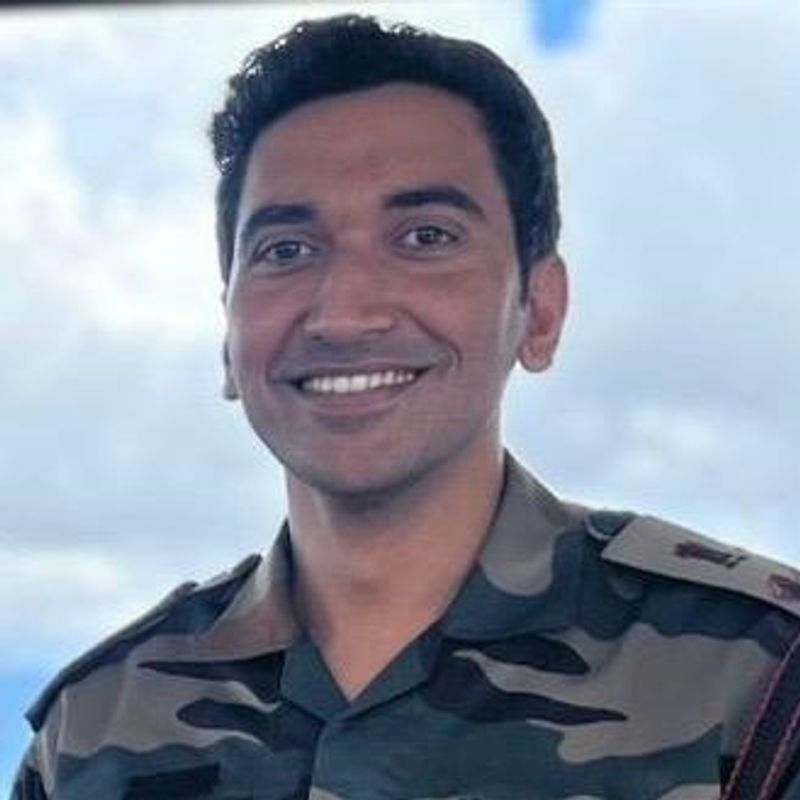
An officer from Mohali, Major Arshdeep Singh Gill, has been awarded Kirti Chakra for gallantry on the eve of the Republic Day, for his role in operations in the northeast.
Serving with the First Battalion of the Assam Rifles, Maj Gill was leading a special patrol along Indo-Myanmar border in May 2025 to protect workers engaged in the construction of the border fence, when it came under sudden fire from a dominating height.
According to available details, he fearlessly executed a counter-ambush operation and assaulted the enemy position through dense undergrowth. Despite intense enemy fire, he neutralised multiple armed cadres, including one armed with an RPG launcher. He ensured zero casualties to own troops through exceptional leadership, gallantry and resolve.
The Kirti Chakra is the second highest peacetime award for gallantry. This year, there are only two recipients of the award, the other being Naib Subedar Doleshwar Subba of the 2nd Battalion of The Parachute Regiment (Special Forces).
A first-generation officer, he was commissioned into the Armoured Corps in June 2016 after passing out from the IMA. He is an alumnus of Chandigarh University and had earlier represented Punjab in hockey in the National Games from 2006 to 20210, according to family sources.
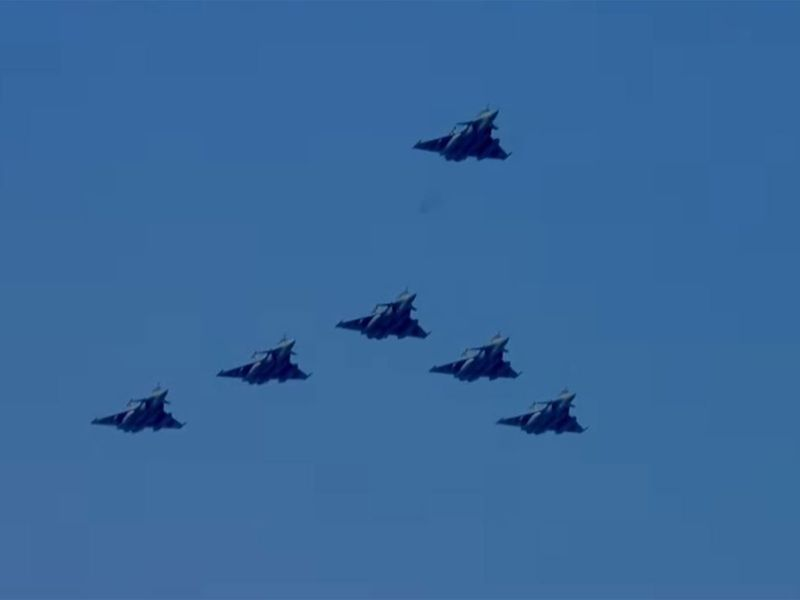
he Indian Air Force presented a stupendous fly-past as the 77th Republic Day celebrations on Kartavya Path in the national capital came to a close on Monday. Precision at tremendous speeds was on display as the Air Force Pilots showcased the incredible symbiosis of man and machine.
A total of 29 aircraft, including 16 fighter aircraft, four transport aircraft and nine helicopters, participated in this year’s Republic Day flypast. These aircraft are operating from five different bases.
The formation comprising one C-130 ac in lead with two C-295 ac in echelon would fly in ‘Vic’ Formation. In the Vic Formation, the aircraft create a single V-shape. In Vic, all planes that belong to one V-shape fly at the same altitude. Those ‘on the wings’ use their leaders’ horizontal stabilizer as a reference point, keeping their own wings on about the same line as the stabilizer they are looking at.
The formation consisting of Six Rafale aircraft flew in ‘Vajraang’ Formation. The ‘Vajraang’ Formation is a specialised, high-precision aerial display that demonstrates air power and strategic capability. It is characterised by its dynamic, tight formation, representing strength and operational readiness.
The formation comprising one P-8i aircraft and Two Su-30 in echelon flew in ‘Vic’ Formation.
One Rafale flying in at 900 kmph behind the Trishul formation, maintaining 300m above ground level, over the water channel North of Rajpath. Approaching the Dais, the aircraft pulled up for a Vertical Charlie leaving spectators spellbound.
During the “Vertical Charlie” the aircraft flew low and fast, pulled up into a vertical climb and performed multiple rolls showcasing incredible thrust, power, and pilot skill.
The Indian Air Force remains fully committed to enhancing India’s aerospace power while demonstrating exceptional operational capability during Operation Sindoor.
The operation highlighted the IAF’s ability to decisively shape military outcomes with speed and precision. Guided by the principle of ‘Train Like We Fight’, the Air Force strengthened inter-service cooperation, ensured rapid integration of new systems and weapons, and sustained high operational readiness through robust logistics, maintenance and indigenisation initiatives.
Earlier, the Air Force showcased a special Sindoor formation comprising 2 Rafale, 2 MiG-29, 02 Su-30 and 01 Jaguar in ‘Spearhead’ formation, dedicated to the IAF’s role in Operation Sindoor, the four-day confrontation in early May following the April 22 terror attack in Pahalgam.
On the ground, a 72-member ensemble, notably including Agniveer women musicians, performed the tune “Sound Barrier”. The Air Force marching contingent, led by Sqn Ldr Jagdesh Kumar, marched in a 12×12 formation. The IAF band consisted of 72 musicians, which included 57 Agniveer men and nine Women Agniveers (being introduced for the first time) and three drum majors led by Sergeant Charles Anthony Daniel.
The band played the tune ‘Sound Barrier’ as it crossed the Presidential dais. The IAF marching contingent comprised four officers (One Contingent Commander and three supernumerary officers) and 144 Airmen.
The Contingent was led by Sqn Ldr Jagdesh Kumar with Sqn Ldr Nikita Choudhery, Flt Lt Prakhar Chandrakar and Flt Lt Dinesh as supernumerary officers. The Air Force Contingent marched abreast in a 12 by 12 formation to the tunes played by the IAF band.
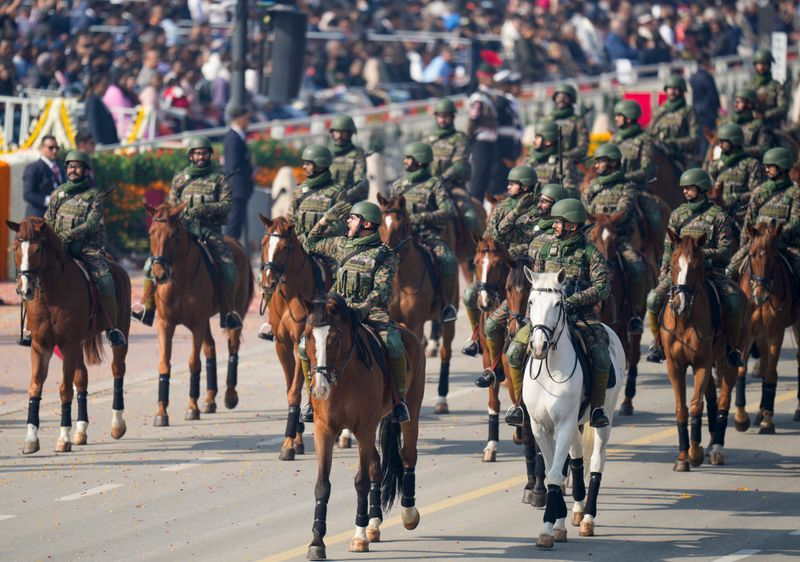
Newly raised Bhairav light commando battalion and Shaktiban Regiment, rocket launcher system ‘Suryastra’ with deep-strike capabilities, and key military assets, including indigenous platforms accompanied with personnel, rolling down the Kartavya Path in a “phased battle array formation” — the 77th Republic Day Parade saw many firsts.
Double-humped Bactrian camels and Zanskar ponies were also part of the ceremonial event for the first time, adding an element of curiosity and excitement among the crowds.dvertisement
Also, marking a first, the contingent members of the mounted 61 Cavalry were seen in battle gear during the parade.Advertisement
The 61 Cavalry, known for its imposing presence as its members wear ceremonial uniform and a striking headgear, has traditionally been the leading contingent of the armed forces in the ceremonial parade.
Capt Ahaan Kumar, 26, a third-generation officer, who led the iconic contingent, an honour he had in the 2025 parade as well, returned to Kartvaya Path, along with his charger ‘Ranveer’, a Hanoverian breed, as the contingent commander thus year as well, albeit in a combat gear.iew More
“For me, leading this historic contingent in a ceremonial uniform gives much greater joy than I had doing it in a combat gear, but yes, it felt very different in this year’s parade,” he told PTI, after the parade.
The Republic Day Parade also saw many other firsts this time.
A mixed scouts contingent seen in their heavy thermal gear in an operational role, were also part of the parade for the first time, the officials said.
For Lt Amit Choudhary, a second-generation army officer, who led this contingent in the parade, it was both a personal milestone and a nostalgic nod to his father who was part of the ceremonial parade in 1990.
Dressed up in characteristic multi-layer suits teamed with special boots and polarised sunglasses meant for high terrain and harsh weather, he and his contingent members drew loud cheers from the crowd, as they marched along the Kartavya Path.
The young officer, a resident of Jammu and Kashmir, is currently serving in 2 Arunachal Scouts of the Assam Regiment.
The mixed scouts contingent had members drawn from Ladakh Scouts, Dogra Scouts, Arunachal Scouts, Kumaon Scouts, Garhwal Scouts, and Sikkim Scouts.
The parade also saw the debut of the Shaktiban Regiment, which has been set up in the artillery, to boost the Army’s firepower capabilities.
The newly raised regiment would be equipped with a drone, counter-drone and loiter munition.
Bhairav light commando battalion had also made its Army Day Parade debut on January 15 in Jaipur. The battalion was raised around October last year.
A Bhairav Battalion of the Sikh Light Infantry regiment took part in the January 26 parade in the national capital.
Bhairav Battalion is a specialised assault infantry unit, bridging the capabilities of conventional infantry and special forces.
“Designed for rapid response and high-intensity operations, it serves as the first responder on the battlefield,” a defence ministry official said.
They embody the ethos of ‘Sant Sipahi’, fierce in battle yet spiritually composed.
The name ‘Bhairav’, inspired by the fierce and protective manifestations of Lord Shiva, symbolises “controlled aggression, invincibility and righteous power,” the official said.
Other key defence assets showcased during the parade included BrahMos, Akash missile system, Medium Range Surface-to-Air Missile (MRSAM) system, Advanced Towed Artillery Gun System (ATAGS), Dhanush artillery gun, and a static display of some drones.
The Defence Research and Development Organisation (DRDO) showcased its Long Range Anti-Ship Hypersonic Missile (LR-AShM), a hypersonic glide missile capable of engaging static and moving targets, designed to carry various payloads.
Captain Harshita Raghav, who led the Remount Veterinary Corps (RVC) contingent, said the contingent also included raptors (kites) and a few Army dogs.
“These animals are soldiers of the Indian Army only. In fact, they are the silent warriors, making them operationally ready, and understanding the requirements of operations from these animals are two very important aspects. They are true force multipliers of the Indian Army,” she told PTI.
Eighteen marching contingents and 13 bands took part in the parade that lasted around 90 minutes.
The dominant theme of this year’s parade was 150 years of ‘Vande Mataram’.

ollowing are the sidelights of the 77th Republic Day celebrations held at Kartavya Path in the national capital on Monday:
The overarching theme of the event was 150 years of ‘Vande Mataram’.dveisement
Prints of old paintings by artist Tejendra Kumar Mitra, illustrating the opening stanzas of ‘Vande Mataram’, adorned the enclosure backdrops along the Kartavya Path.President Droupadi Murmu led the ceremony that commenced at 10.30 am and lasted nearly 90 minutes.
Vice President C P Radhakrishnan, Prime Minister Narendra Modi, Defence Minister Rajnath Singh, the Chief of Defence Staff, the three Service chiefs, National Security Advisor Ajit Doval, Union ministers, foreign diplomats and senior officials were among the spectators.The President of the European Council, Antonio Costa, and the President of the European Commission, Ursula von der Leyen, were the chief guests at the ceremonial parade.
The President of the European Commission attended the event in a maroon and gold silk brocade outfit.
A small EU military contingent carrying the military staff flag and flags of Operations Atalanta and Aspides, the naval operations of the grouping, also participated in the parade.
Murmu and the chief guests arrived at the venue in a ‘traditional buggy’ that was escorted by the President’s Bodyguard. Later, they also departed in it.
The guests at the saluting dais sat behind a glass shield panel.
Around 100 cultural artistes heralded the parade, on the theme ‘Vividata Mein Ekta’ (Unity in Diversity), a grand presentation of musical instruments, demonstrating the nation’s unity and rich cultural diversity.
During the parade, four Mi-17 1V helicopters showered flower petals while flying in the Dhwaj formation.
The parade was led by Parade Commander Lt General Bhavnish Kumar, General Officer Commanding, Delhi Area, a second-generation army officer.
Indian military’s Operation Sindoor also found prominence at the parade on the Kartavya Path, with a tri-services tableau themed on it, displayed among the showcased tableaux, and a special arrowhead formation during the flypast.
India showcased its frontline military assets, including Brahmos and Akash missiles, rocket launcher system ‘Suryastra’, Main Battle Tank Arjun and newly-raised Shaktiban Regiment.
Bhairav Light Commando Battalion and Shaktiban Regiment, rocket launcher system ‘Suryastra’ with deep-strike capabilities, made Republic Day parade debut.
In a first, Army assets, including indigenous platforms accompanied by personnel, rolled down Kartavya Path in a “phased battle array formation”.
Also, marking a first, the contingent members of the mounted 61 Cavalry were seen in battle gear during the parade.
A mixed scouts contingent having members drawn from Ladakh Scouts, Dogra Scouts, Arunachal Scouts, Kumaon Scouts, Garhwal Scouts, and Sikkim Scouts was also part of the parade.
Double-humped Bactrian camels and Zanskar ponies were also part of the ceremonial event for the first time.
Flypast saw participation of a total of 29 aircraft, including 16 fighter jets, four transport aircraft and nine helicopters. These included Rafale, Su-30 MKI, MiG-29 and Jaguar aircraft, complemented by strategic assets — C-130 and C-295, as well as the Indian Navy’s P-8i aircraft.
A total of 30 tableaux — 17 of states and Union Territories and 13 of various ministries and departments — rolled down Kartavya Path. The tableaux showcased a unique mix of 150 years of the national song ‘Vande Mataram’ and the nation’s rapid progress.
A joint ‘DareDevils’ team of motorcycle riders drawn from the Central Reserve Police Force and the Sashastra Seema Bal enthralled the audience with their manoeuvres.
Approximately 10,000 special guests from different walks of life were invited to witness the parade.
This year, the enclosures for the parade were named after the rivers flowing across the nation: Beas, Brahmaputra, Chambal, Chenab, Gandak, Ganga, Ghagra, Godavari, Sindhu, Jhelum, Kaveri, Kosi, Krishna, Mahanadi, Narmada, Pennar, Periyar, Ravi, Sone, Sutlej, Teesta, Vaigai and Yamuna.

After years of delay, the last hurdle to providing direct access to martyr Sukhdev Thapar’s ancestral house in Ludhiana was cleared on Sunday, when the Municipal Corporation (MC) took possession of a 44.50 sq yd property blocking the route.
A joint team of MC officials, district administration and police reached Naughara Mohalla on Sunday morning to take possession. The process went off peacefully as the property owner had vacated the building a day earlier after being informed of the action.
MC officials pasted a notice declaring the property under municipal ownership and locked the premises to establish control. The building would now be demolished to allow construction of a direct road from Chaura Bazaar to Naughara Mohalla.
Ashok Thapar of the Shaheed Sukhdev Thapar Memorial Trust said five properties were identified for acquisition to create direct access. “This last 44.50 sq yd was the main hurdle as the owner was not willing earlier. The MC deposited compensation in the court, after which possession became possible,” he said.
Trust members expressed satisfaction and urged the authorities to expedite the work. Ashok Thapar said the road should be completed before March 23, when the martyrdom day of Bhagat Singh, Sukhdev Thapar and Rajguru would be observed, to enable easier public access.
Senior Deputy Mayor Rakesh Prashar said legal hurdles had been cleared and manual demolition would begin soon, followed by road construction.
Sukhdev Thapar was executed at the age of 23 along with Bhagat Singh and Rajguru on March 23, 1931, at Lahore Central Jail.

n a strongly-worded retort in the UNSC, India said it is not normal to tolerate Pakistan’s continued use of terrorism as an instrument of state policy, as New Delhi hit back at Islamabad’s envoy for advancing a “false and self-serving” account of Operation Sindoor.
India’s Permanent Representative to the UN, Ambassador Parvathaneni Harish, delivered a sharp response to comments made by Pakistan’s Ambassador to the UN, Asim Iftikhar Ahmad.
Ahmad spoke about Operation Sindoor, Jammu and Kashmir and the Indus Waters Treaty in his remarks at the UN Security Council open debate on Monday on ‘Reaffirming International Rule of Law: Pathways to Reinvigorating Peace, Justice, and Multilateralism.’
Harish said Pakistan, an elected member of the Security Council, has a single-point agenda – to harm India and its people.
With Ahmad telling the Council that Pakistan’s response to Operation Sindoor “established that there can be no ‘new normal’ based on coercion or impunity”, Delhi slammed Islamabad, with Harish asserting that terrorism can never be normalised as Pakistan wishes to do.
Rea
“We have heard talk from the Representative of Pakistan about the new normal. Let me reiterate again that terrorism can never be normalised as Pakistan wishes to do. It is not normal to tolerate Pakistan’s continued use of terrorism as an instrument of state policy,” Harish said, adding that India will do whatever is required to protect and ensure the safety and security of its citizens.
“This hallowed chamber cannot become a forum for Pakistan to legitimise terrorism,” Harish said.
Harish said Pakistan’s envoy “advanced a false and self-serving account” of Operation Sindoor, launched by India in May last year, targeting terror infrastructure in Pakistan and Pakistan-occupied Kashmir in retaliation for the April 22 Pahalgam attack that killed 26 civilians.
“The facts on this matter are clear. Pakistan-sponsored terrorists killed 26 innocent civilians in a brutal attack in Pahalagam in April 2025. This august body itself called for holding the perpetrators, organisers, financiers and sponsors of this reprehensible act of terrorism accountable and brought to justice. That is exactly what we did,” Harish said.
Harish’s reference was to the press statement issued by the Security Council in April last year.
In the statement in which the 15-nation body had condemned in the strongest terms the terrorist attack in Pahalgam and had “underlined the need to hold perpetrators, organisers, financiers and sponsors of this reprehensible act of terrorism accountable and bring them to justice”, with the Council stressing that those responsible for these killings should be held accountable.
Harish underscored that India’s actions in Operation Sindoor were measured, non-escalatory, and responsible, and focused on dismantling the terrorist infrastructure and disabling terrorists.
“Till May 9, Pakistan was threatening more attacks on India. But on May 10, the Pakistani military called our military directly and pleaded for a cessation to the fighting,” he said, adding that the destruction caused to multiple Pakistani airbases by the Indian operation, including images of destroyed runways and burnt-out hangars, is in the public domain.
Hitting out strongly at Pakistan for raising the issue of Jammu and Kashmir, Harish said Pakistan has no locus standi to comment on matters that are internal to India.
“The Union Territory of Jammu and Kashmir has been, is, and will always remain an integral and inalienable part of India,” he said.
On the Indus Waters Treaty, Harish said India had entered into the agreement 65 years ago in good faith, in a spirit of goodwill and friendship.
“Throughout these six and a half decades, Pakistan has violated the spirit of the Treaty by inflicting three wars and thousands of terror attacks on India. Thousands of Indian lives have been lost in Pakistan-sponsored terror attacks,” he said.
In the wake of the Pahalgam terror attack, Harish said India was “compelled to finally announce that the Treaty will be held in abeyance until Pakistan, a global epicentre of terror, credibly and irrevocably ends its support for cross-border and all other forms of terrorism.”
Further, India asserted that Pakistan is well advised to introspect about the rule of law.
“It could start by asking itself how it has let its armed forces engineer a constitutional coup through the 27th amendment and giving life-time immunity to its Chief of Defence Forces,” a reference to the 27th Constitutional Amendment passed in November last year under Prime Minister Shehbaz Sharif that gives Pakistan’s Field Marshal Asim Munir lifelong immunity from any legal prosecution.



































































































