Sanjha Morcha

What’s New

Click the heading to open detailed news

Current Events :

web counter

Print Media Reproduced Defence Related News

IAF successfully test-fires BrahMos missile from Sukhoi 34 SHARES FacebookTwitterEmailPrint

IAF successfully test-fires BrahMos missile from Sukhoi

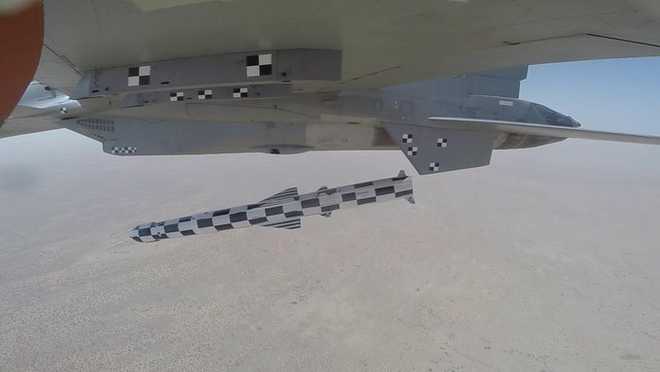
The launch from the aircraft was smooth and the missile followed the desired trajectory before directly hitting the land target, the IAF said. — @IAF_MCC/Twitter

Ajay Banerjee
Tribune News Service
New Delhi, May 22

The Indian Air Force (IAF) successfully fired the BrahMos air version missile from its frontline Su-30 MKI fighter aircraft.

The launch from the aircraft was smooth and the missile followed the desired trajectory before directly hitting the land target, the IAF said.

The target was a remote island in the Bay of Bengal, sources said, adding that it adds a new capability. The BrahMos can be launched at land targets when launched from ground and also from sea. The launch from air is the third dimension.

The air launched BrahMos missile is a 2.5-ton supersonic air-to-surface cruise missile with ranges of close to 300 km, designed and developed by BrahMos. 

Earlier in November 2017, the IAF became the first air force in the world to have successfully fired an air-launched 2.8 Mach speed surface attack missile of this category on a sea target.

Today’s was the second such live launch of the weapon. The integration of the weapon on the aircraft was a very complex process involving mechanical, electrical and software modifications on aircraft. The IAF has been involved in the activity from its inception. The software development of the aircraft was undertaken by the IAF engineers while HAL carried out mechanical and electrical modifications on the aircraft.

The dedicated and synergetic efforts of the IAF, DRDO, and Hindustan Aeronautics Limited have proven the capability of the nation to undertake such complex integrations, the IAF said.

The BrahMos missile provides Indian Air Force a much desired capability to strike from large stand-off ranges on any target at sea or on land with pinpoint accuracy by day or night and in all weather conditions.

The capability of the missile coupled with the superlative performance of the Su-30MKI aircraft gives the IAF the desired strategic reach, the IAF said.


Civil-military relations under strain by Air Marshal Brijesh Jayal (retd)

This is perhaps the first General Election in which the armed forces have truly been sucked into the electoral rhetoric. It’s a new low for our democracy. The new government must recognise that it inherits the challenge of a fraying civil-military relationship, one that has destroyed many fledgling democracies. It is up to the polity to take the initiative to restore the balance.

Civil-military relations under strain

Weak linK: We have been lax in introducing much-needed reforms in every facet of our national security landscape.

Air Marshal Brijesh Jayal (retd)
Former Air Officer Commanding-in-Chief, South Western Air Command

RECENTLY, over 150 veterans, including eight former chiefs of the services, made an appeal to the President in his capacity as the Supreme Commander, expressing concern over the politicisation of the otherwise apolitical armed forces and seeking his intervention. Their apprehension was based on quoted instances of military operations and symbols being exploited during electioneering. Though no political dispensation was named, a reference to the ruling party was evident.

Not long after, one was privy to a news conference held at the headquarters of the principal opposition party where a retired Army Commander, under whose charge the ‘surgical strikes’ were executed in 2016, gave a briefing on the national security report that he had presented to the party president. The irony of the retired General professing to be apolitical in response to a reporter’s question, however, would not have been lost on those sensing a threat to our apolitical armed forces.

Whatever inferences one may draw from these instances, one thing is clear to an impartial observer. This is perhaps the first General Election in which the armed forces have truly been sucked into the electoral rhetoric. This is a new low for our democracy, especially when the reality of civil-military relations is that our polity sings praises of the armed forces when it suits them and takes them for granted when in the saddle. That we have been lax in introducing much-needed reforms in every facet of our national security landscape, in spite of many task force and committee recommendations, speaks volumes of our political intent.But electoral politics aside, this is perhaps a good opportunity for all those concerned about the important issue of civil-military relations in our democracy to look beyond party manifestos and promises to delve deeper into this complex field.

In Army and the Nation: The Military and Indian Democracy since Independence (2015), Prof Steven I Wilkinson, a political scientist at Yale University, draws on uniquely comprehensive data to explore the reasons why India, unlike other countries that inherited colonial ‘divide and rule’ armies, has been able to consolidate its democracy and make its army safe for democracy, unlike its neighbour Pakistan, which emerged from the same colonial Indian institutions.Reviewing the book in Foreign Affairs (September-October 2015), Andrew Nathan writes, “The protection of Indian democracy from military intervention looks on the surface like an unlikely achievement, given the weak institutions of civilian control that India inherited from the British Raj. Reaching back to the early years of Independence, however, Wilkinson shows that India’s new leaders took measures to prevent coups, such as institutionalising internal divisions within the army’s leadership, placing top officers under surveillance, assigning domestic intelligence to a civilian agency, and creating civilian-controlled paramilitary forces to handle internal security and counter-insurgency.”

Wilkinson’s research shows that Indian democracy and polity can claim credit for successfully steering civil-military relations to where India stands today. The question that recent happenings and debates pose is: what does the future hold and can we as a democracy remain sanguine?

According to Wilkinson, “the greatest challenge to civil-military relations is now not over the traditional concerns of higher command structures and ethnic hedging, but rather from the difficulties that the army faces in trying to remain a society apart. Party pressures, corruption and increasing political and societal efforts to interfere in its workings threaten its ability to retain its traditional recruiting structures and hierarchies and lead to strains on what has been up to now one of India’s major successes, the clear divide between the military and politics.”

These strains seem to be rearing their head, if recent events are any indicator. Looking at the external and internal security challenges facing the country that are becoming more demanding by the day and the political discourse that is getting more divisive, one shudders to look at the future with optimism. Clearly, one victim appears to be our civil-military relations and it is up to the polity to take the initiative to set right the balance before these ties begin to sour.

As India conducts another General Election, demonstrating to the international community its credentials as the largest democracy in the world, and as a new government chosen by the people takes charge, there is serious work to be done on the civil-military relationship front. The new government must recognise that it inherits the challenge of a fraying relationship, one that has, as Wilkinson’s work shows, destroyed many fledgling democracies. Equally, military commanders aspiring to choose politics as a career after their colour service must recognise that they owe it to this cause and the men and women they commanded to ensure a healthy cooling-off period, a self-imposed break of some years, before they jump into the rough and tumble of electoral politics.


Army looks to retrieve funds from IL&FS

Tribune News Service
New Delhi, April 27

The Army looks to retrieve its ‘sacred funds’, meant for pension of widows and retired soldiers, which the Army Group Insurance Fund (AGIF) had invested in Infrastructure Leasing & Financial Services (IL&FS) — a company that has gone from a top-rated fiscal institution to one that is now under a serious financial crisis.

The National Company Law Appellate Tribunal (NCLAT), which is hearing petitions with respect to the IL&FS resolution, has been apprised of the AGIF funds. The Army authorities said, “It is a ‘sacred fund’ meant for making payments to soldiers and widows” and the NCLAT has been requested to accord highest priority for this.

Investment in IL&FS was “made on a sound financial logic” by the AGIF and these were done when the company enjoyed ‘AAA’ rating. The company collapsed gradually over the past 12 months. “The AGIF is in a fine state to meet all existing obligations,” Army sources said.

There is a signal from the NCLAT to ensure that investments by pension and PF trusts is not lost in any resolution plan for IL&FS and these get priority even when the repayment starts. Under the resolution plan, the government has categorised IL&FS group companies into various categories based on their financial positions.

More than 50 retirement funds covering over 15 lakh employees have exposure to IL&FS. The PF trusts of state electricity boards, public sector undertakings and banks are among them.


Cong alleges Modi, BJP leaders using armed forces to garner votes, cites veterans’ letter

Cong alleges Modi, BJP leaders using armed forces to garner votes, cites veterans’ letter

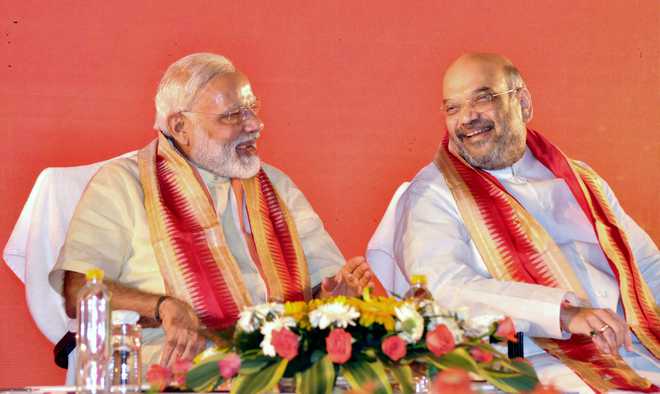
PM Narendra Modi with BJP president Amit Shah. PTI file

New Delhi, April 12

The Congress on Friday accused Prime Minister Narendra Modi and other BJP leaders of using the armed forces for garnering votes while expressing solidarity with the military veterans who have written to President Ram Nath Kovind over what they called “use of military for political purposes”.

The party also urged the President to take action against Modi, Uttar Pradesh Chief Minister Yogi Adityanath, and other BJP leaders for the alleged use of the military to seek votes.

Over 150 military veterans have written to the President seeking his intervention in preserving the apolitical character of the services. The letter, dated April 11, carries the names of eight former service chiefs, but two of them—former Army Chief General (retd) S F Rodrigues and Air Chief Marshal (retd) N C Suri—said they have not signed it.

Congress spokesperson Priyanka Chaturverdi, at a press conference, alleged that both Prime Minister Modi and BJP president Amit Shah, in their public addresses in the last few days, have actively referred to the Pulwama terror attack in which 40 CRPF personnel lost their lives.

“The statements come as both the leaders attempt to make the attack a part of their political narrative in the run-up to the 2019 polls,” Chaturvedi said, referring to Modi’s April 9 election rally in Maharashtra’s Latur, in which he urged first-time voters to dedicate their vote to the soldiers who conducted the Balakot anti-terror air strikes and to those who lost their lives in Pulwama.

“We have also witnessed how PM Modi made an election speech with photographs of 40 Pulwama martyrs in the backdrop,” she said.

Chaturvedi also cited instances of Adityanath and Union Minister Mukhtar Abbas Naqvi making references to ‘Modi ki Sena’.

“Earlier, BJP MP and national executive member Sakshi Maharaj was shamefully smiling, waving and holding a road show standing next to body of Pulwama martyr in Unnao, Uttar Pradesh, and the nation witnessed the despicable act of self-promotion by (Union) Tourism Minister Alphons Kannanthanam who clicked a selfie with a Pulwama jawan’s body in Wayanad,” Chaturvedi alleged.

“We express solidarity with the 156 veterans who have pointed out that the blood and sacrifice of our Armed Forces should not be used as a political pamphlet to seek votes. We would demand Rashtrapatiji—the Supreme Commander of our armed forces—to ensure action against PM Modi, UP CM and several other BJP leaders,” she said.

Earlier, the Congress, in a tweet, alleged that the Prime Minister “may try to use soldiers for votes, but it’s clear that soldiers stand with India and not the BJP.”

Referring to the letter, Chaturvedi said that the veterans had expressed displeasure over repeated instances of political parties using armed forces for political gains ahead of the elections.

The Army veterans have urged the President to take “necessary steps to urgently direct all political parties that they must forthwith desist from using the military, military uniforms or symbols, and any actions by military formations or personnel, for political purposes to further their political agendas,” Chaturvedi said. PTI


SC order on Rafale: Defence, Law Ministers must quit, says Chidambaram

P. Chidambaram. File

SC order on Rafale a huge rebuff’

Former Union Finance Minister P. Chidambaram on Thursday demanded the resignation of Defence Minister Nirmala Sitharaman and Law Minister Ravi Shankar Prasad after the Supreme Court rejected the government plea on ‘stolen documents.’

“The order of the Supreme Court in the Rafale Review Petition case is a huge rebuff to the central government which raised the specious plea of ‘stolen documents’,” he wrote on Twitter. “We demand the resignation of the Defence and Law Ministers who authorised the plea of stolen documents.”

At an official briefing, the Congress said a joint parliamentary committee (JPC) investigation would be ordered into the deal if the party came to power.

Congress spokesperson Abhishek Singhvi said the government tried to mislead the court by withholding three sets of documents that pertained to the former Defence Secretary asking the Prime Minister’s Office not to have parallel negotiations, the dissent notes of the Indian negotiation team and a note detailing the role of National Security Adviser Ajit Doval.

“A JPC probe is the only way to find the wrongdoers. After May 23, when the Congress will return to power, we will order it,” he said.


Let’s not fall prey to Pak provocation by P Stobdan

A lasting India-China conflict serves Pakistan to provoke and prolong its conflict vis-à-vis India by putting into action its ‘Bleed India with a Thousand Cuts’ strategy. Instead of responding to the Pakistani ploy, there is much that India can learn from the way China deploys its economic leverage to retaliate against those harming its interests.
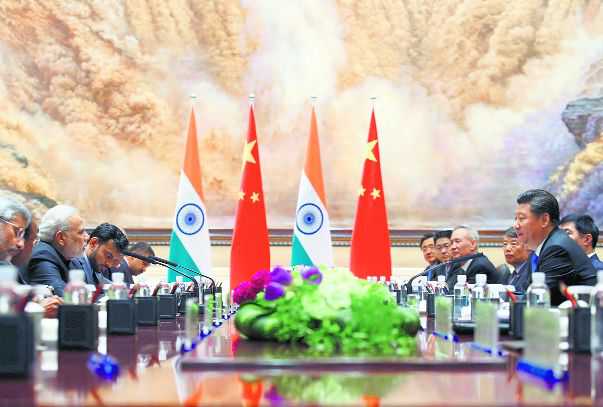
Let’s not fall prey to Pak provocation

GAME PLAN: It’s vital for India to craft a better strategic alignment with three most important global powers: Russia, the US and China.

P Stobdan
Former Ambassador

LYING in wait, much less being complacent when the country is attacked, is neither a virtue nor a good thing to accept, for doing so will buoy up other sundries waiting in the wings to hit India. But we must be careful not to fall prey to provocation, for the tale of sabotaging India’s rise has followed a predictable line.

In 1959, India had got trapped in a similar wave of hysteria in the wake of border skirmishes with China, demanding retaliation despite the government’s effort to hold its peace.

What had ensued were fiery slogans and mutilation of Mao Zedong’s portrait — the Chinese vowed never to forget the insult even for 100 years.

Jawaharlal Nehru was hard-pressed to shelter the Dalai Lama and the public flocked to see Tibet’s legendary phoenix. Morarji Desai likened him to Karl Marx, whom the British had offered sanctuary when he fled Germany.

To get swayed by the overwhelming sentiment, unmindful of the consequences, has proved disastrous, a sort of democratic fallacy. It becomes worse when the country’s vulnerability gets manipulated by vested interests, both domestic and external.

Nehru was doing fine until the US, by the 1950s, was able to outmanoeuvre his domestic and foreign policy by secretly machinating a divergent viewpoint through propagandists such as Minoo Masani, informers such as MO Mathai, adventurists like Bhola Nath Mullik and a host of others who worked for the CIA from at least 1955.

At the domestic level, mass hysteria and a call for a muscular approach work like added fuel, especially when the elections are around the corner. In the run-up to the January 1962 elections, even Lal Bahadur Shastri rhetorically threatened China with a fate similar to that of Goa, which had been liberated from the Portuguese in December 1961.

The war rhetoric brought the Congress back to power — winning 358 of 491 seats in the Lok Sabha with a vote share of 44.78 per cent. But the opposition parties blocked boundary talks with China; they thought it was tantamount to surrender. Despite the Soviet advice for a negotiated settlement, we remained steadfast — ‘boundaries were not negotiable’.

Past experiences indicate that political leaders become captive to domestic hysteria or they like to use it to further their ends. But Nehru was then forced to abandon friendship with China; instead he had to push for a provocative ‘forward policy’ and sent ill-equipped border patrol into disputed territory. Many other adventurous acts followed, perhaps without Nehru’s knowledge. The Chinese denounced Nehru for becoming the ‘running dog of imperialism’.

In September 1962, Krishna Menon ordered the eviction of Chinese troops — possibly against the military assessment. On October 20, the Chinese assault began and Indian troops faced a humiliating defeat.

Menon quickly became the scapegoat — a familiar tactic. Nehru’s position weakened; he was attacked for compromising national security.

At that time, too, nationalists turned to voicing fabled ‘analogies of Indian invincibility’ and power and even drew ‘mystical affinity’ with the Himalayas.

History shows that if not exhibited and channelled appropriately, the outburst of passion can go against the national interest. In 1999, a similar public shrill constrained the government to release terrorist Masood Azhar, who recently masterminded the savage act in Pulwama.

For, it also becomes easier for the external actors to manipulate our emotions to meet their own ends. The Americans skilfully manoeuvred the 1962 defeat into a conflict between communism and democracy.

The US wasted no time in offering  quick military aid to repel Chinese troops, but in return Washington roped in New Delhi to collaborate in its CIA-run Tibet project; thereafter, it freely operated a covert war across the Himalayan border by using Tibetan warriors trained since 1957 in Colorado.

But, the ghost of the 1962 war still haunts us, only to get hardwired to conform to a view that “we could have done no wrong”, even conveniently attributing the defeat to either Chinese ‘treachery and betrayal’ or to Nehru’s ‘idealism’.

Originally limited to trans-border trade and pilgrimage issues, the differences with China suddenly conspired to produce a military conflict in 1962.

Obviously, frenzied war hysteria that followed thereafter eternally turned India and China against each other with all the perceived threats and trappings to play a sort of geopolitical rivalry.

Against these intersecting interests, the two countries have sought to constrain each other through proxies and alliances. Pakistan is one of the tools in this ‘great game’ at play between India and China.

Seemingly, the burden of Cold War politics and pressures continues unabated without really comprehending what the two sides actually want, least what the third factor (the US) would leave us alone to decide the endgame.

Importantly, the assumption whether India should go to war or not always had its limitations. In 1959, India sought a guarantee from the US to ensure that Pakistan would not attack India in case of an India-China conflict. A potential two-pronged military threat still exists, albeit in a reverse way.

To be sure, a lasting India-China conflict serves Pakistan to provoke and prolong its conflict vis-à-vis India, of course, by putting into action its ‘Bleed India with a Thousand Cuts’ strategy. Pakistan, as a failed and rogue state, is now nakedly out in the open. It is a bankrupt country, surviving on Saudi and Chinese largesse.

The nation ought not to succumb to such provocation, for its aim would be to whip up national hysteria which could once again be hijacked for sabotaging India’s economic rise. Possibly, there would also be many avatars of Masani, Mathai and Mullick amidst us who would be having their own agenda that we need to guard against.

Equally important for India is to craft a better strategic alignment with three most important global powers: Russia, the US and China.

In fact, over a long period in history, China has been India’s closest spiritual neighbour and brother. This needs to be reignited in a modern context. A composite national strength that China has acquired enables it to defend itself against foreign aggression. We need to learn from its experiences of de-radicalisation and re-education programmes.

Again, instead of responding to the Pakistani tactic of provocation, there is much that India can learn from the way China deploys its economic leverage to retaliate against those harming its interests.




Surgical Strike Hero Lt Gen Hooda Who Prepared Congress’ Security Doctrine Denies Recommending AFSPA Abolition

Surgical Strike Hero Lt Gen Hooda Who Prepared Congress’ Security Doctrine Denies Recommending AFSPA Abolition

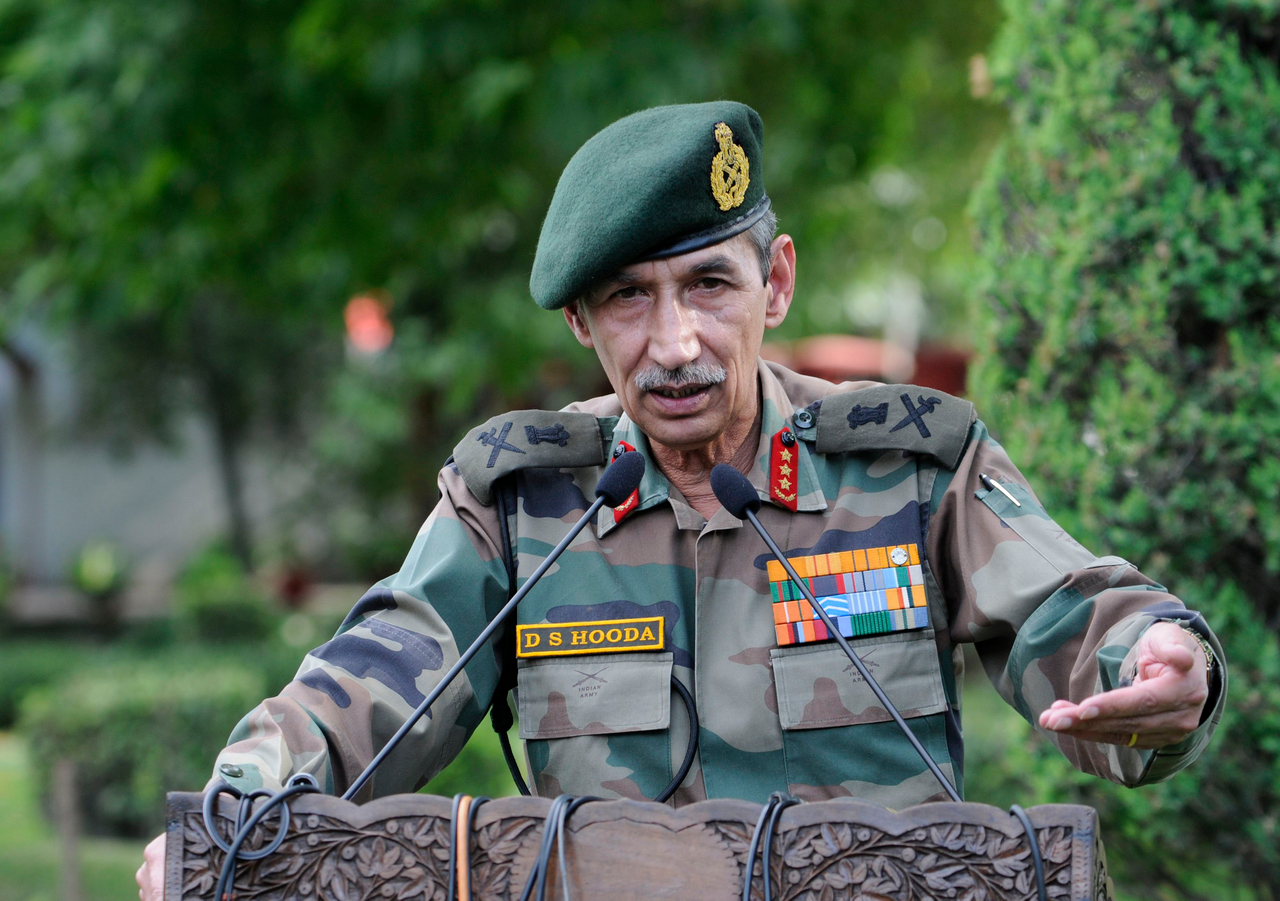
Former Commanding-in-Chief of Northern Command Lt. Gen. Hooda (Waseem Andrabi/Hindustan Times via Getty Images) 

Lieutenant General Deependra Singh Hooda who was the Northern Army Commander during the famed 2016 Surgical Strikes, has denied recommending the abolition of Armed Forces Special Powers Act (AFSPA) in the security doctrine he created for the Congress party.

In an interview given to NDTV’s Vishnu Som, General Hooda who oversaw the surgical strike said that the doctrine encompasses a wide range of issues like India’s internal, external security and its standing in the world affairs.

He added that there is no mention of AFSPA in his doctrine hence no question arises about recommending its abolition. As per General Hooda, first India needs to clearly lay out its political objectives in Kashmir based on which a military strategy can be drawn.

He has also denied claims that he would be joining the Congress.

The Congress party has received flack for promising to review AFSPA in areas like Kashmir. Rahul Gandhi’s party has also promised to review the deployment of forces in the Kashmir Valley.


Lessons from the Banihal near miss by Lt Gen Syed Ata Hasnain (retd)

While Indian intelligence agencies have done a creditable job and the Pulwama incident was not something easily avoidable, it is going to be difficult to defend them in the event of more such acts by pro-Pakistan elements in Kashmir or elsewhere. India can no longer sit and await being hit by the next spectacular event that Pakistan has planned.

Lessons from the Banihal near miss

WORRYING: A new generation of young Kashmiris has been radicalised to associate itself with trans-national radical trends.
Lt Gen Syed Ata Hasnain (retd)

Lt Gen Syed Ata Hasnain (retd)
former GOC, 15 Corps, Kashmir

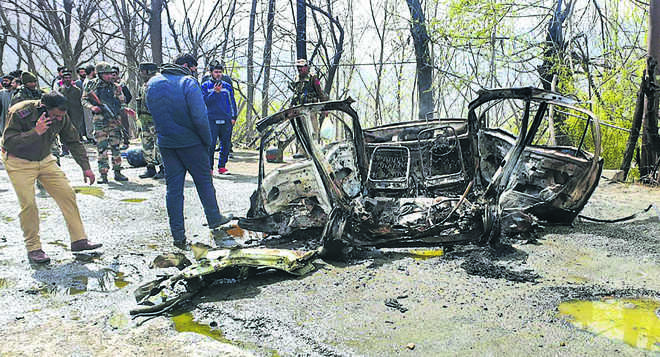
THE attempt to blow up another CRPF bus through a car-borne suicide bomber comes much earlier than estimated. It has been my steadfast belief that the era of improvised explosive devices (IEDs) and car bombs would return with a vengeance to Kashmir, their effect having been witnessed in internal hybrid conflicts of Syria, Iraq, Pakistan and Afghanistan. As the usage got more vicious and there were no qualms about the choice of targets, this unethical tool of organised violence found more and more takers, leading to its comeback in Kashmir.The latest attempt was almost a repeat of the Pulwama attack on February 14, except for the location, which was just south of the Pir Panjal range at Banihal. Owais Amin, a 20-year-old Kashmiri from Shopian, has been arrested for the attempt which went awry when he tried to ram the car fitted with IEDs (improvised explosive devices) into the CRPF bus. At least one IED or a gas-filled cylinder caught fire and probably did not explode, but reduced the car to ashes. Amin escaped in the melee, but was apprehended later by the J&K Police while attempting to sneak back into the Valley.

Those who have been involved in searches for IEDs in J&K in the 1990s and the early 2000s would vouch for the complexities in their fabrication in local houses and subsequent deployment on roads and country lanes. These are not simple demolition sets which people may imagine; these involve more than just the explosive, detonator, fuse wire and switch. Upgrade that to the level of a car bomb and a suicide bomber and it becomes even more dangerous to handle before it detonates. The work involving fabrication of such a car bomb is usually delegated to what are called ‘IED doctors’; one of them involved in the Pulwama incident was later cornered and killed by the Army within 100 hours of the occurrence. There are probably a couple of such ‘doctors’ in the Valley, trained by the Pakistani deep state. The spectre of radicalisation is helping in finding recruits such as Owais Amin and Adil Ahmad Dar (Pulwama bomber). It appears that the effects of what Pakistan planned over many years as part of the Zia doctrine are now beginning to have greater impact. A new generation of young Kashmiris has been radicalised sufficiently to associate itself with trans-national radical trends, something we earlier perceived as unlikely. Ironically, as the international trends are waning, a surge is appearing in Kashmir.The near miss by Owais Amin has not been owned up by any terror group so far and will unlikely find ownership due to the botched attempt or simply due to a chiding the deep state may have given the Jaish-e-Mohammad (JeM) for putting it in a spot. Can we therefore expect a repeat of such attempts in the coming days? The assumption should surely point towards greater possibility. A couple of reasons for this can be identified. First, the General Election in India diverts the attention of intelligence agencies at all levels. Second, the resultant impact at such a time creates more confusion in response and far more antipathy among the public, which is getting more restive by the day. Third, the Pakistani leadership appears fairly gung-ho about the impact of the Pulwama attack and perceives that it weathered the storm of India’s response. Internationally, while there has been a furore, Pakistan probably perceives that it has escaped international opprobrium. Ayesha Siddiqa, noted Pakistani author and commentator, writes: “The understanding in Pakistan is that the post-Pulwama situation has actually worked to its advantage — or is a stalemate. The situation today is comparable to the Rann of Kutch operation in 1965, or the 1965 war. As far as the diplomatic war is concerned, that will be long and protracted.” It is this perceived advantage that spells the dangers of more threats in Kashmir, and not from car bombs alone. Innovative ways of beating the Indian intelligence agencies will be the aim and intent, with maximum impact sought. A misconceived notion seems to exist in Pakistan that India is tied in knots and even serious analysts like Ayesha Siddiqa seems to be swayed by it. There appears to be a fair misreading of India’s military capabilities due to our more than transparent discussions on national media about an existing hollowness. The reported communication by India’s National Security Adviser (NSA) to his US counterpart on February 27 that India may not hold back if the captured IAF pilot was ill-treated and the move of some surface-to-surface missile batteries spells a level of seriousness which Pakistan does not appear to take at face value. Pakistan’s introspection on its ability to wage war against India, given the state of its economy, should force it to desist from any further risk. However, the irrationality and ‘hara-kiri’ approach, without examining the terminal end of actions it initiates, continues to create an impasse which may hurtle the subcontinent towards a war-like situation earlier than ever contemplated before. A lot would depend on what China advises the Pakistani leadership, having just bailed it out of yet another imminent bankruptcy. Also, much would depend on PM Imran Khan’s ability to resist the Generals whose gung-ho attitude and misplaced confidence now needs to be factored even more in India’s appreciation of future security scenarios.

While Indian intelligence agencies have done a creditable job and the Pulwama incident was not something easily avoidable, it is going to be difficult to defend them in the event of more such acts by pro-Pakistan elements in Kashmir or elsewhere. India’s diplomatic efforts must remain at a high pitch not for any other reason but to convey the seriousness with which India looks at the developing situation in the subcontinent. Pakistan appears to have pinned far too many hopes on its nuclear basket. Our unwillingness not to speak about our own nuclear capability may be misconstrued by our adversary.

Perhaps it is time to do what former Army Chief General Padmanabhan did in early 2002 — the conveyance of a message in no uncertain terms. Getting Pakistan to a state of full military mobilisation will cost it dear and put the international community on tenterhooks. India can no longer sit and await being hit by the next spectacular event that Pakistan has planned. An escalation this time will probably mean war and Pakistan can only do lip service to its capability to withstand the Indian military might.


They killed 41, we should kill 82: Capt on Pulwama attack

Time to act, not talk’, Punjab CM wants mix of military, diplomatic, economic measures against pak

They killed 41, we should kill 82: Capt on Pulwama attack

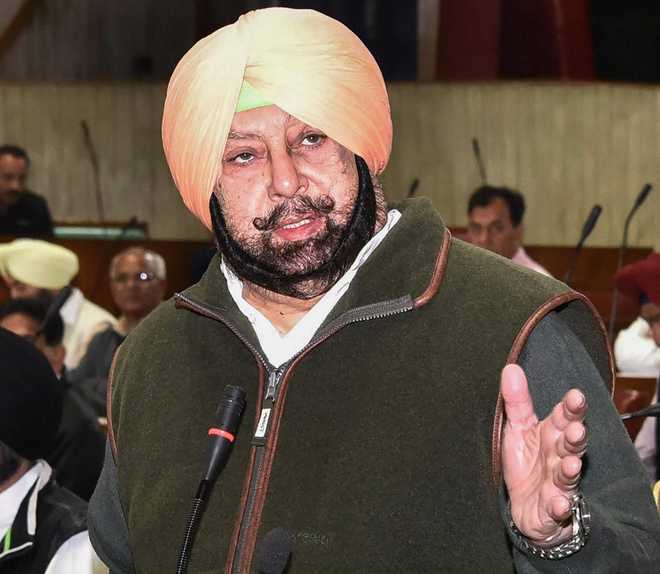
Punjab Chief Minister Capt Amarinder Singh.

Tribune News Service
Chandigarh, February 18

Asserting that the entire country was fed up with the senseless killings of Indian soldiers every day, Punjab Chief Minister Captain Amarinder Singh on Monday called for tough coercive action against Pakistan, which he suggested could be military, diplomatic or economic, or a combination of all three.

Advocating a strong stance in the wake of the Pulwama terror carnage, the Chief Minister said it was for the Centre to decide what form of action should be taken, but it was clear that some measures had to be taken urgently. “India wants it now,” he declared during a chat with some TV channels.

“No one is asking anyone to go to war, but these killing of soldiers is not a joke. Something has to be done. I am fed up, the country is fed up,” said a visibly-agitated Amarinder, adding that he was not asking for war but definitely wanted tit-for-tat action against Pakistan.

“Pakistan can’t hold India to ransom just because they are a nuclear nation, even we are nuclear,” pointed out the Chief Minister, observing that they had nuclear capability even during Kargil but were defeated by the Indian forces. In any case, Islamabad could never resort to use of nuke weapons, as international pressure would not allow that, he said, suggesting that New Delhi should call Pakistan’s bluff against such threats.

It was for the Indian Prime Minister and Defence Minister to decide what action should be taken now, but it was clear that something needed to be done, said an emotional Capt Amarinder, adding that “there is time for talk but that is not now”.

At the moment, there was palpable anger across the country, which wanted some strong measures by the Indian government, he asserted.

The ex-Army man, whose first love has always been the Army, declared that, “If they (Pak-backed terrorists) kill our soldiers, we have to do something.” Calling for a proactive role in destroying the safe havens of the terrorists, he said terror organisations within Jammu & Kashmir have to be dealt with. “We should get 82 of them since 41 of our men have been killed, the Chief Minister asserted, demanding an ‘eye for an eye, a tooth for a tooth’.

‘Army should go after Jaish’

Lamenting that the Army had softened since those days when he had joined it 50 years ago, the Chief Minister said they should go after Jaish-e-Mohammad in Kashmir, instead of firing pellets and blinding youth. “Let’s win their hearts and minds with love,” he said, urging the Army not to look at Kashmiri youth as their enemies.

The message needs to go out to Pakistan – stop meddling in J&K and stop promoting terror; enough is enough, said the Chief Minister, adding that the Pak hand in Pulwama was clear. It was evidently the Army that was calling the shots there, with Prime Minister Imran Khan also a plant of the military, he said.

“The Indian government should take whatever measures required to tackle the terror and we will support them,” he said, adding that inputs could be taken from central agencies like RAW to formulate a structured strategy to deal with the situation. Questions were bound to be asked on the issue of intelligence failure in Pulwama, said the Chief Minister, adding that the government would need to answer for that.

Pointing out that ISI had tried to whip up mischief even in Punjab, where they had been unsuccessful, Amarinder called for a clear-cut policy framework to deal with them. “I have sent out the message loud and clear that our police force is not the same as it was in the 80s and 90s, but has been through the baptism of fire and is ready to deal with their sinister and evil designs,” he added.

If China and Muslim countries stop giving them doles, they (Pakistan) will be left struggling with a begging bowl in hand, the Chief Minister suggested. He called for a global diplomatic offensive against Pakistan, mooting harsh measures to put a lid, once and for all, on Islamabad’s anti-India actions. The surgical strikes had not achieved anything, he commented, adding that Islamabad needs to be made to understand that Indian soldiers are not dispensable.


Asked to comment on the attacks on Kashmiri students and others in the wake of the Pulwama incident, Capt Amarinder asserted they were very much part of the country and Punjab would ensure their full protection. Everyone in the force is one family and we are identified by our units not religion, he added, pointing to the unity in the Army as an example for the entire nation to emulate.

On removal of photographs of Pakistani cricketers from the Mohali stadium, the Chief Minister said while he was not aware of the incident, it seemed like an emotional reaction, possibly by some clerk.

The Chief Minister hoped the Pulwama incident would not push back the Kartarpur initiative, which was the realisation of the aspirations of the entire Sikh community and with which his own grandfather was closely associated, having rebuilt it after the floods in 1920s.