Sanjha Morcha

What’s New

Click the heading to open detailed news

Current Events :

web counter

Print Media Reproduced Defence Related News

India calls for early adoption of anti-terror convention by UN

India calls for early adoption of anti-terror convention by UN
Defence Minister Manohar Parrikar said terror remains the ‘most pervasive and serious challenge’ to international security. PTI file photo

New Delhi, March 6

India on Monday renewed its pitch for early adoption of a global convention by the UN (United Nations) to effectively combat terrorism, terming the menace the single biggest threat to international peace and security.

In an obvious reference to Pakistan, Defence Minister Manohar Parrikar said India has been a victim of “proxy war” for several decades and that there was a need for developing an Asian approach to push the global fight against terror networks.

Calling for early adoption of India-backed Comprehensive Convention on International Terrorism (CCIT) by the UN, Parrikar said terror remains the “most pervasive and serious challenge” to international security and an united approach to deal with it was very important.

He was speaking at a conference on combating terrorism at the Institute of Defence Studies and Analysis.

Parrikar said there must be action against entities which fund terror groups, propagate their ideologies and provide safe havens to terror groups and added that India has been seeking inclusion of these provisions in the CCIT.

Talking about issues relating to global security, Parrikar also mentioned about challenges like global uncertainty, revival of populist movements, heightened nationalism, and backlash against globalisation and possible closing of borders by several countries.

The Union Minister said Asia has been victim of some of the most dreaded terrorist networks and a strong regional push from Asia will exert more pressure on rest of the world to adapt a cohesive framework to combat terror.

Without giving specific details, he said India experienced almost seven per cent of the total terror attacks globally.

“Terrorism remains the most pervasive and serious challenge to international security. Developing a serious and cognitive global response to it is very important but seemingly very difficult to achieve,” he said. — PTI


Gurmehar pulls out of DU campaign FIR on threats to martyr’s daughter after House panel grills police chief

TNS and Agencies

New Delhi, February 28

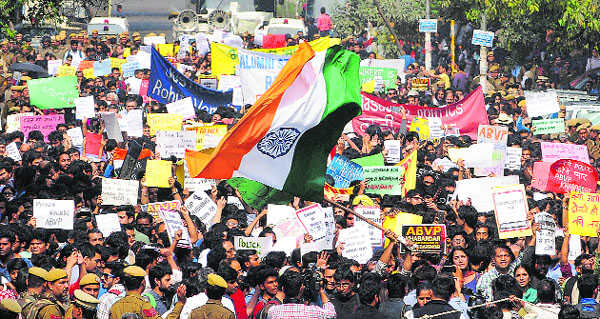
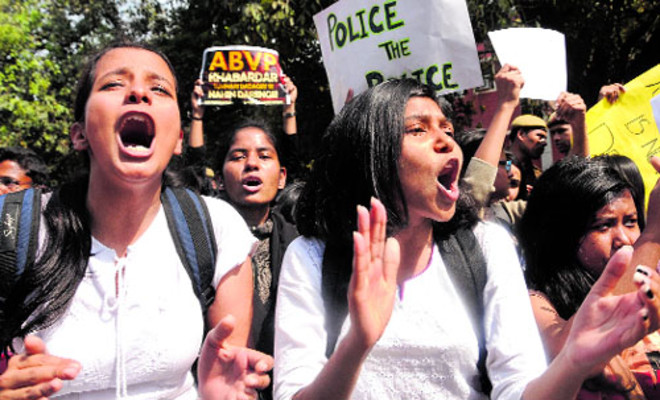
Angered by “stifling of voices,” hundreds of university students and teachers today held a protest march  aimed at the ABVP as the controversy over free speech in the country gathered pace.Faced with alleged rape threats and a virulent social media backlash, the young woman at the centre of the storm, LSR first-year student Gurmehar Kaur, withdrew her protest against the ABVP, the ruling party-affiliated students’ group, which has been accused of browbeating those who support free speech.(Follow The Tribune on Facebook; and Twitter @thetribunechd)The large-scale participation of Delhi University students, said to be largest in recent times, was remarkable given that the institution is not known for volatile student activism like Jawaharlal Nehru University.“The protest is essentially against stifling of voices on campuses across the country, including Delhi University. We want to reclaim the space to discuss and dissent,” said All-India Students Association leader in DU Kanwalpreet Kaur. Several students and teachers of Ramjas College  were last week beaten up allegedly by ABVP members for inviting JNU students Umar Khalid and Shela Rashid to a seminar on free speech, which was eventually cancelled.Gurmehar became the centre of a controversy after she launched a social media campaign against the ABVP, which immediately drew threats of rape, allegedly from ABVP members, and ridicule by a Union minister, a BJP MP and ex-cricketer Virender Sehwag.Union Minister Kiren Rijiju wondered who was polluting her mind. He later said his remark was aimed at Leftists and that Gurmehar was free to express her views. “I stand by my comments. Anybody who tweets on social media platform should be careful. But anyone with a contrary view should be allowed to speak. Gurmehar is a young girl and she should be allowed to speak her mind,” he told mediapersons.Gurmehar’s father Capt Mandeep Singh was killed in a militant attack in Jammu and Kashmir’s Kupwara district on August 6, 1999, four days after Pakistani troops withdrew from Kargil.Today, as the march made its way through the North Campus of Delhi University, with hundreds of students of JNU, DU and Jamia, she tweeted, “All my friends. Our lovely faculty! how I wish I was there.”In an earlier tweet, she urged people to join the march, which is “about students and not about me.” JNU student Kanhaiya Kumar, who is out on bail in a sedition case, also joined the anti-ABVP protest.  “You (ABVP) can’t enforce a particular ideology on anyone and their should be room for discussion,” he said while addressing the protesters.The Delhi University issue was vociferously raised by Opposition members at the meeting of the Parliamentary Standing Committee on Home Affairs headed by senior Congress leader P Chidambaram, amid protests by ruling BJP members. The MPs asked Commissioner of Delhi Police whether security had been provided to Gurmehar in view of the threats issued to her. Within an hour of his being quizzed, he conveyed to the MPs that an FIR had been registered against unknown persons following a complaint by the Delhi Commission for Women in connection with the rape threats issued to Gurmehar allegedly by ABVP workers.NHRC notice to Delhi PoliceNew Delhi: The NHRC on Tuesday sought a report from the Delhi Police over allegations that policemen attacked a female student and manhandled journalists during the February 22 clash at Delhi University’s Ramjas College. In a notice to Delhi Police Commissioner Amulya Kumar Patnaik, the NHRC said it had taken cognizance of complaints and media reports against the police and gave him four weeks to submit a detailed report. IANS


Daughter of army martyr brings Ramjas row to boil

As tweet by daughter of officer killed in 1999 sets social media ablaze, politicians jump in with opposed narratives of subversion and freedom of expression

NEW DELHI: The daughter of an army martyr polarised political and public opinion on patriotism and free speech on Monday, after getting rape threats for posting her protest against the rightwing ABVP over the Capital’s latest campus unrest.

BURHAAN KINU/HTABVP members march with a 180­foot­long Tricolour in DU’s North Campus on Monday.

The controversy began after 20-year-old Gurmehar Kaur, a Delhi University student, posted a picture of herself on Twitter and Facebook. She was seen holding a placard that broadcast her views on last week’s violent clashes in DU where ABVP members allegedly assaulted students, teachers and journalists during a protest march.

“I am student from Delhi University. I am not afraid of ABVP. I am not alone. Every student of India is with me,” the message read. The post went viral on Sunday. She was trolled, called an anti-national, and allegedly threatened with rape for her campaign against the ABVP, which owes allegiance to the RSS, the BJP’s ideological mentor. Politicians jumped into the debate soon enough, with junior home minister Kiren Rijiju asking in a tweet: “Who’s polluting this young girl’s mind? A strong Arm Force prevents a war. India never attacked anyone but a weak India was always invaded.”

Rijiju, the BJP parliamentarian from Arunachal Pradesh, was referring to an old picture of the Lady Shri Ram College literature student that resurfaced on social media. The placard in this photo reads: “Pakistan did not kill my dad, war did.”

Kaur’s father Captain Mandeep Singh was killed in Kashmir soon after Kargil war in 1999. Her social media campaign reignited the debate over intolerance as celebrities such as former cricketer Virender Sehwag and Bollywood actor Randeep Hooda criticising her remarks. The actor even called her a political pawn. Kaur retorted: “Really sweet of you to encourage the hate I’ve been receiving. Makes me feel happy that I adored your work 🙂 Pawn? I can think. I don’t support violence perpetuated on students? Is that so wrong (sic).”

She responded individually to Rijiju and Sehwag too, saying she was not anti-national and her mind is not polluted. The student said she was hurt that the cricketer she had cheered for so often trolled her “at the cost of her father’s death”. CHANDIGARH: Gulgul. That’s what late Capt Mandeep Singh used to call his elder daughter Gurmehar. He wrote her name on a pile of snow in Kupwara in the Kashmir valley, and clicked a picture for his two-year-old daughter back home. It’s a picture that Gurmehar Kaur, 20, carries with her like a talisman 18 years after his death in the Valley.

Today, the first-year English honours student of Lady Shri Ram College in Delhi has become the subject of a vicious war of words being waged on the social media. All over a Facebook post in which she slammed the Akhil Bharatiya Vidyarthi Parishad (ABVP) action at Ramjas College.

Capt Mandeep’s brother Davinderdeep Singh, a professor of English at DAV College, Nakodar, says his brother would have stood like a rock behind his daughter. “He would have supported her tooth and nail. She is entitled to her opinion, she did not say anything anti-national.”

ON CAPT MANDEEP

Capt Mandeep, 30, was posted in 4 Rashtriya Rifles (RR) in Kupwara when militants stormed his camp in August 1999. He was killed in the gunbattle that followed. Davinderdeep, who was 24 at that time, says a few months earlier, his brother had shot down three militants in a 30-hour encounter at Bandipora.

“He was much dreaded by militants active in the area. They had kept a reward on him. Even when they stormed the camp, they shouted out his name,” he recounts.

Capt Mandeep was an avid bodybuilder . Anup Vats, a former professor at DAV College, Jalandhar, recalled how Mandeep had taken part in Mr Jalandhar contest.

VOICE OF RAM

Gurmehar, all of two when Capt Mandeep was killed, and her younger sister Bani, who was only five months old, remember a lifetime spent missing their father.

Gurmehar first shot into limelight in May last year, when she was the subject of a silent video by Ram Subramaniam, an ad filmmaker whose Facebook page, “Voice Of Ram”, aims to “create a positive change”. Telling her story through placards, Gurmehar recounted how she had tried to stab a burqa-clad woman when she was six because she believed Muslims had killed her father.

She had a change of heart when her mother, Rajvinder Kaur, a Punjab Civil Services officer, taught her that it was a war that killed her father, not people from a particular religion. “Today, I am also a soldier just like my dad. I fight for peace between India and Pakistan.”

BOOK ON INDO-PAK PEACE

In a Facebook live chat on January 30 this year, Gurmehar says: “My life has been very difficult. But my mother taught me that hate doesn’t get you anywhere .”

Praising her college, she says it encouraged open thoughts and free conversations. Saying that she was working on Indo-Pak peace, Gurmehar disclosed that she had penned a book on life in the forces and peace between the two neighbours. “We can have a cordial relationship.”

Gurmehar, who commands quite a following in Pakistan, says that she wants to visit Pakistan, hopefully this year.

Davinderdeep says the family is traumatised by the vicious attacks on Gurmehar, calling her anti-national. “We haven’t said a word about this to my father who is very ill.”


A soldier’s daughter, she fights for Indo-Pak peace

HANDIGARH: Gulgul. That’s what late Capt Mandeep Singh used to call his elder daughter Gurmehar. He wrote her name on a pile of snow in Kupwara in the Kashmir valley, and clicked a picture for his two-year-old daughter back home. It’s a picture that Gurmehar Kaur, 20, carries with her like a talisman 18 years after his death in the Valley.

Today, the first-year English honours student of Lady Shri Ram College in Delhi has become the subject of a vicious war of words being waged on the social media. All over a Facebook post in which she slammed the Akhil Bharatiya Vidyarthi Parishad (ABVP) action at Ramjas College.

Capt Mandeep’s brother Davinderdeep Singh, a professor of English at DAV College, Nakodar, says his brother would have stood like a rock behind his daughter. “He would have supported her tooth and nail. She is entitled to her opinion, she did not say anything anti-national.”

ON CAPT MANDEEP

Capt Mandeep, 30, was posted in 4 Rashtriya Rifles (RR) in Kupwara when militants stormed his camp in August 1999. He was killed in the gunbattle that followed. Davinderdeep, who was 24 at that time, says a few months earlier, his brother had shot down three militants in a 30-hour encounter at Bandipora.

“He was much dreaded by militants active in the area. They had kept a reward on him. Even when they stormed the camp, they shouted out his name,” he recounts.

Capt Mandeep was an avid bodybuilder . Anup Vats, a former professor at DAV College, Jalandhar, recalled how Mandeep had taken part in Mr Jalandhar contest.

VOICE OF RAM

Gurmehar, all of two when Capt Mandeep was killed, and her younger sister Bani, who was only five months old, remember a lifetime spent missing their father.

Gurmehar first shot into limelight in May last year, when she was the subject of a silent video by Ram Subramaniam, an ad filmmaker whose Facebook page, “Voice Of Ram”, aims to “create a positive change”. Telling her story through placards, Gurmehar recounted how she had tried to stab a burqa-clad woman when she was six because she believed Muslims had killed her father.

She had a change of heart when her mother, Rajvinder Kaur, a Punjab Civil Services officer, taught her that it was a war that killed her father, not people from a particular religion. “Today, I am also a soldier just like my dad. I fight for peace between India and Pakistan.”

BOOK ON INDO-PAK PEACE

In a Facebook live chat on January 30 this year, Gurmehar says: “My life has been very difficult. But my mother taught me that hate doesn’t get you anywhere .”

Praising her college, she says it encouraged open thoughts and free conversations. Saying that she was working on Indo-Pak peace, Gurmehar disclosed that she had penned a book on life in the forces and peace between the two neighbours. “We can have a cordial relationship.”

Gurmehar, who commands quite a following in Pakistan, says that she wants to visit Pakistan, hopefully this year.

Davinderdeep says the family is traumatised by the vicious attacks on Gurmehar, calling her anti-national. “We haven’t said a word about this to my father who is very ill.”



‘Cross-LoC raids tactical rather than strategic success’

New Delhi, February 23The cross-LoC raids were a tactical rather than a strategic success since the old rules stood, says a new book.“Defeat Is an Orphan: How Pakistan Lost the Great South Asian War” by Myra MacDonald tracks the defining episodes in the relationship between India and Pakistan from 1998, from bitter conflict in the mountains to military confrontation in the plains, from the hijacking of a plane to the Mumbai attacks.India has come a long way from the lonely humiliation of the Kathmandu to Kandahar hijacking in 1999 to the public announcement of cross-LoC raids into Pakistan-held territory in 2016, says MacDonald, a journalist and author specialising in South Asian politics and security.“The cross-LoC raids were a tactical rather than strategic success, since the old rules stood. Pakistan was unlikely to abandon its strategy of supporting some jihadis while fighting others — the ideology of confrontation with India had become too deeply embedded to be uprooted. Nor had India escaped the requirements of ‘strategic restraint’.“Beyond skirmishes on the LoC, more significant Indian military action still faced the risk of escalation into a nuclear exchange. Inside the Kashmir valley, India still needed to find the political means of addressing Kashmiri resentment. In the event of further attacks from Pakistan, moreover, India’s options for further unpredictable retaliation remained limited,” the author says.“If it had international support for its cross-LoC raids, it was precisely because Indian responses to attacks by jihadis from Pakistan had been so carefully controlled since 1998, thanks to Prime Minister Modi’s predecessors,” the book, published by Penguin Random House, says.“It could not continue seeking ever more forceful retaliation without putting that at risk. Nor could it rely on international impatience with Pakistan —- it was too useful a country for China and too worrying for the United States to abandon.”According to MacDonald, Pakistan’s defeat in the Great South Asian War contained a warning for India too.“Pakistan had been brought low by hubris, a chauvinist nationalism and an unhealthy obsession with its neighbour. As it emerged as the far stronger power, India needed to be wary of succumbing to similar sentiments, lest it neglect the need to tend to the domestic stability and restraint that had served it so well,” she says. — PTI


More LAC meeting points likely

Ajay Banerjee

Tribune News Service

New Delhi, February 22

Senior military commanders of India and China today discussed setting up of additional meeting points for the two armies along the Line of Actual Control (LAC) and to have a “hotline” at the Director-General of Military Operation-level (DGMO) on either side.India has such a “hotline” with Pakistan. A 15-member delegation from Western Theatre Command of People’s Liberation Army (PLA), China, is on a five-day visit (February 21-26) to India. The PLA delegation led by Major-General Zhao Jin Song, Vice-Chief of Staff of Western Theatre, met the Indian delegation led by Additional DGMO Maj-General YK Joshi, here in New Delhi today.A statement by Indian authorities today said: “Leaders of two delegations discussed the importance of having regular bilateral exchanges and additional border personnel meeting points.”India, China have five such meeting points along the un-demarcated 3,488-km LAC, the de facto boundary with India—Spanngur Gap at Chusul in eastern Ladakh, Bum-La near Tawang in Arunachal Pradesh and Nathu-La in Sikkim. In the past one year, two additional points have been opened at Daulat Baig Oldie in the disputed Depsang plains in sub-sector north (SSN) of eastern Ladakh and one at Kibithoo in far-eastern Arunachal Pradesh.Sources said the Chinese side has proposed an additional meeting point in south-eastern Ladakh. The two sides also discussed modalities of a DGMO-level hotline. In April last year, when Defence Minister Manohar Parrikar undertook a five-day visit to China, the Chinese had agreed to the draft of the memorandum on establishing a hotline between the two military headquarters. The Indian Army statement said: “The two sides agreed that peace on the border is an important guarantor for development and continued growth.”

5 already in place

  • India, China have five meeting points along the un-demarcated 3,488-km LAC, the de facto boundary with India
  • In the past one year, two additional points have been opened at Daulat Baig Oldie in the disputed Depsang plains in sub-sector north of eastern Ladakh and one at Kibithoo in far-eastern Arunachal Pradesh

Barricades up, drones in the air, border with Haryana fortified

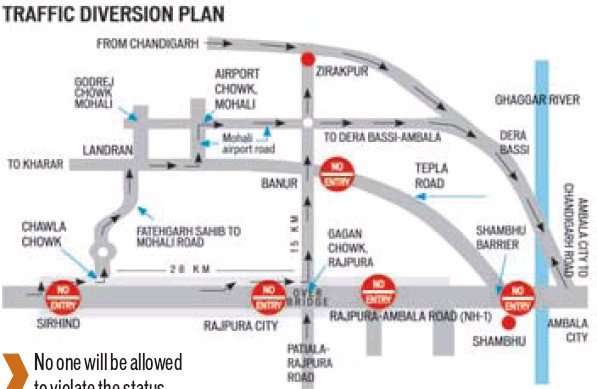
Punjab police deploy 2,000 personnel at Shambhu Barrier

No one will be allowed to violate the status quo order of the Supreme Court come what may. SURESH ARORA, DGP, Punjab

From page 01 Sensing that the political considerations may not allow the Bharatiya Janata Party-led Haryana government to use much force against opposition party Indian National Lok Dal (INLD) that has given a call to dig Sutlej-Yamuna Link (SYL) Canal, the Punjab government has fortified Shambhu Barrier, the entry point of Punjab from the neighbouring state, to ensure status quo on the issue.

getimage


The government has barricaded roads, brick-walled bridges and deployed around 2,000 security personnel in the area. Drone cameras will be used to keep an eye on the movement of INLD workers on the Haryana side on Thursday, the day they are assembling at the Ambala Vegetable Market, 2km from the Shambu Barrier.

As Punjab and Haryana police are gearing up to avoid a face-off between the two states, the ministry of home affairs, too, is keeping tabs on the situation. Both state governments have demanded central reserved forces, 20 battalions by Punjab and five by Haryana.

Authorities in Punjab apprehend that Haryana government may not use force against the INLD as the action may have negative political repercussions, considering the sensitivity of the issue. Punjab DGP Suresh Arora is personally monitoring the security arrangements at Shambu Barrier, the entry point of Punjab from Haryana , including aerial surveillance. “The status quo order of the Supreme Court on SYL will be maintained at all costs,” said Arora.

“I don’t want to comment on hypothetical questions, but let me make it clear that all possible measures has been taken, forces are ready to tackle any situation,” he said, when asked the number of people he was expecting at the site.

The DGP reviewed the arrangements and issued instructions to strengthen the barricading.

More than 5,000 policemen have been asked to reach Patiala and central reserve force will arrive on Thursday. He also held a series of meetings with police officers from Haryana and both sides agreed to work in tandem. Flanked by DGP (law and order) Hardeep Dhillon, Arora briefed the cops at Shambu Sarai, where a temporary control room has been set up.

Dhillon will keep tabs on situation and Patiala IG B Chander Shekhar will lead the force on Thursday.

A mock drill will be conducted on Wednesday. SSPs of Patiala, Sangrur, Barnala, Fatehgarh Sahib, Ropar; DIG (Patiala), DIG (Ropar) and several commandants of various police battalions have been called to Patiala. The central security forces will be deputed as the first line of defence, along with the Punjab Police. Sangrur SSP has been ordered to stop the All India Sikh Students Federation march at Sanaur, where they are going to assemble.

HARYANA POLICE ON TOES IN AMBALA

CHANDIGARH/AMBALA: With leaders of the main opposition party Indian National Lok Dal (INLD) further mobilising its workers from across the state to reach Ambala on Thursday to march towards Ismailpur village on Punjab border to dig the Satluj-Yamuna Link (SYL) canal, Haryana Police have made elaborate security arrangements to prevent any disruption to law and order in Ambala city as well as on National Highway-1.

Ambala superintendent of police Abhishek Jorwal told HT that at least four additional companies (having about 400 personnel) of Haryana Police have been brought from Kaithal, Kurukshetra, Karnal and Panipat to beef up security in the area.

He said traffic diversions have also been announced in the city to prevent any chaos on the rwo-kilometre stretch from Ambala to Shambhu barrier, which is the HaryanaPunjab border on the NH-1.

Earlier, INLD president Ashok Arora and senior leader Rampal Majra met Ambala deputy commissioner Prabhjot Singh, and took permission for using the vegetable market grounds for the assembly of party workers.

clip


BRO chief visits Project Sampark Inspects roads, bridges under construction

Jammu, February 21

Lieutenant General SK Shrivastava, Director General Border Roads (DGBR), visited the Project Sampark from February 19 to 21 and inspected the Reasi-Arnas-Mahore and Budhal-Mahore-Gul roads and bridges under construction.During the visit, the DGBR emphasised on the judicious use of resources and timely completion of works while maintaining the quality as per the norms and standards laid down.Giving details, PRO, Defence, informed that the DGBR critically examined the grey areas and extended his full support towards providing additional requirements for overcoming the challenges. He gave timelines for the completion of the projects and encouraged and motivated the staff on ground to live up to the glory and reputation of the department.The DGBR conveyed that there was an urgent need to upgrade and adopt better technology and materials in the works undertaken by the Border Roads Organisation (BRO) so as to keep pace with modernisation and to save time and speed up the progress. He also impressed upon on the Chief Engineer of Project Sampark to insist upon the field executives to carry out the tests as mandated, using field trial evaluations.Meanwhile during his visit, he met Chief Minister Mehbooba Mufti, Northern Command chief and Commander of the 16 Corps. During the meetings, he discussed the security concerns and issues pertaining to the BRO particularly the impediments and hurdles in the progress of work and sought their assistance in overcoming them. — TNS


Cong acts defensive as Karra calls Army Chief’s remarks ‘politically motivated’

Cong acts defensive as Karra calls Army Chief’s remarks ‘politically motivated’
Tariq Hameed Karra, former PDP leader

Tribune News Service

New Delhi, February 18

The Congress found itself on the defensive today after new entrant to the party and former PDP leader Tariq Hameed Karra called Army Chief Bipin Rawat’s remarks on the stone-throwing youth of Jammu and Kashmir “political”.“As far as the Army Chief’s statement is concerned, I feel it is a politically motivated statement. It is very unfortunate that a force like the Army, deputed to protect the nation’s sovereignty, is politicised,” said Karra, after formally joining the Congress in the presence of party vice-president Rahul Gandhi, who said he was happy to have someone of Karra’s stature on board in the state.Karra, elected MP from Srinagar in 2014, had resigned from the Lok Sabha and PDP in mid- September last year over the “PDP-BJP alliance’s mishandling of the Kashmir unrest”.The Congress today distanced itself from Karra’s remarks which party general secretary (Jammu and Kashmir) Ambika Soni sought to “correct”.“Don’t go into whether a comma was placed here or there. What Mr Karra meant was that the ruling party has politicised the statement of the Army Chief and the Congress condemns such politicisation. The Congress has always stood against terrorism. What he (Karra) said was the Army Chief’s statement is being given a political colour by Union minister Jitendra Singh. It’s the BJP which is politicising the Army,” Soni said when asked if the Congress ascribed to the views of Karra, a founder member of the PDP who fell out with the party after it allied with the BJP in Jammu and Kashmir.To a query on what the Congress thought of the Army Chief’s remarks that stone-throwing youth who help terrorists escape would be treated as anti-nationals, Soni said, “We have always stood for zero tolerance for terrorism. The Congress stands with the Army. They are the best suited to handle the situation.”Karra for his part slammed Prime Minister Narendra Modi for “politicising the Army” and called him a “small man occupying a big chair”.“He (Narendra Modi) is not a prime ministerial material. He is a small man sitting in a big chair,” said Karra, who had defeated National Conference patron Farooq Abdullah in Srinagar in the 2014 parliamentary polls.Earlier today, Karra met Congress president Sonia Gandhi and Rahul Gandhi before being formally inducted into the party. Present at the event were Congress JK chief Ghulam Mir and party legislature leader Rigzin Jora.Addressing reporters, Karra said the PDP was founded in 1999 on the principles of fighting fascist forces and his conscience did not allow him to work with the PDP when it allied with those very forces. He said he resigned after the alliance “maimed the people in J&K, mishandled the unrest and jailed and blinded people.”


General’s remarks will increase hostility: NC Separatist leaders too flay the statement

General’s remarks will increase hostility: NC
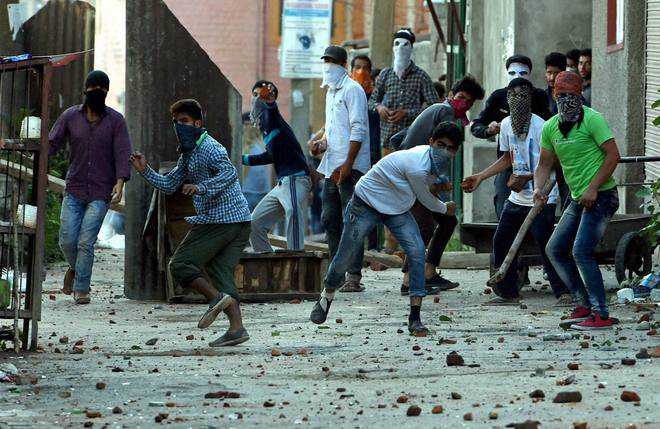
Protesters throw stones at security forces in Srinagar. File photo

Tribune News Service

Srinagar, February 16

Mainstream political parties and separatist organisations have strongly reacted to the remarks of Army Chief Gen Bipin Rawat that “tough action” would be taken against the people supporting militants and creating hurdles in operations of the security forces.Expressing disappointment over the remarks, the National Conference said such posturing would compound the situation and increase hostility in the Valley. “It is tragic that New Delhi is trying to talk to the youth of Kashmir through the defence establishment when there is a need to engage them politically,” a spokesman of the NC said.“Youth rushing towards encounter sites and incidents of stone-throwing on the forces during encounters are worrying and alarming signs of the sense of alienation and disenchantment in Kashmir,” he added.In a statement, the hardline APHC Chairman, Syed Ali Geelani, termed it as an “apparent threat to carry out a killing spree of civilians”, which had become a practice over the past seven decades. He said the Centre’s “arrogance and stale thinking” was the basic reason for continuous bloodshed and political uncertainty in the state. He said during the situations arising in encounters people “exhibit their extreme valour and without any fear even face tough and dangerous situations.” The separatist leader that instead of taking this development serious, “they (government) are beating about the same bush” and suppress people at the barrel of gun.The moderate APHC chairman, Mirwaiz Umar Farooq, said the threat issued by General Rawat to the people of Kashmir “is unfortunate and reflects a tyrannical mindset towards the people of Kashmir.” He said the Army Chief “needs to ask the executive as to why is the institution of the Army being used to crush a mass political movement and why do people at the obvious risk to their lives gather?”JKLF chairman Yasin Malik said threatening the protesters was a case of “political immaturity,” which amounted to a direct threat to the people of Kashmir. Malik termed the Army Chief’s statement as an open invitation to many to take up arms. “This statement may add to the miseries of Kashmiris but it will also push many youth to the wall and drive them towards armed struggle hence promote violence in the region,” Malik added.

Army Chief spoke in national interest: Rijiju

  • New Delhi: Union Minister Kiren Rijiju on Thursday endorsed Army Chief Bipin Rawat’s statement on tough action against those creating hurdles during anti-terror operations in Kashmir, saying the country’s interest was supreme. “There should be action against the stone-throwers and whoever works against national interest,” he added. “Whatever the Army Chief said, it is in national interest. There is no need to misinterpret it. There is nothing wrong in the statement,” he said. Asked about the prevailing security situation in J&K, Rijiju said he would not like to comment on the routine law and order matters. — PT

Govt advises locals to stay away from encounter sites

Srinagar, February 16

The government has advised the public to stay away from the counter-insurgency operation sites for their own safety and ordered that prohibitory restrictions would be imposed within a radius of three kilometres from the site of any such operations.The district administrations of Srinagar, Budgam and Shopian advised people not to move towards or assemble near the places where encounters take place between security forces and militants to avoid loss and injuries to precious human lives.Further, prohibitory restrictions have been imposed within the radius of three kilometres from the site of any counter-insurgency operation in these districts, an official spokesman said.However, these curbs would not apply to the movement of ambulances, medical & paramedical staff, and government employees

Militants again strike at Valley bank

Suhail A Shah

Anantnag, February 16

Militants today looted Rs 3.20 lakh from J&K Bank’s Turk-e-Wangam branch in Shopian district of south Kashmir. This was the fourth such robbery in less than three months in the Kashmir valley.The gunmen, believed to be three or four in number, fired several shots in the air before forcing their entry into the Turk-e-Wangam branch of the bank.“The gunmen barged into the bank and looted around Rs 3.20 lakh,” said Shopian Superintendent of Police Tahir Saleem. He said the gunmen were militants.After the police reached the bank soon after the incident, they had to beat a hasty retreat due to violent protests of local youths. The youths alleged that the robberies were being staged by security forces to malign militants.However, the police said the protest took place to provide the militants time to flee.Today’s robbery was the fourth such incident in less than three months. The other three robberies took place at J&K Bank branches in Pulwama and Budgam districts in November and December last year.After a robbery in the Ratnipora area of Pulwama on December 15, the police had claimed that Lashkar-e-Toiba militants were caught on CCTV cameras of the bank, establishing that militants were behind the robberies.The police had cited demonetisation as a possible reason for the robberies. Soon after, the LeT had issued a statement distancing itself from the robberies.

Four robberies after demonetisation

  • November 21, 2016: Gunmen attack J&K Bank’s branch in the Arihal area of south Kashmir’s Pulwama district, loot Rs 13 lakh
  • December 8, 2016: Gunmen loot Rs 13.38 lakh from the J&K Bank branch in the Charar-e-Sharief area of central Kashmir’s Budgam district
  • December 15, 2016: Militants barge into the Ratnipora branch of J&K Bank in Pulwama district of south Kashmir, take away Rs 9.84 lakh
  • February 16, 2017: Rs 3.20 looted from the J&K Bank branch in Turk-e-Wangam of Shopian district insouth Kashmir

Soldier commits suicide in J&K’s Samba town

AMMU: A soldier committed suicide by shooting himself with his service weapon in the garrison town of Samba on the Jammu-Pathankot national highway on Thursday. He was identified as Havildar Kishan Singh Rathore of 24 Grenadiers, a native of Chapra village in Nagpur district of Rajasthan. “Havildar Kishan Singh Rathore shot himself in the neck with his INSAS rifle at Maheshwar, which has Samba Brigade. He died on the spot,” said a police officer.