Sanjha Morcha

What’s New

Click the heading to open detailed news

Current Events :

web counter

Print Media Reproduced Defence Related News

Where Pakistan stands G Parthasarathy International censure and internal instability have left it out in the cold

Where Pakistan stands
Endgame? The Pakistan army chief is determined to see Nawaz Sharif’s ouster.

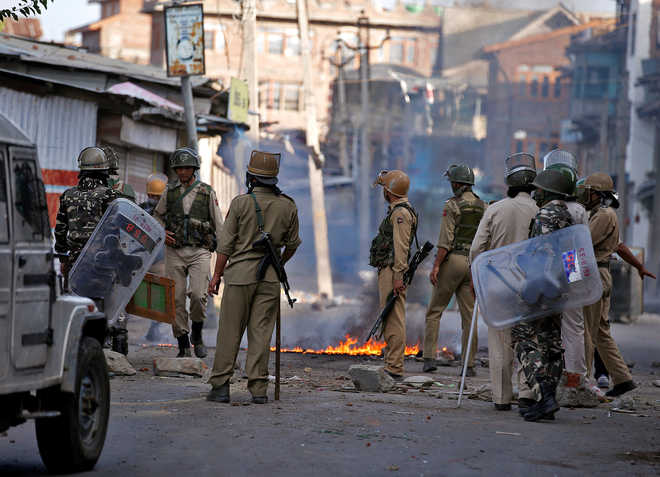
FOLLOWING the visit of Home Minister Rajnath Singh to Islamabad, the time has come for a dispassionate analysis of where we stand, as we prepare for a scheduled visit by Prime Minister Narendra Modi to Islamabad in November, for the SAARC Summit. We need to understand the dynamics of internal developments in Pakistan and its foreign policy imperatives. I had occasion to meet well-informed Pakistani politicians, former diplomats, academics and retired generals in recent days. Pakistan is going through difficult political times. It is being shunned and distrusted by the US and its Western allies; regarded as an untrustworthy country by Gulf Arabs and Iranians alike; and reviled by neighbours Bangladesh, Afghanistan and India for sponsoring terrorism. Its sole “friends” appear to be China and Turkey, which is just recovering from a coup. Pakistan is finding scant international support for its territorial claims in J&K. It is facing a hostile reaction from Afghanistan for its efforts to fence the Durand Line, which no Afghan and many Pakistani Pashtuns do not recognise as international border. There have been escalating tensions and clashes along the Pak-Afghan border, as Pakistan tries to regulate cross-border movement by constructing a gate at the Torkham border. It is evident that its army chief, Gen Raheel Sharif, who is due to retire on November 30 and evidently looks forward to an extension, loathes PM Nawaz Sharif and seems determined to get him ousted for the involvement of his sons and daughter in the Panama bank accounts scandal. Raheel Sharif, whose uncle and brother were killed in the 1965 and 1971 conflicts, detests India. He has acted independent of the government and parliament in conducting military operations in the Khyber Pakhtunkhwa Province bordering Afghanistan, apart from continuing massacres and illegal abductions in Baluchistan.It is in these circumstances that the killing of terrorist Burhan Wani has led to both the army and Nawaz virtually competing with each other in raising domestic passions by embarking on a propaganda barrage against India. Home Minister Rajnath Singh’s counterpart Chaudhry Nisar Ali Khan, who has his eyes on Nawaz’s job with army backing, was hardly likely to miss the opportunity to appear more hostile than his boss, Nawaz, during the SAARC meeting. Moreover, anti-India rallies were organised by the likes of Hafiz Saeed, across Pakistan’s capital. Mr Rajnath Singh made a blunt presentation about Pakistan’s role as a state sponsor of terrorism and narcotics smuggling. These were, in any case, the main subjects on the agenda. Mr Rajnath Singh was also careful in not violating any SAARC convention. He did not name Pakistan in his speech. Given the present political climate in Pakistan and the ongoing power struggle between Nawaz and Raheel Sharif, Pakistan will continue with this charade, till the situation in the Valley becomes normal. The Americans have already called on Pakistan to end its support to terrorist groups operating from its soil, in India and Afghanistan. British columnist Owen Bennett Jones has tendered similar advice in the highly respected Karachi-based Dawn newspaper. But, underlying all this, I sensed from comments by Pakistani friends that their much-touted Zarb-e-Azb military operations have not only displaced 1.8 million Pashtun tribals from their homes, but some 40,000 tribals have fled into Afghanistan. Many of them are preparing for retribution across the Afghanistan-Pakistan border. There are, predictably, allegations that intelligence agencies of India and Afghanistan are hand in glove in fomenting violence in Pakistan.It is clear that we should be prepared for a continuing propaganda barrage from Pakistan. We, in turn, should prepare for a well-planned diplomatic and political offensive against Pakistani military actions, excesses and rights violations during army operations in Baluchistan, the tribal areas of Pakhtunkhwa and on the hapless Mohajirs of Karachi. The Mohajirs, after all, migrated from India and still have familial and other ties with relatives and friends in India. It also needs to be noted that Pakistan’s annexation of Baluchistan after the Partition was effected by duplicity, deceit and military force. Baluchistan’s ruler, the then Khan of Kalat, refused to accede to Pakistan. His successor also holds that Pakistanis are in illegal occupation of the province. The people of Baluchistan have waged armed struggles against the Pakistan State since 1948. In the most recent and ongoing military conflict since 2003, thousands of Baluch freedom fighters have been killed and an estimated 15,000 people are missing. The army has defied orders of Pakistan’s supreme court to produce those illegally abducted by it. Baluch grievances are not only political, but also driven by exploitation of their natural resources and denial of equitable employment and other opportunities by the ruling Punjabi elite.New Delhi also needs to review its approach to dealing with militancy in the Kashmir valley. While successive governments in Srinagar keep demanding more and more money for projects, especially after floods, there has to be much more accountability on how these funds are spent. While it is good to keep channels of communications open across a wide cross section of society, to convey genuine interest in addressing their grievances, it would be unrealistic to expect anything positive from any high-profile engagement with the Hurriyat. Two Kashmiri Hurriyat leaders went against the wishes of Pakistan and its proxies — Mirwaiz Mohammad Farooq and Abdul Ghani Lone. Pakistan-sponsored terrorists killed both of them.  One doubts if the present Hurriyat leaders will, in these circumstances, show the courage to question what Pakistan orders them. But a carefully calibrated process of engagement with a wide cross section of society in J&K is imperative, with enough political space being given to the Chief Minister to act credibly. Lastly, the security forces need to carefully review their tactics and imaginatively use minimal force necessary to deal with any situation. We are in for a long haul in the Kashmir valley.


clip


Kargil war heroes, veer naris honoured

Kargil war heroes, veer naris honoured
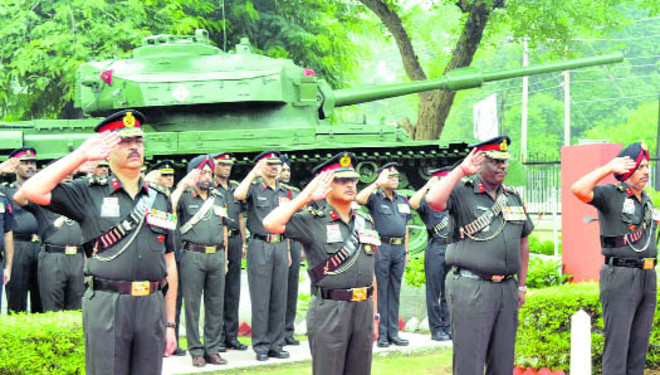
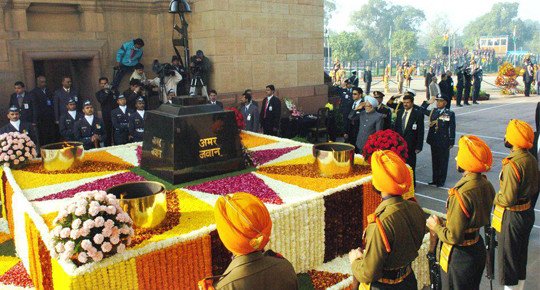
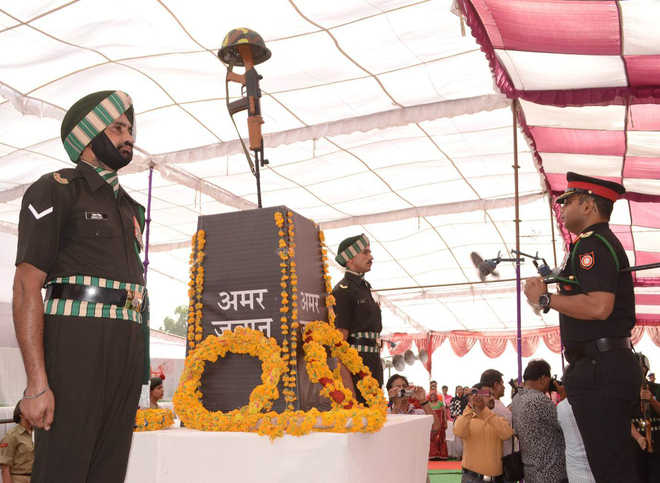
Officers of the Punjab Regiment pay tributes at Amar Jawan Jyoti during Vijay Diwas celebrations at Sriganganagar on Tuesday. A Tribune Photograph

Our Correspondent

Abohar, July 26

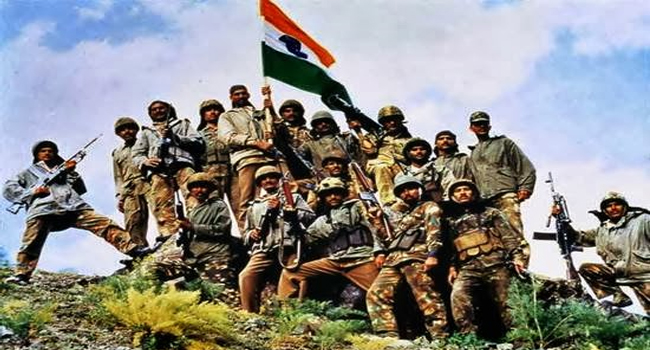
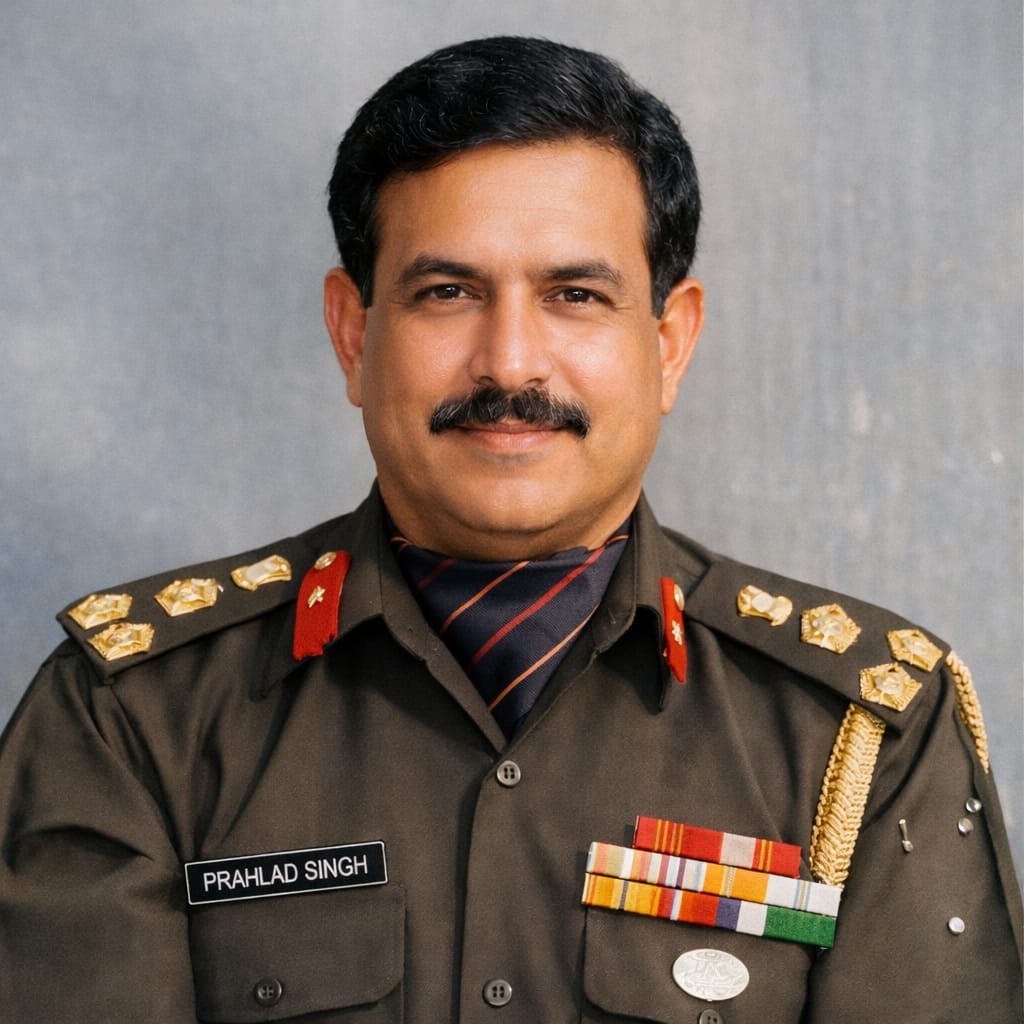
Eight Army soldiers, who had participated in the 1999 Kargil War and 24 veer naris (war widows) were honoured during Vijay Diwas function at Ramlila Ground in neighbouring Sriganganagar today.The function was organised jointly by the All-India Ex-servicemen Council, Sanskar Bharati and the MR Jindal Charitable Trust.Col Amit Kumar Sharma, Commanding Officer, 17 Punjab Regiment, was the first to lay a wreath on Amar Jawan Jyoti ceremonially.MR Jindal Charitable Trust chairman BD Aggarwal and his wife Bimla presented shawl and Rs 21,000 each to ex-servicemen Ashok Kumar, Mohammad Khan, Durga Ram, Prahlad Singh, Rohtash, Ram Niwas and Moman Singh.Ashok Kumar of Haryana was in the contingent which hoisted the Tricolor at Kargil after the Indian Army’s victory over the enemy.Sixteen youths who had got “C” certificate or “A” grade in National Cadets Corps (NCC) were awarded Rs 11,000 each on the occasion.

Kargil Diwas celebrated

Amritsar, July 26

On the occasion of Kargil Vijay Diwas, a wreath-laying ceremony was organised today at Panther Inspiration Park. General Officer Commanding, Panther Division, along with Junior Commissioned Officers (JCOs) and Other Ranks (OR) laid wreaths to pay homage to Kargil martyrs. Veterans from Amritsar also attended the function and laid wreaths to pay homage to the martyrs of Kargil.Similar functions were also organised at Dera Baba Nanak War Memorial and Batala War Memorial. — TNS

Tributes paid to martyrs on Kargil War anniversary
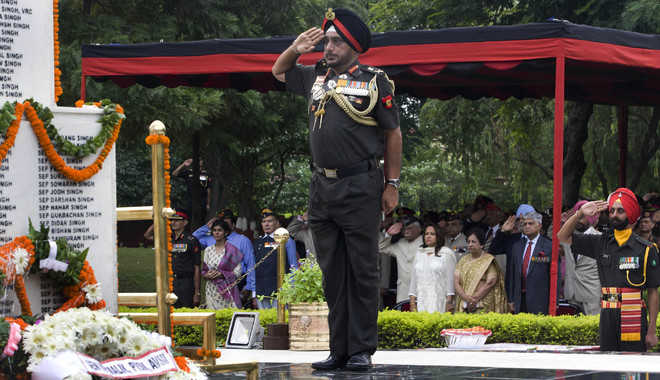
Tributes paid to martyrs on Kargil War anniversary
Lt Gen KJ Singh, GOC-in-C, Western Command, along with other Army officers and veterans, salutes martyrs on the 17th anniversary of Kargil War at Chandimandir on Tuesday. A Tribune photograph

Tribune News Service

Chandigarh, July 26

The 17th anniversary of the Kargil War was observed at Headquarters Western Command, Chandimandir, today. It was on this day in 1999 that the last of the Pakistani infiltrators were evicted from the Indian territory.To pay homage to the martyrs, a wreath-laying ceremony was held at the Veer Smriti War Memorial in Chandimandir.Lt Gen KJ Singh, General Officer Commanding-in-Chief, Western Command, paid floral tributes at the memorial. Serving officers and junior commissioned officers of some of the units that had participated in the conflict, also known as Operation Vijay, were also present.General VP Malik, who was the Army Chief during the conflict, led senior veterans in paying homage and also laid a wreath to commemorate the sacrifices of soldiers.The next of kin of martyrs of Operation Vijay and gallantry award winners also attended the function and were felicitated on the occasion.

Homage paid to Kargil War martyrs

Tribune News Service

Patiala, July 26

The nation is celebrating the 17th Kargil Vijay Diwas to commemorate the victory over Pakistan in the war that ended  on July 26, 1999. The Indian Army was successful in pushing back Pakistani forces from 16,000-18,000 ft of rough heights in Kargil and the adjoining areas.The week-long celebrations got over on July 26 and were marked by commemorative functions across the country.Kargil Vijay Diwas is a day of remembrance for, and tribute to, our armed forces and the martyrs whose determined efforts saved our country from the enemy on this day in 1999 during the ‘Operation Vijay’.In Patiala, the Army commemorated the victory in a solemn wreath-laying ceremony at the Cenotaph led by the General Officer Commanding of the Black Elephant Division and also paid homage to the Kargil war martyrs.Intrusion from Pakistani forces in the areas of Kargil and Dras was aimed at taking control of heights dominating the Srinagar-Leh road with the aim of blocking our supply lines and making the maintenance of our positions in Siachen even more difficult. Our soldiers regained the heights by climbing near the vertical rough peaks over totally exposed rocky terrain against forces firing and bombarding from well-prepared and entrenched positions.Stories of leadership and sacrifice brave soldiers were also documented to pay homage to them. A total of 527 Armymen from the country died and 1,367 got injured in the war.Four Param Vir Chakras, Nine Maha Vir Chakras and 50 Vir chakras, battle honours and unit citations will serve as evidences of guts, bravery and professionalism of our Navy, Air force and Armymen who are ever ready to serve and make sacrifices to protect our motherland.

Kargil Vijay Diwas

  • Kargil Vijay Diwas is a day of remembrance for, and tribute to, our armed forces and the martyrs whose determined efforts saved our country from the enemy on this day in 1999 during the ‘Operation Vijay’.

FROM SCHOOLS

Kargil Vijay Diwas

Patiala: DAV Patiala witnessed patriotic fervour as 16th anniversary of Kargil Vijay Diwas (Kargil Victory Day) was celebrated with amalgamated feelings of proud and pain. The martyrs of Kargil were offered floral tributes amidst singing of song ‘Ae Mere Watan Ke Logon’ and raising of slogans ‘Bharat Mata ki Jai’ leaving everyone teary-eyed. A special hawan was solemnised in the memory of the martyrs. A special screening of a documentary was arranged for 250 students of class VI followed by a quiz based on the same. The students participated enthusiastically in the quiz. Monika Gupta, NCC in-charge, made the students aware of the significance of the day and told them how the soldiers braving the chill at Kargil-Dras sector defeated Pakistani intruders and hoisted our National Flag. She said as many as 530 soldiers laid their lives in the operation. Principal SR Prabhakar said: “Kargil Victory Day was something really to celebrate in honour of those brave soldiers and their families, who sacrificed their lives or a life of their loved ones for India. We must thank those brave people who lost their lives for saving and protecting us and should be ready for any kind of sacrifice for our country”.

Q-biz Competition

Budha Dal Public School here organised a Q-biz competition for the students of classes XI and XII. The basic vision of Q-biz was to test the cognisance skills of the students. It aspires to engage all those students who believe in applied and holistic learning to identify all those mavericks, who consistently learn, innovate and improvise.

Tiger Week

‘Tiger Week’ was inaugurated at The Millennium School, Patiala, in view of the observation of ‘World Tiger Day’ on Monday. With the main aim of bringing awareness among the people about saving wild animals, especially the tiger, a nukkad natak was presented. Students and teachers of the school took part in a rally to highlight the importance of saving the animals from extinction. Sukhdarshan Singh, director, Markfed, gave the green signal and appreciated the endeavour of the school. Sally Andotra, principal of The Millennium School, Patiala, thanked the guests and conveyed her distress at the decreasing number of tigers and how it will affect our environment. She impressed upon all to contribute individually in doing so. She said the school would conduct various activities such as poster-making, debate etc, throughout the week. At the end, she highlighted that the school keeps observing such activities for the all-round development of students. — TNS

Kargil Vijay Diwas celebrated in city
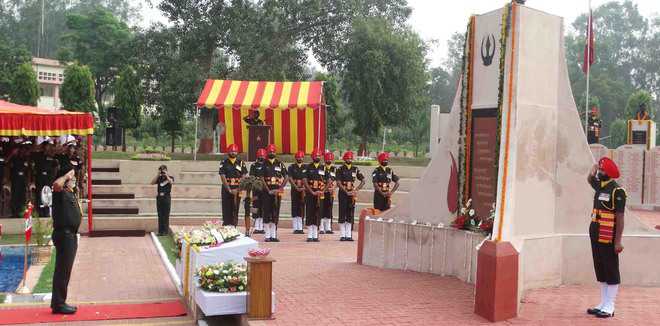
Kargil Vijay Diwas celebrated in city
Vajra Corps pays tributes to the Kargil martyrs in Jalandhar on Tuesday. A Tribune Photograph

Tribune News Service

Jalandhar, July 26

A special function was organised by the Kashyap Naujwan Dharmik Sabha where families of martyrs of the Kargil war and martyrs of other Army operations were honoured here today.Deputy Commissioner KK Yadav was the guest of honour at the function.Pawan Kumar, president of the Sabha, said they had been organising this function for the past 16 years to salute the great soldiers who sacrificed their lives for the nation. Over 20 families belonging to Punjab and Himachal Pradesh of martyrs of the Kargil war and other operations took part in the function in honour of the war heroes.Several speakers said such functions should also be organised at the government level also. They also said that many memorials of martyrs in the region were lying in a shambles and the district administration was not paying heed to their upkeep. On this, DC KK Yadav assured the gathering to hold a meeting with the organisers of this function and promised that enough would be done to keep the memorials in a good shape.Vajra Corps remembers its braveheartsOn the occasion of the 17th anniversary of the Kargil war, Lieutenant General JS Cheema, General Officer Commanding Vajra Corps, offered floral tributes to Kargil martyrs at a solemn ceremony at the Vajra War Memorial in Jalandhar Cantonment. This was followed by a pledge taken by all present at the ceremony to dedicate themselves to the cause of the nation. A large number of veterans also attended the event and paid tributes to the martyrs.Kargil Vijay Diwas is celebrated in honour of the Kargil War heroes for the success of Operation Vijay. On this day, July 26 1999, the Indian Army successfully took command of the high outposts which had been illegally occupied by the Pakistani intruders. 527 soldiers from the Indian Armed Forces laid down their lives for the cause of the motherland during the war. The event is celebrated with full military decorum and solemnity.

Remembering the heroes

Kargil Vijay Diwas is celebrated in honour of the Kargil War heroes for the success of Operation Vijay. On this day, July 26 1999, the Indian Army successfully took command of the high outposts which had been illegally occupied by the Pakistani intruders. 527 soldiers from the Indian Armed Forces laid down their lives for the cause of the motherland during the war. The event is celebrated with full military decorum and solemnity.

42 martyrs and the flame is still bright!

Rachna Khaira

Tribune News Service

Jalandhar, July 26

Forty two personnel of Jalandhar district from the military and paramilitary forces have sacrificed their lives in four operations launched in various parts of the country since Independence.With 11 officers, one junior commissioned officer, eight from various paramilitary forces and remaining from other ranks of the Indian Army, a majority of these bravehearts sacrificed their lives in Operation Rakshak.While 27 personnel were killed in Operation Rakshak that commenced on November 15 in 1989 and is going on till date in Jammu and Kashmir and Punjab, three were killed in Operation Rhino that is going on in the entire state of Assam since September 15, 1991. Three more causalities were reported in the district in Operation Meghdoot that is going on in the Siachen area since April 1, 1984. While three more were killed in Operation Parakaram that ran in the entire country from December 14, 2001, to March 31 in 2004.While four Jawans were killed in various encounters with terrorists in J&K areas, one was killed in a counter insurgency operation in Jammu and Kashmir and another one was killed in an IED blast on a BSF bus in 2004.While the whole nation remembered its martyrs of the Kargil war, the families of these bravehearts, too, shed tears in solace to remember their sons who laid down their lives while safeguarding the nation.While remembering his son Major Kanwal Gulzar Singh of 5/9 GR who died during Operation Rakshak in 1999, his emotional mother Simar Kaur said he was known as ‘Yudhister’ (the eldest of Pandava brother) amongst his unit officers for his upright, caring and sombre nature.“He used to stand by the truth all the time. He always used to tell me that I should not get worried about him. Even though he called me a few hours before going out on the fateful operation on the night of July 4, he did not reveal anything,” said Kaur. She further added that he was very fond of reading and had a huge collection of books. The mother has preserved his books as her priced possession.Speaking to Jalandhar Tribune, Sukhwinder Kaur, sister of martyr Sepoy Sodhi Ram, burst into tears and said that since the death of her brother Sodhi Ram during Operation Rakshak in 2004, she along with her younger sister, was staying with her old parents. “There is no one to take care of our parents. Our in-laws started beating us after his death for various reasons. I, along with my sister, left their houses and began staying with our parents only,” said Kaur. Sodhi Ram was killed in a terrorist action in 2004 in J&K.Sukhwinder further said that there should be a provision in the army also to provide jobs to the next of kin or a family member of other ranks as well.Sonu, son of martyr L/NK Tirath Ram of 53 Battalion of the BSF, said that though there were reports that his father was killed in a terrorist encounter in the Sambha sector, the family was informed that he lost balance and accidentally fell from a bunker.“Though we demanded a martyr’s status for our father from the BSF, they refused to do so and only recorded it as an accident,” said Sonu.

Students pay homage to Kargil War martyrs

Tribune Reporters

Ludhiana, July 26

In today’s busy world when people have become too materialistic and have no time even for near and dear ones, there are brave soldiers on the borders who safeguard the country. Hundreds of soldiers have sacrificed their lives to ensure a secure environment for the countrymen.To remember and honour such soldiers, many schools in the city paid a floral tribute to the martyrs in commemoration of Kargil Vijay Diwas. To instill patriotism among the youth, the schools held various competitions and activities depicting patriotic feelings.

Shamrock School

A special assembly was conducted at Shamrock Christian Senior Secondary School, Hambran Road, wherein the students sang patriotic songs in remembrance of war heroes. A two-minute silence was marked as a respect to the departed souls. An inter-house speech competition was also held.

BVM, Kitchlu Nagar

A patriotic song competition was held at Bhartiya Vidya Mandir Senior Secondary School, Kitchlu Nagar, in commemoration of the day. The staff and students paid homage to the brave soldiers. The students pledged to serve the nation in their best capacity. A documentary on Kargil War was also shown.

BVM, Udham Singh Nagar

A special assembly was held, wherein Sheetal Sharma, a school teacher, gave a speech in praise of Kargil soldiers. A patriotic song was presented by Raghu Gulati of Class XII. A documentary film was shown to the students.

Green Land School

NCC cadets of Green Land Senior Secondary Public School paid homage to the martyrs of Kargil War. An inter-house declamation contest was also organised.

The Unirise World School

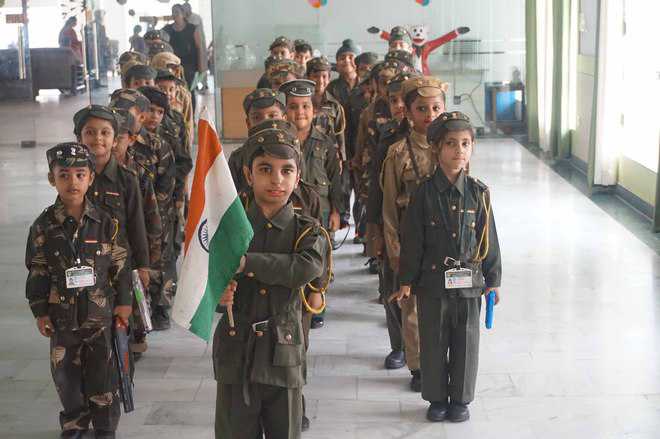
Jagraon: A special assembly was organised on the campus of The Unirise World School and a cultural programme was held, wherein students of classes III and VI presented patriotic poems. Assembly in-Students put up badges depicting the National Flag on their shirts.

Erdogan’s grandiose plans by S Nihal Singh ::::Exploiting Turkey’s failed coup

Erdogan’s grandiose plans
Powered up: Erdogan is unapologetic about his overreaching ambitions.

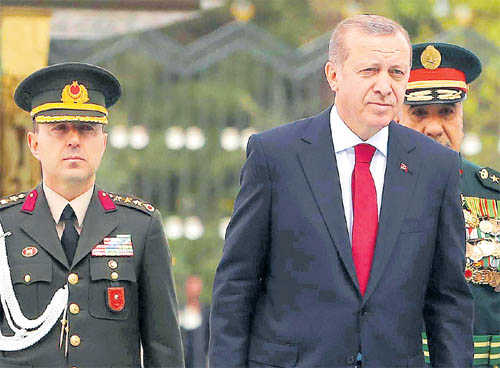
THANKS to Turkey’s key position in a turbulent region and help to stem the flow of refugees to Europe for a price, the world’s capitals are responding cautiously to President Recep Tayip Erdogan’s moves to detain thousands and propose giving himself all powers over the military and civilian fields. He has publicly declared that it is an opportunity given by God and he is exploiting it to the hilt.The coup of July 15 initiated by a section of the armed forces, which fizzled out quickly with political parties and the public condemning it, has culminated in a wholesale cleansing of the armed forces, including many generals and admirals, and the civilian and judicial power structures. The state’s enemies now are the Gulenists, followers of Fetullah Gulen, a self-exiled cleric living in America being charged with instigating the coup. Here we must explain the peculiarities of the Turkish legacy. Ataturk, the builder of modern Turkey on the ruins of the Ottoman Empire, left a transformed country, abolishing the symbols of religious beliefs and practices to the extent of changing the written script to Roman characters. But he left behind a tradition of the army assuming state power and Turkish history is littered with a succession of coups carried out in recent times by the armed forces underlining the military being the main power centre. Mr Erdogan entered the political arena as a religion-flaunting mayor of Istanbul. He was imprisoned briefly for flaunting his religious card. But he and his colleagues were mining the religious constituency for his Justice and Development Party (AKP) and as his party’s fortunes progressed, he sought the help of Gulen and his “service” movement to create conditions in which the military could no longer pose a threat to the civilian dispensation. In his earlier avatar as prime minister, Mr Erdogan had presented himself as a moderniser making determined moves to seek membership of the EU and undertook legislative measures to comply with its norms and started negotiations with the militant Kurdish party, the PKK, to try to end the longstanding insurgency. There was resistance in the EU (the European Economic Community as it then was) to absorbing millions of Muslims into the community. It is still not clear what made Mr Erdogan change direction. But the demands of his main community, the upworldly mobile religiously-observant new middle class in Anatolia, were very different. Even as the Gulenists helped Mr Erdogan in making the country safe from coups, it came at the cost of Gulenists becoming a force by infiltrating the ranks of the armed forces and the civil and judicial services. The marriage between the AKP and the Gulenists lasted till Mr Gulen discovered that Mr Erdogan had his own agenda of assuming total power. He had sought exile in the US earlier. In 2013, Gulenists named senior members of the Turkish cabinet and Erdogan’s family members in serious corruption charges. The war between the two sides was on, with Ankara now demanding Mr Gulen’s extradition from the US.  Mr Erdogan’s own ambitions grew exponentially. After being elected and re-elected prime minister, he declared his intention to change the constitution to convert the system into an executive presidency. While in search of a two-thirds majority in Parliament, despite relatively poor showing in two elections, he resigned to run for presidency through an election he won. Although Mr Erdogan has still to secure a constitutional amendment, he runs the country in practice having appointed a more pliant prime minister. The present situation is full of ironies. His hero Ataturk pulled the country out of its fall by confining religious practices to the dustbin. By contrast, Mr Erdogan is seeking to re-emphasise religion, giving primacy to headscarves for women and observing other Muslim conventions to please his main domestic constituency and remain in power. Yet Turkey remains a key player in the Middle East because of its location, its military strength and the state of other countries in the region. Until recently, it was the main conduit for an army of jihadists fighting in the Syrian civil war. Its stricter control of borders came after American and Western pleading, as was its belated decision to let the US and allied aircraft use the Incirlik air base for bombing IS targets. A number of bombing incidents in Turkey are believed to be expressions of IS anger over Ankara’s policy change. Turkey has resumed its war with the Kurdish PKK in the south-east of the country in particular. The picture is further complicated by the Syrian Kurds being the best ground fighters in the American effort to get the better of the IS. And Russian intervention in the Syrian civil war through supporting the Assad regime mainly by air power gives a further loop to something of an East-West struggle.The most serious consequence of recent developments in Turkey is that a country that was supposed to be a stabiliser in a maddeningly disturbed area has itself become a cause for concern as Mr Erdogan seeks total supremacy over all his combined political foes. His goal is nothing short of constructing a new Ottoman dispensation even as he subverts the essence of the Ataturk revolution.Turkey is hosting millions of Syrian refugees, as are its neighbours. Americans’, and the world’s, attempts to end the Syrian civil war have stumbled, with Russia now a new party to be consulted, as the US realises, despite the Obama administration’s antipathy to Moscow. How Ankara can help this process remains doubtful, apart from Mr Erdogan’s efforts to unseat Syrian President Bashar al-Assad. Clearly, the Turkish ruler’s attention will be devoted in a greater measure to his domestic problems.America’s contest with the IS will continue, with bombing runs now extended to Libya with its different armed centres of power fighting the recognised coalition. The Obama administration is leaving it to the next President to frame a new policy for the Middle East and the world.


Army truck falls into deep gorge near Mana village, 2 jawans dead

Tribune News Service

Mussoorie, July23

Two Army jawans were killed while one was injured and another missing when the Army truck they were returning from Ghastoli fell into a deep gorge near Mana village near the China border in Chamoli district today. The accident took place after the driver of the truck lost control over it and it fell in a deep gorge.The services of a helicopter was called for but was not available due to an inclement weather. However, a Border Roads Organisation (BRO) team working tirelessly was able to open the road near Badrinath so that injured could be brought to a hospital in Joshimath.Meanwhile, a search was on for the missing jawan. Chamoli SP Priti Priyadarshini said the truck was returning from Ghastoli towards Mana village in Chamoli district when it met with the accident.She said the Chamoli District Magistrate had directed use of a helicopter to rescue the injured and rush him to hospital but the helicopter did not reach there due to the inclement weather.Meanwhile, the BRO team is working to open the road at Lambagad and only after that the injured would be taken to hospital, said the SP.Two killed in road accidentDehradun: Two persons were killed while three seriously injured when the utility vehicle they were travelling in fell into a deep gorge here yesterday. The injured were admitted to a hospital.The accident occurred when the driver of the utility vehicle was trying to avoid boulders, rolling down from a mountain top on the Kalsi-Chakrata road. Villagers called the police and with the help of villagers, they rescued and admitted them to the hospital.The deceased have been identified as Bagiram and Tara Dutt. The injured passengers have been identified as Surat Ram, Rameshwar Dimri and driver of the utility vehicle Ravi Kumar. The bodies have been sent for autopsy.


A career to look back at with pride

Lieutenant General KJ Singh retires on Sunday, July 31 as Western Army Commander after a distinguished career spanning four decades. Commissioned in 1977 in 63 Cavalry, he established a bond with the men he commanded; a professional’s hallmark. He did the staff course with the Navy in an experiment in jointmanship. Valuable lessons were learnt by him in a stint with the UN mission in Angola. Command of an armoured regiment, brigade and division followed while commanding XXXIII Corps tasked with the defence of Sikkim and Bhutan brought him the greatest satisfaction as a tankman. Additional armoured and mechanised units were inducted bringing about a change in the nature of operations. The previous defensive mindset prevailing until then was changed. Now any intruding enemy armour or infantry was to be decimated in killing areas.

PHOTO: HQ WESTERN COMMANDLt Gen KJ Singh inspecting weapons and equipment recovered after the Pathankot airbase attack. During his tenure, the effort of the troops was to check infiltration by terrorists as far forward as possible.

The achievements continued in his last posting at Chandimandir. Orientation of operational plans for the Ravi-Chenab corridor was changed.

An aggressive, layered defence against infiltration and terrorist movements in the Jammu region brought results in the Arnia, Samba and other encounters. Vigilant citizens were enlisted into the Jagruk Hindustani scheme, a grassroots information system. Other innovations included overcoming the shortage of officers by introducing JCO-led mobilisation for war. Developing the DharUdhampur road as an alternate to the vulnerable Pathankot-Jammu highway was a strategic initiative. Setting up of the think tank Gyan Chakra and the command museum displayed KJ Singh’s vision and drive in full measure.

The achieving zeal was also displayed in welfare measures for ex-servicemen including the senior veterans’ home, additions to the Ex-Servicemen Contributory Health Scheme (ECHS) and a host of other administrative initiatives.

As the general rides off into the sunset today in the tank he commanded as a subaltern (he’s actually doing it in his old regiment), he can certainly look back with satisfaction at having served his country well.

NAVAL COASTAL SURVEILLANCE OPERATIONS

A naval detachment (NavDet in Service parlance) has taken up guard at Androth Island in Lakshadweep. Another NavDet will soon be operational on Bitra in the same island group.

These NavDets are small details consisting of 2-3 officers and 25-30 ratings tasked with maintaining surveillance initially establishing a presence in far-flung territories building up to full-fledged bases. The NavDets will maintain surveillance to frustrate moves by terrorists, arms smugglers and pirates. For this purpose they will employ coastal radars networked to the BEL-developed Coastal Surveillance System.

The system can watch over the complete Indian coastline from a consolidated focal point. For local operations, the NavDets will be equipped with Gemini rigidinflatable boats and Solas Marine fast interceptor craft (FICs). The general nautical and coastal security scheme envisages a networked surveillance system with a chain of radar stations and small and large naval forces working in conjunction to deny our space to any hostile elements.

NORTHERN COMMAND TAKES TO TWITTER

Northern Command with it’s active involvement in counterinsurgency and cross-LOC operations not to speak of engaging with the Chinese interacts with the media on a daily, even hourly basis. The need to be in sync with the new communication super-highway is imperative.

Therefore, it was in the fitness of things that the formation’s media team now operates a Twitter handle (NorthernComd_IA) for regular updates on operations, encounters, military news and most importantly to squelch rumours and counter disinformation. Good luck to the Dhruvas!


Mishaps not new for IAF with Russian-origin AN-32

NEW DELHI: Reliable workhorse — that’s how experts describe Antonov-32, the military aircraft that went missing over the Bay of Bengal on Friday.

COURTESY: IAFThe Antonov-32 is a Russian-origin aircraft that has been in service with the Indian Air Force since 1984. About 250 AN-32s are in service around the world.

The Antonov-32 is a Russianorigin aircraft that has been in service with the Indian Air Force since 1984.

Its design is based on the older AN-26, which first flew in 1969. About 250 AN-32s are in service around the world.

The IAF was the first foreign customer to buy the AN-32 because of the strong defence relations between India and the erstwhile Soviet Union.

India has, over the years, bought 125 of the turboprop military transport aircraft and a little more than 105 are still in service.

India’s AN-32 fleet is currently being upgraded and modernised with advanced avionics, communications systems, landing aids, new oxygen systems and better seats. The upgrade was aimed at extending the aircraft’s service life by 15 years to 40 years.

A contract was signed with Ukraine’s state-owned arms trading agency to refurbish India’s AN-32s by 2017, but the project has run into problems because of the conflict in that country.

The fighting in Ukraine also affected the supply of spares that were to be used to upgrade some 65 aircraft in India.

The AN-32, which can carry 40 to 50 passengers or 7.5 tonnes of cargo, is usually considered a reliable aircraft despite the absence of creature comforts.
The IAF has lost a handful of AN-32s in accidents, the most serious being the crash of one of the aircraft near Delhi’s Indira Gandhi International Airport in March 1999 that killed all 18 people on board and four more on the ground.

In March 1986, one of the first AN-32s being delivered to the IAF from the Soviet Union, disappeared over the Indian Ocean and no trace was found of the aircraft or the seven people on board.

In June 2009, an AN-32 aircraft with 13 people on board crashed while flying from Mechukha in Arunachal Pradesh to Jorhat in Assam. The IAF decided to upgrade the aircraft soon after this crash


Stop inciting violence in India, vacate PoK, Pak told

Stop inciting violence in India, vacate PoK, Pak told
India has accused Pakistan of fanning discontent in the Valley. — Reuters file

New Delhi, July 21

India on Thursday lashed out at Pakistan for “inciting and supporting” terrorism in Jammu and Kashmir and instead asked it to vacate its illegal occupation of Pakistan-occupied-Kashmir (PoK).In a sharp reaction over anti-India rallies being held in Pakistan and other statements emanating from there over the situation in Kashmir, Ministry of External Affairs (MEA) said India strongly condemns encouragement and support to UN-designated terrorists and their activities from Pakistan.Read: Pakistan spreading terrorism in India, says Rajnath
Ministry spokesperson Vikas Swarup also said in view of the threats of marches and protests at the High Commission of India in Islamabad, Pakistan should ensure full safety and security of Indian officials and their families there.

(Follow The Tribune on Facebook; and Twitter @thetribunechd)

“We have seen reports about rallies, events and statements related to J&K in Pakistan and PoK over the last two days. We have also noted that the events were led by UN-designated terrorists, who had in the past protested the elimination of dreaded terrorists including Osama bin Laden and Taliban leader Akhtar Mansour in Pakistan.“India strongly condemns the encouragement and support which such terrorists and their activities receive from Pakistan’s state.”We once again ask Pakistan to stop inciting and supporting violence and terrorism in any part of our country and refrain from its deplorable meddling in our internal affairs in any manner,” the spokesperson said.Asserting that the observance of ‘Kashmir’s Accession to Pakistan Day’ exposes Pakistan’s longing for the territory of J&K, Swarup said, “India demands that Pakistan must fulfil the obligation to vacate its illegal occupation of POK.”   India also asked Pakistan to stop “misleading the international community and Kashmiris through meaningless exercises such as the so-called elections today in PoK which Pakistan ironically calls ‘Azad’ (free).At least 43 people have died and more than 3,000 have been injured in the violence that erupted in Kashmir after the killing of 22-year-old terrorist Burhan Wani by security forces on July 8.India has accused Pakistan of not only pushing in terrorists but also fanning discontent within the Valley by providing support to terrorist outfits in fomenting the recent trouble in Kashmir.Pakistan used Wani’s killing to needle India at the United Nations and issued statements where it accused India of atrocities in Kashmir. Pakistan also observed ‘Black Day’ on July 19 to express solidarity with the people of the Valley over the killing of Wani. — PTI


Rajnath blames Pakistan for stoking violence in Kashmir

Rajnath blames Pakistan for stoking violence in Kashmir
Squarely blames Pakistan for the mess in Kashmir. ANI

Vibha Sharma

Tribune News Service

New Delhi, July 18

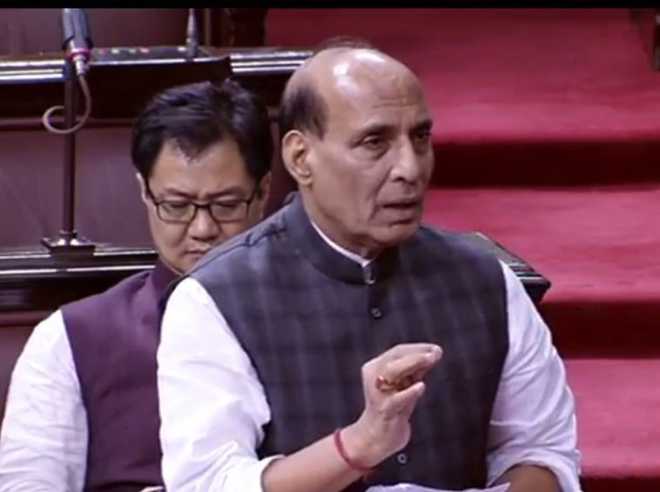
Union Home Minister Rajnath Singh on Monday blamed Pakistan for stoking violence in Kashmir.He was replying to a discussion in the Rajya Sabha on the recent violence in the Valley.Whatever happened in Kashmir has pained me and PM Narendra Modi. He was in constant touch on the issue even while abroad, he said.Replying to the charge that excessive force was used to quell the violence, Rajnath said he and Jammu and Kashmir Chief Minister Mehbooba Mufti had instructed security forces to use maximum restraint.He said a team of eye specialists had been sent to Kashmir. He said as many as 1,671 security personnel had been injured.Rajnath said an extremist had been killed and Pakistan is celebrating Black Day, which is unacceptable. Whatever is happening in Kashmir is sponsored by Pakistan, he added.“I agree there should be a dialogue. I told Mehbooba Mufti that I wanted to come to Srinagar and begin a dialogue process with the locals.” He said the CM had asked him to wait till the situation returned to normal.“Some vested forces are trying to misguide Kashmiri youth. We promise that we will bring them to the right path,” he said.He condemned Pakistan for trying to interfere in matters related to Indian Muslims. “We, and not Pakistan, will look after Indian Muslims. Pakistan, which itself is divided over religious issues, is playing a dirty game. We are not indulging in divisive politics. We will carry everyone along on the issue,” he said.Earlier, Leader of Opposition in Rajya Sabha Ghulam Nabi Azad hit out at the Centre over “brutalities” inflicted on civilians in Jammu and Kashmir, asking if civilians should be “treated in the same manner as militants”.Starting the discussion on the Kashmir situation in the Upper House, Azad said he did not want to blame anyone–either the Centre or the state government. However, it was a matter of concern why the situation had deteriorated so much, he added.People had died in all 10 districts in the Valley, which is unprecedented, he said. The way guns were used, the sheer brutality with which pellets were used and the police controlled the situation is unacceptable, he said.Azad said no party, including the Congress, supported militancy. But there should be a difference between how a militant and the old, women and children are treated. “We support your call against militancy,” Azad told the government. “However, we cannot support you in the way you are treating ordinary citizens,” he added.“As many as 1,800 people are lying injured in hospitals. This type of violence was not used even in Haryana despite a huge agitation there,” he said.The way Kashmiri students are “treated” in educational institutes is adding to the “lack of trust” that people have in the current government at the Centre, Azad alleged.“The BJP does not have acceptability in Kashmir Valley, we had warned,” Azad said, adding, “The BJP’s “mismatch” with the PDP had resulted in the “bursting of the simmering lava”.He said there should be a healing touch and not the use of “disproportionate force” in the Valley. Why such a disproportionate force was not used elsewhere in the country, he wondered.Azad said he is all for the freedom of Press but the media should also act responsibly. The way TV channels compete with one another in inciting sentiments, they should be taken to task.Azad asked the government to call an all-party meeting and fix responsibility of those who used “excessive force” in the Valley.Leader of the House Arun Jaitley thanked Azad for highlighting the issue. He said many a time one needed to get out of one’s political limitations and show a level of statesmanship.


An old new militancy ::Written by Syed Ata Hasnain

In the absence of political engagement, a wide space has opened up for radicalisation in the Valley.

kashmir protests, kashmir violence, burhan wani death, burhan wani killing, Mehbooba Mufti, Burhan Wani, hizbul mujahideen, hizbul, hizbul commander, hizbul militant, Afzal Guru, kashmir violence, kashmir valley, jammu kashmir news, kashmir news, india news

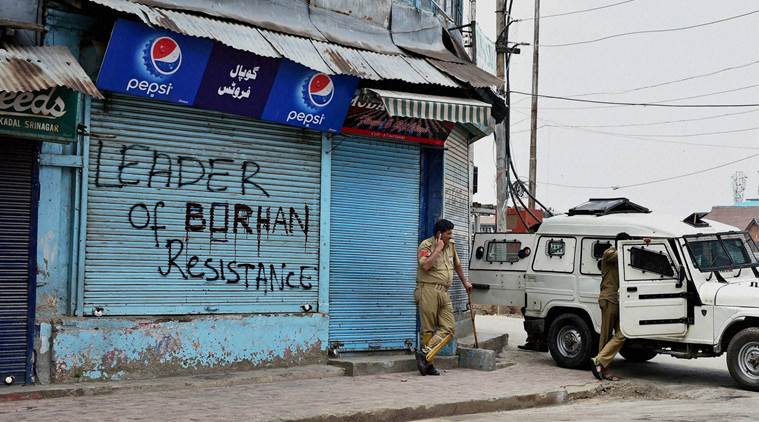
A terrorist’s days are always numbered and so were Burhan Wani’s. Leading the new militancy in South Kashmir, the 22-year-old angry young man from the passionately anti-India town of Tral brought an aura of romance to terror in South Kashmir. Induced into leading a renegade life because of the allegedly undignified treatment by a few errant policemen, Burhan swore retribution. Rather than follow the path of extreme violence, he acquired a Robin Hood image through social media, which catapulted him to iconic fame in the eyes of those favouring a fracture from India. This enabled him to attract 60-70 young local Kashmiris to a similar cause, and empowered them to take the path of violence. In reality, his new militancy was all about indigenous struggle, with “azadi” as the aspiration; hence the attraction.

Burhan met his end at Kokernag in an encounter which was in the offing for some time once the focus of intelligence had him in the spotlight. His death expectedly sparked widespread violence in the streets. The situation throws up many questions which need to be answered here, in as much black and white and least through shades of grey. Was it necessary to neutralise Burhan at a time when all triggers attempted by the separatists had failed to instigate a return to the situation in 2008-10? Could it have awaited the termination of the Amarnath Yatra, the implications being obvious?
WATCH VIDEO: Kashmir Protests: Visuals Of Curfew In the State

Intelligence generated opportunities to neutralise an important terrorist who has acquired inspirational status, do not come easily. Terrorist leaders of the past have survived over 10 years in the same area in South Kashmir and Burhan was becoming larger than life, an embarrassment to the army and police. The decision to target him was correct. The decision to hand over his body for burial with full knowledge of the implications, was a bold one and no doubt considered by all stakeholders. This decision too was correct because it diluted the angst to some degree. Without the body, prayers “in absentia” would still have taken place all over South Kashmir and Srinagar; what the tempers would have been like could not be ascertained.
The more important thing to examine is the continued linkage between the directors sitting across the LoC and the speed with which the stone-throwing mobs mobilised, as if the contingency was well thought out. The focus with which 17 police stations were targeted on the first day appeared almost like a military plan. Remote places like D.H. Pora near Shopian, otherwise low in terror activity and with mainstream political influence, erupted unpredictably. Mobs were bold enough even to target the air force station at Awantipura and the BSF camp nearby, a far cry from 2010.

WATCH VIDEO: Kashmir Protests Victim: 5-Year Old Zohra On How She Got Hit


The deduction is clear. With the improvement in Pakistan’s internal security situation, focus has returned to Kashmir to arrest the situation perceived as slipping from Pakistan’s control. Pathankot was the first attempt; it upset the peace process. Handwara and Sainik Colonies were the second and third attempted triggers; both failed. Contingency planning probably focused on the potential neutralisation of a terrorist leader perceived as charismatic by the public. That a terrorist leader’s days are numbered has already been stated and in today’s environment the average life span in militancy is a mere six months. Burhan was pushing his luck for five years.


The officials admit that the violence was expected, as is the norm in Kashmir, but the speed, scale and spread were not. A return to 2008-10 spelt advantage for the deep state in Pakistan, and for the separatists and ideologues, who had been vainly attempting a revival of the mass upsurge and not finding the trigger to achieve the desired effect. And that really is the story behind the sordid drama being played out all over again.

The Central and state governments are being accused of being in denial of the problem and barking up the wrong tree, with the former engaging Pakistan in a peace process which will apparently go nowhere. That may be a trifle unfair; I do believe that the issues are mutually exclusive. What is, however, wholly true is the dearth of a strategy. Anyone who has worked in and experienced Kashmir’s turbulence will tell you that the angst and the alienation come from the sheer lack of communication, the inability of the political community to shed the fears of 26 years of proxy conflict and engage deeply with their constituencies; the lack of grassroot politics and the mistaken belief that polls make up for all that. In the absence of this engagement, a wide space has been opened to the religious ideologues. Can anyone deny that the so-called radicalisation of society and power at the hands of the rabblerousing clergy happened right under our noses? Reports were frequently made but the buck was passed through chains of bureaucracy without application of mind on how to tackle it.

The inevitable question is: What next? There is no option but to cast aside all political differences and come on to the same page. Leaving ego aside, all-party delegations must get to the ground and engage those willing to be engaged even as no nonsense is broached on the law and order front. They can even meet the clergy, if necessary, to stop impassioning the street with sermons and negativity. Let the Unified Command burn the midnight oil to come up with options for reducing strife at the tactical level. In 2010, it was the brigade commanders and officers below that rank who proved tenacious and subtle in dealing with elders and youth alike. There is no guarantee it will work this time — but try we must.

Whenever this phase passes, let Delhi’s think tanks focus on Kashmir instead of giving priority to issues of faraway West Asia and South China Sea. That, too, is important but not as much as the home turf which needs more ideas on how to communicate better with a population awaiting just that. All is not lost, but it will be, if the message does not sink in this time.

images
The writer is former GOC of the Srinagar-based 15 Corps and fellow, Delhi Policy Group and Vivekananda International Foundation.

Misuse of AFSPA Extra-judicial killings have no place in a civilised society

The Supreme Court has come out strongly in favour of the human rights of Indian citizens, including those living in the “disturbed” areas. The court’s direction on a PIL petition on the 1,528 alleged killings by security forces and the police in Manipur shows that it was not satisfied with the submissions made in defence by the government and the Army. After a long time the controversial Armed Forces Special Powers Act (AFSPA) has come under a critical review. The court has asserted that there is no absolute immunity under the Act.
While the Army maintains that it needs AFSPA’s protection, allegations of misuse of power have surfaced frequently and bred resentment against the state and its armed forces in Manipur and Jammu and Kashmir. Ideally, the Army should not deal with terrorism. Punjab was able to contain militancy without Army help. Whenever the Army is deployed, it has to be ensured that excessive or retaliatory force is not allowed to be used. A prolonged Army deployment with unlimited powers under AFSPA can prove counter-productive as has happened in Manipur. For many years now Manipur has lived with internal disturbances, fake encounters and protests against AFSPA. The Centre and the state government are to blame for the excessive reliance on the Army to contain insurgency.
The Supreme Court has called for an inquiry by an independent agency into all Manipur encounters that have happened in the last two decades. This will hopefully make the powers-that-be realise that no matter how difficult and challenging a situation, violations of the rule of law cannot be overlooked or sanctioned. The Army, at best, can supplement the civil administration’s efforts to control a volatile situation in the short term. If allowed to carry on beyond a point for whatever reason — political convenience or inadequacies of the state/Central forces — the arrangement is bound to backfire. When AFSPA is allowed to stay for six long decades, instances of abuse of power are bound to crop up. As and when excesses happen, these must be investigated thoroughly and swiftly so that the guilty don’t go unpunished.