Sanjha Morcha

What’s New

Click the heading to open detailed news

Current Events :

web counter

Print Media Reproduced Defence Related News

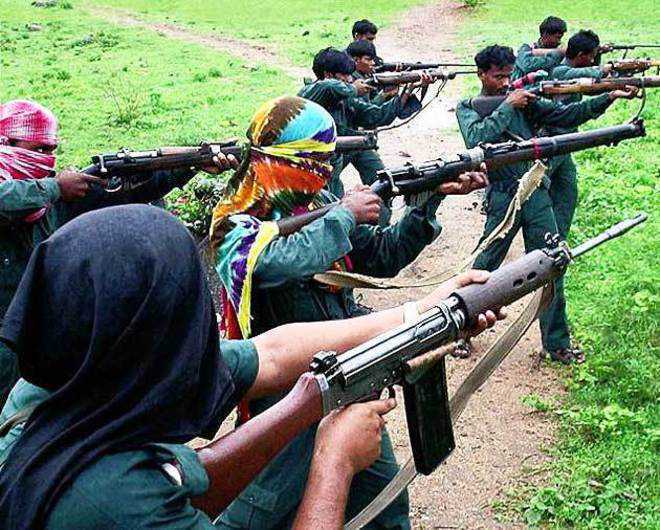
Five Maoists killed in encounter with security forces in Jharkhand

Five Maoists killed in encounter with security forces in Jharkhand

Latehar, April 4

Five Maoists were killed in an encounter with security forces in Serendaag jungle of Jharkhand’s Latehar district on Wednesday, a police officer said.The encounter between the Maoists and a joint team of the district police and the CRPF is still on, Superintendent of Police Prasant Anand said.Bodies of the five ultras had been recovered from the spot along with three AK-47 rifles, he said. PTI


Air Vice-Marshal visits war museum

Air Vice-Marshal visits war museum

Tribune News Service

Dharamsala, April 2

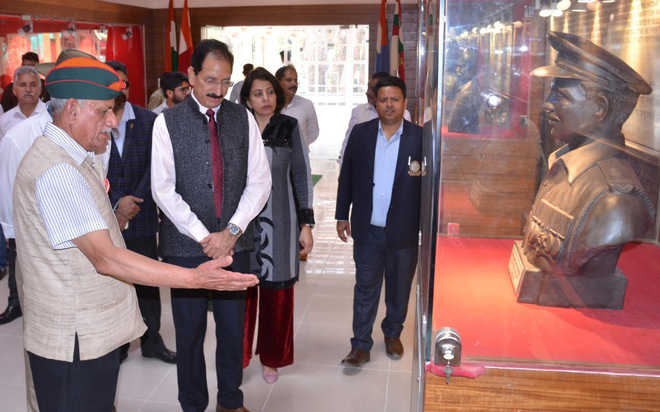
Air Vice-Marshal AK Nabh on Monday visited the incomplete war museum in Dharamsala. The Rs 10-crore museum was inaugurated by former Chief Minister Virbhadra Singh before the Assembly elections in November 2017.It was supposed to be inaugurated on Independence Day last year.The Air Vice-Marshal said the Indian Air Force would provide photographs for display. Officials of the district authorities also accompanied him. SDM Dharmesh Ramotra said the officer had assured them of all possible help.


Restructuring the armed forces by Col Mahesh Chadha (retd)

Switching over to the Theatre Command system is required. But for this, the bureaucracy and the defence services need to take care of its fallout — most importantly the likelihood of mass-scale reduction in higher ranks.

Restructuring the armed forces

Col Mahesh Chadha (retd)

The recent announcement by the government to restructure the armed forces is a step in the right direction. Warfare today has become more complex with its three dimensions enlarged to encompass not only conventional and technology-driven but tools also nuclear, cyber and space ones. China has done it already. But Pakistan is not likely to venture into it as it does not have any commands and its corps are under the GHQ with political overtures. China has made it more inclusive by having Politico-Army Theatre Commands based on geographical parameters — each many times bigger than our operational commands. Chinese President Xi Jinping’s threat that China will not lose an inch of its ground at any cost is a warning for us to be prepared for any eventuality that may arise on our borders.

The background

At the time of Independence, we had a loose armed forces structure: areas, divisions and corps in the Army and squadrons and divisions in the IAF and Navy. When in 1947 Pakistan attacked us in J&K, we raised a corps and a command HQ for the western borders, and later a command HQ for the eastern borders. After every war — of 1962, 1965, 1971 and 1999 with China and Pakistan — some more divisions, and corps HQ were raised. However, it was in the aftermath of the 1971 war with Pakistan that Northern and after the 1999 Kargil conflict South-Western and Training Commands were raised. Similarly, the IAF and Navy increased their commands and today, we have 17 commands — seven each of the Army and IAF and three of the Navy, including two training commands — ironically, as the latter are treated on a par with an operational command, and went on to produce a COAS. While these new raisings created more high ranking officers, they reduced the areas of responsibility and created boundaries to be criss-crossed with due coordination with each other — at times difficult to achieve. In these conflicts, the synergy of the three services remained an overriding lacuna, except in 1971 where the Chairman of the Joint Chiefs Committee was the redoubtable Sam Manekshaw; hence the birth of Bangladesh.As early as the eighties, General K Sundarji had propounded the theory of Theatre Commands. In his book The Blind Men of Hindoostan, he talks of the changing concepts of warfare where synergy of the three arms can only be achieved if there is a single command and control system as compared to the existing separate ones. That time, it was the beginning of the cyber space warfare. So, he dwelt upon the nuclear aspect and recommended to our leaders to take a wake-up call lest we were found wanting in safeguarding the territorial interests of our nation.  Since then, both China and Pakistan have allied and made strides in escalating threat to us by the day. The OBOR and CEPC are only a part of the grand strategy to strangle India in the Indian Ocean, South China Sea and along  Nepal, Myanmar, Bhutan and Sri Lanka. Thus, all the more the requirement of the integration of all forces under one head to take on the land, air and sea battles.

The present status

Justifying as operational needs, it is the successive pay commissions and cadre reviews  — one such is again in the pipeline which has resulted in the creation of higher ranks, truncated commands, eg Western Command that stretched from J&K to Rajasthan is divided into three — Western, Northern and South Western Commands. Similarly, at the corps level, in J&K alone there are three Corps as compared to one till 1971. It is this expansion that has caused the formations and units to live with deficiencies in arms, armour, engineer and artillery equipment — the most essential requirement to fight any war. We cannot afford to be a welfare Army, where comparison with the bureaucracy has become more of a one-upmanship than pragmatism. There is need to keep the armed forces lean and thin and not top heavy as it is today unwieldy. If a state government has so many chief secretaries, should the army too have so many generals, where there is a hierarchical command structure? Putting a lt-general under another seems ridiculous.

The way forward

Though there has been loud thinking on adopting the Theatre Command system, switching over to it will require the bureaucracy and the defence services to sit together to first define the concept and take care of its fallout — most importantly the likelihood of mass-scale reduction in higher ranks, which will definitely create heart-burning. The one suggestion to overcome such an eventuality is to have four-star generals as Theatre Commanders and a five-star general as the CDS. This would be in consonance with the concept as suggested by Sundarji and other expert committees, the recent being the Shekatkar committee. That since the 1980s such a three-service command exists in Andaman and Nicobar can act as a model. The Integrated Defence Staff HQ can be the restructured CDS. All the 17 commands could be merged so as to create only six or seven role-specific commands — Northern and Eastern under the Army; Western under the IAF and the Southern under the Navy. Theatre Commands North and East could be mostly composed of the Army and IAF, West and South of the Army, IAF and Navy. Cyber and Nuclear Commands could remain as such, a three-star general of any service and an expert component under the PMO. The Training and Maintenance Commands could be wound up. However, no change is visualised in the corps and below formations, except to revert to the old command structure at the area level etc. The schools of instructions and officers’ training academies would also need a review as most of them do not require a lt-general as the commandant to train them. An upcoming brigadier or a major-general would fit the bill. The logistics support units too should be reorganised to meet the requirements of each service. This will save considerable budget that can be utilised to fill the deficiencies in arms and equipment. Peace time vs war timeThe services will have to shed their individuality and adopt a unified philosophy so that the system works well,  as a homogeneous entity. However, in operations, it will require deft handling at the level of the CDS when the situation may require the placement of additional or reduced forces under one or another Theatre Command. In the process, the rehabilitation of many redundant high-ranking officers should not be considered as the largesse endowment of cadre review, but as a cache of great experience and talent. Therefore, it would be a progressive transformation. The government must ensure that the downsizing in the armed forces is not wasted or taken advantage of by the central paramilitary forces and civilian counterparts. If at all, as a last resort, a golden handshake may be considered.


Body at forest resort | Murder charge part of Punjab Police rivalry: WWICS Group

Rajiv Bajaj, director, WWICS Estates Private Limited, addressing the media in Chandigarh on Thursday.

The mystery around the death of a 28-year-old CTU employee deepened on Thursday with the WWICS Group, an immigration consultancy, linking the case with the suicide of former Chief Khalsa Diwan (CKD) head Charanjit Chadda’s son.

Lt Col Baljit Singh Sandhu (retd), chairman of WWICS Group, and owner of Forest Hill Resort in Nayagaon, is named in the FIR of the CTU worker’s murder. He remains untraceable.

Baljit’s son Davinder Sandhu is lodged in the Amritsar jail for allegedly abetting the suicide of Charanjit’s son Inderpreet Chadha. A Punjab Police special investigation team (SIT), led by Punjab ADGP Parbodh Kumar, is investigating the case.

Addressing a press conference here, Rajiv Bajaj, director of WWICS Estates Pvt Ltd, while speaking on behalf of Baljit and his son, claimed internal rivalry of Punjab Police’s officials was behind the murder case.

A local Kharar court on Thursday extended the remand of the three accused by two days.

Claiming that it was a deep-rooted conspiracy to bring down DGP (human resource development) S Chattopadhyaya, Bajaj demanded a CBI probe in the matter.

“While Davinder is already behind bars, some influential people are now trying to implicate his father Baljit in the case in which he has no role. While the body was recovered from Haryana, the Mohali Police have named our MD (Baljit) in the murder case in haste,” said Bajaj. He also denied that the victim was found dead on the premises of the resort.

The victim, Abhishek Guleria, a Burail resident and native of Himachal Pradesh, had gone missing on March 14. He was found dead on the Pinjore-Baddi road on March 25.

After getting leads, Mohali police named Baljit in the murder FIR on March 27. Besides, they had arrested three employees of the upscale Forest Hill Resort, located 5km from PGIMER, Chandigarh, for allegedly dumping the victim on the Pinjore-Baddi road on March 22.

While the trio is facing a case under Sections 302 (murder), 201 (destruction of evidence) and 120B (criminal conspiracy) of the Indian Penal Code, no charges have been pressed against Baljit.

The accused, liasoning officer Gurdeep Bains, his assistant Tarsem Singh and security in-charge Balwinder Singh, had claimed that they found Guleria’s body in the tank of resort’s sewage treatment plant, following which they informed Baljit, who asked them to dispose of the body to avoid controversy.

‘Davinder being forced to implicate HRD DGP’

Alleging that Davinder was being tortured in police custody, the WWICS management claimed that the former was being forced by IG (crime) LK Yadav, a member of the SIT probing the Chadda suicide case, to implicate Punjab DGP HRD S Chattopadhyaya by naming his association with Kuljeet Ghuman, a woman accused in the suicide case.

“Chattopadhyaya is being implicated only so that he is not considered for Punjab DGP’s post that is getting vacant in the next few months. Since he is also heading the SIT formed by Punjab and Haryana high court for investigating Bhola drug racket in which names of many influential people, including high-ranking officials of Punjab Police may also come up, Chattopadhaya is being framed in the Chadda suicide case. Chattopadhyaya has already informed the HC of being deliberately implicated in the case,” Bajaj claimed.

He went on to claim that just to overreach the HC-formed SIT headed by Chattopadhaya, the special task force (STF), dealing with investigation of drugs in Punjab, had recently been put under the charge of the DGP, while earlier, it was directly reporting to the Punjab chief minister.

Accused’s remand extended

A local Kharar court on Thursday extended the remand of the three accused by two days. Sources from the district police said more raids were carried out at the WWICS offices in Phase 6, Mohali, and in Chandigarh, to nab Baljeet. But he remained untraceable.



France pitches for another batch of 36 Rafale jets procurement by India

France pitches for another batch of 36 Rafale jets procurement by India
The issue of Rafale deal figures in the talks between Prime Minister Narendra Modi and French President Emmanuel Macron.

New Delhi, March 10

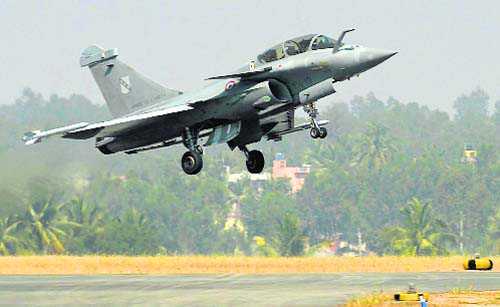
France on Saturday pitched for starting negotiations over procurement of another batch of 36 Rafale jets by India with French President Emmanuel Macron describing the fighter jet programme as a key aspect of the bilateral defence cooperation.Sources said there was a communication from the French government recently indicating its eagerness in making an announcement by the two sides favouring additional procurement of Rafale jets for the Indian Air Force.They said the issue of Rafale deal figured in the talks between Prime Minister Narendra Modi and Macron.”India had made a sovereign decision in this respect (Rafale fighter jet) and we are monitoring the progress in the field. We very much want to continue the programme.”It is a long-term contract which is mutually beneficial. I personally consider it as the heart of the strategic partnership,” Macron said in a statement to media after talks with Modi.India had signed a government-to-government deal with France in 2016 to buy 36 Rafale fighter jets at a cost of about the Rs 58,000 crore. The Congress has been demanding details of the deal, alleging that the deal negotiated under its rule was much cheaper than the contract signed by the Modi government.Officials said the French side pitched for procurement of another batch of 36 Rafale jets by India during the talks between French Defence Minister Florence Parly and her Indian counterpart Nirmala Sitharaman.In the meeting, Parly said extending the current deal will further bolster defence cooperation between the two countries, they said. The Indian side conveyed that no decision has been taken yet on the issue.The Indian Air Force has also been favouring procurement of more Rafale jets from France. It had communicated to India earlier too, seeking additional orders of Rafale jets.In the talks, Modi and Macron noted with satisfaction the “on-schedule” progress in the implementation of acquisition — related agreements, including the Rafale aircraft deal, a joint statement issued after Modi-Macron talks said.”They looked forward to continue their discussions to expand and deepen the ongoing defence manufacturing partnerships,” it said. – PTI





Fearing ‘hot summer’ along LAC, India ups patrolling in Arunachal

Fearing ‘hot summer’ along LAC, India ups patrolling in Arunachal

Ajay Banerjee

Tribune News Service

New Delhi, March 31

India, it seems, is militarily preparing for a “hot summer” along the Line of Actual Control (LAC) — the de facto 3,448-km boundary with China running all along the Himalayan ridge line.Post the 73-day (June 16 to August 28, 2017) Doklam stand-off, India has increased patrolling along the far-eastern part of Arunachal Pradesh. The remote mountainous terrain at Kibithu, Walong and the Lohit valley are in greater focus. Surveillance is not possible through UAVs due to dense tree foliage. Hence, patrolling has to be on foot in the valleys of Lohit, lower  Subhansiri, upper Subhansiri, Siang,  Dibang,  Delai and Dau.These are very narrow valleys in which the invader will have a military disadvantage, said a senior military officer.Walong, Kibithu and Lohit were the locations of pitched India-China battles in 1962, but things have changed. India has militarily tailored its response to stall any incursion.A rather candidly written ‘History of the conflict with China’ produced 30 years after the war by the Historical Division of the Ministry of Defence describes the battle of Walong: “A defensive battle against heavy odds, the troops fought bravely, but being out-numbered and out-weaponed in automatics and ammunition, suffered heavily.” But it was no walkover. “Indian troops offered stiff resistance, but they had to vacate their positions,” says the MoD’s book.After that, India has had a fully functional airstrip at Walong and a division (some 20,000 troops) located in the eastern-most corner of India. All key bases have road connectivity, a far cry from 1962 when a 14-day Tezu-Walong trek was the only option.India’s move has come after Beijing’s troops have taken to intensive patrolling in areas that are disputed all along the LAC and have been building military infrastructure. US confirms military build-up on both sides

  • On January 25,  US-based think tank Stratfor released a report ‘Preparing for a rematch at the top of the world’. It said India and China have continued with a build-up of military resources on either side
  • It released satellite images of airbases of both countries and said “the imagery confirms that both China and India are pursuing a wide-ranging strategic build-up that has only accelerated in the wake of the August agreement (to dis-engage)”

AFT: Outing with permission to be considered on duty

Vijay Mohan

Tribune News Service

Chandigarh, March 4

Ruling that a person who has gone to watch a movie after duty with due permission of the authorities will be considered as being on duty for the purpose of benefits in case of any mishap, if he meets with an accident, the Armed Forces Tribunal (AFT) has granted special family pension to the mother of an airman almost a decade after his death.Corporal Vishal Raj, who belonged to Pathankot, had died in a road accident in 2009 when the motorcycle on which he was travelling along with another airman met with an accident while they were returning to Kalaikunda Air Force Station in West Bengal after watching a film in a nearby town.The Ministry of Defence, however, refused to sanction special family pension that is applicable for armed forces personnel who die on duty on the grounds that his death was not attributable to military service. His mother, Tripta Devi, was sanctioned only ordinary pension.Thereafter, she approached the AFT, claiming that her son was on active military service and was not on leave at the time of accident. In her petition, she contended that before going for the movie, he had made the necessary entries in the records of his squadron and had properly booked-out of the sub-guard room. The ministry, on the other hand, argued that based upon the court of inquiry proceedings, he was not performing any military duty at the time of the accident and consequently his family was not entitled to the special pension.Drawing inference from past judgments on the issue by the high courts, the AFT and the relevant provisions of law, the tribunal’s Chandigarh Bench comprising Justice Mohammad Tahir and Lt Gen Munish Sibal held that in view of the facts and circumstances of the case, Vishal had sustained injuries while he was on duty and the injuries because of which he died, can be attributable to military service.The tribunal had directed the Ministry of Defence to calculate the special family pension and release it to Tripta Devi within three months. The arrears of the pension, however, have been restricted to three years preceding the date of filing the petition as she had moved the AFT after a lapse of seven years from the incident.Relief to airman’s kin AFT’s Chandigarh Bench allowed special family pension to the mother of an airman from Pathankot who died after sustaining injuries in an accident during his posting at Kalaikunda Air Force Station in West Bengal. The victim was returning after watching a film in a nearby town

.


Modernisation of Army under way: Sitharaman

Modernisation of Army under way: Sitharaman

Tribune News Service

Dehradun, March 25

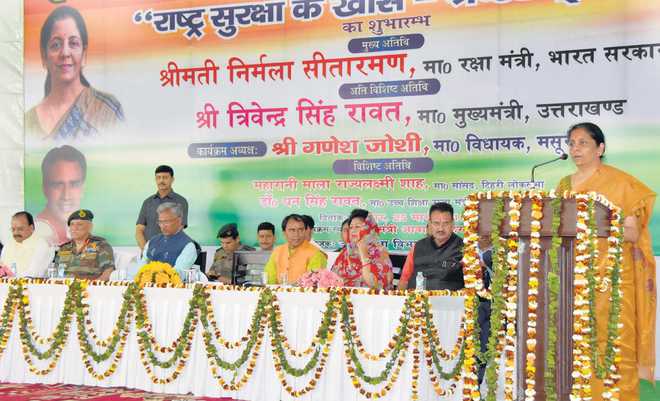
Union Defence Minister Nirmala Sitharaman said modernisation of Indian Army was under way. She credited Prime Minister Narendra Modi with the modernisation programme. The Defence Minister was here on Sunday to honour students of the state, who have been selected in Indian Military Academy and National Defence Academy in the recent years. “When you join the forces after competition of training at your respective academies, you will be proud to join a modernised Indian Army”, Sitharaman said addressing the gathering of successful students. She also asserted that the Army was fully prepared to deal with any situation. The minister recalled her visit to the Uttarakhand region during childhood days, pointing that the region was then known for Char Dham yatra. “But today Uttarakhand is also known as Veer Bhumi as a large number of youth from the state join defence forces these days”, she said. The minister also praised Col Ajay Kothiyal, Director, National Institute of Mountaineering, Uttarkashi, for his efforts towards motivating the state youth to join the armed forces.   Nirmala Sitharaman also handed over a cheque of Rs 50,000 each to the successful student of Uttarakhand, who have been selected in Indian Military Academy and National Defence Academy from 2014 to 2018. A total of 140 selected students were felicitated by the minister. She also honoured family members of Victoria Cross awardee Late Gabbar Singh Negi, Veer Chandra Singh Garhwali and other defence forces martyrs.Chief Minister Trivendra Singh Rawat said it was a matter of honour that Prime Minister had reposed faith in a daughter of the country by making Nirmala Sitharaman as defence minister of the country.Chief of Army Staff Gen Bipin Rawat, Uttarakhand Higher Education Minister Dhan Singh Rawat and Mussoorie BJP MLA Ganesh Joshi were among the prominent persons present on the occasion.


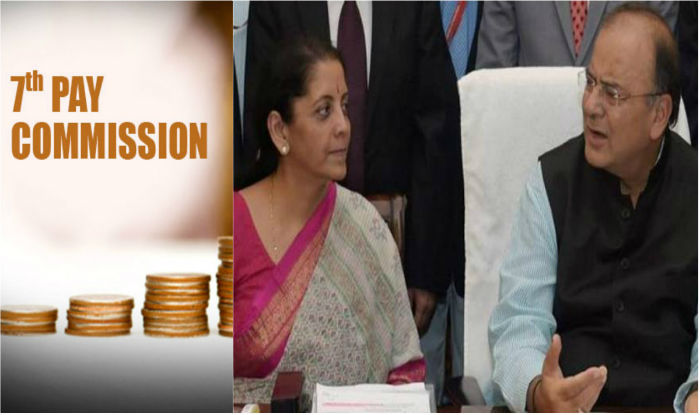
7th Pay Commission: Defence Minister Nirmala Sitharaman Requests Finance Minister Arun Jaitley to Remove Education Fee Cap For Martyrs’ Children

The savings have been reported to be Rs 3.20 crore approximately. The highest amount drawn has been reported to be Rs 18.95 lakh per annum per student,” said Bhamre.

New Delhi, February 10: Defence Minister Nirmala Sitharaman on Saturday requested Finance Minister Arun Jaitley to remove the education fee cap under 7th Pay Commission for children of soldiers who lost their lives while serving the country.

Earlier in January, the government made it clear that there will be no immediate review of its decision to put a cap of Rs 10,000 per month on educational assistance given to children of martyrs or of those disabled in action.

Replying to a question in the Rajya Sabha, Minister of State for Defence Subhash Bhamre said the educational assistance has been capped as per the recommendations of the 7th Pay Commission and those demanding its review have been communicated about the government’s position on it.

Indian Navy Chief Admiral Sunil Lanba wrote to Defence Minister Nirmala Sitharaman requesting the government to look into it s prior order that limits education reimbursement to the children.

“Reply has been sent (to them) stating that the combined amount of tuition fee and hostel charges has been capped at Rs 10,000 per month in accordance with the recommendations of the 7th Central Pay Commission as accepted by the government,” Bhamre said.

Under the scheme, rolled out in 1972, tuition fee of children of martyrs or those disabled in action were completely waived in schools, colleges and other professional educational institutions.

However, on July 1, the government had issued an order capping the amount to Rs 10,000 per month, triggering discontentment among all the three services.

The Chiefs of Staff Committee (CoSC), comprising the Army, Navy and the Air Force chiefs, had written to the defence ministry requesting the issue to remove the cap.

Approximately 250 students have been reported to be affected during current financial year following the government’s decision to cap the assistance, Bhamre said, adding that “the allowance shall go up by 25 percent each time DA rises by 50 per cent.”

He said that out of a total 2,679 students during the year 2017-18 (up to December 27, 2017), 193 students have been reported to be drawing more than the capped amount.

“The savings have been reported to be Rs 3.20 crore approximately. The highest amount drawn has been reported to be Rs 18.95 lakh per annum per student,” said Bhamre.


Status quo at Doklam, says Indian envoy

Status quo at Doklam, says Indian envoy

Beijing, March 24

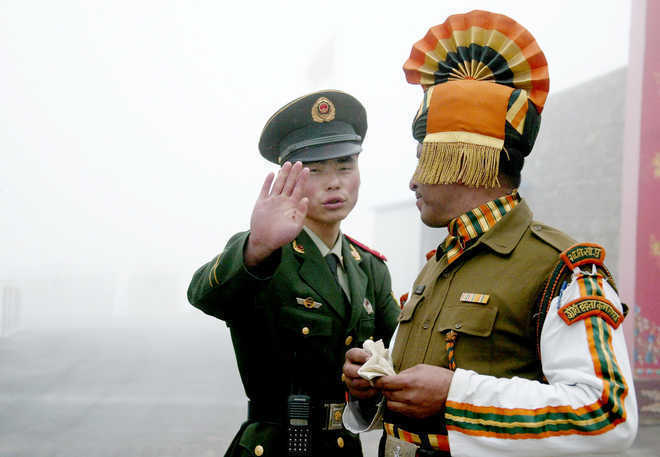
“No change” has taken place at the Doklam standoff area after it was resolved last year, India’s envoy Gautam Bambawale said and blamed China squarely for the face-off, saying it happened because Beijing tried to alter the “status quo” which it should not have.The 73-day standoff ended on August 28 last year after China agreed to halt the road building activities at Doklam in Sikkim section.“No, I can tell you that in Doklam area, which we call close proximity or sometimes the face-off site, the area where there was close confrontation or close proximity between Indian and Chinese military troops, there is no change taking place today,” India’s Ambassador to China Bambawale said, reacting to reports of Chinese military stepping up infrastructure build-up in the area.The Chinese side may be putting more military barracks to put in more soldiers, but that is well behind the sensitive area, he said in an interview to Hong Kong-based South China Morning Post. — PTI