Sanjha Morcha

What’s New

Click the heading to open detailed news

Current Events :

web counter

Print Media Reproduced Defence Related News

Roads to Gangotri, Yamunotri blocked

Roads to Gangotri, Yamunotri blocked

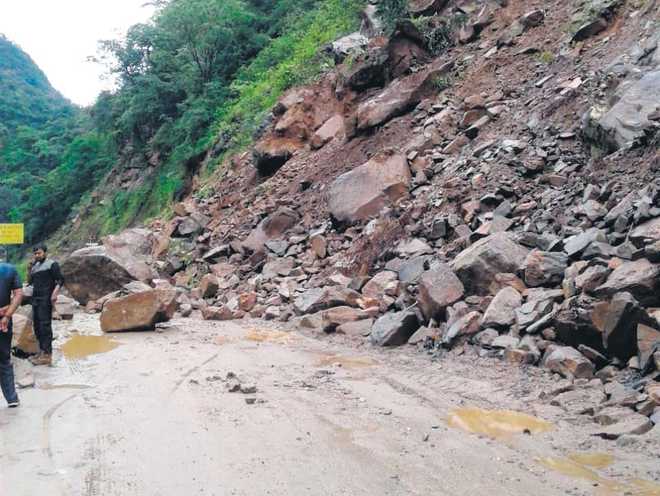
A blocked road in Uttarkashi. Tribune photo

Tribune News Service

Dehradun, July 28

Incessant rain in most parts of Uttarakhand threw normal life out of gear on Saturday. All schools remained shut in Dehradun as the district administration had declared a holiday on Saturday.According to the state disaster management authority, the Rishikesh-Gangotri national highway (NH-108) had remained blocked since morning due to debris falling in Maneri and Naytala. While the Rishikesh- Yamunotri (NH-94) national highway was also blocked at Ojri, Sayanchatti, Dabarkot and Ranachatti. The district authorities said JCB machines were being utilised for removing debris. There may be no respite from rain on Sunday as the Met Department has forecast heavy to very heavy rain, which is likely to occur in Dehradun, Nainital, Uttarkashi, Tehri, Haridwar and Pauri in the next 72 hours. On Friday, Rishikesh recorded 132mm of rain, Mussoorie recorded 99 mm, Haridwar 96 mm, Dehradun 98.8 mm, Uttarkashi 65 mm, Tehri 60 mm and Mukteshwar 19 mm.  In Dehradun, 45 roads were blocked, most of these are in Tyuni in Chakrata. In Tyuni, shopkeepers had been asked to remain vigilant as the water level in the Tons river had swollen. In Haridwar, waterlogging occurred at several places in Pathri village. A bridge that connects Sidcul and Haridwar has developed cracks due to the seasonal rivulet flowing underneath. Meanwhile, Chief Secretary Utpal Kumar Singh had instructed the Disaster Management Department to remain alert keeping in view the continuous rain and Met Department predicting further rainfall in the region. Immediate response system (IRS) has also been made fully active.


China moves troops to Doklam, Indian army says routine movement

India China,Doklam,China army in Doklam

The India army has downplayed reports about heightened activity by the People’s Liberation Army (PLA) in the Doklam plateau and attributed this more to the rotation of troops and winter stocking than a desire by China to strengthen its presence in a region where armies of the two countries were locked in an uneasy 73-day standoff last year.

  Senior army officers who spoke on condition of anonymity said the Chinese had made no attempt to cross the Torsa nullah that virtually bisects the 100 sq km plateau near the tri-junction of India, China, and Bhutan. They added that there had been no change in the ground situation.

The PLA, the Indian army (out of Doklam, or Doka La as India calls it) and the Royal Bhutanese Army (at Chela Post) are stocking their posts for winter. When there’s a changeover for troops, the strength of the posts is temporarily doubled with outgoing troops briefing their incoming counterparts.

The army’s explanation comes after US Congresswoman Ann Wagner said during a US Congressional hearing on Wednesday that the Chinese PLA had resumed activities in Doklam.

The army officers cited above added that, specifically, the PLA battalion guarding the Batang La-Meru La-Sincha La axis, which is part of the Doklam plateau, is being rotated with supporting logistics activity.

“As in the past year, the PLA plans to stay put in Doklam area this winter; the other two armies (India and Bhutan) are also stocking up for normal heavy snows in this mountainous region,” said one of the officers.

The Chinese PLA has around 700 troopers in the Doklam area with a back-up of heavy vehicles and large prefabricated barracks.

The Torsa Nullah, which meets Amu Chu in Chinese territory, divides the plateau in such a way that 60% is under Chinese control and the remaining with India.

Contrary to the reports, the PLA has no surface-to-air missiles or S-300 systems placed in the area as they would be sitting ducks in times of hostility with the Indian Army sitting on the dominating heights of Doklam plateau, the officers said. The Chinese do have surface-to-air missiles, but these are stationed deep within Chinese territory, in Yadong, the officers added. The Royal Bhutan Army also has a significant number of troopers at Chela Post to monitor Chinese movement despite Beijing putting pressure on Thimpu to resolve the border dispute between the two countries.

Although the Chinese PLA had been sending patrols to meet Bhutanese troops after crossing the Torsa Nullah gorge on Doklam since the previous decade, the 2017 stand-off occurred as the PLA tried to carve out a road to reach Jhampheri ridge at the point close to Indian positions in Doklam and where the Torsa Nullah was crossable on all-terrain military vehicles.

According to Indian Army officers, if the PLA had been allowed to cross the nullah at that place, the Indian positions would have been rendered vulnerable.


Martyrs, faujis and gardens in full bloom

The sector boasts of the beautiful Gurdwara Bagh Shaheedan, which is built close to the site where Baba Sukha Singh and Baba Harkirat Singh were martyred fighting the Mughals; a Garden of Annuals with trees flowering through the year; and the city’s first

From page 01 CHANDIGARH: One of the first army housing projects in the city came up over here, offering units to both senior and junior personnel. But that’s not all. Sector 44 is also home to banking and insurance personnel as well as advocates, journalists, doctors, architects and engineers.

KESHAV SINGH/HT■ Calling all ye faithful: The Gurdwara Bagh Shaheedan is a prominent landmark at Sector 44 in Chandigarh.The beautiful Garden of Annuals spread over an area of 5.5 acres also ensures that this place gets a pop of colour every month, thanks to the 25 to 30 varieties of flowering plants grown here in April every year for the summer and around 50 varieties in October for the winter months.

Inaugurated in 2003 and maintained by six gardeners, this is one spot where children, the elderly and couples gather for chats, leisurely walks or sports (for the young of course).

“You will find flowers such as calendula, dahlia, pansy, carnation, marigold, salvia and more,” says Harchand Singh, junior engineer at the horticultural department.

Summer annuals include balsam, cosmos, kochia, nicotiana and cockscomb. There are 40 beds for flowers in all over here, Singh adds. SPACE FOR EVERYONE

Sector 44 has 216 army flats. “It’s the first such project in a residential area to come up in 1984 in the city,” says Kamini Sharma, president of the Sector-44 Army Flats Resident Welfare Association. Army personnel from the ranks of brigadiers to subedars live here.

Life Insurance Corporation officials have about 50 to 60 units here and about 100 housing units are for officials of the Reserve Bank of India (RBI) and other banks. RBI also has some vacant land allotted for flats.

Interestingly, the sector has the maximum number of leasehold houses under the Chandigarh Housing Board (CHB). “Around 2,000 houses in all the four blocks of the sector are under the CHB, and we have been fighting to get these converted to freehold,” says VK Nirman, president, Sector 44 D Resident Welfare Association.

FOR ALL COMMUNITIES

People of all faiths have their own place of worship here. Gurdwara Bagh Shaheedan makes for a historically significant site for the Sikh community as it’s built close to the site in Burail village where Baba Sukha Singh and Baba Harkirat Singh were martyred while fighting against tyrant Mughal rulers in 1769. It was built on a spot earlier known as Mahanta Da Bagh in the memory of Baba Sukha Singh and the other martyrs. Baba Banda Singh Bahadur is also believed to have visited the spot with his army.

Another place of religious importance here is the First Baptist Church of Chandigarh, which was founded in 1980 by Pastor Nazir Masih, his journey to faith in Christ beginning while he was a young child.

From its humble beginnings with just three families meeting in a small apartment, it now has a large campus that was built in 1988.

Shri Laxmi Narayan Mandir in Sector 44 C is dedicated to the goddess Laxmi and Narayan, another name for Vishnu.

TEMPLES OF EDUCATION Planned as a self-contained unit as envisaged by Swiss-French architect Le Corbusier, Sector 44 has six senior secondary schools, including St Joseph’s Senior Secondary School, The British School, St Xavier’s Senior Secondary School, Government Model Senior Secondary School and Chandigarh Baptist School.

And when it comes to health care, the Urban Health Training Centre, which comes under the department of community medicine of Government College and Hospital (GMCH), caters to the residents of sectors 43, 44 and the adjoining JJ Colony.

INVASION OF THE CROWDS Old-timers feel the sector has become a little crowded now. Some years ago people could actually ride cycles in the cycle lanes, something that’s almost impossible in the rush hours now because of the traffic. “There has been no improvement. We have failed Corbusier and his idea of planned city,” says Gulshan Girdhar, a resident. “Earlier, you could see people going on cycles and buses in the morning and after that roads would be empty because everyone was at their place of work after 10am,” says Girdhar. “There used to be buses for every place, from Central Secretariat to Vidhan Sabha and recently I saw a bus with just two passengers, which was sad,” says PDS Uppal, a local resident. Open spaces too are shrinking says TS Thukral, a member of the Sector 44 B RWA and retired chief electrical engineer from Northern Railways.

ABUZZ WITH ACTIVITY

The Sector 44D Market is a hub of activity with fancy eating joints and dhabas, mostly attracting students renting out apartments and rooms here.

Locals swear by the jalebis, says property dealer Ramesh Duggal of Duggal Estates, one of the first shops to come up here. He recommends the samosas too and says “this is the best time of the year to savour the snacks from the Guru Nanak Sweet Shop.” The market used to get a huge student crowd some years ago because of coaching institutes, which have now moved to Sector 34,” he adds.


Indian Army Recruitment 2018: Online application open for 14 Short Service Commission posts, apply @ joinindianamy.nic.in

ndian Army Recruitment 2018: The Indian Army on Saturday began the application process to fill 14 vacancies for the Short Service Commission (SSC). The unmarried male and female candidates within the age limit of 21 to 27 years can apply for the post via the official website @ joinindianamy.nic.in.

Indian Army Recruitment 2018: Online application open for 14 Short Service Commission posts, apply @ joinindianamy.nic.in

The Indian Army on Saturday began the application process to fill 14 vacancies for the Short Service Commission (SSC). The unmarried male and female candidates within the age limit of 21 to 27 years can apply for the post via the official website @ joinindianamy.nic.in. The interested applicants can apply for the post on or before August 16, 2018. As per the notification, there are total seven seats for both the male and female candidates. The candidates having a background in law can also apply for the posts of Judge Advocate General (JAG) entry Scheme 22nd Course April 2019. The selected candidates will be first kept on a probation period for six months.

Here we have listed the steps you need to follow to apply for the Indian Army Recruitment 2018:

  • First of all, visit the official website of Indian Army’s official website- joinindianarmy.nic.in.
  • After the website gets displayed on your screen, click the ‘APPLY/LOGIN’ button popping on the screen.
  • The candidate then has to fill the application form available at the website.
  • In the application form, fill all your details including your name, address, e-mail, mobile number, category and educational qualification.
  • After filling the form, make the payment and confirm your registration.
  • Download a copy of the registration and take a printout for the future reference.

Also Read: SSC GD Constable Recruitment 2018-2019: Notification, Age Limit, Eligibility, Syllabus and How to apply for 54,953 posts

Indian Army Recruitment 2018 Eligibility Criteria:

The applicants should have an LLB Degree with at least 55% marks from a college or University recognised by the Bar Council of India. The applicants can go through the official notification to go through the other details of the exam including syllabus, exam pattern and exam dates etc.

According to the News18, the shortlisted candidates will be selected on the basis of the Service Selection Board Interview.

Also Read: UPSC Prelims Result 2018: Civil Services prelims result declared @ upsc.gov.in

Here is the list of Selection Centers:

  • Allahabad (Uttar Pradesh)
  • Bhopal (Madhya Pradesh)
  • Bangalore (Karnataka)
  • Kapurthala (Punjab)

http://


Officer confined to mental ward: Send him home with father, Delhi High Court tells IAF

Kriyad Yogesh Bhankhariya (30) reportedly had alcohol dependency and mental issues for which he was initially treated in the psychiatric ward of the Army Base Hospital.

Officer confined to mental ward: Send him home with father, Delhi High Court tells IAF

The Delhi High Court Friday ordered that the Indian Air Force (IAF) allow one of its non-commissioned officers, who it had allegedly confined to a mental ward for 77 days, to go home with his father. Kriyad Yogesh Bhankhariya (30) reportedlady h alcohol dependency and mental issues for which he was initially treated in the psychiatric ward of the Army Base Hospital. In June, he was shifted to the medical centre at Tughlakabad Air Force Station.

His father Yogesh Kumar (54), through counsel Md Azam Ansari, claimed Kriyad, a corporal, was illegally and forcibly confined at the psychiatric ward without his consent and prior intimation. The father also told the court that his son stopped drinking heavily in 2008, and was only a social drinker.

The IAF, represented by the Centre’s standing counsel Ripudaman Bhardwaj, claimed that the decision was taken for Kriyad’s well-being. The IAF’s counsel also contended that the man should give an undertaking that he will not drink and create ruckus during duty hours.
Responding to the IAF’s stand, a bench of Justice S Muralidhar and Justice Vinod Goel said, “It is a great danger and the person may lose his life if kept beyond the mandatory time limit for any treatment, which is 28 days in the present case.”

“It cannot be a casual approach in this kind of treatment,” it said, adding that “the man has already undergone treatment and it seems, after talking to him, that he is fine”.

“Let him go home straight with his father,” the bench said, telling Kriyad that “we expect that you do not let us down in any manner and join your duty”.

It also directed authorities and the IAF that the man be allowed to visit the doctor on appointment before July 17.
Speaking to The Indian Express later, Yogesh said he had spent many sleepless nights in his son’s absence, and that he is “fine” now. He also alleged Kriyad was force-fed medication.

The court also said the newly enacted Mental Healthcare Act, which came into force on July 2018, made it clear that a person could not be forced to undergo treatment without his consent, adding that the IAF “cannot ignore the laws of the country”.

Terming the conduct of the IAF “irresponsible”, the bench wondered how many such cases were yet to be highlighted. “This practice should be stopped immediately and the Mental Healthcare Act should be applied to all its (IAF’s) centres,” said the bench.

It also asked the IAF for Kriyad’s treatment record, and a report on the protocol for dealing with issues of stress and substance abuse in the force, on the next date of hearing, August 17.


Army Chief Bipin Rawat’s mantras for jawans: No place of puris, pakoras, corrupt practices; read full list

Regarding the ration provided by the Army for the benefit of its personnel, Rawat said one can’t utilize CSD liquor and groceries for personal profits.

army training, army chief, army ranks, army jobs, army training, indian army ranks, indian army training, bipin rawat, bipin rawat village

The 27th Army chief, who is known for speaking his mind, has from time to time pitched for modernisation of the armed forces.

With an aim to pluck out ‘corrupt practices’ from within the Indian Army setup, the chief of Army staff General Bipin Rawat has prescribed a few tough measures for soldiers and officers in the ranks. From checking misuse of CSD liquor and groceries to unhealthy diet, the Army Chief has sent a stern message. In an advisory sent in Internal Army Wide Area Network, General Rawat has vowed to weed out officials, who will be found indulging in graft practices, irrespective of their ranks and stature. Apart from this, he has laid down directives that regimental, station events, must not be ostentatious, according to Times of India report. In order to check discrimination, the Army Chief has asserted that jawans should not be engaged in menial jobs.

Regarding the ration provided by the Army for the benefit of its personnel, Rawat said one can’t utilize CSD liquor and groceries for personal profits. Talking about unhealthy diet, General has asked authorities concerned to opt for nourishing foods instead of items like “puris and pakoras”, the report said.

The 27th Army chief, who is known for speaking his mind, has from time to time pitched for modernisation of the armed forces. The aforementioned measures are for the betterment of the Army. Earlier this year, Rawat had emphasized that “Economic rise takes place if the country is secure”. Rawat, who hails from Uttarakhand, said that “we have to build and develop confidence among the investors that the nation’s borders are secure and the internal security situations are under control for which there is a requirement for the budget for the defence forces”. He also had asserted that “Economic development and military modernisation must go hand-in-hand”.

General Rawat had earlier exhorted jawans to strengthen the ‘strong image’ that is associated with the Army. General Rawat took over the cherge from his predecessor General Dalbir Singh Suhag in December, 2016. He boasts of an illustrious career spanning over 40 years with vivid experience in high altitude warfare and counterinsurgency operations.


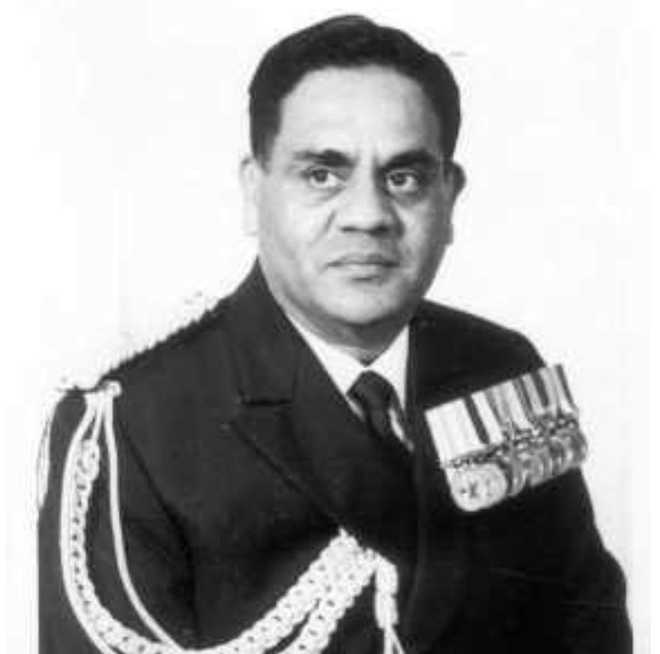
Ex-Navy Chief JG Nadkarni dies at 86

Mumbai:Former Navy chief JG Nadkarni dead

Former Navy Chief Admiral Jayant Ganpat Nadkarni passed away here on Monday, an official spokesperson said. He was 86. Nadkarni, the 14th Chief of Naval Staff (December 1987-November 1990), breathed his last at the naval hospital here, INHS Asvini. A widower, he is survived by two sons, including one who is a Rear Admiral in the Indian Navy. Settled in Pune post-retirement, he was an avid maritime historian and was a founding member of the Maritime History Society. His wife, Vimal Nadkarni, had died in late 2016. – IANS


Surgical strike clips & Army’s honour by Pravin Sawhney

Surgical-strike operations are covert, never announced and always denied. The video clip of strikes, and comments of Lt-Gen DS Hooda raise disturbing questions on the Army’s professionalism which impinge upon national security.

Surgical strike clips & Army’s honour

Lt-Gen Hooda’s remarks a reflection on Army leadership. Tribune Photo: Mohammad Amin War

Pravin Sawhney

Strategic affairs expert

The recently released video clip of the surgical strikes, and the comments of the then northern army commander, Lt-Gen DS Hooda, have raised two disturbing questions on the Army’s professionalism which directly impinge upon India’s national security.

Mission objective

The first concerns the mission objective. The seniormost theatre commander, Lt-Gen Hooda, is of the view: “We did not even remotely think that it will end Pakistan-sponsored terrorism.” Instead, “We proved that we were capable of crossing the heavily guarded Line of Control and strike at multiple points.” Moreover, “We are capable of doing it again.” To recapitulate, strikes were done at seven temporary terror launch pads (not Pakistan Army posts) across the LoC by the Army’s 4 and 9 Special Forces on the night of 28-29 September 2016. According to the then Director-General Military Operations (DGMO), Lt-Gen Ranbir Singh (now the northern army commander), “Significant casualties were inflicted on terrorists.” The Pakistanis were informed about the strikes before they were announced to the Indian people. Significantly, they were told that India had no further plans for such strikes.The DGMO’s remarks run contrary to what is taught to professional armies the world over. Such operations are covert, never announced and always denied. Most importantly, the enemy is kept guessing about when and where the next wave of strikes would come from. The latter compels the enemy to review his war-preparedness before launching counter-attacks, which would almost certainly lead to tactical-level escalation. This is because the initiator of the strikes, while well-prepared for an escalation, resorts to surgical strikes to caution the enemy to mend ways or face the well-defined war-escalation ladder.The Indian Army did the opposite. By telling Pakistan that it need not fear any more strikes, the Indian Army and the political leadership admitted to the lack of war-preparedness and political will for tactical-level escalation, or any more such strikes. The Indian Army, therefore, failed in the textbook legitimate mission objective of such strikes, which should have been to check (temporarily halt), if not end cross-border terrorism.Given this, Lt-Gen Hooda’s comments, to say politely, are intriguing and speak volumes about the Army leadership. On the issue of “crossing the heavily guarded LoC”, the Indian Army had done it better, multiple times, without fanfare and without senior Army and political leadership’s direct involvement, in the decade of 1990s until November 2003, when the ceasefire came into being. Instead of terrorists, Army’s unit commandos (not even Special Forces) on numerous occasions had raided Pakistani posts, killed their soldiers, later denied the acts, and got gallantry awards too! These actions had kept Pakistani cross-border terrorism in-check, and below the escalation threshold.However, after the Indian Army’s conduct post September 2016 strikes, the Pakistani Army did what was best for them. It stoutly denied surgical strikes, and while heaving a sigh of relief at the state of Indian Army’s poor escalation capabilities, intensified the infiltration and fire assaults across the LoC, killing Indian soldiers and civilians. Not only have India’s losses of its soldiers shot up, thousands of civilians living close to the LoC have also been forced to relocate to makeshift shelters.In the larger war-fighting scenario with Pakistan, the 2016 surgical strikes did as much damage as the 2001-2002 Operation Parakram, the 10-month long military standoff. While Operation Parakram — as the failed military coercion attempt — had blunted India’s conventional warfighting capabilities, the surgical strikes had blunted India’s tactical-level capabilities on the LoC. Since a likely war is expected to begin at the LoC (limited to the mountains and high altitudes) for fear of crossing the nuclear weapons threshold on the international border, the so-called surgical strikes have convinced Pakistan that it could continue its proxy war unabashedly, killing more Indian soldiers and civilians. 

Politico-military relations

The second serious concern is about politico-military relations in conduct of war which has become complex. While mission-building is done together, the military leadership has the critical responsibility to both advise and emphasise upon the political leadership about what can and cannot be done, and the implications thereof. For example, General Sam Manekshaw advised and insisted to Prime Minister Indira Gandhi (India’s only leader who understood national security) the timings and preparedness for the 1971 war which India won decisively.This was not done in the 2016 strikes, where the political leadership converted the Army mission into a political mission: to create a perception of a first-of-its-kind spectacular operation! Since videos of the strikes were shot, it was a given that the Modi government would be disclosing it at a politically opportune time. With a big chunk of pliant media at its beck and call, the Modi government would showcase itself as the best custodian of national security. Given the national narrative, where anyone who questions the government or the Army leadership is dubbed as anti-national, it will not be difficult to silence the informed critics.All this has been done by undermining the Army leadership which was initially against the disclosure of the video clips. It knew that having done extraordinarily better in the past in tactical-level operations, the video clips showed the Army and its leadership in poor light to the discerning observers. The clips showed some terrorists being killed and a few bunkers and military constructions destroyed; the larger effect was given by the background roaring commentary. What came to mind after viewing the clips was the then foreign secretary, S Jaishankar’s remarks made to the Parliamentary Committee on Foreign Affairs. He said, “The strikes were target-specific, limited-calibre, counter-terrorist operations across the LoC which the Army had done in the past too, but this is the first time the government has gone public about it.” Since any military force is as good as its leadership, it is time to pause and ponder over the future of the Indian Army. Can the honour, valour and professionalism of this force of 13 lakh remain secure and respected when its leadership seems to have pledged its own to the government?



Grenade attack on Army patrol in Shopian

Srinagar, June 29

Militants on Friday hurled a grenade towards an Army patrol party in Shopian district of Jammu and Kashmir, police said.There are no reports of any loss of life.A grenade was lobbed towards the Army patrol party in Ahgam area of Shopian in south Kashmir, a police official said.The area had been cordoned off, the official said.Further details are awaited. PTI


Army chief Rawat junks UN report on ‘rights abuse’

I don’t think we should get too concerned. Some of these reports are motivated. I don’t need to speak about the human rights record of the Indian Army.
GEN BIPIN RAWAT, Army chief

From page 01 NEW DELHI: Army chief General Bipin Rawat on Wednesday trashed a recent United Nations report on alleged human rights abuses in Jammu and Kashmir as “motivated,” reiterating the government’s position that it was “fallacious, tendentious and motivated.”

“I don’t think we should get too concerned about the report. Some of these reports are motivated,” Rawat said on the sidelines of a cyber security conference.

He said the army’s human rights record was “absolutely above board.

Released on June 14, the report by the Office of the United Nations High Commissioner on Human Rights, titled ‘Report on the Situation of Human Rights in Kashmir: Developments in the Indian State of J-K from June 2016 to April 2018, and General Human Rights Concerns in Azad J-K and Gilgit-Baltistan,’ sought an international inquiry into the alleged abuses.

General Rawat added, “I don’t need to speak about the human rights record of the Indian Army. It is well known to the people of Kashmir and to the international community.”

The report also sought repealing of the Armed Forces Special Powers Act (AFSPA) “urgently” and also the immediate removal of “the requirement for prior central government permission to prosecute security forces personnel accused of human rights violations in civilian courts.”

Reacting to the report when it was released, a government spokesperson said, “It is overtly prejudiced and seeks to build a false narrative,” and violated “India’s sovereignty and territorial integrity.”