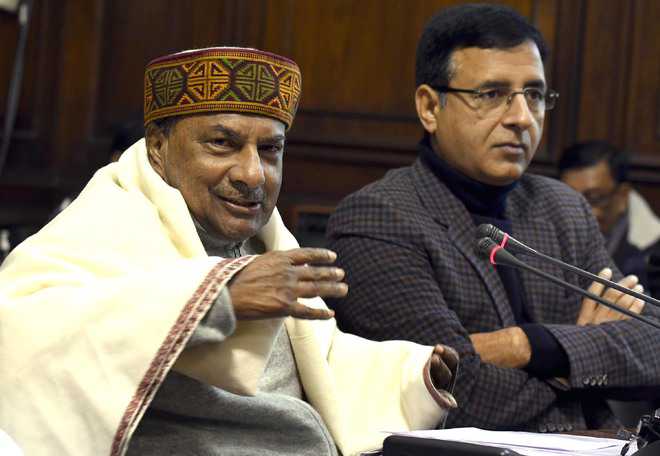
Former Defence Minister and Congress leader AK Antony and Randeep Singh Surjewala in New Delhi on Monday. MR Bhui
Tribune News Service
New Delhi, December 31
Former Defence Minister AK Antony on Monday accused the Narendra Modi government of going soft against Anglo-Italian helicopter maker AgustaWestland and asserted that then Congress president Sonia Gandhi and the present party chief, Rahul Gandhi, never interfered either in the defence deals or in the functioning of the Defence Ministry during his tenure (October 2006-May 2014).
The issue of the AgustaWestland has cropped up as Christen Michel, a UK national, is in custody in India and for allegedly acting as the middleman in the purchase of the 12 VVIP helicopters for Rs 3,600 crore. The purchase was scrapped by the Congress-led UPA regime following allegations of corruption in Italy, the headquarters of AgustaWestland’s mother company Finmeccanica (now named Leonardo). Antony accused the BJP of misusing ‘agencies’ and spreading lies.
“If we had anything to hide (in the AgustaWestland deal) would we have cancelled the contract, would we have ordered a CBI probe, would we have moved international arbitration to encash the back guarantee?” he questioned. Listing out that the deal was scrapped by him after allegations in Italy, he said in February 2013 the process of black listing was started but the company could not be blacklisted till we encashed our bank guarantee.
Antony questioned the functioning of the Modi government which in July 2014 blacklisted Finmeccanica and in August that year removed the same company from the blacklisting.
“Were you acting against the accused or were you helping them?” Randeep Surjewala questioned the BJP. Surjewala asked the BJP to clarify how Goa Chief Minister and former Defence Minister Manohar Parrikar had reportedly told his Cabinet colleagues about being in possession of a file on the Rafale jet deal.
Meanwhile, in the Lok Sabha the Congress said it was ready for a debate on the Rafale jet deal on January 2.
“Jaitley ji has thrown a challenge … we are ready for a debate on January 2. Please decide a time,” Congress Leader in Lok Sabha Mallikarjun Kharge said.
How can entire para be typo’: Mallikarjun Kharge seeks JPC in Rafale deal
Last Saturday, the defence ministry had filed an application before the Supreme Court for the correction of a paragraph in its order on the Rafale jet fighter deal.
“We want a JPC as we’ll only get to know everything when Parliament members sit and look into the files. A JPC was formed in Bofors and 2G cases also. How can there be a typo? Had it been one word it would’ve been understandable, entire paragraph can’t be a typo,” Congress Lok Sabha floor leader Mallikarjun Kharge told ANI on Wednesday.
Last Saturday, the defence ministry had filed an application before the Supreme Court for the correction of a paragraph in its order on the Rafale jet fighter deal.
Though the court’s ruling effectively vindicated the government’s stand that due process had been followed in reaching the Rs 59,000 crore deal, and had said that there was no reason to order a probe by the CBI.
However, the Congress pointed out that the judgment had referred to the government’s stand that the pricing details had been shared with the Comptroller and Auditor General (CAG) of India, and that the government auditor had submitted a redacted report to parliament. It also indicated that parliament’s Public Accounts Committee (PAC) had examined the report.
That error had been picked up by the petitioners and the opposition which had claimed that the government had misled the court with its original submission.
“How does the Supreme Court judgment have this line that Rafale pricing has been examined by the PAC. Now, we have to ask the government, where is this CAG report?” Congress president Rahul Gandhi had said at that time.
The original paragraph in the order (paragraph 25) said: “The pricing details have, however, been shared with the Comptroller and Auditor General (hereinafter referred to as CAG), and the report of the CAG has been examined by the Public Accounts Committee… Only a redacted portion …was placed before the Parliament and is in public domain.”
In its submission asking for a correction, the defence ministry had said that the court seems to have misunderstood it, which was, it added, “in the form of bullet points”. According to the ministry, the “second bullet point” read: “The Government has already shared the pricing details with the CAG. The report of the CAG is examined by the PAC. Only a redacted version of the report is placed before the Parliament and in public domain”.
The petition had argued that the use of the word “is” was “a description of the procedure usually followed” and asked the court to replace “has been” in paragraph 25, which seems to suggest that the act has already taken place, with “is”.
Ideally, of course, the government’s original submission should have used “will be” instead of “is” to make things clear.
“They have given wrong information to the court and on the basis of that information, the court has given its verdict. Now, I will request all the PAC panel members to fix a meeting to summon the attorney general and the Comptroller and Auditor General. We want to ask them when did they submit the Rafale report to the House and when did it come to the PAC, when did they come to give evidence, and when did we present the PAC report to Parliament?” Kharge had said on Saturday.
Responding to Congress’ allegations of misleading the court and over which the party has been stalling the functioning of Parliament, Union law minister Ravi Shankar Prasad had said at that time that the error was a technicality.
“He is going into technicality, I am going on substance. The court verdict is in 34 para(graph)s. It has dealt with all the issues (raised by Rahul). If he (Rahul) wants to find faults to do politics, I have nothing to say,” Prasad had said.
Arun Jaitley had earlier too responded to the Congress’ demands for a JPC saying that the Supreme Court judgement was clear and that the demand for a JPC probe was intended to prevent a discussion in Parliament.
“The creators of falsehood will still persist with falsehood even at the cost of their own credibility. Only their captive constituencies will clap,” he had written in a blog post on his site.
First Published: Dec 19, 2018 14:32 IST
Indian Army chief should know that no one feigns disability
Physical and mental health of the forces is integral to modernisation of the Indian Army.
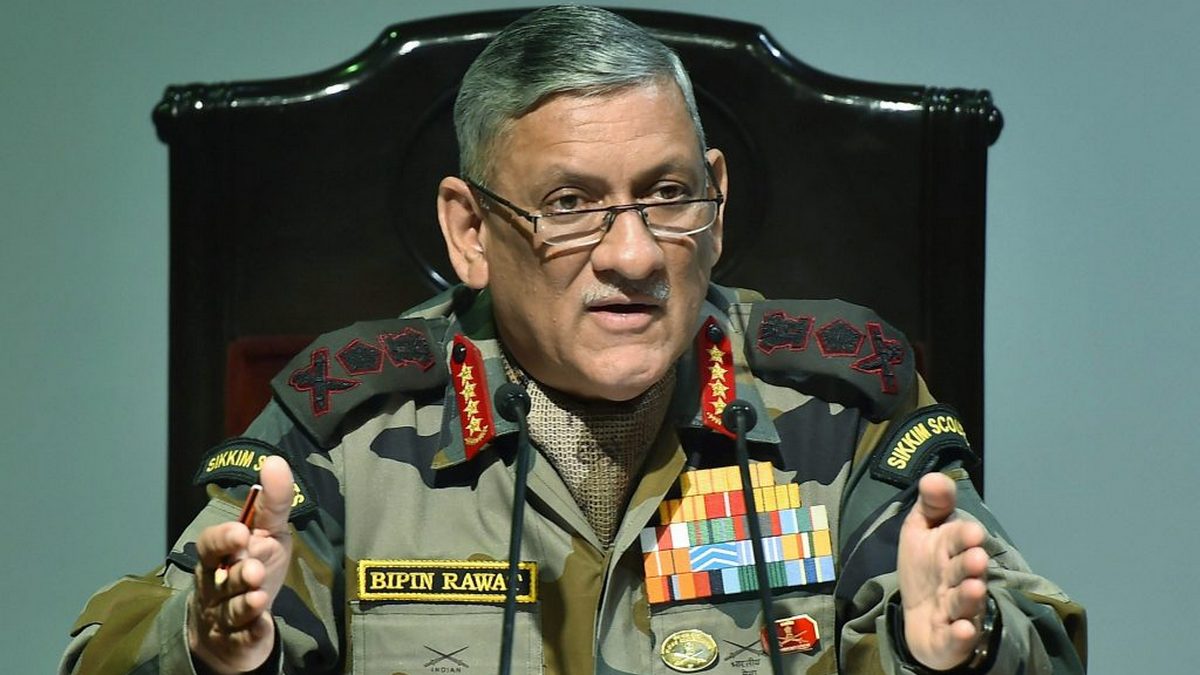
Indian Army chief General Bipin Rawat last Thursday said that the Army is not a job provider, and warned soldiers against feigning disability.
Considering General Bipin Rawat’s audience consisted of disabled veterans and serving soldiers, there is much to be said about the forbearance of these men that they listened. No one feigns disability.
General Bipin Rawat said, “A section of soldiers and officers who call themselves disabled on grounds that they are suffering from high blood pressure, hypertension and diabetes seek concession from being deployed at difficult operational posts.” This is ironic.
Generalisation doesn’t work
It is well-known that officers with such existing conditions (and much of this expresses itself after joining service), who are out on an exercise or deputed in tough, forward or high-altitude, areas may not have access to supportive diets and medical attention. At times, they may not be able to cope with inimical terrain and have collapsed or suffered setbacks and have had to be either sent back or evacuated.
But General Bipin Rawat’s statement on ‘feigning disability’ impacts not only the credibility of the disabled soldier, but also the veracity of institutions such as the Directorate General Armed Force Medical Services (DGAFMS) and the Medical Services Advisory Committee that certify the degree of disability.
Medical conditions such as hypertension are covered by rules as ‘affected by stress and strain of military service’ and also by several judgments of the Supreme Court.
With the advances in modern medicine, ‘feigning disability’ requires a multiple and varied level of collusion. While an odd case may have slipped past the system, generalising feigned disability is disrespectful to both retired and serving personnel.
The Indian Army had declared 2018 as the ‘Year of the Disabled Soldiers in the Line of Duty’, a move that surely does not come too soon.
Over the years, one has seen how cases of disability have been dealt with by the government where the percentage of disability, whether the disability can be attributed to service or not, whether it was a pre-existing condition or not, has been at the discretion of the administrative and financial authorities and the pension wing of the ministry of defence.
That the issue had already been decided by a medical board and approved by the competent authority on the military side of things are of little consequence. This leads to litigation where the matter is taken to court and in the event of the decision being in favour of the litigant, the state shows its upper hand by filing Special Leave Petitions (SLPs) before the apex court. Much of this exercise is usually a waste of public money and, in several cases, the disabled soldier eventually wins his or her case.
Despite the court’s order, there are cases where the government drags its feet in terms of compliance. The forces serve in the toughest of terrains, handle all sorts of equipment, engage constantly with both insurgency and infiltration, and are away from families for long periods. The physical and mental fallout of such deployment is undeniable and leads to both physical and mental disability.
This fact was well recognised by the previous Raksha Mantri who set up a committee of experts to review service and pension matters to minimise litigation and strengthen mechanisms for redressal of grievances. The committee had four retired Generals and an eminent advocate, himself a former military officer, working extensively on disability litigation. In the said report, para 2.2.1 (page 15) specifically focuses on denial of disability benefits by incorrectly branding in-service disabilities as “neither attributable, nor aggravated by service”. The report points out that there is an inherent paradox where all stakeholders agree on granting disability pension, but more often than not this is contested in a court of law due to rigid interpretation of provisions and clauses.
Modernisation in true sense
The world over, disabled soldiers are given immense respect and their due within the system. There is a need to take this learning on board while clamouring for modernisation of the Army because the physical and mental health of the forces is as integral to modernisation as weaponry and equipment. With a steady reduction in the number of young people opting for the armed forces as a career choice, it is important that welfare of forces be demonstrated both in words and in action to attract young people to the Army.
If we want to attract the best young talent to the armed forces, there is a need to demonstrate recognition of the existing conditions of service and an understanding of the fallout it may entail.
Having said that, stating that the Indian Army is not a “means of employment” undermines other avenues of employment. While there is no doubt that the service of the soldier to the nation is most noble, every job serves its role in nation-building. Leaders need to be supportive, and should identify the gaps and build capacity to strengthen institutions.
Judges say delay in case let accused roam free for years; observe ‘law and order machinery had broken down’
NEWDELHI:The role of Delhi police as an investigating agency has yet again come under scanner with the Delhi High Court slamming it for its failure (in 1984) to control anti-Sikh riots that killed 2,733 people and shielding the accused by not registering cases against them.
A bench of Justice S Muralidhar and Justice Vinod Goel stated that there was an “abject failure” of the Delhi police in registering FIRs and probing the cases, which let the accused roam free for several years.
“….it requires to be noticed that this is a case where there was an abject failure by the Delhi Police to conduct a proper investigation and this has already been adverted to extensively hereinbefore,” the court said in its judgment.
The court said that the “law and order machinery had clearly broken down and it was literally a “free for all” situation which persisted. “The aftershocks of those atrocities are still being felt. That many cases remained to be properly investigated was acknowledged recently by the Supreme Court by which it was considered appropriate to constitute a three-member Special Investigating Team (SIT) to proceed to investigate as many as 186 cases in which further investigation had not taken place”.
The judgment also noted that many witnesses, at several occasions, deposed in their statements of how the police did not register an FIR and even if they did, the cases were not investigated fairly.
The court also stated that the police did not prepare the site plan and it was prepared only in 2006, 22 years after the incident.
A site plan is a drawing prepared by the investigating officer to explain the crime spot, which is submitted along with other case papers to the court.
“This is a case based on direct evidence and not circumstantial evidence. Had it been prepared contemporaneously at the earliest point in time, the site plan might have been an important document. In the present case, however, the site plan was prepared in 2006, i.e. 22 years later,” the court noted.
Addressing the issue on the credibility of the witnesses, the court said, “The fact of the matter is that many of these witnesses
were living in fear and had completely lost confidence in Delhi Police and were therefore, unsure about coming forward to speak the truth. They could gather confidence only after the CBI took over the investigation”.
The judge said it was “extraordinary that despite there being as many as 341 deaths in the Delhi Cantonment area alone over the span of four days beginning Nov 1 1984, only 21 FIRs were registered and, of these, only 15 pertained to deaths/murders”.
Terming it to be “strange”, the court said that despite widespread killings in the area, no mention was found in the Daily Diary Register (DDR).
“It is clear, therefore, that in those chaotic conditions, the local police force was inadequate for the task at hand,” the court said adding that there was an utter failure to register separate FIRs with respect to each of the five deaths that form the subject matter of the present appeals.
Judge slams ‘political patronage’
It is important to assure those victims waiting patiently that despite the challenges, truth will prevail and justice will be done. JUSTICE S MURALIDHAR
NEW DELHI: Convicting Congress leader and former MP Sajjan Kumar in the 1984 anti-Sikh riots, the Delhi High Court on Monday criticised political leaders for providing “patronage” by shielding perpetrators and “engineering the riots”.
Justice S Muralidhar said courts required a different approach to deal with the cases as the perpetrators had been aided by an “indifferent law enforcement agency.”
“A majority of the perpetrators of these horrific mass crimes, enjoyed political patronage and were aided by an indifferent law enforcement agency. The criminals escaped prosecution and punishment for over two decades,” justice Muralidhar said.
“It took as many as 10 committees and commissions for the investigation into the role of some of them to be entrusted in 2005 to the CBI, 21 years after the occurrence,” he added.
“The court would like to note that cases of the present kind are indeed extraordinary and require a different approach to be adopted by the courts. The mass killings of Sikhs between 1st and 4th November 1984 in Delhi and the rest of the country, engineered by political actors with the assistance of the law enforcement agencies, answer the description of ‘crimes against humanity’…,” justice Muralidhar said.
The court said that “crime against humanity” was first acknowledged in a joint declaration by Britain, Russia and France on May 28, 1915, against the government of Turkey following the large scale killing of Armenians by the Kurds and Turks with the assistance of the Ottoman administration.
The observations came while deciding a batch of appeals filed by the Central Bureau of Investigation (CBI) and the victims against the acquittal of 73-yearold Kumar in May 2013. The case relates to the killing of five Sikhs in Raj Nagar Part-1 in Palam Colony in southwest Delhi on November 1 and 2, 1984 and burning down of a gurdwara in Raj Nagar Part-2.
Out of the six accused, Kumar was acquitted, five others were convicted for armed rioting and murder. The accused had also appealed their conviction and quantum of sentence.
The court also said that it was impossible to proceed against Sajjan Kumar in the normal scheme of things because of the ongoing large-scale efforts to suppress cases against him by not recording or registering them.
The judge added that the criminal justice system stands “severely tested” in the process of trial and it is essential in a democracy governed by the rule of law to be able to call out those responsible for such mass crimes.
A much-needed balm for victims after 34 years of tortuous battle
THE SENTENCING WILL NOW ADD SPEED AND HOPE TO THE OTHER CASES THAT ARE STILL BEING INVESTIGATED
NEW DELHI: From late-evening of October 31 to November 3 in 1984, a daughter saw her father being set on fire, a wife looked on helplessly as her husband and son were dragged by lumpens and bludgeoned to death with iron rods and a brother lost three siblings. He identified them from the watch one was wearing and the other two, from their half-burnt clothes.
Daughter Nirpreet Kaur, wife Jagdish Kaur and brother Jagsher Singh have lived a wretched life in the pursuit of justice, perhaps because their claim is that they saw a powerful Congressman and Member of Parliament of the area, Sajjan Kumar, exhort the mob and order the killing of Sikhs in the Raj Nagar locality, in Palam Colony.
Finally, after a long wait of 34 years, justice has knocked on their door. Until then, each of the three variously approached the police and the many commissions of inquiry to give a first-hand, ‘I witnessed the carnage’ account, but it stayed buried in affidavit after affidavit.
For them, revisiting 1984 was always a painful memory; the denial of justice a second stab in the heart.
They say that they saw Sajjan Kumar, and heard him, saying, “Ek bhi sardar zinda nahi bachna chahiye… en sardaron ko maro, enhone hamari maa ko mara hai,” (not even one Sikh should be spared. Kill them, they have killed our mother), but till the year 2011, no court of law even heard their testimonies.
As their lawyer, HS Phoolka once said: “Whenever it came to commissions of inquiry, Sajjan Kumar’s name appeared prominently, but whenever it went to the police, his name disappeared.”
If today, Sajjan Kumar stands convicted, it is because the Central Bureau of Investigation (CBI) and not the police was the investigating and prosecuting agency.
The Congress leader was acquitted by the lower court, even though the public prosecutor RS Cheema, in his concluding remarks in the session’s court, said that the riots were a conspiracy of terrifying proportions that indict the police.
Simply put, his argument was that the men in uniform took the side of the rioters.
According to police rules, all movements of police officers are recorded minute by minute in the thana daily diary but the diaries for those days were totally blank. In Raj Nagar, specifically, Jagdish says she saw the chowki in-charge applaud the mob and ask them, ‘kitne murge bhun diye’ (how many Sikhs have you roasted). All this, while the bodies of her husband and son lay nearby. The policemen did the same in Delhi Cantt, tagging over 30 deaths, including Nirpreet’s father, Nirmal Singh, into a single FIR.
Sajjan Kumar’s name was never put in the list of the accused and the summons for Nirpreet were sent to an address that never belonged to her.
Respite for the victims came only after the Nanavati Commission submitted its report in 2005 and concluded that there was ‘credible evidence’ against Sajjan Kumar.
Affidavits filed by Jagsher and Jagdish finally counted for something. The case against Kumar was entrusted to the CBI.
They stood strong, through the threats and the lure to turn hostile.
The pressure was so acute and the frequency of threats so alarming, the victims applied for police protection; and they couldn’t be from the Delhi police. The CBI director finally wrote to the DGP Punjab and got them gun-toting policemen who would shadow them to court.
It is important to detail each step that derailed justice for over three decades.
Finally, the CBI secured the testimony of a joint secretary in Delhi government’s home department, who told the court that the director of prosecution had signed off on a file, saying the sanction to prosecute Kumar should not be granted.
With Kumar’s conviction, the thousands who still await justice can hold on to some hope.
The same evidence did not hold good in the sessions court, but with the High Court reversing that order, the victims can breathe easy in the belief that even though justice was delayed, it was not entirely denied.
The victims spent close to a life time testifying to Kumar’s role. He has now been sentenced to life imprisonment in a strong judgement in which the court held that the accused ‘enjoyed political patronage.’
Kumar’s sentencing will now add speed and hope to the many other cases that are still being investigated. 1984 saw the worst riot —many like to call it genocide —in which over 3000 Sikhs were brutally killed.
For all those who witnessed these deaths, the judgement comes as a long needed balm.
SIT probing 2 other cases against Sajjan
NEWDELHI:The Central Bureau of Investigation (CBI) case of the five murders during anti-Sikh riots in west Delhi’s Raj Nagar, in which senior Congress leader Sajjan Kumar was convicted on Monday, is not the only case in which the former parliamentarian is said to be involved.
A three-member special investigation team (SIT), formed to reinvestigate the cases of the 1984 anti-Sikh riots, is probing Kumar’s alleged role in two other cases. One of them includes the murders of a man and his son in west Delhi. The Ministry of Home Affairs (MHA) had constituted the SIT in 2015.
The two cases are among the eight that the SIT reopened for investigation. An official said Kumar has already been interrogated twice during the probe. He was last interrogated by the team in March last year.
An official said the case is related to the murder of Jaswant Singh and his son, Hardeep. Singh’s wife, Dajleet Kaur, is an eyewitness. The woman in her statement to the police in 1991 has reportedly accused Kumar of instigating the mob to attack the Sikhs in her neighbourhood.
Delhi Police had registered the case in 1991 but closed the probe in 1993.
“This is an important case against Kumar. This is the one case in which there is an eyewitness. The team is yet to file a chargesheet in court. In the two other cases, too, his role has come up but the evidence in the third case is not very strong,” an official familiar with the case details said on condition of anonymity.
In 2015, after the SIT was formed, the team re-examined 293 cases which were closed by the Delhi Police. Of the 293 cases, the team filed closure reports in 233 cases, citing lack of evidence. In 52 cases, the team filed reports in which the victims or the accused were not traced and started probe in eight cases. Of the eight cases, the police filed a chargesheet in five, while the remaining three are pending investigation. Kumar is one of the alleged accused in these three cases.
In November, a city court awarded death sentence to man for the murder of two men in south Delhi’s Mahipalpur on November 1, 1984. This was one of the five cases in which the police had filed a chargesheet.
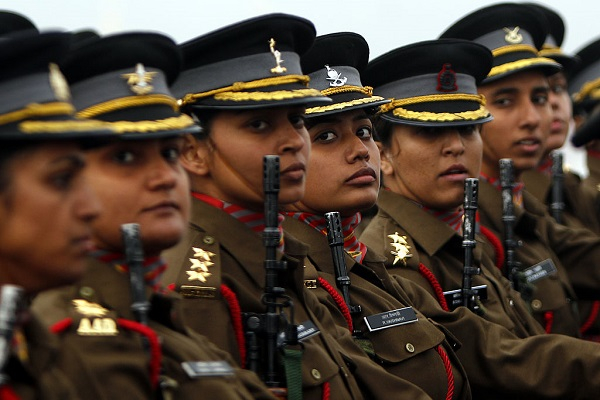
Permanent Army Commission For Women Soon? Army To Open Six New Branches, Proposal Sent To MoD
Women officer contingent of Indian Army (Arun Sharma/Hindustan Times via Getty Images)
Indian Army has planned to open six more branches for the permanent commission of women, and a letter has been sent to Ministry of defence regarding the same.
The government is likely to announce it after the winter session of parliament which begins from 11 December, as reported by New Indian Express.
As of now, women officers are appointed in the legal, medical, education, signals and engineering branches of the Army. New opportunities include image interpreter, cyber and IT, language specialist and service board.
The army’s plan comes after Prime Minister Narendra Modi’s speech on Independence Day that more opportunities for women will be created in the Army. “Women officers commissioned in short service will get opportunity for permanent commission like their male counterparts. This is my gift to the women of this country today,” said Modi.
Also, the Army has plans to induct women at the jawan rank. Army chief General Bipin Rawat said that 100 women soldiers would be recruited into the military police as jawans.
Women were inducted into the Army Education Corps and the Judge Advocate General Branch without cabinet or Parliament approval. This time, too, the government will not be required to give its go-ahead, claimed the report.
Currently, women are appointed as the Short Service Commissioned officers from the Officers Training Academy, Chennai. They can serve up to 14 years.
Rafale: No commercial favouritism, rules SC while rejecting court-monitored probe
C declines probe into Rafale fighter jet deal with France.
Satya Prakash
Tribune News Service
New Delhi, December 14
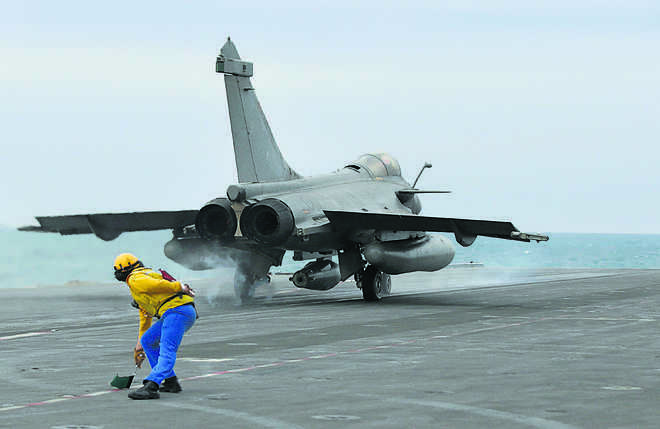
In a big relief to the Narendra Modi government, the Supreme Court on Friday dismissed petitions seeking a court-monitored probe into the purchase of 36 Rafale fighter jets from France under an inter-government agreement.
A Bench of Chief Justice of India Ranjan Gogoi, Justice Sanjay Kishan Kaul and Justice KM Joseph said there were no irregularities in the deal and the decision making process for the purchase 36 Rafale fighter jets from Dassault was above board.
The court said the need for fighter jets and Rafale’s quality we’re never under question and it was not the court’s job to get into comparative pricing details.
“We cannot go into the wisdom of why the deal for 36 Rafale jets was made and not the original 126 aircraft. We cannot ask the government to go for 126 aircraft,” the Bench said.
For the first time, four senior IAF officers – three Air Marshalls and an Air Vice Marshall – and Additional Secretary (Defence) had appeared in the top court to explain various aspects of a defence deal.
CJI Gogoi had asked several questions about previous acquisitions, which generation of aircraft IAF was using. Air Vice Marshall J Chalapathi had told the Bench that the last acquisition was Sukhoi-30 and before that Mirage Aircraft were bought in 1985.
He had said while most of the countries were using 4th and 5th generation fighter planes, IAF was using 3rd or sub-4th generation (3.5) aircraft.
“Our country can’t remain unprepared when adversaries have acquired 4th & 5th generation fighter jets compared to none by India. We have interacted with senior Indian Air Force officers and there is no doubt about need and quality of Rafale jets,” the Bench said.
It’s not correct for the court to sit as an appellate authority on every aspect of the deal,” the Bench added.
Terming it “unfortunate”, Prashant Bhushan, cousel for one of the petitioners said, “It’s a totally incorrect judgment given by the Supreme Court.”
The top court had reserved the verdict on November 13 on the contentious issue after hearing arguments from counsel for the petitioners, including Prashant Bhushan, senior journalist Arun Shourie and Attorney General KK Venugopal who had defended secrecy clause of the deal estimated to be of Rs 58,000 crore.
Alleging irregularities in the deal, petitioners ML Sharma, Prashant Bhushan, Vineet Dhanda and Sanjay Singh had demanded registration of an FIR and a court-monitored investigation into it.
Following the court’s October 31 order, the Centre had submitted in a sealed cover the pricing details of 36 Rafale jets.
The process of acquisition had started in 2001 and India was to purchase 126 Medium Multi Role Combat Aircraft (MMRCA) but the contract negations reached a stalemate and Request for Proposal compliance was finally withdrawn in June 2015. During the protracted process India’s adversaries modernized their combact capabilities, the AG had submitted.
It was in this background that India signed an agreement with France in September 2016 for the purchase of 36 Rafale fighter aircraft in a fly-away condition as part of upgrading process of the Indian Air Force equipment.
It has better deliverables, the AG had said, adding norms prescribed under Defence Procurement Policy -2013 were followed.
The Bench said, “Minor variations in clauses should not amount to setting aside of the Rafale jet deal.
The Bench agreed with Attorney General’s argument that the decision on types of aircraft and weapons needed to be procured was a matter for experts and could not be adjudicated upon by the judiciary.
In its first reaction on the Supreme Court dismissing all petitions seeking a review of the Rafale jet purchase, the Congress on Friday said the apex court was limited by constitutional provisions to get into pricing issues and only a parliamentary probe can look at that.
Not giving up on the issue despite the court saying there was no reason to doubt the deal the Congress reiterated its demand for a JPC into the purchase repeating its old allegations of corruption and nepotism in favour of the Anil Ambani led Reliance Defence which got the offset contract in the deal with the French jet maker Dassault Aviation.
Even as the BJP fielded senior ministers to demand an apology from Congress President Rahul Gandhi for “fear mongering” around the deal the Congress media head Randeep Surjewala said the ruling party will have to answer why the jet originally priced low was eventually bought at three times the previous cost.
“The issue is of corruption, which the government will have to answer. We demand a JPC. The government must tell why HAL was dropped as the partner and transfer of technology clause of the original deal compromised; why a fledgling private company was given a major contract and how the deal was a government to government deal when France didn’t even give a sovereign guarantee and sufficed to give a letter of comfort for the deal,” said the Congress.
Gandhi have instructions to Surjewala to keep the Rafale pot boiling with Surjewala saying “PM Narendra Modi should order a JPC if he has nothing to hide.”
Rahul should apologise: Rajnath
Union Home Minister Rajnath Singh has asked the Congress and its president Rahul Gandhi to apologise to the Parliament for “misleading” the nation and causing
“damage” to the country’s international reputation when levelling allegations on the purchase of the Rafale fighter jets.
Outside the House, Congress MP Shashi Tharoor dismissed the demand for an apology saying “there will be no apology. We need to establish the truth as tax payers money is involved”.
Inside the House, Speaker Sumitra Mahajan did not allow Mallikaarjun Kharge to speak till Congress leaders were protesting in the Well of the House and did not return to their seats. A visibilily angry Kharge said the party was demanding a JPC.
Anil Ambani welcomes decision
Reliance Group Chairman Anil Ambani had welcomed the Supreme Court order, saying it established the falsity of politically motivated allegations against his firm.
In its ruling on a batch of petitions seeking a probe into the deal, the apex court said there was no occasion to doubt the decision-making process in the procurement of the 36 Rafale fighter aircraft from France.
Dassault Aviation, the makers of Rafale, had entered into an agreement with Ambani’s Reliance Defence Ltd (RDL) for fulfilling offset obligations.
“I welcome the judgment of the Hon’ble Supreme Court today summarily dismissing all PILs filed on the Rafale contracts, and conclusively establishing the complete falsity of the wild, baseless and politically motivated allegations levelled against Reliance Group and me personally,” Ambani said in a statement.
DATEWISE PROGRAMME : MILITARY FESTIVAL CHANDIGARH :2018
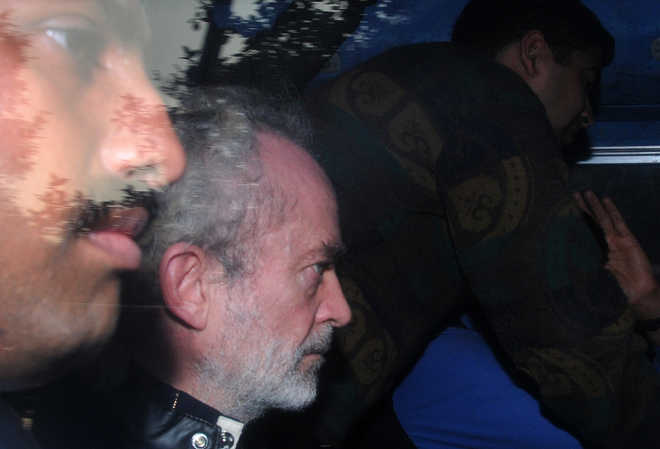
CBI takes Christian Michel, the alleged middleman in the Rs 3,600-crore AgustaWestland VVIP chopper deal, to the Patiala House Court in New Delhi on Wednesday. Tribune photo: Mukesh Aggarwal
Tribune News Service New Delhi, December 5
Patiala House Court remanded British national Christian Michel in Central Bureau of Investigation’s custody for five days on Wednesday over charges of corruption in the Rs 3,600-crore AgustaWestland VVIP chopper deal.
Michel is one of three suspected middlemen in a deal that both CBI and Enforcement Directorate are investigating for financial irregularities. Michel was extradited from Dubai late on Tuesday night and brought in for questioning.
Special CBI judge Arvind Kumar rejected Michel’s bail application on the ground that the case was complex.
Prosecution argued that CBI needed Michel’s custody to question him about the case, including details of possible kickbacks to senior politicians and officers, and to help them uncover a money trail.
Security was tightened at the Patiala House Court complex before Michel was brought in.
Around 15-20 personnel of the CRPF and 30 Delhi Police officials were deputed in the court complex as well as outside several of its gates, said one of the police officials.
Michel, 54, landed at the Indira Gandhi International Airport on a Gulfstream jet at 10.35 pm on Tuesday after which he was arrested by the CBI in connection with the case.
The other suspected middlemen being investigated are Guido Haschke and Carlo Gerosa.
Both CBI and ED had an Interpol red notice (RCN) issued against Michel after a court issued a non-bailable warrant against him.
The CBI has alleged there was an estimated loss of euro 398.21 million (approximately Rs 2,666 crore) to the exchequer in the deal that was signed on February 8, 2010 for the supply of VVIP choppers worth euro 556.262 million.
The Enforcement Directorate (ED), in its chargesheet filed against Michel in June 2016, had alleged that he received euro 30 million (about Rs 225 crore) from AgustaWestland.
The money was nothing but “kickbacks” paid by the firm to execute the 12-helicopter deal in favour of the firm in “guise of” genuine transactions for performing multiple work contracts in the country, according to the charge sheet.
The ED investigation found that remittances made by Michel through his Dubai-based firm Global Services to a media firm he floated in Delhi, along with two Indians, were made from the funds which he got from AgustaWestland through “criminal activity” and corruption being done in the chopper deal that led to the subsequent generation of proceeds of crime.
On January 1, 2014, India scrapped the contract with Italy-based Finmeccanica’s British subsidiary AgustaWestland for supplying 12 AW-101 VVIP choppers to the IAF over alleged breach of contractual obligations and charges of paying kickbacks of Rs 423 crore by it for securing the deal.
The CBI on September 1, 2017, had filed a charge sheet in the case in which Michel was named as one of the accused.
Former IAF chief SP Tyagi was also chargesheeted by the CBI in a Delhi court along with nine others in connection with a bribery case in the VVIP chopper deal.
Tyagi (73) is the first chief of the Indian Air Force to be chargesheeted in a corruption or a criminal case by the CBI and he has denied all charges against him.
Besides him, the agency has also chargesheeted retired Air Marshal JS Gujral along with eight others, including five foreign nationals, in the charge sheet filed before the Special CBI Judge.
Anglo-Italian company, AgustaWestland, is also one of the accused.
Others named in the charge sheet are—Tyagi’s cousin Sanjeev alias Julie, advocate Gautam Khaitan, alleged European middlemen Carlo Gerosa, Christian Michel, Guido Haschke, former AgustaWestland CEO Bruno Spagnolini and former Finmeccanica chairman Giuseppe Orsi.
They have been chargesheeted for offences under the Prevention of Corruption Act and the IPC in the case relating to the alleged bribery of Rs 450 crore.
Tyagi, who had retired in 2007, his cousin Sanjeev and Khaitan were arrested on December 9 last year by the CBI in the case. These accused are currently on bail.
Michel has denied the charges against him.
Meanwhile, when UK High Commission was asked about whether they had consular access to Michel, the commission’s spokesperson told The Tribune: “Our staff continues to support the family of a British man following his detention in the UAE. We are in contact with his family and the Emirati authorities regarding his case, and are urgently seeking information from the Indian authorities on his circumstances”. WithPTI
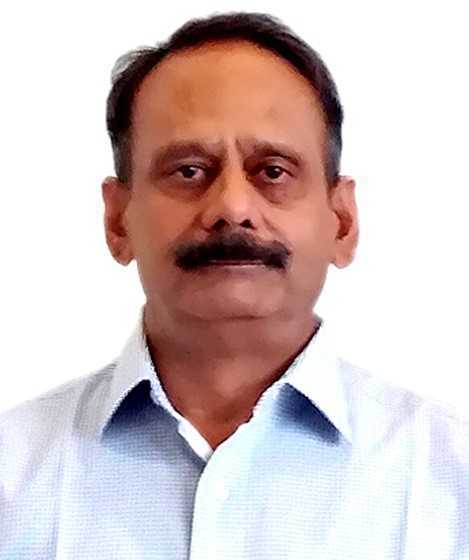
Harishwar Dayal, 1981 batch Indian Defence Service of Engineers (IDSE) officer, has been appointed as the Director General (Personnel), Military Engineer Services, at the Army Headquarters.
Prior to this appointment, he was posted Additional Director General (Projects) in Chennai, responsible for works in entire Coast Guard, all Ordnance Factories, all DRDO labs, modernisation of central ordnance depots and some major Army installations.
An alumnus of the Indian Institute of Technology, Kanpur, he is credited with the construction of highly specialised storage and handling facilities for missiles and different type of fuels for the first time in the country while working directly under Dr APJ Abdul Kalam, who was then the DRDO chief. He also constructed the first Aakash Missile Test Bed and compressed air facilities for trial of missile engine and various other special facilities and prestigious projects. — TNS
KARTARPUR: Punjab state minister Navjot Singh Sidhu was clearly the man of the match at the groundbreaking ceremony here for the Kartarpur corridor on Wednesday, with Prime Minister Imran Khan joking the former cricketer would easily win if he contested elections in Pakistan.
AFP■ Pakistan PM Imran Khan addresses the gathering at the groundbreaking ceremony in Kartarpur.
Sidhu was at Khan’s side along with Indian ministers Harsimrat Kaur Badal and Hardeep Singh Puri, with Pakistan Army chief Gen Qamar Javed Bajwa standing behind, as the premier inaugurated work on the corridor. Sidhu later sat beside Khan and foreign minister Shah Mahmood Qureshi at a public gathering, sharing smiles and pleasantries.
Several speakers referred to Sidhu and every mention drew loud cheers from the audience, which included a large number of Indian and Pakistani Sikhs.
Bajwa first spoke of Pakistan’s plans to open a corridor to Kartarpur Gurdwara when he met Sidhu at Khan’s swearing-in in August, but the former cricketer faced criticism on his return to India for having hugged the Pakistan Army chief.
Pakistan’s religious affairs minister Noor-ul-Haq Qadri referred to the “historic hug” in his speech and said: “If there were more such hugs, a lot of our problems would be solved.”
Sidhu, clad in a purple turban and matching kurta, was effusive in his praise of Khan in a speech peppered with several Punjabi couplets and passages from the Guru Granth Sahib. “When the history of the Kartarpur corridor is written, the name of Imran Khan will be written on the first page and in the first line.”
During his speech, Khan said he was inspired by the verses recited by Sidhu and read out a Punjabi couplet by Pakistani poet Munir Niazi. “I was affected by what Sidhu said. I didn’t know he knows so much about Sufi poetry,” he said.
Khan also joked about Sidhu’s electoral prospects in the country.
“What crime did Sidhu commit by coming here? And Sidhu, let me tell you one thing — from what I’ve been seeing since yesterday, you can come and contest elections here in Pakistan and you will win, especially in Punjab,” he said.
Referring to the need for strong and determined leadership in India and Pakistan to resolve problems, Khan said there were two types of politicians — those with big visions who take chances and those who are scared and worried about vote banks. “I hope that we will not have to wait till Sidhu becomes prime minister to have friendship between India and Pakistan,” he said to loud laughter.
State Stalwarts
ALL HUMANS ARE ONE CREATED BY GOD
HINDUS,MUSLIMS,SIKHS.ISAI SAB HAI BHAI BHAI
CHIEF PATRON ALL INDIA SANJHA MORCHA
LT GEN JASBIR SINGH DHALIWAL, DOGRA
SENIOR PATRON ALL INDIA SANJHA MORCHA
MAJOR GEN HARVIJAY SINGH, SENA MEDAL ,corps of signals
.
.
PATRON ALL INDIA SANJHA MORCHA
MAJ GEN RAMINDER GORAYA , CORPS OF
sanjhamorcha303@gmail.com
PRESIDENT SOUTH ALL INDIA SANJHA MORCHA
COL SS RAJAN BOMBAY SAPPERS,
PRESIDENT SAS NAGAR ALL INDIA SANJHA MORCHA
GROUP CAPT AMARJIRT SINGH
PRESIDENT UTTARAKHAND ALL INDIA SANJHA MORCHA
COL B M THAPA ,BENGAL SAPPERSS
PRESIDENT HARAYANA STATE CUM COORDINATOR ESM
BRIG DALJIT THUKRAL ,BENGAL SAPPERS
PRESIDENT TRICITY
COL B S BRAR (BHUPI BRAR)
PRESIDENT CHANDIGARH ZONE
COL SHANJIT SINGH BHULLAR
.
.
PRESIDENT PANCHKULA ZONE AND ZIRAKPUR
COL SWARAN SINGH
joint PRESIDENT SAS NAGAR (MOHALI)
COL BALBIR SINGH , ARTY
INDIAN DEFENCE FORCES
DEFENCE FORCES INTEGRATED LOGO
FORCES FLAGS
15 Th PRESIDENT OF INDIA SUPREME COMMANDER ARMED FORCES
Droupadi Murmu
DEFENCE MINISTER
Minister Rajnath Singh
CHIEF OF DEFENCE STAFF (2nd)
General Anil Chauhan PVSM UYSM AVSM SM VSM
INDIAN FORCES CHIEFS
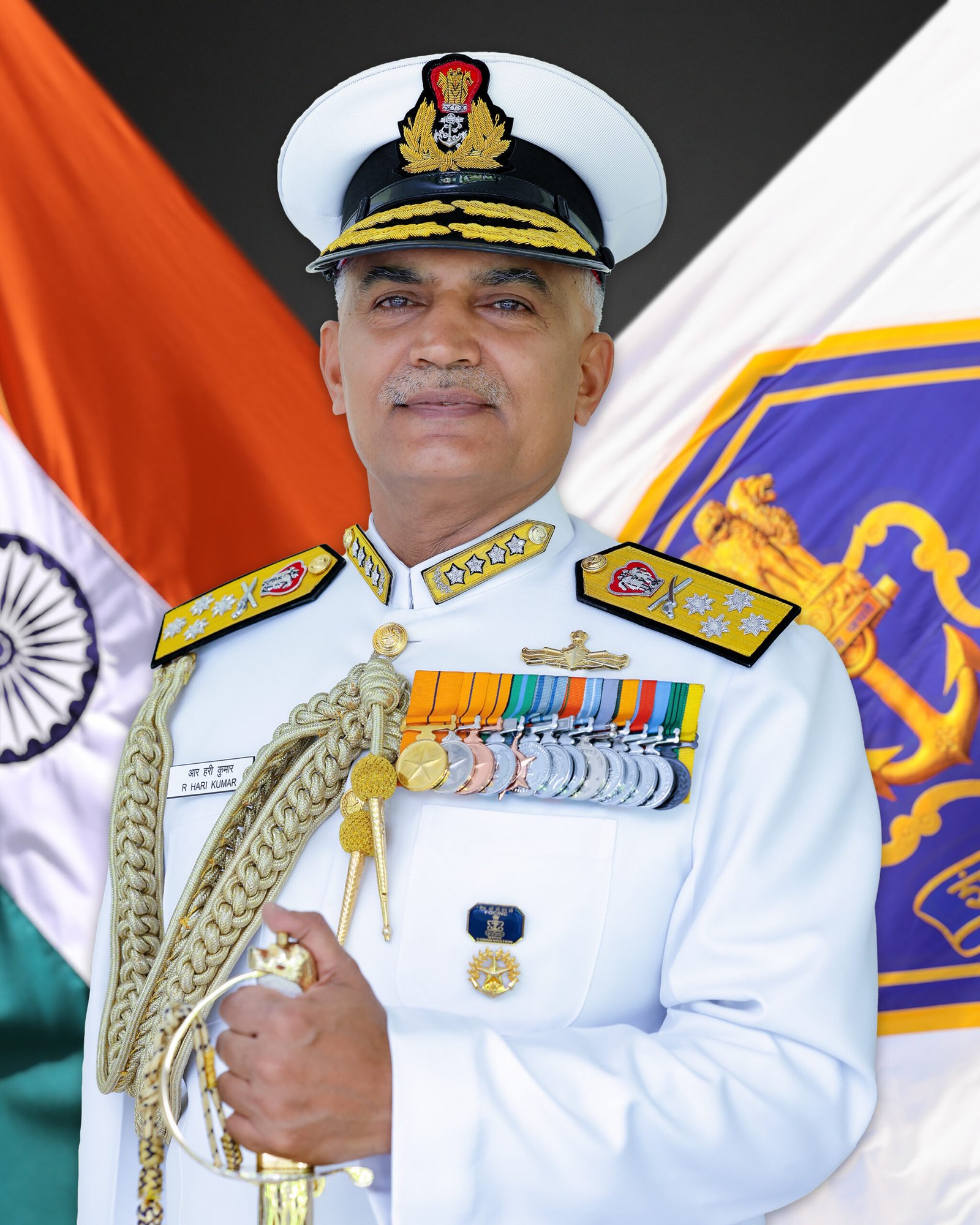
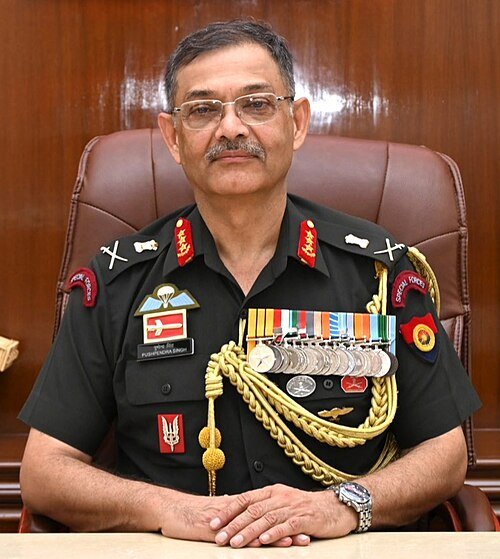
CHIEF OF ARMY STAFF(29th)
General Upendra Dwivedi, PVSM, AVSM (30 Jun 2024 to Till Date)