Sanjha Morcha

What’s New

Click the heading to open detailed news

Current Events :

web counter

Print Media Reproduced Defence Related News

Budgam chopper crash IAF should punish those responsible for ‘friendly fire’

Budgam chopper crash

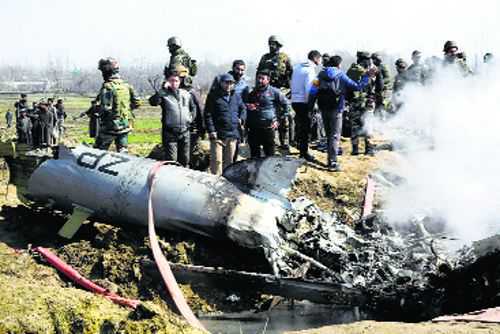
A day after the February 26 Balakot airstrike, an Mi-17 helicopter of the IAF crashed at Budgam in Kashmir. All six IAF personnel on board and a civilian on the ground were killed, including a young Squadron Leader from Chandigarh, Siddharth Vashisht. The tragic incident was reduced to a footnote amid the euphoria over the retaliatory aerial action and the release of Wg Cdr Abhinandan Varthaman from Pakistan’s custody. With the ongoing inquiry indicating that lapses led to the crash, the IAF has set the ball rolling by removing the Air Officer Commanding of the Srinagar air base.

The helicopter was downed by a surface-to-air missile of the IAF itself, even as the air defence system was on the highest alert after the airstrike. The incident happened around the time Indian and Pakistani jets were engaged in a dogfight over Nowshera in J&K. It is shocking that the IFF (Identification, Friend or Foe) system, which automatically transmits a unique identification signal, was switched off on the Mi-17. The probe should pinpoint who all were responsible for not following the mandatory procedures despite strict instructions from the Air Force Headquarters. It’s also imperative to ascertain whether it was just an accident that happened in the fog of war or someone misguided the pilot. Importantly, the Barnala-based node of the IAF’s Integrated Air Command and Control System (IACCS), which was tracking the aerial skirmish and collating information from radars, unmanned aerial vehicles and surveillance planes, had not marked this helicopter as an ‘intruder’.

The Budgam episode has remained shrouded in mystery for almost three months. It has been an agonising wait for the victims’ families, who want to know — as does the entire nation — what exactly went wrong that fateful day. As soon as the investigation is completed and accountability fixed at various levels, the truth — no matter how unpalatable — should be made public. Taking the disturbing matter to its logical conclusion is a litmus test for the IAF, whose credibility is at stake.


US approves sale of 24 MH 60 Romeo Seahawk helicopters to India

US approves sale of 24 MH 60 Romeo Seahawk helicopters to India

India has been in need of these formidable anti-submarine hunter helicopters for more than a decade now.

Washington, April 3

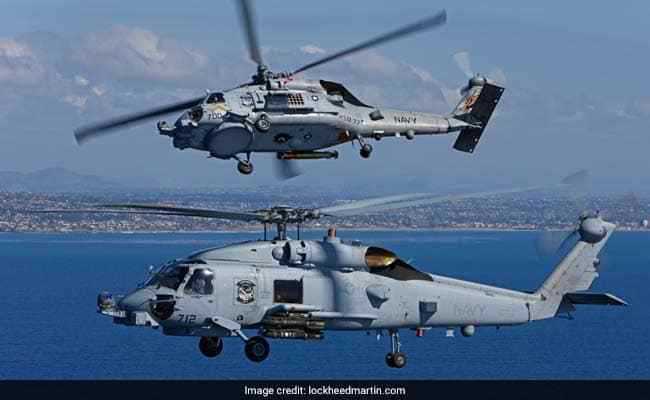
The US has approved the sale of 24 multi-role MH-60 ‘Romeo’ Seahawk helicopters to India at an estimated cost of USD2.4 billion, the State Department has said.

India has been in need of these formidable anti-submarine hunter helicopters for more than a decade now.

Designed for hunting submarines as well as knocking out ships and conducting search-and-rescue operations at sea, the Lockheed Martin-built helicopters, would replenish India’s ageing fleet of British-made Sea King helicopters.

The Trump Administration on Tuesday notified the Congress that it had approved sale of 24 MH-60R multi-mission helicopters, which would provide the Indian defence forces the capability to perform anti-surface and anti-submarine warfare missions.

In its notification, the State Department told the Congress that the proposed sale would support the foreign policy and national security of the US by helping to strengthen the US-Indian strategic relationship.

The sale, at an estimated cost of USD 2.4 billion, would improve the security of a major defensive partner which continues to be an important force for political stability, peace and economic progress in the Indo-Pacific and South Asia region, it said.

“The proposed sale will provide India the capability to perform anti-surface and anti-submarine warfare missions along with the ability to perform secondary missions, including vertical replenishment, search and rescue and communications relay,” said the Congressional notification.

India would use the enhanced capability as a deterrent to regional threats and to strengthen its homeland defence, the notification said, adding that India would have no difficulty absorbing these helicopters into its armed forces.

The proposed sale of this equipment and support would not alter the basic military balance in the region, it said.

Currently deployed with the US Navy as the primary anti-submarine warfare anti-surface weapon system for open ocean and littoral zones, the helicopters are considered the world’s most advanced maritime helicopter.

According to industry experts, it is the most capable naval helicopter available today designed to operate from frigates, destroyers, cruisers and aircraft carriers.

MH-60 Romeo Seahawks would add lethal capabilities of the Indian Navy which, experts say, is the need of the hour given the aggressive behaviour of China in the Indian Ocean region.

According to US Naval Air System Command, the MH-60R Seahawk missions are anti-submarine warfare, anti-surface warfare, surveillance, communications relay, combat search and rescue, naval gunfire support and logistics support.

As the Navy’s next-generation submarine hunter and anti-surface warfare helicopter, the MH-60R Seahawk is considered the cornerstone of the Navy’s Helicopter Concept of Operations. PTI


Tearful adieu to Sqn Ldr Vashisht

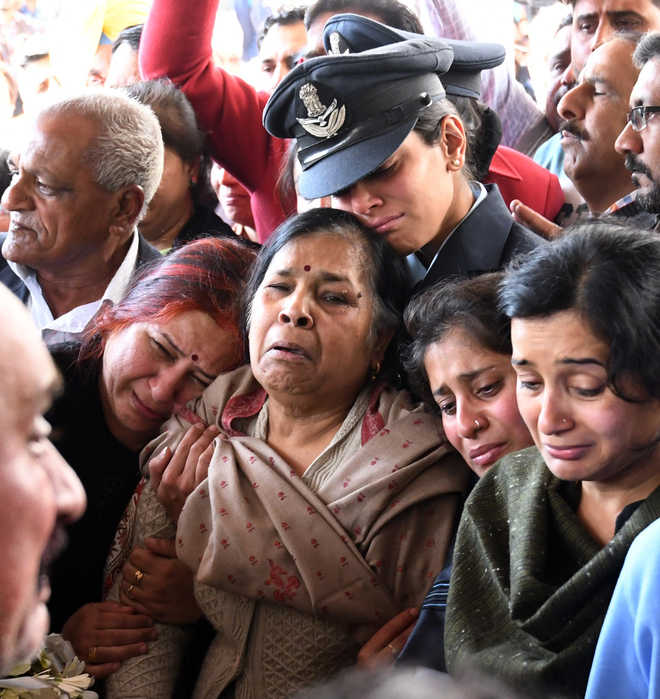
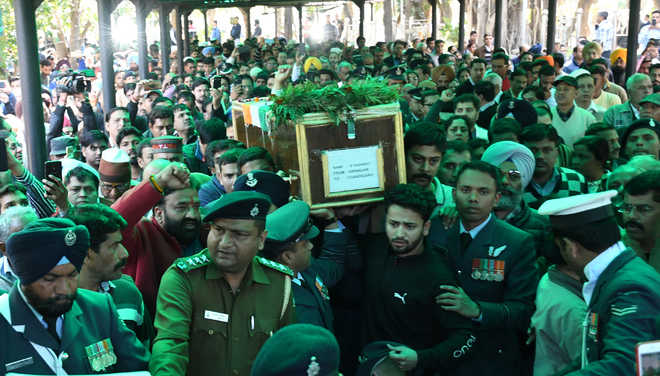
Squadron Leader Aarti Singh, wife of Squadron Leader Siddharth Vashisht, who was among the six personnel killed in a chopper crash near Budgam in J&K, and other family members during his cremation at Sector 25, Chandigarh, on Friday.

Tribune News Service
Chandigarh, March 1

The mortal remains of Squadron Leader Siddharth Vashisht, who died in the Mi-17 helicopter crash near Srinagar on February 27, were consigned to flames with military honours here on Friday.

A large number of people, including senior defence and civilian officers and political leaders, were present to bid the final adieu to the airman.

Wreaths were laid on his Tricolour-draped coffin on the behalf of Chief of the Air Staff, Air Officers Commanding-in-Chief of the Western Air Command and the Maintenance Command, Air Officers Commanding Advance Headquarters, 12 Wing and No. 3 Base Repair Depot, Station Commander High Grounds and the Commanding Officer of 154 Helicopter Unit to which the Siddharth Vashisht was posted.A ceremonial guard reversed arms as a mark of respect while a bugler sounded the Last Post. A three-shot volley was also fired in salute.

His wife Squadron Leader Aarti Singh, who was also posted at Srinagar, also laid a wreath. His father Jagdish Kasal lit the pyre. The mortal remains were airlifted from Srinagar to Chandigarh last evening.The officer is survived by a two-year-old son. He was the youngest of four siblings. Before being commissioned into the Air Force in 2010, he had studied at Shivalik Public School, Sector 41, and DAV College, Sector 10.

Siddharth was posted to Srinagar in July last year and prior to this, he was based in Coimbatore. He was also part of the IAF rescue operations during floods in Kerala.

Members of his family said he had received a commendation for his services on January 26, besides other awards.

The family belongs to Hamidpur village near Naraingarh and had shifted to Chandigarh some time ago. Siddharth’s father had served in the Army before becoming a bank officer. His grandfather and great-grandfather were also soldiers.

A large number of relatives, well-wishers and colleagues paid their last respects to the officer.

Yesterday, top functionaries of the UT Administration, including the Governor, the Adviser to the UT Administrator, the Director General of Police, the Deputy Commissioner and the Senior Superintendent of Police, had offered condolences to the bereaved family.


A battle viewed through colonial prism by7 Aveek Sen

ndian soft power is projected across the world by Bollywood, which is immensely popular both in Afghanistan and the Pashtun belt of Pakistan. Most people, be it in India, Pakistan or Afghanistan, have a better sense of history through popular culture rather than through books. Kesari only serves to pin the blame for British occupation of Afghan lands on Indians.

A battle viewed through colonial prism

Perspective: Though Kesari doesn’t outrightly vilify the ‘other’ (Afghans), one would still identify with the ‘us’ (Sikh regiment) due to the style of narration.

Aveek Sen
Journalist working on cyber security and geopolitics of India’s neighbourhood

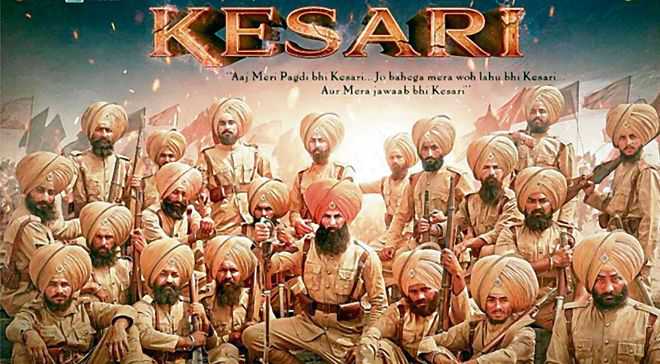
AKSHAY Kumar’s movie Kesari is about the Battle of Saragarhi, fought between Afghan tribesmen and the 36th Sikhs regiment of the British Indian Army in 1897. While the battle showcased Sikh valour, it served British imperial interests and should not have been glorified.

The movie starts off with the narration that following the decline and fall of the Sikh empire, which had extended till Afghan lands, the British took control of the three forts of Lockhart, Gulistan and Saragarhi. From time to time, mullahs (Islamic clerics) would incite Afghan tribesmen to wage jihad.

Saragarhi is situated in Khyber Pakhtunkhwa province of Pakistan. Khyber Pakhtunkhwa was known as the North West Frontier Province during the Raj. The area is considered to be occupied territory, and till date Afghanistan does not accept the borders the British drew through Afghan and Pashtun land. The region of the Gandhara civilisation had been predominantly inhabited by the Pashtuns not only during the few centuries after the creation of the modern Afghan state by Ahmad Shah Durrani, but also for thousands of years. The Durand Line border drawn through the Afghan heartland is a colonial British creation and Indians should not be sharing the blame for it. Only its colonial masters are to blame for what a colonial army did. The movie has a scene in which Havildar Ishar Singh (Akshay Kumar) laments that they are a ‘slave army’ of the British.

Though the film doesn’t outrightly vilify the ‘other’(Afghans), one would still identify with the ‘us’ (the Sikh regiment) due to the style of the narration. There is token secularism as Sikh soldiers help rebuild a mosque of the local Afghans and the Afridi tribal sardar (head) declares that the pag (turban) of the Sikhs won’t be desecrated. During the fighting, Ishar Singh lies half-dead on the ground and a mullah tries to desecrate his turban. Ishar Singh stabs him in the throat and then tells the invading contingent that they could kill him but shouldn’t desecrate his holy turban. The Afridi tribal sardar then promises him that they won’t defile his turban. In a later scene, the Orakzai tribal sardar tells the Afridi sardar that there isn’t enough time to attack the other two forts but he won’t return just like that. The Afridi sardar tells him that he may do as he pleases but they shouldn’t desecrate the turban of any Sikh. The tribesmen then proceed to burn down sections of the fort and pillage it.

But are the Afghan tribesmen shown as honourable only as a masquerade? In an early scene, there is a depiction of a tribal jirga (panchayat) where a mullah sentences a woman to death by beheading for running away from the house of her husband, to whom she was forcibly married. Ishar Singh intervenes and saves her. Here the ‘us’ versus ‘them’ characterisation is clear. This scene was unnecessary, if not to project the Afghan tribesmen as savages. 

It is not unlikely that such practices were prevalent then because these exist even now. But there is also the modern way of life among the Pashtuns, a large number of whom are Left-leaning. The major party in the Pashtun belt of Pakistan, the Awami National Party (ANP), is a Left-leaning progressive party. The Afghan politicians, too, espouse the cause of women’s rights.

Former Ambassador Rajiv Dogra, who has written a book on the Durand Line and British occupation of Afghan lands, says that let us not confuse a battle with the war. A movie on a specific battle will give the impression that the battle is greater than the war. The valour of the Sikh soldiers of the colonial British army is unquestionable, but it has to be seen in the larger context. The Afghan tribesmen were reacting to the British occupying their lands by forcing Afghan king Abdur Rahman Khan to sign the Durand Line agreement. Moreover, Sikhs and Pashtuns have a history of antagonism. The Sikh empire’s writ didn’t go beyond Peshawar when parts of the Afghan territory were under Sikh rule. The British feared the Pashtun and used the antagonism the Sikhs had for them. This took the form of heroism in this battle. The antagonism carried on till Partition when the Pashtuns and Sikhs were at each other’s throats. A movie can’t span centuries and delve into philosophical issues, but this is the larger context.

Human rights activist and advocate Tariq Afghan from Upper Dir, Khyber Pakhtunkhwa province, questioned why only the ills of Afghan society are shown in such movies. There could be a movie on Khushal Khan Khattak, who fought against Mughal emperor Aurangzeb, says Tariq. Khattak was a warrior, poet, writer, politician, tribal chief and a great military leader of that time. Why not glorify him as he was a strong liberal voice during Aurangzeb’s reign? Aurangzeb imprisoned him in the Fort of Ranthambore. Why not a movie on Khan Abdul Ghaffar Khan (Frontier Gandhi), who was a close aide of Gandhi and fought for the independence of the subcontinent. In Pakistan, people call us Indian agents because we are the followers of Frontier Gandhi, says Tariq. “Many books have been written by Indian authors on Ghaffar Khan, but Bollywood has ignored him and his struggle. This is injustice with Pashtuns who supported the Congress before Independence.”

Indian soft power is projected across the world by Bollywood, which is immensely popular both in Afghanistan and the Pashtun belt of Pakistan. One wonders why a movie like Kesari has been made. Most people — whether in India, Pakistan or Afghanistan — have a better sense of history through popular culture rather than through books. As such, the film only serves to pin the blame for British occupation of Afghan lands on Indians.


Pak takeover of JeM HQ Charade will strip PM Imran Khan of credibility

Pak takeover of JeM HQ

PAKISTAN can easily claim the world record for banning terrorist organisations. Ever since 9/11 it hurtled down the road of proscriptions and has rarely lifted its foot off the pedal. The problem is that the banned organisations do not remain cowed down for long. Their leading stars continue to rain down invectives on the Pakistan army’s enemy of the day, while public prosecutors fail to press home the charges, leading to courts repeatedly letting off the hook these terror-cum-charity outfits. Evidence suggests that the ban serves each time the purpose of getting the monkey off the army’s back. In the latest replay, Pakistan has banned two terror outfits led by Hafiz Saeed and its administration took over the Bahawalpur headquarters of Jaish-e-Mohammed (JeM) chief Masood Azhar.

Clearly, the problem is in implementation. First banned in 2002, Hafiz Saeed’s Lashkar-e-Taiba (LeT) and JeM would have been decimated by now, had there been a determined effort by Pakistan. After the 26/11 Mumbai attacks, it again proscribed 16 terror outfits, including the two anti-India terror outfits. Saeed’s principal gunslingers were jailed and it appeared, for once, that the centrist government of Asif Ali Zardari had got the measure of the radicals. But two dead public prosecutors later, the trial petered out. Even the US, which freely indulges in drone hunting of terrorists on Pakistani soil, was unable to get at Saeed despite a multi-million bounty.

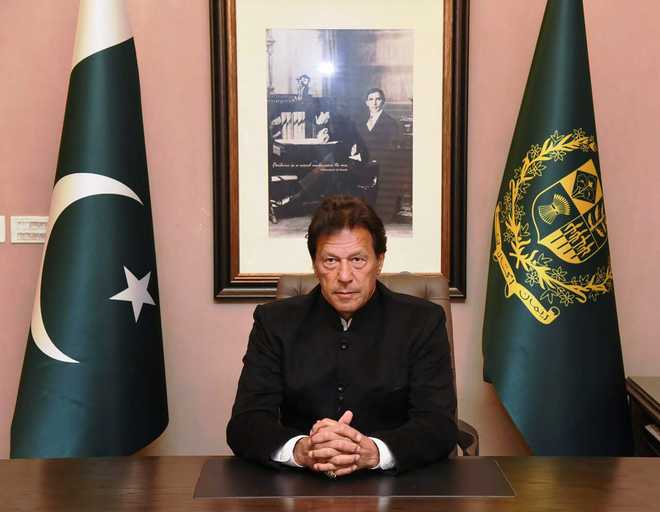
But Pakistan is under the pump after the Financial Action Task Force (FATF) gave it a three-month deadline to sharpen the implementation of its anti-terror financing laws. The recent Saudi bailout may have been the last act of generosity by Pakistan’s all-weather friends. Its impending blacklisting by the FATF could deter foreign investors and hinder Pakistan’s access to international markets. The road ahead for Pakistan is already tough without the distraction of a large neighbour unveiling all available tools of coercion. As India determinedly tightens the political screws — it has gained access even to the Organisation of Islamic Countries (OIC) where Pakistan till now had the field to itself — and leverages its geo-economic charm, PM Imran Khan may find himself bereft of viable options.


Lt Gen Ranbir reviews security ahead of polls

Tribune News Service

Srinagar, April 1

Ahead of the parliamentary poll, Commander of the Northern Army Lt Gen Ranbir Singh arrived in Srinagar on Monday for a two-day visit to review the security situation in the region. “Accompanied by the Chinar Corps Commander Lt Gen KJS Dhillon, Lt Gen Ranbir visited the forward areas in the frontier district of Baramulla, where he was briefed by commanders on ground about the current situation,” an Army statement said.

“During the visit, the Army Commander was briefed on the counter infiltration grid and operational preparedness of the formations, apart from the various developmental works being undertaken to improve the life of the people residing in remote areas,” it stated.

“He was appreciative of the measures and standard operating procedures instituted by the units and formations,” the statement read.

Later in the day, the Army Commander was briefed on the prevailing operational aspects by Lt Gen Dhillon at Badami Bagh Cantonment.


Diplomatic isolation in bits & pieces Govt’s verbal slugfests do not achieve much

Sandeep Dikshit in New Delhi

If External Affairs Minister Sushma Swaraj was prescient while speaking in Parliament a week before the Pulwama attack, she would have eschewed the part commending the Indian diplomatic community for getting Pakistan “successfully blacklisted by the comity of nations”. The talk of diplomatically isolating Pakistan entered the governmental lexicon in January 2016 after a spate of attacks rocked the government’s equanimity. Since then, the only two successes chalked by Indian diplomacy is getting Pakistan blackballed by the Financial Action Task Force and preventing it from hosting the SAARC summit, which was in the nature of a self-goal, for the move has wrecked the organisation that India had created.

Since then, there have been pyrrhic victories or even verbal slugfests touted as diplomatic wins such as young Indian diplomat Eenam Gambhir berating Pakistan as “Terroristan”. Pakistan has, in the past, endured such barbs from more powerful countries and bigger statesmen like John McCain and Barack Obama.

There are many tools for isolating a country and diplomatic isolation of the kind India professes to practice would rank as the lowest on the scale. The successful deployment of policy tools hinges on the offended country’s economic and military power, besides its interconnections with the target country.

The attempt at isolation is long drawn out and the outcome is unpredictable. Venezuela and Iran are two test cases where the US is attempting a regime change by strangulating their economies. As India-Pakistan ties are skeletal, all that New Delhi had to be content with is withdrawing the Most Favoured Nation status.

If Sushma Swaraj was correct in stating in May last year that Pakistan is trying to reach out to India because it senses isolation on the issue of terrorism, Islamabad wouldn’t have managed to gather representatives or ships of 46 countries for a five-day multinational exercise that ended a week back.

And while the foreign office talks of diplomatic isolation, it later emerged that the national security advisers of both countries had secretly met. Pakistan even managed to cadge generous assistance from Saudi Arabia, which is now said to be in India’s corner on the strength of PM Modi’s personal chemistry with the sheikhs of West Asia. Diplomatic isolation also does not cut ice with other countries when India not just keeps alive the back channels of communication, but also sends two union ministers to Pakistan for the Kartarpur project ceremony.

India needs to spell out, like the US or Russia, what exactly does diplomatic isolation mean? Is it hot words at international meets or a sustained multi-dimensional effort with an end goal in sight? Does the UNSC blacklisting of Masood Azhar achieve anything? The US has, in the past, put hundreds of Taliban fighters on the UNSC blacklist only to pull some of them out when it felt the need to negotiate a settlement.

The end game of demolishing terrorist headquarters at Muridke (Hafiz Saeed) and Bahawalpur (Azhar Masood) and killing both the leaders entails a degree of ruthlessness, pain and risks an embarrassing blowback. Is Modi up for it? He should have in mind that his “dear friend” Benjamin Netanyahu owes his political longevity in part to his older brother’s heroics in rescuing Israeli hostages from a hijacked plane at Entebbe. Or that Barack Obama’s path for re-election was smoothened by the capture of Osama bin Laden. That, however, means moving from diplomatic isolation to military action, firm in the belief that the diplomats have insured against any other country coming to the offending country’s aid as was the case with Iraq under Saddam Hussein.

If India’s past wars are any guide, Pakistan was not exactly friendless during the 1965 and 1971 hostilities. In 1971, the Shah of Iran supplied military equipment as well as diplomatic support against India. In 1965, Indonesia offered to seize Andaman and Nicobar Islands to spread Indian forces thin. But Kargil provided a different benchmark. Hardly any country spoke in favour of Pakistan. In the end, US President Bill Clinton browbeat Nawaz Sharif into handing back mountain peaks that hadn’t been recaptured by the Army. As long as a former Pakistan military chief heads the 41-nation Islamic Military Counter Terrorism Coalition, the sledgehammer approach is unlikely to work. The limited conflict of Kargil and the preceding diplomacy makes one long for the measured escalation of those days by the trio of Vajpayee, Jaswant Singh and Brajesh Mishra.


Accountability a must for armed forces by Lt Gen Kamal Davar

The dividing line between military transparency vis-a-vis military secrecy has been much debated.

he Indian armed forces are held in near-reverence and affection by the nation, necessitating them to always display professional acumen, moral courage and integrity of the highest order. (Representational Image)

In democracies the world over, institutions are constitutionally mandated to serve their nation in consonance with the nation’s aspirations and objectives. An institution exists because and for the nation, and not the other way around. Legally and logically, all institutions are accountable to the Constitution from which they derive their responsibilities and strength.

In India the image of most institutions over the years, since the country’s Independence, has taken a beating as regards their equity, performance, professional integrity — at least in public perception. However, if there is one institution which has unquestionably retained its awe and respect in the nation’s acuity and, equally, its emotions, it’s the Indian armed forces.

Through challenging times faced by the nation since India’s violent Partition in 1947, India’s armed forces have acquitted themselves with the highest professionalism, uncommon valour and sacrifices to uphold the integrity and honour of the nation. However, events of the past month, namely, the Pulwama terrorist strike and India’s retaliatory air operations in Pakistan’s Balakot have raised significant points in the minds of some security analysts, the foreign media and even some doubting Thomases in India as regards the results of the military action. The dividing line between military transparency vis-a-vis military secrecy has been much debated.

A few skeptics and some learned ones too have asked: Does the unique respect of the nation towards its armed forces make the latter remain in the comfort zone of its cocoon, answerable to no one but themselves? It is essential, in keeping with the glorious reputation of India’s tri-services, that doubts in the minds of anyone and anywhere are amply answered in the larger interests of the nation and the armed forces themselves.

The defence forces exist to defend the country from external and internal aggression, to preserve and further national interests — something that they have consistently achieved with matchless sacrifices, aplomb and victories for the nation. However, it is equally important that wherever shortcomings in their operations surface, those must not be pushed under the carpet and ignored on some fuzzy notions of misplaced pride, secrecy or political considerations under pressure from the ruling establishment. Operational security considerations also must be given their due importance for the elements of surprise and secrecy substantially govern success in military operations.

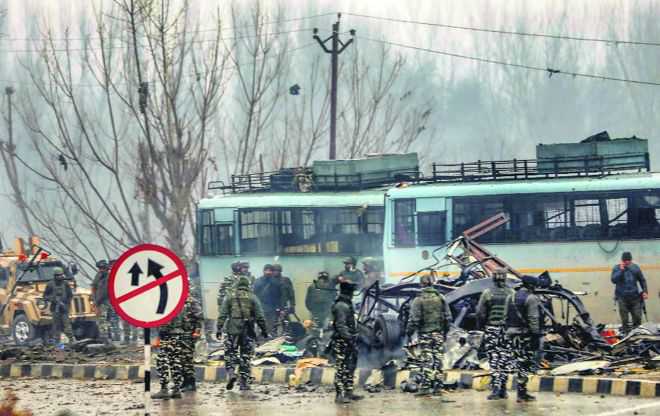
The dastardly Pakistan-inspired and supported terrorist strike on February 14, 2019, on a CRPF convoy in Pulwama in Jammu and Kashmir resulted in more than 40 fatalities. That this tragedy is attributable to a serious intelligence failure, shoddy road clearance drills besides the faulty decision to dispatch such huge numbers of paramilitary personnel by road and not by air (as now ordered) cannot be denied by security professionals anywhere. That India altered the counter-terror policy paradigm by launching retributive aerial attacks deep inside Pakistani territory was indeed a welcome change and, resultantly, would have sent the correct signal to a terrorism-sponsoring Pakistan.

The Indian Air Force’s deep strike and the resultant casualties in and damage caused to Jaish-e-Mohammed’s training camp in Balakot in Pakistan’s Khyber-Pakhtunkhwa province and the next day’s shallow aerial counter strike in the Poonch-Naushera sector by Pakistan would have thrown up many lessons for India’s security hierarchy. That these lessons are addressed with alacrity and the seriousness they demand requires no elaboration.

Even in a democracy where transparency is essential in certain policy matters, the media, especially the over-noisy electronic media, has to absorb the fact that strategies and tactics, operational details, targeting and timings, employment of new weapons and platforms, strengths and weaknesses must not be discussed in the public domain. However, at an opportune time, the official arm of the government/services can and must share relevant details with the public which do not compromise national security. Equally, lapses, where emerging, even within the security forces must be analysed in great depth for future improvements.

Post the Kargil War, the Vajpayee government had, very appropriately, carried out a comprehensive review of India’s higher defence management under the aegis of the Kargil Review Committee (KRC) and the Group of Ministers (GoM). The KRC and the GoM had done a remarkable job and some of the security organisations now in place owe their existence to them. Though India was clearly victorious in the Kargil War, the government at that time did not hesitate to discuss openly whatever shortcomings in the defence structure there were, dispensing the garb of national security or jingoistic patriotism! In the US, it is commonplace for serving generals/admirals to depose and testify before congressional committees on matters pertaining to national security. Accountability to the nation is thus a very normal hallmark in all democracies.

As the world’s largest democracy and an aspiring global player, India has to conduct itself like one. Consequently, all its institutions have to be scrupulously accountable to the nation’s Constitution and not to personalities or political dispensations. The Indian armed forces are held in near-reverence and affection by the nation, necessitating them to always display professional acumen, moral courage and integrity of the highest order. As the last bastion of the state, the three services, both in peace and war, must continue to serve the nation as only they can and never, ever compromise on the values of truth, honour and valour. For retaining their high-pedestal-esteem in a democratic set-up, the armed forces must also accept that they are no holy cows either and should welcome any legitimate queries from the government or the public as regards their functioning or performance as long as operational security considerations are not compromised.

Equally, responsible people in the nation must acknowledge the simple fact that merely questioning the government or any institution on matters pertaining to national security is not being anti-national!



Indian Army’s new sniper rifle paired with old improvisation tactics will turn tables at LoC

Sniping is not a new phenomenon along Line of Control (LoC) and Indian Army’s improvisations have made up for lack of equipment.

Indian Army

The media has repeatedly said over the last few months that sniping is a new modus operandi at the Line of Control between India and Pakistan and the Army is losing this new war due to ageing equipment.

Out dated equipment is a concern, and therefore the Indian Army has just bought new deadly sniper rifles for the Northern Command – .50 Calibre M95 by Barrett and the .338 Lapua Magnum Scorpio TGT by Beretta – to replace the Russian Dragunov.

But contrary to media’s claims, sniping is not a new phenomenon, and is in fact a tried-and-tested way of achieving moral ascendancy along the Line of Control (LoC) and the Indian Army hasn’t fared poorly. Improvisation has largely made up for lack of adequate equipment.


Also read: Deadly new sniper rifles are here for Northern Command soldiers along LoC


A force-multiplier

The Soviet-era Dragunov sniper rifle has been the mainstay of the Indian Army in conventional operations along the LoC as well in counter-terror missions. However, the 800-metre effective range offered by the Dragunov is now insufficient for modern-day warfare.

Yet, the Indian Army through improvisation, correct training and selection has created an environment wherein sniping has become a force multiplier. The adversary too hasn’t been static on this front.

I recall on the first day of my command at Siachen in 1995, we lost an outstanding young officer, keeping vigil on his post from behind a four-feet wall, to a single shot fired by the enemy. Investigation showed that the shot was fired by a medium machine gun (MMG) from a range of 4,200 metres. It is definitely not a range from which an MMG is fired, but improvisation made it possible.

Sources within the Indian Army say that there is no despair over inadequate sniping equipment because improvisation has made up for it, with even anti-material rifles being used for sniping now. However, improvisation alone cannot ever be a permanent solution to fighting the adversary; soldiers won’t say it but they know it.

The purchase of new sniper rifles, with enhanced range of 1500-1800 metres, was much-needed, but their arrival doesn’t guarantee overnight success. Some degree of improvisation and innovation will again be the key to ensuring optimum utilisation.


Also read: The new danger in Kashmir: Cold, calculating snipers who are wary of close contact


How to maximise effectiveness

The effectiveness of a weapon can be maximised when the user is confident about it, its technical characteristics including faults have been well-understood, and the required talent pool has been created for it among the fighting units.

All this can happen fast, given the Indian Army’s penchant to pursue an aim with utmost focus. But it also needs to add institutional weight behind the effort, through reintroduction of the sniper training course and sniper competitions, which stopped several years ago. Those who acquire requisite skills after rigorous training must be suitably rewarded.

Introducing the Sniper Badge is the first such step and only those meeting the stringent standards must earn the right to display it. Shooting ranges of 1,800 metres and beyond are not available along the LoC. There is little scope for the troops deployed to train with the equipment unless select batches are sent for training at the ranges in desert areas or central India. The best training ground, of course, is the LoC itself and there is no doubt that a simultaneous on-the-job training, while fighting the adversary, can continue there.

But we need more than just a gung-ho approach to streamline the creation of a talent pool that once existed in the Infantry units.

Sniping war will continue

It is important to know why sniping is a difficult operation at the LoC and yet easy enough to grab opportunities when they present themselves. Recently, a one-star rank officer of the Pakistan Army was seriously injured in an exchange of fire in the Lipa sector. It led to the Pakistanis targeting two JCOs on our side in the Kupwara sector. Both operations, the Pakistani and ours, involved the use of snipers. Many more exchanges have been reported over the last year. The LoC posts are virtual citadels with a labyrinth of deep communication trenches to afford movement within the post without enemy observation, but there are a number of other places where any movement is under observation.

Terrain domination in some areas give either side the advantage of observation, and vegetation is not available everywhere for cover. A quid pro quo situation exists at most places along the LoC where there are mutual vulnerabilities that prevent risk taking by either side. He who has the ability and confidence to prevent exposure of potential targets becomes the psychological winner, a major contribution to moral ascendancy at the LoC. It forces a lot of movement by night.


Also read: The enemy at the gates has a new weapon and Indian Army needs to wake up


At the LoC, the Indian Army will always be forced to offer more targets than the adversary not only because of the higher quantum of deployment, but also due to the nature of it. Deployment in small detachments in tactically unsound positions along the LoC to prevent infiltration is common; tactically unsound may seem strange to older soldiers, but the fact remains that in counter infiltration the aim is to prevent terrorists getting across and not the defence of some real estate. This increases vulnerability especially when the LoC fence is under reconstruction or maintenance.

The idiom ‘two can play this game’ is applicable all along the LoC. While ceasefire will remain on paper, violations will take place. Sniping exchange, however, is largely unreported and therefore remains outside the purview of public gaze.

The sniping war, therefore, will continue even as other means of moral domination emerge. The arrival of new sniper weapons, combined with improvisation and a return to the old-world sniper training culture, will definitely help in turning the tables on the adversary to a greater extent.

The author, a former GOC of Srinagar-based 15 Corps, is associated with the Vivekanand International Foundation and the Institute of Peace and Conflict Studies. He is the Chancellor of Central University of Kashmir.

Get the PrintEssential to make sense of the day’s key developments.


Indian Navy rescues 192 in cyclone-hit Mozambique

New Delhi, March 24

As part of its relief operations in cyclone-hit Mozambique, the Indian Navy has rescued more than 192 persons and provided assistance to 1,381 at medical camps set up by it, a statement said.

Cyclone Idai made landfall in East and Southern Africa around March 15 causing widespread destruction and loss of human lives in Mozambique, Zimbabwe and Malawi. In response to a request from Mozambique, India diverted three naval ships to the port city of Beira, a Ministry of External Affairs statement said. — PTI