Sanjha Morcha

What’s New

Click the heading to open detailed news

Current Events :

web counter

Print Media Reproduced Defence Related News

ARMY MOVES ITS GUNS CLOSER TO LoC

JAMMU: Amidst spike in terror attacks on camps of security forces in Kashmir and truce violations by Pakistan along the border, the army has moved its artillery guns, including Bofors, close to the LoC.

“We have been anticipating that they (Pakistan troops) will open mortar fire on our posts and forward villages on the ridge. Amid escalating tensions with a rogue country like Pakistan where army is in charge, we have to be cautious and wellprepared. So, we moved artillery guns close to the border,” said defence sources.

On August 15 last year, when India was celebrating Independence Day, the Pakistan army had shelled forward villages with 1,200 mm mortars in Poonch district. The shelling left six villagers dead.

In June 2012, India eventually had to move an artillery battalion from Mendhar to Krishna Ghati sector in Poonch district in the wake of intense Pakistan shelling.


Army made country proud by launching surgical strikes: Rajnath

Army made country proud by launching surgical strikes: Rajnath
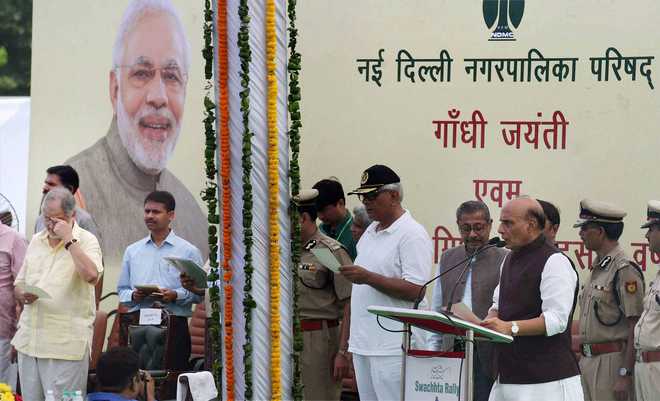
Home Minister Rajnath Singh reads out an oath for cleanliness on occasion of 147th birth anniversary of Mahatma Gandhi at Central Park in New Delhi on Sunday. Lt Governor Najeeb Jung is also seen. PTI

New Delhi, October 2

The valour displayed by Indian soldiers to the entire world by the manner in which they carried out ‘surgical strikes’ against terror launch pads across the Line of Control has made the country proud, Home Minister Rajnath Singh said on Sunday.

“The country as well as the whole world is aware of this (surgical strikes)… the way our jawans displayed valour have made India proud,” Singh told reporters here after inaugurating a ‘smart toilet’ constructed here under the Swachh Bharat Mission.

Responding to a query on doubts raised by Pakistan over the operation alleging that India has not released the footage of the operation, the Home Minister said, “Just wait and watch”.

On Friday, Army had trashed media reports in Pakistan about Indian casualties during the operation in which about seven terror shelters across the Line of Control were targetted.

Army had also said “black propaganda” was being carried out by some Pakistani TV channels showing “morphed” video clips depicting Indian Army casualties. — PTI


China blocks tributary of Brahmaputra in Tibet to build dam

China blocks tributary of Brahmaputra in Tibet to build dam
China is constructing its most-expensive hydro project on the river

Beijing, October 1

China has blocked a tributary of the Brahmaputra river in Tibet as part of the construction of its “most expensive” hydro project which could cause concern in India as it might impact water flows into the lower riparian countries.The Lalho project on Xiabuqu river, a tributary of Yarlung Zangbo (the Tibetan name for Brahmaputra), in Xigaze in Tibet involves an investment of 4.95 billion yuan (USD 740 million), Zhang Yunbao, head of the project’s administration bureau was quoted as saying by Chinese state-run Xinhua news agency on Saturday.Xigaze also known as Shigatse is closely located to Sikkim. From Xigaze, the Brahmaputra flows into Arunachal Pradesh.

(Follow The Tribune on Facebook; and Twitter @thetribunechd)

Terming it as the “most expensive project”, the report said the project, whose construction began in June 2014, was scheduled to be completed in 2019.It was not clear yet what impact the blockade of the river would have on the flow of water from the Brahmaputra into the lower riparian countries like India and Bangladesh as a result, it said.Last year, China had operationalised the USD 1.5 billion Zam Hydropower Station, the largest in Tibet, built on the Brahmaputra, which has raised concerns in India.But China has been maintaining that it has taken into consideration India’s concerns and allays apprehensions of restricting the flow of water, saying its dams are run on the river projects not designed to hold water.The outline of China’s 12th Five Year Plan indicates that three more hydropower projects on the mainstream of the Brahmaputra in the Tibet Autonomous Region have been approved for implementation.In March, Union Minister of State for Water Resources Sanwar Lal Jat said in a statement that India had expressed its concerns to China about the likely impact of the dams.While there is no water treaty between the countries, India and China established an Expert Level Mechanism (ELM) on trans-border rivers and in October 2013 the two governments signed a memorandum of understanding on strengthening cooperation on trans-border rivers under which Beijing provides data to India on the water flows.The blockade of the Brahmaputra river tributary comes at a time of India’s reported decision to suspend talks with Pakistan under the Indus Water Treaty as part of its efforts to hit back at Pakistan in the aftermath of the Uri attack.Chinese Foreign Ministry spokesman Geng Shuang gave a guarded reply when asked on September 27 about India’s reported move.“As a friendly neighbour to both India and Pakistan, China hopes that India and Pakistan can properly address disputes and improve relations through dialogue and consultation, maintain and enhance all-round cooperation and join hands to promote regional peace, stability and development,” Shuang told PTI.Some of the rivers under the Indus water treaty originate in China. PTI


Pak still in anaesthesia after surgery: Parrikar

Pak still in anaesthesia after surgery: Parrikar
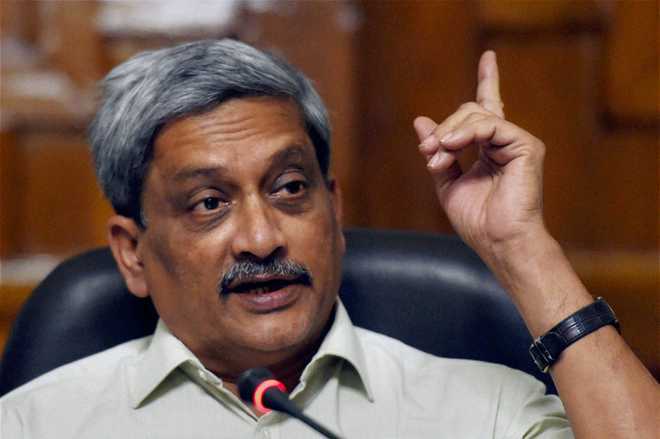
Defence Minister Manohar Parrikar. PTI

Dehradun, October 1

In his first remarks after the cross-LoC anti-terror strike, Defence Minister Manohar Parrikar on Saturday compared Pakistan’s condition to an “anaesthetised patient” after a surgery and said like Hanuman the Indian Army has recognised its prowess.

“Pakistan’s condition after the surgical strikes is like that of an anaesthetised patient after a surgery who doesn’t know that the surgery has already been performed on him. Even two days after the surgical strikes, Pakistan has no idea what has happened,” Parrikar said.

(Follow The Tribune on Facebook; and Twitter @thetribunechd)

“India loves peace and does not believe in unprovoked aggression but it won’t take terror lying down,” he said, adding that the strikes were also meant to give a message to Pakistan that Indian troops knew how to retaliate.

Comparing the Army to Hanuman, he made a reference to the Ramayana in which the monkey god crossed an ocean in a single stride after he was reminded about his extraordinary powers by Jamwant.

“Indian troops were like Hanuman who did not quite know their prowess before the surgical strikes,” Parrikar said.

Congratulating the troops for the precision and efficacy of the strikes, the Minister said he greeted all its members for their extraordinary feat.

“The surgical strikes gave our forces an idea of what they were capable of doing. Pakistan is bewildered following the strikes, not quite knowing how to react,” Parrikar said in his first public reaction after the strikes.

“Indian troops caught Pakistan unawares as our commandos did what they had to without Pakistani authorities getting a wind of it,” he said, addressing a gathering at Peethsain in Pauri district.

The Defence Minister was addressing the gathering after unveiling a statue of noted freedom fighter from Uttarakhand Veer Chandra Singh Garhwali in his ancestral village Peethsain.

India carried out surgical strikes on seven terror launch pads across the LoC on the intervening night of September 28 and 29, inflicting “significant casualties” on terrorists preparing to infiltrate from PoK.

Accompanied by Pauri MP and former chief minister Bhuvan Chandra Khanduri from Delhi, Parrikar was welcomed at Peethsain by senior party leader Satpal Maharaj, former CMs Bhagat Singh Koshiyari and Ramesh Pokhriyal Nishank besides Pradesh BJP President Ajay Bhatt.

All party leaders showered praise on the Indian troops for their displaying extraordinary valour by carrying out the surgical strikes 3 kms into the LoC saying it taught a befitting lesson to Pakistan which had a track record of responding to India’s friendly advances with a terrorist or military offensive. — PTI



Indian surgical action was carefully measured: US experts

Indian surgical action was carefully measured: US experts
The Indian response was indeed coming, say US experts. AFP

Washington, September 30

The Indian surgical strike inside Pak Occupied Kashmir (PoK) against terrorist planning to sneak into India for terrorist activities was “carefully measured”, a top American think-tank said on Friday, adding that the onus for escalation lay purely on Pakistan.“This Indian response was indeed coming; both as a signal to Pakistan and as reassurance for Indian domestic audiences. Modi could not let the outrage at Uri go unanswered,” Ashley Tellis of the Carnegie Endowment for International Peace, a top American think-tank, said.

(Follow The Tribune on Facebook; and Twitter @thetribunechd)

“The Indian action was carefully measured: striking at terrorist launch pads was meant to signal that India has not lost its freedom to retaliate, but puts the onus of further escalation on Pakistan,” Tellis told PTI.Responding to a question, Tellis said the US would counsel restraint, but unless the administration was willing to turn the screws on Pakistan–which was unlikely–India would be guided by its own interests, not American pleas for forbearance.“I think Pakistan has its hands full right now, it is unlikely to respond to the Indian action militarily, but the larger sub-conventional war against India will continue,” Tellis said.Rick Rossow from the Centre for Strategic and International Studies (CSIS) recalled the hint of such strikes as a possible tool last year, when the Indian Army initiated an attack against militants in Myanmar.“India has also shown other new tools in its confrontation with Pakistan, such as withdrawing from the upcoming SAARC summit, building stronger ties with other South Asian nations, and using closer security ties with the US as a hook to press for reduced military cooperation with Pakistan,” he said.“This will likely keep Islamabad on its toes, though when employing new tools in such a struggle, clear messaging is the key, so both sides know the other’s intentions. This will guard against unanticipated escalation,” Rossow said.According to him, following a number of recent provocations that India has linked to Pakistan-based militant groups, the government of Prime Minister Narendra Modi has employed a different set of tools to respond to these incitements.“These tools may not be altogether new, but the fact that they have been the focus of India’s response to Pakistan’s incitements marks a different approach,” he said.Rossow said while the Indian Ministry of Defence has stated it does not plan additional strikes, it is not clear whether the current tensions between India and Pakistan will escalate further.“There is certainly little expectation that Pakistani militants, under varying degrees of control by Pakistan’s military, will be deterred from initiating further attacks. But the costs to Islamabad of supporting terrorism are increasing, and taking different forms than before,” Rossow said.Jonah Blank, from the RAND Corporation think-tank, said that after the Mumbai 2008 attacks, India’s patience had reached its limit.“Pathankot was the breaking point. It was probably unrealistic to expect that the Uri attack would fail to bring a military response,” he said.“The phone call between Ajit Doval and Susan Rice accomplished two important things: First, it enlisted the US to help prevent a Pakistani counter-strike. Second, it avoided jeopardizing the India-US relationship by having Washington find out about the attack from Islamabad or the media, he noted.“There was never much likelihood that the US would condemn the attack. After an American surgical strike against Osama bin Laden in Abbottabad, any criticism of India for a cross-border action would have seemed hypocritical,” Blank said.“The outcome, limited Indian strike, limited Pakistani response, was probably as good as could have been desired. A stronger Indian strike, or a Pakistani escalation into full warfare, would not have served either nation’s interest,” he said. PTI


Ravi flows into Pak as Centre reviews treaty

Solution lies in Shahpur Kandi dam, but project hangs in balance due to objections by J&K govt

Ravi flows into Pak as Centre reviews treaty
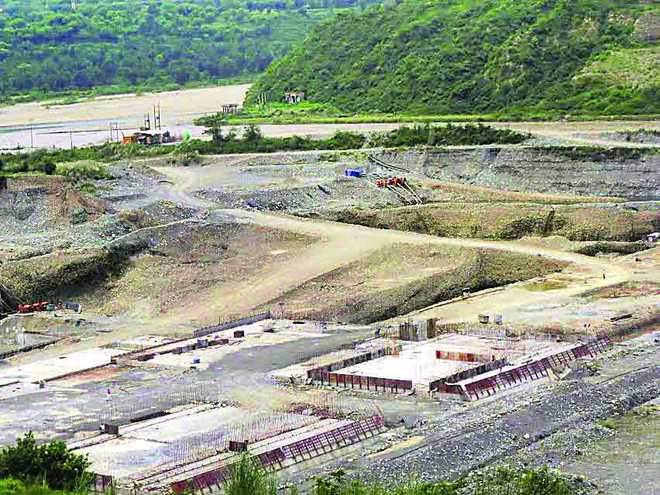
A file photo of the Shahpur Kandi project. Tribune photo

Sarbjit Dhaliwal

Tribune News Service

Chandigarh, September 28

Even as Prime Minister Narendra Modi has favoured maximising the internal use of three rivers, the Indus, Jhelum and the Chenab, that are part of the 1960 Indus Waters Treaty with Pakistan, the Punjab Government’s Irrigation Department engineers have showed their concern over the flow of the Ravi waters to Pakistan downstream Madhopur Headworks in Pathankot district.They want that the work on the Shahpur Kandi dam project be resumed to stop the flow of water to Pakistan, besides bringing more area under irrigation in Jammu region and enhancing the irrigation capacity in Punjab.The Ravi water was to be pooled at the proposed balancing reservoir by raising the dam with an estimated cost of Rs 800 crore at Shahpur Kandi, about 11 km downstream the Ranjit Sagar dam.Half of this reservoir was to be made in Punjab territory and the other part in Jammu and Kashmir. The land for the project was acquired years ago and the Centre was to fund 90 per cent of the project. However, following objections by the J&K Government, the work was suspended two years ago.Consequently, whenever excess water is released from the Ranjit Sagar dam in the Ravi, especially during summer months, a good amount of water flows to Pakistan via Madhopur Headworks in the absence of a balancing reservoir at Shahpur Kandi. Dr GS Dhillon, former chief engineer, Irrigation Department, said: “The balancing reservoir should have been completed even before the Ranjit Sagar dam.”In summer, when the demand for power goes up, all hydro-power units installed at the Ranjit Sagar dam are made operational. To operate turbines about 15,000 cusecs of water has to be released. Of this, 12,000 cusecs is released into the Upper Bari Doab Canal and Madhopur-Beas Link Canals at Madhopur Headworks and the remaining flows to Pakistan.During the monsoon, sometimes floodgates of the Ranjit Sagar dam have to be opened due to topping up of the reservoir. Again, the water goes to the neighbouring country.The J&K Government has taken the plea that since the Punjab Government has terminated the River Waters Sharing Agreement in 2004, the previous agreement relating to the Ranjit Sagar dam and Shahpur Kandi dam between Punjab and Jammu and Kashmir too have become defunct.The Punjab Government has taken up this issue with the Centre asking it intervene, but the J&K Government has refused to budge from its stand.Kahan Singh Pannu, Irrigation Secretary, Punjab, said the state government had been trying hard to convince the J&K Government over the matter, but to no avail. He said if the project was completed, it would bring additional 65,000 hectares of land under irrigation in Jammu region, besides stopping the flow of Ravi waters to Pakistan.

About the project

  • The Ravi water was to be pooled at the proposed balancing reservoir by raising the dam at Shahpur Kandi
  • Half of this reservoir was to be made in Punjab and the other part in J&K
  • The land was acquired years ago. However, following objections by the J&K Govt, the work was suspended two years ago

‘Make tunnel to divert Chenab water’

  • Pritam Singh Kumedan, a consultant to the Irrigation Department, has written to the Prime Minister, Union Government’s Secretary, Irrigation, and the Indus Waters Commissioner, urging them to divert the Chenab water into the Ravi through Marhu tunnel. The work on the tunnel was taken up immediately after the Partition, but it was stopped after Pakistan raised hue and cry over the project. Kumedan said the Chandra and Bhaga rivers originate in Lahul and Spiti region and meet at Tandi to merge with the Chenab. In 1948, Punjab had prepared a project to divert 20,000 cusecs of water of the Chenab to the Ravi by building a tunnel at Marhu, 5 km downstream Tandi. Kumedan said the Indus and Jhelum could not be diverted as it was technically not feasible, but the Centre could revive the tunnel project at Marhu.

No abrogation, but India to test Indus treaty waters

No abrogation, but India to test Indus treaty waters

No abrogation, but India to test Indus treaty waters
Tribune News Service
New Delhi, September 26
India today took the bold decision to fully utilise the potential of the three western rivers as per the Indus Waters Treaty (IWT), in an attempt to increase the pressure on Pakistan after the Uri attack.
India’s decision stops short of “abrogation” of the treaty and aims at playing within the legal limits. The decision is set to rattle Pakistan and the world, too.
Prime Minister Narendra Modi chaired a meeting today to review the IWT. According to sources, Modi said, “Blood and water can’t flow at the same time.”
The meeting was attended by Principal Secretary to PM Nripendra Misra, National Security Adviser Ajit Doval, Foreign Secretary S Jaishankar, the Water Resources Secretary and other senior officials. The treaty was reviewed and it was decided that India would exploit to the fullest capacity the three Pak-controlled rivers — Indus, Chenab and Jhelum — as per the Indus Waters Treaty. In addition, a decision has also been taken to review the construction on the Tulbul navigation project, which has been suspended since 2007.
Sources said it was felt at the meeting that the IWT wasn’t fair to the people of Jammu and Kashmir, but its fuller implementation would benefit them. Sources add the government’s plan was to exploit an option that hadn’t been exercised in the past 30 years — to use the western rivers to benefit farmers of Jammu and Kashmir.
Jammu and Kashmir Deputy Chief Minister Nirmal Singh last week said the state government would support whatever decision the Centre took on the IWT.
The historic treaty signed in 1960 has stood the test of time so far, despite the wars fought between the two nations.

Apex court’s no to PIL

  • New Delhi: An SC Bench on Monday rejected a plea for an urgent hearing on declaring as null and void the Indus Waters Treaty signed by India and Pakistan in 1960. Petitioner ML Sharma said the treaty was invalid as it should have been signed by the President instead of Prime Minister Jawaharlal Nehru. There was no hurry in hearing the plea as the treaty was 56 years old, the CJI said. tns

Sharif caught on wrong foot

Sharif caught on wrong foot
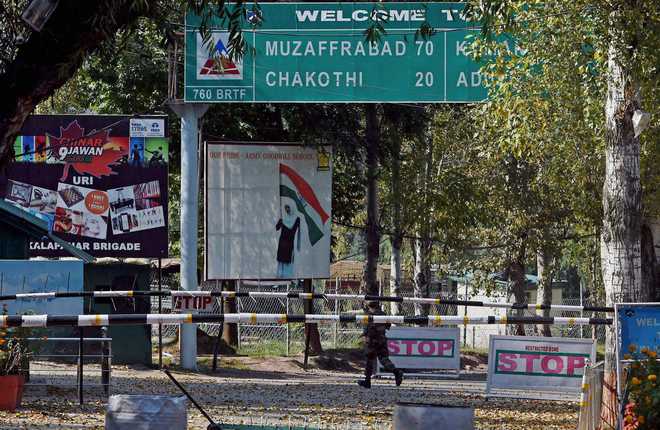
The Army Brigade Headquarters in Uri. Tribune Photo: Amin War

Arun Joshi

Tribune News Service

Srinagar, September 24

Pakistan Prime Minister Nawaz Sharif has concluded that last Sunday’s terror attack on the Army base in north Kashmir’s Uri sector in which 18 soldiers lost their lives and many more injured could be a “reaction” to the situation in Kashmir, an unmistakable reference to the ongoing disturbances in the Valley.This statement is a self-indictment of Pakistan. In all senses of the word, “reaction” clearly states that the militants “hurt” by the Kashmir situation in which more than 80 lives have been lost had mounted the attacks. Hence, he believes that Pakistan is blameless, and “India, without waiting even for the conclusion of the attack had blamed Pakistan without any evidence.”First of all, the question is why Nawaz Sharif did not assert this position in his speech at the United Nations General Assembly on Wednesday, when he drew an angry imagery of the “Indian brutalities on Kashmiris peacefully protesting for their right to self-determination”. If the “intifada in Kashmir” and the attack are cause and effect, then why did Pakistani premier hide this revelation from the world body. India would have been on the back foot and the listeners would not have ignored his ill-informed bluster.It could have been a “reaction,” but Nawaz Sharif did not tell that where from the militants originated, but by going by the conventional wisdom, he meant that they were locals and Pakistan had no hand in it. This could be a possibility, but the facts speak otherwise. The reality is that militants, who hurled grenades and showered bullets on the soldiers at the crack of dawn in the hilly Uri area, and their commanders and organisations are headquartered in Pakistan and Pakistan-occupied Kashmir.Even if the attackers were locals, again the question is who had declared Burhan Wani, a militant commander killed in July 8 encounter, as “martyr” and had observed “black day” on July 20, and who hailed him as a “young leader” of the Valley – the answer is Pakistan. The Islamabad-Rawalpindi were keen to turn the death of Burhan to their advantage and cause disturbances and violent protests in Kashmir at the time when the people were preoccupied with their normal activities, tourists were landing in hordes and the children were in schools.How could India raise accusing fingers towards Pakistan when the operation was still in progress, Pakistan Prime Minister has asked this question which may sound very valid and in need of convincing answer. There is a template of fidayeen attacks, which are mounted by the Lashkar-e-Toiba and Jaish-e-Mohammad, both headquartered in Pakistan. If they were locals, there are so many Army camps in Kashmir, which could have been targeted. There was no need for the local militants to travel all the way to remote Uri, a border area lying adjacent to the Line of Control where, otherwise, there is no presence of militants. The template of such attacks in Poonch, Mohra, Pampore, Pathankot had all the fingerprints of Pakistan. So, why Pakistan should get edgy about it? It must learn to own its people but then there is a history that it was Nawaz Sharif’s government that had refused to take back Pakistani soldiers’ bodies during the Kargil conflict. Denial is the best weapon with Pakistan, but it doesn’t work all the time.


India signs deal to acquire 36 Rafale fighter jets from France

India signs deal to acquire 36 Rafale fighter jets from France
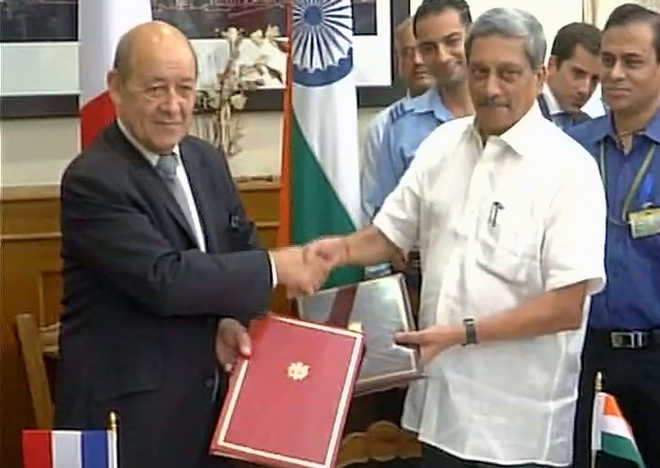
French Defence Minister Yves Le Drian arrived on Friday to finalise the deal. ANI

Ajay Banerjee
Tribune News Service
New Delhi, September 23
India on Friday inked the much-awaited contract to buy 36 Rafale fighter jets at a cost of 7.87 billion euros (Rs 58,828 crore) from France.
Defence Minister Manohar Parrikar and his French counterpart Jean-Yves Le Drian signed the deal.
This will end the two-decade gap in procuring new fighter jets for the Indian Air Force (IAF) and will provide a technological edge.

(Follow The Tribune on Facebook; and Twitter @thetribunechd)

The IAF has not procured any new fighter jets for long, the last being the Sukhoi 30-MKI from Russia first ordered in mid-1990s and since then licence-produced in India by Hindustan Aeronautics Limited (HAL).The first of the jets from France is to be delivered in 36 months, that is September 2019, and the entire lot will be delivered over the following 30 months. The French company will make India-specific changes like the next-generation missiles like Meteor and Scalp, which will add capability much beyond India’s immediate adversaries. The plane will be fitted with synthetic aperture radar and radar-jamming.The Meteor is a BVR (Beyond Visual Range) air-to-air missile with a range in excess of 150 km. It will allow the IAF to hit targets inside both Pakistan and Tibet from within its own territory. The Scalp is a long-range air-to-cruise missile with a range of 300 km.Parrikar said, “Rafale is a potent aircraft which will add to the IAF’s capability.”The total cost includes 3.42 billion euros as the cost of the bare planes; 1.8 billion euros for associate supplies for infrastructure and support; 1.7 billion euros for India-specific changes to the plane; 710 million euros for the additional weapons package and 353 million for performance-based logistics support.Under the logistics support, Dassault will ensure that at least 75 per cent of the fleet remains operational or airworthy at any given time.


Uri attack probe points to several procedural lapses

Uri attack probe points to several procedural lapses
Probe says before attacking four terrorists might have stayed put in a village located at a vantage point. — PTI file

Uri, September 22

Initial investigations into the terror attack on a highly-guarded army camp in Kashmir here have pointed towards several procedural lapses, including lack of coordination between two guard posts.The National Investigation Agency (NIA), meanwhile, was finishing documentation work in the case besides effecting seizures of material evidence from the scene of attack.

(Follow The Tribune on Facebook; and Twitter @thetribunechd)

The investigators probing the deadly attack in which 18 soldiers were killed have also found that the perimeter of the highly sensitive Brigade Headquarters of the Army was not properly fenced at several places, official sources said today.The probe also pointed towards the possibility of the four terrorists involved in the attack having sneaked in from Pakistan-occupied Kashmir (PoK) through Haji Peer Pass on the intervening night of September 16/17 and stayed put at Sukhdar village, overlooking the Brigade headquarters, they said.Sukhdar village is located at a vantage point allowing an unhindered view of the layout of the army base and movement of personnel inside it.The growth of wild grass and bushes around the perimeter of the brigade is seen as one of the factors that could have facilitated undetected movement of the terrorists close to the fencing, which was cut by the ultras to sneak inside the base, the sources said.Standard security procedures provide for mowing any tall grass and cutting of bushes around vital security installations but it was not done around the target site.The initial probe has also pointed towards the failure of two manned guard posts, located barely 150 ft from each other, to detect the intrusion inside the base by the terrorists, they said, adding it could have been due to lack of coordination between the two guard posts.The Jammu and Kashmir Police have collected call details and internet data usage of all active cellphones and broadband connections in Uri town for the period of 24 hours prior to daring attack on the army base, the sources said.The sources said the data along with the partial analysis carried out by state police has been handed over to the NIA for further investigation. The state police have also handed over the DNA samples of the slain militants to the NIA.Slain militants buried
The authorities have buried the slain militants in a village graveyard close to the Brigade headquarter. The last rites of the deceased were performed by the local Imam and some residents, the sources said.The NIA team, which arrived here on Tuesday, is in the process of completing the case documentation and collecting the material evidence from the site which would form part of seizure memo, the sources said.They said the arms, ammunition and other seized articles have been packed in wooden boxes for transportation to Delhi as these would be part of case property.  The NIA team is also trying to retrieve data from the Global Positioning System (GPS) sets recovered from the slain militants.The NIA on Tuesday registered a case to probe the terror attack at the Army installation in Uri.It took over the investigation from the state police, which had registered a case on Sunday, and began probe by collecting evidence available with the Army formation at Uri.The NIA team led by Inspector General G P Singh has been camping in Uri since its arrival here yesterday.Some members of the team will return to Delhi tomorrow while others will stay back at Uri to carry out further investigation, including questioning of people who might be familiar with the movement of the militants prior to the attack.The team would prepare a dossier and may make a formal request to Pakistan once the identity of the four was ascertained.Army has also instituted an inquiry into the attack with preliminary probe suggesting that the terrorists had entered the area at least a day before mounting the brazen assault.The inquiry besides ascertaining lapses, if any, would also suggest measures to prevent such attacks in the future as Pakistan-based groups were indulging more in “shallow infiltration”, which means that terrorists strike the first available installation after crossing the Line of Control.Meanwhile, the road passing through the Brigade headquarters — which connects Uri town to 12 villages close to the Line of Control — was today thrown open for civilian traffic after remaining off limits for the past four days.Civilian vehicles were allowed to pass through after thorough checking but the brigade premises was kept out of bounds for media personnel. — PTI