Anti Drone System from Zen Technologies works on detection, classification, tracking on passive surveillance, camera sensors & neutralisation of the threat via jamming drone communication
The Indian Army (IA) and Indian Air Force (IAF) are increasing their efforts to acquire more advanced anti-drone systems in response to the growing threat from hostile drones and unmanned aerial systems (UAS) in both conventional and irregular warfare.
Current Procurement Efforts
The Indian Army has issued a tender for nine more indigenous integrated drone detection and interdiction systems (IDD&IS). This is in addition to systems already inducted for the frontier with China.
The IAF is seeking new anti-swarm drone systems, including 10 kamikaze drone-based systems, 10 mobile micro munitions-based systems, and 100-200 vehicle-mounted counter-UAS.
The IAF will begin inducting 200 radio frequency jammer guns. The Army is acquiring around 30 vehicle-based drone jammers.
Need For Advanced Systems
More advanced anti-drone systems are needed with multiple soft-kill and hard-kill options and longer interception ranges.
These systems include jamming, spoofing, and blinding systems to disrupt drone command-and-control links, as well as laser-based directed energy weapons (DEWs) for hard kills.
The Army requires advanced versions of vehicle-mounted IDD&IS with soft-kill jamming ranges of 2-5 km and effective hard-kill ranges through lasers of around 800 meters.
The IAF needs effective multi-sensor, multi-kill systems against smaller drones to address operational gaps.
Indigenous Development And Collaboration
India is behind other countries in indigenously developing complex counter-drone technologies.
The Defence Research and Development Organisation (DRDO) has developed anti-drone systems with 2-kilowatt to 10-kilowatt lasers, and the armed forces have ordered 23 such systems. DRDO is also developing DEWs with higher power.
Domestic private firms are partnering with foreign companies for advanced anti-drone solutions. For example, U.S. company Anduril Industries and Indian Mahindra Group are collaborating to co-produce an AI-enabled counter-UAS.
Other Key Points
The Army still relies heavily on older air defence systems.
Conflicts such as those in Armenia-Azerbaijan, Israel-Hamas, and Russia-Ukraine have highlighted the increasing threat from drones.
There is an emphasis on developing and deploying effective counter-drone systems, including jamming, spoofing, blinding systems, and laser-based DEWs.
Zen Technologies has launched AI-powered anti-drone system called Vyomkavach designed to neutralize rogue UAV threats.
The Indian Army has deployed anti-drone systems along the Line of Control (LoC) to thwart infiltration attempts.
The DRDO will unveil a laser-based directed energy weapon during the Republic Day Parade 2025.
TNN
In A Major ‘Make In India’ Boost: Ordnance Equipment Factory Develops Sukhoi Su-30MKI Brake Parachute Safety Mechanism System
The Ordnance Equipment Factory (OEF) in Hazratpur, Firozabad, is set to manufacture brake parachutes for the Indian Air Force’s (IAF) Sukhoi Su-30MKI fighter jets, a significant step towards boosting indigenous defence production.
The brake parachute system for the Su-30 fighter jet is a crucial safety mechanism designed to decelerate the aircraft during landing, preventing runway overruns. It ensures safe stopping distances in both routine and emergency conditions, particularly for high-speed aircraft like the Su-30MKI4. The system is deployed at a velocity between 180 km/h and 300 km/h.
Upon deployment, an auxiliary parachute extracts the pack cover and main parachute from the container. The inflated main parachute produces drag, which reduces the speed of the aircraft, in turn shortening the landing run. The brake parachute is made of Fabric Nylon 66 and has a surface area of 50 sqm. The system is intended to reduce the aircraft landing run length after an aborted take-off.
Until now, India had relied on Russian suppliers for these parachutes, making the aircraft’s sustainment dependent on external sources. This technology transfer marks a major step toward self-reliance, reducing dependence on foreign manufacturers.
DRDO has transferred the technology to manufacture Su-30 brake parachutes to OEF Hazratpur. The transfer of technology (ToT) occurred at the Aero India 2025 event in Bangalore.
OEF Hazratpur, a unit of DPSU TCL (defence public sector undertaking, Troop Comforts Ltd), received the ToT to manufacture Su-30 brake parachutes from DRDO. OEF Hazratpur has been a key player in manufacturing specialized defence parachutes and aerial delivery systems and has collaborated with DRDO on multiple projects.
The brake parachute system is a crucial safety mechanism designed to decelerate fighter aircraft during landing, preventing runway overruns. It ensures safe stopping distances in both routine and emergency conditions, particularly for high-speed aircraft such as the Su-30MKI.
The technology transfer is expected to strengthen India’s self-reliance in defence manufacturing. This supports the Aatmanirbhar Bharat initiative, which aims to boost indigenous defence production and reduce reliance on foreign suppliers.
Besides OEF, two private firms – Oriental Weaving & Processing Mill Pvt Ltd (Navi Mumbai) and Kohli Enterprises (Gurugram) – also received ToT for bulk production of brake parachutes for Su-30.
The IAF is expected to place an order for Made in India brake parachutes worth ₹500 crore for Su-30MKI
OEFHZ will also export brake parachutes for a Southeast Asian country, with an export order worth USD 65,000 for its Su-30 fleet.
OEF Hazratpur operates under Troop Comforts Limited (TCL) and is committed to strengthening India’s defense self-reliance through cutting-edge technology. They are also producing arrester barriers for aircraft safety and exploring drone advancements for surveillance and logistics.
OEF Hazratpur introduced a Multi-Spectral Camouflage Net at Aero India 2025, enhancing concealment across visual, infrared (IR), and radar frequencies.
The brake parachute is designed to reduce the aircraft landing run length after an aborted take-off. It is made of Fabric Nylon 66 and has a surface area of 50 sqm.
IT News
F-35 For India: Why Trump’s Fifth-Generation Stealth Jet Offer Could Be A Double Edged Sword
India’s consideration of the F-35 fighter jet, following U.S. President Donald Trump’s offer, presents a complex scenario that requires careful evaluation of strategic, economic, and operational factors.
urn:uuid:43766a1c-f55d-416e-ba0c-c3fa4f4d6444
The offer comes amid strengthening defence ties between India and the United States, with both nations aiming to enhance military cooperation across various domains. Trump has committed to increasing military sales to India significantly, which includes the potential provision of F-35 stealth fighters. However, this proposal is still in its preliminary stages, as no formal acquisition process has been initiated yet.
Acquiring the F-35 could draw India deeper into the U.S. sphere of influence, potentially compromising its strategic autonomy. Historically, India has opted for Russian and French aircraft over American ones due to concerns about operational independence and geopolitical pressures.
The introduction of the F-35 could hinder India’s own fifth-generation fighter project, the Advanced Medium Combat Aircraft (AMCA), which has been under development with significant investments. Ensuring that this indigenous program is not adversely affected is crucial for India’s long-term defence capabilities.
The offer has raised concerns in Pakistan, which views the potential deal as a threat to regional stability. Pakistan’s officials have urged the international community to consider the implications of advanced military technology transfers to India.
What are the economic aspects of acquiring the F-35 are multifaceted?
The F-35 program has faced criticism for its high costs and performance issues. Maintenance and lifecycle costs are significant considerations that India must evaluate against its budgetary constraints.
The extent of technology transfer associated with the F-35 deal is uncertain. India will need to assess what technologies it would receive and how they would integrate with its existing systems.
Operational Challenges
The F-35 is lauded for its advanced capabilities, including stealth features and network-centric warfare capabilities. However, it also presents operational challenges:
The aircraft has been plagued by high maintenance costs and reliability concerns, which could impact operational readiness for the Indian Air Force (IAF) already struggling with a limited number of fighter squadrons.
The IAF must consider how well the F-35 would integrate with its current fleet and operational doctrines, especially in light of threats from adversaries like China, which has deployed advanced aircraft near Indian borders.
The China-Russia-Pakistan Factor
The potential acquisition of F-35 fighter jets by India could significantly impact its relationships with other countries, especially China and Russia.
China
If India acquires the F-35, China may perceive it as a direct challenge to its air superiority in the region, as China is rapidly upgrading its air force with the J-20 stealth fighter. Acquiring F-35s would enable India to conduct deep-penetration strikes inside enemy territory, including most of China, while maintaining operational stealth, which could worry Beijing. China might view the F-35 deal as part of a broader strategy by the U.S. to contain its influence in the Indo-Pacific region.
Russia
Buying the F-35 could create tensions between New Delhi and Moscow, as Russia has traditionally been India’s main weapons supplier. If India decides to buy the F-35, it might have to rethink its dependence on Russian weapons because the U.S. could impose sanctions, or India could face difficulties in making American and Russian defence systems work together smoothly. Russia is already providing India with the S-400 air defence system, which has previously caused concerns in Washington.
Pakistan
Pakistan has raised concerns that the transfer of advanced military technologies to India could affect military balance and strategic stability in South Asia. If India gets the F-35, Pakistan might respond by strengthening its military partnership with China or acquiring more advanced Chinese J-31 stealth fighters to maintain balance.
While the prospect of acquiring F-35 fighter jets offers potential enhancements to India’s air combat capabilities, it necessitates a thorough evaluation of strategic autonomy, economic implications, and operational readiness. India’s decision-making process must weigh these factors carefully to ensure that any move aligns with its broader defence objectives and regional security considerations.
Our Correspondent Jammu, February 16 Amid frequent reports of ceasefire violations along the Line of Control (LoC) in the Jammu region, an Army post in the Poonch area came under fire on Sunday. The incident occurred in the Gulpur sector,…
Our Correspondent
Jammu, February 16
Amid frequent reports of ceasefire violations along the Line of Control (LoC) in the Jammu region, an Army post in the Poonch area came under fire on Sunday.
The incident occurred in the Gulpur sector, when bullets were fired towards the Army post from across the border. In response, Indian soldiers also opened fire towards the source of the attack. This marks yet another instance of Indian soldiers coming under fire from across the border.
Sources said that it was not immediately clear whether the Pakistan army was behind the firing, or it was terrorists hiding in the forests and waiting for an opportunity to sneak in.
The Army had recently assured that the ceasefire along the LoC remained intact. In response to media reports, the Army stated, “No exchange of fire of heavy-calibre weapons has taken place. Minor incidents are not unprecedented along the LoC.”
Sources indicated that there was no reported damage on the Indian side following Sunday’s cross-border firing.
The government has responded by sending even more forces, but the situation is not under its full control.
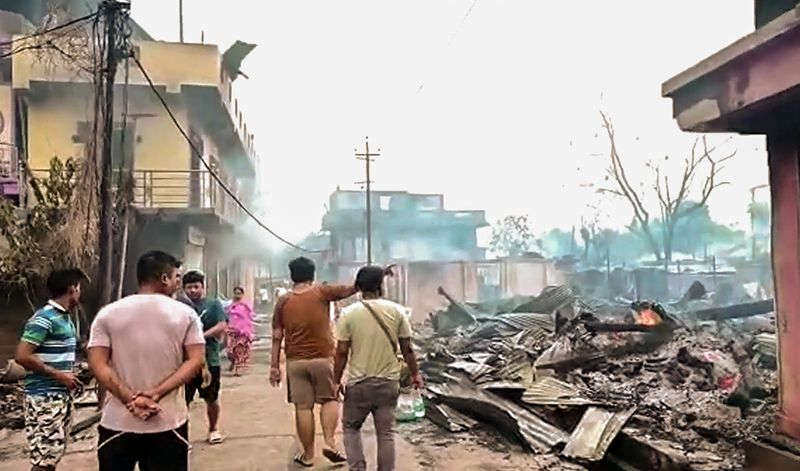
Finally, the BJP and, through it, the Government of India have taken some decisive steps towards sorting out the mess in Manipur in the recent past. The government first posted a seasoned bureaucrat as the Governor of the state, then it asked Biren Singh, Chief Minister of Manipur, where the BJP was ruling, to step down and four days later, on February 13, it imposed President’s rule in the state.
All these steps were taken quickly, in conjunction. But they had been long overdue. The BJP and, hence, the BJP government in the state had been hoping against hope that the matters would get sorted by the feeble steps that the government had taken since the start of the violence in the state on May 3, 2023.
The long strife continued almost unabated, with a few short periods of lull in between. It has led to very strained relations between the Meities and the Kukis. The problem got aggravated due to many other factors, too, which had serious implications from various corners.
Two factors were holding the BJP back from taking firm action: the fact that we are a democracy; and that the ruling party at the Centre was the same as that in the state. Putting such a state under President’s rule would be an embarrassment for the party as it would mean a censure of its own functioning.
Additionally, the party could not find a successor CM who was acceptable to all.
However, the ruling party has now bit the bullet. It is better late than never.
Looking ahead, a lot of work is needed to be done. First, let us look at the genesis of the problem to help tackle it.
The military junta in Myanmar does not have full control over the entire territory of its country, especially in the areas bordering Manipur. Many groups in these areas are fighting their government and even have control over some parts.
Also, due to the violence, the international drug trade from the infamous Golden Triangle, primarily through Moreh town and the area of Manipur, was suffering as the areas under opium cultivation there had reduced or were not increasing. Many Kuki and related tribes had started crossing over to Manipur, mainly in the Churachandpur area, which is dominated by the Kukis, with the help of their local kith and kin. They started growing opium in Manipur. Locals also joined them in this lucrative cultivation.
When this came to the notice of the state government, action was taken to identify the illegal immigration. Locals, supported by powerful international drug lords loaded with tons of money, resisted this action.
They wanted to put the government on the back foot. To their good luck — and bad luck for the state — an order by the Manipur High Court on the request of Meiteis to be given the Scheduled Tribe status gave them a reason to create trouble by misinterpreting that order.
The order, dated March 27, 2023, stated that “the state shall consider the case of the petitioners for inclusion of the Meetei/Meitei community in the Scheduled Tribe list, expeditiously….” It was only an order for consideration of the plea and not for giving the ST status to the Meiteis. But the Kukis deliberately misrepresented it, saying that the Meiteis had been given the ST status.
Though this paragraph was later deleted by the high court, the damage had been done. Both sides started taking out rallies, some violence also erupted and blockades and counter-blockades by the two communities came up. The Meiteis are from the valley side and the Kukis and other related tribes from the hills. The situation worsened. It turned so bad that people from the valley could not go to Churachandpur and vice versa.
The Kukis demanded a separate administration. They did not want the Meiteis to have the ST status as they felt it would affect their job quota and also enable the Meiteis to legitimately buy land in the hills. So, a kind of full-scale civil war between the two communities erupted, with violence leading to loss of lives and displacement of people from both sides.
It is alleged that drug lords, with their deep pockets, have played an important role in fuelling this situation. Soon, the government and its machinery were overwhelmed by the violence.
Unfortunately, such a division between the two communities also spread to the government, including the police, to some extent. It made the situation worse. Criminals and dormant insurgent groups also jumped into the fray, and the result was a total breakdown of the government machinery. Police stations and armouries, too, were attacked and more than 5,000 weapons looted. There are also allegations that many weapons were handed over by the police due to fear or complicity.
Such a large number of weapons in the hands of undesirable elements and violent groups is a big threat to the state. Hardly one-fourth of these weapons has been recovered. To make the matters worse, the Kuki groups even use drones to spread violence. They obviously have a lot of support.
Countries like China, Pakistan and Bangladesh have their own vested interests in the region and have tried to fish in the troubled waters. The Myanmar situation is also a big factor.
The government has responded by sending even more forces, but the situation is not under its full control.
So, the task is cut out now for the President’s rule authorities. Their priority should be to stop the violence and get the looted weapons back. A lot of work needs to be done simultaneously.
The main tasks include investigating cases, putting the state economy on rails, restoring harmony and peace between the communities, rehabilitating the displaced, tackling illegal immigrants, having an impartial police and bureaucracy, sealing the border with Myanmar to stop illegal migration and smuggling of drugs and weapons, thwarting the ill designs of foreign countries and restoring the political process.
Let’s hope that peace is achieved soon. This beautiful state in the North-East deserves peace and happiness not only for its own sake but also for India.
My first visit to Poonch, a sleepy border town tucked in the picturesque Pir Panjal hills of western Jammu and Kashmir, was in November 2005. The town was still reeling from the devastating earthquake that had struck in October that year. As part of an INTACH team tasked with assessing the damage to cultural heritage in the region, our mission spanned Poonch, Jammu and Reasi. The journey was sombre, our hearts heavy as we documented destruction, took photographs, and interviewed locals who were trying to rebuild their lives.
The journey to Poonch was arduous, winding through rugged terrain and damaged roads. By the time we arrived, the sun had set, casting a fiery orange glow over the hills — a breathtaking contrast to the devastation around us. The next morning revealed the full scale of the earthquake’s destruction. Buildings lay in rubble, and families sifted through debris, salvaging what they could. Yet, amid the ruins, the rich architectural heritage of Poonch stood as a quiet proof to its once-thriving past. Poonch has endured not one but two monumental tragedies — the Partition of 1947, which split the region into ‘Indian Poonch’ and ‘Pakistan Poonch’, and the 2005 earthquake.
Despite its tragic history, Poonch’s heritage speaks volumes about its vibrant past. As a jagir, Poonch flourished during the reign of Raja Moti Singh, whose vision brought significant architectural development to the region. Poonch boasts of a number of prominent buildings such as the Poonch Fort, Bagh Deodi, the Town Hall, and several aristocratic bungalows, bearing the title of ‘mahal’ — all reflecting an architectural blend of Kashmiri, colonial and vernacular influences.
During our assessment, we traversed the entire old city and while the Poonch Fort stood out, the one building that left a lasting impression was the Town Hall. Built as a multipurpose cultural space in the late 19th century, it hosted cultural performances before falling into decline post-Partition, serving as a grain storage facility and partly as a municipality office. Its grand papier mache ceiling and ornate jharokas hinted at its former glory, but the earthquake had damaged it substantially.
Town Hall
We also visited the Saran, or serai, a sprawling complex and a cultural hub for traders before 1947. After Partition, it became a refuge for displaced families, many of whom still live there. Over time, the grand complex was divided into smaller units.
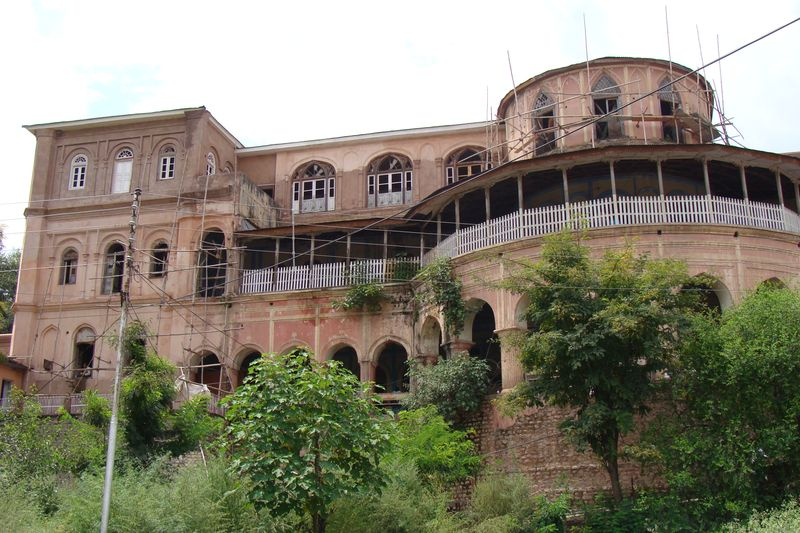
Another fascinating site was the Moti Mahal. Built in 1926 by Raja Sukhdev Singh, its tall circular towers and steep roofs resemble Scottish manor houses. Located near the Garhi Jungle, the Raja’s private hunting grounds, the palace grounds boast of 200-year-old trees and exotic birds. Post-Partition, the palace became the headquarters of Brig Pritam Singh’s 93 Brigade.
Apart from these grand buildings, the vernacular architecture of Poonch also stood out. Traditional houses featured central courtyards, ornate gateways, carved eaves and intricate wooden porticos, illustrating the skill of local craftsmen and taste of the builders. The town was also once a bustling trading hub, as demonstrated by the now-dilapidated Syndicate Building. Constructed between 1896 and 1898, it served as a business centre, primarily for cloth merchants. During Partition, it became a refuge for displaced families. The surrounding area, once a thriving wholesale textile market, now bears little resemblance to its former self.
As we supervised the partial restoration of the fort, I made several visits to Poonch and forged lasting connections with its people. Their stories of Partition were both heart-wrenching and inspiring. One such story came from a family forced to leave their home during Partition. Decades later, visitors from Pakistan sought them out. As the families met, the mother asked if their farm, fruit trees and the baolis still existed. To her amazement, the visitors confirmed that they did. Upon returning to Pakistan, they sent water from the baolis and fruits from the farm as a gesture of goodwill — a poignant reminder of shared heritage and community bond.
Another emotional moment was standing at Zero Line, the last checkpost near the LoC. From there, I could see twinkling evening lights of villages on the Pakistan side. There was something sad about these villages that were all part of the same cultural and geographical landscape up until 1947.Poonch, despite its tragedies, remains a town of resilience, rich in heritage and human spirit. While it retains its picturesque charm amid verdant mountains and terraced fields, its historic fabric is rapidly diminishing, overshadowed by hybridised modern constructions. The neglect and lack of meaningful conservation efforts have stripped Poonch of its soul, leaving its heritage unrecognisably altered and its stories fading into oblivion.
— The writer is Principal Conservation Architect, INTACH, J&K
THE imposition of President’s rule in Manipur, a few days after Chief Minister N Biren Singh’s resignation, is a belated but necessary intervention in a state ravaged by ethnic violence for nearly two years. The conflict between the Meitei and Kuki-Zo communities, which has claimed over 250 lives and displaced thousands over the past nearly two years, has exposed the failure of both the state and Central governments in maintaining law and order. Article 356 of the Constitution, often criticised as a tool of political manipulation, has in this case been invoked due to an undeniable breakdown of governance. The BJP-led government collapsed under the weight of its own contradictions, unable to quell the violence or even agree on a successor to Singh. This political paralysis, coupled with allegations against Singh, made President’s rule an inevitable outcome.
For the Kukis, this move provides a measure of relief as they had long accused Singh’s administration of bias. However, scepticism remains. Will direct Central control pave the way for reconciliation or will it simply be a holding pattern until the BJP finds a politically expedient way forward? The state’s ethnic divide is deep and any solution must involve genuine dialogue rather than administrative band-aids.
The broader question is whether President’s rule will be used to merely restore the BJP’s control or to genuinely reset Manipur’s fractured political and social fabric. The Modi government, which has largely remained distant from the crisis, must seize this opportunity to initiate meaningful peace-building measures rather than let the state drift into prolonged uncertainty. Anything less would be another betrayal of Manipur’s long-suffering people.
Jammu and Kashmir Lieutenant-Governor Manoj Sinha on Saturday ordered the dismissal of three government employees, including a police constable, citing their involvement in terror activities, said officials. The officials said the LG invoked Article 311 (2) (c) of the Constitution…
Jammu and Kashmir Lieutenant-Governor Manoj Sinha on Saturday ordered the dismissal of three government employees, including a police constable, citing their involvement in terror activities, said officials.
The officials said the LG invoked Article 311 (2) (c) of the Constitution to terminate the services of the three employees after an investigation by law enforcement and intelligence agencies clearly established their terror links. Sources said the dismissed employees had been identified as constable Firdous Ahmad Bhat, school Education Department teacher Mohammad Ashraf Bhat and Forest Department orderly Nisar Ahmad Khan.
Role in killing minister, SI
Orderly Nisar Ahmad Khan had role in a 2000 blast that killed then Power Minister Ghulam Hasan Bhat
Constable Firdous Ahmad Bhat found involved in an attack on a police party in 2020
The attack had led to the killing of Sub-Inspector Ashraf Bhat
The LG’s decision, which has come despite an elected government being in place in the UT, has been criticised by Valley-based political parties. More than 70 government employees have been dismissed in the past few years over terror links by the LG under Article 311. Two employees were fired in November last year, a month after the National Conference came to power.
Reacting to the fresh dismissals, Chief Minister Omar Abdullah said everyone was “innocent until anything was proven”. The officials said the dismissed policeman, who was arrested in May last year, was initially appointed as Special Police Officer in 2005 and subsequently promoted as constable in 2011.
Lodged in Kot Bhalwal Jail, Bhat was posted at a sensitive position of Electronic Surveillance Unit in the J&K Police but started working for terror outfit Lashkar-e-Taiba (LeT). However, he got exposed when two terrorists—Waseem Shah and Adnan Beigh—were arrested in Anantnag with a pistol and a hand grenade as they were planning to attack non-local civilians and tourists, the officials said.
During the interrogation, Bhat revealed his sinister design and led to the recovery of a sizable quantity of arms, including pistols, ammunition and explosives, from his residential quarter in Police Housing Colony in Srinagar and a newly constructed house in Mattan, Anantnag.
Using his police constable cover, he was transporting arms, ammunition and explosives for terrorists and investigation also revealed that he was working for Hizbul Mujahideen’s commander Khursheed Dar and LeT terrorist Hamza Bhai and Abu Zarar, besides Jutt. “He not only provided classified information about security forces movement, collection, storage and delivery of arms ammunition, but also guided terror attacks,” the officials said.
They said he was also found involved in an attack on a police party in 2020, which led to the killing of Sub-Inspector Ashraf Bhat, an attack on a group of tourists in Pahalgam on May 18 last year that left two persons injured.
The officials said he was also involved in radicalising and luring the youth to join terror ranks, besides using terrorists to blackmail government officials, including his colleagues and businessmen.
They said Ashraf Bhat, a resident of Reasi who was appointed as ‘Rehbar-e-Taleem’ teacher in 2008 and later regularised in June 2013, was affiliated with the LeT. “For many years, his activities were undetected but eventually came to light in 2022 and he was arrested and is currently lodged in Reasi jail,” the officials said.
During the course of investigation, it was revealed that Bhat’s handler was Mohd Qasim, most-wanted LeT terrorist who is based in Pakistan. “The LeT found him useful because as a teacher, Bhat was best placed to radicalise youth and carry out terror activities. He helped the LeT raise finances for terror activities and coordinated transport of arms, ammunition and explosives,” they said.
Khan, who joined the Forest Department in 1996 as a helper and is currently posted as an orderly at the forest range office in Verinag (Anantnag), was found working for Hizbul Mujahideen, the officials said. They said his links with the outfit first came to light in 2000 when a landmine blast in Anantnag killed the then Power Minister Ghulam Hasan Bhat and two policemen. “Khan and another accused had provided logistical support to the terrorists to carry out the attack. He also helped in smuggling RDX used in the blast,” the officials said, adding he was arrested, chargesheeted but later acquitted in 2006 after the “witnesses backtracked”.
Despite his acquittal, Khan continued his work for the terror group. His role was again exposed in 2016 when he played a central role during the Valley’s unrest following the killing of Hizbul terrorist Burhan Wani, the officials said.
Second US military flight brings 117 deportees, men in ‘shackles’ again
65 from Punjab, 33 Haryana, 8 Guj | Another plane with 157 expected today
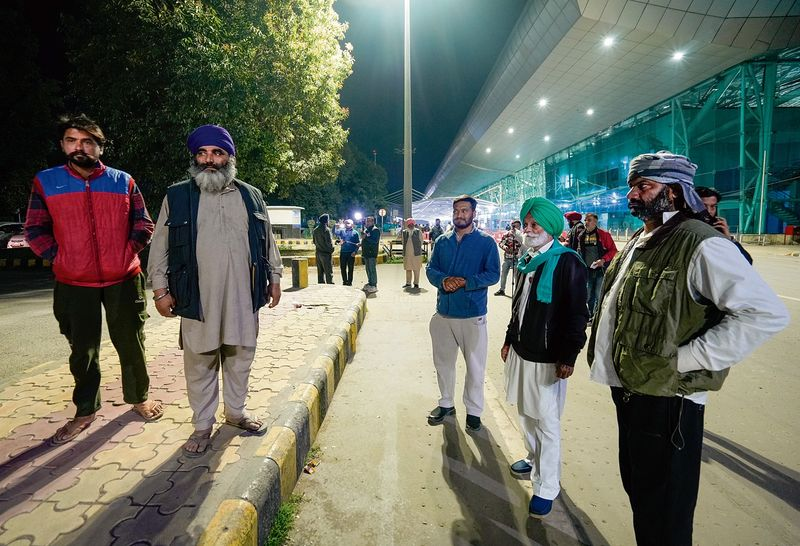
A US military plane carrying 117 illegal Indian immigrants, including 65 from Punjab, landed at Amritsar’s Sri Guru Ram Dass Jee International Airport at 11.32 pm on Saturday, said officials.
Apart from the 65 Punjabis, the flight brought back 33 persons from Haryana, eight Gujarat, three Uttar Pradesh and two each from Goa, Maharashtra and Rajasthan, said the officials. One deportee each was from Himachal Pradesh and Jammu and Kashmir. Five of the deportees were women.
It was the second such batch of Indians to be deported by the Donald Trump administration within 10 days as part of its promised crackdown on illegal immigrants.
Sources said unlike the first flight, women were not handcuffed and chained this time. The shackling of the deportees during the long flight was widely criticised in India. In response, External Affairs Minister S Jaishankar had assured that the government was engaging with US officials to ensure deportees were treated with dignity. He emphasised that while immigration laws must be upheld, humane treatment should not be compromised.
Immigration officials, Punjab Police personnel and representatives from the Ministry of External Affairs and the Punjab Government were among those present at the airport. A large number of relatives too were waiting anxiously. Considering the exhaustive journey, the local administration had made elaborate arrangements to receive the deportees and had also kept medics ready. An official said arrangements had been made for the overnight stay of deportees from other states, who would depart for their native places tomorrow morning.
On February 5, a US military aircraft carrying 104 Indian illegals had landed at Amritsar. Of them, 33 each were from Haryana and Gujarat, and 30 from Punjab. Yet another flight carrying 157 deportees is expected to land on February 16, said officials.
From wedding preparations to grief, families left inconsolable
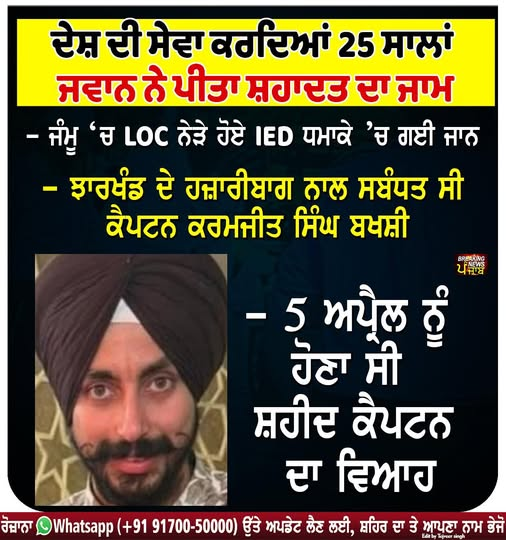
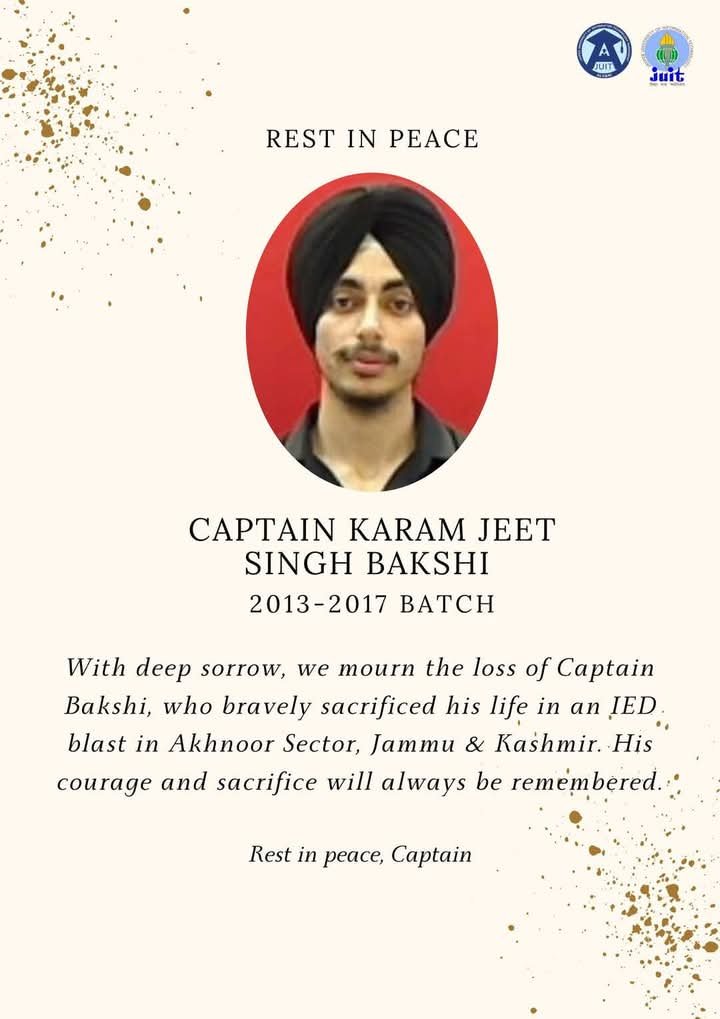
In a tragic turn of events, two soldiers, Captain Karamjit Singh Bakshi and Naik Mukesh Singh Manhas, lost their lives in an IED explosion triggered by terrorists along the Line of Control (LoC) in Akhnoor sector on Tuesday. Both men…
In a tragic turn of events, two soldiers, Captain Karamjit Singh Bakshi and Naik Mukesh Singh Manhas, lost their lives in an IED explosion triggered by terrorists along the Line of Control (LoC) in Akhnoor sector on Tuesday. Both men were set to marry in April.
RIP brave heart
Capt Karamjit Singh Bakshi who died in an IED blast on LoC in Akhnoor along with Naik Mukesh. He was the only Son.
He was to get married on 05th April 2025.
“To every man upon this earth Death cometh soon or late. And how can man die better? Then facing fearful odds, For the ashes of his fathers, And the temples of his Gods.”
Jai Hind
A pall of sorrow descended on Mukesh’s home in Kamila village, Samba district, where his family had been eagerly preparing for his wedding. His father, Chagatar Singh, overwhelmed with grief, recalled, “Mukesh wanted to join the Army since his childhood and was very fond of cricket. He had served in Ladakh, Punjab, and Kashmir before moving to Akhnoor. He returned to his duty on January 28 after completing the housework for his wedding. He was supposed to marry in April, around the 20th or 21st.”
Chagatar Singh shared, “He was a cricket lover, and during his last visit, he even worked hard to prepare a cricket pitch for the youth of the village.” Villagers remembered Mukesh as an enthusiastic cricketer and an extroverted soul who always extended a helping hand. The news of Mukesh’s death sent shockwaves through Kamila, a close-knit village where the tragedy was deeply felt. Mukesh’s mortal remains reached his village, and the final rites were performed by the family later today.
The loss was compounded by the tragic coincidence of Captain Karamjit Singh Bakshi’s death. The 29-year-old, from Jharkhand’s Ranchi, had been awaiting his own wedding. He had just returned to duty after finalising preparations for his marriage. His family, who were expecting a celebration, are now grappling with an unimaginable loss.
Karamjit’s father, Ajninder Singh Bakshi, recalled his son’s dedication and sacrifice. Karamjit, the only son, had left his home in Hazaribagh after his engagement to a medical officer in the Army. As news of his death spread, residents of Hazaribagh gathered at his home to pay their respects. The grief was palpable as the community collectively mourned the loss of a young man.
Captain Karamjit’s mortal remains were scheduled to arrive in Ranchi by late Wednesday evening, with the final rites planned for Thursday. In the wake of these tragedies, the families of both Captain Bakshi and Naik Manhas are left to mourn the loss of their sons, whose lives were stolen before they could begin the new chapter in their lives.
(With PTI inputs)
State Stalwarts
DEFENCE MINISTER
Minister Rajnath Singh
ALL HUMANS ARE ONE CREATED BY GOD
HINDUS,MUSLIMS,SIKHS.ISAI SAB HAI BHAI BHAI
CHIEF PATRON ALL INDIA SANJHA MORCHA
LT GEN JASBIR SINGH DHALIWAL, DOGRA
SENIOR PATRON ALL INDIA SANJHA MORCHA
MAJOR GEN HARVIJAY SINGH, SENA MEDAL ,corps of signals
.
.
PATRON ALL INDIA SANJHA MORCHA
MAJ GEN RAMINDER GURAYA ,MADRAS REGIMENT
sanjhamorcha303@gmail.com
PRESIDENT SOUTH ALL INDIA SANJHA MORCHA
COL SS RAJAN BOMBAY SAPPERS,
PRESIDENT UTTARAKHAND ALL INDIA SANJHA MORCHA
COL B M THAPA ,BENGAL SAPPERSS
PRESIDENT HARAYANA STATE CUM COORDINATOR ESM
BRIG DALJIT THUKRAL ,BENGAL SAPPERS
PRESIDENT TRICITY
COL B S BRAR (BHUPI BRAR)
PRESIDENT CHANDIGARH ZONE
COL SHANJIT SINGH BHULLAR
.
.
PRESIDENT PANCHKULA ZONE AND ZIRAKPUR
COL SWARAN SINGH
INDIAN DEFENCE FORCES
DEFENCE FORCES INTEGRATED LOGO
INDIAN AIR FORCE
Air Officer C-in-C WESTERN AIR COMMAND
AIR MSHL S PRABHAKARAN AVSM VM
AOC-IN-C, EASTERN AIR COMMAND
Air Marshal Inderpal Singh Walia
AOC-in-C SOUTH WESTERN AIR COMMAND
Air Marshal Vikram Singh
AOC-IN-C, SOUTHERN AIR COMMAND
Air Marshal J.Chalapati
AOC-IN-C TRAINING COMMAND
AIR MARSHAL SK GHOTIA VSM
AOC-IN-C MAINTENANCE COMMAND
Air Marshal Jagdish Chandra
Flag Officer Commanding in Chief, Western Naval Command
ice Admiral R Hari Kumar, PVSM, AVSM, VSM
Flag Officer Commanding in Chief, Eastern Naval Command
Vice Admiral Sanjay Bhalla, AVSM, NM
Flag Officer Commanding in Chief, Southern Naval Command