All posts by webadmin

India Closely Monitoring China’s Presence In Indian Ocean, Says Navy ChiefSaturday, March 01, 2025 by Indian Defence News

Earlier Chinese Song-class of submarines were surveilled loitering the Indian Ocean Region

India is closely monitoring China’s growing presence in the Indian Ocean, according to Indian Navy Chief Admiral Dinesh K Tripathi. The Navy keeps a watchful eye on the activities of the Chinese PLA Navy, including their warships and research vessels, to ensure that Indian interests in the region are not compromised.

This heightened vigilance is part of India’s broader strategy to address potential threats from neighbouring countries, including the surprising growth of the Pakistan Navy, which is receiving significant support from China.

China’s increasing naval presence in the Indian Ocean is seen as part of its broader ambition to become a global maritime power. The PLA Navy’s activities are not limited to military operations; they also involve research vessels that survey ocean parameters, which could aid in future submarine operations.

Admiral Tripathi’s highlighted the extensive maritime collaboration between China and Pakistan, which has been ongoing for over two decades. This partnership has significantly bolstered Pakistan’s naval capabilities, particularly since 2009. Key aspects of this collaboration include:

China has provided Pakistan with substantial maritime equipment, including, 3 F-22 frigates, these are part of China’s efforts to enhance Pakistan’s naval capabilities. 4 Type 054 warships, these are multi-role warships that offer advanced operational capabilities.

A satellite tracking vessel, this enhances Pakistan’s surveillance and communication capabilities at sea.

This collaboration is part of a broader strategic partnership aimed at countering India’s influence in the Indian Ocean Region (IOR). China’s support helps Pakistan strengthen its naval presence, which is crucial for both countries’ interests in the region. The partnership contributes to the geopolitical dynamics in the IOR, with India closely monitoring these developments to ensure its maritime security and dominance in the region.

Additionally, China’s strategic investments in ports across the Indian Ocean, such as Gwadar in Pakistan, are viewed with concern by India, as these could potentially be used to enhance China’s naval capabilities in the region.

Despite these challenges, Admiral Tripathi emphasised that India has an effective structure in place to monitor and respond to maritime activities. The Indian Navy remains alert and prepared to protect the country’s coastline and interests in the Indian Ocean.

The Navy Chief also noted that while the oceans are open to all, any operations must not compromise India’s security.

India’s approach reflects a proactive stance towards maintaining maritime security and stability in the face of China’s expanding naval presence.


Indian Elite Commandos Participate In Exercise Desert Hunt 2025

Exercise Desert Hunt 2025, conducted by the Indian Air Force from February 24 to 28, 2025, at Air Force Station Jodhpur, was a landmark integrated Tri-Service Special Forces exercise.

This high-intensity drill brought together elite units from the Indian Army, Navy, and Air Force, including the Para (Special Forces) of the Army, the Marine Commandos (MARCOS) of the Navy, and the Garud Special Forces of the Air Force. The exercise aimed to enhance interoperability, coordination, and synergy among these units to ensure a swift and effective response to emerging security challenges.

Designed to enhance interoperability, coordination, and synergy among the three Special Forces units, the exercise tested their ability to respond swiftly and effectively to evolving security threats. Key training components included airborne insertion, precision strikes, hostage rescue, counter-terrorism operations, combat free falls, and urban warfare scenarios—all conducted under realistic battlefield conditions.

The exercise included a range of complex scenarios such as airborne insertion, precision strikes, hostage rescue operations, counter-terrorism drills, combat free falls, and urban warfare simulations. These were conducted under realistic conditions to test the combat readiness, endurance, and adaptability of the forces.

Senior military officials supervised the exercise to validate joint doctrines and assess the effectiveness of integrated operations. The exercise served as a critical platform to foster inter-service cooperation, reinforcing the Indian Armed Forces’ commitment to strengthening national security through seamless collaboration.

Exercise Desert Hunt 2025 demonstrated the Indian Armed Forces’ capability to operate as a unified and cohesive unit, ready to tackle multifaceted security challenges. It highlighted the importance of jointmanship in modern warfare and marked a significant milestone in enhancing India’s defence preparedness.

The successful execution of the exercise showcased the elite capabilities of India’s Special Forces and their dedication to protecting the nation, underscoring the importance of such exercises in an increasingly complex global security landscape.


India’s Matsya-6000 Deep-Sea Submersible Successfully Completes Wet Testing, Setting A Milestone In Underwater Exploration

India’s ambitious deep-sea exploration project, Matsya-6000, has successfully completed its wet testing, marking a significant milestone in the country’s underwater exploration capabilities. Developed under the Samudrayaan Project, a component of the Deep Ocean Mission, Matsya-6000 is a fourth-generation deep-ocean submersible designed to accommodate three humans within its spherical hull.

The wet testing, conducted at L&T Shipbuilding in Kattupalli Port from January 27 to February 12, 2025, involved both manned and unmanned dives to assess the submersible’s power and control systems, floatation stability, and life-support systems.

Matsya-6000, India’s first deep-sea human submersible, is designed to dive to a depth of 6,000 meters and features several key technologies and systems:

Hull And Design: It has a compact 2.1-meter diameter spherical hull made from a strong titanium alloy, capable of housing three humans. The hull is designed to withstand extreme underwater pressure.

Subsystems

 Main Ballast System: For diving and surfacing.

 Thrusters: Allow movement in all directions.

 Battery Bank: Provides power.

 Syntactic Foam: Used for buoyancy.

Communication Systems

 Acoustic Modem: For underwater communication.

 Underwater Telephone: Enables voice communication.

 VHF And GPS: For precise location tracking.

Life Support And Sensors

 Advanced Life Support Systems: Ensure a safe atmosphere for the crew.

 Navigation Joysticks: For precise control.

 Oceanographic Sensors: For data collection.

 Underwater Lighting And Cameras: For observation and documentation.

Additional Features

 Robotic Arms: For sample collection.

 High-Resolution Imaging Systems: For detailed observations.

 Propellers: Allow movement in six directions.

 Emergency Endurance: Up to 96 hours.

Key Features of Matsya-6000

Material: Made from an 80mm-thick titanium alloy, which is strong and fracture-resistant, ideal for withstanding extreme underwater pressures.

Endurance: Offers 12 hours of normal operation and up to 96 hours in emergency situations.

Design: Compact 2.1-meter diameter spherical hull, accommodating three humans.

Technology: Equipped with advanced life support systems, navigation devices, and communication systems.

Matsya-6000, India’s first deep-sea human submersible, is designed to dive to a depth of 6,000 meters, placing it among the elite group of submersibles capable of such extreme depths. Here’s how it compares to other notable deep-sea submersibles:

Comparison With Other Submersibles

Titan Submersible: Unlike the Titan, which was made of carbon fibre and suffered a tragic implosion, Matsya-6000 uses titanium for enhanced safety. The Titan was lighter and more affordable but lacked the robustness needed for extreme depths.

Other Deep-Sea Submersibles: Only a few countries like France, the US, China, Russia, and Japan have developed submersibles capable of similar depths. Matsya-6000 is lighter and more cost-efficient compared to some of these, thanks to the use of “off-the-shelf” components.

Operational Depth: Matsya-6000 is designed to reach 6,000 meters, comparable to the deepest-diving submersibles globally. This capability positions India among the leaders in deep-sea exploration.

Advantages of Matsya-6000

Indigenous Development: It is an indigenous project under the Samudrayaan mission, showcasing India’s technological capabilities in underwater engineering.

Advanced Safety Features: The use of titanium and redundant systems ensures enhanced safety for its crew.

Scientific Capabilities: Equipped with advanced sensors and instruments for deep-sea mineral exploration and scientific research.

Manned And Unmanned Tests

The tests included eight dives, with five being unmanned and three manned, to evaluate the submersible’s performance in real oceanic conditions.

The emergency endurance of Matsya-6000 is up to 96 hours. This means that in case of an emergency, the submersible is equipped to support its crew for an additional 96 hours beyond its normal operational endurance of 12 hours, extending the total potential endurance to 108 hours.

Despite some limitations in underwater communication due to the restricted harbour depth, the tests confirmed that Matsya-6000 is on track for future demonstrations in deeper waters.

The next milestone for the submersible includes demonstration dives to depths of up to 500 meters by the end of 2025, paving the way for further explorations towards its maximum depth of 6,000 meters.

Matsya-6000 is equipped with advanced technologies, including a main ballast system, thrusters, a battery bank, syntactic foam for buoyancy, and sophisticated control systems, navigation devices, and communication systems.

The submersible is part of India’s broader Deep Ocean Mission, which aims to develop technologies for harnessing living and non-living resources from the deep oceans, aligning with the country’s vision of becoming self-reliant in underwater exploration.

The successful completion of the wet tests has bolstered confidence in India’s ability to conduct deep-sea missions with human crew, positioning the country among the few nations capable of such feats.

IDN


HAL’s Bittersweet Aero India: A Yashas Trainer Surprise; TEJAS Tongue-Lashing By Air Chief

Hindustan Aeronautics Limited (HAL) experienced a bittersweet moment at Aero India 2025 with the unveiling of its upgraded Hindustan Jet Trainer-36 (HJT-36), now renamed ‘Yashas’. This significant development marked a positive note for HAL, as the Yashas trainer has undergone extensive modifications to enhance its capabilities.

The aircraft features state-of-the-art avionics and an ultra-modern cockpit, which will improve training effectiveness and operational efficiency. Additionally, the Yashas is equipped with a FADEC-controlled AL55I Jet engine, providing a superior thrust-to-weight ratio and reliability.

It is designed for Stage II pilot training, counter insurgency operations, and armament training, among other roles.

However, the event was also tinged with disappointment, particularly concerning the Light Combat Aircraft (LCA) TEJAS. Despite being a flagship indigenous project, the TEJAS has faced challenges in meeting certain expectations. The TEJAS has been a symbol of India’s indigenous aerospace capabilities, having been inducted into the Indian Air Force. Nonetheless, HAL’s efforts to upgrade and innovate, as seen with the Yashas, highlight the company’s commitment to advancing India’s aerospace sector.

Aero India 2025 provided a platform for HAL to showcase its capabilities and innovations, aligning with India’s broader vision of becoming self-reliant in the aerospace and defence sectors.

The event underscored the importance of indigenous manufacturing and technological advancements, reflecting the government’s push for ‘Atmanirbhar Bharat’ or self-reliant India.

IT News


Meitei militia outfit lauds Centre’s role in restoring peace in Manipur

A day after Union Home Minister Amit Shah called for fencing of Manipur’s international border from both sides and also directed dismantling of drug network, Meitei militia outfit Arambai Tenggol appreciated the Centre’s efforts to restore peace in the strife-torn…

A day after Union Home Minister Amit Shah called for fencing of Manipur’s international border from both sides and also directed dismantling of drug network, Meitei militia outfit Arambai Tenggol appreciated the Centre’s efforts to restore peace in the strife-torn state.

The militia, which has been blamed for attacking the tribal Kuki community and destroying their homes ever since ethnic violence had erupted in Manipur in May 2023, in a statement on Sunday expressed, “heartfelt applause” to Shah for his “unwavering commitment to fostering peace and stability in Manipur,” noting that “his leadership has been pivotal during these challenging times”.

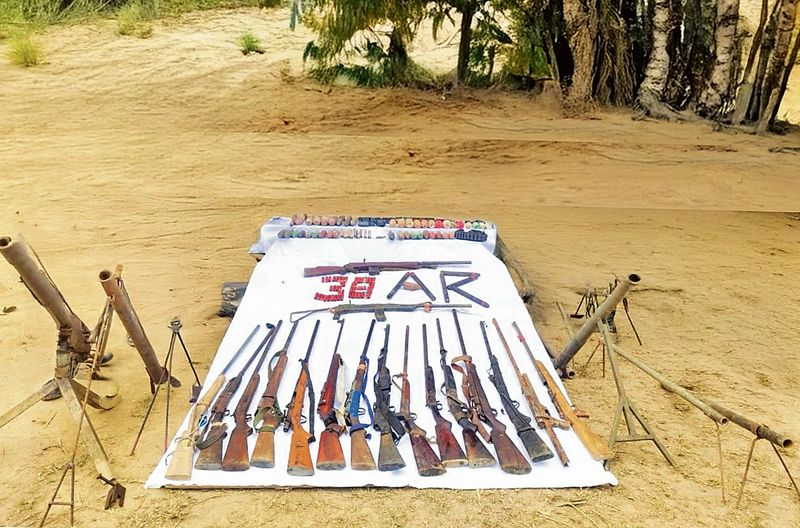
42 more arms surrendered

Imphal: Forty-two more firearms and cartridges have been surrendered by the public in five districts of ethnic strife-torn Manipur, the police said on Sunday. The firearms were surrendered in Imphal West and East, Churachandpur, Bishnupur and Tamenglong districts. Security forces also dismantled two illegal bunkers at Mark Hill under Thingsat hill range in Kangpokpi district. Another three illegal bunkers were dismantled at Wakan hill range in the adjoining area in Kangpokpi and Imphal East districts. PTI

The statement also thanked Governor Ajay Kumar Bhalla, whose “prompt actions and assurances during the recent meeting with the Arambai Tenggol have instilled a renewed sense of hope among the citizens

Security measures along Manipur’s border with Myanmar were also commended, with the group noting the “swift progress in completing the fencing work” which they described as “crucial in safeguarding our territory and enhancing security.”

The statement reinforced Arambai Tenggol’s support for anti-drug trafficking initiatives, stating they “wholeheartedly support the Governor’s strong stance against drug trafficking and his vision to make Manipur a drug-free state”.

The Arambai Tenggol is fully committed to supporting all initiatives that promote normalcy in Manipur. We believe that through collaborative efforts, we can work towards a peaceful and developed Manipur that reflects the aspirations of all its residents,” the militia said in the statement.


Trudeau to bring up Trump’s threat to annex Canada in meeting with King Charles

The king has come under criticism in Canada for being silent about Trump’s threats to annex Canada

Canadian Prime Minister Justin Trudeau will meet King Charles III, the country’s head of state, on Monday where he will discuss US President Donald Trump’s threats to make Canada the 51st state.

The king has come under criticism in Canada for being silent about Trump’s threats to annex Canada.

Trudeau said in London on Sunday he will discuss matters of importance to Canadians with Charles and said “nothing seems more important to Canadians right now than standing up for our sovereignty and our independence as a nation”.Charles is the head of state in Canada, which is a member of the British Commonwealth of former colonies.

Overall, the anti-royal movement in Canada is small, but the silence of the monarch on Trump’s threats has spurred talk in recent days.

Former Alberta premier Jason Kenney said “for Canadians disappointed that King Charles has not commented” on Trump’s threats he can only act on the advice of Canada’s prime minister.

“The Government of Canada should ask the Head of State to underscore Canadian sovereignty,” Kenney posted on X.

The king, who met on Sunday Ukrainian President Volodymyr Zelenskyy, has invited Trump to come to Scotland for a state visit.

“Great news that the Prime Minister will be having an audience with the King of Canada tomorrow. Hopefully this result in the King making a statement regarding his Canadian Realm,” constitutional lawyer Lyle Skinner posed on X.


Uttarakhand avalanche toll 8 as bodies of 4 more BRO workers recovered

The bodies of the last four of the trapped labourers were recovered from the site of the avalanche-hit Border Roads Organisation (BRO) camp at Chamoli in Uttarakhand on Sunday, taking the death toll to eight as the authorities ended the…

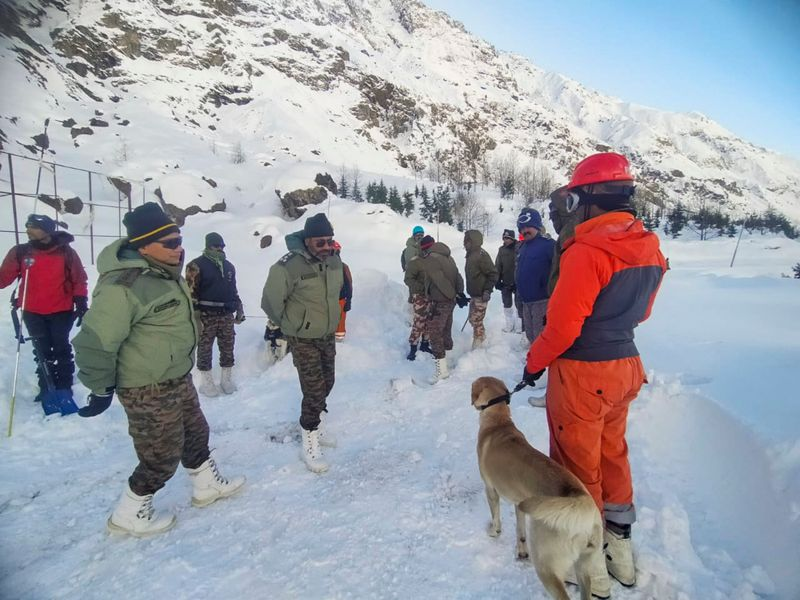
Helicopters, sniffer dogs and thermal imaging technology were used to expedite the rescue operation in Chamoli district of Uttarakhand. PTI

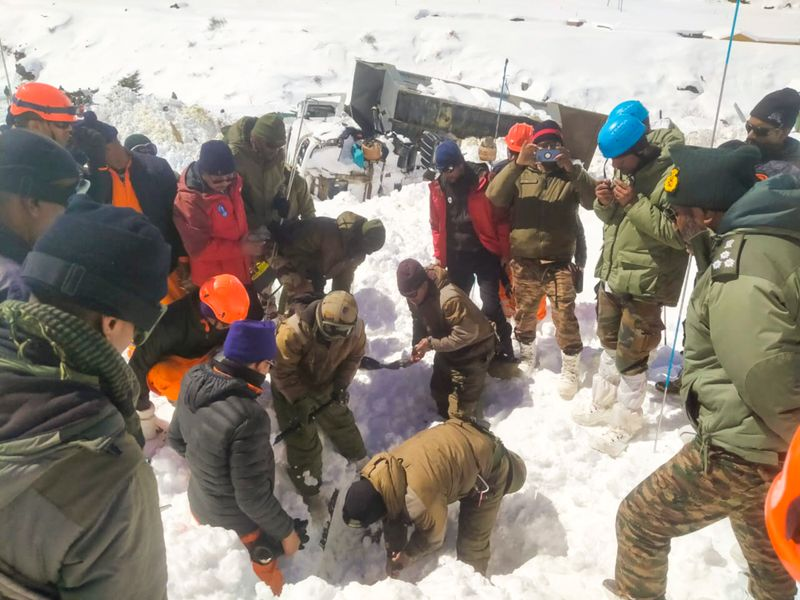
The bodies of the last four of the trapped labourers were recovered from the site of the avalanche-hit Border Roads Organisation (BRO) camp at Chamoli in Uttarakhand on Sunday, taking the death toll to eight as the authorities ended the nearly 60-hour rescue operation.

Army doctors said the 46 workers who were rescued on Saturday were brought to the military hospital in Joshimath. Two of them were referred to AIIMS, Rishikesh.

An avalanche had struck the BRO camp between Mana and Badrinath at 7: 15 am on Friday. “Out of the 54 labourers who went missing after the avalanche, 46 were rescued and eight found dead,” Chamoli District Magistrate Sandeep Tiwari said.

Four bodies were retrieved on Saturday and as many on Sunday. Earlier, it was believed that the total number of trapped labourers was 55 but on Sunday this number was revised to 54 as one of the missing, Sunil Kumar, had proceeded on leave before the accident.

More than 200 personnel from the ITBP, BRO, NDRF, SDRF, IAF and the district administration were engaged in the rescue operation. Located 3 km from Badrinath, Mana is close to the Line of Actual Control with China.

The trapped workers found dead on Sunday were Arvind Kumar Singh (43) from Dehradun, Anil Kumar (21) from Rudrapur, Ashok (28) from Fatehpur in Uttar Pradesh and Harmesh from Una in Himachal Pradesh, officials said.

Helicopters, sniffer dogs and thermal imaging technology were used to expedite the rescue operation. Eight helicopters — five from the Army, two from the IAF and a civil chopper — were engaged to evacuate the rescued from the Mana post to the military hospital in Joshimath, the headquarters of the Army’s Ibex Brigade.

https://googleads.g.doubleclick.net/pagead/ads?gdpr=0&client=ca-pub-8115901613940036&output=html&h=280&adk=4143928250&adf=3830261204&pi=t.aa~a.1973454478~i.11~rp.4&w=1100&abgtt=6&fwrn=4&fwrnh=100&lmt=1740972657&num_ads=1&rafmt=1&armr=3&sem=mc&pwprc=4947137612&ad_type=text_image&format=1100×280&url=https%3A%2F%2Fwww.tribuneindia.com%2Fnews%2Futtarakhand%2Futtarakhand-avalanche-toll-8-as-bodies-of-4-more-bro-workers-

In addition, a drone-based system that can detect ‘buried objects’ was transported to Joshimath, and a UAV, five quadcopters and three Mini UAVs were deployed.


Rusted anti-tank mine found in J-K’s Samba       

The mine was noticed by a villager during cremation of a person at Kamore village near Tanwar border out post on Saturday

A rusted anti-tank mine was found and subsequently destroyed in a controlled explosion by the bomb disposal squad in Samba district of Jammu and Kashmir, officials said on Sunday.

The mine was noticed by a villager during cremation of a person at Kamore village near Tanwar border out post on Saturday.

Police summoned the bomb disposal squad and the mine was destroyed.


Uttarakhand avalanche: Four more bodies recovered, toll rises to 8; 60-hour rescue operation ends

The lone worker who remains missing is 43-year-old Arvind from Dehradun

The bodies of the last four of the trapped labourers were pulled out of the site of the avalanche-hit Border Roads Organisation (BRO) camp in Chamoli on Sunday, taking the death toll to eight as authorities ended the nearly 60-hour rescue operation.

Army doctors said 46 workers who were rescued on Saturday have been brought to the military hospital in Jyotirmath. Two of them have been referred to AIIMS, Rishikesh. Three of the workers are in critical condition, Lt Col DS Maldhya said.

The body of the last missing worker has also been retrieved. The recovery marks the culmination of the Mana Village Rescue operation, Defence Public Relations Officer (PRO) Lt Col Manish Shrivastava said.

“Out of the 54 labourers who went missing after the avalanche, 46 were rescued alive and eight found dead,” Chamoli District Magistrate Sandeep Tiwari said.

Helicopters, sniffer dogs and thermal imaging technology were being used to expedite the rescue operation due to apprehensions about possible inclement weather on Monday, officials said.

Three bodies of the missing labourers were found on Sunday, district administration officials said in Gopeshwar. With this, the number of workers who lost their lives in the Mana avalanche has mounted to seven. One person is still missing for whom the search is in progress, they said.

The bodies have been brought to Jyotirmath by helicopter where the post-mortem was being done at the Community Health Centre.

The deceased include Anil Kumar (21) from Rudrapur in Uttarakhand’s Udham Singh Nagar district, Ashok (28) from Fatehpur in Uttar Pradesh and Harmesh from Una in Himachal Pradesh, the officials said.

The lone worker who remains missing is 43-year-old Arvind from the Clement Town area in Dehradun.

The avalanche hit the Border Roads Organisation (BRO) camp between Mana and Badrinath on Friday, burying 54 workers inside eight containers and a shed. Earlier, it was believed that the total number of avalanche-hit labourers was 55 but one of them was on unauthorised leave and had reached home safely.

A total of eight helicopters – five from the Army, two from the Indian Air Force and a civilian helicopter hired by the Army — have evacuated all rescued persons from Mana Post to military hospital at Joshimath, the headquarters of the Army’s Ibex Brigade.

A drone-based system that can detect ‘buried objects’ has reach Joshimath on board a IAF helicopter. Apart from this, a UAV, five quadcopters and three mini UAV’s have been deployed.

The labourers were part of Border Roads Organisation team tasked to an infrastructure project. Mana is the last village on the India side and is close to the Line of Actual Control (LAC) with China.

A stretch of 20 km of road between Joshimath and Mana is under snow.

Indian Army doctors on-site have performed life-saving surgeries for those in dire need, while helicopter operations from the Joshimath helipad are in full swing. — with PTI


Congratulations to Brig HPS Bedi (Retd) VSM who lead **Team Golf Spartans ** for Winning& receiving Runner up Trophy : at the Qutub Golf League .Delhi Golf Club

BRIG HPS BEDI : PRESIDENT HARYANA STATE UNIT OF SANJHA MORCHA

Proud of you all!
Putt to Glory!
With Love to You All🥰
Well Lead (Captain)
Brig HPS Bedi

Enjoying at the Qutub Golf Course after the Final round. Our team picked up the Runner’s up trophy at the Qutub Golf League . Amazing day and awesome evening 🎉