All posts by webadmin

OROP panel to hold public hearings

Vijay Mohan

Tribune News Service

Chandigarh, August 3

The one-man Judicial Committee of former Chief Justice of the Patna High Court L Narasimha Reddy, set up by the Centre to look into implementation of the One Rank One Pension (OROP) formula for ex-servicemen and address anomalies arising thereof, will hold public meetings and hearings on the issue.The committee will hold meetings with the retired service fraternity at 19 places across the country and the first public hearing is scheduled to be held at Chandigarh on August 17, it is learnt.While the implementation of OROP was announced by the government last year, many ex-servicemen said the orders issued were not in line with the accepted definition of OROP, thereby denying them the full benefits.A major sore point with the veterans was that their representatives were not involved in the decision-making process and there was no formal system through which they could directly approach the committee and submit their views. The committee was set up in December 2015.The committee’s mandate includes putting forth recommendations on whether to extend the benefit of OROP to reservists, whether the decision to grant benefits of assured career progression under OROP needs to be modified and whether pension tables for more than 33 years of service are to be formulated.The committee will also examine the pension equations between regular officers in the junior rung and their equivalent ranks in the Army Medical Corps, Army Dental Corps, Remount and Veterinary Corps, Territorial Army, Emergency and Short Service Commission officers and honorary ranks.


Mi-17s to fly to Russia for overhaul

Shaurya Karanbir Gurung

Tribune News Service

New Delhi, July 24

India’s Mi-17 1V helicopters, used primarily  for disaster rescue operations and transportation of troops to remote areas, are finally going to Russia for a major overhaul.Mi-17 1V is a product of Kazan Helicopters, which also carries out the overhaul. A major overhaul means not only repairs or change of engine, but also avionics and hydraulics. For the Border Security Force Air Wing, this comes four years after the choppers started getting grounded in Delhi for running on outdated parts.BSF’s Mi-17 1Vs are based out of Delhi because the hangars are better equipped. This reduces their capacity to work outside Delhi, as they have to undergo maintenance after every 50 flying hours.Four of BSF’s six Mi-17 1Vs were grounded in 2012. The fifth gave away in January last year and the last one was grounded last month. At present, all require a complete overhaul.The situation is equally bad for the Indian Air Force. It has four squadrons of Mi-17 1Vs, each having 12 helicopters, meaning a total of 48. Most are grounded as they have reached the overhaul stage.The BSF, on its own, does not have the resources to overhaul the Mi-17 1Vs and looks to the IAF for help. However, the Air Force expects it to strike a deal with the manufacturing firm on its own. These machines were bought along with the ones procured by the IAF in 2003.Other than the four squadrons of IAF’s Mi-17 1Vs, the remaining have been converted to Mi-17 V5. “The Mi-17 1Vs cannot always be sent to Russia. Because it is not practical to establish a servicing facility in India for the 1V, it will be eventually be phased out,” said an official, adding that a base repair depot for overhauling the Mi-17 V5 will be established in Kanpur.


IAF plane carrying 29 disappears


LAST SEEN AN-32 lost height rapidly from 23,000ft, about 280km off Chennai

NEW DELHI/ CHENNAI: An Indian air force plane carrying 29 personnel went missing over the Bay of Bengal on its way from Chennai to the Andaman Nicobar Islands on Friday, triggering an expansive search involving helicopters, warships and a submarine.

The Russian-origin Antonov-32 plane disappeared about 280 km off the coast of Chennai from where it had taken off at 8.30 am. It was due to arrive around midday at Port Blair — about 1,400km away — which hosts India’s only tri-service command.

The plane was flying 12 air force personnel, one each from the army, navy and coast guard and eight civilians, some of them family members of soldiers. It also had a crew of six. The medium-lift plane, upgraded last year, can fly for four hours and 15 minutes without refuelling.

“The aircraft was observed to have carried out a left turn with rapid loss of height from 23,000 feet,” an Indian Air Force (IAF) official told Hindustan Times.

IAF officials said the missing plane made its last radio contact at 8.46 am and it was last seen on the radar at 9.12 am.

At least four planes, including two P-8I long-range maritime surveillance aircraft, helicopters and 13 warships are scouring the sea looking for the plane.

AN-32 missing; 29 on board

Massive search operation on to trace Chennai to Port Blair plane

Tribune News Service

New Delhi, July 22
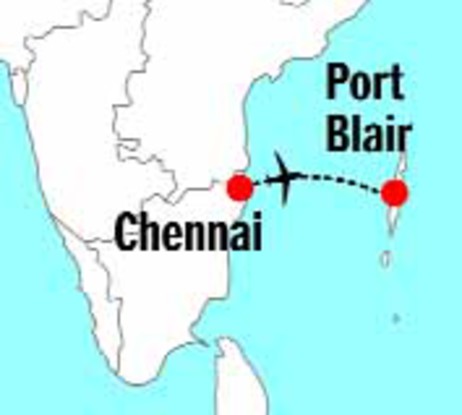
An Indian Air Force transport plane, AN-32, with 29 people on board was reported missing over the Bay of Bengal this morning. The Navy, IAF and the Coast Guard have launched a massive search operation.The plane was among the 64 AN-32s in the IAF fleet that were upgraded and re-equipped under a $400 million contract by the parent manufacturer in Ukraine. The plane, based at Sulur (Coimbatore), had developed defects thrice since July 2, sources confirmed.(Follow The Tribune on Facebook; and Twitter @thetribunechd)The remaining 40 planes of the AN-32 fleet are to be upgraded from next year at the IAF’s “1 base repair depot Kanpur”. As many as 104 AN-32 aircraft were imported from Soviet Union in phases between 1984 and 1991. The upgrade of these planes, between 25 and 32 years old, is being done to extend their life, allowing the last batch to fly till 2035.The plane had taken off at 8.30 am from the Tambaram air base, Chennai, and was scheduled to land at 11.30 am at the Port Blair naval base in Andaman and Nicobar Islands.The plane was on a routine flight, carrying men and material to Port Blair, and all those on board were either service personnel or civilian staff of the services.The plane last made radio contact with the Chennai Air Traffic Control at 8.46 am, 16 minutes after the take-off. Its radar signal was last seen at 9.12 am. The pilot did not radio the location or sound “Mayday” (crisis) before it was reported missing.A submarine, equipped with the system to pick up signals from the locating beacon of the aircraft, has been diverted to look for the plane.Navy’s P8-I surveillance aircraft has also been pressed into service along with the Dornier surveillance planes of the Navy and the Coast Guard. These carry powerful sensors and send live imagery to the control room.Besides, a dozen naval warships and two Coast Guard vessels have set sail.The IAF has dispatched a C-130-J and an AN-32 for search. The Chennai-Port Blair IAF “courier” flight flies thrice a week.Those on board included six crew, 15 personnel from the IAF, Army, Navy and Coast Guard, and eight civilians who were family members of the personnel. One of the passengers was a woman IAF officer married to a Coast Guard officer based in Port Blair.Defence Minister Manohar Parrikar is likely to visit Tambaram air base on Saturday.

(With agency inputs)


Not new to midair scare

  • Soviet-origin AN-32, said to be a sturdy plane, has been involved in several fatal crashes and instances of structural failure
  • In 1994, the navigator’s bubbler, which allows him to look at the terrain below, shattered, sucking him out over the Himalayas
  • A few years ago, the cargo ramp of an AN-32 on Leh-Chandigarh circuit with 42 on board burst open at 25,000 feet
  • An AN-32 fatally crashed in J-K in 1986; and mid-air collisions were reported near Ludhiana in 1992 and Assam in 2012


Army chief visits Srinagar to review situation in Valley

SRINAGAR: Army chief General Dalbir Singh reviewed the security situation in Kashmir on Wednesday and appealed to the people to maintain peace while calling for strict vigil along the Line of Control (LoC).

PTIChief of Army Staff Gen Dalbir Singh having a word with army officers during his visit to the Srinagar-based Chinar Corps on Wednesday.

The Army chief also complimented the troops on ground for showing maximum restraint even in the face of grave provocation besides appreciating the synergy being shown among all security agencies that has resulted in successful counter-terrorist operations, an Army spokesman said.

“The Chief of Army Staff reviewed the security situation in Kashmir during his visit to the Srinagar based 15 Corps,” the spokesman said. He said the Army Chief was briefed by the Northern Army Commander Lt Gen D S Hooda and Chinar Corps Commander Lt Gen Satish Dua on the situation along the LoC and the hinterland including the measures instituted to ensure close coordination with all security and other government agencies towards maintaining peace in the Valley.

The Army chief, accompanied by the Northern Army and Chinar Corps Commanders, also visited the Kupwara Division in north Kashmir and Awantipur based ‘Victor Force’ where he was briefed on the operational preparedness as also the initiatives taken by Army in collaboration with civil administration to alleviate hardships being faced by the populace due to the prevailing unrest, the spokesman said.


Pak fanning discontent in Valley, stay off: India

Pak fanning discontent in Valley, stay off: India
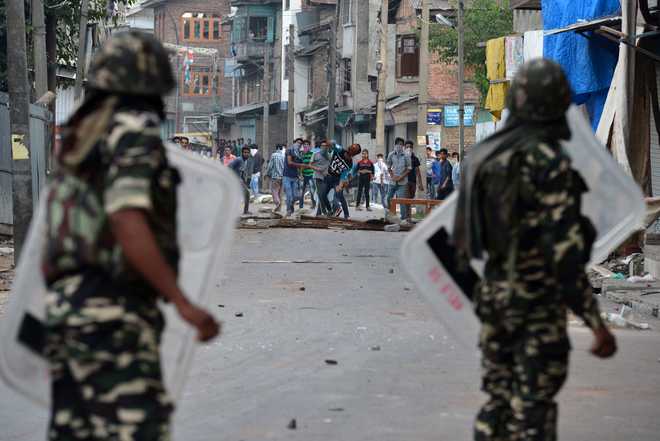
Protesters clash with security personnel in Srinagar on July 14, 2016. — AFP

New Delhi, July 14

Hitting out at Pakistan for trying to internationalise the killing of Hizbul militant Burhan Wani, India today  reiterated that Kashmir was an internal matter and that Pakistan had no locus standi. India accused Pakistan of sending terrorists into its territory and fanning discontent in the Kashmir valley.At the United Nations, India’s Permanent Representative Syed Akbaruddin said Pakistan used terrorism as a state policy towards the “misguided end of coveting the territory of others”.His strong remarks followed Pakistan’s PR Maleeha Lodhi describing Wani as a ‘Kashmiri leader’.Pakistan had summoned the Indian High Commissioner in Islamabad on Monday and raised the Kashmir issue.Ministry of External Affairs spokesperson Vikas Swarup today said the Indian envoy told Pakistan that Kashmir was India’s internal matter and that India had rejected the demarche issued in the matter.“Terrorism is terrorism and no amount of justification on part of Pakistan is going to change that,” Swarup said. Dismissing reports that India planned to summon Pakistan High Commissioner Abdul Basit, he said this being an internal matter, India saw no reason to involve Pakistan.  On a dialogue with Pakistan, he reaffirmed that India never shied away from talks. However, he said it was incumbent upon Pakistan to create the right atmosphere as “talks and terror cannot go hand in hand”.  — TNS

Bilawal calls up Mirwaiz, vows support

  • Srinagar: Pakistan People’s Party chairman Bilawal Bhutto called up Mirwaiz Umar Farooq on Thursday and expressed ‘solidarity’ with the Kashmiris, the moderate faction of the Hurriyat Conference said. “Spoke to @MirwaizKashmir & expressed condolences, condemnation & solidarity withpeople of #Kashmir,” Bilawal wrote on his twitter handle. TNS

Naval officer’s widow struggles to find out cause of his death

Naval officer’s widow struggles to find out cause of his death
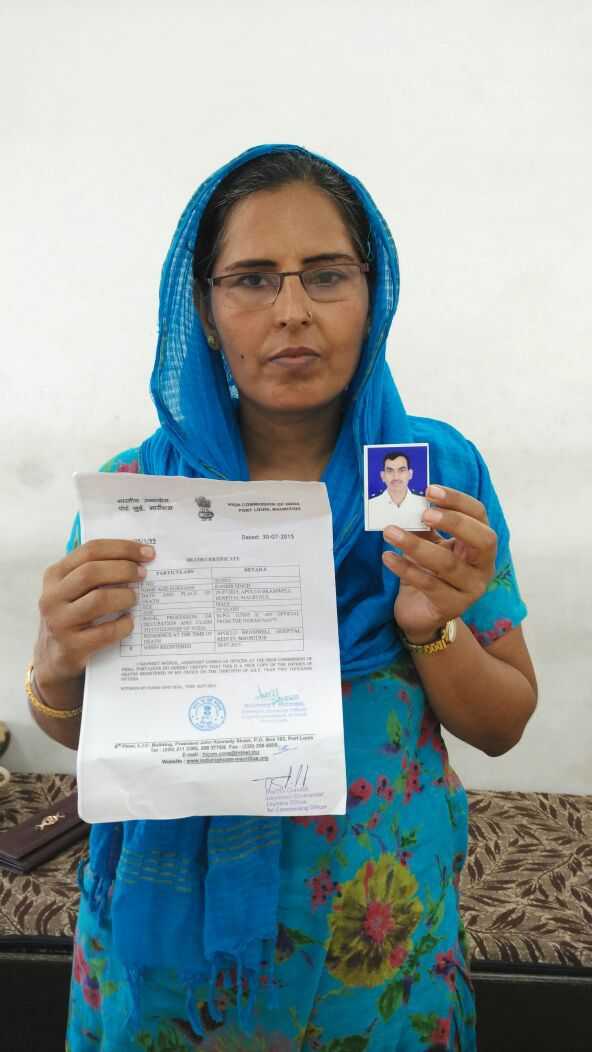
Vanita Singh, widow of Ranbir Singh, shows a letter written to the President and the Prime Minister to know the cause of her husband’s death. Photo: Indervesh Duhan

Sat Singh

Tribune News Service

Bhiwani, July 13

Ranbir Singh of Indian Navy died in 2015 while he was on a 45 days’ official tour on INS Teg in Mauritius. Officials attributed the death to brain haemorrhage, but his widow Vanita Singh (36) refused to buy this theory.“After repeated requests and an RTI plea, Navy has failed to tell me in writing the cause of my husband’s death,” she told the media here today.Vanita is a mother of two children.“On July 25, 2015, Navy officials told me that my husband was seriously ill in Mauritius. They took me to hospital, where his body was lying, on July 29,” Vanita said, adding she was told verbally that Ranbir died of brain haemorrhage.She said her husband was physically fit before leaving for Mauritius. “When I saw the body, there were injury marks on his head. That made me suspect foul play.”Ranbir of the district’s Kadma village had joined Navy in 1995. He was posted as the Senior Chief Petty Officer (SCPO) at the time of his death.Vanita claimed she did not receive support from the Navy in bringing back the body. “There is a protocol to bring the body back home. In my case, I had to arrange everything.”On her struggle, she has written to the President, Prime Minister, Defence Ministry and Navy Admiral, demanding that the cause of Ranbir’s death should be made public, but all in vain.But she is determined. “I will put more efforts to get a court of inquiry conducted, as knowing the cause of my husband’s death is my right,” she added.


Valley braces for tough day ‘Martyrs’ Day’ today; PM for calm; Rajnath’s US visit off

Mukesh Ranjan

Tribune News Service

New Delhi, July 12

Chairing a high-level meeting on the situation in Kashmir within hours of his return from the four-nation Africa tour, Prime Minister Narendra Modi today appealed for “calm and peace.” He is believed to have expressed “unhappiness” over the media coverage of the violent protests following the killing of Hizbul millitant Burhan Wani and the latter’s portrayal as a “hero”. The meeting was attended by Home Minister Rajnath Singh, Finance Minister Arun Jaitley, External Affairs Minister Sushma Swaraj, Defence Minister Manohar Parrikar, Minister of State for PMO Jitendra Singh, NSA Ajit Doval and Foreign Secretary S Jaishankar, among others. The PM was briefed on the Wani encounter, the subsequent violence and Pakistan’s response to the terrorist’s death. The issue of a Rs 80,000-crore package recently announced for Jammu and Kashmir was also taken up.Sources said Home Ministry officials expressed concern over the situation in the Valley in the next two days. Separatists intend to observe July 13 (tomorrow) as “Martyrs’ Day” and there is every possibility of emotions running high after the Friday prayers the following day.Rajnath is expected to make a statement on the violence on the first day of the Parliament session (July 18). He was to visit the US for the ‘Homeland Security Dialogue’ scheduled for next week. Sources said it would not be “possible for him to embark upon the US visit” in view of his “busy schedule in Parliament” and that the new dates had yet to be worked out. He was also to travel to Pakistan for the SAARC Home Ministers’ conference in August, but the visit is “highly unlikely” now.

6283361703


PM pushes for deeper defence, security ties with South Africa

PM pushes for deeper defence, security ties with South Africa
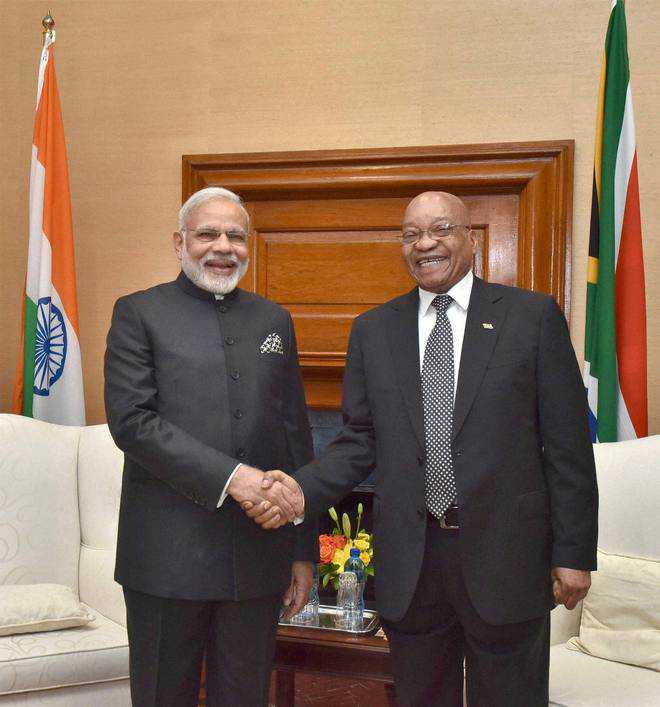
Prime Minister Narendra Modi shakes hands with South African President Jacob Zuma in Pretoria on Friday. PTI

Simran Sodhi

Tribune News Service

New Delhi, July 8

Prime Minister Narendra Modi today reached out to South Africa on the second leg of his Africa tour and recalled Mahatama Gandhi and Nelson Mandela saying the duo connected the two nations.Defence and security co-operation was high on agenda as well as increased co-operation at international forums. South African President Jacob Zuma is scheduled to visit Goa later this year to attend BRICS Summit, an event that will provide both the leaders another chance to discuss various issues. Interestingly, Zuma did not explicitly endorse India’s bid for a permanent seat in the UNSC, but said South Africa would work with India on reforming the council. The issue of the Nuclear Suppliers Group (NSG) also came up since South Africa was among those nations that had objected to process-related procedures for India’s entry. Modi “thanked the President for South Africa’s support for India’s membership to the Nuclear Suppliers Group”. In a joint statement issued at the end of the talks, Modi reiterated India’s commitment to comply with NSG guidelines and continued commitment to non-proliferation and disarmament. “Beyond economic ties and links of business, trade and investment, we can also partner in defence and security,” Modi said in Pretoria after holding delegation-level talks with Zuma. Terrorism was another topic discussed between the two leaders.


An obituary all my own :::::Col Mahesh Chadha (retd)

LEST my kin takes recourse to singing paeans of my moderate accomplishments in life, I thought it prudent to write my own obituary. History is replete with such instances: Shah Jahan got his grave constructed next to his beloved wife’s at the Taj Mahal; his successor, the cruel  Aurangzeb, a modest earthen grave at Daultabad; and Alexander the Great  kept his empty hands hanging out of the coffin. All of them were conquerers and emperors and had their wishes fulfilled, whereas I am Shakespeare’s “a poor player who struts and frets his hour upon the stage and is heard no more”. So, I prefer Ghalib’s “Hue kyon yun marke ruswa, hue kyon na gharq-e-dariya; na kahin janaza uthta na kahin mazar hota” (Why in death did I have to suffer such humiliation; why I had been not swallowed by a river, as there would have been no funeral nor a grave).Obituaries often cover up what would otherwise be worthless and embarrassing — to say only kind words even if it tantamount to being  PB Shelly’s Ozymandias “whose frown and wrinkled lip and sneer of cold command tell that its sculptor well those passions read which yet survive, stamp’d on these lifeless things, the hand that mock’d them and heart that fed”, and the pride… “My name is Ozymandias, king of kings: look on my works and despair!” I am the child born just before India became free, beginning a ‘once upon riches’ story traversed long distances under fire and piercing knives from Lahore and Shimla to Chandigarh. Facing scarcity of everything, except hard work, self-respect, faith and never-say-die spirit, my parents endured hardships and put me in an English-medium school, emphasisng on character building, integrity and personal sacrifice. Mediocre at studies and sports, both in school and college, I adored some of the great personalities of that era and their profound thoughts: Gandhi’s My Experiments with Truth and the Gita; Rudyard Kipling’s If; Kennedy’s “Ask not what your country can do for you” speech; Patton’s “No bastard ever won war by dying for his country”; Churchill’s ‘victory’ sign. I continued to be realistic and dreamy; dominating but flexible; firm but angry; upright and scheming; pure and not-so-pure; virtuous and vile; but ever introspecting and trying to improve myself.In the aftermath of the 1962 defeat at the hands of China and the betrayal by Pakistan in 1965, I resolved to join the Army — for a promising, bright future. Participating in the 1971 war with Pakistan, at a place where we lost ground, though remorseful, I too joined the victory lap at the dismemberment of Pakistan. A career that had its highs and lows — nothing very creditable — but lent leadership, sincerity of purpose, selflessness and personal sacrifice.No regrets — no worthwhile social service, no castles built, no bank balance. A simple family man full of love and concern, I have nothing very substantial to leave behind except good wishes and blessings for my lineage, my admirers and my detractors;  peacefully fading away like a soldier of Douglas MacArthur.


Missiles hurting human index in Pakistan, India

Anwar Akhtar
A positive sign is that Pakistan is seeing a downturn in violence. If only the state would give up its obsession with ‘strategic depth’, ‘enemy is India’ and the good Taliban/bad Taliban equation.

Missiles hurting human index in Pakistan, India
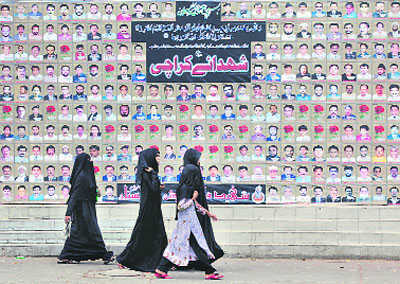
IN SHADOW OF DEATH: Women walk past a wall with portraits of people killed in a 2013 bombing in Karachi. REUTERS

HOW do you measure social progress in Pakistan? Where to begin? The economy? Growing according to some indicators. Property speculation? Also up, especially in Karachi, Lahore and Islamabad.A quick look at Pakistan’s many social ills — inequality, poverty, street children, gender inequality, law and order breakdown, violence against women, corruption, weak governance — tells you to spin around Clinton’s famous line. It’s not just the economy, stupid. It’s more than that.So how do you measure social progress in Pakistan? Something a colleague has been asking me for a while, given my work on The Samosa media project on human rights and culture in Britain and Pakistan. That colleague is Michael Green, director of the www.socialprogressimperative.org. This organisation has now gone further in answering this question, for all countries, with their annual Social Progress Index (SPI).The 2016 SPI has confirmed just how bad things are in Pakistan. It defines social progress as: “The capacity of a society to meet the basic human needs of its citizens, establish… building blocks… to enhance and sustain the quality of their lives… reach their full potential.”Awful news for Pakistan. Of 133 countries in the Social Progress Index for 2016, Pakistan ranks 113th. India is 98th and Bangladesh 101st. The ranking for tolerance and inclusion is even worse — Pakistan comes 132nd of 133.As someone with family in Pakistan, who has spent a lot of time in Pakistan and has a lot of love for Pakistan, I try to take the glass-half-full scenario. Karachi is a great economic engine, a megacity of huge potential. I’m full of admiration for countless welfare and charitable networks — Edhi Foundation, the Citizen’s Foundation, Human Rights Commission Pakistan, KVTC Karachi, Simorgh Women’s Welfare Project, Azad Street Children Welfare and Care Pakistan, to name a few — that work tirelessly to alleviate poverty, provide education and justice for the poor.The message from the SPI table for 2016 is terrible. Pakistan is staring into the abyss, a perfect storm of rapid population growth, social injustice, a huge street children population (estimated by the UN at 1.5 million), gender inequality, institutionalised state violence against women and chronic lack of economic opportunities for most people. Yes there’s a growing middle class, but in a county of 200m, too many are left out. The 2016 SPI has confirmed worst fears about how bad things are in Pakistan. Its evidence-based analysis makes difficult reading for those who care about Pakistan. This has to be seen in context. It is hard to plan transport, education and health provision when the Taliban and other hate-fuelled sectarian groups are waging war across the country.There may soon come a point where it becomes impossible to turn things around unless action is taken to address the immediate risks to Pakistan’s future as a state — poverty, lack of education, sectarian hatred and so on. How do you develop transport infrastructure, national schools programme or national health provision in such circumstances?A positive sign, as recently stated, is that Pakistan is seeing a downturn in the violence. Only if the state would stop its failed strategy of ‘strategic depth’, ‘enemy is India’ and the good Taliban/bad Taliban equation. Those in power, the military, billionaire oligarchs, and politicians need to understand that Pakistan is nearing the tipping point to becoming a failed state.There is criticism of Pervez Musharraf’s period as president, including outrageous attacks on civil society and abuse of democracy that ultimately led to his failure. One thing he at least tried — and I am not sure if the current leadership is — was a plan to tackle poverty, the educational crisis and other social ills.What would such a plan entail today? I think it involves raising a most sensitive issue in Pakistan. The country’s military expenditure in 2015 was $9.5 billion. India spent over $30bn in 2016. Nearly all this money goes to the West. It is colonisation by another method. Until this Dr Strangelove madness ends and both countries focus on education, trade, social welfare and peaceful relations, the annual SPI will I fear make ever more upsetting reading for Pakistan. A huge step in the right direction would be to reduce expenditure on missiles and increase it for education, health, housing and transport. Another is for the state to stand against the hate messages against women and minorities in Pakistan, promoted by sectarian parties in Pakistan, by tackling violence against women and protecting minority rights.The writer is director of www.thesamosa.co.uk, a culture and politics site with a focus on Britain and South Asia. (By arrangement with Dawn)