All posts by webadmin

10 minutes that shook the nation

In a post-war India struggling with disenchantment and rising prices, Gandhi used the incident to unite the people

Sardari Lal was injured in the airplane bombing at Gujranwala on April 15

Hall Gate, Amritsar

Prof JS Grewal & Prof Indu Banga The First World War had just ended. There was a lot of disillusionment, a lot of disenchantment. The prices were rising. Disbanded soldiers were acutely unhappy and felt cheated. People were protesting all over. They had wanted concessions, but what the British gave them was the Rowlatt Act. Mahatma Gandhi had already started acting against it and was mobilising people. Massive protests were being organised across Punjab too. Amid all this happened the Jallianwala Bagh massacre.It was Baisakhi day and Sikhs from nearby villages were visiting the Golden Temple. Some of them with families were resting in the Bagh. Col Reginald Dyer, a British officer, arrived with the troops and ordered them to open fire at the people in Jallianwala Bagh. Hundreds died on the spot, several hundreds were injured, making it a watershed moment in the history of the national movement. However, what make the incident important were the events that led to it.The early 20th century saw the mobilisation of masses through various causes. The Swadeshi movement and Ghadar movement had taken place, along with the revolutionary activity in Bengal and Maharashtra. There was a lot of discontent among Michael O’Dwyer’s forced recruitment for the war. He was actually an arch imperialist, who played an active role in various imperialist organisations in the UK after his retirement. All this had already angered people. The Indians who had fought in the war had returned with the idea of political concessions. They had thought there would be equality. There was considerable discontent in Punjab. Prof Ravinder Kumar, a historian of modern India, has written on this in detail in Urban Society and Urban Politics: Lahore in 1919.The people’s restlessness made the British worried and they were afraid of a repeat of 1857. The Ghadar leaders had openly talked about 1857 as the First War of Independence and they tried to bring about an uprising of the British Indian army. There was an exaggerated fear among the British that there could be a possibility of this kind of situation. They were paranoid and had been actually expecting something in 1907, the 50th anniversary year of 1857, when Ajit Singh and Lala Lajpat Rai were deported to Burma. This is what Dyer had also claimed and O’Dwyer was his biggest defender.In the aftermath of the tragedy, Rabindranath Tagore relinquished his knighthood in May 1919 and Gandhi gave up his medal of Kaiser-e-Hind in August 1920. The SGPC had resolved to support non-cooperation in 1921.That was the least they could have done to protest. What made the Jallianwala Bagh massacre more important was the context in which it happened, the times that were. It fitted into the scenario. In 1919, people were protesting against the Rowlatt Act; in 1920, the Khilafat Movement and the Non-Cooperation Movement had started and continued for another year until it was dropped in 1922. These three years are very important in the history of modern India. The Jallianwala Bagh incident is important in the sense that it created a possibility for Gandhi and some other leaders to come together and use this and the other movements against the British. This, like the return of titles and awards, became a feature of the non-cooperation movement. The effort was to bring together all anti-British forces together. And he succeeded in it to a large extent and emerged as the most important Indian leader after these three years.To say that the Jallianwala Bagh tragedy made him big would be too simplistic a statement. He made his own inquiry into the incident. He seized upon the opportunity, which was in continuation of the agitation against the Rowlatt Act and used it for unprecedented political mobilisation under non-cooperation.It may be added that Udham Singh avenged the incident by murdering O’Dwyer in March 1940. The event is said to have left a deep mark on Bhagat Singh, who is believed to have carried home soil from the Bagh. It turned Akali leader Kartar Singh Jhabbar, a pacifist interested in social and educational reforms, into an extremist political activist.This period remains a watershed in the Indian freedom movement, and the Jallianwala Bagh tragedy was an important one in a chain of events.— As told to Sarika Sharma
Army’s ‘bovine battle’ to cut cost, free up land

Struggles to give away 22,000 cattle after closure of military farms; Rs 300-crore annual burden

Army’s ‘bovine battle’ to cut cost, free up land

Ajay Banerjee

Tribune News Service

New Delhi, August 5

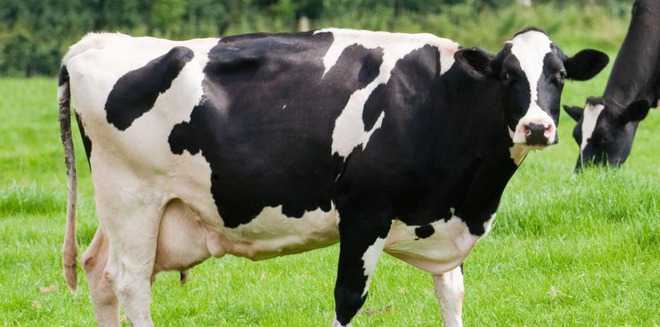
The Indian Army is faced with ‘bovine battle’ as it struggles to hand over some 22,000 cows it owns. The Army is spending Rs 300 crore a year on their upkeep — feed, manpower, salaries and day-to-day expenses.In July last year, the Ministry of Defence (MoD) ordered the closure of 39 military farms across the country. Started in 1889 by the British, such farms are redundant as the milk supply is no more dependent on them.The farms sit on 20,000 acres of prime defence land that is now needed for new projects like upcoming ground-based missile storage, aviation, new raisings and even housing for jawans.The cows should have been handed over a year ago, but there was no interest at auctions. The MoD, in last week of June, issued instructions to give away the cows at a nominal rate of Rs 1,000 each to central and government units besides cooperatives.The Army originally had 25,000 cows, of which 2,700 were given away. Some 22,000 cattle head still remain and are being looked after by the Army. After the fixation of a nominal cost, the Army has received applications to take away 11,000 more cattle head, sources have confirmed. The cost of transportation is to be borne by the purchaser.A large number of these cows are of high-yield variety ‘Frieswal’ developed by cross-breeding the Holstein Friesian cow of the Netherlands with the Sahiwal of India.As per the MoD plan, 12 of the 39 British-era military farms were to close by August 15, 2017, and the remaining by the end of October 2017.These farms, when running full steam, met 14 per cent of about 210 million litres of annual milk supply needed by 1.3 million-strong Army. The rest is now procured through various cooperative milk supply schemes run across the country.The ‘white revolution’ of the 1970s changed the dynamics of milk availability. On December 28, 2017, Union Agriculture Minister Radha Mohan Singh told a parliamentary consultative committee that “India continues to be the largest producer of milk in the world since last 15 years”. Milk production, which was around 17-22 million tonnes in the 1960s, has increased to 163.7 million tonnes in 2016-17.The original decision to close down the military farms was taken in 2013 after a meeting of the Army Commanders. While 29 farms were to shut shop between 2013 and 2015, the remaining 10 had to follow suit by 2017.The farms are spread in places like Ambala, Jalandhar, Pathankot, Jammu, Srinagar, Kargil, Udhampur, Meerut, Ranikhet, Ahmednagar, Gwalior, Jabalpur, Secunderabad, Mhow, Jhansi, Dimapur, Guwahati, Jorhat, Panagarh, Kolkata, Agra, Allahabad, Lucknow and Kanpur, among others.British legacy 

  • Started in 1889 by the British, 39 military farms have far outlived their utility of providing milk to forces
  • As per the MoD plan, 12 of the 39 farms were to close by August 15, 2017, and the remaining by the end of October 2017
  • Of 25,000 cows, 2,700 were given away, while some 22,000 still remain. With little interest at auction, these are now being offered at Rs 1,000 each

US designates LeT commander global terrorist

US designates LeT commander  global terrorist

Photo for representational purpose only.

New Delhi, July 31

In the latest counter-terrorism action, the US Departments of State and Treasury have notified Lashkar commander Abdul Rehman al-Dakhil as a specially designated global terrorist (SDGT). The list imposes sanctions on “foreign persons who have committed, or pose a significant risk of committing, acts of terrorism that threaten the security of American nationals or the country’s national security, foreign policy or economy”. Among other consequences, all of his property and interests subject to US jurisdiction are blocked, and US persons are generally prohibited from engaging in any transactions with him, said the State Department.Dakhil, a longtime member of Lashkar-e-Toiba (LeT), was an operational leader for the attacks carried out in India between 1997 and 2001. In 2004, Dakhil was captured in Iraq by British forces and held in US custody. He was transferred to Pakistan in 2014. After his release, Dakhil returned to work for LeT as divisional commander for the Jammu region. — TNS


Guard against Imran’s political reverse swings Bhopinder Singh

The road to spirituality and prime ministership was coincidentally also marked by his third marriage to the scholarly-austere-mystic Bushra Maneka.

Pakistani politician Imran Khan, chief of Pakistan Tehreek-e-Insaf party, speaks to media after casting his vote at a polling station for parliamentary elections in Islamabad. (Photo: AP)

Pakistani politician Imran Khan, chief of Pakistan Tehreek-e-Insaf party, speaks to media after casting his vote at a polling station for parliamentary elections in Islamabad. (Photo: AP)

The man from the dustbowl district of Mianwali, Pakistan, who has feathered his illustrious hat as a former cricketer, commentator, philanthropist and politician, is now poised for the biggest “captaincy” of his 66 years as Prime Minister of Pakistan. The flamboyant Pathan of the Niazi-Burki stock has come a long way since forming his Pakistan Tehreek-e-Insaf or PTI (Pakistan Movement for Justice) in 1996, and then winning the solitary seat by himself in the 2002 general election with 0.8 per cent of the national vote to now emerging as the biggest party in the 2018 general election.

Reminiscent of his cricketing life accusations of “ball-tampering” to deliver his lethal reverse swings, the political road to the PMO was paved with eerily similar murmurs of “friendly rigging” to take his political fortunes to its nadir. The PTI has finally emerged as the third major political force as it has bettered its 2014 performance, where it came third with 35 seats, even though it had garnered the second highest numbers of the popular vote (16.92 per cent, to Pakistan People Party’s 15.32 per cent, with 42 seats). The second successive transition of democracy from the PPP to PML(N) in 2013, and now from the beleaguered PML(N) to PTI is potentially the longest run for participative democracy in Pakistani history, and for the portents of the oft-quoted “Naya Pakistan” (New Pakistan)!

New Delhi watched the political hustings silently and without preferences in the quiet knowledge that irrespective of the individual in the Prime Minister’s position, the shadow of the “establishment” (read Pakistani military) will always loom and prevail in the background. Mr Khan has been consistently accused of being the “ladla” (favoured one) of the Pakistani “establishment”, and both the outgoing PML(N) and reduced-to-provincial-role PPP have already started rejecting the verdict “due to manifest and massive irregularities”. Whispers of the “establishment’s” preference for Mr Khan over the others first came out during the crippling azadi march of 2014, when the followers of Mr Khan’s PTI and those of moderate Islamic cleric Tahir-ul-Qadri were said to have been given the silent nudge by the military to organise the “sit-in” against the ostensible electoral frauds by the PML(N). Since then, while the Sharif brothers and the Bhutto-Zardari clans have been mired under multiple cases of corruption — the essential narrative of “King Khan” as the proverbial messiah of Pakistan’s economic slide and ignominy of corruption has been allowed to form.

Since his cricketing days, Mr Khan has developed a personality that has been larger-than-life and replete with instances of self-confessed misdemeanours that have ironically added to his persona. These traits of successful appropriations, selective ambivalences and “economies-of-truths” have come handy to evolve and mature the quintessential politician. Basking under the popular perception as the discoverer of the famed art of “reverse swing”, the real credit actually goes to the lesser-known Sarfraz Nawaz or even earlier Mr Khan’s clansman Farrakh Khan. Neither a tearaway pacer like Shoaib Akhtar nor as talented as Wasim Akram — the relatively more disciplined (only on the cricket ground) Mr Khan still emerged as the greatest Pakistani cricketer and captain of all time. His off-field exploits have been legendary on both sides of the LoC, as also in the West, only to rediscover his Islamic moorings and contemplative identity after meeting his mentor Mian Bashir. The supposed transformation from the playboy-socialite Imran Khan to the serious politician has since overcome all subsequent accusations of moral dalliances and infidelities, as exposed recently in the autobiography by his former wife Reham Khan. The road to spirituality and prime ministership was coincidentally also marked by his third marriage to the scholarly-austere-mystic Bushra Maneka.

While welcoming his opening spell of “you take one step forward, we will take two”, India must guard against the political reverse swings that are inevitable. His political, moral and personal malleability has earned him contradictory monikers like “Taliban Khan” and “Teflon Khan” alike. While frequently invoking and alluding to Jinnah and Iqbal’s vision of Pakistan as his lodestar, he was also in the forefront of submitting adjournment notice against the ban on Hafiz Saeed’s Jamaat-ud-Dawa. Sensing the popular mood he has dovetailed and postured his perceived angst against the US as a fierce critic of drone attacks, even though they target terrorists who have made Pakistan bleed. He carefully avoids the contentious root cause by saying incredulously: “In Pakistan, the main problem is not extremism”, and adds naively that it is one of “governance failure” — the implied context of which means different things to different people, yet offending none. His seesaw relationship with the military has also been opportunistic, with him either lambasting the generals or quietly acquiescing to their ways, like in recent times. The innate populism couched in his overtly political statement that he would not stay in the Prime Minister’s mansion as he would be “embarrassed” by its opulence militates against the reality of his own 40 acre hilltop mansion in Islamabad.

The political pitch awaiting his formal ascendancy will retest his temperamental skills as he will have to navigate the carefully defined contours of governance that could enfeeble, rile and rouse the proud Pathan in the “land of the pure” after the “establishment” has dumped the Sharif-Bhutto “props” who overstepped their mandate. Like all powerful and seemingly decisive Opposition leaders, who brave the streets against the ruling establishments, the change of role and responsibility to that of actual governance is a completely different ballgame. Charm offensives and glib talk have their limits and in countries like Pakistan the real challenge is managing the home turf and the “palace intrigues” within, as opposed to “external” threats (read India) that are strategically postulated as bogies to keep various institutions like the military, clergy and politicians relevant as diversionary tactics.

Historically, lionised individually and often accused of selfishness and lacking team spirit, for example his speech after the 1992 World Cup or by the likes of his contemporaries like Javed Miandad, the next innings has just started. India too therefore needs to take guard.

Tags: imran khanhafiz saeednawaz sharif

3 militants behind killing of trainee cop gunned down in south Kashmir’s Kulgam

3 militants behind killing of trainee cop gunned down in south Kashmir’s Kulgam

Majid Jahangir

Tribune News Service

Srinagar,  July 22

At least three militants behind the abduction and killing of a trainee constable were killed in an encounter with security forces in south Kashmir’s Kulgamdistrict of Jammu and Kashmir on Sunday, the police said.

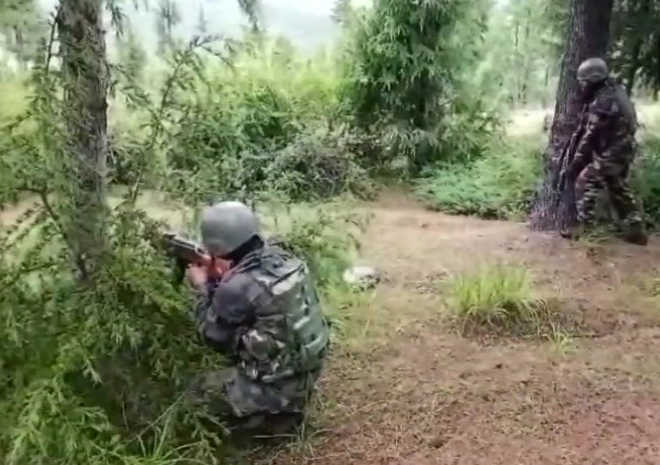
The gunfight erupted at Wani Mohallah, Khudwani, some 65 km from Srinagar, when joint teams of the police, Army and CRPF launched a cordon and search operation in the area after an input about militant presence.

“The CASO (cordon and search operation) turned into an encounter when hiding militants opened fire at around 5.30 am, injuring one Army jawan. In the gunfight that followed, all three militants were killed,” a police officer said. “We have recovered two AK rifles and a carbine.”

Police sources said one of the slain militants is suspected to be a Pakistani national.

Police said the trio was involved in the abduction and killing of the cop in the district on Saturday.

“Terrorists involved in the abduction and killing of Constable Saleem yesterday have been killed in an encounter at #Khudwani Kulgam. Search continues,” J&K Police tweeted after the gunfight.

A policeman, Mohammad Saleem Shah of Mutalhama Kulgam, was killed by militants after he was abducted from his house. His body was recovered from a nursery village, Redwani Payeen, yesterday afternoon. Police had said the body bore severe torture marks.


Late on Saturday, militant group Hizbul Mujahideen had released a “confessional statement” of the cop. (With inputs from Suhail A Shah in Anantnag)


More than my wife: When IAF Squadron Leader Meet Kumar, killed in MiG 21 crash, narrated his love for the jet

More than my wife: When IAF Squadron Leader Meet Kumar, killed in MiG 21 crash, narrated his love for the jet

Eyewitnesses recall that even during the last minutes, he appeared to have steered away the aircraft from the civilian area towards the fields to ensure that no harm was caused to the people living in that locality.

NEW DELHI: Indian Air Force (IAF) Squadron Leader Meet Kumar, flying a MiG-21 fighter jet, took off from Pathankot air base on Wednesday on a routine sortie. A little about an hour later, the aircraft crashed near Kangra in Himachal Pradesh, killing the officer who shared a very special bond with the jet and had spent more time with it than his wife.

Eyewitnesses recall that even during the last minutes, he appeared to have steered away the aircraft from the civilian area towards the fields to ensure that no harm was caused to the people living in that locality.

As soon as the news of the crash and his unfortunate death came out, a video shot by the Indian Air Force – A Date With An Airwarrior – featuring him went viral. Dressed up in his uniform, with his gear on, Squadron Leader Meet Kumar, can be heard recalling the special bondthat he shared with this machine, which he said was much more than his love for his wife.

http://

Here is the transcript of his statement:

“My name is Squadron Leader Meet Kumar. I am posted to 18 Squad. I have been flying this beautiful machine called MiG-21.”

“This machine is a multi-role aircraft wherein it can undertake any sort of missions. This aircraft is, particularly for a high landing speed. Every landing is different. On this aircraft, we have a 57 mm rocket. We can carry high-calibre and low calibre bombs. The aircraft is capable of carrying 8 bombs at a time and when you are flying this aircraft, you feel none other than God.”

“The bond that I share with this machine is very rare. It is more than my wife. We know each other very well. I have spent more time with this machine than my wife.”

Defence Minister Nirmala Sitharaman expressed “deep grief” over his death. “Our heartfelt condolences to the family of brave pilot Sqn Ldr Meet Kumar, who we lost in the fateful crash,” she said. A Court of Inquiry (COI) has been ordered into the accident.

This is not the first instance of a pilot being killed in a MiG crash. In fact, the IAF has been grappling with rising incidents of accidents involving its flying platforms.

Minister of State for Defence Subhash Bhamre had on Wednesday told the Lok Sabha that a total of 25 accidents involving IAF aircraft have been reported since 2015-16. He said that a total of 39 people died in the accidents and that IAF lost all the aircraft involved in the crashes. He said there were five accidents involving aircraft of the Army during the period in which four people were killed.

The MiG-21 jets were inducted into IAF in the early 1960s and many of these planes have been lost in crashes.


HEADLINES PRINT MEDIA NEWS ::15 JUL2018

  1. VETERAN COL ATAMJIT SINGH COMES TO RESCUE OF DEBT RIDDEN OFFICERS TWIN DAUGHTERS
  2. IN RARE CRITICISM, NAVY OFFICER BLAMES IAF FOR ‘TRUST DEFICIT’ BETWEEN FORCES
  3. INDIAN NAVY’S CAVE DIVING RESCUE CAPABILITY, LIKE IN THAM LUANG, DOES NOT EXIST
  4. OFFICER CONFINED TO MENTAL WARD: SEND HIM HOME WITH FATHER, DELHI HIGH COURT TELLS IAF
  5. GOVT TO FINALISE S-400 DEFENCE DEAL WITH RUSSIA SOON AS NIRMALA SITHARAMAN SAYS US LAWS DON’T APPLY HERE
  6. FIXATION OF PAY OF OFFICERS OF THE RANK OF LT COL (LEVEL 12A) AND COLONEL (LEVEL 13) VIDE MOD
  7. GENERAL BIPIN RAWAT’S INDICTMENT OF OFFICERS FOR PLAYING GOLF IN JAMMU AND KASHMIR WAS UNWARRANTED
  8. DELHI DRAMA SHAMES ALL BY LT GEN BHOPINDER SINGH
  9. A GENERAL RETIRES | 101 THE JOURNEY | UNIQUE STORIES FROM INDIA
  10. TOO EARLY TO TALK ABOUT ARTIFICIAL INTELLIGENCE’
  11. SECURITY, NOT DISPLACEMENT PUNJABIS IN MEGHALAYA SHOULD NOT BE RELOCATED
  12. LT GEN RANBIR STRESSES ROLE OF TECHNOLOGY IN NATION-BUILDING DELIVERS A LECTURE DURING INTERNSHIP CAMP AT KATRA VARSITY
  13. LT GEN HASNAIN IS CUK CHANCELLOR
  14. SOLDIER INJURED BY PAKISTAN SNIPER FIRING ALONG LOC IN J&K
  15. ARMY CHIEF REVIEWS SECURITY IN AKHNOOR
  16. RARE SIKH EMPIRE ITEMS ON DISPLAY IN LONDON EXHIBITION
  17.  INDIA-MAKE EQUIPMENT COSTLIER, MOD ASKS WHY TO EXAMINE HOW PUBLIC SECTOR FIRMS ARRIVE AT COST

Commando, civilian killed in Kupwara

Commando, civilian killed in Kupwara

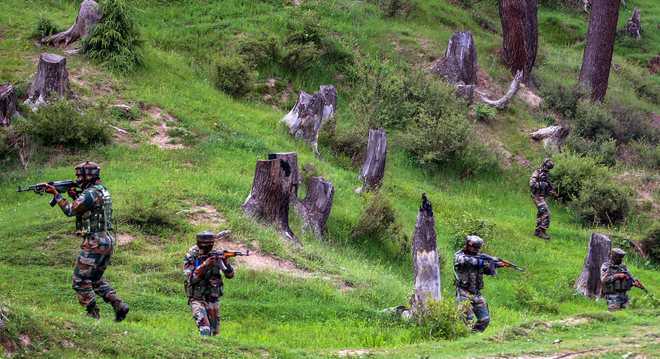
Security personnel take position during an encounter in Kupwara in Wednesday. — ANI

Azhar Qadri

Tribune News Service

Srinagar, July 11

An Army commando of the elite Special Forces was killed in a gunfight with militants during a search operation in north Kashmir’s Kupwara district on Wednesday.A civilian was killed when security forces fired at stone-pelters in Trehgam area of Kupwara district.  The soldier, identified by the police as Mukul Meena of 3 Parachute Regiment, a resident of Alwar in Rajasthan, was evacuated to a military hospital where he was declared “brought dead”. The Kupwara SSP,  Sriram Dinkar, said a search for militants was launched in Kandi forest area on Tuesday evening following a tip-off. “Since then, there has been intermittent firing and brief contacts with the militants.”  The entire forest area in the hinterland has been cordoned. The officer said it was yet to be ascertained whether the militants had infiltrated from across the Line of Control (LoC) recently or had been hiding there for a while. Infiltration into Kupwara has been on the rise in recent weeks with the Army killing 22 militants during the Ramadan ceasefire which ended mid-June. Two more were killed in the subsequent weeks. According to a senior Army commander, 250 to 275 militants are waiting to infiltrate into Kashmir in groups of 20 to 25 at different launch pads facing the area under the Srinagar-based 15 Corps. 


Militant killed in Kupwara gunfight

Militant killed in Kupwara gunfight

Tribune News Service

Srinagar, july 9

An unidentified militant has been killed in a gunfight that erupted at Khanpora Handwara forest in Kupwara district on Sunday evening when joint forces were combing the area.”So far, one militant has been killed. The operation is under way,” an Army officer said. Meanwhile, militants targeted three CRPF camps in the Tral area of south Kashmir’s Pulwama district on Monday.The first grenade was lobbed towards the headquarters of 180 Battalion of the CRPF around 10.15 am. It exploded outside the camp.Five hours later, unidentified militants attacked another CRPF camp at Batagund, Tral, with a grenade.”There was no immediate report of casualties in the two grenade attacks,” said a CRPF officer. The third attack was on a police post at Airpal in the Tral area. However, the grenade missed its target.