All posts by webadmin

Congress delegation again meets CAG over Rafale; seeks forensic audit

Congress delegation again meets CAG over Rafale; seeks forensic audit

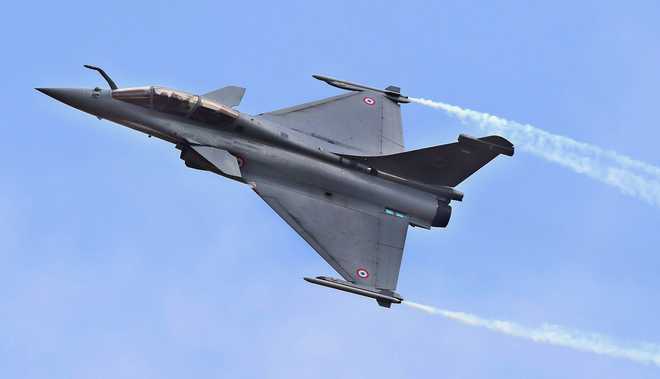
Photo for representation.

Tribune News Service
New Delhi, October 4

A high-level Congress delegation on Thursday petitioned the CAG for the second time in 15 days and sought forensic audit of the Rafale deal between India and France.

In a memorandum to CAG Rajiv Mehrishi, the Congress appealed to the central auditor to undertake “his constitutional duty” and expose the facts of Rafale to enable parliament to take a view on the issue.

The Congress is simultaneously demanding a joint parliamentary committee probe into the matter.

Repeating the allegations it has been making in the Rafale matter, the Congress said the 36 jet deal compromised national security by cutting down on the jet order and also removing the transfer of technology clause for HAL in the original negotiations which the Congress-led UPA had started.

“It is our clear understanding that all the contours of this conspiracy, corruption, endangering of national security and crony capitalism can be uncovered only thorough a probe by the Joint Parliamentary Committee (JPC). It is expected that the CAG which has a constitutional mandate and authority to scrutinise every document, in this case including original tender, understanding reached between Dassault and HAL and the arbitrary decision of the Prime Minister without any mandate from the Cabinet Committee on Security (CCS) will undertake a forensic audit,” the memorandum said.

The delegation, comprising senior Congress leaders Ahmed Patel, Anand Sharma, Jairam Ramesh, RPN Singh and Randeep Surjewala, urged the CAG to “bring all facts on record to enable Parliament to fix accountability for the Rafale scam”.

The Congress had earlier met the CAG on this issue on September 19.


Surgical strike not the only option to tackle terrorism from Pakistan: Army Chief Gen Bipin Rawat

New Delhi: While reiterating that Pakistan-sponsored terrorism is the biggest challenge to the country, Army Chief General Bipin Rawat on Tuesday warned that the armed forces have several options open, including surgical strikes, to teach a firm lesson to the country’s enemy.

”Terrorism emanating from Pakistan is the biggest challenge to the country. But surgical strikes are not the only option we have. The armed forces have several other better options for tackling cross-border infiltration and terrorism,” Gen Bipin Rawat said.

Though Gen Rawat stopped short of disclosing what strategy the armed forces were planning to adopt in order to tackle cross-border terrorism, he threw enough indications of a major military action in future if the situation warranted.

In a stern warning to Pakistan, General Rawat warned that the country’s armed forces were fully prepared to deal with any eventuality as war can take place any time.

In view of the current situation in Jammu and Kashmir, the Army Chief admitted that there was a need for another surgical strike on terror launch pads across the Line of Control.

“I won’t deny this. But surgical strikes are not the only option with us. We keep reviewing the situation and prepare our strategy accordingly. We can’t disclose how and when, but we will certainly take a decisive action whenever needed,” he added.

General Rawat said this in an exclusive interview with Zee News Editor Sudhir Choudhary during which he spoke on a wide range of issues, including the change of guard in Pakistan, political atmosphere in the country, recent kidnapping and killing of jawans and civilians, alleged violation of human rights by the armed forces, the need for another surgical strikes on terror launch pads, the Rafale row and whether he harboured any political ambitions.

Expressing his views, Gen Rawat said peace and stability in the region can be established only if the civilian government in the neighbouring nation and its armed forces make an honest effort towards it.

”Peace can come, insurgency and cross-border terrorism can end if the Imran Khan government in Pakistan takes an honest effort in that direction. Till the time the civilian government in Pakistan remains under the clutches of its army (ISI) peace will remain a distant dream,” Gen Rawat said.

While revealing that he had never met his Pakistani counterpart Gen Qamar Javed Bajwa, Gen Rawat said that the former has the capability of ending the proxy war between the two countries, cross-border infiltration, terrorism and all turbulence along the India-Pakistan borders.

However, in view of Gen Bajwa’s reported provocative statements, Gen Rawat said that chances were grim that the bloodshed will end in J&K.

He said that Pakistan-back terrorists were utterly frustrated with Indian Amry’s counter-terror operations in which several top terrorists had been eliminated.

”Recent kidnappings and killing of armed forces personnel, civilians and J&K policemen indicate that they (Pakistan-backed terror outfits) are frustrated and losing ground, ” he said.

Gen Rawat, while praising the officers and jawans of the armed forces, said that the country is fully prepared to deal with any eventuality and to protect the national borders.

To those seeking evidence of the 2016 surgical strike, Gen Rawat urged ”please trust your armed forces and believe in what they do and say.” ”For Army, Operation is a priority, not taking evidence of a strike,” he added.

Gen Rawat, while pitching for the inclusion of latest technology in modern warfare, said continuous upgradation of the armed forces, weaponry, logistic support is needed to sharpen the combat capabilities of the armed forces.

The Army Chief also referred to the ongoing row over Rafale defence deal. He said that defence procurement should be done through Government-to-Government channels, which will eliminate the risk of middlemen and ensure transparency.

Interestingly, Gen Rawat had on Sunday said that surgical strike is a weapon of surprise and must remain so while hinting that the security forces will respond when the appropriate time comes.

”Surgical strike is a weapon of surprise. Let it remain a surprise,” General Rawat had said.

Rawat also backed the Narendra Modi government’s decision to cancel talks with Pakistan, asserting that talks and terror cannot go together.

Gen Rawat said that whichever party comes to power at the Centre, the Indian Armed forces will always remain ”apolitical.”

The Army Chief also said infiltration from across the border persists despite the call for a ceasefire by Pakistan and stressed that this cannot be allowed to continue and appropriate action has to be taken to deter terrorists from disrupting the peace in the Kashmir Valley.

”Infiltration from across the border persists despite the call for a ceasefire by Pakistan,” said Rawat stressing that ”this cannot be allowed to continue”.

”They have been carrying out barbaric acts and Pakistan Army is used to doing this. It is not the first time that they have done it,” the Army Chief said.

When asked if he harboured any political ambitions, Gen Rawat said, ”No.”

I an not cut out for that. I would like to be remembered as an Army officer who lived his dream, who led his side with pride, and the one who always admired and respected his olive green uniform.

The no-holds-barred interview with Army Chief came nearly a week after a BSF soldier was shot dead by Pakistani forces and his mutilated body was found later.

The Army had conducted a massive surgical strike on terror launch pads across the Line of Control on September 29, two years ago.

Meanwhile, the Defence Ministry has decided to observe ‘Parakram Parv’ commemorating the valour and sacrifice of the armed forces on the anniversary of the 2016 surgical strikes on terrorism launch pads along the LoC.

A three-day main event between September 28-30 will be organised at the India Gate lawns in the national Capital besides similar events at 53 locations in 51 cities across the country to “highlight the valour of the Indian armed forces in general and special forces in particular”.

Defence Minister Nirmala Sitharaman would inaugurate the event on September 28 at India Gate lawns.

“To showcase the courage, valour and sacrifice of the armed forces, `Parakram Parv`, which literally means a celebration of valour, is being observed,” Army spokesman Colonel Aman Anand said.

The Army conducted surgical strikes (on the intervening night of September 28-29, 2016) which had strategic ramifications and were aimed to “dissuade the inimical adversary from adopting the path of violence and to ensure an environment of peace for the nation”.

Naval officer to be rescued in 16 hours

Shubhadeep Choudhury

Tribune News Service

Kolkata, September 23

The ordeal of Abhilash Tomy, the injured Naval officer drifting in the south Indian Ocean in his damaged sailboat, may end by Monday.a tweet, Defence Minister Nirmala Sitharaman said, “Spoke to VCNS VAdm Ajit Kumar P, AVSM, VSM regarding the condition of injured navy officer @Abhilashtommy. The rescue mission is being coordinated with the Australian Navy. The injured officer shall be picked up in the next 16 hrs by a French vessel Osiris.”

From the French ship, Tommy is expected to be shifted to Australian Navy vessel HMAS Ballarat which is equipped with medical facilities. HMAS Ballarat has already sailed from Perth this morning.

Indian Navy frigate INS Satpura, which has been diverted towards Tomy’s location in the South Indian Ocean for rescue, will reach there by Friday, a Navy spokesman said.

Drifting in the high sea for about 48 hours now, the Navy officer, the only Indian participant in the Golden Globe Race (GGR), has complained of vomiting and chest burning. The race organisers tweeted his message sent to them via satellite.

“5 lugged cans of ice tea. Having that. Vomiting. Cont. chest burnin,” Tomy said in a message which was tweeted by the GGR this afternoon. According to GGR, Tomy has not drunk water since his boat was hit by a storm on September 21, leaving him injured and damaging his yacht.

The 39-year-old sailor, who has circumnavigated the globe once, had on July 1 embarked on the 30,000-mile journey through some of the world’s toughest seas aboard a non-motorised sailboat all alone.

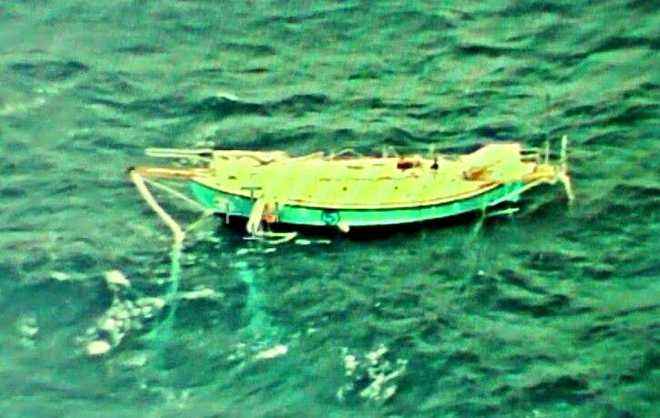
A Navy plane tasked with locating Tomy has successfully spotted the yacht. Tomy heard the noise of the plane and got very excited. “Heard AC (aircraft). ETA Rescue? (expected time of arrival of rescue?),” Tomy asked the GGR organisers via satellite.

Navy officer asks ‘ETA Rescue?’ after hearing noise of plane

Navy officer asks ‘ETA Rescue?’ after hearing noise of plane

A picture of Abhilash Tomy’s boat taken from the Navy plane on Sunday morning.

Shubhadeep Choudhury

Tribune News Service

Kolkata, September 23

Drifting in the high seas for about 48 hours now, Abhilash Tomy, the daring Indian Navy officer who is the only Indian participant in the tough Golden Globe Race (GGR), has complained of vomiting and chest burning.

He has had some ice tea. Organisers of the race have tweeted Tomy’s message sent to them via satellite.

“5 lugged cans of ice tea. Having that. Vomiting. Cont. chest burnin”, Tomy said in a message which was tweeted by the GGR at around quarter past three this afternoon.

According to GGR, Tomy has not drunk water since his boat was hit by a storm on September 21 and left him severely injured besides causing major damage to his yacht.

The 39-year-old sailor, who has circumnavigated the globe once in the past, had on July 1 embarked on the 30,000-mile journey through some of the world’s toughest seas aboard a non-motorised sailboat all alone.

The Navy has deployed a frigate INS Satpura (with a Chetak helicopter on board) and tanker INS Jyoti for rescue of its intrepid officer who is a winner of the Keerti Chakra.

INS Satpura and INS Jyoti were operating in the Indian Ocean from where ships were diverted to the South Indian Ocean for the rescue operation.

A Navy plane tasked to locate Tomy has also successfully spotted the yacht. Tomy heard the noise of the plane and got very excited. “Heard AC (aircraft). ETA Rescue? (expected time of arrival of rescue?),” Tomy asked the GGR organisers via satellite.

Tomy’s location was initially tracked to approximately 1,900 nautical miles south west of Perth, Western Australia. The boat may have drifted further off from the coast by now.

According to GGR, a French fisheries patrol vessel arranged by the Australian marine rescue authorities to reach the scene has got delayed due to bad weather. Gregor McGuckin, a fellow GGR participant who is heading toward Tomy in his sailboat, has also slowed down because of the weather.

However, Australian warship HMAS Ballarat, which is tasked to provide medical assistance to Tomy after his rescue, has set off for the scene this morning.

In a press statement issued at 4.15 this evening, Indian Navy said its P-8I aircraft operating ex-Mauritius visually sighted the ‘SV Thuriya’ (Tomy’s yacht) at 0750 hrs this morning. Continuous watch over the boat is being maintained by Navy and RAAF aircraft till rescue is completed.

“The officer in his last text message has indicated that he is safe on the boat; however is immobile due to back injury,” stated the press release.


Govt blames UPA for HAL exclusion from Rafale deal

SITHARAMAN VS ANTONY Debate over contract details continues

› The UPA should have ensured that HAL’s offer was appealing enough for Dassault to conclude the agreement… It’s not for us but for the UPA to answer why the agreement did not happen NIRMALA SITHARAMAN, Union defence minister
Since there is a growing perception that the Modi government’s Rafale purchase deal has more skeletons in its closet, let there be a JPC probe to bring out the truth AK ANTONY, former defence minister

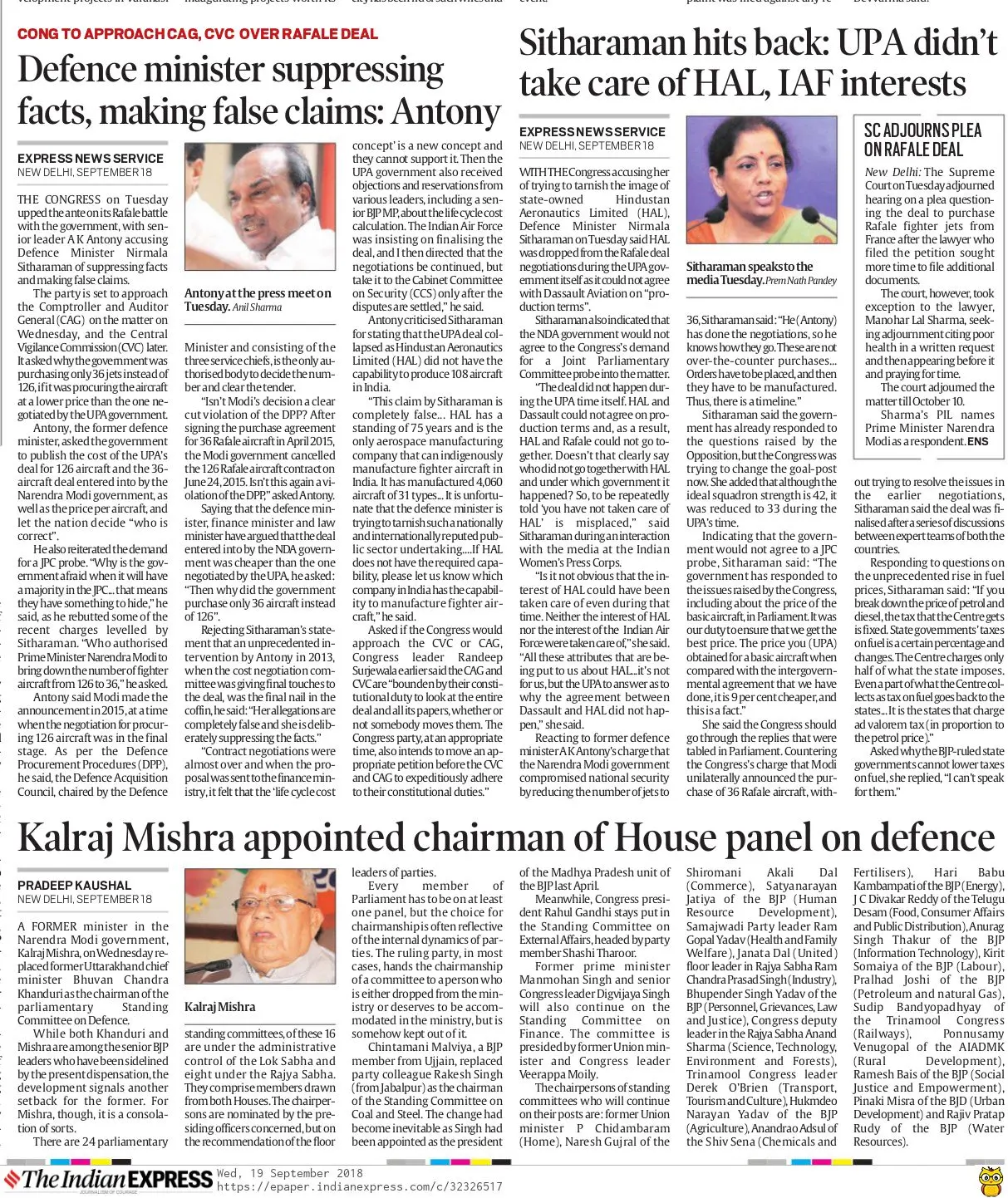
NEWDELHI: The NDA government and the Congress locked horns over the controversial ₹59,000crore Rafale deal on Tuesday, with defence minister Nirmala Sitharaman asserting that Hindustan Aeronautics Limited (HAL) lost out on the chance to build the warplanes because of the previous UPA regime, and former defence minister AK Antony accusing Sitharaman of suppressing facts and demanding that a joint parliamentary committee probe be set up to investigate the deal.

“Dassault Aviation (the maker of Rafale jets) and HAL could not agree on production terms… The UPA government should have ensured that HAL’s offer was appealing enough for Dassault to conclude the agreement (to build 108 Rafale jets in India),” Sitharaman said, while interacting with reporters at the Indian Women’s Press Corps.

The NDA’s decision to enter into a government to government deal with France to buy 36 Rafale warplanes was announced in April 2015 with the deal signed a little over a year later. This replaced the UPA regime’s decision to buy 126 Rafale aircraft, 108 of which were to be made in India by HAL.

Sitharaman said it was for the UPA regime to answer why HAL was not chosen as a partner for the contract. “It’s not for us but for the UPA to answer as to why the agreement between Dassault and HAL did not happen.”

In a separate press conference, Antony accused the government of being guilty of “gravely compromising” national security in the Rafale deal. “Since there is a growing perception that the Modi government’s Rafale purchase deal has more skeletons in its closet, let there be a JPC probe to bring out the truth,” the former minister said. He said the parliamentary committee could reveal the truth by poring over all the files related to the Rafale deal .

Antony accused Sitharaman of trying to blemish the HAL’s image. Last week, Sitharaman said the previous negotiations for 126 fighters collapsed as HAL did not have the required capability to produce the fighters in collaboration with Dassault.

Antony said if the deal negotiated by the NDA was better than the UPA’s then why did the government buy only 36 aircraft and not 126 planes.

A Congress leader, who spoke on the condition of anonymity, later said leaders of the party planned to meet the Comptroller and Auditor General of India on Wednesday to ask for a thorough investigation in the matter.

Sitharaman underlined the government had responded to price issues raised by the Congress in Parliament. “It was our duty to ensure that we get the best price. The price you (UPA) obtained for a basic aircraft when compared with the inter-governmental agreement that we have done, it is 9 per cent cheaper,” she said.


clip

clip


Leopard’s urine helped the Indian Army in its surgical strike, says Lt Gen who led the strikes in Pakistan

he Indian Army officer who participated in the 2016 surgical strike inside Pakistan territory said that the troops carried leopard’s urine to scare the dogs during the operations.

n operational strategy, while crossing villages en route, the Indian Army soldiers would spray leopard urine outside the villages. He added that the strategy worked well and the dogs left the teams ‘alone’. The teams thus achieved the much-needed stealth in the risky operation 15 km inside Pakistani territory.View image on Twitter

View image on Twitter

ANI

 @ANI
 There was a possibility of dogs in villages barking at us on the route. I knew they are scared of leopards. We carried leopard urine with us & that worked & dogs didn’t dare to come forward: Lt General RR Nimbhorkar, Former Nagrota (J&K) Corps Commander on Surgical Strike (11.09)
 Nimbhorkar further added that the Indian Army had studied the pattern of the terrorists operating out of launchpads and zeroed down upon 3:30 am as the appropriate time to carry out the strikes on the terror bases. ‘Three pads’ were destroyed and ’29 terrorists’ were killed in the operation that was lauded by the political leadership.

Ludhiana­born Anshdeep is first Sikh in US Prez security

Sought court intervention against the job’s requirement to be turban­less

KANPUR: Ludhiana-born Anshdeep Singh Bhatia has become the first Sikh to have been inducted into the security detail of US President Donald Trump.

■ Anshdeep Singh Bhatia being inducted into US President Donald Trump’s security.

Anshdeep was inducted last week after he completed his gruelling training in the United States.

FAMILY MOVED TO LUDHIANA IN 1984

His family moved to Ludhiana from Kanpur during the 1984 antiSikh riots.

He lost his uncle and a close relative after the frenzied mob stormed their house in Kanpur’s KDA Colony in Barra.

His aunt’s marriage was scheduled in second of week of November and the family was busy making arrangement.

Anshdeep’s father Devendra Singh was also injured in the attack and had received three bullet wounds.

His grandfather Amreek Singh Bhatia, manager with Punjab and Sind Bank, opted for a transfer to Ludhiana. His father, who was into the pharmaceutical business in Kanpur, married in Ludhiana and moved to the United States with his family in 2000. Anshdeep was 10 at that time.

Anshdeep who dreamt of making to the President’s security one day stumbled upon a block when he was told he would have to change his looks.

But Anshdeep moved the court against the riders and the decision came out in his favour.


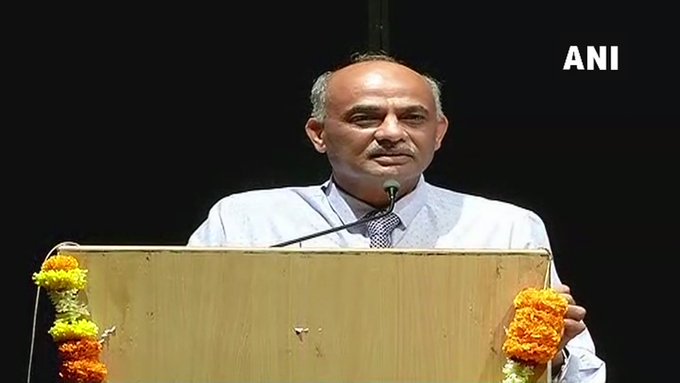
India, Pakistan attend SCO military exercises: New Delhi must continue to separate politics from multilateral interests by Lt Gen Syed Ata Hasnain

Something quite fascinating has just happened at Chebarkul, a Russian town located 1,800 kilometres east of Moscow. A not-too-reported event has generated different types of emotions among people in India who are aware of the happenings there. It was a joint training event of the armed forces of the eight full members of the Shanghai Cooperation Organisation (SCO), organised for the first time after the induction of both India and Pakistan into the grouping’s membership.8

It was in Qingdao, China that the Chinese- and Russian-sponsored regional cooperation body, which now includes member countries from both Central and South Asia, saw the political and diplomatic optics being fully played out with the new expanded membership. The SCO was founded at a summit in Shanghai in 2001 by the Presidents of Russia, China, Kyrgyz Republic, Kazakhstan, Tajikistan and Uzbekistan. India and Pakistan were earlier associate members but became full members last year after which the expanded summit took place at Qingdao in June this year, which was attended by Prime Minister Narendra Modi.

Representational image. AFP

The Chebarkul event saw the Indian and Pakistan armies coming together to train along with other member armies, for international security related contingencies, to include counter-terrorism, peacekeeping and disaster management. Before describing what international military cooperation training exercises are all about it may be appropriate to consider why the Chebarkul event was considered awkward by many in India, including a couple of television channels.

After Modi’s serious effort to break the ice with Pakistan through his surprise and unscheduled visit to Lahore on 25 December, 2015, the years 2016 and 2017 saw just the opposite of what India had intended. The Pathankot terror attack was followed by the Uri attack in Sep 2016 and the Nagrota attack in November of the same year. India put on hold an attempted process to find an elusive peace with Pakistan, immediately after Pathankot and subsequent events cemented its resolve that peace talks and sponsored terror could not go on hand-in-hand — an opinion, supported by a very large segment, developed in India as the response to Pakistan’s continued sponsorship of terror on Indian soil, particularly in Jammu and Kashmir.

Rationally, this opinion frowns on attempts by private bodies, peace groups (often called peaceniks), media houses and other advocates of unconditional talks with Pakistan; the argument of the latter elements is that without engagement and talks none of the differences between India and Pakistan can be ever resolved. The first opinion remains fixed on the resolve that no talks are possible unless there is demonstrated intent by Pakistan on a series of demands including the prosecution of those involved with the Mumbai terror attacks of November 2008. This point-of-view also promotes the belief that any private initiatives involving people-to-people contact or other means of engagement only demonstrate Indian weakness to pressurise Pakistan since the latter continuously attempts to legitimise the proxy war it has chosen to wage against India since 1989.

Now this is where the perceptional paradox arises with context to the event at Chebarkul.

On one hand, cricketer-turned-politician Navjot Sidhu’s visit to Pakistan and the spontaneous hug with the Pakistan army chief General Qamar Javed Bajwa, during the inauguration of Prime Minister Imran Khan, has been hugely criticised by some who advocate a no-engagement policy. A significant section of the media took Sidhu to the cleaners. Just when the idea was getting well embedded that India would not compromise on the strong messaging it intended to continue sending to Pakistan and the international community about no possibility of talks or engagement of any kind, there are suddenly many images of the Indian and Pakistan armies coming together at Chebarkul.

A recording of a friendly volleyball game between the two contingents has been made available for viewing on social media.

While the Indian Army unit won all three games in that match, the atmosphere shows friendly cheering and most interestingly many Pakistan Army officers coming over to the Indian team and warmly complimenting its members. There has been feeble protest against the Indian Army’s involvement in joint training with the Pakistan Army and the government has expressed nothing to say that such events won’t take place again.

At this juncture it’s good to revert to the Chebarkul event and guess what else would have happened there. Among many other activities, a simple tactical setting would have been projected and battle procedures and drills would have been discussed in order to work out how to respond to these situations while identifying what aspects of interoperability were necessary to refine them. The Indian and Pakistani contingents would be much at home with each other with commonality of language, terminologies and even formats for orders and briefings. Visits to each other’s camps and social events involving international cooking would surely have been scheduled.

It may be worthwhile to recall that Indian and Pakistani peacekeeping contingents have often served together on a single UN mission: Somalia, Congo and Sudan were three of these where officers from the two armies have exercised operational command or some control over each other’s contingents. All this without a blemish. In fact, the relief of the Pakistani armour squadron from airport security duties by a half squadron of just-arrived Indian tanks in Somalia in October 1993, saved the day for the US Embassy in Mogadishu. Pakistani tanks could then immediately move to secure the embassy that was under serious threat.

There are professional international responsibilities of the Indian Army that call for social inter-mixing, joint training and operations with the Pakistan Army. It is not known to many that Indian officers attend training courses abroad alongside Pakistani officers and have the best of relationships extending to their families. They work together as part of UN Military Observer teams, on staffs of missions and at the Department of Peacekeeping Operations (DPKO) in the UN headquarters New York. India’s officers and soldiers know exactly how to conduct themselves with military efficiency and correctness; the dignity of the Indian Army being the issue highest in their priority.

The SCO event at Chebarkul is nothing unusual. In a resetting world there will be many such events and India will appear churlish if it is to refuse attendance by its army representatives in order to score political brownie points that may not translate to the diplomatic sphere.

It’s best for the nation to continue abiding by the policy the government is following: To separate the political aspects of the relationship with Pakistan from other multilateral interests and commitments. Even the media would be well-advised to look beyond the horizon and see the larger gains from international military engagements that could only incidentally involve the Pakistan Army too. Perhaps the much in-demand strategy within India, of engaging with the actual rulers of Pakistan’s destiny (its army), could well have had its beginning there, at Chebarkul in the bleak Russian landscape. The town is known more for one of the largest meteorite strikes in recent history. One just wonders whether that was a good omen.

The author is a retired lieutenant-general and former general officer commanding 15 and 21 Corps


Judicial inquiry ordered into ex-serviceman’s ‘custodial’ death

Judicial inquiry ordered into ex-serviceman’s ‘custodial’ death

Jaipur, August 30

A judicial inquiry has been ordered into the alleged custodial death of a 60-year-old former serviceman in Rajasthan’s Bharatpur district last week, an official said on Thursday.

Naik (retd) Prahlad Singh was detained at Kumher police station for allegedly creating nuisance in a drunken state. Singh apparently hanged himself from one of the bars using a blanket provided in cells, District Inspector General Malini Agarwal had said.

However, the Army’s administrative commandant in Bharatpur had written to the district collector on Monday, alleging that Singh died due to severe beating and third-degree torture.

Denying that the judicial enquiry was ordered after Army intervention, District Collector Sandesh Nayak told PTI such inquiry was a protocol and the same was followed immediately after Singh’s death.

Army sources said today that they had received the copy of the Monday’s order from the district administration.

Refusing to comment on the issue, Station House Officer Brijesh Meena said he was posted at the Kumher police station a day after the incident and would not like to comment as a judicial inquiry was pending.

Singh’s family members had also lodged a complaint with the police, stating that it was not a case of suicide. — PTI


GMADA attributes delay to holidays, pending consent from air force

CHANDIGARH : With the August 10 deadline given by the Greater Mohali Area Development Authority (GMADA) to illegal structure occupants around the Indian Air Force (IAF) base boundary long over, the inaction 12 days after has been attributed by the agency to government holidays and pending written consent for the drive from the IAF authorities.

HT PHOTOIllegal structures identified by GMADA near the Indian Air Force base.

Meanwhile, a joint survey by GMADA, Chandigarh MC, Zirakpur municipal officials and the IAF on August 20 allegedly did not witness much participation from agencies other than GMADA, according to the IAF officials. The IAF officials have also been disappointed over the ‘inaction’ on the part of Zirakpur municipal officials and said their arrival was more of an ‘eyewash’.

It was the IAF that had raised the issue of illegal constructions within the 100 metre periphery of their base boundary before the Punjab and Haryana high court.

Amninder Kaur, estate officer, regulatory, GMADA, said had it not been for some non-working days, including visit by a Union minister due to which police was not available during the demolition drive.

The estate officer said they are awaiting a written consent from the IAF authorities for carrying out the demolition drive.

IAF ALSO RAISES ISSUE OF CLOGGED DRAINS After the instructions from the HC, on August 3, GMADA served a seven-day notice to nearly 100 such encroachers to evacuate the earmarked area in Pabhat, Jagatpoura and Kailana villages around the air base. After that, GMADA, despite marking the illegal structures with red arrows, hesitated from demolishing, saying the occupants maintained that they haven’t infringed the 100m ‘no construction zone.’

The IAF has also pointed out clogged drains coming out of the airport, which is yet to be addressed by the Mohali administration. These blocked drains remain a major threat to the runway under construction.


India, Pak ‘can’t duck facts’ anymore

India, Pak ‘can’t duck facts’ anymore

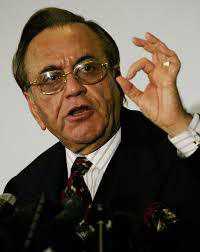
IN an interview with The Tribune’s Smita Sharma, Pakistan former Foreign Minister Khurshid Mahmud Kasuri recalls Atal Bihari Vajpayee’s impact on ties. Excerpts:Your view on Atal Bihari Vajpayee’s contribution to India-Pakistan ties?I knew Vajpayee not just as Foreign Minister, but also as Member of Parliament. When he visited Lahore on his bus yatra, I was present at the government house where he made a very moving speech. He came across as a man of peace. He made an interesting remark which left a positive impact on those of us present. When I was Foreign Minister, SAARC, as usual, was hostage to India-Pak relations. The summit was held in January 2004 and we were not sure if any substantive talks between the two countries would take place. We thought there would only be a courtesy call. It was decided that Vajpayee and Musharraf should meet and modalities were settled one day earlier by two Foreign Ministers Yashwant Sinha and me. Next day, the meeting took place at the President’s House. We were very happy that President Musharraf and PM Vajpayee arrived at a solution in the January 6 joint declaration. That set into motion possibly the most successful peace process since 1947 although it did not substantially materialise during Vajpayee’s time. What do you see as the India-Pak future given non-state actors to wheels within wheels remain?War is not possible. We have been near nine war situations. The two countries realise that whether it is nuclear, conventional or sub-conventional level, they have reached almost parity. Not an inch of territory can pass from one to another… everything has been tried. When you talk about non-state actors, Pakistan complains about Indian activities in Balochistan that was mentioned in Sharmal Sheikh declaration. PM Manmohan Singh faced flak for it in India. This was akin to what Nawaz Sharif faced because of lack of Kashmir in the Ufa declaration. You cannot duck anymore… we have to face facts about what India alleges and you cannot just live with the situation in Kashmir.Can PMs Imran Khan and Narendra Modi make a difference? Is the Pakistan army on board?The beginnings have not been bad. Imran Khan has a good reputation as a popular figure in India also. The fact that PM Modi rang him was well received in Pakistan. The cricket bat sent through the High Commissioner sends a message. It will be unfortunate if we have to wait till 2019 Indian elections to find solutions. Solution on Kashmir framework would be impossible without Pakistan army and ISI supporting it. Pakistan military is not averse to peace but wants a just, negotiated settlement on honourable terms.Will SAARC summit be revived?I believe strongly in regional cooperation. Now we are ready to meet each other in SCO (Shanghai Cooperation Organisation) but not in SAARC which is our home ground. We don’t want to kill SAARC which has a lot of hidden advantages.


War is not possible. We have been near nine war situations. The two countries realise that whether it is nuclear, conventional or sub-conventional level, they have reached almost parity. Not an inch of territory can pass from one to another.Khurshid Mahmud Kasuri, Pakistan Former foreign minister