All posts by webadmin

DEFENCE MANUFACTURING-II Maruti model can drive defence production

In the second and concluding article, The Tribune examines the need to do away with historical legacies and well-worn procedures as well as develop the fortitude to accept setbacks. Only a radical departure from all past practices may have the potential to help defence manufacturing stand on its feet.
Maruti model can drive defence production
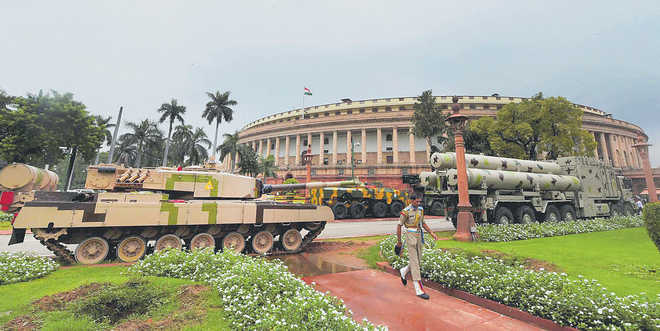
ARMS & SELF-RELIANCE: A tank and weapons on display at Parliament House. The DRDO organised a defence exhibition of tanks, Brahmos missiles & other equipment to mark 70 years of Independence. PTI

THE natural expectation is that government should do what it takes to achieve a breakthrough in defence manufacturing.  Every new political executive discovers the strength of tradition and of the constituencies in favour of the status quo, as well as the inherently conservative nature of all bureaucracies which are comfortable only with incremental changes. Fortunately, a strong government enjoying continuing popular support with a growing nationalistic fervour should be able to take big decisions and implement them. There are complex issues to grapple with and difficult decisions to be taken.In most technology and capital-intensive segments only one national entity can be supported to become strong enough to give autonomous capability. In the case of Europe, countries chose to consolidate their national air industries in European Aeronautic Defence and Space Company (EADS). After many years and considerable public spending, EADS succeeded in developing a real competitor to Boeing in the Airbus. In the Eurofighter, they developed a world-class military plane. Hence, taking a clear view of the optimal industry structure 10 to 15 years down the road and the future of the present set of ordnance factories and the defence PSUs in different segments is unavoidable.  Since the economic reform process began, large PSUs have ceded space to new private sector entrants and become white elephants where now they can neither be privatised as they have no value, nor can they be closed because of the large workforce. Air India and BSNL are good examples. Is it desirable to replicate this? Is corporatisation of ordnance factories doable? Is greater professionalisation and empowerment along with gradual disinvestment to create, say, an equivalent of Boeing/Dassault in HAL, an option worth pursuing? Is strategic divestment to suitable Indian private firms with proven manufacturing ability a viable option and, if so, in which segments?  Would having private strategic partners for a few platforms while leaving the rest of the system untouched, as seems to be under way now, the best way to go forward? Would it not be prudent to choose strategic partners only with proven manufacturing abilities, or, this is not relevant if there is sufficient financial depth? What safeguards, if any, are required in the eventuality of non-performance by chosen strategic partners? There are no easy answers. Taking a hard-headed view on these questions is necessary and is the intrinsic burden of leadership. The implication of having private sector entry and at the same time continuing with the public sector for the same platforms needs to be thought through. To illustrate, having many aircraft and helicopter manufacturing facilities, where only final assembly, controlled by foreign technology providers, is undertaken in India, without any real technological ability to develop new models growing in one organisation to become a world-class national player, would not serve the real purpose.  There may be some less capital-intensive segments where genuine competition over time may be feasible and desirable. A rational calculated view needs to be taken on weapon systems where India should try and have one world-class player and where it can afford two players. This is equally relevant for sub-assemblies and components which are the actual building blocks and usually do not get the attention they deserve.Then, there is the widely prevalent view in the Armed Forces that the DRDO has not yet given them weapons that they would really like to use whether it is the LCA or the battle tank. In any case, whatever has been developed is an assembly of primarily imported engines, sub systems and parts. So, does it make sense to write off whatever has been done and accept failure? Or, is the ability to design and develop a weapon platform even with imported sub-systems, not a significant enough achievement which should give confidence that succeeding rounds of development of newer versions are bound to be better?  Does it not then make sense to continue from what has been achieved and see what more is needed to produce  newer versions which appear good enough to the armed forces? Should such development not be funded and undertaken continuously to develop systems which may be equivalent to what is being used by the forces now and as a potential supplement, in the first instance? Is the present system of having a centralised DRDO responsible for technology and system development with production enterprises making only modest efforts in research and development, optimal? Or, having different verticals with responsibility for both platform development and production, as is the case with all western defence firms, a better model with the advantages of clear focus, accountability, incentives and rewards? Could not the successful experience of ISRO and Atomic Energy of working in genuine development partnerships with Indian firms to develop almost all that they needed to overcome the handicap of the international technology denial regime be replicated?  Should PPPs in system and technology development as well as manufacturing be pursued?    Could the armed forces moderate their expectations by lowering the bar to have, not the best in class in the world, but what is good enough for what our northern and western neighbours possess? (From this perspective, many have argued that even the present LCA is good enough.)  Willingness to lower the bar also increases competition as well as the ability to seek a higher degree of technology transfer for new systems needed now and which have to be necessarily procured internationally. Since the procurement system is tied to procedure and paranoid about any deviation from what is set out in the beginning, negotiating the best terms for technology transfer is not permitted.  As a result, India is unable to even begin making full use of the window of opportunity which is now there, with the US making India a major defence partner for technology transfer. Every procurement process should have the bjectives of getting what the forces need and maximise national technological ability and reduce future import dependence. A good Indian experience to recall is that of Maruti. Through a search and negotiation process, Suzuki was chosen as the technology and equity partner. A smaller player, it was willing to go the farthest in technology transfer and genuine partnership. Maruti selected vendors in a fair manner very quickly, but not through the rigid price-bidding process the only permissible route today. Vendors were helped with technology tie-ups and became long-term partners and suppliers with periodic negotiated price revisions. Maruti, like other global car companies, undertook only final assembly.  The outcome exceeded expectations. India was able to evolve a globally competitive private sector national auto-component industry. It is now a leading global hub for competitive small car manufacturing. On the international scene many firms, with frontline platforms, critical sub-assemblies, or materials/components, do not see much of a commercial future with declining defence budgets in their countries. They may be willing to part with technology, go in for genuine joint-venture partnerships, and even be available for acquisition — presenting an opportunity for technological leapfrogging. An empowered, bold leadership, acting strategically to create medium-term national capabilities is required to take a holistic view of procurement for specific needs, along with technology development and acquisition. An altogether different paradigm of decision making needs to be put in place. Without this, it is unlikely to make progress in defence manufacturing at the speed that is needed and also possible. (Concluded)The writer is former Secretary DIPP, Govt of India.

India-Pakistan Hostility: America’s Good Intentions May Not Reflect Ground Realities by Lt Gen Ata husnain

India-Pakistan Hostility: America’s Good Intentions May Not Reflect Ground Realities

India-Pakistan Hostility: America’s
Good Intentions May Not Reflect Ground Realities
SNAPSHOT
Nikki Haley’s proposal to mediate is actually loud thinking about what the US may wish to see in the near future.

The Trump Administration may be attempting to change policies, which it may feel have not delivered. But the degree of sensitivity of issues must be central to such policies.

Noble may be the intent of a big power to bring estranged neighbours, anywhere in the world, to the negotiating table. However, if that is done without realistic assessment of the ground situation and without considering the likely immediate response, the effort would be doomed to failure. One cannot be unfair to a nation such as the US because its institutional understanding of the international security environment is usually up to date. Yet its actions may not always support its thinking.

The context here is the statement of Nikki Haley, US Ambassador to the United Nations, about a proposal to mediate between India and Pakistan and stabilise the potential conflict situation in South Asia; something which has seen many critical moments in the last 28 years. The statement reads:

“It’s absolutely right that this administration is concerned about the relationship between India and Pakistan and very much wants to see how we de-escalate any sort of conflict going forward. I would expect that the [Trump] administration is going to be in talks and try and find its place to be a part of that because it’s concerned about the situation”.
It has to be assumed that Ambassador Haley was referring to US mediation and not merely facilitation because other parts of her statement did refer to the administration’s intent to be proactive about preventing the bubbling over of conflicts, with even the President personally involved.

Pakistan, of course, was quick to respond by welcoming the statement, forgetting that it is a signatory to the Shimla Agreement of 1972, which lays down bilateralism as the only means to problem resolution with India. India’s spokesman Gopal Bagley, an old Pakistan hand, clearly rejected the idea. Pakistani media made it out to be a result of the five-day visit of Indian National Security Adviser (NSA) Ajit Doval to Washington where purportedly discussions on Pakistan, its terrorist problem and nuclear weapons were held with a number of high-ranking officials.

So what has actually triggered the sudden rush of blood to look towards reversal of a policy which has been followed to the tee by at least three previous administrations on the trot? The State Department has seldom given credence to rants by Pakistan at the UN General Assembly sessions or any other international gatherings, but to think that Pakistan’s importance is in any way insignificant to the US scheme of things would be a half truth. Pakistan’s geo-strategic location bears tremendous importance for the US. It controls the access to the heart of Asia and the reverse access to the Indian Ocean. It flanks both Afghanistan and Iran, two countries the US has deep interests in, in different ways.

However, the real importance of Pakistan is in the negative. The more it is in confrontation mode with India, chasing a charade and a dream of wresting Jammu and Kashmir through its avowed strategy of ‘a thousand cuts’, the more it ties itself in knots. Its pursuance of perceived interests both at borders and in neighbouring territories has led it to adopt the notorious policy of friendly and unfriendly terrorists, employing the former as strategic assets. To add to it are its infirm democratic credentials and a military which rules the roost and takes all the strategic decisions.

The US analysts have for long worried about the state of security of the nuclear arsenal reputed to be fourth largest in the world with its control in military hands. But all this has been known for long and it’s for these very reasons that the US policymakers have treated Pakistan with kid gloves, ensuring they do not push it over the top. They need it for the logistics route to Afghanistan and for the stabilisation efforts there. They also need US influence over it to prevent it completely playing to the Chinese tune.

In fact, if there is any plausible reason for alarm bells in Washington forcing some rethink, it could be the recent parleys between Russia, China and Pakistan; reportedly for the purpose of stabilising Afghanistan. The US is looking for a way to remaining more relevant in South Asia at a time when other big powers appear to be stealing a march. Should it therefore be presumed that the US is insufficiently enthused by its emerging strategic partnership with India?

A better explanation may be the necessity for a super power to balance its options far better than to put all eggs into one basket; it does make strategic sense from a US standpoint, after all, the investment in Pakistan’s stability has been costly and over quite a long time. That should not in any way put off Indian policymakers, who are known to be pragmatic and comprehensive in thinking. The importance of the US-India strategic partnership cannot be dented by such actions.

The only other perceivable trigger appears to be the high profile status suddenly occupied by the China Pakistan Economic Corridor (CPEC), its operationalisation considered by many as the most strategic event for long. There is no doubt that it gives Pakistan a confidence boost with talk of the current 5 per cent being converted to 7 per cent growth in GDP terms, in the next three years. It is possible the US thinking harped on the feasibility of a strategically emboldened Pakistan with Chinese backing, undertaking a dangerous mission against India. That would be catastrophic and the source of much instability in Asia.

India is confident of its stand over J&K notwithstanding the very turbulent conditions which have existed there for the last one year. Drawing it out into internationalisation and mediation will force it to compromise on its stance which has been amply clarified. It wishes stability and will work towards that. Its approach in adopting bilateralism has ensured it a position of strength with very few ever questioning its credentials.

An article by Robert Cassidy in National Interest magazine, “How Pakistan Warped into a Geopolitical Monster” refers to the support which terror groups affecting Afghanistan and the rest of the South Asian region receive at the hands of the Pakistani establishment. He goes on to say “As long as they enjoy external enablement, they have no incentive to reconcile”. Perhaps the strategic stalemate in Afghanistan is in the minds of the officials of the Trump Administration, who probably feel that progress towards peace between Pakistan and India will help Islamabad shed its propensity to depend on terror groups to deliver its strategic interests.

The US establishment’s approach appears to reflect some advantage that it perceives in reducing tensions in the subcontinent. No attempted backroom diplomacy is being reported and such actions are usually preceded by shuttle diplomacy. Admitted that Nikki Haley’s projection is actually loud thinking about what the US may wish to see in the near future. Many administrations have thought similarly but have avoided delving into any form of mediation or even facilitation except in crisis times. One is reminded of the Gates shuttle diplomacy of 1990 and the Clinton Administration’s role during Kargil in 1999. These examples should never be applied to the larger relationship issues between India and Pakistan. India’s stand is quite clear. It will engage Pakistan in dialogue but not under duress and definitely not with Pakistan continuing to sponsor proxy war in India.

The Trump Administration may be attempting to change policies, which it may feel have not delivered the dividends on ground. That is sensible but the degree of sensitivity of issues has to be kept centre point and consultation before decisions and even loud thinking would always be prudent.


PUNJAB NEWS::27 MAY 2017

Capt to re-examine Ladhar case, HC told

Chandigarh, May 26

The Chief Minister would have a re-look on the previous government’s decision to let off senior IAS officer SR Ladhar with just a warning, the Punjab and Haryana High Court was today told.Ladhar had collected an arbitration fee from farmers for deciding disputes with the National Highway Authority of India. Additional Advocate-General V Ram Swarup informed the Bench of Justice Rajan Gupta that the competent authority — the CM — would re-look at the decision of October 9, 2012, taken by the then CM.”Taking a lenient view of the matter, if the officer complies with the orders of the government, a written warning may be issued to him and he may be instructed to remain careful in respect of government rules/instructions,” the CM had ordered.An affidavit filed by Chief Secretary Karan A Singh said the matter was being taken up with the competent authority. For the purpose, six weeks’ time was sought.The HC, on the previous date of hearing, had asked the state to specify whether the action amounted to “misconduct” or “offence”. The query came on a contempt petition by advocate HC Arora against IAS officer Sarvesh Kaushal and others for not complying with directions issued by a Division Bench in October, 2013.Arora earlier stated that in October, a Division Bench had directed the state to ensure remittance of the arbitration fee charged by Ladhar along with proportionate interest. The exercise was to be completed in a month from the date of amount deposit by Ladhar. Thereafter, the amount charged from individual landowners was to be refunded within the next month. Arora submitted that the respondents were unable to ensure compliance of judgment. — TNS

Court stays dismissal of Punsup DGM

Saurabh Malik

Tribune News Service

Chandigarh, May 26

Just about a fortnight after the services of Punsup (Punjab State Civil Supplies Corporation Limited) Deputy General Manager were terminated on the allegations of possessing a false experience certificate, Justice Jaishree Thakur of the Punjab and Haryana High Court has stayed the operation of the impugned order.Justice Thakur said the court was prima facie of the opinion that it was a fit case where stay could be granted since a co-ordinate Bench was already seized of the matter regarding the genuineness of the experience certificate and challenge to the appointment was already pending consideration in different proceeding.“Hence, the effect and operation of the impugned order dated May 10 is stayed till the next date of hearing,” she added.The Bench was earlier told that the impugned order was passed in accordance with a condition in the offer for appointment. It specified that the appointment letter issued would be cancelled without issuance of notice, if deficit was found upon checking of certificates. It was added that the petitioner’s appointment was challenged by one Harmeet Singh, who alleged that the experience certificate was forged and fabricated.Justice Thakur observed that the stand taken by Punsup in an earlier written statement was that an inquiry, marked to Manager (Administration) for checking the authenticity of the experience certificate submitted at the time of appointment, found it to be “correct and genuine”. The Bench directed Punsup to conclude the inquiry. But apparently a fresh inquiry was initiated against the petitioner.Appearing before Justice Thakur’s Bench, the petitioner’s counsel, Akshay Bhan, submitted that once the High Court was seized of the matter regarding the genuineness of the experience certificate, the order of termination should not have been passed.

Not afraid of threats, don’t need more security: Amarinder

Not afraid of threats, don't need more security: Amarinder
Capt Amarinder Singh. File photo

Chandigarh, May 25

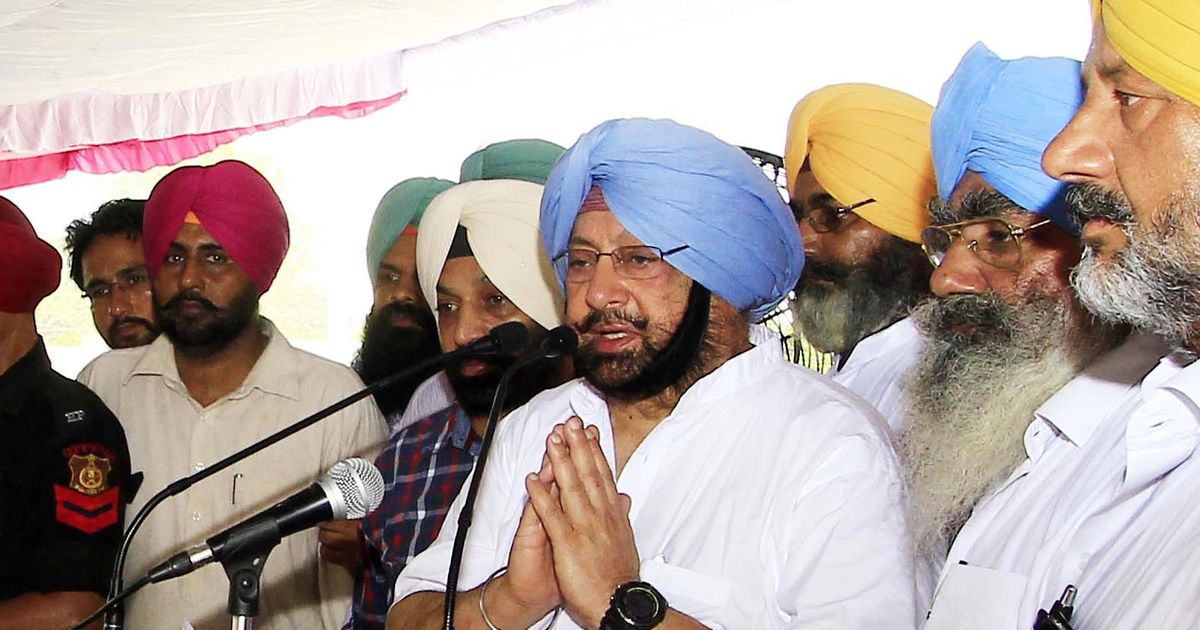
Punjab Chief Minister Amarinder Singh on Thursday said he is not afraid of threats to his life from pro-Khalistan elements and that there was no question of enhancing his security.Three videos are rocketing around the Internet in which men, suspected to be based in Canada, are seen giving threats to the chief minister and Congress MP Ravneet Singh Bittu.(Follow The Tribune on Facebook; and Twitter @thetribunechd)He dismissed media reports that the Punjab government has sought Z-plus security from the Centre for him and Bittu, saying the state police was “more than capable of protecting the people, including Congress leaders”.”There is no question of approaching the central government for more security. I have full faith in the capabilities of Punjab police, which is doing an excellent job,” the chief minister said.Singh in a statement said he was more than ready to take on “such forces which are trying hard to disrupt peace and harmony in Punjab. I will do everything in my power to thwart their nefarious designs”.The chief minister said he and his government will not be cowed down by the threats from such “spineless people who do not have the courage to come to Punjab and openly confront him”.He said if pro-Khalistan elements came to Punjab, his government will “take suitable action to ensure that they do not get away with their cowardly threats and attempts to revive terrorism in the state”.The Punjab government will retaliate in a suitable manner to ensure that peace in the state is not disturbed at any cost, he said.An official spokesperson in the Chief Minister’s Office also said Singh was not going seek additional security in the wake of the threats.The chief minister has clearly told his officials and colleagues in the government that there should be no move on their part to scale up his security cover, the spokesperson said.He said organisations like Sikhs for Justice, which was purportedly behind some of the videos doing the rounds on social media, “were being supported, overtly or covertly, by certain Indian-origin members of Canadian Parliament”.These elements were bringing a bad name to the NRI Sikh community and diluting the latter’s contribution to the development and progress of those countries, including Canada, he added. — PTI

clip

clip

182 schools record zero pass percentage

Ludhiana district tops the list with 30 such schools

As many as 182 schools in the state have recorded zero pass percentage in Class-10 examination of the Punjab School Education Board (PSEB), results of which were declared recently.

Ludhiana district tops the list with 30 schools registering zero pass percentage this year, followed by Patiala with 24 schools, Jalandhar 21 and Sangrur 17.

This dubious distinction has also been achieved by 12 schools each in SAS Nagar and Bathinda districts, 11 in Hoshiarpur and 10 in Mansa.

When HT visited some government schools in Jalandhar with zero pass percentage, principals and teachers blamed the government for not providing them enough teachers. Some others blamed the Right to Education (RTE) Act under which they get “weak” students.

In Government Senior Secondary School at Khiwa in Nakodar, English lecturer Tej Pal Kumar was seen doing clerical work on a computer and when asked about the principal, he said the school does not have principal for the past four years and he is officiating.

Asked about the 0% result of the school, he said, “The RTE policy is responsible for it. A student who reaches Class 10 does not even know a basic formula of mathematics,” said Tej Pal. From the school, 11 students had given the exam and not even a single student could pass.

Moreover, he claimed, the school has no language teachers and even science and maths mistresses joined in November 2016.

In Government High School, Sarhali, all the 31 students have failed. “There are no teachers of social studies and English. Lack of a proper head in the school is another major problem,” said Leena, the school in-charge.

In Government Senior Secondary School, Nihaluwal, all 36 students who appeared in the exams flunked. Principal Harmeet Kaur said, “The school doesn’t have maths and English teachers.”


6 dead as stone-pelting mob storms polling station in Budgam

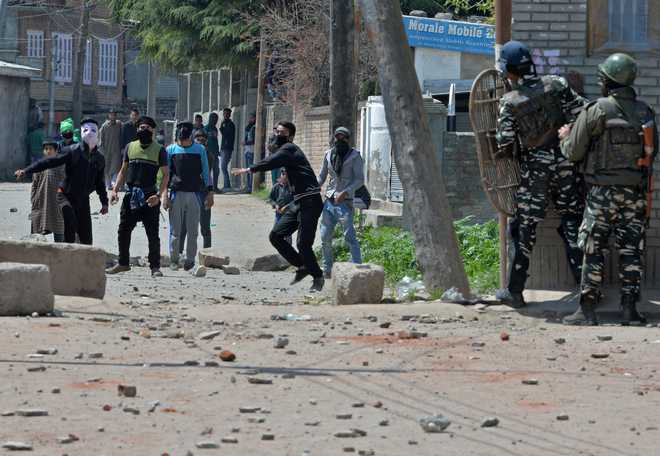
Protesters clash with security forces near a polling station in Srinagar on April 9, 2017. — AFP

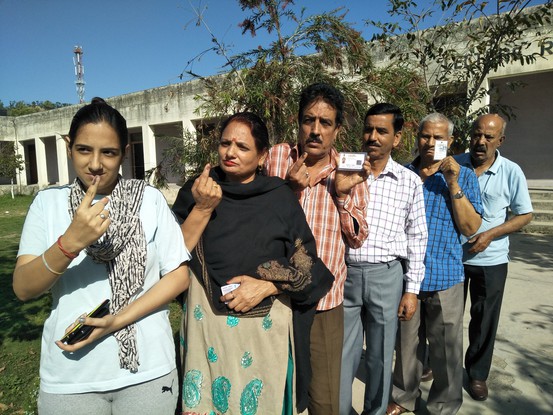
Kashmiri migrants show their inked fingers after casting vote at a polling station on the outskirts of Jammu on Sunday. Tribune photo: Inderjeet Singh

Tribune News Service

Srinagar, April 9

Six youths were killed and several others were injured when security forces opened fire on a stone-pelting mob that stormed a polling station in Budgam district in this Lok Sabha constituency on Sunday, disrupting polling, which saw an abysmally low 5.84 per cent turnout till 3 pm.Hundreds of protesters stormed a polling station at Pakherpora in Chrar-e-Sharief area of Budgam district and ransacked the building, officials said. (Follow The Tribune on Facebook; and Twitter @thetribunechd)Security forces fired several warning rounds to disperse the mob, which did not relent.Those killed were identified as 20-year-old Mohammad Abbas, 15-year-old Faizaan Ahmad Rather, Nissar Ahmed of Beerwa, and Shabir Ahmed of Daulatpora Chandoora, while two more have yet to be identified.

They said the BSF, deployed for security of the polling stations, fired live rounds as they were not provided with pellet guns.

Voting was affected in urban areas as the polling staff and security forces bore the brunt of stone-pelting incidents reported from across the district, comprising two assembly segments. However, polling in rural areas was higher than in Ganderbal town and other urban areas.

Army was called out in aid of the state administration in the Gadura area after a mob rained stones at polling stations and tried to burn down a building where a booth was located, officials said, adding that petrol bombs were hurled at the booth as well as the security forces guarding it.

The area connects the district with Soura area of Srinagar and is often used by militants to infiltrate into the city.

Ironically, a poster of Zakir Moosa, commander of Hizbul Mujahideen, appeared in the vicinity of a police station in the main town of Ganderbal leaving police personnel red-faced.

A visit to the area, located barely 20 km from Srinagar city, showed protesters gathered outside poll booths and staging a sit-in asking voters to refrain from polling.

Opposition National Conference leaders, including its president and candidate, Farooq Abdullah, and his son Omar attacked the Jammu and Kashmir government led by Mehbooba Mufti for having completely failed to ensure smooth conduct of the polls.

Comprising Ganderbal and Kagan assembly seats, the district has been a traditional bastion for National Conference.

In the Chenar area, one Mohammed Ramzan Rather and his wife and other villagers faced the wrath of angry protesters when they were on their way to vote. He was rushed to Kangan district hospital with a bleeding head.

The nearby locality of Wakura wore a deserted look after protesters pelted stones at security forces in the morning. After being on the defensive for over two hours, securitymen fire several rounds of tear gas shells to disperse the protesters.

Fifteen polling booths in Ganderbal and two in Kangan had reported zero votes till 1 pm. There are 209 polling stations in this district, all of which have been declared sensitive or hyper-sensitive.

Ganderbal town recorded 6.95 per cent of polling while the adjacent Kangan area recorded 16.9 per cent of polling by 1 pm.The average percentage of the district was 11.9 per cent.

An unusual incident occurred at Gutlibagh area where a group of 25 people cast their ballot at 9 AM and later resorted to pelting stones at the polling station to prevent others from casting their votes. — With PTI inputs


Missing Sukhoi: China pays close attention; IAF search on

Beijing/Tezpur (Assam), May 25

The Chinese military today said it was paying “close attention” to the incident in which an Indian Air Force fighter jet with two pilots on board went missing along the Sino-India border two days ago.Paying “close attention” to it, Chinese defence spokesman Col Ren Guochang said when asked at a briefing about whether the Chinese military would help trace the missing Sukhoi fighter jet. However, he refused to give any details.In Assam, search operations continued for the third day today for the missing Sukhoi-30 fighter jet that went missing on May 23 after taking off from Salonibari airbase here on a routine training sortie, sources said.Ren’s remarks appeared positive compared to the curt comments of Chinese Foreign Ministry spokesman Lu Kang who had said that he has no information on the missing plane and warned India that it should avoid disrupting peace and stability in Arunachal. — PTI


Don’t shadow me, meet people, Capt tells OSDs

Move aims to clip wings of OSDs who owe allegiance to ‘rival’ factions within his core team that decides access to MLAs, officers, media

Hectic lobbying is on for cabinet berths and posts of chief parliamentary secretaries. Many party leaders are also lobbying for their business interests. It will soon be business as usual in the Congress. A SENIOR MLA

CHANDIGARH: Return to power after 10 years of political exile has its own exigencies, no matter how urgent the need for austerity. So Punjab chief minister Captain Amarinder Singh made a slew of appointments to adjust his key aides as advisers and political secretaries.

The younger lot have been appointed as officers on special duty (OSD) with charge of different districts. Among the five young OSDs appointed so far, the youngest is a 24-year-old law student, Ankit Bansal. The other four are Gurpreet Singh alias Sonu Dhesi, Jagdeep Singh Sidhu, Sandeep Singh Brar and Damanjeet Singh Mohi.

However, all these OSDs were doing for now was hangout at the CM’s camp office at his private residence in Sector 10 of Chandigarh — he has yet to move to his official residence — and be seen around him.

According to sources in the government, in a stern diktat from the CM, the OSDs have been given a list of dos and don’ts. The first is “not to enter the CM residence, until asked”. Second, “not to accompany the CM, until asked”. And the third, “not to seek appointments” with the CM for people. They have been asked to meet people of districts they have been entrusted with and get their problems and applications to the notice of the CM and his officers.

Behind the appointment of OSDs is also a power struggle within “rival” camps in the CM’s core team of advisers and secretaries.

“The OSDs owe their allegiance to one or the other camp close to Amarinder. Each camp tries to control access of CM to people they perceive to be from the rival camp, be it MLAs, officers or the media. Right now, hectic lobbying is on within the camps for cabinet berths and posts of chief parliamentary secretaries for MLAs close to them. Many party leaders are also lobbying for their business interests. It will soon be business as usual in the Congress,” a senior MLA said requesting anonymity.

The letters have gone to the young team of OSDs barring two of Amarinder’s trusted aides –MP Singh, who is CM’s OSDcum-secretary and Sandeep Sandhu, an Amritsar-based businessman who has been made in-charge of camp office at Amritsar.


J&K : Mix of Old and New Makes A Workable Strategy BY Lt Gen Syed Ata Hasnain, PVSM, UYSM, AVSM, SM, VSM (Retd)

We need a healthy mix of old and new options to formulate a workable strategy to resolve the current imbroglio
Author:
Lt Gen Syed Ata Hasnain, PVSM, UYSM, AVSM, SM, VSM (Retd)
Wednesday, May 24, 2017

Burhan Wani, new militancy, the scourge of the stone thrower, terrorist funerals, emboldened school children resisting the CRPF, manipulated video and the like are all associated with the new Kashmir situation. For veterans of the past who saw a different dimension of the militancy it is not easy to appreciate the new threats and the dangers they spell. However, there are some basics which apply in every situation and not for nothing do accomplished practitioners of operational art advise their subordinates to go back to the drawing board or ‘back to basics’ to address most problems.

In the world of soldiering the nature of conflict may rapidly change but most essentials just remain the same. Basic instinct tells a soldier what is the next thing to do. A prudent mix of the old and new makes a workable strategy. Here is how.

I ascribe the above understanding to the adoption of the Cordon and Search Operations (CASO),now under execution in South Kashmir. Lots of veterans would recall how populations loathe these when they are conducted as per the book. They are also great occasions to fraternize and even attempt to change the minds of the public. Earlier CASOs were invariably accompanied by a civic action team comprising a Regimental Medical Officer (RMO), his staff and administrative elements. Off late, at least since the beginning of the millennium we have been carrying out only intelligence based search operations. The scope of generic CASO was reduced to just a few houses on basis of suspicion. With the kind of situation which has recently developed in the area bounded by Kulgam, Shupian, Pulwama and Bijbehara and the daily run of bank robberies, the writ of the state has virtually come under question with governance nearly paralyzed. A series of CASOs of the old-world style, a sweep through, selective searches and broad domination, appear to have been followed displaying flexibility in thinking. When in trouble going back to the drawing board and to the basics, appears to have been followed as a notion.

When there were attempts at intimidation of the columns through stone throwing coercion was given a bye. However, if these operations have to continue for effect and there is more intimidation, limited coercion will have to follow. This cannot be one off and needs to repeat often irrespective of material results; domination and prevention of freedom of movement being the essential focus.

Surprisingly there were expectations of definitive results from these operations, even by some people in uniform. It should be well known that CASOs rarely produce results but are outstanding means of measured ‘intimidation’, domination and psychological pressure on terror groups and their supporters. These active day and night operations will keep terrorists on the run. The crossings on the Jhelum River need to be controlled, in fact dominated, even if Marcos from Bandipura have to be redeployed. Obviously more troops are required and these should be brought in very early, possibly a division worth along with a HQ. We cannot have HQ Victor Force alone responsible for the Amarnath Yatra, Central and South Kashmir. Troops had been redeployed from South Kashmir to the LoC for the counter infiltration grid when things had become quieter here. Prudence demands that there need be no hesitation on part of senior commanders to turn the clock. If tactics of old are to be followed so must force levels of the past be restored.

A notion which needs analysis is the idea that Kashmir is back to the Nineties and that India is losing it. Somehow Pakistan also perceives as if it is winning the proxy conflict and its perception is prevailing upon the Indian public in no small way. I can recall the number of times this question has been put to me through the last fifteen years or so. Each time the security situation slips self-doubts rise. It is to the credit of the Indian Army that despite the ups and downs due to the inability of taking the situation beyond security stabilization, we have still managed to keep it well short of the Tipping Point towards which Pakistan wishes to push it. Yes, the situation today is bad and alienation is very high but in 1990 when it all came to a head we were responding with virtually shoe string resources and experience only of Sri Lanka or Nagaland. Today we have 63 battalions of Rashtriya Rifles (RR) in J&K and we need to be thankful these did not redeploy to the Red Corridor as was being contemplated in 2010. There are close to 60 CRPF units in the Valley alone and the JK Police has its own numbers. More than anything else we have the experience and the benefit of success and failure. That, however, is a subjective asset contingent upon the amount of intellect we wish to apply and quantum of failure we wish to admit. Converting near failure to success is an art of leadership and I would always look upon the current situation as a grand opportunity to apply the lessons of failure and reinforce the lessons of success. The only thing we definitely did not have in 1990 is 24×7 media penetrating our homes and minds. How this can be converted into an asset is another aspect which has been insufficiently examined.

A public order situation as the one in Kashmir,seen to be crossing a threshold, needs to be tackled the robust way in a calibrated manner. We did it in 1990 and some years thereafter. Formal adoption of Sadbhavana as a hearts and minds exercise only commenced in 1997 after we had crossed a threshold of control through the employment of legitimate hard power. The Security Forces (SF) therefore have to demonstrate firmness with correctness. They need to ensure that they are not baited into overreaction. Qualification of what is legitimate hard power must be clearly understood by commanders down the chain and an extra effort must be made to embed the altered rules of engagement into all ranks.

There are other domains which need to be simultaneously addressed. As a policy the Government does not wish to engage with separatist leaders or anti-India elements that for long appear to have been legitimized as the potential future political leadership of J&K. The events of 2016 were like a watershed when the reluctance of these very elements to engage with India became almost final. The Government then decided not to engage but rather delegitimize them; it has actually led to their disempowerment in the eyes of the separatist cadres too. However, it has also led to the creation of a dispersed under cover leadership which may not fully have been discovered even by intelligence agencies. This identification is a necessity and must form one of the elements of focus of the intelligence campaign.

Among all supportive dimensions relevant to the restoration of the situation in Kashmir, two stand out. First is the identification and engagement of the right people whose support will work against the anti-national elements. Second is to follow an effective policy of countering the proactive Pakistani and Separatist propaganda; ideal is to have a proactive policy of information handling to take your own message to the people before the adversary’s message. In other words it is all about messaging the narratives openly, transparently and sufficiently.

Engagement and Outreach

One can start with a definition of the term which has rarely been attempted in the past. It can involve the following:-

A series of actions taken over time to meet and fraternize with different Definition. segments of the public for better understanding of culture, faith, social environment, aspirations and level of alienation.

• Involves determining specific administrative problems of the people, resolving those that can be within means and taking up issues with Government authorities for resolution of the remaining.

• Also assist in explaining Government’s views to the public.

• Countering Pakistan and Islamic propaganda.

Functionaries I meet who know J&K well all recommend engagement and outreach alongside robust no nonsense operations but remain hesitant about how this can be done in the face of ongoing violence and alienation. I find this strange; a lack of application of experience, intellect and an inability to take risk. “It requires creativity and will to explore ideas”, as one experienced journalist puts it. The dearth is of ideas which flow when you keep channels of communication open with diverse entities. If you do not meet people and do not go down to villages to speak to those who matter little, the ideas will seldom come. It is not for me to suggest models of outreach but I would follow a simple dictum of hybrid conflict; ensure what you do carries the stamp of the whole of government.

Start from places least affected by violence; there is never a need to jump into the eye of the storm. It must start small with local administrators and police officials, the security and administration being provided by the Army.

Ensure presence of maximum young people and also women plus a few members of the clergy.

Use the points of the above definition to good effect.

Listen rather than talk and allow legitimate grievances to be aired. Resolve what one can be with assistance of the civil administration.

I am aware that the resentment among the youth is immense and there will be attempts at rabble rousing but that is the risk one takes in such initiatives. The event must never be labeled an Army initiative but a local government one for greater legitimacy. A small medical camp on the sidelines increases the legitimacy; lady doctors and pediatricians are a must.

This is just a model of the past which needs adaptation to the current. It needs to be done at unit level. With a few elders, one or two members of the clergy and some youth; there can be legitimate discussions even at company level. I always admit that better than me were my company commanders; the young majors of 46 RR (Sikh); in dealing with the populace of Baramula. That was our strength and still is, in that very sensitive town. Implicit faith in the capability of the junior officer and his Commanding Officer holds the Indian Army in great stead and that should never dilute. From the peripheral areas when the word spreads replication can begin in the inner core in a gradual spread. The recent move, in Victor Force to conduct engagement in small groups, is already receiving positive feedback.

It is a question of understanding and experience. The kind of engagement described above gives no political legitimacy to anyone; it only gives administrative empowerment to the people and the administrators. The security so necessary for the safe move of administrators is provided by the Army and Police along with intelligence backup. None of this goes against the national discourse of not giving in to violence as a means of coercing the government. In due course it will assist in political outreach too.

There has to be a media imprint for this. National and local media can be sounded. ‘Government Functionaries interact with Local Youth’ at different places in Kashmir should be headlines in local media and the subject of discussion in the evening on national visual media. Repeats of this will multiply interest and create more faith and more hope. That has what has been destroyed in the last one year which needs to be restored.

Counter Propaganda and Strategic Communication

There is a physical dimension to outreach as explained above but there also exists a virtual one. It’s old wine to keep regretting how Pakistan realized the significance of the information domain and continues to exploit it to the hilt. The recent uploading of videos, WhatsApp messages, generation of flash mobs and anti-government propaganda have only one source, the Inter Services Public Relations wing (ISPR) of the Pakistan Army. The important thing is to realize that without a campaign to counter the ISPR and build favorable narratives; our efforts to stabilize Kashmir may not fully succeed. It’s not for me to suggest themes, narratives and ideas but suffice to flag that this has to be institutional. It cannot be left to the Army to run although we can build on its efforts which continue with limited resources. There has to be a national effort which has to be civilian oriented with ownership at both Central and State Government levels. It may also be prudent to advise that these campaigns need professionals to run them with deep insight into the situation, cultural and political sensitivities and psyche. Since this is something quite new and the information domain has hardly been our forte ever since its very effective handling in 1971, we need a body to examine this thoroughly on fast track. The mechanism for execution must be established in less than six months.

The Indian public need not be demotivated or disturbed by any notions of having lost Kashmir. It will take much more than just a couple of stone throwing demonstrations for Pakistan to wrest Kashmir from us. In fact that is the underlying theme of the very first campaign which must be crafted.

Bringing a nation of 1.25 billion people with an Army of 1.3 million to its knees by attempting to take away a part of the national territory and its people is surely not something Pakistan is ever capable of achieving.


Russia nod to Kamov JV Copters to be built under ‘make in India’ initiative

Russia nod to Kamov JV

Ajay Banerjee

Tribune News Service

New Delhi, April 5

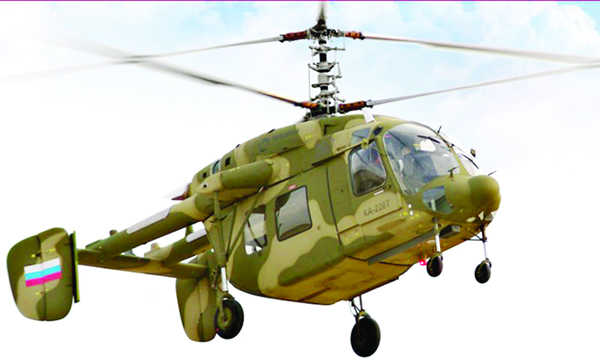
In the first major ‘make in India’ move, Russia has formally agreed to have a joint venture with India for production of the Kamov-226T light-utility helicopter.The two long-standing military allies had been discussing the project since December 2015, but Russia had not approved the joint venture (JV). Top sources in the Ministry of Defence today confirmed that Moscow had conveyed its consent, which was accorded by President Vladimir Putin.New Delhi was not satisfied with the price being asked by the Russian side and it was one of the reasons for holding back the formal JV.The MoD would then ask the new company to submit its technical and commercial proposal within six months, meaning some cost negotiation will be carried out in the future.Kamov-HAL are to produce 200 of the Kamov 226T copters at a cost of nearly US$ 1 billion (Rs 6,500 crore) or Rs 32 crore per copter. Sixty of these copters will come in fly-away condition from Russia, another 40 will be assembled in India and the remaining 100 will be fully built in India.An inter government agreement inked in October 2016, during the Narendra Modi-Putin meeting at Goa, had announced the Kamov deal.The twin-engine Kamov 226-T will replace the single-engine Cheetah/Chetak, usually deployed for surveillance, dropping small loads and for rescue, including of troops posted at forbidding heights such as the Siachen Glacier-Saltoro Ridge region.The three services and the Coast Guard currently have 430 Cheetah/Chetaks. These are based on the 1950s’ designed Alouette Aérospatiale 315B Lama of France.

New firm to be floated

  • India, Russia will now form new company ‘Indo-Russian Helicopters Private Ltd’
  • Russian govt-owned Rostec Corporation will own 49.5 pc stake in the firm
  • Ministry of Defence-owned Hindustan Aeronautics Limited will own the rest 50.5 pc
  • Indian forces need some 800 light utility copters over next decade

How Amarinder Singh’s response to Operation Bluestar made him a political icon in Punjab

How Amarinder Singh’s response to Operation Bluestar made him a political icon in Punjab

The two men who would eventually take charge of Punjab’s destiny in later years –Amarinder Singh and Parkash Singh Badal – were not in the state when Operation Bluestar was being executed. Amarinder Singh was near Shimla, playing a round of golf when the news about the army operation broke. His attention was distracted by the crackling sound of a radio in the vicinity of the golf course, which carried three key words: army, Bhindranwale and Golden Temple.

“I immediately walked up to the house [in which the radio was on] and requested the owner if he would let me in and listen to the bulletin.” The owner acceded to the request.

Amarinder’s worst fears had come true.

He promptly called off his golf game and returned to Shimla to ponder over and execute his next line of action. It had to be strategised carefully because it could have serious personal as well as financial repercussions. He called upon his colleague (Mrs) Rajinder Kaur Bhattal, who was also holidaying in Shimla, to inform her about what had happened at Amritsar.

Senior Congress leaders from Punjab, such as Gurdarshan Singh (from Nabha), Beant Singh (from village Kotli in Ludhiana), Sukhbans Kaur Bhinder (from Gurdaspur), Rajinder Kaur Bhattal (from Sangrur), Amarjit Kaur (from Patiala) and Amarinder, had decided that in the event of the Centre sending forces into the Golden Temple, they would all strongly lodge their dissent by going to New Delhi and maybe tender their resignation from the party as a sign of protest. In Amarinder’s case, he would have to resign from Parliament as well as from the Congress party.

As it turned out, none of the others resigned and some did not even reach New Delhi, citing one reason or the other. According to Amarinder, Rajinder Kaur Bhattal excused herself as one of her children was suffering from severe diarrhoea. Sukhbans Kaur Bhinder exempted herself because she had other commitments to fulfil. Beant Singh and Amarjit Kaur also managed to avoid going to the national capital with him. The only other person who lived up to his word was Gurdarshan Singh. He accompanied Amarinder to New Delhi, a tough journey under the prevailing circumstances.

From Shimla, Amarinder drove to his house in Chail from where he contacted the army commander for assistance to enter Punjab. Once all arrangements were in place, he drove to Chandimandir (a military station close to Chandigarh) where he met and lunched with the army commander.

Assured of a safe passage through Punjab, Amarinder then informed Gurdarshan Singh and both Congress leaders set off for New Delhi in their luxury cars to air their grievances to the Congress high command, a euphemism for the party president: Prime Minister Indira Gandhi. On reaching New Delhi, Amarinder met Indira Gandhi at her residence and handed her his resignation.

Amarinder’s ensuing conversation with Indira Gandhi was very candid and emotional.

The prime minister, who had evidently not taken Amarinder’s earlier assertions of quitting seriously, demanded his reasons for resigning from Parliament and the party. He reminded her of their previous conversation and emphasised the very strong association of the Patiala family with the Sikh religion and its related history. She then asked him to rethink. “This was reason enough for me to not reconsider my decision,” affirms Amarinder.

Not used to hearing a “no”, Indira Gandhi got up from her chair and stormed out of the room, leaving Amarinder on his own. Torn between his religion, political future and close association with the Gandhi family, Amarinder left his resignation on her table and walked out of the room soon after.


Since the Congress high command was now worried about the growing dissent amongst senior Sikh leaders, it evoked its crisis management “mantra”. Veteran Surjit Singh Majithia from Amritsar, a former deputy defence minister and a close relative of Gurdarshan Singh, had been requisitioned to dissuade the latter from tendering his resignation. Surjit Singh Majithia was successful in his mission.

It was none other than his childhood friend Rajiv Gandhi who attempted to placate Amarinder and convince him to change his mind, as his decision would politically bring down the Congress further in Sikh esteem.

However, Amarinder stood his ground and refused to oblige. He had already stated his position and anxiety to Rajiv Gandhi earlier. To avoid the pressure from his schoolmate and senior party colleagues, Amarinder went into hiding. On 10 June 1984, he finally approached BBC’s India correspondent, Sir Mark Tully, and went public with his resignation. BBC was the first news service to announce Amarinder Singh’s quitting from Parliament and the Congress party.

The same day, Amarinder Singh also released a press note about his move and the reasons behind it. The Tribune (a widely read Chandigarh-based newspaper) reported: “Mr Amarinder Singh of the Congress (I) today resigned from Parliament in protest against what he called ‘“entry of the army into the Akal Takht’”. In a signed statement, Mr Amarinder Singh said he was also resigning from the Congress. [He also declared]: “I shall now endeavour to bring about normalcy in the state and re-establish the cordial relations between the Sikhs and the Hindus.”


A couple of days later, Devinder Singh Garcha, Congress MP from Ludhiana, also resigned from Parliament and the Congress party. Elsewhere in the country, in the aftermath of Operation Bluestar, a large number of Sikhs deserted the armed forces and Khushwant Singh, the eminent writer and journalist, returned the Padma Bhushan, the third highest civilian award of the country, conferred on him in 1974. However, he did not resign from Parliament, which he represented through the Rajya Sabha (1980 to 1986).

Why did most other Punjab Sikh Congress leaders not resign and what made Amarinder stick to his resolve?

The answer to this question can perhaps be found in history through this excerpt from The Rajas of the Punjab: “The village Mehraj…in the modern Bathinda district was founded [by Amarinder’s ancestors] on the advice of Guru Hargobind [the sixth Guru], who had built the Akal Takht [early in the seventeenth century].”

Amarinder further clarifies: “Guru Gobind Singh had sent my ancestors a hukumnama [literally meaning a letter of command to preserve the religion]. There was no way that I could turn back from my decision.”

If it was an emotional decision taken to demonstrate his protest against the use of the army in the Sikhs’ holiest shrine, Amarinder Singh’s decision could also be hailed as a very astute political move, though it had its share of repercussions including long- term harm to financial interests.

The Congress upped its ante against Amarinder. There were a series of press releases condemning the erstwhile scion of Patiala’s decision. Several Congress leaders hailed the army action and met Rajiv Gandhi to show their support for Indira Gandhi. About twenty MLAs, including Dr Kewal Krishan, Sajjan Kumar Jakhar, Lal Singh and Jagdev Singh Jassowal, termed Amarinder’s resignation from Parliament as a complete “betrayal” of the faith reposed in him by the people. In a joint statement, they declared that the resignation was a “direct encouragement” to anti-national and communal forces. They also asserted that at a juncture “when the forces of disruption and disintegration were striking against secular forces, this step of Amarinder Singh’s was nothing short of a stab in the back of national interest and unity”.

The resignation, which clearly was an outcome of a combination of many factors, elevated, among a majority of the Sikhs, the position of the Patiala scion, who till then could only win in his home constituency. It catapulted him to a position of “persona grata” in Punjab’s politics.

The resignation can easily be referred to as his first major political manoeuvre in the complicated political chessboard of Punjab.

It was high on emotional connect, strong on religious resonance and shrewd on political wisdom. It was the hallmark of a statesman in the making, whose patriotism was never in doubt.

The decision also helped the Patiala family members in absolving themselves of an enormous ignominy, which could be attributed to the founder Ala Singh. In March 1762, Ala Singh had accepted the title of raja from the Afghan invader Ahmad Shah Abdali. Abdali was responsible for plundering of the Golden Temple twice besides killing thousands of pilgrims and filling the sacred pool with human bodies and carcasses of cattle. The founder of Patiala, Ala Singh, in Sikh history has appeared as a tainted figure, who, to attain and keep his power, had sided with the Afghan ruler Ahmad Shah Abdali during his invasions of India.

Even though Amarinder continues to maintain that his resignation had nothing to do with politics, this step ushered in another key contender in Sikh politics. Amarinder justifies his move: “Our association with the Gurus and the Sikh faith is beyond politics. Politics is nothing. I have no regrets whatsoever,” claims Amarinder.

Excerpted with permission from Captain Amarinder Singh: The People’s Maharaja – An Authorized Biography, Khushwant Singh, Hay House.


Nod to Barak missile for Navy

New Delhi, April 3

The government today approved procurement of a fresh batch of Barak surface-to-air missiles for naval warships from Israel to enhance India’s maritime capability.   A meeting of the Defence Acquisition Council (DAC) approved capital acquisition proposals totalling over Rs 860 crore, including for the purchase of Barak missiles.(Follow The Tribune on Facebook; and Twitter @thetribunechd)The clearance to procure Barak missiles  at around Rs 500 crore comes ahead of Prime Minister Narendra Modi’s expected visit to the country. — PTI