All posts by webadmin

1967 batch ex-Army officers relive old days at IMA

1967 batch ex-Army officers relive old days at IMA
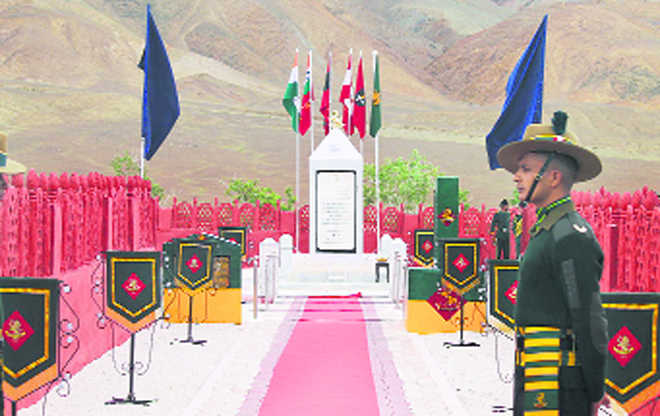
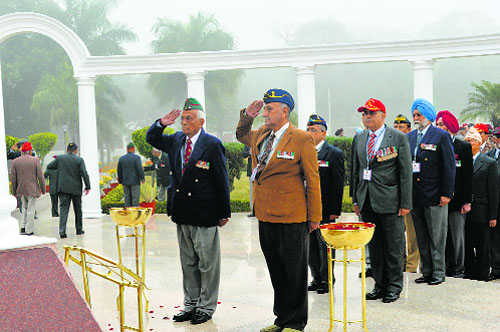
Ex-Army officers pay tributes at the war memorial at IMA in Dehradun. tribune photo

Jotirmay Thapliyal

Tribune News Service

Dehradun, December 15

Over 200 ex-Army officers along with their spouses gathered at the Indian Military Academy to celebrate the Golden Jubilee of their passing out as officers from the Academy on December 16, 1967. The occasion was all the more special as the passing out course that included 40th regular and 24th technical entry course was one of the illustrious batches awarded for gallantry. Capt Devender Singh Ahlawat was awarded Maha Vir Chakra, posthumously. Members of the batch were awarded two Veer Chakras, two Shaurya Chakras and six Sena Medals. The course further has the distinction of fielding nine Lt Gen rank Officers, of which one was the Chief of Integrated Defence Staff, one Vice Chief of Army Staff, three Army Commanders, one Deputy Chief of Army Staff and three Director Generals of their departments. One of the batch members, Gen KS Rao, was the first Indian to circumnavigate in his yatch around the globe. Major Kiran Inder Kumar, a mountaineer, lost his life in an attempt to conquer Mount Everest. Col Pavan Nair has had the distinction of constructing the first Indian Base “The Dakshin Gangotri” in the Antartica and Col SD Umalkar captained the Services Cricket Team in Ranji Trophy matches.There was an air of great cheer and optimism at the gathering. Several formal and informal events were organised to celebrate the historic occasion. The functions commenced with the course mates and the ladies paying homage to the 42 departed comrades and to other bravehearts at the IMA memorial. Welcoming the course, IMA Commandant Lt Gen SK Jha spoke about the present day- to-day activities at the Indian Military Academy. He said it was an honour for Indian Military Academy to host such an event. Briefing the course on its post-commissioning activities and achievements, Col Atul Mehra gave a presentation with an interlude of interesting slides from the training period at Indian Military Academy. Former Army Commander Gen KS Jamwal, who was also the winner of the Sword of Honour and also gold medal awardee offered a vote of thanks to the staff of Indian Military Academy and all the participants. 


487 cadets pass out of IMA

487 cadets pass out of IMA
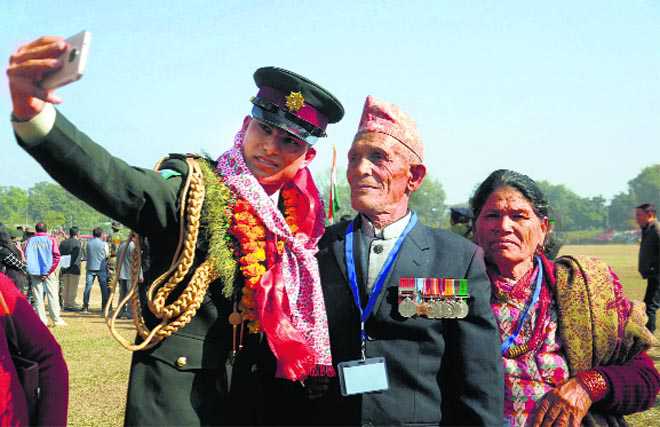
An officer takes a selfie with his family after the passing-out parade at the Indian Military Academy in Dehradun on Saturday. PTI

Tribune News Service

Dehradun, December 9

As many as 487 Gentlemen Cadets of regular course, technical graduate course and university entry scheme course, including 78 foreign Gentlemen Cadets from seven friendly countries, passed out of the Indian Military Academy, Dehradun, today. Bangladesh Army Staff Gen Abu Belal Muhammad Shafiul Huq reviewed the parade. He congratulated the Gentlemen Cadets on the successful completion of their training at the IMA. He also acknowledged the commitment of instructors and the staff of the IMA and their dedication to the Gentlemen Cadets. “The IMA’s world-class reputation and achievements of its officers are attributed to the outstanding quality of its instructors and the staff,” he said.As the reviewing officer, he presented the Sword of Honour and gold medal to academy Cadet Adjutant Chandrakant Acharya. The silver medal for the Gentleman Cadet was presented to academy under officer Amarpreet Singh Dhatt while the bronze medal was presented to the battalion under officer Sourav Das. The silver medal for the Gentleman Cadet standing first in the order of merit from foreign GCs was presented to junior under officer Alexander Simonaitis. The Chief of the Army Staff banner was awarded to Naushera for standing overall first among 16 companies for the Autumn Term 2017.The GOC-in-C, ARTRAC, Lt Gen MM Naravane and IMA Commandant Lt Gen SK Jha were present on the occasion.


MILITARY LITERATURE FESTIVAL Graphic exposure to skirmishes & soldiers

Comics with sagas of battles make for tremendous stories and are a good way to engage young minds

Graphic exposure to skirmishes & soldiers

Roopinder Singh

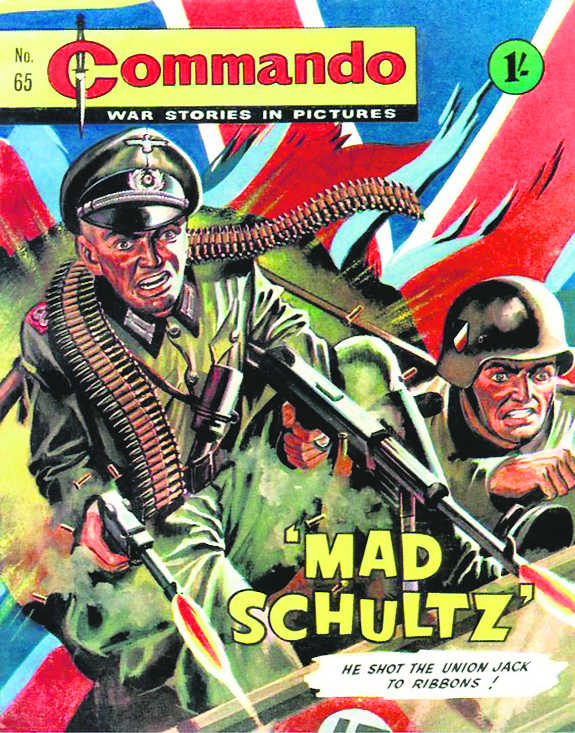
Achtung! Nostalgia! Schoolchildren of a certain vintage, had more than a passing acquaintance with the battles and warriors of  World War II, all thanks to often-forbidden, always-frowned-upon comics that brought  alive the stories of courage, cowardice and camaraderie alive in our minds.These school-days staples were profusely illustrated with pithy stories, told from the point of view of the Allied Forces. A convenient 7×5½ inch size allowed these to be portable; the standard 68 pages ensured a good read from a comic that did not bulge out inconveniently. Commando Comics were often bartered, exchanged, begged for and even stolen. For school boys, these were the ultimate escape into a world of adventure and action that allowed them to break away from the mundane routines and the oppressive discipline that all public schools manage to impose on their students. The cover was well executed in colour while the rest of the comic was full of black and white line drawings that gave a foxhole account of soldiers in battle. The Germans, often derogatorily called Krauts, were a villainous lot, some were humane though, if the story demanded them to be so. That comfortable world of black and white had — not a shadow of the greys of political correctness, sharply delineated character lines and easily identifiable enemies. We were too young to know the difference, but the stories had a strange allure. It was only much later that the horrors of, say, the bombing of Dresden, came into our consciousness. Commando Comics eventually took up other wars, including World War I, Spanish Civil War, the Falklands War and the conflict in Korea and Vietnam. For aficionados of a certain generation, Commando Comics have a special significance. Likewise, Tin Tin was forever on one campaign or the other. Near home, Amar Chitra Katha rose to the occasion, with stories of heroes from Indian forces. The Kargil and Siachen conflicts, too, had compelling stories of courage, and became subjects of graphic publications. AAN Comics has published a number of these including Siachen: The Cold War, which Rishi Kumar wrote, and a series on Param Vir Chakra winners — Capt Vikram Batra, Lt Manoj Kumar Pandey, Rifleman Sanjay Kumar and Subedar Yogendra Singh Yadav. Aditya Bakshi published Yeh Dil Maange More! on Capt Vikram Batra. Sagas of battles make for tremendous stories, and comics are still a good way to engage young minds. Commando Comics, which date back to 1961, are still published regularly, and are now available digitally as well. 


MILITARY LITERATURE FESTIVAL Lift veil of secrecy, let the narrative flow

The absence of a policy on declassifying military files fuels misperceptions and impedes analysis

Lift veil of secrecy, let the narrative flow
Defeated, not disgraced: Contrary to popular belief, Indian troops held on in Ladakh, most notably at Rezang La in eastern Ladakh, during the India-China war in 1962. photo by the writer

Ajay Banerjee

Despite four full-blown wars, a conflict in Kargil and the dramatic capture of Siachen Glacier in 1984, any history detailing the role of Indian Armed Forces remains cloaked in secrecy.

With no clear policy on declassifying military files, details are not known beyond the closed circle of armed forces; the only officially released history is that of the 1947-48 India-Pakistan war published by the History Division of the Ministry of Defence (MoD). Beyond that, sources of military history in public domain are books written by retired officers. The ‘histories’ of Indo-Pak wars of 1965 and 1971 have been published by the MoD, but these carry a caveat by the authors: “I don’t consider this as an account of proper history”.

In the military, the units are building blocks. On ground, the troops have no training to document historical records. Researchers are handicapped in the absence of a system to collect and collate data, maps or sketches in archives. Transfer of post-1947 military records to the public domain has not been satisfactory.

Need to correct misperceptions

A popular belief is that India was totally ‘disgraced’ in the 1962 India-China War, all thanks to the narrative from Australia-based author Neville Maxwell’s book India’s China War that blames India for the ‘forward policy’ in the Himalayas and identifies it as a trigger point for ‘justifying’ China’s attack along the disputed frontier. But is it entirely correct?

The Henderson Brooks report on the 1962 War is classified even as Maxwell put out portions of it on a website. Another book, History of the Conflict with China. 1962, released for ‘restricted’ circulation by the MoD in March 1993, says the ‘forward policy’ — a decision taken by India in November 1961 — was to restrict the Chinese to their claim-line of 1956 and stop claims over the new territory in 1960. It was to “prevent further infiltration into unoccupied areas of Ladakh”, says the book that accepts the shortcomings, but tells how Indian troops held on in Ladakh, most notably at Rezang La in eastern Ladakh, just 5 km south-east of the hamlet of Chusul. “The Indian soldier was defeated but not disgraced in Ladakh,” it says, dispelling the notion of ‘disgrace’.

Other than the 1962 war, the book narrates the 1967 Nathu la (Sikkim, then not part of India) firing incident. It reads: “The Chinese troops suddenly opened machine gun fire on September 11, 1967, inflicting heavy casualties. The GOC 17 Div — the redoubtable Maj Gen Sagat Singh — blasted the Chinese positions with 5.5 medium guns. The Chinese agreed to a ceasefire on September 16. They had lost 400 men killed or wounded as compared to Indian loss of 65 killed and 145 wounded.” This hour of glory is officially not de-classified.

A small number of Indians, including the writer, have this book, which carefully carries the caveat: “The facts do not necessarily reflect the view of Government of India”. This indicates lack of ownership.

Change policy, declassify files

Anecdotes abound about Operation Meghdoot (Siachen), Operation Pawan (Sri Lanka) or the nine-month India-China standoff at Sum Drong Chu in Arunachal Pradesh in 1986-87. The Public Record Act 1993 does not entail automatic declassification of military records and exemptions under the Right to Information Act 2005 are a deterrent for researchers.

Nitin A Gokhale, author of books Beyond NJ 9842: The Siachen Saga and 1965: Turning the Tide — How India Won the War, argues, “Documenting history in absence of any official declassified record is tough. I go by personal accounts. It’s time to lift the veil of secrecy and have a policy to declassify.”

His views are echoed by Cmde Abhay Kumar Singh (retd), research fellow at the Institute of Defence Studies and Analyses. “There is no system of declassifying files. The Navy has published its history and has put it on its website, means the Navy backs it,” he says.

Since 2000, the Centre for Armed Forces Historical Research (CAFHR) under the Ministry of Defence backed think-tank United Service Institute is mandated to study history and its declassification and to assist their preservation of records. Secretary CAFHR, Sqn Ldr Rana TS Chhina (retd), says, “Nations that don’t learn from the past cannot prepare for future challenges. It is imperative that Indian military history writing breaks out of the hagiographic model and develops a mature, balanced and critical narrative style that allows for analysis and debate.”

A war history cell at the Centre for Land Warfare Studies (CLAWS) produced a paper in 2016 titled A Historiographic Analysis of the Military History of Post-Independent India. Authored by Jaideep Chanda, it is blunt in stating: “An analysis of the military historical literature in India will primarily find personal accounts mostly written by retired Army officers…. the dearth of pure objective analysis and recording of facts by trained historians is sorely missed.”

Lessons from British ‘history writing’

The British dovetailed their version of history into accounts of military-diplomatic operations during ‘The Great Game’ (1815-1907) when the British expanded into Punjab and Kashmir. They attempted to capture Afghanistan and captured Lhasa, Tibet while the Russians entered and captured central Asia.

The British changed the course of history of Punjab and documented it. Gen Sir Charles Gough, who, as a teenaged officer of the Bengal Cavalry, took part in the Second Anglo-Sikh war (1848-49), penned The Sikhs and the Sikh Wars: The Rise, Conquest, and Annexation of the Punjab State. It was released in 1897, four years after Duleep Singh, the exiled son of Maharaja Ranjit Singh, died amid questions raised in Britain. In 1849, when the British had won over Punjab, JD Cunnighman came out with A history of the Sikhs, From the Origin of the Nation to the Battles of the Sutlej. It sets the narrative and is cited even today.

In Tibet, British Army Officer Col Sir Francis Younghusband, under the guidance of his mentor Lord Nathaniel Curzon, Viceroy of India (1899-1905), invaded Tibet in 1904. London did not agree with Curzon-Younghusband annexation of Tibet, However, Sir Francis wrote India and Tibet in 1910, giving his point of view.

The same was true in case of Afghanistan Lt-Col Sir Alexander Burnes, a British diplomat, wrote two books — Cabool: A Personal Narrative of a Journey To, and Residence in that City and Travels Into Bokhara. Burnes got knighted in 1839 and was killed in 1841, but such was the narrative that modern-day author William Dalrymple in his 2012 book Return of a King: The Battle for Afghanistan narrates how Burnes is still known as ‘Sikander’ in Afghanistan.

Books by Gough, Younghusband, Burnes and Cunningham are still sold online and cited world over by researchers, historians and the media, further driving the narrative.


HEADLINES 06 DEC 2017

MILITARY FEST IN PROGRESS ::;EVENTS PICTORIAL SCHEDULE

PARAMOTORS, MILITARY BANDS LEND FESTIVE TOUCH TO SUKHNA

3 PARAM VIR CHAKRA AWARDEES AT MILITARY LITERATURE FESTIVAL

ACCOUTREMENT CEREMONY AT IMA

DY COMMANDANT’S PARADE HELD AT IMA

MILITARY SHOULD BE KEPT OUT OF POLITICS, SAYS ARMY CHIEF GENERAL RAWAT

MINISTRY OF DEFENCE DOUBLES HONORARIUM FOR GALLANTRY AWARDEES

WHAT’S THE WISDOM OF MOVING THE US EMBASSY FROM TEL AVIV TO JERUSALEM? BY SYED ATA HASNAIN

UNDERSTANDING PERVEZ MUSHARRAF’S NEWFOUND LOVE FOR INDIA’S MOST WANTED HAFIZ SAEED BY LT GEN SYED ATA HASNAIN (RETD)

NO LET-UP IN VALLEY OPS: RAWAT PRESENTS PRESIDENT’S STANDARD TO THREE ARMOURED REGIMENTS

NIRMALA TO RECONSIDER FEE CAP FOR MARTYRS’ CHILDREN

OPEN INVITATION TO ALL FOR MILITARY LITERATURE FEST :::07 DEC TO 09 DEC 2017 AT CHANDIGARH LAKE CLUB


Rohtang Pass thrown open to traffic, 46 rescued

SHIMLA: Over 40 people, including patients and defence personnel who were stranded at a camp, were rescued as BRO opened the Rohtang Pass for traffic on Thursday.

AQIL KHAN /HT■ The Lahaul & Spiti administration has asked the army to allow it to use the underconstruction strategic tunnel in Rohtang in the wake of any medical emergency.

At least 180 vehicles crossed the pass on Thursday.

The 13,000-ft high passRohtang Pass was closed and traffic on the Manali-Leh highway had come to a standstill following heavy snowfall on November 17.

At least 46 persons, including patients and defence personnel, were lodged at Kokhsar village, 70 km uphill from Manali.

Speaking to Hindustan Times, 38 Border Road Task Force commander AK Awasthi said, “The Border Road Organisation (BRO) had on Wednesday completed snow clearance operation on Rohtang Pass, but did not allow movement of traffic due to ice on roads. The pass was thrown open for traffic on Thursday morning.”

Saying that the clearing operations were a great challenge, Awasthi said, “80-member work force worked 12 hours while subzero temperature affected efficiency of machines. High-velocity winds in the area also made snow clearance more difficult,” he said.

Meanwhile, the district administration in Lahaul & Spiti has also sought help from the army asking it allow the use of under construction strategic tunnel in Rohtang .

“We have requested the defence authorities to allow us to use tunnel in case of medical emergencies,” said deputy commissioner Lahaul & Spiti Dewa Singh Negi. MARRIAGE PARTY RESCUED

As many as 35 members of a marriage party, who were trapped in snow, were brought to Udaipur, 60 km from Keylong on Thursday. The marriage party, which had left for Miyarh valley on November 15 from Kullu, was caught in the snow. “They all have been taken to a rest house in Udaipur,” said Udaipur naib tehsildhar Karam Chand.


2-month-long ops led to Lashkar killings

2-month-long ops led to Lashkar killings
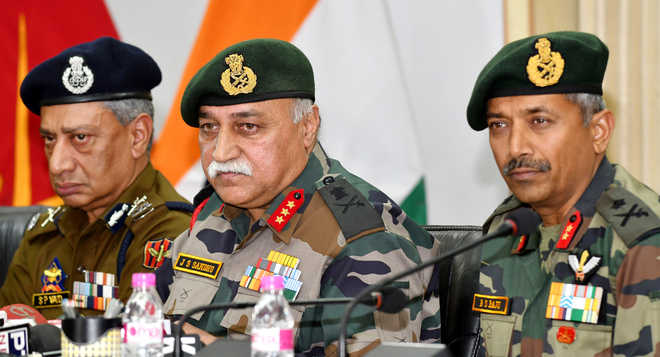
Chinar Corps GOC Lt Gen JS Sandhu along with Victor Force GOC Maj Gen BS Raju and DGP SP Vaid addresses a press conference in Srinagar on Sunday. Tribune Photo: Amin War

Tribune News Service

Srinagar, November 19

The relentless operations in Hajin for the past over two months by security forces yielded fruits on Saturday when they eliminated the six-member Pakistani group of the Lashkar-e-Toiba which was involved in many killings and also injuring CRPF commandant Chetan Cheeta.Six top Lashkar militants, including Obaid, alias Osama Jangvi, son of Abdul Rehman Makki, second in command of Jamat ud Dawah, and nephew of alleged mastermind of Mumbai attacks Zakir Rehman Lakhvi, were killed in a gunfight at Chandrageer in Hajin, Bandipora, 32 km from Srinagar. An elite Garud commando of the Indian Air Force (IAF), Corporal Jyoti Prakash Nirala, 31, who was operating with the Army for operational training was also killed in the gunfight.The General Officer Commanding of the Srinagar-based 15 Corps, Lt Gen JS Sandhu, on Sunday said Hajin was an area of focus for the security agencies.“Terrorists had resorted to some atrocities in the area. As a strategy, we had launched several operations in Hajin mid-September onwards. We were practically launching search operations on a daily basis. We had inducted Special Forces in the area and along with the intelligence network, police and the CRPF, the law and order in Hajin was brought under control. We were keeping a watch over the Chandrageer area for the last two-three days and yesterday based upon a specific input, the joint operation was launched in which six terrorists were eliminated,” Lt General Sandhu said at a joint press conference also attended by Director General of Police Shesh Paul Vaid and senior police, Army and CRPF officers.“All six were foreign terrorists led by Mehmood Bhai and comprised the bulk of the Hajin group. I want to highlight that the Hajin group (of the Lashkar) has largely been decimated,” he said. “We will continue the operations and we hope to restore peace in the Valley as soon as possible.”The DGP said the operation on Saturday evening had “cleaned up the area”. “I am sure the people will have a sigh of relief and they would lead a life free of terror,” Vaid said at the joint briefing.Obaid was the third member of the Lakhvi’s family who had joined the Lashkar ranks and got killed in Kashmir since 2007. Hajin, which was once the headquarters of counter-insurgency group Ikwan, had of late turned into a strong base for Lashkar. Earlier this year, Lakhvi’s another nephew Musaib was also killed in Hajin.IGP, Kashmir, Munir Khan said the Lashkar leadership is sending their relatives to boost the morale of its cadres. “There is a leadership bankruptcy in the Lashkar and other organisations. In a way to motivate their cadres operating in the Valley, they started sending close relatives. It is nothing more than that,” Khan said.Top officers involved in the anti-militancy operation said they had plugged loopholes to ensure no repetition of the past as this group had managed to escape at least twice in recent months.“In the past operations, the militants used to fire indiscriminately at a single point to break the cordon. In a few cases they had managed to escape and we lost many of our men. On Saturday afternoon when the operation was launched around four suspected houses, they followed the same strategy, but we had plugged all exit routes and in half an hour all six top militants were killed,” a police officer said. “We suspected a local militant might have been part of the group, but he was not with them. The combing operation was over in two hours.”Nearly 200 terrorists still active in KashmirThe Army on Sunday said 190 militants were killed in the Kashmir valley this year. The GOC, 15 Corps, Lt Gen JS Sandhu, said out of the 190 militants, 66 were killed along Line of Control while they were trying to infiltrate. “Of the killed, 80 terrorists were locals and 110 were foreign terrorists. This has brought a remarkable change in the ground situation,” he said. Around 200 militants, including 110 to 120 locals, are currently active in Kashmir.


Martyred Mandi jawan was lone bread-winner of family Body to be brought to his village by road today

Martyred Mandi jawan was lone bread-winner of family
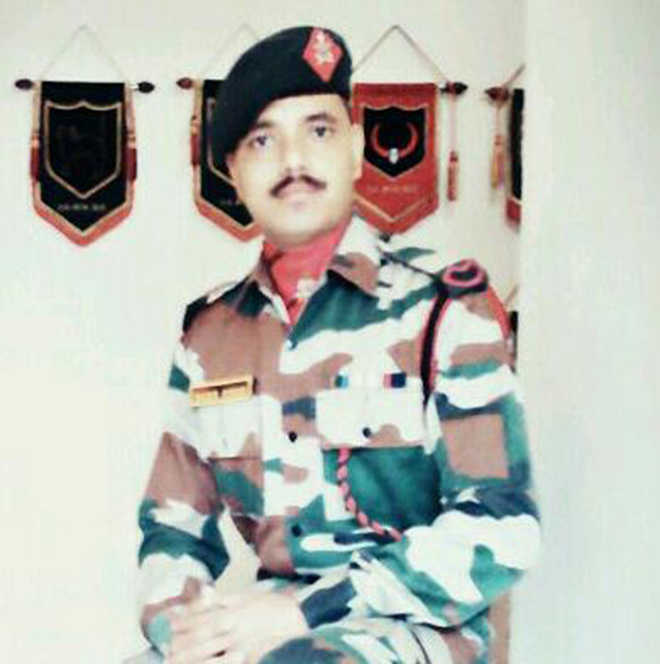
Inder Singh, an Assam Rifles jawan, was killed in an explosion at Manipur’s Chandel district on Monday. He was on patrolling duty at Maha Mani village when the improvised explosive device exploded around 6.15 am.

Tribune News Service

Mandi, November 14

The world of Mandi soldier’s family came crashing down when the news of his death reached his village. Inder Singh, an Assam Rifles jawan, was killed in an explosion at Manipur’s Chandel district on Monday. He was on patrolling duty at Maha Mani village when the improvised explosive device exploded around 6.15 am.The blast claimed the lives of two Assam Rifles jawans and left six injured.Inder’s family at Pandoh village in Mandi district was inconsolable. The martyr’s wife and mother said he was the lone bread-winner as his father had died long ago. His seven-year-old son had no idea what was happening in the house. Relatives were seen consoling the family. His wife said life would never be the same as tears rolled down her cheeks. Though the family is proud of Inder’s sacrifice, it will be difficult for them to come to terms with the loss.The family and relatives are waiting for the body which will be brought by road from Pathankot.Deputy Commissioner, Mandi, Madan Chauhan said the body was expected to arrive here on Wednesday morning and the cremation would be done the same day. He added that the district administration would provide every possible help to the family.


Zimbabwe military denies coup in TV address; says President, family safe Soldiers, armoured vehicles seal road access to govt offices

Zimbabwe military denies coup in TV address; says President, family safe
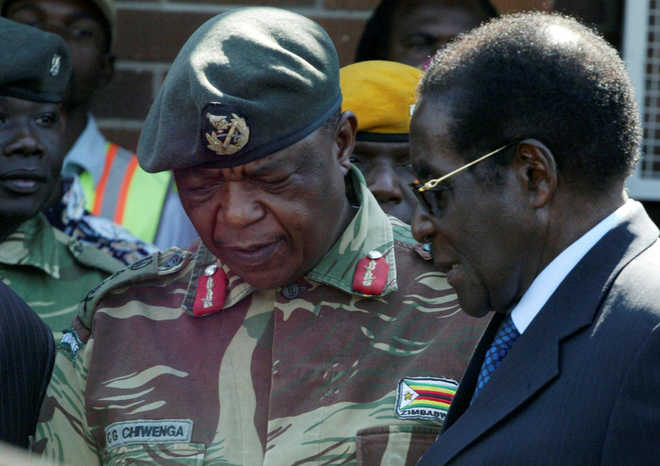
President Robert Mugabe and General Constantino Chiwenga. Reuters/file

Harare, November 15

Zimbabwean military officers read an address live on state TV on Wednesday, saying they were not launching a coup but were “targeting criminals around” President Robert Mugabe.

(Follow The Tribune on Facebook; and Twitter @thetribunechd)

“It is not a military takeover of government,” said one general reading a statement.

“We wish to assure the nation that his excellency the president… and his family are safe and sound and their security is guaranteed.

“We are only targeting criminals around him (Mugabe) who are committing crimes that are causing social and economic suffering in the country in order to bring them to justice,” Zimbabwe Major General SB Moyo, Chief of Staff Logistics, said on national television on Wednesday.

“As soon as we have accomplished our mission, we expect that the situation will return to normalcy.”

Zimbabwean soldiers and armoured vehicles blocked roads to the main government offices, parliament and the courts in central Harare, a Reuters witness said on Wednesday.

While nearby, Zimbabweans queued for cash outside banks as public taxis ferried commuters to work.

The military detained Finance Minister Ignatius Chombo on Wednesday, a government source said. Chombo was a leading member of the so-called ‘G40’ faction of the ruling ZANU-PF party, led by Mugabe’s wife Grace, that had been vying to succeed Mugabe.

Soldiers deployed across the Zimbabwe capital Harare on Tuesday and seized the state broadcaster after Mugabe’s ruling ZANU-PF party accused the head of the military of treason, prompting frenzied speculation of a coup.

Just 24 hours after military chief General Constantino Chiwenga threatened to intervene to end a purge of his allies in Mugabe’s ZANU-PF, a Reuters reporter saw armoured personnel carriers on main roads around the Capital.

Aggressive soldiers told passing cars to keep moving through the darkness. “Don’t try anything funny. Just go,” one barked at Reuters on Harare Drive.

Two hours later, soldiers overran the headquarters of the ZBC, Zimbabwe’s state broadcaster and a principal Mugabe mouthpiece, and ordered staff to leave. Several ZBC workers were manhandled, two members of staff and a human rights activist said.

Shortly afterwards, three explosions rocked the centre of the southern African nation’s capital, Reuters witnesses said.

Mugabe, the self-styled ‘Grand Old Man’ of African politics, has led Zimbabwe for the last 37 years.

In contrast to his elevated status on the continent, Mugabe is reviled in the West as a despot whose disastrous handling of the economy and willingness to resort to violence to maintain power destroyed one of Africa’s most promising states.

The United States and Britain advised their citizens in Harare to stay indoors because of “political uncertainty.” “US citizens in Zimbabwe are encouraged to shelter in place until further notice,” the US statement said.

The British Foreign & Commonwealth Office statement told “nationals currently in Harare to remain safely at home or in their accommodation until the situation becomes clearer.” The Southern African nation has been on edge since Monday when Chiwenga, Commander of the Zimbabwe Defence Forces, said he was prepared to “step in” to end a purge of supporters of sacked vice president Emmerson Mnangagwa.

Only a few months ago, Mnangagwa, a former security chief nicknamed “The Crocodile”, was favourite to succeed his life-long political patron but was ousted a week ago to pave the way for Mugabe’s 52-year-old wife Grace to succeed him.

‘Politics over the gun’

Chiwenga’s unprecedented statement represented a major escalation of the struggle to succeed Mugabe, the only leader Zimbabwe has known since it gained independence from Britain in 1980.

Mugabe chaired a weekly cabinet meeting in the capital on Tuesday, officials said, and afterwards ZANU-PF said it stood by the “primacy of politics over the gun” and accused Chiwenga of “treasonable conduct … meant to incite insurrection.” The previous day, Chiwenga had made clear the army’s refusal to accept the removal of Mnangagwa – like the generals a veteran of Zimbabwe’s anti-colonial liberation war – and the presumed accession of Grace, once a secretary in the government typing pool.

Local government minister Saviour Kasukuwere, a leading figure in her relatively youthful ‘G40’ faction, refused to answer Reuters questions about the situation in Harare. “I’m in a meeting,” he said, before hanging up shortly before midnight.

Army, police and government spokesmen refused to answer numerous phone calls asking for comment.

‘Defending our revolution’

Neither Mugabe nor Grace have responded in public to Chiwenga’s remarks and state media did not publish his statement. The Herald newspaper posted some of the comments on its Twitter page but deleted them.

The head of ZANU-PF’s youth wing, which openly backs Grace, accused the army chief of subverting the constitution.

“Defending the revolution and our leader and president is an ideal we live for and if need be it is a principle we are prepared to die for,” Youth League leader Kudzai Chipanga said at the party’s headquarters in Harare.

Grace Mugabe’s rise has brought her into conflict with the independence-era war veterans, who enjoyed privileged status in Zimbabwe until the last two years when they spearheaded criticism of Mugabe’s handling of the economy.

In the last year, a chronic absence of dollars has led to long queues outside banks and an economic and financial collapse that many fear will rival the meltdown of 2007-2008, when inflation topped out at 500 billion percent.

Imported goods are running out and economists say that, by some measures, inflation is now at 50 percent a month.

According to a trove of intelligence documents reviewed by Reuters this year, Mnangagwa has been planning to revitalise the economy by bringing back thousands of white farmers kicked off their land nearly two decades ago and patching up relations with the likes of the World Bank and IMF.

Whatever the outcome, analysts said the military would want to present their move as something other than a full-blown coup to avoid criticism from an Africa keen to leave behind the Cold War continental stereotype of generals being the final arbiters of political power.

“A military coup is the nuclear option,” said Alex Magaisa, a UK-based Zimbabwean academic. “A coup would be a very hard sell at home and in the international community. They will want to avoid that.” Agencies

PUNJAB State to hold nation’s first military lit fest

Vijay Mohan

Tribune News Service

Chandigarh, September 27

A three-day military literary festival, the first such event in the country that would focus on contemporary thought and promote recent publications on defence and national security, is being organised here by the Punjab Government from December 7 to 9.Sources said the modalities and programme of the event were being worked out and different themes explored. Chief Minister Capt Amarinder Singh had held a meeting in this regard yesterday.“Books published recently are being shortlisted and their authors would be invited to talk about their work. Panel discussions on the topic would also be held,” an official said. Besides, there could also be talks by eminent persons on current military issues and other aspects of national security as well as subjects like war stories, military history and acts of gallantry, the official added.The idea of a military literary festival was mooted by Governor VP Singh Badnore earlier this year while releasing a book on the legendary Saragarhi battle authored by the CM. He opined that a number of senior and distinguished retired defence officers, including close to a 100 lieutenant generals, were based in Chandigarh and their expertise and experience should be a source of enlightenment for others.

clip