All posts by webadmin

Last Sikh Queen’s earrings fetch nearly 6 times auction estimate

Last Sikh Queen’s earrings fetch nearly 6 times auction estimate

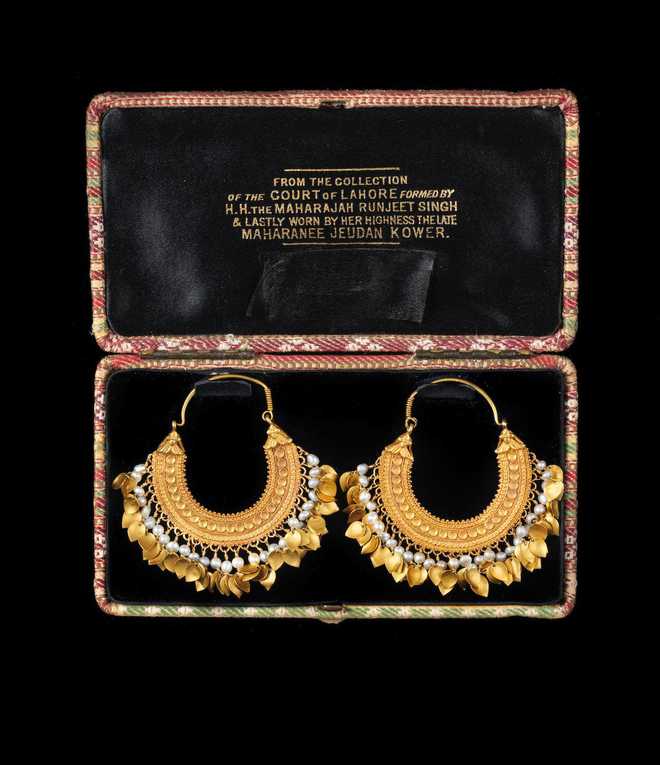
The earrings belonged to the youngest wife of Maharaja Ranjit Singh. Photo courtesy Twitter handle: @bonhams1793

London, April 25

A pair of gold pendant earrings from the collection of last Sikh Queen of Punjab Maharani Jind Kaur fetched 175,000 pounds, nearly six times the guide price, at an auction here.The earrings, the highlight of the Islamic and Indian sale at Bonhams yesterday, were estimated to attract bids between 20,000 and 30,000 pounds.The earrings belonged to the youngest wife of Maharaja Ranjit Singh, who was the only wife of the Sikh ruler not to commit sati on his funeral pyre following his death in 1839.She went on to be appointed as the de facto ruler of Punjab before being captured by the British. It was only many years later when she arrived in England that her jewellery, including the earrings on sale, were handed back to her.“The impressive price paid for these beautiful pieces of jewellery conveys their significance,” said Oliver White, Head of Islamic and Indian Art at Bonhams.“These gold earrings are a powerful reminder of a courageous woman who endured the loss of her kingdom, and persecution and privation, with great dignity and fortitude,” he noted.When Kaur’s five-year-old son Duleep Singh was proclaimed Maharaja of Punjab in 1843, she was appointed Regent.The Punjab Empire at the time stretched from the Indian Ocean to the Himalayas and the court was fabled for its artistic and scientific achievements and opulence and riches.The East India Company invaded and annexed Punjab, despite armed opposition organised and led by Kaur. She was deposed in 1846, separated from her son and imprisoned.According to Bonhams’ historians, the Maharani’s personal wealth was confiscated and the state Treasury plundered by the British Army.The famous Koh-i-Noor diamond and the Timur Ruby were sent back to London as gifts for Queen Victoria. Mother and son were eventually reunited after 13-and-a-half-years in 1861 when Kaur moved to England to be with her son. She died in 1863.Besides her earrings, some of the other Indian highlights of the Bonhams auction this week included a painting by Gujarati artist Ghulam Mohammed Sheikh.His ‘Composition in green and black’ inscribed on the reverse with the artist’s name sold for 40,000 pounds, within the guide price estimate of 35,000 and 45,000 pounds.Another Indian painting, dating back to circa 1820-30, ‘Shiva and Parvati with Ganesh, Karttikeya and Nandi on Mount Kailasa’ went under the hammer for 16,250 pounds, beyond the estimated 8,000-12,000 pounds.A ‘Mother and Child’ portrait by Jamini Roy dating back to circa 1950 fetched 11,875 pounds, also beating the guide price estimate of 6,000-8,000 pounds. — PTI


UK envoy sorry for calling Golden Temple a mosque

UK envoy sorry for calling Golden Temple a mosque

London, April 24

A top UK diplomat has called the Golden Temple a mosque following which he apologised for the gaffe amid protests by Sikhs.Simon McDonald, Permanent Under-Secretary, Foreign & Commonwealth Office, referred to the Golden Temple in Amritsar as the “Golden Mosque” in a tweet on Monday.“At the Queen’s birthday party, presented with picture of The Queen at Golden Mosque in Amritsar in 1997, a permanent memento for Deputy High Commission’s wall,” he tweeted. On realising his mistake, he apologised for the gaffe. The Foreign Office top diplomat said this morning: “I was wrong: I am sorry. I should, of course, have said the Golden Temple or, better, Sri Harmandir Sahib.”However, Bhai Amrik Singh, the chairman of the Sikh Federation, said: “This was a major gaffe by a top civil servant and unacceptable. It demonstrates a remarkable level of ignorance from someone in his position.” “In our view, a public apology and admitting the mistake is not enough. What we need is a commitment from the UK government and senior civil servants to root out such ignorance and discrimination or we will continue to face hate, abuse and threats of violence,” he was quoted as saying by The Guardian.The gaffe comes as Labour Party leader Jeremy Corbyn vowed to launch an independent inquiry into Britain’s military role in the Indian Army’s 1984 raid on the Golden Temple under his party’s government. The Labour leader promised that an investigation into the attack, which is said to have left thousands of people dead, would be in the party’s next manifesto. — PTI


Why the row over DSP cadre merger with Delhi, other UTs

SENIOR POLICE OFFICIALS SAY THE MERGER WILL SET A SYSTEM IN PLACE, CURRENTLY NON­EXISTENT, FOR PROMOTION AND TRANSFER OF CHANDIGARH POLICE DSPS, WHICH CAN ONLY HAPPEN ONCE THEY ARE A PART OF DANIPS

From page 01 CHANDIGARH: There’s been a row over a home ministry (MHA) proposal to merge the deputy superintendent of police (DSP) cadre of Chandigarh Police with that of Delhi, Andaman and Nicobar Islands Police Services (DANIPS), with even the Punjab chief minister opposing the idea.

HT FILE■ A number of Chandigarh Police officials are reportedly against the proposal for merger of the DSP cadres as they don’t want a transfer to other UTs.WHAT’S THE PROPOSAL?

The ministry of home affairs (MHA) has proposed the merger of the Chandigarh Police deputy superintendent of police (DSP) cadre with the Delhi, Andaman and Nicobar Islands Police Services (DANIPS). There are at present 23 sanctioned posts of DSPs in Chandigarh police with 11 are held by officials of the Chandigarh cadre and 10 by DANIPS.

RATIONALE BEHIND THE PROPOSAL

Senior police officials say the merger will set a system in place, currently non-existent, for promotion and transfer of Chandigarh Police DSPs, which can only happen once they are a part of DANIPS. The police officials are permanently stationed in Chandigarh once they are recruited at the assistant sub-inspector (ASI) level.

WHEN WAS THE PROPOSAL INITIATED?

Anuradha Gupta, an IAS officer from the Haryana cadre, was UT home secretary when a DSPs deputation met her to ask for promotion to the rank of superintendent of police (SP). As no such provision existed then and SPs came to the city on deputation from New Delhi, Gupta proposed the merger for the first time.

WHY ARE SOME OFFICERS AGAINST THE PROPOSAL?

Some Chandigarh Police officers don’t fancy the idea of leaving the comforts of the city and move to other UTs. Then comes the question of seniority – once the merger happens they will be junior to their DANIPS counterparts as they are recruited as ASIs whereas the former, say in Delhi Police, are recruited a higher level as sub-inspectors.

WILL THE MERGER BE A GOOD MOVE?

The merger, many police officers say, will be in the interest of the local police officers as more openings will be created for promotions to SP or even DIG ranks.

Transfer to other UTs should also not be such a big issue for the DSPs, they say.

WHY IS THE PUNJAB CM AGAINST THE PROPOSAL?

Punjab chief minister Capt Amarinder Singh has opposed the move, saying Chandigarh is the capital of Punjab and a disputed territory as of now. He has called for continuing the existing pattern of all Chandigarh UT posts being shared between Punjab and Haryana in a 60:40 ratio. The merger will dilute the stake of Punjab in Chandigarh, making the CM a likely target for rival parties Shiromani Akali Dal and Aam Aadmi Party for working against the interests of the state.

WHAT NEXT?

DANIPS now is a proposal put forward by MHA for comments and observations up to May 19, after which it will be sent to Union Public Service Commission (UPSC) for approval. From there, it will go to the finance and then the personnel ministries and finally to the Union Cabinet for clearance.

It has also been learnt that inspectors and police officials in line for promotion to posts of DSPs in Chandigarh are contemplating legal action if the proposal is implemented.


Defence secy flies SU-30 at IAF base in Sirsa

SIRSA: Defence secretary Sanjay Mitra visited the Air Force base at Sirsa on Saturday. He was accompanied by Air Marshal SB Deo, Vice-Chief of Air Staff.

HT PHOTPDefence secretary Sanjay Mitra (third from left) before taking a sortie in a Su­30 MKI aircraft at the Indian Air Force base in Sirsa on Saturday.

The defence secretary and the Air Marshal flew a sortie each in Su-30 MKI squadron based at Sirsa. The mission was flown in a dense network-centric environment as part of the ongoing pan India IAF level exercise Gaganshakti.

The two-week long exercise, being conducted by the IAF, is one of the biggest so far in terms of participation of forces, intensity of operations and scale of logistical support, a defence release said. The defence secretary and the Air Marshal also interacted with the personnel of the base.

Ex-servicemen walk for martyrs

IT WAS WONDERFUL TO HAVE CIVILIANS AND EX­SERVICEMEN MEET AND DO SOMETHING TOGETHER FOR A NOBLE CAUSE

Here we are on a beautiful morning in April, all ready for a walkathon. This one is, however, different from a sporting event that’s usually dominated by youngsters. Ek Kadam Shahidon Ke Naam (One step for the martyrs) has been organised by ex-servicemen from Ambala for India’s martyrs – soldiers killed in action.

■ The writer with other participants during the walkathon in Ambala.Two groups are participating in the event, one starting from Ambala city and another from Ambala Cantonment with both converging at the Jaggi City Centre for a small cultural programme and refreshments.

I am with the Ambala Cantt group and we take off on the dot at 6.45 am from the Phoenix Club. It is a 5-km route along the GT Road. As convenor of the Ambala Indian National Trust for Art and Cultural Heritage (INTACH) I am happy to be walking with INTACH members Vipin Malhotra and Saighalji and many spirited ladies, all our aching limbs and tiredness forgotten. As the ladies request that we slow down, we pause for a group photograph and then walk on to remember our heroes who sacrificed their lives for the nation.

Bhalla Saheb, an IAF ex-serviceman becomes nostalgic as we pass the Air Force Station where he had been posted 50 years ago. At 82, this tall, slim, and straight ‘young man’ matches steps perfectly with the rest of us.

Finally, we realise we have done it! Approaching Jaggi City Centre near the Kingfisher Resort, on the AmbalaChandigarh highway, we find over a thousand people, neatly seated, and enjoying the cultural programme. Many people have come from villages close by, including families of ex servicemen. A woman sarpanch recounts the sacrifices of her husband (a Subedar in the army) who died fighting the enemy on the India-Pakistan border. Then there are people reciting poems, one eulogising Shaheed Bhagat Singh and another highlighting India’s unity in diversity. The atmosphere is charged with positive energy and we all seem to be suddenly connected by a single thread – desh bhakti (love for the nation).

As we enjoy the programme, relishing our healthy breakfast served at the venue, some veterans take the stage to salute our martyrs. There are cheers as Subedar Multani Saheb and his dedicated team (organisers) request the chief guest, Dr R C Mishra, additional director general of police, to give away awards to walkathon participants who are above 85 years of age. How beautiful!

As the event comes to an end we promise to meet again, realising how wonderful it is to have civilians and ex-servicemen meet and do something together for a noble cause.


Thanks to social media, public interest in strategic military affairs is on the rise

Last week I was at Varanasi for the Kashi Manthan, a programme set up by a group of young, impassioned people with interest in military strategic affairs. I also helped to set it up by putting in a request to some of the finest speakers on the Indo-Pacific, Pakistan, Afghanistan, China and Maritime Security. The organisers led by Mayank Singh, assistant registrar of the Banaras Hindu University, functioning in a personal capacity, had set up the seminar in such a professional way that it could put quite a few in Delhi to shame.

There was a capacity audience although many may have come to hear some television personalities. Yet, it wasn’t the knowledge level but the interest level which was palpable.Ever since the advent of social media and the 24×7 news channels, interest levels in matters military and strategic have moved higher. But there are just a few who can join the dots of the past. Many are humble in their opinion that they are unaware of the details of some complex issues but there are many highly opinionated people who neither have any sense of history nor wish to acquire the same.

Although Delhi has a large number of think tanks with very frequent seminars, talk shows and related events the levels of knowledge are not particularly high. The problem is mostly related to the holding of extreme positions. Very rarely does one find people with the ability to argue both sides.

We have bemoaned the lack of a strategic culture in India, particularly the abysmal understanding on military strategic affairs. That is why public opinion on Jammu and Kashmir only relates to the robust aspects of operations and hardly the measures which bring stability and peace.

That senior military leaders examine every aspect of an issue does not occur to most. This is why even as we take strategic learning to centres well away from Delhi, the need for military officers, both serving and retired, to speak and guide the enthusiasts is a must. The inclusion adds greater flavour.

In a recent seminar at the Punjab University in Chandigarh, serving senior officers of the Army did not hesitate in answering difficult questions and being contrarian. The media did well to give extensive coverage to the event. Kashi Manthan made no pretensions; the best part was the sheer excitement on display that such an event had been organised at Varanasi, a city not normally associated with strategic affairs.

Being one of the speakers, I digressed from my area of focus to display a map of Asia and the Middle East and briefly explain to the audience the importance of getting the geography of our areas of interest into the mind’s eye. Most newspaper readers usually glance at the news. Even if they do read some ongoing issues of interest, the mind’s eye is unable to create a mental graphic. Without that mental graphic it is extremely difficult to understand strategic affairs.

I used the map to bring home why Pakistan was such an important state to the international community. Once you do that people find it so much simpler to understand the China Pakistan Economic Corridor (CPEC), the dependence of the US on Karachi port for its logistics supplies to maintain the force in Afghanistan and why Pakistan has such an obsession with the Arab world. It also explains China’s compulsions to keep India pegged to the Himalayan belt. I also focused on explaining why the map of India must not be just pulled out of the internet because most such maps show the incorrect representation of Jammy and Kashmir.

Kashi Manthan must actually give impetus for many more such manthans in different cities at universities and other institutions. The corporate world as part of its corporate social responsibility could be devoted towards development of Indian strategic culture. I would strongly urge the Indian Armed Forces to also examine how they can chip in with their knowledge.


NBWs issued against Lt Col Sandhu Mohali police name four more persons in FIR; remand of 3 accused extended

Tribune News Service

Mohali, March 31

After failing to trace Lt Col BS Sandhu (retd), the Mohali police on Saturday procured the leading businessman’s non-bailable arrest warrants (NBWs) from the court of JMIC, Kharar.Besides, the police have named four more persons in the FIR registered in the case of murder of CTU employee Abhishek Guleria. They also got a four-day extension in the remand of three persons, employees of Lt Col Sandhu’s Forest Hill Resort (FHR) at Nayagaon here, already arrested in the case.Notably, Sandhu was nominated in the case on March 27and was asked to join investigations by the Mohali police.Confirming the development, Superintendent of Police (Detective) Harbir Singh Atwal said they have procured non-bailable warrants against Sandhu. “Our teams were making rounds of his (Sandhu) residences, offices and farmhouse for the past couple of days but he has been remaining elusive. We filed an application in the court on Saturday and got his arrest warrants,” said SP Atwal.Apart from that, the police also named four more persons in the case. They are Ramesh, Ramesh Chand, Dharampal and Davinder, who are also said to be working as security guards at the FHR. “They were involved in stuffing the victim’s body in a sack. We have nominated all of them. They would be examined soon,” said the police. Meanwhile, the local police also procured an extension of four more days in the remand of the three arrested accused — Balwinder Singh, Gurwinder Singh Bains and Tarsem Lal. The police sought the extension on a plea that the accused were needed for reconstruction of the crime scene and during cross-examination of the four persons, who have been named in the case.The police have also summoned the victim’s kin to get information about his (victim’s) missing wallet. The victim, Abhishek Guleria, a resident of Burail and native of Himachal Pradesh, had gone missing on March 14. He was found dead on the Pinjore-Baddi road on March 25.


F-16 gives India unique opportunity to be at centre of world’s largest fighter aircraft ecosystem’

‘F-16 gives India unique opportunity to be at centre of world's largest fighter aircraft ecosystem’
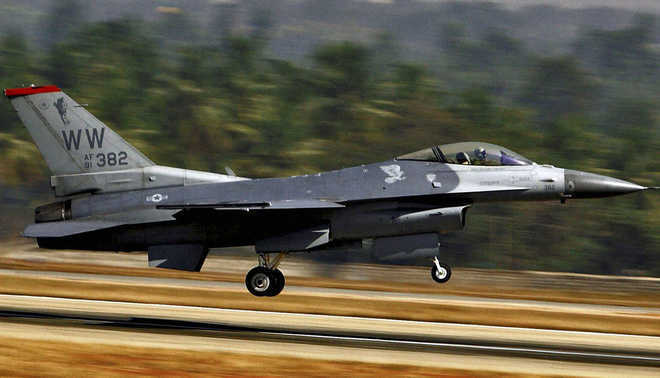
File photo of F-16 fighter plane. PTI

Washington, March 19

F-16 jets give India a unique opportunity to be at the centre of the world’s largest fighter aircraft ecosystem and it is the only programme with proven performance to meet its operational needs and ‘Make in India’ priorities, according to an American defence company.

As India continues to shop around to add new fighter jets into its air force, Lockheed, which is the world’s largest defence company which has offered to relocate its entire production line to India has said that it intends to create far more an F-16 “assembly line” in India.

“We plan to introduce two new words into the lexicon of international fighter aircraft manufacturing: “India” and “exclusive.” F-16 production in India will be exclusive—something that has never before been presented by any other fighter aircraft manufacturer, past or present,” Vivek Lall, vice president, Strategy and Business Development, Lockheed Martin told PTI in an interview.

“The F-16 gives Indian industry a unique opportunity to be at the centre of the world’s largest fighter aircraft ecosystem,” Lall said.

“The F-16 provides unprecedented manufacturing, sustainment, upgrade and export opportunities to Indian industry well into the future. Only Lockheed Martin and its Indian partners can deliver the capabilities and industrial benefits to truly propel India’s military and defense industrial base into the future, Lall said.

He has played a key role in some of the big ticket American military sales to India, including the General Atomics-built Guardian Predator Drones announced by the US last year. Known as a renowned global aerospace leader, Lall recently joined Lockheed after spending a few years in General Atomics.

“The F-16 is the only aircraft programme in this competition with the proven performance and industrial scale to meet India’s operational needs and Make in India priorities,” he said, claiming that that no competing aircraft comes close to matching the F-16’s operational effectiveness and industrial success.

“The success of the F-16—3,000 F-16s flying today with 25 leading air forces—is a testament to the cost-effective, combat-proven capabilities the F-16 delivers. That combination of cost and capabilities is why F-16 production opportunities today total more than 400 aircraft, including India,” he said.

Lockheed is offering F-16 Block 70, which is the most advanced version of the aircraft.

“The F-16 continues to aerodynamically outperform its competitors and advanced technologies are continually integrated into the F-16. Block 70 mission systems are completely new and leverage technologies from the F-35,” Lall said.

The F-16 remains the backbone of the US Air Force, the world’s most capable air force, he said.

Structural and avionic upgrades to the US F-16 fleet will extend service life to 2045, while the F-16 becomes even more capable as technology enhancements from the F-22 and F-35 are continuously integrated across all three platforms, he added.

Responding to a question, Lall said the offer from Lockheed is cost advantage for India.

The single-engine F-16 has a 30-40 per cent lower operation and maintenance cost per flying hour than twin-engine aircraft in its class, according to figures published by the Office of the Under Secretary of Defense, he said.

“Whether you’re talking about battlefields or budgets, the F-16 is the clear choice for India,” he said.

Lall, however, refused to reply questions on F-35.

“Any discussions regarding potential new F-35 customers begin at the government-to-government level. It is not our place to speak on behalf of the US government or the government of India,” he said.

Notably the US Pacific Command Commander Admiral Harry Harris during his two recent Congressional testimonies have supported selling F-35 to India.

“At the moment, India is considering a number of US systems for purchase, all of which USPACOM fully supports: the F-16 for India’s large single-engine, multi-role fighter acquisition programme, Harris told the Congressional committees last week.

He also said the purchase includes, F/A-18E for India’s multi-engine, carrier-based fighter purchase; a reorder of 12-15 P-8Is; a potential purchase of SeaGuardian UAS; MH-60R multi-role sea-based helicopter; and F-35 Joint Strike Fighter. PTI


China making N-powered super carrier, submarines

China making N-powered super carrier, submarines

Ajay Banerjee

Tribune News Service

New Delhi, March 18

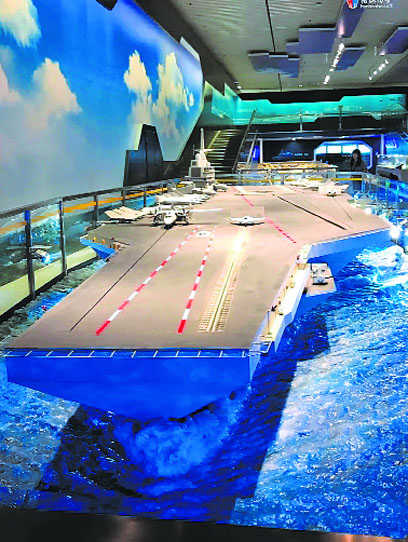
In what could be a deliberate move, China’s state-owned shipbuilder has revealed, and then removed from its website, plans for a massive naval scale-up, including a nuclear-powered sea-going aircraft carrier of 1 lakh tonnes and a new set of nuclear submarines that would be more silent while operating underwater.The state-owned China Shipbuilding Industry Corporation (CSIC), which runs Dalian shipyard where China builds its aircraft carriers, revealed future plans with models last week only to later remove the same from its website. This could possibly be a deliberate move to tell the world what’s coming, especially as India expands to dominate greater parts of the Indian Ocean while Japan is adding to its naval fleet and the US has increased its naval presence in South-East Asia.The CSIC is a major shipbuilder for the People’s Liberation Army Navy (PLAN) and its biggest item could be China’s first nuclear-powered carrier. In strategic circles, this is identified as “Type 003”. Till now, there were only estimates on its size, structures and operations. Now, it seems, this will be the largest non-American warship in the world. China already has two diesel-electric powered carriers—the Ukraine-built “Liaoning” and the domestically built carrier, CV-17, launched in 2017.Only the US and France, operate nuclear-powered carriers. The Chinese one is expected to displace between 90,000-100,000 tonnes and have electromagnetically assisted launch system (EMALS) for fighter jets (only the US has tried these, so far). It will possibly carry J-15 fighters, J-31 stealth fighters, airborne early warning and control aircraft, anti-submarine warfare helicopters, and stealth attack drones.A nuclear-powered carrier will give China unlimited endurance at sea as the ship will not need to stop for fuel, and water is nowadays recycled from sea.The CSIC website also said it would build a new nuclear-powered submarine, likely to be called Type 095 nuclear-attack submarine (SSN). Compared to the existing Shang Class nuclear submarines, the 095 SSN will include new noise-reduction measures. The CSIC said it was also working on a separate “quiet” submarine, autonomous robot submarines or what are called the armed unmanned underwater vehicles (UUVs). Autonomous UUVs, armed with torpedoes and missiles, could undertake missions that manned vessels cannot.Separately, the US Department of Defence, in its annual report to the Congress titled “Military and Security Developments Involving the People’s Republic of China 2017”, warned: “The PLAN lays high priority on the modernisation of its submarine force. It currently possesses 63. By 2020, this force is likely to grow to 78.”

The aircraft carrier

  • It seems the new aircraft carrier will be the largest non-American warship in the world; only theUS and France operate nuclear-powered carriers so far
  • The Chinese one is expectedto displace between 90,000-100,000 tonnes and have electromagnetically assisted launchsystem for fighter jets (only theUS has tried these, so far)

The submarine

  • The new nuclear-powered submarine is likely to be called Type 095 nuclear-attack submarine (SSN)
  • Compared to the existing Shang Class nuclear submarines, this will include new noise-reduction measures

War memorial opening on March 23

Una, March 14

A war memorial at the Municipal Park here will be formally inaugurated on March 23.In a press note issued here today, chairman of the district Ex-Servicemen Welfare Council Yashpal Thakur said members of 87 martyrs’ families would be honoured. The memorial, which displays the names of all martyrs, has been constructed with contributions from ex-serviceman, the Municipal Committee, the district administration, social organisations and public funds. — OC


The French embrace Hard questions remain unanswered

The French embrace

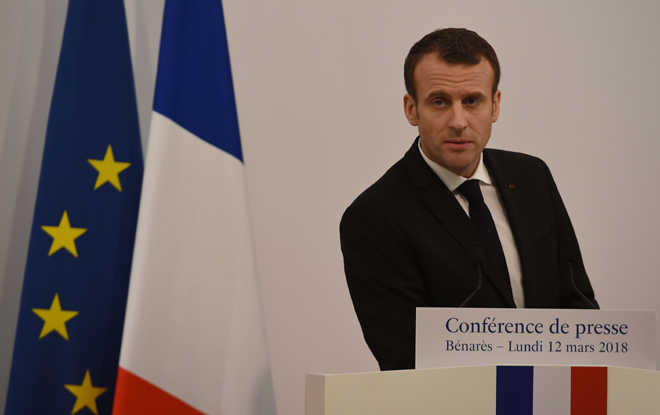
The photogenic and politically correct French President Emmanuel Macron waltzed through his India state visit with the customary Parisian sophistication and panache by playing on South Block’s insecurities to set the stage for offloading more defence equipment on India. In brass tacks, the French signalled their intentions to supply two more squadrons of Rafale fighters; reopened conversations on a mega French nuclear power project; and won orders for their companies equal to one year of Indo-French trade. In return, India got a French offer to checkmate China in the Indian Ocean by the liberal use of each other’s naval facilities. The French astutely played on Indian susceptibilities and worries vis-a-vis a rising China to project themselves as India’s best allies. But will a French President, whose maiden overseas State visit was to Beijing, watch India’s back in a square up with China? Or when the Sino-French bilateral commerce is 10 times Indo-French annual trade? Paris, anyway, lost interest in South China Sea after being drummed out of Vietnam and Cambodia decades back. The second billing, after the joint Indo-French maritime alliance, was taken by the reopening of talks for French nuclear plants, rejected the world-over for their unproven technology and steep tariff. We are none the wiser about whether the French have patched up the security vulnerabilities in Scorpene submarines after 20,000 pages of its classified data was leaked to the media. The silver lining of Macron’s visit was the simultaneous staging of the first summit of the International Solar Alliance (ISA). France’s co-promotion of the ISA (along with India) brought in several heads of state from the mineral-rich Francophonic Africa where the Indian diplomatic footprint has been traditionally weak. The best challenge to China should be on land rather than in the oceans. India can do this in Africa by dovetailing the India-Japan led Africa Growth Corridor with an India-France trade centred foray in West Africa by riding on the opportunity given by the ISA. This approach will meet India’s prime aim of opening new trade avenues to compensate for the loss of existing ones due to the coming trade war.