Guv addresses Assembly, showcases financial bankruptcy of Punjab

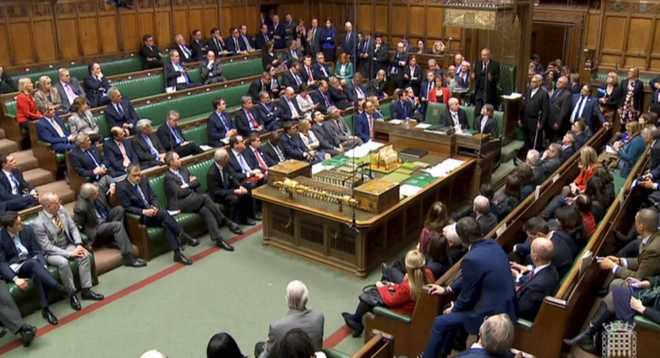
Governor VP Singh Badnore addressing the first session of the 15th Vidhan Sabha. Tribune photo
Sanjeev Singh Bariana
Tribune News Service
Chandigarh, March 28
Showing Punjab a financially-collapsed economy with an abysmally-high revenue deficit of Rs 13,484 crore and the fiscal deficit of Rs 26,801 crore, Governor VP Singh Badnore on Tuesday said the government is committed to “restoring the financial position of the state and to once again put it on a high-growth trajectory”.He was addressing the first session of the 15th Vidhan Sabha here.
Badnore, in his 35-minute speech, said, “Punjab’s financial health has been under stress for some time on account of ballooning salaries and wage bills of employees, mounting debt burden, slow growth of revenue receipts as compared to revenue expenditure and loss-making public sector units (PSUs).While the SAD MLAs arrived a little before the start of the session at 11 am and exchanged pleasantries with the Congress legislators, the AAP MLAs, along with Bains brothers of the Lok Insaaf Party, arrived last.The major opposition had walked out of the House on Monday in protest against the Speaker not allowing debate on the Governor’s address.Badnore said, “During the last five years (2012-2017) the projections/targets of the state excise and VAT revenue were never achieved. During the last 10 years, the total debt of the state had increased from Rs 48,344 crore to Rs 1,82,537 crore at the end of 2016-2017. The government had borrowed Rs 15,632 crore on behalf of the Punjab State Power Corporation Limited alone. In order to settle the gap in Cash Credit Limit (CCL) for foodgrains, the government agreed to term loan which further burdened the state. Even the atta dal scheme and urban and rural missions were taking credit from banks.“At the moment the government is trying to come to grips with the financial mess it inherited; implementation of poll promises will be visible in the coming budget (2017-2018),” he said.“As a step towards easing debt of farmers who are forced to commit suicide, the government will enact a legislation to prohibit ‘kurki’ and sale of farmers’ lands by lending agencies. The government will continue to provide free power to farmers. It will establish an Agriculture Board (APB) responsible for contract farming in the state. The state will take all administrative and legal measures to defend the water rights of the state.“Spelling strict action against drug dealers, the government will pass the Confiscation of Drug Dealers Property Act besides setting up a special task force which will report directly to the Chief Minister for daily monitoring.”Taking a dig at the earlier SAD-BJP government, Badnore said the state witnessed deterioration in the quality of governance with increased political governance through ‘halqa incharges’ in forcible occupation of government and private businesses, both in transport and mining. The government is committed to simplifying the processes to deliver services through a new Governance Reforms and Ethics Commission (GREC).The Governor said all MLAs and MPs would be required to declare details of their immovable properties on January 1 each year. For the current financial year they will be required to provide the details by July 1. Fresh surveys will be carried out for providing the government endeavour of providing ‘ghar ghar mein naukri’.The Governor also underlined a complete revamp of the police and change in attitude of law-enforcing agencies. Territorial jurisdiction of police stations will be rationalised and police will follow a schedule of fixed duty hours except in case of emergencies.Badnore said the government would make all efforts to commission the Shahpur Kandi hydel project and Mukerian II hydel project to increase the generation capacity of the state from the current 13,960 MWs. The government proposes to assign increased role to the private sector in providing transport facilities to citizens. Clearly hinting at the ministers in the last government, he said “all illegal and ineligible permits will be cancelled”.“The government will ensure 30 per cent reservation for SCs in allotment of houses, and residential and commercial plots. The government will also provide 30 per cent reservation to women in government jobs.”The Governor forgot to say ‘the House is adjourned’ before walking out of the House after the national anthem when his speech concluded. The AAP leaders sat for five more minutes before leaving the House.
Capt Amarinder Singh takes on Parkash Singh Badal on CPS issue

Capt Amarinder Singh. Tribune file
Rajmeet Singh
Tribune News Service
Chandigarh, March 28
Punjab Chief Minister Capt Amarinder Singh on Tuesday took on former chief minister Parkash Singh Badal on the chief parliamentary secretaries issue.Speaking after the Governor’s address, Amarinder said the Akalis had made more political appointments, including 30 advisers/OSDs.He said the CPS bill would be brought after proper legal scrutiny in the next session. The CM said he favoured a good technocrat to head the PSPCL as its CMD.
(Follow The Tribune on Facebook; and Twitter @thetribunechd)
Lal Singh to be the Chairman of Punjab Mandi Board, orders Meanwhile, the Punjab government declared the second half of Tuesday as holiday in all its offices, educational institutes, corporations and boards throughout the state and Chandigarh in view of the death of former agriculture minister Gurdev Singh Badal.
No change in red beacon policy, says Punjab CM
 Cabinet Minister Charanjit Singh Channi looks on as his driver removes beacon from his vehicle in Chandigarh. Tribune file photoTribune News ServiceChandigarh, March 28
Punjab Chief Minister Amarinder Singh on Tuesday evening denied having rolled back his decision to do away with red beacons for him and his ministers.A spokesperson of the state government claimed the Transport Department mistakenly put out part of the party’s election manifesto, which social media had picked up and circulated as an official notification.The Transport Department later withdrew the purported order. The chief minister also directed the chief secretary to have a correct notification sent to him for immediate release, the spokesperson said, adding that the notification will be issued soon.There was no question of change in policy and the state government was fully committed to shedding VIP culture, of which red beacon has for long been the most visible symbol, the spokesperson said. An official statement issued after the decision was taken said beacons were removed soon after the state government took a decision to shun VIP culture at its maiden meeting. The government’s move to shed the VIP frills is in line with the state Congress poll manifesto.Though the chief minister and the Cabinet ministers were exempted in the Congress manifesto, they decided to bring themselves within the ambit of the decision, said an official spokesperson.
Posts on offer
IAS gain, technocrats’ loss
Power engineers are set to lose the post of CMD of PSPCL to the IAS lobby. When the Punjab State Electricity Board was split, they were agitated over the unbundling but were pacified with the assurance that the top posts in the new utilities would stay with them. No matter how competent, engineers can hardly match IAS officers with life-time experience and expertise of being on the right side of politicians. Henceforth, the CMD post, it is reported, will remain with the IAS. Technical qualifications of an IAS officer cannot equal a technocrat having long hands-on field experience.There is much that is wrong in Punjab’s power sector but the Amarinder Singh government has taken on priority the task of replacing the previous Akali Dal-BJP government favourite at the helm of PSPCL with an officer of personal choice. For that the rules are being rewritten. In this respect not much seems to have changed. The Badal regime had gone out of the way to keep KD Chaudhri on the job. Merit does not matter when loyalty is involved. With an IAS officer as CMD and a retired IAS hand as the regulator it would be business as usual on the power front. None would question frequent tariff hikes to cover up inefficiency or pilferage, the growing mountain of debt on PSPCL, non-recovery of dues from government departments, delays in subsidy payments or slow implementation of the Centre’s UDAY scheme. The IAS biradari is most comfortable in the maintenance of the status quo — unless the political class sends out signals to the contrary.Politicians rewarding loyalists is a countrywide phenomenon but in Punjab it extends to the creation of unnecessary posts that carry ministerial status and burden the depleted treasury. Rules are being tweaked to accommodate candidates of choice. The proposal to revive posts of Chief Parliamentary Secretary mocks the high court ruling on the issue. It is amusing to see former CM Badal and present CM Amarinder Singh quibbling over who has created more posts. Both have experience in buying loyalty and keeping political peace at the state expense.
White Paper on state’s fiscal mess: Guv
Says govt committed to restoring financial position of state and putting it on high-growth trajectory
Governor VP Singh Badnore addresses the Vidhan Sabha on Tuesday. Tribune photo: Manoj Mahajan
Sanjeev Singh Bariana
Tribune News Service
Chandigarh, March 28
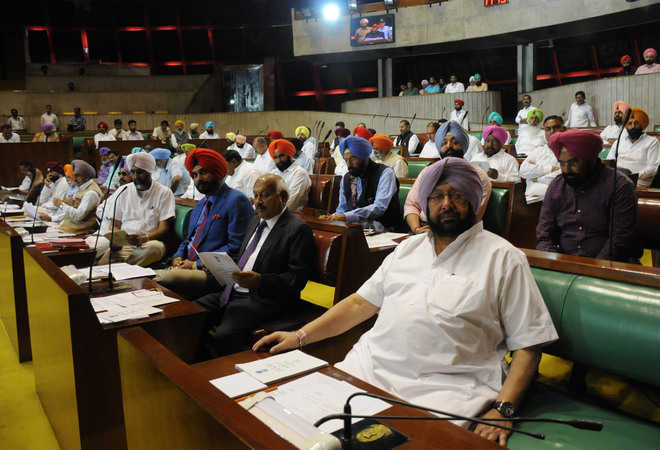
Chief Minister Capt Amarinder Singh with his Cabinet colleagues in the Assembly.
Blaming the earlier SAD-BJP government for the “collapsing” economy with an alarming Rs 13,484 crore revenue deficit and a fiscal deficit of Rs 26,801 crore, the Punjab Government today said it would bring out a “White Paper” on development works, governance reforms and the state’s financial state to “apprise the common man on the present (pitiable) situation inherited by the government.”Addressing the Vidhan Sabha, Governor VP Singh Badnore said: “The government is committed to restoring the financial position of the state and to once again put it on a high-growth trajectory.”In his 35-minute speech, he said, “Punjab’s financial health has been under stress for some time on account of rising salaries and wage bills, mounting debt burden, slow growth of revenue receipts as compared to revenue expenditure and loss-making public sector units (PSUs).”The SAD MLAs arrived a little before the start of the session at 11 am. They were seen exchanging pleasantries with Congress legislators. The AAP MLAs and the Bains brothers of the Lok Insaaf Party (LIP) arrived last. Badnore said, “During the last five years (2012-2017) the projections/targets of the state excise and VAT revenue were never achieved. During the last 10 years, the total debt of the state had increased from Rs 48,344 crore to Rs 1,82,537 crore at the end of 2016-2017. The government had borrowed Rs 15,632 crore on behalf of Punjab State Power Corporation Limited alone. In order to settle the gap in the cash credit limit (CCL) for foodgrain, the government agreed to term loan, which further burdened the state. “At the moment, the government is trying to come to grips with the financial mess it has inherited; implementation of poll promises will be visible in the coming Budget (2017-2018).” He said to prevent debt-trapped farmers from committing suicide, the government would enact a legislation to prohibit ‘kurki’ and the sale of farmers’ land by the lending agencies. It would continue to provide free power to the farmers, establish a board for contract farming, and take administrative and legal measures to defend its water rights.To fight the drug menace, he said: “The government will pass the Confiscation of Drug Dealers Property Act besides setting up a special task force which will report directly to the Chief Minister.” Blaming the deterioration in governance on “political interference through halqa heads” during the SAD-BJP regime, he said the government was committed to simplifying processes for better services through a new Governance Reforms and Ethics Commission (GREC).He said all MLAs would be required to declare details of their immovable property on January 1 each year and for the current financial year by July 1. Fresh surveys would be carried out for the “ghar ghar mein naukri’ endeavour.The Governor, underlining the need to revamp the police and a change in the attitude of law-enforcing agencies, said the territorial jurisdiction of police stations would be rationalised and the policemen would have fixed duty hours, except in case of emergencies.Badnore said the government would make efforts to commission the Shahpur Kandi hydel project and the Mukerian-II project to augment power generation that now stood at 13,960 MW. The government proposed to give a greater role to the private sector in providing transport facilities. “All illegal and ineligible permits will be cancelled”.He said the government would ensure 30 per cent reservation for SCs in the allotment of houses and residential and commercial plots, besides 30 per cent quota for women in government jobs.At the end of the speech, the Governor forgot to say ‘the House is adjourned’ and walked out after the National Anthem. The AAP leaders kept sitting for five minutes and then left.
Governor’s Address retrograde: BadalChandigarh: Former Chief Minister and SAD stalwart Parkash Singh Badal on Tuesday said he had been saddened by the address given by the new government to the Governor to read as it was “a directionless, visionless and retrograde step that contains no outline for growth, development and prosperity of the state”. In a statement, he said: “The address sounded more like a cry-baby’s list of grievances than a sound policy and vision statement of grown-up and mature administrators. It is a fault-finder, not a path-finder. It shows that at least up to now, the government proposes to just push blame for their failures to their predecessors.” TNS
Bill on CPS post in Budget session, says Amarinder
Tribune News Service
Chandigarh, March 28
Chief Minister Capt Amarinder Singh today said the Bill for the appointment of Chief Parliamentary Secretaries (CPSes) and Parliamentary Secretaries would be tabled during the Budget session in June.Earlier, there were reports that the proposed Bill would be tabled in the ongoing Vidhan Sabha session.Taking on former CM Parkash Singh Badal, who has announced to oppose the Bill, Amarinder said: “How can the former CM speak on the issue when 18 CPSes appointed by the SAD-BJP were termed illegal by the Punjab and Haryana High Court?”He said the Bill would be legally vetted and the points raised by the High Court while quashing the appointment of the CPSes would be taken into account. He maintained that the ministers had a lot of work and attaching Parliamentary Secretaries of their choice would help them. The CM, however, refused to share the number of Parliamentary Secretaries to be appointed.Speaking after the Governor’s Address, Amarinder said while the SAD-BJP government had appointed nearly 30 OSDs and advisers, the Congress had so far made 14 political appointments.Talking to The Tribune, Finance Minister Manpreet Badal said: “First, the remaining ministers have to be inducted, only then can the CPSes will appointed.”On bringing transparency in government functioning, Amarinder said the Lok Pal would be made more effective and the CM and ministers would be brought under its ambit.On his commitment to end the drug menace in four weeks after coming to power, he said: “Already 200 persons involved in drug trafficking have been arrested in 10 days. We are not waiting for the STF to become operational. The ADGP-rank officer of the SFT, Harpreet Sidhu, would be joining by next Friday and he would have a clear mandate to act against peddlers.”
Bir Devinder, Arshi ask govt not to give vehicles to MLAs
Sarbjit Dhaliwal
Tribune News Service
Chandigarh, March 28
The heavy debt burden on the state notwithstanding, Punjab is the lone state in this part of the country which provides vehicles to its MLAs.“The practice of giving vehicles to MLAs by the government began in 1992 when militancy was at its peak. These vehicles were given for security purpose. However, this practice was not discontinued post-militancy. It should be stopped immediately,” said Bir Devinder Singh, a former Deputy Speaker.“Now, peace reigns and there is no need of such largesse to the MLAs,” he added.Former MLA Hardev Arshi said he had written to the government, opposing the move. He said there was no logic in giving vehicles to MLAs when they were given Rs15 per km for travelling in private vehicles.Under the free travel facility provision, they can charge up to Rs3 lakh per annum for travelling by road, rail and by air. For them, travelling allowance by air is same as admissible to Class I officials. For MLAs and ex-MLAs, there is facility for free travel in state-owned buses.Arshi said the practice of giving official vehicles to MLAs should be discontinued.Sources said some newly elected MLAs refused to accept gypsies and have asked for luxury vehicles.An MLA gets Rs25,000 per month as salary and an equal amount as constituency and secretarial services allowance. Besides, he gets Rs5,000 per month as compensatory allowance, Rs10,000 as office allowance, Rs4,000 as sumptuary, electricity allowance. There is a provision of Rs10,000 as telephone allowance and Rs10,000 as secretariat allowance.The MLA is also entitled to Rs50 lakh as loan for building or purchasing a house and Rs15 lakh to buy a car. There is also provision of pension for the MLAs. A person, who has served as Member of the Assembly is entitled to a pension of Rs15,000 per month plus DA for the first term and an additional pension of Rs10,000 per month plus DA for every subsequent term irrespective of his/ her tenures in the Vidhan Sabha. Before 1992, the Assembly did not complete its term most of the time.
Liquor vend draw today
Excise policy fails to enthuse contractors, few apply
 The applications received are much less than the actual number of liquor vends that the government wants to allot.
Ruchika M Khanna
Tribune News Service
Chandigarh, March 28
The Capt Amarinder Singh government faced its first roadblock after its much touted excise policy, which was announced 10 days ago, failed to enthuse liquor contractors who have shied away from applying for vends in seven districts of the state.A few applications have been received by the Punjab Excise and Taxation Department for Ludhiana, Patiala, Fatehgarh Sahib, Sangrur, Moga, Faridkot and Bathinda. Applicants have shown interest in buying vends in only some parts of these districts, while most of the other liquor vends have no takers.Sources said the applications were nearly half of the total vends in these districts. Even in parts of the three holy districts — Amritsar, Anandpur Sahib and Muktsar — where there is a restriction on the opening of vends near holy shrines and now on vends near highways, the applications received are much less than the actual number of vends that the government wants to allot.Officials in the state Excise Department said among the worst hit was Ludhiana, where applications were received in rural areas, not much in urban areas. The annual liquor business in Ludhiana is estimated at Rs 700 crore and with few takers for the vends here, the business could be hit badly.The Excise Department had initiated the process of allotting liquor vends last week. Yesterday was the last day for receiving applications and the compilation of all applications received by the government was being done today so that the draw of lots for the liquor vends can be done on Wednesday.Vivek Pratap Singh, Excise and Taxation Commissioner, said: “Though the response had been lukewarm, we will again invite applications for the leftover vends.” “If we do not get any response, the policy allows us to give a 5 per cent concession in the licence fee for these vends. If this also fails, we have the option of running the vends on our own. The roadmap of the government itself running the vends is ready and will be presented only after we exhaust all options,” he said.
Lal Singh is Mandi Board Chairman
 Lal Singh
Tribune News Service
Chandigarh, March 28
Senior Congress leader Lal Singh was today appointed Chairman of the Punjab Mandi Board with the Cabinet rank.A party functionary said Lal Singh, senior vice-president of the PPCC, had been “compensated” for being denied ticket from Sanaur due to the one family, one ticket norm during the recently held Vidhan Sabha elections. His son, Rajinder Singh, who was given the ticket, has won from the Samana Assembly segment.Once opposed to Capt Amarinder Singh, Lal Singh later mended ways with him.In politics since 1977, Lal Singh has fought eight elections and was elected MLA six times. He has worked with three Chief Ministers — Late Beant Singh, Late Harcharan Brar and Capt Amarinder Singh (2002-07).Apart from working as acting president of the PPCC, Lal Singh has handled the work of the campaign committee of the PPCC during the recently Punjab Vidhan Sabha elections.Sources, meanwhile, said more appointments in boards and corporations were in the offing.
Govt to observe Tohra’s death anniv
Chandigarh: The state government has decided to commemorate the 13th death anniversary of panthic leader Jathedar Gurcharan Singh Tohra with a state-level function at his native Tohra village in Patiala district on April 1. Chief Minister Captain Amarinder Singh has ordered that necessary arrangements be made for organising the event. He has deputed his Cabinet colleague Sadhu Singh Dharamsot to attend the function, a spokesperson for the Chief Minister’s office said here on Tuesday. tns
Farmers get auction notices, want debt waiver expedited
Parvesh Sharma
Tribune News Service
Sangrur, March 28
Even as the Congress government has set up an expert group to accelerate the process of farm debt waiver, several banks continue to issue auction notices to farmers who defaulted on the repayment of loans.Several organisations have asked the Punjab Government to issue directions to the banks against the auction of farmers’ properties to prevent any clash between them and government officers.“Banks are still harassing farmers and threatening to auction their land to recover debt. We request the government to issue a notification to waive all farm loans at the earliest. Thousands of farmers have already committed suicides in the state. The government must act immediately to prevent the situation from deteriorating further,” said Bikramjit Singh, district president, Bhartiya Kisan Union, Ekta, (Sidhupur).Some bank officials told The Tribune that they had not been told to stop the recovery of debt from the farmers.During the election campaign, the Congress had got forms filled by the farmers under its campaign “Karza kurki khatam, fasal di poori rakam”. Recently, members of the BKU Ekta (Ugraha) prevented the auction of land of a farmer, Balwant Singh of Kheri village in the district.
Delay in services defy purpose of Sewa Kendras
 The Sewa Kendra near the Celebration mall in Amritsar on Tuesday. Photo: Sunil Kumar
Manmeet Singh Gill
Tribune News Service
Amritsar, March 28
Even though the Sewa Kendras, which were set up by the government to ease out the process of giving birth and death certificates, are not being able to deliver on promises. The issuance of certificates takes at least 30 days, when these are meant to be issued within seven days from the date of application.Even employees at Sewa Kendras ask applicants to visit after the Kendra after 30 days, so that they do not have to return empty handed. “The time mentioned on the receipt is seven days, but we do not get certificates before at least 30 days. A lot of time is consumed at the Birth and Death Registration Office of the Municipal Corporation,” said an employee.Sources at the MC’s Birth and Death Registration Office said the lack of sufficient manpower with the office and incomplete digitisation of records resulted in delay of services.Even though the Right to Service Act empowers applicants to file a complaint if they fail to get the service within stipulated time frame of seven days, there are seldom any complaints. The lack of awareness on the part of applicants about the appellant authority with which complaint is to be filed and the apprehensions of inconvenience result in almost no complaints.“A month’s time has almost become a norm. If the MC gets fully equipped to deal with such applications, it will help people get certificates quickly,” said an applicant, Joginder Singh.Sources at the Birth and Death Registration Office said they get nearly 400 applications daily through Seva Kendras, most of which are related with name entry, correction in spellings and issuance of new certificates. “Before the certificate is issued, the office is responsible to check all facts which takes time,” said an official.
No Badal-bashing by guv, but focus on ‘inheritance of loss’
BADNORE’S ADDRESS Terms AkaliBJP govt’s governance reforms as ‘pseudo’, no demand for Chandigarh as state capital
My govt proposes to bring white paper on development, governance reforms and financial position of state to apprise the common man of what we have inherited VP SINGH BADNORE, Punjab governor
CHANDIGARH : In his first address for the new Congress government, Punjab governor VP Singh Badnore, formerly with the BJP, did not face many hiccups. There was no reference in his address to previous government as either Prakash Singh Badal government or that of SAD-BJP. But the Captain Amarinder Singh government, through the governor, did dwell on its “inheritance of loss”.
 KESHAV SINGH/HTPunjab CM Capt Amarinder Singh welcomes governor VP Singh Badnore at the Punjab Vidhan Sabha in Chandigarh on Tuesday.
Badnore started by congratulating people of Punjab for showing “exemplary vision, maturity and commitment” during the recent elections by giving a historic mandate to this government. Nothing more than a reiteration of party’s poll manifesto promises already approved by the state cabinet in its first meeting, the governor spoke of ending “monopoly” of the powerful without naming Badals or their businesses.
“The state has seen deterioration in quality of governance due to increased political interference of halqa in-charges, forcible occupation of government and private businesses, both in transport and mining. The claims of governance reforms have also not been fully borne out by the plight of the common man. My government will also end cartelisation of cable TV networks by bringing a cable authority act,” he saiD
Badnore then went on to highlight empty coffers and rising debt of Punjab. “My government has inherited an empty treasury with revenue deficit of Rs 13,484 crore and fiscal deficit of Rs 26,801 crore. Large borrowings aggravated the financial stress and the total debt has increased from Rs 48,344 crore in 2006-07 (when previous Amarinder government went out of office) to Rs 1.82 lakh crore by end of 2016-17. My government is trying to come to grips with the financial mess it has inherited and the promises made to people will fully be reflected in the coming budget,” he said.
He also spoke of inheriting ₹31,000 crore term loan due to previous government accepting it as gap in cash credit limit for foodgrain procurement, “huge borrowings” for atta-dal scheme, urban and rural missions and pending pensions, scholarships and power subsidy bills. “My government proposes to bring white paper on development, governance reforms and financial position of state to apprise the common man of what we have inherited,” he said. NO MENTION OF SYL
Without mentioning the Satluj Yamuna Link (SYL) canal, the governor said the previous government “failed” to protect interest of Punjab in the distribution of river waters by not properly defending the legal cases.
“The state shall take all possible administrative and legal measures to defend its rights over river waters,” he said. The Amarinder government also gave a miss to demanding Chandigarh as state capital, a staple in every governor’s address during Badal’s tenure.
‘LIP SERVICE TO DALITS’
Accusing its predecessor of paying “lip service” to welfare of Dalits and OBCs, the Amarinder government promised to ensure 30 percent reservation in allotment of houses, residential and commercial plots for SCs.
OMBUDSMAN FOR NRIS
The governor announced a special portal for NRIs and an ombudsman to monitor action on their complaints.
Time ticking on poll promise, govt says 485 drug dealers nabbed in 10 days
CHANDIGARH: Racing against time on its promise of eradicating drug menace from Punjab in four weeks of coming to power, the Captain Amarinder Singh government on Tuesday claimed arrest of 485 drug traders and peddlers in a multi-agency crackdown across the state since it took over.
 KESHAV SINGH/HTChief minister Amarinder Singh attending the assembly session in Chandigarh on Tuesday.
Speaking to reporters after the governor’s address, Amarinder said the crackdown has started and ADGP Harpreet Sidhu has taken charge of the special task force. “I am seeking daily reports on the crackdown,” he said.
Later, the chief minister’s office in a statement said SHOlevel teams, backed by CIA and anti-narcotics cell units, have been formed in every district and state special operations (SSOP) cells have also joined the drive. The CM directed state agencies to coordinate with central agencies, such as Narcotics Control Bureau (NCB), Directorate of Revenue Intelligence (DRI) and customs department, to check smuggling of drugs into the state from other parts of India and abroad.
The CMO spokesperson said in the period between March 16 (the day the new government was installed in the state) and March 27, a total of 3.9-kg heroin was recovered during raids by the special teams, including 1-kg by the BSF. In addition, the seizures included poppy husk (622 kg), smack (528 gram), charas (2.22 kg), opium (24.39 kg), bhang (1.879 kg) and ganja (65.6 kg). The special teams have also recovered 133 bottles of syrup, 1,075 injections and 90,993 capsules/ pills packed with drugs, besides 11.2 kg of intoxicant powder in the said period, he said.
JALANDHAR TOPS IN DRUG SEIZURES
Maximum number of 63 cases have been registered in Jalandhar (rural) district, from where maximum recovery of 7.25-kg opium and 1-kg heroin was made by the BSF along the border. The Jalandhar police have launched its own helpline number, appealing to the public to come forward with any information on drugs smuggling and supply. All police stations have been directed to make lists of drug peddlers and bootleggers, who have been booked at least twice in the past 10 years and put them under surveillance. Seminars and educational programmes in schools and colleges, along with ‘nukkad nataks’, road shows are also being organised for which the government is also roping in NGOs, youth clubs and Nehru Yuva Kendras.
Capt govt gives in to pressure, halts VIP security review
UTURN Govt puts process on hold till further orders, many Cong leaders among those who have objected to the review order
EARLIER, OFFICERS WERE TOLD TO PREPARE LIST OF VIPs AND TRIM THEIR SECURITY COVER; IN THE FIRST PHASE, 50 MLAs, EXMINISTERS, 100 VIPs WERE COVERED
CHANDIGARH: The much-hyped review of VIPs’ security —ordered by the newly elected Congress government soon after assuming power — has been put on hold till further orders. Reason: “Political pressure.”
In its latest letter (a copy in possession of HT), the Punjab Police headquarters has asked its field officers to keep the withdrawal (of security) orders in abeyance.
Earlier, the Captain Amarinder Singh-led government had told its officers to prepare a list of VIPs and trim their security cover. In the first phase, security cover of more than 50 MLAs, former ministers and over 100 “VIPs” was pruned or completely removed.
The latest decision comes in the wake of “political pressure” mounted by VIPs . Though ADGP (security) BK Bawa could not be contacted despite repeated attempts, senior police officials confirmed the latest development and said the earlier orders were issued in “haste”.
Sources in the chief minister’s office said there were allegations of “discrimination” too. It is alleged that in some cases, various appointees of the SAD-BJP government were accommodated whereas the security of member of Parliaments was pruned.
The two Congress MPs from Punjab, Santokh Chaudhary and Ambika Soni, who also lost their pilot vehicles in the earlier orders dated March 21, have also objected to the review.
“I have raised my apprehensions after I got to know that MPs would get only four security personnel. We had fought terrorism in Punjab too and threat from such (radical) elements remains there,” said Chaudhary.
Former Congress MLAs Kewal Dhillon and Lal Singh’s security has also been reduced.
“Pick-and-choose policy was followed in the earlier review. While the security cover of a media adviser in the previous government was completely removed, the other was allowed few gunmen. Son and cousin of Union minister Vijay Sampla were also allowed to keep two gunman each,” said a senior IAS, whose two gunmen were withdrawn.
All eleven security personal guarding General JJ Singh (retd), who fought assembly elections against Amarinder were also withdrawn.
Faux pas by transport dept leaves Cong govt red-faced
CHANDIGARH: Hardly a fortnight after the Punjab cabinet decided to do away with beacon atop vehicles, the state transport department on Tuesday committed a faux pas and issued an “order” permitting its use for the chief minister and cabinet ministers.
 HT FILEThe purported order issued by the transport department permitted the use of red beacon for the CM and his cabinet.
The purported order, which also allowed the beacons for chief justice and judges of the Punjab and Haryana high court, was withdrawn when it went viral on social media and people started taking potshots at CM Capt Amarinder Singh, who after the first cabinet meet had announced to shun VIP culture
By the evening, the CM had to intervene and a government spokesperson issued a clarification, denying any change in his government’s policy against use of beacons, categorically ruling out dilution of the stance.
The spokesperson said the transport department had “erroneously put out a part of the (Congress) poll manifesto, which the social media had picked up and published as an official notification”.
Following a cabinet decision on March 18, the CM and his council of ministers stopped using red-beacon lights on their cars. Though the chief minister and ministers were exempted in the party’s manifesto, they had decided to bring themselves within the decision’s ambit, a spokesman had then said.
Sources said the goof-up occurred on the part of office of the state transport secretary as the actual noting of the Congress manifesto was not read properly. The file regarding the notification, sources revealed, was also signed by transport secretary Sarabjit Singh, who did not respond to repeated calls and text messages by HT.
Amarinder also talked to chief secretary Karan Avtar Singh and ordered to issue a fresh notification. Sources said the chief secretary also pulled up officials of the transport department, which withdrew the “purported order”.
CM: How can Badals object to CPSes, they made them
ONE CPS COSTS ₹3 LAKH A MONTH; BADALS’ 23 CPSes COST ₹9 CRORE ANNUALLY
CHANDIGARH: At a time when the Captain Amarinder Singh government is making all the right noises, be it ending VVIP culture or crackdown on drugs, it finds itself in an unenviable position of meeting aspirations of party leaders and workers waiting for spoils of power after dry run for 10 years.
The spree of political appointments in the chief minister’s office — six OSDs, four advisers (one cabinet rank, two minister of state rank and one ADGP rank) and four secretaries — has raised eyebrows about the financial implications of the move on the cash-starved state.
There is clamour among not just Amarinder loyalists for posts of ministers of state and chief parliamentary secretary but also some young and restless MLAs who want to be “groomed” for bigger roles. That explains the hurry of the government to bring a legislation to appoint CPSes, which has been deferred to the budget session slated in June.
Former Punjab CM Parkash Singh Badal, who had appointed 24 chief parliamentary secretaries ignoring the constitutional cap of 18 for Punjab cabinet, on Monday said he would oppose any move of the government to appoint CPSes. In addition, Badal as CM and his son Sukhbir Badal as deputy CM had a fleet of advisers and OSDs, one for every move they made.
Hitting back, Amarinder defended both the political appointments in CMO and proposed CPS legislation while speaking to mediapersons after the governor’s address on Tuesday. “How can Badals object to CPSes? They made them first. The number of advisers appointed by me is also less than by the Badal father-son duo. Badal as CM had 16 advisers and OSDs and Sukhbir had 14. Which makes it 30. Look at Sidhu (minister Navjot Singh Sidhu), he has three departments with him — local government, tourism and cultural affairs. Does he not need a CPS to help him?” Capt said.
But it is not just the numbers game. All the CPSes appointed by the Badal government were stripped of their posts following Punjab and Haryana high court verdict holding them as “unconstitutional”. Also a matter of concern is Punjab’s precarious finances. Sources in the finance department said the Badal government’s 24 CPSes cost the state ₹9 crore annually. “Each CPS costs the state ₹3 lakh per month (including his pay, perks and car). If the Amarinder government appoints 18 (one each with a cabinet minister), it will still be around ₹7 crore,” they said.
Punjab finance minister Manpreet Badal, who wants both the symbolism of austerity and actual gains of low salary bills, had a different reason for the government not tabling the bill in the current session. “First the cabinet has to be expanded for CPS to be appointed. Who will they be attached to otherwise?” he said. Amarinder’s legal hawks too may have advised against a hasty move that can hit a legal roadblock, and till then the carrot will keep dangling for wannabe ministers and CPSes.