All posts by webadmin

Chetak Corps pays tributes to martyrs on Vijay Diwas

Chetak Corps pays tributes to martyrs on Vijay Diwas
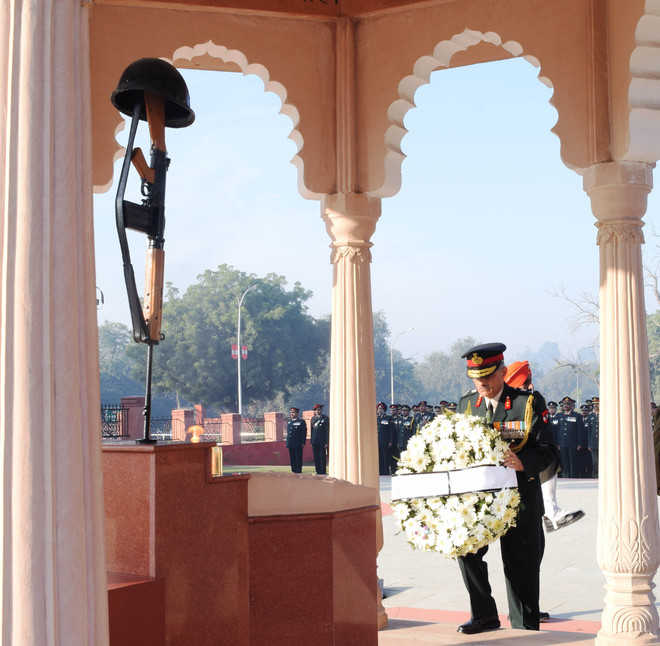
Lt-Gen Ashwani Kumar, General Officer Commanding, Chetak Corps, during a wreath laying ceremony at Yodha Yaadgar War Memorial in Bathinda on Friday. A Tribune photo

Tribune News Service

Bathinda, December 16

Chetak Corps commemorated the 45th anniversary of Vijay Diwas at the Bathinda Military Station.The commemoration began with a wreath laying ceremony at Yodha Yaadgar War Memorial by Lt-Gen Ashwani Kumar, General Officer Commanding, Chetak Corps and other serving personnel in remembrance of soldiers who made the supreme sacrifice in the service of the nation.Tributes were paid to soldiers who took part in the 1971 war and brought glory to the country.Vijay Diwas (victory day) is celebrated every year on December 16 to mark India’s victory in the Indo-Pak war of 1971.The war ended after the Eastern Command of the Pakistani army signed the Instrument of Surrender in Dhaka, marking the liberation of Bangladesh.


Dispel The Spectre of War; Rein in The War Mongers

cdb09f24-f386-46cd-8b85-6ef9bc4450f8
MAJOR GENERAL SG VOMBATKERE


India’s September 29 cross-LOC strike was conducted professionally, as expected of the apolitical army of the Indian Republic. Pakistan’s predictable response is denial of its ever having happened.

It could have been left at that, but the government and the opposition (such as it is), encouraged by TRP-hungry TV channels provoking certain publicity-hungry military veterans, have been using the apolitical army’s professionalism to make political or personal capital of the success of the operation, thus stoking war hysteria among a vocal minority. 

More specifically, Defence Minister Manohar Parrikar stated that it was he who enabled the Army to realize its own power and capability. Further, notwithstanding Prime Minister Narendra Modi discouraging chest-thumping over the success of the strike, Parrikar is freely indulging in it, even suggesting that enlargement of the conflict is possible. 

Somewhat more worrying is the fact that USIBC (US-India Business Council) sees “tremendous [business] opportunity” for USA’s military-industrial corporations, as tensions heighten between India and Pakistan. Whether or not India and Pakistan are presently economically or logistically capable of entering into even a short war (as in 1965, 1971 or 1999), the assurance of business in military hardware is being surreptitiously ensured. 

In addition, there is sufficient unfortunate precedent for countries entering into war or conflict simply to divert public attention from domestic problems, and India and Pakistan (and US and China too) presently have that motivation. 

Chinese artfulness overshadowed PM Modi’s “jhula diplomacy” at Sabarmati soon after he had assumed charge as PM. Even as the two sipped tea, Chinese troops were intruding into India near Depsang la in Ladakh, and most of PoK’s Gilgit was already occupied by Chinese PLA troops. 

PM Modi’s 2016 Independence Day mention of Pakistan’s problems in Balochistan, followed by an important Balochi seeking asylum in India, and most recently a Balochi “official” proposing creation of a Balochi government-in-exile in India, has clearly turned China more openly against India, because its CPEC terminates in Gwadar port on Balochistan’s Arabian Sea coast.

Some strategic thinkers suggest that India “taking on” Pakistan actually amounts to challenging China, thus opening our northern and eastern fronts in addition to our western front with Pakistan. It must be recalled that with the Lhasa railway in operation, China has excellent logistic support for its military already deployed on India’s Tibetan border, within comfortable missile range of India’s populous heartland cities. Further, we must not fail to note that when India proposed reworking the Indus Water Treaty to “punish” Pakistan, China immediately brought up its control over Yarlung Tsangpo (Brahmaputra) waters to effectively kill the proposal. 

India had drawn close to USA with PM Manmohan Singh’s initiative for strategic partnership with successive US presidents Clinton, Bush and Obama, when LEMOA and CISMOA, both of military importance, were proposed. There being no substantive difference between the (essentially neoliberal) strategic-economic outlooks of the NDA-1, UPA-1 & 2, and NDA-2 governments, today these two Agreements are on the verge of being operationalized. This has worsened India-China relations. 

Pakistan peevishly demanded similar “treatment” from the US. All this has driven the Pakistani State – the present elected government ostensibly in the driving seat, but with the steering wheel, accelerator and clutch-and-gears controlled by its army – ever closer to China, which has over the years provided it nuclear technology, weapon-delivery systems and hardware. 

A section of India’s electronic media has sought to humiliate Pakistan by tom-tomming the eminently successful September 29 cross-LOC strike, even as India has launched a diplomatic offensive to isolate Pakistan in the international community. With East Pakistan gone (1971) and Balochistan – 40% of its land area – now “on the block”, Pakistan feels threatened and cornered, but is predictably defiant in the warmth of China’s support. 

India’s choice of close (albeit subordinate) strategic partnership with the US has alienated both China and Russia, which have been moving closer together because of the common threat represented by the US in the Pacific and NATO in Europe.

Pakistan is moving closer to both China and Russia, and the strategic lines are being drawn more clearly. At the same time, India-Pakistan relations are in a tail-spin, with India talking about Balochistan while Pakistan talks of the Kashmir unrest, and both beat war drums. 

With terror-exporter Pakistan effectively run by its India-hating military-ISI combine, and badly hit by its own Frankenstein monster on the one hand, and a strongly right-wing government in India embattled by a make-or-break political situation at home on the other hand, the sub-continent appears close to escalation of military hostilities, possibly even war. 

By talking at each other rather than with each other, India and Pakistan are doing what can only profit military-industrial corporations which manufacture and supply military hardware, and smell business opportunity in the deaths and wounds of the inevitable victims of war. 

War is the product of forces in the international political stratosphere, caused by default or design of politicians, and prosecuted by generals who are far from the battle-fronts. 

Battles are fought by middle-rank and junior officers, JCOs and soldiers, who are the primary casualties. No soldier of any country in his right senses wants war, even if he trains and prepares assiduously for it, and proudly rises to the occasion like the Indian officers and soldiers have repeatedly done. 

The common citizen of every country wants peace and social tranquility, not war. But today, the Indian sub-continent is teetering on the edge of war. It is therefore the crying need of the hour for all right-thinking citizens in India and Pakistan to speak up and prevail upon their respective governments to de-escalate tensions and begin talks, rein in the war-mongering sections of the media and the public, and initiate appropriate diplomatic measures without, at the same time, lowering the military guard. 

This is eminently doable if military efficiency and prowess is not subordinated to domestic or international political expediency. As far as India is concerned, “NO WAR” should be the opening mantra if we want peace and development according to “sab ka saath, sab ka vikas”, coined by PM Modi. 

(Major General S.G. Vombatkere, VSM, retired as Additional DG Discipline & Vigilance in Army HQ AG’s Branch.)

Allow the Valley to heal by Arun Joshi

Allow the Valley to heal
scarred & broken: Only a determined attempt at course-correction will help.

NEW DELHI is busy in its revelry under the “masterstroke” of demonetisation in the country, with an illusion-filled claim that all acts of terrorism in Kashmir have come to an end with the “surgical strike” on black money and counterfeit currency. Pakistan has been rendered penniless for sponsoring terrorism on this side of the border as its fake currency notes have no takers. It is wishful thinking that Kashmir has returned to days of peaceful paradise.The bitter fact is that Kashmir is slipping out of India, psychologically. There is a drastic change in the mindset of the people who have seen the worst kind of atrocities being inflicted from both sides over the past four-and-a-half months. What has hurt them most  —more than the killings — is the blinding of young stone-throwers, some of them innocents caught in the shower of pellets, sitting in their homes, while watching the protests as curious onlookers. They do not go into the cause — the violent protests with stones and petrol bombs, but talk of the security forces excesses. They don’t make any distinction between the local police, paramilitary force personnel or the Army. All these are clubbed together as the “Indian forces” or the 

“government forces”.

Physically, more terrain has been occupied by the anti-India elements. There are more local militants and the ground swell for insurgency is overflowing. People empathise with the militants. Countless masses who attend the funerals of slain militants are volunteers — certainly not coerced men and women. By any stretch of imagination, it is a very serious situation, the repercussions of which would be felt in the next couple of years, unless there is a determined attempt at course-correction by the government.What is being pointed out is that normalcy has fnally returned to the Valley. Schools open at weekends, examinations are on, public transport has started plying, more and more shops have started opening during daytime, and separatists have been forced to moderate their protest calendar. This welcome return to the unmistakable signs of normal day-to-day life needs to be analysed with clear glasses.One part of it is that the people who had lent their support to the shutdowns and protests have developed a fatigue factor. Even normal life had become a dream for them. Daily clashes, torching of government property, particularly schools, and the stones that dented vehicles and injured travellers, deserted streets, and 24×7 gloom had caused depression to set in among the people. And they wanted to come out of this depression. What did they do? Knock the doors of separatists because the rulers told them that their efforts would yield no results unless separatists gave a green light.The second part was a spree of arrests and raising the number of security personnel, mostly Army troops, to quell the disturbances. Stone-throwers had retreated more than six weeks ago to escape the arrests. Some of them had shifted outside the Valley, others were scared of violent clashes after having seen the consequences. The element of the use of force and heavy presence of soldiers cannot be overlooked. Today, there are more footprints of soldiers and paramilitary forces in the Valley  than ever before.Kashmiris want to live a normal life. They have natural instincts like any other race to generate economic activity and pursue fruitful careers, and live without any fear of midnight knock or stones shattering their houses and vehicles or boulders and timber log keeping them as besieged people. They wanted freedom from this suffocating atmosphere, which visited them this year following the killing of Burhan Wani, a militant leader, in July. Burhan Wani was a product of radicalism. He preached radicalism. He had called for the setting up of Caliphate in Kashmir in which the “revolution” was to be carried out by killing policemen and snatching their weapons. His social media face got the boost than his actual height and robust physique. That social media image was imprinted among young Kashmiris who trusted him with his face on Facebook profile or the words on Twitter. But now things have moved far beyond, where even if Burhan Wani was to take new birth, he would find himself overtaken by the events and radicalism among youth. He would look like a follower rather than the leader of the radical ideology.And let it be put straight and clear that the Indian surgical strikes in Pakistan-occupied Kashmir have shown that those were no game-changer really. Pakistan has not stopped terror activity nor was it in need to retaliate with surgical strikes. That would not have been a useful proposition for it. And so it is continuing with infiltration and terrorists are attacking police stations and police camps.On November 25, the Indian Army lost a soldier in an encounter at Bandipore in north Kashmir and two policemen were killed in an ambush at Kulgam in south Kashmir. Pakistan has activated its sleeper cells. There are plenty of them in and outside the system. This is the real danger. Violence along the Line of Control can be responded with heavy gunfire and mortar shelling, as the Indian Army did on November 23 to “unleash heavy retribution” for Pakistan’s cowardly act (of mutilating the body of one of the three soldiers killed in the Macchil sector in Kupwara district in north-west Kashmir) on Tuesday.The Indian assault left three Pakistani soldiers dead and also nine travellers. And Pakistan was quick to move the United Nations. The UN, which is the most disliked institution by India as far as its intervention in Kashmir is concerned, was ready with sermons that the “Kashmir issue be resolved by India and Pakistan as per the peoples’ wishes”. These kind of international statements on Kashmir strengthen those who believe that they can pin down India on Kashmir. They are losing faith in dialogue with New Delhi. This is a dangerous situation. The opening of markets and public transport ferrying commuters are not the signs of hearts having been conquered. Much more needs to be done.


Pak army chief warns of surgical strikes

General Raheel Sharif says strikes will not be forgotten by Indians for generations, warns of escalating Kashmir dispute

NEW DELHI: Pakistan’s military leadership upped the ante in a war of words with India on Thursday, with army chief Gen Raheel Sharif saying any surgical strike by Pakistan would not be forgotten by Indians for generations to come.

PTI FILEIndia’s surgical strikes along the LoC in September were in response to an earlier attack on an army camp in Uri.

Air force chief Sohail Aman too warned India against escalating a dispute over Kashmir into full-scale war. The rhetoric by the military leadership came a day a flare-up of hostilities along the LoC following the killing of three Indian soldiers, and the mutilation of the body of one, on Tuesday. Pakistani authorities said 11 civilians and three soldiers were killed in shelling by Indian forces.

Sharif, who is on a farewell tour of army units before his retirement on November 29, was quoted by The Express Tribune as saying that “if Pakistan were to launch surgical strikes, India would not be able to forget it for generations to come”.

“India will be teaching its children about Pakistan’s surgical strike if the latter took such measures. Pakistani troops are capable of teaching Indian forces a lesson,” he said. Sharif ’s remarks, made while addressing a ‘jirga’ of tribal elders in the Khyber semi-autonomous region, were also an apparent riposte to the surgical strikes carried out by Indian troops along the LoC in September in retaliation for an attack on an army camp in Uri by Pakistan-based militants.

In Karachi, Air Chief Marshal Sohail Aman said Pakistan’s armed forces were prepared for all contingencies. “We are not worried about India at all, it is better if they show some restraint,” he told reporters on the margins of a defence exhibition.

Meanwhile, India on Thursday said the Pakistan army was giving tacit support to terrorists who targeted an Indian patrol in Machil sector that killed three soldiers. The body of one of the soldiers was mutilated. In a demarche issued to Pakistan deputy high commissioner on Wednesday night, the government conveyed it strongly deplored the tacit support of Pakistan Army to armed terrorists that came from close to Pakistan Army posts on November 22, external affairs ministry spokesperson Vikas Swarup said.

The government also protested the deliberate targeting by Pakistan Army of 18 villages along LoC, which resulted in a non-fatal casualty besides causing extensive damage to public and private property and displacement of civilian population, said Swarup.


China stands up for Pak again, calls border closure ‘irrational

Simran Sodhi

Tribune News Service

New Delhi, October 11

China today again lived up to its reputation of being Pakistan’s strong ally and friend when it questioned India’s claims of Pakistan being behind the Uri terror attack and further labelled India’s decision to fence the India-Pak border as ‘irrational’.The comments were made by some leading Chinese experts and carried in Global Times, a newspaper which is known to be close to the Chinese Government and is viewed primarily as a channel to promote and reflect the perspective of the Chinese Government.Post the Uri attack, India has tried to show to the world Pakistan’s complicity in the attacks and the Chinese statement today is a setback.“India is making a very irrational decision, since no exhaustive investigation has been conducted after the Uri incident, and no evidence proves Pakistan is behind the attack,” Hu Zhiyong, a research fellow from the Institute of International Relations of the Shanghai Academy of Social Sciences, is quoted by the Global Times on Monday.China’s reaction to India’s decision to seal the 3,323-km border with Pakistan by December 2018 is also a bit of a shocker. Hu is quoted as saying that this action was reflective of the “Cold War mentality” and that this “would only cause deeper hatred among residents living in India and Pakistan-controlled Kashmir”.On Monday, China had accused India of trying to make political gains by insisting on the United Nations ban on Jaish Chief Masood Azar as an international terrorist. Even on the entry into the Nuclear Suppliers Group (NSG), while China seems open to talks, it is quite clear that it would never let India into the club without dragging the case of Pakistan’s membership alongside.On Saturday, PM Narendra Modi is scheduled to meet Chinese President Xi Jinping on the sidelines of the BRICS Summit in Goa. Sources have indicated that Modi will again raise the issue of India’s entry into the NSG with Xi. However, in light of the series of comments coming out of China in the past two days, the meeting between the two leaders is likely to yield no results

HM to brief regional media on Oct 17

  • Home Minister Rajnath Singh would address nearly 150 editors of the regional media in Chandigarh on October 17 to explain them the state of the country’s internal security scenario and also the prevailing situation along the India-Pakistan border
  • The two-day event would see participants from Haryana, Punjab, Himachal, J&K, Chandigarh, Uttarakhand, Uttar Pradesh, Assam and other Northeastern states

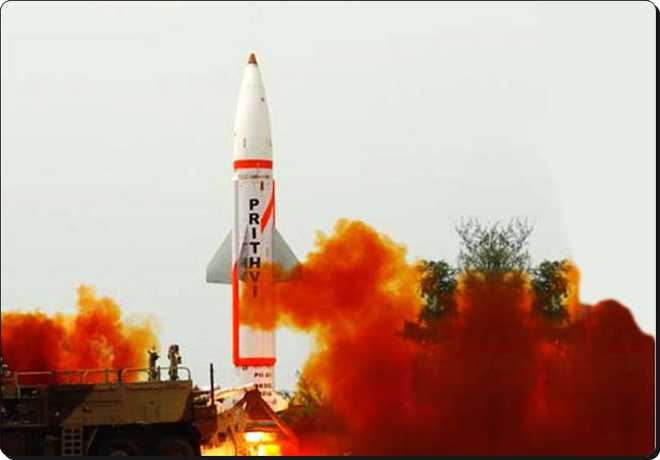
India successfully conducts twin trial of Prithvi-II missile

India successfully conducts twin trial of Prithvi-II missile
Photo from the twitter account of @airnewsalerts

Balasore, November 21

India on Monday successfully test-fired its indigenously developed nuclear capable Prithvi-II missile twice in quick succession as part of a user trial by the army from a test range at Chandipur in Odisha.

In salvo mode, the two surface-to-surface missiles which have a strike range of 350 km and are capable of carrying 500 kg to 1,000 kg of warheads were successfully test-fired in quick succession from mobile launcher from launch complex-3 of the Integrated Test Range (ITR) at around 9.35 am, defence sources said.

(Follow The Tribune on Facebook; and Twitter @thetribunechd)

A similar twin trial had been conducted on October 12, 2009 from the same base where both tests were successful.

The missile is thrusted by liquid propulsion twin engines. It uses advanced inertial guidance system with manoeuvring trajectory to hit its target, they said.

The missiles were randomly chosen from the production stock and the entire launch activities were carried out by the specially formed strategic force command (SFC) and monitored by the scientists of Defence Research and Development Organisation (DRDO) as part of training exercise, a defence scientist said.

The missile trajectory was tracked by the DRDO radars, electro-optical tracking systems and telemetry stations located along the coast of Odisha, sources said. The downrange teams on board the ship deployed near the designated impact point in the Bay of Bengal monitored the terminal events and splashdown.

Inducted into Indian armed forces in 2003, the nine-metre-tall, single-stage liquid-fuelled Prithvi-II is the first missile to be developed by the DRDO under the Integrated Guided Missile Development Programme, defence sources said.


China loves Pakistan? Secret Behind

China and Pakistan relations are the best example of how greed for money, power and supremacy can bring even opposite ideologies together. Pakistan is an Islamic republic and China has no love lost for Islam. Burkhas are banned in China, people with long beard can’t ride public transport, Muslim shopkeepers are forced to sell liquor and government employees and their kids can’t go to mosques or observe fast during the month of Ramdan. Still China and Pakistan are closest of allies.

On Saturday 1st Oct 2016 China extended its technical hold on India’s move to get Pakistan based JeM chief Maulana Masood Azhar listed as a terrorist by the UN, just two days before the expiry of the hold. An extremely calculative move by China as Massod Azhar is an important part of Pakistan’s terror assets and China will not do anything to disturb the trust that both countries have built based on mutual gains. So what if the whole world is facing the menace of terrorism. So what if the terrorists like Masood Azhar is a threat to the whole humanity.

Pakistan’s foreign policy revolves around China and for China, Pakistan is pivotal for establishing economic and military supremacy in Central Asia, Middle East,Afghanistan and eventually Europe. Mutual benefit involves pure economics.Firstly China is earning loads of money by exporting arms to Pakistan. Only a few years back the US and China shared an equal portion of Pakistan’s arm imports, 39% and 38% respectively. Today China has 63% share and the US has only 19% share. China is world’s third largest arm exporter and as China’s biggest buyer of arms credit goes to Pakistan. Secondly CPEC is a very ambitious dream project of China and role of China in the future of central Asia, Middle East and Europe would depend on it. CPEC will hugely impact China’s industry and economy.


Pakistan bans 2 groups with al-Qaeda, IS links

ISLAMABAD: Pakistan has banned two militant groups with links to the Islamic State and al-Qaeda for their involvement in several terror attacks, according to the National Counter-Terrorism Authority (NACTA).

AFP FILEOfficials said the groups were banned after recent deadly attacks in Balochistan and Sindh provinces.

The website of NACTA showed the ban on Jamaat-ul-Ahrar and Lashkar-e-Jhangvi al-Alami was imposed on November 11, taking the total number of proscribed groups to 63.

The Jamaat-ud-Dawah (JuD), blamed for the 2008 Mumbai attacks, is not among the banned organisations and is only “under observation”.

Lashkar-e-Jhangvi al-Alami has been linked to the Islamic State while Jamaat-ul-Ahrar is linked to al-Qaeda.

Jamaat-ul-Ahrar is a breakaway faction of the Tehrik-e-Taliban Pakistan and Lashkar-iJhangvi Al-Alami is also affiliated with sectarian organisations that have targeted the Shia minority.

Officials said both groups were banned after deadly attacks in Balochistan and Sindh provinces, including an assault at the Sufi Shah Noorani shrine in Balochistan that killed 52 people.

The IS claimed the attack on the shrine and Lashkar-e-Jhangvi al-Alami spokesman Ali bin Sufyan said his group was cooperating with the IS “directly or indirectly”.

The IS and Lashkar-e-Jhangvi al-Alami also claimed an attack on a police academy in Balochistan that killed more than 60 people.

The Lashkar-e-Jhangvi (LeJ), a Sunni group, has its roots in Punjab province and has usually targeted the Shia minority.

Jamaat-ul-Ahrar had claimed responsibility for a suicide attack on the Civil Hospital in Quetta in August that had killed at least 75 people.

Two LeJ militants were recently arrested for killing qawwal Amjad Sabri in Karachi but this was later denied by police.

The list of banned groups on the NACTA website showed that the JuD has been “under observation” since January 17, 2007.

The Lashkar-e-Taiba and Jaish-e-Mohammed have been listed as banned groups since January 14, 2002.


Govt unwilling to air cross-LoC raid proof

Army gives footage; ministers ‘not to speak out of turn’

Govt unwilling to air cross-LoC raid proof
Armymen patrol near LoC in Pallanwala sector, 70 km from Jammu. PTI

K V Prasad

Tribune News Service

NEW DELHI, OCTOBER 5

Amid the political clamour for authenticating the surgical strikes by the Indian Army on terror launch pads across the Line of Control in Jammu and Kashmir, the emphatic view among those tasked with security is that there is little room for such a concession.Doubting Thomases can continue to raise questions, but sources privy to the thinking in the higher echelons of the security establishment on the South Block told The Tribune that notwithstanding the vociferous demands, the government is unwilling to succumb to it.Across the border, Pakistan Prime Minister Nawaz Sharif continued to raise the temperature on developments in Jammu and Kashmir and maintained that without any investigation into the Uri incident, within a few hours, India blamed Pakistan for the attack.On his part, Prime Minister Narendra Modi is understood to have cautioned his Cabinet colleagues not to speak out of turn on the surgical strikes and leave the job to those entrusted to comment. The sources said the view is that succumbing to the demand of providing evidence would be a cowardly response. This categorical assertion came even as the Army handed over footage of the strikes recorded by the assault teams.(Follow The Tribune on Facebook; and Twitter @thetribunechd)“The laid-down procedure has been followed. The DGMO [Director General of Military Operations] briefed [about the surgical strikes]. It was not the Defence Minister, nor the PM and not the Home Minister. That was the right thing to do and they [Army] did it. There was a time when documents were submitted. Now clips are given and the clips have been given,” Minister of State for Home Hansraj Ahir told reporters here.As the debate intensified, the Congress sought to couch the demand for making the evidence public as it will help to call Pakistan’s bluff. “Time was ripe to expose the malicious lies,” it said.