All posts by webadmin

Shirking Responsibility by Lt Gen Bhopinder Singh

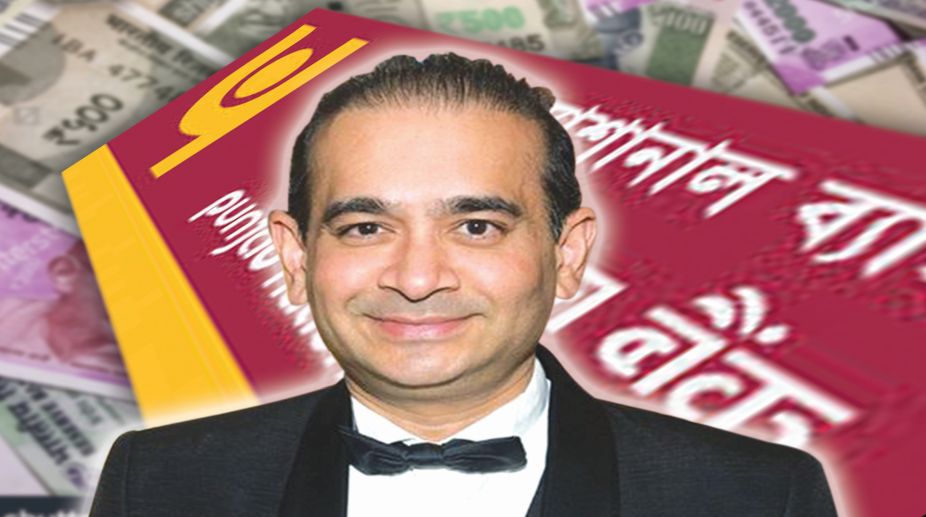
Indian democracy, Rafale deal, PNB scam, Nirav Modi

Indian democracy is designed on the Westminister model, and it proximates the structural moorings of the same rules and regulations of governance. Beyond the trumpeted statistics as the ‘world’s largest democracy’, the grim reality of the dismal condition of its institutions ~ legislature, judiciary and executive ~ showcases a huge gap between the two ‘mature’ democracies. The principle of counter-balancing institutions to preserve the spirit of the Indian Constitution has been compromised because of inefficiency, overreach and factionalism. This has resulted in a ‘moral crisis’ in addition to the functional ineptitude. The foundational temper and conscience which influenced the freedom struggle and then the profundity of the Constitution envisages a certain behavioural ‘morality’ from its leadership to uphold the Constitution’s principles, directives and duties. Honest ownership of actions and responsibilities, irrespective of their implications is one of the most basic, and sadly waning attributes in the Indian narrative.

In 1956, owning ‘moral’ responsibility, the then Railway Minister Lal Bahadur Shastri had tendered his resignation following the Ariyalur train disaster. His honesty was not recognised as weakness as he later went on to become the Home Minister and then, the Prime Minister. This template of moral probity, rectitude and conscience has since then been too scarce. Not that such decisions rooted in individual ‘conscience’ can absolve the establishment from the serious allegations of neglect, wrongdoing or inaction; but it can surely sensitise, galvanise and improvise the entire value-chain of governance, into immediate course-correction. Today, the concept of ‘head-rolling’ has acquired a very sinister, undemocratic and convenient dimension. In order to assuage the public pressures of immediate action, the axe usually falls on lower-level administrative functionaries who become cannon  fodder to hide the systemic rot. The other escape mechanism is to sidestep the blame with the standard accusations of a ‘political conspiracy’.

Contrast this with the  response of the previous British Prime Minister, David Cameron who on being named (not convicted) in the Panama leaks, admitted, “I know that I should have handled this better, I could have handled this better. I know there are lessons to learn and I will learn them” and went on to accept the blame by saying, “Don’t blame Number 10 Downing Street or nameless advisers, blame me”. Later on the crucial Brexit referendum, the results of which were not legally binding and were only of persuasive import, Mr Cameron accepted ‘moral’ defeat by resigning from the post of Prime Minister. He said: “British people have made a very clear decision to take a different path, and as such I think the country requires fresh leadership to take it in this direction”. His preferred position of ‘stay’ versus ‘exit’ had narrowly lost out ~ 52 to 48. At the age of 49, Mr Cameron who had once stated that “I was the future once”, assumed ‘moral’ responsibility for his action and resigned. Today, he serves as the President of Alzheimer’s Research UK, to campaign for medical research funding!

Unfortunately in India,  there seems to be no accountability or responsibility of leadership for any acts of commission or omission. From the recent PNB scam, CBSE exam leak, Rafale deal, minority-lynching and so on, the promised change by the ‘Party with a difference’ is sadly a continuum of fate for the common man. Spin-doctoring of facts and figures has been elevated to a fine art by glib spokespersons, who blunt each accusation with either a stoic silence or an aggressive counter-recital of ‘facts’ that clinically detail worse statistics and scale of misfortune during previous dispensations. The language in the accompanying social media  is  derisive and carefully couched in semantics that willy-nilly juxtapose every contrarian view into portents that are ultra-nationalistic, religious or exclusivist.

Even executive decisions on matters of economics, trade and commerce such as Demonetisation, were bizarrely contexualised and equated to questioning the ‘Indian Soldier’! The deflective dissonance and empty posturing following any fresh  scam distracts from any substantial acceptance, introspection and ‘head-roll’ on account of any dereliction in accountability and responsibility.

Certain institutions like the  Armed Forces and the Judiciary, which are (were?) relatively spared the intrusion of the politico-bureaucratic obfuscation, rise to the occasion and deliver as they have their own system of meritocracy, discipline and accountability. Often, these institutions have to outstretch beyond their defined-mandate to deliver when the other political and administrative entities betray inability, incapability or fear to do so. The operative expression in the Armed Forces is to deliver even ‘at the cost of paying the ultimate price’. Such undiluted leadership traits of ‘leading from the front’ have ensured that the institution has the highest officer-to-soldier casualty ratio in the world. However, the winds sweeping the guarded barracks or even the precincts of courtrooms are not spared the corrosive impact of the societal decay that could stymie institutional efficacy of these last government bastions of responsibility.

For India’s democracy to grow further, all political dispensations across the centre and the states have to glorify a culture of probity and transparency, instead of ridicule, jingoism and majoritarian. Democratic instincts need to be honed and strengthened like the RTI Act, instead of disempowering moves like the recently retracted order to potentially deny PIB accreditation to journalists. The modern-day terminology is replete with terms like ‘fake news’, jumlaa, presstitudes that ought to be anathema to a ‘moral’ nation which is proud to be liberal, progressive and inclusive. The promised economic revival has yet to metamorphose, the relationship with the neighbouring countries are at an all-time low with traditional allies like Nepal and Maldives alienated,  the minorities are vulnerable, and the agrarian crisis has deepened considerably.

It is true that all of this is not necessarily the creation of the current dispensation, but harping on the past can denude credibility. Neither is questioning the government of the day anti-national. Nor for that matter does it tantamount to siding with the Opposition. It is the duty of all citizens to openly ‘question’ and insist on accountability and responsibility for the good of society and the nation, irrespective of the individual’s political affiliation.

The writer IS Lt Gen PVSM, AVSM (Retd), Former Lt Governor of Andaman & Nicobar Islands & Puducherry

Why Pakistan’s Strategic Confidence Is On The Wane

China and Pakistan ... dubious friendship.

Snapshot
  • Pakistan has many things to worry about, including the FATF deadline, and its dubious friendship with China isn’t going to help.

Pakistan betters us at a couple of things. First is its outreach and ability to tell its version of every story to the world well before us. The second is its capability to exude confidence far beyond what the circumstances actually permit. Its soldiers tend to be brash and project artificial and unrealistic bravado when facing Indians; almost as if a defensive mechanism has been switched on. That can be attributed to the emotive response to its defeat in the 1971 war; something they don’t have control over.

Admittedly, in the last two years or so, I deduce from my observations and subsequent analyses, based on many conversations with Pakistani citizens that the country’s strategic confidence has been on the rise, to the point of actually adding cockiness to the national image. Without going into too much detail, the reasons for this surmise are alluded to six factors.

First, an economy which was then perceived as improving, at least till recently. Second, the enhanced strength of the strategic relationship with China arising primarily out of the flagship status given to the China Pakistan Economic Corridor (CPEC) within the Belt and Road Initiative (BRI). Third, the return to good old days with former ally Saudi Arabia; General Raheel Sharif’s appointment as head of the 42-nation Islamic Military Counter Terrorism Coalition being the facilitator. The relationship had some challenges when Pakistan refused to send troops to assist Saudi Arabia in the war in Yemen. Fourth was the Russians warming up to Pakistan although with an intent to maintain the balance of power in the subcontinent after India moved towards a strategic partnership with the US. Fifth, with an improvement in the counter terrorism situation, Pakistan believes that it had won the internal security challenge it had been confronted with since 2007. Sixth and the last was the US blowing hot and cold without ever being able to carry out its threats against Pakistan, even through the first year of the Donald Trump Administration. This is inevitable because the US is compelled to maintain its troops in Afghanistan, facilitated by Pakistan, and its lines of communication. Also, the necessity of keeping terror networks such as the Haqqanis under control obviated any meaningful coercion against Pakistan.

Now in the last few weeks as my travels bring me in contact with people from Pakistan, they appear to reflect diffidence with an almost overnight dilution of confidence in their nation. So what has happened that there was such a dramatic turnaround in self perception? I think many in Pakistan are beginning to believe less in what their government and their army tells them.

On the one hand, we hear of 5.8 per cent gross domestic product growth this year with prospects of Pakistan heading towards the 7 per cent figure. However, devaluation of the Pakistani rupee twice, taking it to an exchange rate of Rs 115 to a dollar, doesn’t appear to signal such strength in the country’s economy. With just $12 billion in its foreign exchange reserves, Pakistan was placing many eggs in the basket of the Chinese, especially after CPEC was heralded as the flagship project of BRI. Neither the Pakistani citizens nor their media appear to have any clarity about the viability of the CPEC and its profitability for Pakistan. Informed sources point out that once debt servicing of the loans received for the CPEC begins, there could be an outflow of as much as $5 billion per year. Queries and discussions elicit no intelligible responses; everyone seems to be at sea.

The spectre of what is being experienced in Sri Lanka’s Hambantota as well as the case of leasing of the naval base in Djibouti seems to be causing some consternation about what deals with the Chinese really mean. Amid brief mutterings about how well Pakistan knows about Chinese dealings, the follow up questions on other domains such as the CPEC’s effect on the psyche of the common Pakistani receive even more negatives. Pakistan’s public demands to know where the promised jobs are, everything seems to be done by the Chinese themselves. The Chinese presence in large numbers is causing security problems and the ultra radical elements which constitute a fairly large number are not happy with the infringement on Islamic culture and ways.

The fact that the Chinese are wary of Pakistani businessmen travelling to the Xinjiang area is also not going down too well with Pakistanis, who have taken the Sino-Pakistani relationship for granted all these years. The ‘deeper than the oceans and higher than the skies’ bit can get dented when Pakistanis are known to be entering Xinjiang and marrying into the Uyghur, something the Chinese are very sensitive about. And we have not even mentioned Baluchistan yet. The corridor through the Baloch territory will cause sufficient headache for the Pakistani security forces.

The domain which Pakistan seems to be the most defensive about and to which they will have no rational answers at all is the Financial Action Task Force (FATF) strictures of March 2018 and the decision to give it time till May 2018 to prepare an action plan to put an end to terror funding. This will decide whether Pakistan has to be placed on the black or the grey list. Even the Chinese voted against Pakistan after some initial hesitation. Pakistan has been under FATF monitoring before, from 2012 to 2015, and can claim to know the ropes. However, this time it may be a bit more real. President Trump did not seem to be joking with his first tweet of the New Year in 2018, when he observed how Pakistan has been reneging on its promises despite being the recipient of US largesse. A FATF stricture could be a clamp on Pakistan’s international banking system.

All this should worry Pakistan no end especially when the Line of Control (LoC) remains hot and there would be pressure from the friendly proxies for support to more operations in Jammu and Kashmir’s hinterland, where they would wish to be seen active in an election year. Whatever brave face Pakistan wishes to put on, it is clearly at wits end because the LoC pressure from the Indian Army is not easing. Knee jerk responses through breaches of ceasefire and targeting of civilian habitation have been absorbed by India, which is no longer in the mood for talks of any kind. Ratcheting terror activities will only fetch Pakistan negative dividend at the FATF.

In the light of all this, is there likely to be some change of heart in the Pakistan’s military and political leadership? This is the time India’s formal and informal diplomacy must be at a high to project how we have suffered Pakistan’s waywardness all these years. Equally, India needs to be alert to the fact that Pakistan’s continuing and increasing dependence on China could coerce it into inimical actions at the borders to support something the Chinese may have in store for the subcontinent; people do keep talking of a Doklam 2. It’s worry time and India’s political, diplomatic, military and intelligence domains need to be on a higher state of alert through this summer. Sometimes, loss of confidence can lead to wayward steps by nations; hopefully Pakistan isn’t thinking that way.


Defence outsourced by Ajay Banerjee

Despite various govts going slow on hi-tech defence acquisitions, it now emerges that India is the largest weapons importer. This is ‘inglorious’ in the face of stridency over ‘desi’ production. And as we struggle, our neighbours find ways to forge ahead with new defence partners, a fact we can ignore to our peril

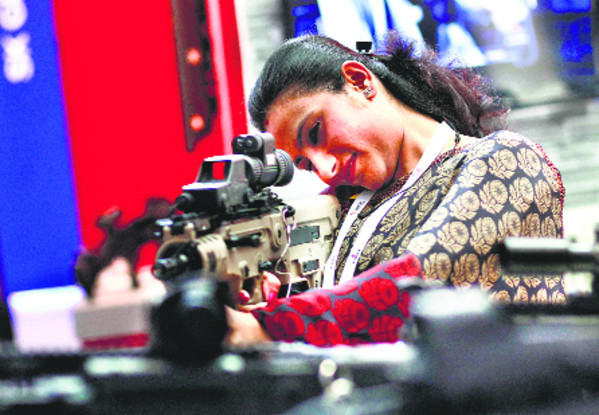
Ajay Banerjee in New DelhiBuying weapons to protect over 1.34 billion people and secure borders with seven nations — with a land frontier of over 15,000 km and a coastline extending to over 7,500 km — is a good idea. But the thought to be dependent on foreign defence supplies (India imports some 70 per cent of its equipment) is unsettling, self-defeating even. Accessing national data as to how we acquire the high-tech weapons and meet our defence needs could be a daunting task, given veils of secrecy. Yet an international resource on global security, the Stockholm International Peace Research Institute (SIPRI), regularly comes out with general figures indicating, among others, the scale to which our defence import has risen. On March 12, SIPRI released its data, reconfirming that India, yet again emerged as the biggest importer of weapons in the world. Clearly, there is a lack of ‘strategic autonomy’ ideally desired by a nuclear armed nation with the third largest armed forces.The SIPRI’s annual report ‘Trends in international arms transfers’ makes an assessment for a five-year block (2013-2017). It said: “India was the largest importer of major arms and accounted for 12 per cent of the global total.” SIPRI has been studying the conflict and arms sales for over 50 years. It compared this five-year block with the previous 2008-2012’s to conclude: “India’s imports increased by 24 per cent”. That means New Delhi was importing 24 per cent more military equipment, pointing at the sluggish ‘Make in India’ besides the failure to make its own cutting-edge weapons, equipment and war-fighting arsenal.For defence experts, that foreign component accretion over the decade is ‘inglorious.’ Amit Cowshish, former financial advisor, Ministry of Defence, says “It will keep on happening till India can have its own capacity to produce equipment.”Ambitious plans & realities

On March 22, the Ministry of Defence laid out a draft defence production policy. It is ambitious at its best as it talks about making India among the top five countries in aerospace and defence industry. It also talks about self-reliance in key technologies by 2025, and puts India on the exporter-track. It sets a target of Rs 1,70,000-crore ($26 billion approx) turnover in defence goods and services involving additional investment of nearly Rs 70,000 crore (US $10 billion approx). It looks at achieving exports of Rs 35,000 crore (US $5 billion approx) by 2025. Commodore C Uday Bhaskar (retd), now director, Society for Policy Studies, terms this plan as “incongruous,” saying “India is living in a make-believe world.”Domestic defence production for 2016-17 stands at Rs 55, 894 crore, up from the Rs 43,746 crore in 2013-14. Efforts, so far, to make a military-industrial base have remained sluggish, hampered by budgets and a lack of cutting-edge technology. Lt Gen KJ Singh (retd), a former Western Army Commander avers: “It appears everyone has good intentions, sadly, that is not translating into action.”Successes & ironies

There are a few, take a look:

  • Nuclear submarines of the Arihant class, made from scratch, in India; or the Scorpene class submarines made at Mazagon Docks Limited Mumbai.
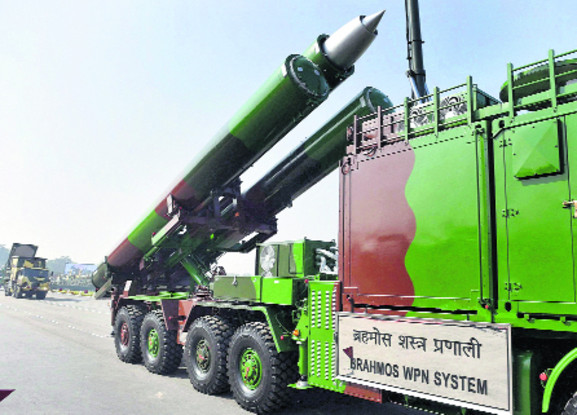
  • Supersonic BrahMos, Agni, Akash or the Prithvi missiles.
  • Strangely, the country is struggling to produce a good rifle. Some 11 lakh of various types are needed for which Indian private companies have been allowed to have a tie-up with foreign partners and put up their proposals. Light combat aircraft Tejas faces delays and slow production rates (Only 6-8 planes are produced per annum, the need is for 16-20).
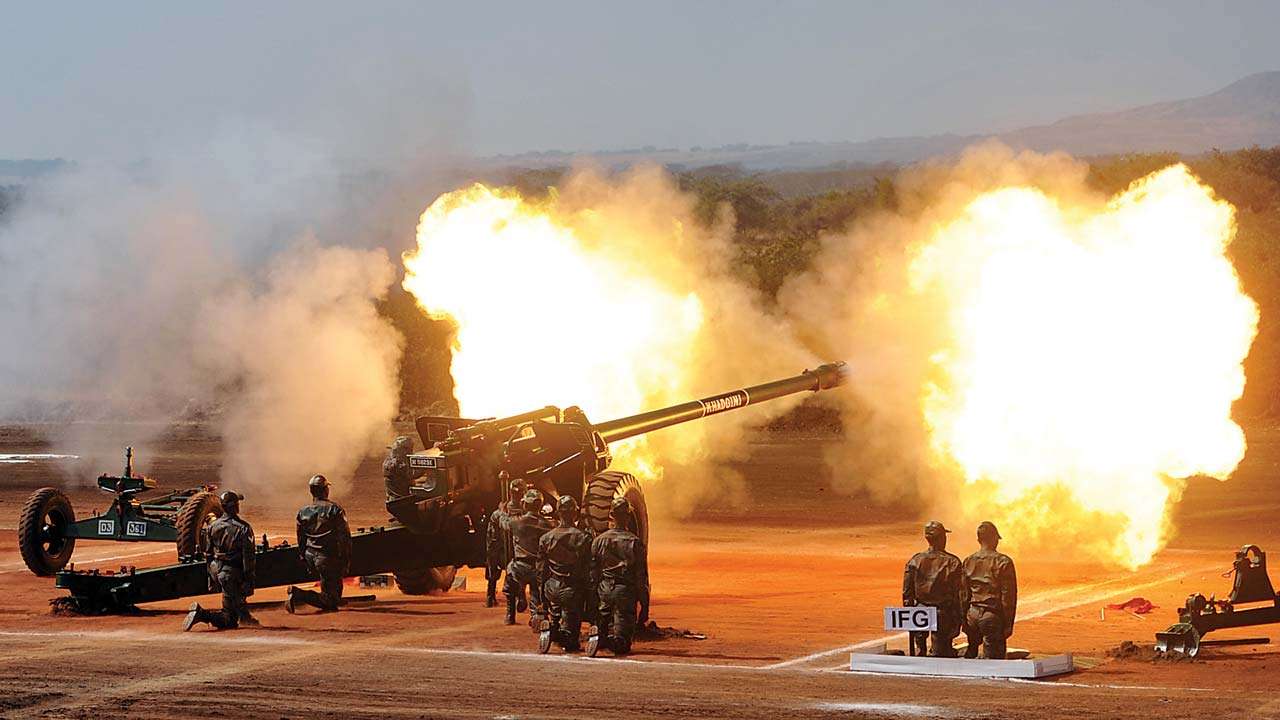
  • Artillery guns produced jointly by the Defence Research and Development Organization and private companies — Tata Power SED and Bharat Forge — have been a success.
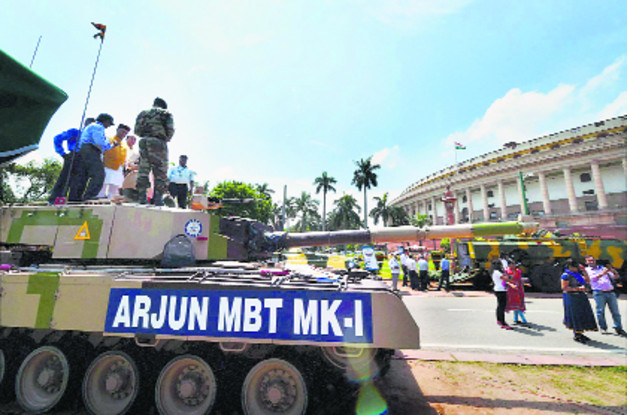
  • The next version of the Arjun tank needs modifications, but the delay is due to the Army frequently changing the requirements.
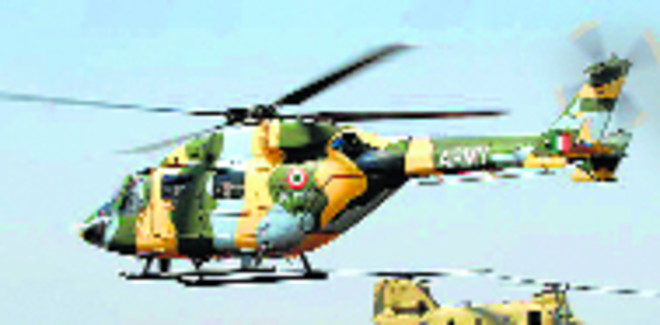
  • The Dhruv helicopter and its variants have finally been accepted as ‘superb’ machines.

Budget pains

In a report on March 13, a parliamentary panel said the defence budget for the year 2018-2019 was ‘inadequate’ and ‘barely enough’ to cater for inflation. Maj Gen BC Khanduri (retd), a BJP MP from Uttarakhand, heads the panel. “Capital budget allocation for the Army had dashed hopes as it was barely enough to cater to the rise in expenses on account of inflation, and did not even cater for the taxes,” the Vice Chief of the Army told the panel. For 2018-19, the Army projected a need for Rs 44,572 crore, it gor Rs 26,815 crore. The Navy wanted Rs 35,695 crore, but got only Rs 20,003 crore. The IAF is managing with Rs 35,770 crore against its need for Rs 77,694 crore. The Army today has 68 per cent of equipment in the ‘vintage category.’ Around 25 projects indentified under Make in India may be foreclosed due to inadequate budget, the report said. “For a country that seeks strategic autonomy, the tag for being the largest importer of weapons and equipment is a contradiction,” says Commodore Bhaskar. The government has lined up a mix of private-public sectors. The hint lies in the numbers and the expansion of the nine defence public sector undertakings (DPSUs). In the financial year ending March 31, 2017 these companies collectively made a profit of Rs 5,482 crore. A report of the parliamentary panel says “no budgetary support is being given to the DPSUs.” These nine companies are being modernized. “The best way to break the mould is to move away from the existing procedures of acquisition,” says Lt Gen KJ Singh Private sector potential

To give a hint at the potential, the hull of the nuclear submarines series is being made by L&T. Amit Cowshish, former financial advisor, Ministry of Defence, has a word of caution: “The new draft production policy merely talks about private and public participation. In reality it could take years for it to get rolling.”The Modi government has liberalized FDI and touted it as a major policy-shift to okay up to 49 per cent stake for foreign companies when partnering Indian companies. Now another tweak to the FDI is coming up. The Draft DPP-2018 says: “FDI regime in defence will be further liberalized. The FDI up to 74% under automatic route will be allowed in niche technology areas.”


India needs…

400fighter jets

1,700tanks

800helicopters

18 more


Indigenously produced

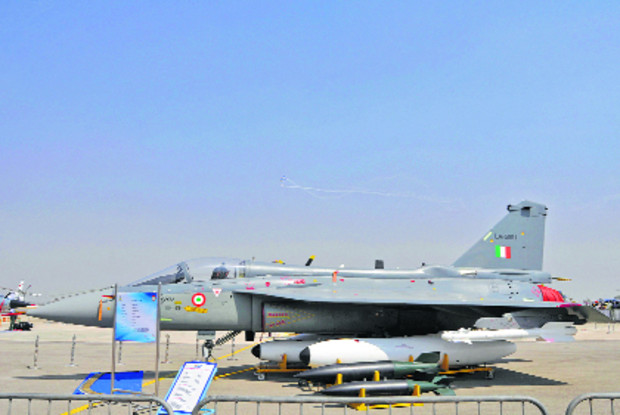
Tejas: HAL is making the first 40 Tejas. Upgraded 83 Tejas too will come. Another 201 Tejas Mark II are on the drawing board Artillery guns: The Dhanush gun is a copy of the Bofors gun, will go for final user trials in May. Both will fill the need for more than 2,700 guns over the next decadeCopters: The biggest success story. Forces need some 800 copters. Some 200, Advance Light Helicopters, the Dhruv, are flying Arjun Mark-II: Two regiments of Arjun tanks were inducted. The Army wanted 93 improvements. Arjun Mark II is an improved versionAircraft carrier Vikrant: It is set to be commissioned 2020. The making of the ship takes the country into an exclusive league of nationsBrahMos/Agni: The BrahMos is an Indo-Russian venture that adorns lead warships of the Navy. It’s deployed along Pak border. N-tipped Agni missiles have propelled India into the exclusive club of countries — US, UK, Russia, France & China


US rises in India as Russia looks at Pak

Ajay Banerjee

In 2013-17, Russia accounted for 62 per cent of India’s arms imports. India zeroed in on Sukhoi-30 MKI fighter jets, a sea-borne aircraft carrier, the INS Vikramaditya, and a few dozen Mi-17 V5 helicopters. Based on existing orders and weapons, Russia will remain, by far, the main supplier of major arms to India for the foreseeable future. The volume of Russian equipment was almost the same as it was in 2008-12.With India diversifying its sources to include the US since 2008, things have changed dramatically. The SIPRI report said: “Between 2008-12 and 2013-17 arms imports from the US increased by 557 per cent, making it India’s second largest arms supplier.” The US now accounts for 15 per cent of Indian supplies. This development is the aftermath of the India-US strategic partnership first signed in 2005 and renewed in 2015. In 2013-17 such supplies included the Boeing P8-I long-range maritime patrol aircraft, the C-130 strategic transport aircraft, C-17 heavy lift transporter and the Apache-64 combat helicopters. India’s arms imports from Israel also increased (by 285 per cent) between 2008-12 and 2013-17, making Israel the third largest supplier to India with 11 per cent share in the Indian market.China’s course

Since 2013 India replaced China as the top arms importer in the world. China, on the other hand, is now the fifth largest exporter selling its manufactured equipment to Pakistan and Bangladesh, among other countries. It now accounts for 5.7 per cent of all arms sold globally. China also remains an importer and is fourth on the global import list. Some 4 percent of all global sales go to China. Russia is its biggest supplier and has a share of 65 per cent in this. Russian supplies to Pak

The US is the biggest exporter and has a 34 percent share of all global exports while Russia has a 22 per cent share. A total of 35 per cent of all Russian exports go to India and 12 per cent to China. Another 10 per cent go to Vietnam. India and Vietnam are locked in separate boundary disputes with China.Interestingly, Russia has a new friend in Pakistan and supplied 5.6 per cent of weapons and equipment to India’s western neighbour. Russia is the third largest supplier to Pakistan, after China and US. This has happened in the past three years when Russia provided the Mi-series attack copters. Earlier Russia did not supply anything to Pakistan which is now an importer of 2.8 percent of all weapons sold globally. “Despite its continuing tensions with India and ongoing internal conflicts, Pakistan’s arms imports dipped by 36 per cent between 2008-12 and 2013-17,” said the report. Future machines

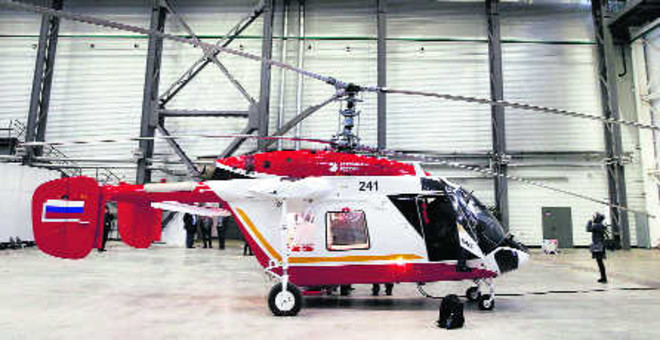
  • Kamov-226T: Russian Kamov-HAL to produce 200 of them for Rs 6,500 cr. These are meant for IAF, Army. The twin-engine Kamov will replace Cheetah/Chetak
  • Fighter jets: A fresh global tender coming, inviting military aviation firms to make fighter jets in India. New Delhi is looking for 115-120 jets to add to 36 Rafales from France
  • Future   (FICV): It is worth about Rs 60,000 cr. Private and PSU firms are in the race to make the 20-tonne tracked, amphibious and air transportable machine
  • Naval Utility Helicopters: A Rs 21,738-crore project. 16 copters to come in a flyaway condition. These copters carry radars, sensors and a lightweight anti-sub torpedo and Small arms: The MoD okays separate plans to procure over 11 lakh pieces. These include 6.22 lakh assault rifles, 4.43 lakh carbines, 6,000 sniper files and 41,000 LMGs are used for search, rescue, and communication
  • Submarines: Four global players have submitted bids for Rs 70,000-cr order for six subs. Russian, French, German and Swedish firms are in the race

Concerns of the Indian Army by Lt Gen Ata Hasnain

Indian Army

In 2005 the Indian Armed Forces very zealously adopted the concept of ‘transformation’, a term borrowed from the lexicon of the US Armed Forces. Essentially it meant ‘a very big change’; that change was essential in the sphere of war fighting due to the way various technologies, with information technology (IT) at the core, were rapidly demanding a move well beyond the military capabilities of the Cold War period.

Fresh from its then recent experience of ‘Operation Parakram’, which involved massive mobilisation against Pakistan, the Indian military attempted to explain to the political and bureaucratic authorities how it was looking at the future even as ‘transformation’ was underway in various countries. Its enthusiasm found few takers and support for its ambitious projects was halfhearted. Although the 11th and 12th Plans did cater for incremental manpower needs the wherewithal just could not materialise. ‘Transformation’ died a natural death around 2011, buried under the mountain of neglect, lack of perception and inability to financially support the change which was being sought.

It’s due to the history of this neglect that finally the Army’s Vice Chief, Lt Gen Sarath Chand was recently forced to inform the Parliamentary Committee on Defence Affairs on the lack of preparedness and severe glitches in the Army’s modernisation program, a position equally applicable to the Navy and the Air Force. Most reports on this important issue affecting India’s national security have focused on the details of the failure of financial backing and the inability to remove bureaucratic hurdles. However, a simple summary projected by most of these reports conveys the message without the attached details. In an adequately prepared war machine 30% of weapons and equipment should fall in the state of the art (SOA) category, 40% in current and 30% in vintage category. The existing state of the Indian Army brought to the notice of the Committee is 8% SOA, 24% current and 68% vintage category.

With existing and emerging threats arising out of China’s consistent efforts at domination of the continental and maritime domains, exchanges on the LoC, the possibility of collusion between China and Pakistan and sponsored terrorist actions which could cross the threshold of India’s tolerance, the possibility of armed standoff against both adversaries remains live. While most analysts agree that all out conventional war is still a remote contingency this cannot be used as a dictum for the state of the nation’s military preparedness which should never be sub optimum.

Unfortunately, the idea does not seem to find favour with those who control the purse strings, that being optimally armed, equipped, trained and motivated is half the battle and sends appropriate messages of deterrence or dissuasion, as the case may be. No doubt there are competing domains for the share of national resources but the element of risk that is involved in remaining underprepared in the military domain must overshadow all other considerations. The perceptions that emerge from the military leadership cannot be dismissed lightly and trust in its professional judgment is only prudent.

It needs to be recalled that in 1965 Pakistan’s adventurous plans were based on its perception that any delay in attempting to capture its claimed areas would be risky as the Indian military was reforming and equipping itself but was then not fully prepared for war. Assumptions of military weakness tempt adversaries.

The Army’s current leadership has unnecessarily been under fire for making public utterances from time to time. The Army Chief, Vice Chief and a few Army Commanders have expressed their frank opinion about perceptions of threats and preparedness. In earlier years, the Army leadership was content with transparently placing its observations and concerns to the government through its annual reports and theme papers; these were never made public and rarely acted upon. Providing answers to parliamentary questions still adhered to what the government wished to reveal. It is the annual presentation to the Parliamentary Committee which was always considered an appropriate forum to be realistically transparent. Much depended upon the members of the committees of the past, their level of understanding and perceptions about security affairs.

The present committee’s better grasp has obviously been the trigger for the current expression of concern. It too has realized that 1.49% of the GDP at Rs 2.79 lakh crore which forms the defence budget cannot hope to meet both the revenue and capital needs of the defence services. In strong words the Army Vice Chief stated, “The 2018-19 budget has dashed our hopes; the marginal increase hardly caters for inflation…allocation of Rs 21,338 crore for modernisation is insufficient even to cater for committed payment for 125 on-going schemes, emergency procurements, and 10 days worth of ammunition at intense rates”.

What is also revealing is that gaping holes in perimeter security of major army camps remain unaddressed as the much touted allotments for this are within the existing budget. Coupled with the huge expenditure on meeting the needs for response at Doklam, it is reliably learnt that the Army’s current transportation and some other budgets ran out of funds a couple of weeks ago, well before the end of the financial year.

What is going to be the result of this transparency? Will it help in better appreciation of the grave deficiency in defence capability and capacity which is becoming more and more apparent? What the Army needs to do is to continue speaking about this and let the public perception on the deficiency become more realistic. There are ways of being transparent without upsetting any rules. In functional democracies like ours its ultimately public perception which pushes governments to adhere to norms of as basic a requirement as national security.

The writer commanded the 15 Corps in Jammu & Kashmir. The views are personal


Mobile CSD unit at Bangana sought

Our Correspondent

Una, March 19

Ex-servicemen of the Bangana subsivision have raised their demand for a mobile unit of canteen stores department (CSD) at the subdivision headquarters. The demand was raised at the quarterly meeting of the district Sainik Welfare Board here.According to an official communique, a non-official member of the district-level committee of the Sainik Welfare Board said there were about 5,000 ex-servicemen and their families besides scores of other families of serving defence personnel in Bangana, who had to travel to the Una district headquarters or to Badsar in Hamirpur district for CSD facilities.The ex-servicemen have demanded that the mobile CSD unit visit Bangana at least twice a month so that the ex-servicemen and their families could purchase grocery and other items. Demands for a community building for ex-servicemen at the Una district headquarters and demarcation of land for a proposed Army cantonment in Gagret developmental block were also raised.Additional DC Kritika Kulhari, while presiding over the meeting, directed the officials concerned to take appropriate action with regards to the demands. She informed that the financial assistance for the marriage of daughters of ex-servicemen had been raised from Rs 16,000 to Rs 50,000, adding that during the last quarter, 33 such cases had been forwarded to the Director of Sainik Welfare.Their plea

  • There are about 5,000 ex-servicemen and their families in Bangana
  • They have to travel to the Una district headquarters or Badsar in Hamirpur district for CSD facilities
  • They have demanded that the mobile CSD unit should visit Bangana at least twice a month

C17 lands on China border

C17 lands on China border
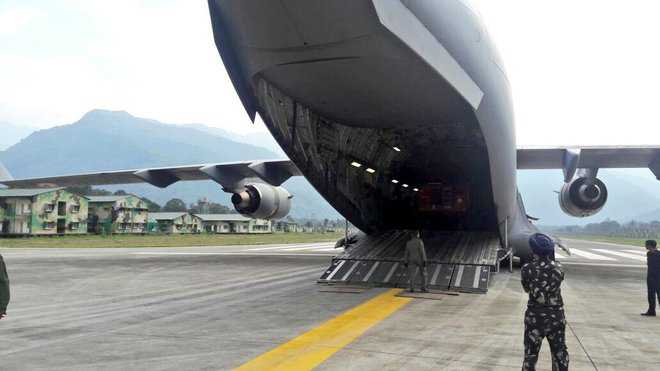
C-17 Globemaster at Tuting airfield in Arunachal Pradesh. — ANI
  • Sending a message to China, the IAF on Tuesday landed the C17 Globemaster, the biggest transport aircraft in its stable, at the advanced landing ground at Tuting in Upper Siang district of Arunachal Pradesh.
  • Describing the mission as historic, an IAF spokesman said the mammoth C17 Globemaster could execute this mission owing to the sublime flying skills of the pilots
  • After completion of the trial landing, the C17 also carried out an operational mission airlifting operational load into the austere airfield. TNS


Army gears up for e-warfare

Vijay Mohan

Tribune News Service

Chandigarh, March 7

After inducting ground-based electronic warfare (EW) systems over the past couple of decades, the Army now wants to take this battlefield domain into the skies. It has projected a requirement of aerial systems for reconnaissance, surveillance as well as countering hostile radio and cellular networks and satellite-based systems.According to the Technology Perspective and Capability Roadmap – 2018 document that was issued by the Ministry of Defence a few days ago, the Army has projected a requirement for three aerostat systems, seven heliborne EW systems and 10 EW payloads for remotely piloted aircraft.The document, the first edition of which was issued in 2013, identifies the requirements of the three services in various domains over the next decade and serves as a guide for the industry for planning or initiating technology development, partnerships and production arrangements.The Army’s requirement for the aforementioned aerial systems comes along with an additional requirement for 10 integrated EW systems that can be mounted on tracked or wheeled vehicles. The Air Force and the Navy too have projected requirements for different types of EW platforms to meet their operational needs.The broad parameters for the EW systems include the capability to deny effective use of electronic spectrum by the enemy, detect, monitor, and jam enemy cellular and satellite communication receivers, radars and GPS systems, carry out communication intelligence and electronic countermeasures, besides integrating photo-recce and image correlation for physical identification of targets. The IAF had inducted two aerostats over a decade ago and drawn up plans for further acquisitions, which are still hanging fire. An aerostat is an unpowered balloon tethered at a certain height above the ground and equipped with surveillance and communication equipment. It can remain deployed for a number of days at a stretch, scan a wide swath of area and is particularly effective for detecting low-flying or surface objects.Aerial EW systems that the Army is envisaging can also be used for counterterrorist operations and sub-conventional conflict situations besides conventional deployment.


Seeks aerial systems
  • Projects a requirement for three aerostat systems, seven heliborne electronic warfare (EW) systems and 10 EW payloads for remotely piloted aircraft
  • The objective is to deny effective use of electronic spectrum by the enemy, detect, monitor, and jam enemy cellular and satellite communication receivers, radars and GPS systems

Centre may set up a force to induct Naga insurgent group’s armed cadre

NEWDELHI: The Union home ministry and the Issak-Muivah faction of the National Socialist Council of Nagaland (NSCN-IM) have discussed creating a special auxiliary regiment, or an armed police force on the lines of the India Reserve Battalion (IRB) to induct the armed cadres of the Naga insurgent group, a senior home ministry official has said.

HT FILE■ The proposal is part of the Centre’s deliberations with the NSCN­IM with whom a Framework Agreement was signed in 2015.The proposal is part of the Centre’s deliberations with the NSCN-IM with which a Framework Agreement had been signed in 2015 to find a permanent solution to the Naga conflict.

The government has so far not revealed the contents of the Framework Agreement but a high ranking official of the ministry of home affairs (MHA), who is part of the peace process with the Naga group, said the Centre and the NSCN-IM have discussed recommending that “heavily armed cadres of the insurgent group” form a new unit that will operate under the government’s watch.

“Our government is dedicated to achieving a peaceful solution to the Naga issue and channeling the armed cadres to form such a force under the government of India will ensure peace and prosperity for the state,” the ministry official said on the condition of anonymity.

The official added that details such as the time frame of establishing the regiment, recruitment for the top brass of the said regiment or whether or not the insurgent group will give up its weapons are yet to be worked out.

Under the current arrangement, which came about after the government signed a ceasefire agreement with NSCN-IM in 1997, cadres of the insurgent group remain armed when they are in their camps located in Nagaland, the official added.

Former home secretary GK Pillai said the decision to induct NSCN-IM cadres must be a part of the final step of rehabilitation package for the insurgents.

“In the past, too, we had raised two BSF battalions comprising surrendered Naga militants. Same has been done in left-wing affected areas and in Kashmir. There must be between 4,000-5,000 armed NSCN-IM cadres and the government ideally should provide an income source as part of the peace deal to keep them away returning to militant fold,” Pillai said.

The revelation comes after tension over the government’s decision to hold assembly elections in Nagaland before the signing of the Naga peace accord subsided last week with the BJP forming an alliance with the Nationalist Democratic Progressive Party (NDPP). This was after civil rights groups and political parties in the state, including the ruling Naga People’s Front (NPF), announced they would not contest the assembly polls scheduled for February 27 until the Naga political problem was resolved. The NSCN-IM had extended its support for boycotting elections.

The senior home ministry official also said the government used both “hot and cold manoeuvres” to navigate the politics revolving around the election boycott call, adding that Union home minister Rajnath Singh, his deputy Kiren Rijiju and Naga interlocutor RN Ravi played key roles.

“The NSCN-IM recently issued statement that they will not use violence to enforce election boycott call.

“Compare the statement with the day when all political parties in Nagaland decided to boycott elections when filing of nominations too seemed to be a distant possibility.

“We have crossed the first hurdle, nominations have been filed. Now let’s have faith in Naga people for turning up to vote,” the official said.


clip

clip


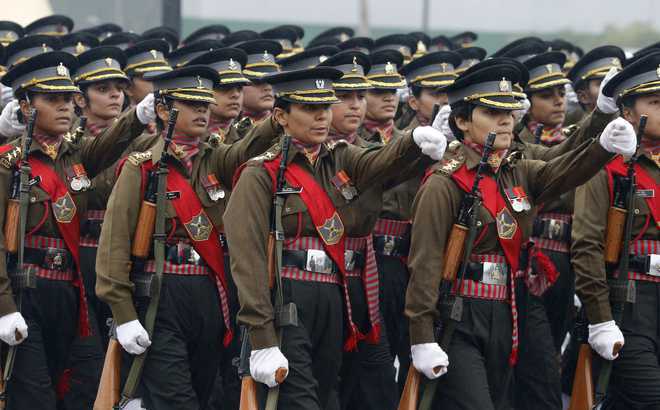
Centre denies discrimination against women in Army recruitment

Centre denies discrimination against women in Army recruitment
Two petitions allege discrimination against women in the Army”s recruitment policy related to its engineering and education corps.

New Delhi, February 10

The Centre has opposed in the Delhi High Court two petitions that allege discrimination against women in the Army’s recruitment policy related to its engineering and education corps.A bench headed by Acting Chief Justice Gita Mittal was told that the allegation of discrimination against women in Indian Army with respect to their recruitment in the force is “baseless, unfounded and devoid of merit”.The Army sought dismissal of the two PILs filed by a lawyer that have alleged “institutionalised discrimination” against women by the Army as it does not recruit them into the two corps by giving them a permanent commission.However, the Indian Army maintained that it has in “1992 introduced women special entry scheme (officers) for induction of short service commission (women officers)”, under the appropriate provisions of the law.”Prior to this there was no provisions of entry of women officers to the Indian Army,” the ministry added.Advocate Kush Kalra said that, “This discrimination on grounds of gender is violative of fundamental right of equality before law, the right not to be discriminated on the ground of sex, the equality of opportunity in the matters of public employment, the right to practice any profession and occupation and the human rights of the women.”Women candidates are denied entry into the Engineering Corps under the 10+2 Technical Entry and the University Entry schemes in contrast to their male counterparts, one of the petitions said.The lawyer in his other plea has said the reason given by the Army for not recruiting women is that they are not eligible for permanent commission in the army while the Army Educational Corps is a permanent commission.The petitioner has sought an order declaring the Indian Army’s eligibility conditions which disentitle women from being recruited in the Army Educational Corps as void, since they are inconsistent with the fundamental rights of women.In his other plea relating to entry of women into the Engineering Corps, the petitioner has said the advertisement inviting application for recruitment only mentions male candidates and not female.”As per the eligibility criteria only unmarried male candidates are eligible for recruitment to the 10+2 Technical Entry and University Entry schemes (both for permanent commissions), which in-fact means no female with equivalent qualification are eligible.”This practice is discriminatory. The respondents (MoD and Army) are treating equals unequally. It is arbitrary and discriminatory against women,” the petition on Engineering Corps said.Kalra has also sought an order declaring the eligibility conditions for recruiting unmarried males alone in the Engineering Corps under the two entry schemes for a permanent commission as unconstitutional. — PTI