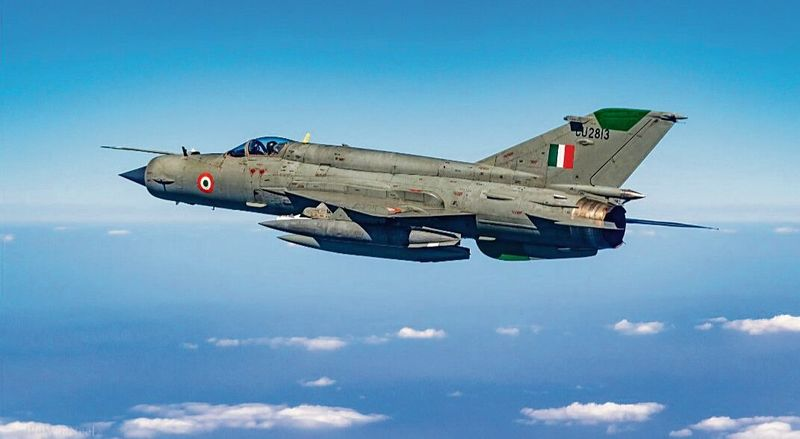
A deal with the Soviet Union was signed in 1962 and the first batch of eight pilots trained at Lugvoya Airbase in Kazakhstan. The first batch of 10 aircraft arrived in April 1963, forming No.28 squadron, the First Supersonics at Chandigarh.
In 1961, the Indian Air Force (IAF) opted to procure the Soviet-origin MiG-21, a third generation jet fighter aircraft, over several other Western competitors such as the British English Electric Lightning and the US F-104 Starfighter.
A combination of strategic, economic, political and operational factors influenced this decision. Not only was the MiG-21 cheaper than its Western counterparts, it came with the Soviet offer of full transfer of technology and rights for manufacture in India, something the West was unwilling to do.
With geopolitical shifts, India also sought to diversify sources of Defence equipment, which till then had been dependent on the West. Strengthening ties with the erstwhile Soviet Union also offered a strategic balance against China and Pakistan.
A deal with the Soviet Union was signed in 1962 and the first batch of eight pilots trained at Lugvoya Airbase in Kazakhstan. The first batch of 10 aircraft arrived in April 1963, forming No.28 squadron, the First Supersonics at Chandigarh.
The MiG-21’s Mach 2 speed, agility and climb rate, as well as other characteristics such as a simpler design and ruggedness as compared to western fighters suited India’s requirements.
Hindustan Aeronautics Limited began licence production of the MiG-21 in 1966 at its Nashik plant. A total of 1,200 aircraft of different variants were procured till 2010, with later variants undergoing significant upgrades. At its peak, over 400 MiG-21 aircraft were in service with the IAF. The fleet, however, also came under scrutiny for the high number of accidents it suffered.
As the last of the remaining MiG-21 prepare to fly into the sunset on September 26, after being a game-changer in the skies over the Indian subcontinent for 62 years, here are five prominent operations that mark their journey with the IAF:
1. Bombing of Governor’s House in Dacca, 1971
In the eastern theatre during the Liberation of Bangladesh Campaign, MiG-21s played an instrumental role, not only in achieving air superiority but also undertaking ground attack roles. A key operation was attacking the Governor House in Dacca (now Dhaka), considered by military historians as the final nail in the coffin that led to the collapse of the Pakistan Army in the east.
On December 14, 1971, following intelligence reports of a top-level meeting at the Governor House, four MiG-21s armed with rockets were launched from the Guwahati airbase. Around 12:55 pm, they hit the house with pinpoint accuracy, causing its roof to collapse. The building was hit two more times, first with two MiG-21s, followed by two Hunters.
Following the bombing, the Governor of East Pakistan, AM Malik, who was until then undecided on whether to resign, submitted his resignation to the United Nations (UN). The entire East Pakistan government followed, resigning to the UN, leaving the defence of Dacca in the hands of Pakistan’s eastern army commander Lt Gen AAK Niazi, who surrendered two days later.
The MiG-21s also rendered the Tezgaon airfield at Dacca out of action by carrying out never-attempted-before steep glide bombing missions to crater the airstrip. This resulted in the IAF gaining air superiority over East Pakistan, paving the way for unrestricted ground, air and naval operations.
2. Photographing Skardu airbase, 1985
As Operation Meghdoot, India’s campaign in the Siachen Glacier, the world’s highest battlefield, which began in 1984 was under way, a MiG-21 is said to have executed a daring photo-recce mission in 1985 of which little is known publically.
Equipped with an underbelly Type-96 pod carying a Vinten panoramic camera, it streaked through the Shyok valley, flying just a couple of hundred feet above the ground and made an arduous run over Skardu in Pakistan Occupied Kashmir, photographing its newly laid runway and adjacent areas to collect intelligence on Pakistani aircraft, airfield status and logistics.
The pilot employed low-level penetration at high speed to evade radar, navigating by maps and visual landmarks due to limited aids available in the remote terrain. Other fighter aircraft provided cover.
Skardu was and continues to be a strategic Pakistan Air Force forward airbase located in the Gilgit-Baltistan region and its monitoring its activities was critical due to its role in supporting Pakistan military operations in the Siachen Glacier region.
Even in the 1971 India-Pakistan War, Skardu had been a high-value target for supporting enemy operations in the Northern Sector. The IAF conducted a daring bombing raid on Skardu on December 17, 1971, using Canberra bombers and An-12 transports to damage the runway, thereby preventing Pakistani operations. Even then, recce flights by MiG-21s were conducted to confirm the damage, marking one of the aircraft’s early forays into the fighter-recce role.
3. First into combat during Kargil conflict
MiG-21s were among the first fighters to go into combat on May 26, 1999, when the Indian Air Force formally entered the Kargil conflict along the Line of Control in northern Jammu and Kashmir.
MiG-21s, alongside MiG-23s and MiG-27s, launched the opening attacks at 6:30 am, targeting enemy camps, logistic routes and supply dumps overlooking key areas along the frontlines in Dras, Kargil and Batalik sectors.
Flying out of Srinagar and Avantipur airbases, the MiG-21s were primarily used for ground attack missions and close air support, besides undertaking photo-reconnaissance and battle damage assessment missions as well as combat air patrols.
MiG-21s were adapted for precision ground attacks in narrow, high altitude valleys and confined spaces, targeting small enemy outposts, bunkers and supply lines through manual aiming and unguided bombs and rockets, requiring exceptional skills. These strikes were critical in softening enemy positions.
In the absence of advanced navigational aids, IAF pilots innovatively used hand-held GPS and stopwatches for navigation in low-light conditions, achieving effective results without advanced technology. By mid-July, when the war started winding down before its cessation on July 26, the MiG-21s had carried out about 580 strike missions and 460 air defence sorties.
4. Pakistani Atlantique shoot down, 1999
On August 10, 1999, a few weeks after the Kargil conflict, a MiG-21 intercepted and shot down a Pakistani Navy Breguet – 1150 Atlantic maritime patrol aircraft over the Rann of Kutch in Gujarat.
The French-built, twin-turboprop aircraft from Pakistan Navy’s No. 29 Squadron had taken off from Mehran Naval Base at 9:45 am. Around 10:51 AM, the IAF ground radar at Naliya airbase in Gujarat detected the aircraft approaching the border near Badin.
Two MiG-21s from No. 45 Squadron, the Flying Daggers, were scrambled. According to official accounts, the Pakistani aircraft intruded 10 km into India twice and was repeatedly warned. The Atlantique ignored commands and turned aggressively towards the MiG-21s.
At 11:17 am, Sqdn Ldr RK Bundela, flying the lead MiG-21 fired an R-60 infrared-homing air-to-air missile from a 3 km range, hitting the Atlantique’s port engine. The plane caught fire, descended, and crashed near the border village of Talhar.
All 16 Pakistani crew members, including five officers and 11 trainees, were killed. Sqn Ldr Bundela and the ground-based fighter controller, Wg Cdr VS Sharma were decorated with the Vayu Sena Medal.
5. Post-Balakot air duel, 2019
MiG-21s were among the aircraft that were deployed to counter Pakistan’s aerial activities in the wake of the IAF’s strike on terrorist camps at Balakot in Khyber Pakhtunkhwa in Pakistan in the aftermath of a terrorist strike at Pulwana in Jammu and Kashmir in which 40 CRPF personnel were killed in 2019.
The MiG-21, the oldest fighter in the IAF’s inventory was pitted against the F-16, the most advanced aircraft that the Pakistan Air Force flaunts, with the IAF claim that an F-16 was shot down in an aerial duel over the skies of Jammu and Kashmir close to the Line of Control (LoC).
Two MiG-21 Bisons were scrambled from an operational readiness platform to intercept four Pakistani aircraft that intruded into Indian airspace in Rajouri sector.
One of the pilots, Wg Cdr Abhinandan Varthaman, fired an R-73 missile at an F-16 resulting in a radar blip being tracked as an F-16 from its signature vanishing from the screen, according to a top IAF officer.
Varthaman’s own MiG-21 was also hit after he reportedly transgressed across the LoC in the heat of the moment and he landed inside Pakistan Occupied Kashmir after ejecting. He was captured but later repatriated to India and was decorated with the Vir Chakra.