All posts by webadmin
Army seeks carbines for close combat
The requirement is of 2 lakh light-weight modular carbines with advanced optical sights and laser designators
Vijay Mohan
Tribune News Service
Chandigarh, June 11
Even as the Army is scouting for a new assault rifle to replace its existing standard issue firearm, it has projected another requirement of a carbine for a close quarter battle.A request for information issued today reveals that the Army’s requirement is of 2 lakh light-weight modular carbines with advanced optical sights and laser designators, of which 44,000 guns are required immediately.The Army also wants to switch over to the 5.56 mm caliber for the carbine, the same as the existing INSAS assault rifle made by the Defence Research and Development Organisation. It earlier used the Sterling 9 mm carbine, which is now obsolete. Broadly put, a carbine is a smaller, lighter version of an assault rifle that is issued to a specific category of troops.It also wants to switch over to a higher caliber for its standard assault rifle, from the 5.56 mm to 7.62 mm. The 5.56 mm bullet is designed to injure rather than kill. Western armies first started switching over to it in the 1970s with the rationale that an injured soldier would tie down more human and material resources of the enemy than a dead one. The Army began switching from 7.62 mm self-loading rifles to 5.56 mm INSAS in the late 90s. It is now being felt that with increasing involvement in low-intensity conflict and counter-terrorist operations, a more lethal caliber with a higher range and killing power is required.DRDO’s Director General, Armament and Combat Engineering Systems, Pravin K Mehta says the DRDO is not taking up any project to develop a 7.62 mm rifle for the Army. The new rifle is expected to be an imported weapon manufactured in India under collaboration by private firms or the state-owned Ordnance Factory Board.The OFB, which has also issued an expression of interest inviting partnership from firms to manufacture modern 7.62 mm rifle, had come up with a weapon based on the AK-47 design.
Amarinder Singh rubbishes reports of ever mulling to join BJP, slams media for distorting old news
New Delhi: Punjab Chief Minister Amarinder Singh said on Wednesday he wanted to float his own party due to “differences within the Congress” two years ago, but never toyed with the idea of joining the BJP.
“It is absurdity,” he said, brushing aside reports that he wanted to join the BJP. “They have produced stale news. This is two years ago when there were differences in the Congress and I said I will form my own party. Where is the question of joining the BJP? I think there are too many channels and there is too little news,” he said.

will come a time when we will bounce back,” he said. Speaking at a function to mark the Delhi launch of his book on the Saragarhi battle and the unveiling of his biography “The People’s Maharaja”, he said he did not shy from speaking his mind on controversial subjects like the alleged Khalistani leanings of the Canadian defence minister and the ‘human shield’ action of an Indian Army Major in Kashmir.
He stuck to his stand on Khalistani support in the Canadian government and said the Justin Trudeau dispensation had several members who were Khalistani supporters, including Sajjan Singh.
“His (Sajjan’s) father was part of the Khalistani movement that has brought trouble in Punjab,” he said. Amarinder also reiterated his support for Major Nitin Gogoi, saying he took the right decision to protect the lives of his own men and said as a soldier he did a “great job”. “I think the entire Indian Army supports him and I hope he gets an award for meritorious service,” he said.
Claiming to be a positive man, who always preferred to look at things and situations positively, Amarinder came out candidly with his views on various subjects, while mincing no words in offering his criticism where he thought it was merited.
In his biography, he also referred to an episode in his biography, where he felt “betrayed” by the then Prime Minister Chandrashekhar, whom he had talked to in getting 21 Khalistani terrorists to surrender, only to find them shot dead a few months later.
Asked about the “demise” of Aam Aadmi Party (AAP) in Punjab, Amarinder said he merely read the situation on the ground and found that there was no groundswell in the party’s favour, just a hype in the media, especially the social media. The people of Punjab wanted a stable government and voted for one, he said.
The Punjab chief minister refused to be drawn into criticism of 95-year-old Parkash Singh Badal, saying he had nothing personal against the Badals. He also said it was not him who got him arrested, but was a result of the legal fallout.
On the SYL canal issue, Singh said warned of the revival of terrorism and naxalism if the canal was constructed, causing southern Punjab to go dry.
He pointed out that water was the main issue in the Anandpur Sahib resolution and could once again become the source of contention and violence in the state. Amarinder said drugs was a major concern, which his government was tackling with all its might. He also felt that industrial revival and infrastructural development was important for Punjab’s revival.
He also narrated excerpts from own latest book on military history, ‘The 36th Sikhs in the Tirah Campaign 1897-98 — Saragarhi and the defence of the Samana forts’, that struck an emotional chord with the audience.
The book, “The People’s Maharaja” authored by Khushwant Singh, brings out interesting incidents of his life from his childhood days to the present times.
Threats to peace in Punjab reappearby Lt Gen Kamal Davar (retd)

The Centre and the state administrations will have to keep a “hawk-eye” by effective human and technical surveillance on the remnants of the Bhindranwale followers and radicalised religious outfits.

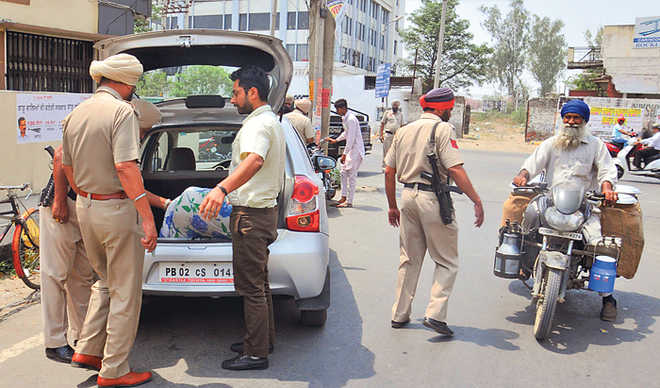
Forearmed is forewarned: A policeman carries out a search at a checkpoint in Jalandhar. Keeping in view the subversive designs of the ISI, a hawk-eye will have to be kept to ensure that there is no breach of security in the border state. Tribune Photo
THE fact that Pakistan’s notorious spy agency, the Inter-Services Intelligence (ISI), has built a formidable reputation for its diabolical string of terror-oriented successes in Afghanistan and, importantly, India in the past few decades is unquestionable. It is equally a reality that the ISI has not been able to achieve former Pakistani military dictator, Gen Zia-ul-Haq-conceived diktat of “bleeding India by a thousand cuts.” But no one in India’s security institutions should downplay the ISI’s dogged persistence in stoking the fires in India, be it Jammu and Kashmir or the North-East and now Punjab, once again.The “Khalistan Movement”, checked and then buried after many years of a concerted struggle by the endeavours of the Centre, successive Punjab state governments, the will of the common people of Punjab and the professionalism of the security forces, is now showing signs of re-emerging. This churning is, once again, attributable to Pakistan’s ISI, making renewed efforts to stir the pot like in the 1980s and early 1990s.One of the chief architects of combating the highly violent and grossly anti-national “Khalistani Movement”, supercop KPS Gill passed away recently. No representatives from the previous ruling Akali Dal and even the Aam Aadmi Party did not care to attend the formidable cop’s “bhog ceremony” in New Delhi. This does display the priorities and inclinations for national causes of these two parties. The very fact that the Punjab Chief Minister Capt Amarinder Singh specially went from Punjab to New Delhi to pay homage to KPS Gill displays the correct attitude that India’s politicians must display publicly for those who have honestly and professionally spent their lifetime working for the unity and integrity of India. Undoubtedly, KPS Gill was one such personality. Somewhere, successive governments have not given him his due. As leopards never change their spots, some intelligence agencies too display a propensity for consistency in their evil ways. The ISI stands out as a glaring example for now reviving its wicked strategies to create unrest in India’s strategic border state of Punjab in concert with the sinister forays it is planning in the neighbouring Jammu and Kashmir. All security organs of the nation and Punjab will have to factor in their security preparedness to thwart Pakistan’s new stratagem of stoking communal disharmony and terrorist acts in Punjab. Fortunately, the Punjab Chief Minister is a former Army officer and thus will be able to galvanise as well as keep a sharp eye on the state police, the intelligence set-up and the members of the central police organisations and paramilitary forces deployed in Punjab. Effective synergy between all security organs of the state and the Centre is a pre-requisite to counter the security threat will be merely stating the obvious. The Ministry of Home Affairs, the sleuths of the Intelligence Bureau and the Border Security Force will have to work in close coordination with the Punjab Police. Additionally, units and formations from the Army and Air Force deployed close to the international border will have to be included in the overall existing security matrix, even during peacetime. Standard Operating Procedures between these different set-ups must be streamlined for effective and speedy responses to any terrorist threats as and when they emerge. It is hoped that lessons learnt from the security inadequacies witnessed, in the last two years, from the Dinanagar and Pathankot episodes, will be scrupulously rectified. Terrorism, in most parts of the world, is linked to drug running and Punjab is no exception. With Pakistan’s ISI having foisted the drug menace in India’s strategic and communally sensitive state, since the last many decades, the Punjab administration, down to the panchayat level has to remain more than vigilant. The Congress Party, in its campaign during the recent state elections in Punjab had made the eradication of the drug problem as one of its major planks. It is time for the Punjab government now to go on an all-out blitzkrieg to root out this serious menace from Punjab.Millions of Punjabi youth, once famed for their physical prowess, are now mere shadows of their earlier “avatars” — gravely afflicted by drugs from neighbouring Pakistan. Only a dedicated effort by the Punjab government, anti-drug campaigns by civil society especially religious and educational institutions, ruthless stamping out of drug-runners by effective policing at the grass-roots level and speedily administered justice will have to be ensured. Local manufacturers of toxic drugs need to be severely punished under the law of the land.The Centre and the state administrations will have to keep a “hawk-eye” by effective human and technical surveillance on the remnants of the Bhindranwale followers and radicalised religious outfits like the Babbar Khalsa, the Khalistan Commando Force and such like outfits. The Shiromani Gurdwara Parbandhak Committee and their political mentors, the Akali Dal, must put in unwavering efforts to ensure that radicalisation among their followers is nipped in the bud.Canada has a fair number of Khalistani sympathisers and our intelligence outfits including the Research and Analysis Wing and the National Technical Resources Organisation have their work cut-out, including keeping an eye on these anti-national elements and particularly on “hawala money” transactions. Meanwhile, our Ministry of External Affairs must send out a stern message to the Canadian government not to be lax with anti-India Khalistani supporters in their country. The Punjab Chief Minister displayed courage and pragmatism in not hosting the Canadian Defence Minister on his visit to Punjab as the latter reportedly has Khalistani sympathies. How many politicians will do that? The coming months will be crucial to ensure that Khalistani stirrings are effectively squashed notwithstanding the ISI’s evil machinations. Importantly, all political parties in Punjab must not politicise national security challenges. It is imperative for all of them to rise above petty motivations and thus create a conducive environment for the “sword-arm” state of India to ascend to its yet unattained progress and glory.The writer is the founder-DG of India’s Defence Intelligence Agency. The views expressed are personal.
Nawaz’s Iran challenge
Pak faces grave security issues along its borders with Afghanistan & India too

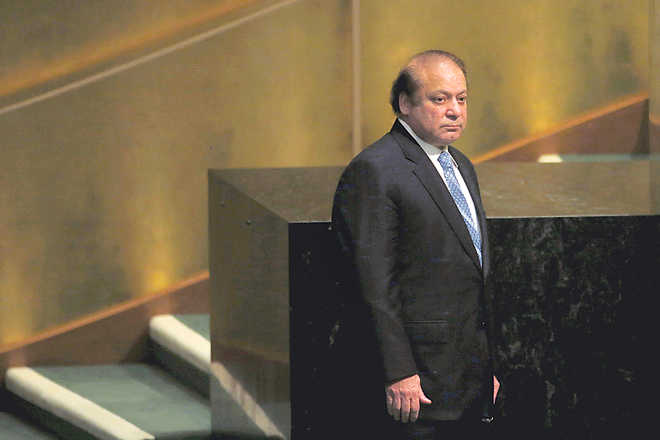
game plan: Sharif is hoping to get the US in his corner during the Saudi meet.
THE past 18 months have seen a bitter power struggle in Pakistan between the elected government led by Nawaz Sharif and his former army chief, the overbearing Gen Raheel Sharif, who was desperately seeking an extension. His ambitions were sidestepped and his ego assuaged by getting him appointed as the head of a Saudi-led military alliance of 41 Sunni Islamic countries. With the Panama Leaks exposing his vast foreign assets, Sharif remains under pressure from a less than sympathetic Supreme Court, which has appointed a committee of civilian and military officials to further investigate the charges.To add to Sharif’s woes, he came under new pressures. In an act of brazen defiance and indiscipline, the army publicly challenged a notification issued by the PM’s office to deal with the leak of information in Dawn newspaper. With a somewhat more rational army chief now holding office, Nawaz has been able to ward off challenges from the army for the present. But he will have to expend considerable time and effort in dealing with the Supreme Court and charges of corruption. There is, however, little doubt that if he successfully deals with these issues, he can overcome challenges posed by Imran Khan’s PTI and Asif Ali Zardari’s PPP, and win the parliamentary elections in 2018, even though the economic situation is fragile, with external debt growing rapidly.Pakistan now faces serious challenges to peace and security along its land borders with Iran, Afghanistan and India. While Pakistan’s borders with India and Afghanistan have been traditionally disputed and tense, troubles on its borders with Iran grew as Pakistan got drawn into the American ‘war on terror’. Iranian Sunni extremist groups were armed and trained in Pakistan to attack targets across the Balochistan-Iran border. The Iranians allege CIA-ISI involvement in these attacks by a group called ‘Jundallah’, whose present-day version goes by the name of Jaish-ul-Adl (army of justice). Barely a fortnight ago, the Jaish-ul-Adl mounted a cross-border attack on the Iranian town of Mirjavejh, near the Balochistan-Iran border, killing 10 Iranian soldiers. After a visit by the Iranian foreign minister, Mohammad Jarif, produced only Pakistani platitudes, Iran’s army chief Major-General Mohammad Baqueri warned that his forces would attack terrorist havens within Pakistan unless Rawalpindi stopped cross-border attacks. These developments coincided with escalating tensions across the disputed Pakistan-Afghanistan border, leading to casualties on both sides and an assertion by President Ashraf Ghani that he would not visit Pakistan. The Taliban, meanwhile, stepped up its ‘spring offensive’ across Afghanistan. Pakistan, in turn, accused Afghanistan of fomenting terror across the Durand Line in collusion with India. In the meantime, the unpredictable and inconsistent Trump administration has indicated it will be enhancing its military deployment in Afghanistan and increasing Afghan firepower. Iranian foreign minister Jarif arrived in Kabul on May 7 amidst these developments. He called for greater cooperation between Kabul and Tehran in combating terrorism, adding: ‘There is no such thing as good terrorists and bad terrorists.’ His Afghan counterpart Rabbani, in turn, asserted that Afghanistan wants neighbouring countries to work on dismantling the sources of funding of terrorist groups.It is now evident that with expectations of Russian and Chinese backing, Pakistan intends to continue its support for the Taliban. We need to have some candid discussions with our Russian friends on this at the highest level. While Sharif may want to meet Modi at the Shanghai Cooperation Organisation Summit in Kazakhstan, it would be naïve to believe that the Pakistan army is going to relent on its fomenting terrorism and violence in Jammu and Kashmir and elsewhere in India. Given the fact that the Pakistan army and Sharif are evidently not on the same page on the Kulbhushan Jadhav affair, India will have to wait and see if Sharif has the political space to spike the army’s intentions to continue on its present path on this issue. Moreover, there should be no relenting on taking all available measures, overt and covert, to make Pakistan pay heavily for its adventurism in J&K. In the light of these developments, Sharif’s visit to Saudi Arabia for a get-together of the 41-member Sunni military alliance, during the Saudi-Trump summit is clearly designed to avail of the occasion to persuade Trump that Pakistan will be a steadfast ally in his war against the IS and ‘radical Islam’. Will Trump, the avowed master of cutting ‘deals’, be impressed by such posturing, given his distrust of Pakistani policies on Afghanistan? Trump’s visit to Saudi Arabia is primarily to boost American arms sales, cut deals in the energy sector and encourage the tough posture that Deputy Crown Prince Salman has adopted towards Iran and Yemen. Despite his loathing for Gen Raheel Sharif, Nawaz will miss no opportunity to impress Trump with the fact that a Pakistani general is commanding the ‘Islamic alliance’, while asserting Pakistan’s commitment to fight terrorism globally. But it is clear that Pakistan’s enthusiastic participation in a Saudi-led, American-backed alliance is not going to please Iran.These are issues that are going to shape Indian diplomacy significantly in coming months. New Delhi will need to discuss measures to squeeze Pakistan on its support for cross-border terrorism, in discussions with Iran and Afghanistan, both bilaterally and trilaterally. Our unusual decision to publicise cuts in our oil imports from Iran needs to be reviewed, even as we press Iran to discard its reluctance to fulfil its commitments on Indian participation and investment in its energy projects. Delays in moving ahead in the development of Chabahar Port need to be addressed at the highest level. PM Modi has shown considerable skill in carrying out a delicate diplomatic balancing act in the Gulf and West Asia by developing good ties with all major players — Saudi Arabia, Israel, Iran and Egypt. These skills will be fully needed and tested while dealing with the emerging scenario across our western neighbourhood.
Army set to deploy fleet of armed choppers in NE
INDIA HAS REDOUBLED EFFORTS TO ENLARGE ITS DEPLOYMENTS IN THE NATION’S EASTERN SECTOR IN AN ATTEMPT TO KEEP A CHECK ON NEIGHBOUR CHINA
NEW DELHI: Beefing up its force levels in the northeast to counter China, the Indian Army is all set to deploy a squadron of weaponised Dhruv advanced light helicopters in Assam’s Likabali town.
This will be the army’s first armed helicopter unit in the region.
India has redoubled its efforts to strengthen its deployments in the eastern sector, with the raising of a new mountain strike corps and stationing of front-line Sukhoi-30 fighter planes. The armed force is also engaged in the reactivation of advanced landing grounds, deploying supersonic cruise missiles and proposed basing of special operations aircraft.
Speaking on the condition of anonymity, army sources said the Dhruv Mk-IV squadron with 10 indigenously-built helicopters was likely to be functional in two to three months, as part of an overarching plan to scale up the force’s offensive capabilities in the eastern sector.
There are four weapon stations on the helicopter with a turret gun in its nose area. Weaponised Dhruv helicopters are equipped with air-to-air missiles, 70 mm rockets and 20 mm turret guns.
Newer variants are being equipped with anti-tank guided missiles, infrared jammers and obstacle avoidance systems.
The army’s aviation wing has an armed chopper squadron near Jodhpur and another unit is coming up in one of the northern states.
The army is speeding up a new mountain strike corps whose raising was kicked off in January 2014 in West Bengal’s Panagarh.
Aimed at countering China in the northeast, the government will spend around ₹40,000 crore on the new corps, 17 Corps, which is likely to be fully operational by 2025.
The corps will be equipped with M777s ultra light-weighed howitzers ordered from the United States in November 2016 under a $750-million contract. The contract is for 145 M777s.
Of these, 25 ready-built weapons will be supplied by the United States of America (USA) over the next two years and the remaining 120 howitzers will be produced in the country under the Modi government’s ambitious Make in India initiative.
Manufactured by Britain’s defence and aerospace company, BAE Systems, the guns will be built in India in collaboration with Mahindra Defence. The 155 mm/39-caliber howitzers have been bought to increase the army’s capabilities in high altitude
Last August, India cleared the deployment of a special version of BrahMos supersonic cruise missiles in the northeast.
Weeks after the Indian government cleared the new BrahMos regiment at a cost of ₹4,300 crore, China warned that such a move would have “a negative influence” on stability along the border.
Navy rescues ship from pirates

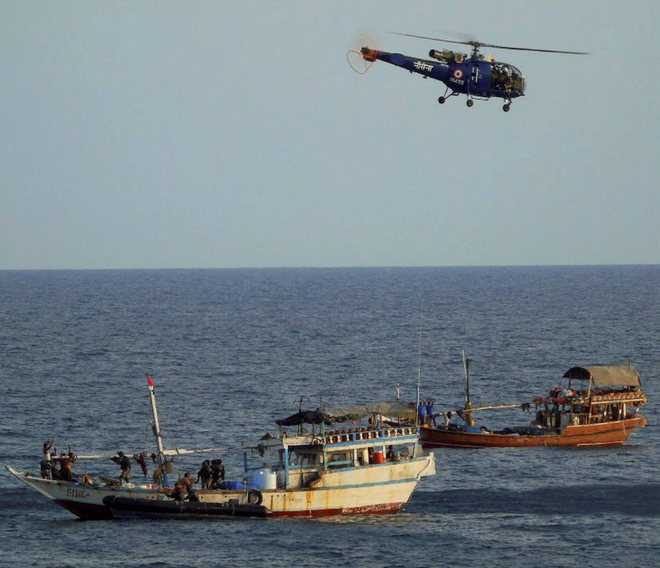
An Indian Navy chopper in action in the Gulf of Aden on Tuesday. PTI
New Delhi: The Indian Navy rescued a merchant vessel MV Lord Mountbatten from a piracy attempt in the Gulf of Aden on Tuesday. Ironically, the 20,000 tonne ship is named after Lord Louis Mountbatten, the last Viceroy of British India. A Navy spokesperson said, “On May 16, about 16:45 hrs, the INS Sharda received a distress call from MV Lord Mountbatten, 230nm South-West of Salalah Oman in the Gulf of Aden. The vessel had reported an incident of attempted piracy by two suspicious mother vessels along with 7-8 skiffs.” INS Sharda, which was 30nm from the merchant vessel at that time responded immediately. The ship was deployed for anti-piracy operations since April 6, 2017. As soon as INS Sharda arrived at the location three of the skiffs which are like fast motor boats fled the area. TNS
Army prepared for a two-and-a-half front war, says chief Gen Rawat

Gen Bipin Rawat. PTI file
New Delhi, June 8Chief of Army Staff Gen Bipin Rawat on Thursday said the Indian army is well prepared to face external, as well as internal threats to the country.In an interaction with ANI, Gen Rawat said, “The Army is fully ready for a two-and-a-half front war.”He said even though India is ready for a multi-front war there are effective mechanisms available to defuse an adverse situation. “Even the PM has stated that for the past 40 years not even a single bullet has been fired on the Indo-China border,” said Gen Rawat.
(Follow The Tribune on Facebook; and Twitter @thetribunechd)
In a freewheeling conversation with ANI, Gen Rawat said a new strike corps, 17 Strike Corps, is being raised specifically for mountain warfare. When asked about the delay in its raising, the Army chief said a process as complex as that took time. He said, “It is being raised from scratch. The recruitments are on. As it is, to prepare an army soldier it takes about three years from recruitment process to training and then orienting and finally their deployment.”Gen Rawat went on to discuss modernisation plans of the army, saying the government is aware of our all needs and is supporting us in every manner. “Make in India is a good initiative, it will give results in two to three years,” he said.He said all armies across the world maintained an inventory in the ratio of 30:40:30. Here 30 per cent equipment is state-of-the-art technology, 40 per cent is undergoing modernisation and the rest 30 per cent is obsolete, which requires an upgrade.Gen Rawat concluded by saying that the Army’s preparations are not against any specific country. ANI
Making of a warrior & the ultimate sacrifice by Lt Gen Raj Sujlana (retd)
Military training academies are the edifice of national integration. Petty loyalties of regionalism, caste or religion are subordinated to the brotherhood of arms. Lt Ummer Fayaz too upheld the integrity of the nation over the diktat of terrorists

SALUTE TO A BRAVEHEART: The grieving family & relatives of Lt Ummer Fayaz Parray, who was murdered by militants while he was on leave. PTI

ON May 9, the joyous mood of wedding celebrations in the township of Batapura, Shopian suddenly turned gloomy, the terrorists struck. Their target Lieutenant Ummer Fayaz Parray was quickly bundled away; the next morning his bullet-ridden body was found. His only fault was that as an Indian Army officer he had decided to uphold the integrity of his country, contrary to the dictates of the terrorists. Earlier, families of police and Army personnel have been threatened and warning to either quit or get eliminated. Despite the danger, Ummer showed his strength of character and belief that he was on the right lines by going home on leave. At the Indian Military Academy (IMA), he was highly motivated and a fitness freak. A one-liner on him by his course mates speaks volumes, he “could debate anyone on any topic!” Like every other young officer, he was ready to prove his worth, earn his spurs as a leader of fighting men, rise to higher ranks and what’s more, to ensure a better tomorrow for his parents and two sisters. But as he lay wrapped in the Tricolour, his dreams were snuffed out with him, leaving behind a shattered family. His cold-blooded murder soon after the dastardly beheading of a JCO of the Army and a NCO of the CRPF shows the barbarism of the terrorists — brutality, cowardly conduct and total disrespect for human values and rights. Their aim is clear, to terrorise the local population and show their helplessness. No terrorist organisation is likely to claim Ummer’s killing, false propaganda will surface but silence is likely to rule. The local population, however, must see through the terrorists’ game plan and rise to the occasion, instead of getting cowed down. Realisation must also dawn to perceive their future in the nefarious designs of the terrorists. Reaction to this heinous act has surprisingly been subdued. A few politicians did make a mandatory condemnation, but missing were the rhetoric-loaded human rights activists, the separatist leaders and civil society at large. Evidently, they do not see any wrong in the killing of an unarmed soldier at home feasting with his family? Sadly, his remembrance will be restricted to his family and his brother in arms.Ummer’s name will be engraved at the War Memorial at the IMA and the Hut of Remembrance at the NDA, he will rest for ever in the Valhalla of the Brave. However, his murder must not go in vain, it may just turn out to be a defining moment.Terrorist violence will continue but their abhorrent acts will only strengthen the resolve of the Army and its leaders to crush the scourge of terrorism and its adherents. Yes, sacrifices will have to be made, but then the future officers on passing out from the IMA swear by the Code of a Warrior. The punch line reads, “I am a Warrior, fighting is my dharma,” and they abide by the spirit of the Academy song, which says, “Diwarein ham banenge Ma, talwarein ham banenge Ma, chhu le tujhko hai kis mein dam, Bharat Ma teri kasam, tere rakshak rahenge hum!”The reputation of IMA as a world-class military institute has been built by its alumni over decades. It is a matter of pride that since 1955, over 1,200 cadets from 32 friendly countries have been trained here fostering better relations with a host of countries. The training is dynamic, a confluence of tradition and technology in the field of warfare, to produce knowledge warriors. They are nurtured with attributes of outward and inner self, with compassion for the men and chivalrous traits to lead their men and order a resilient command of,”Follow me!”Training covers a vast canvass but an interesting part is the development of military bearing and appearance by drill ustaads, our very worthy JCOs and NCOs. A different world awaits the new entrants to the IMA and for many it is a cultural shock. To start with, he is “privileged” to a new style of haircut, some refuse to recognise themselves, but given a few days and they realise that this was the easiest part of the training. Many have never seen dawn but here even before the cockerel calls, it is time to jump out of bed, rush through the morning ablutions and be on parade all spruced up and well before time. Here is where he encounters the inimitable drill instructors, who are unique and a class apart. To a greenhorn cadet, drill instructors are egoistic, who constantly preach the gospel of sincerity towards duty, honour and service to the country — their only qualities being an unnatural gloss on boots, immaculate dress, flawless creases, a chest with shining medals, ramrod straight and a voice which puts thunder to shame. But the drill instructors have their way, standards set are achieved and there is no wavering. Finally, when a cadet crosses the Rubicon of Antim Pag to the strains of the heart-touching Auld Lang Syne, he is a smart, upright and confident commissioned officer, chiselled by his ustaad who takes tremendous pride in being the first to salute the young officer. Here begins the very special Officer- Man bond. Some drill instructors are legends indeed. It’s nearing five decades, but the memory of Subedar Major Kanshi Ram remains etched in mind, his penchant to speak in English had loads of humour but our smile had to be invisible as he boomed, “Who the he, understanding the tree!”This brings me to the War Memorial, the sanctum santorum, where every cadet takes an oath to tread the path set by his predecessors, today stands proof of the tremendous sacrifices made; 845 names of brave hearts are engraved on its sacred façade, 846 and 847 are being engraved, Ummer will be at 847. Traditionally, every six months in June and December a day prior to the “Passing out Parade” a very moving and solemn remembrance service is held at the Memorial. Invited to the Academy are very special and honoured guests, the next-of-kin of the martyrs during the past five months; as paeans are read and wreaths laid, the Passing Out Course stand on vigil to honour their fallen brethren, the respect and care does provide some solace and strength to their departed comrades’ family but wet eyes and emotions are in plenty.Military training academies are also the edifice of national integration. Here petty loyalties of regionalism, caste or religion are subordinated to the brotherhood of Arms, it is indeed the Mahayana of nation building! The transformation in a short time is amazing. Cadets join as Bongs, Biharis, Jatu, Punji, Sardar, Tambi, Tante, Yado —but soon all this disappears into the realm of light banter and only Indians pass out. Camaraderie and friendships formed here are life-long, reminiscences and discussions on Army life are omnipresent, only the battleground of company-operating bases or COB has metamorphosed to charcha over beer! A few lines from a tribute to Ummer by an Army veteran, “Teri shahadat banegi aatank ki dushman; maut ka safeer ‘Raji’chhipta rahega (Merchants of death will be scared and in hiding); Zinda hai Ummer Fauji tun, zinda hi rahega!”The writer is a former Commandant of the IMA, Dehradun, & former Chairman, Punjab Public Service Commission.