All posts by webadmin

INSTEAD OF BABUS,STAND BY DEFENCE FORCES:AMARINDER

A LETTER TO DEFENCE MINISTER PARRIKAR

As Recd on Face Book and stated by Capt Amrinder Singh MP ( who defeated Finance Minister Arun Jaitley at Amritsar  in the last election)

Mr Parikar, once again you have shown your inability to understand the services. You can order them in operational matters and they will do as ordered. On what grounds can you order them to accept the 7th pay commision? Is this Nazi Germany and are you Hitler to issue such a dictatorial order? The three Chiefs are reflecting the views of each and every soldier in uniform or out of it. Instead of you standing by your defence services you are toeing the line set by your Babus. Do you realize the implications of your attitude? You have a highly disciplined force, perhaps the only pillar in our democracy that works without ever commenting. Do you want a disgruntled service? If the services are to loose their standing by placing them below your Babus and police, that is exactly what you will have, and then God help our country with a beligerant China and Pakistan. Will you then lead your Babus into battle? Have you heard of a word called morale? If so, you are in the process of demolishing it. Put your act together Parikar and put your self above party, politics and Babus and stand by your forces. Demoralising them will effect the security of our nation. Either stand by your services or quit. Perhaps the PM can find another defence ministers out of the multitude he has on parliament. You too Mr Prime Minister look beyond those who lack foresight and personally intervene. This is a matter of national security and beyond that of the comprehension of Parikar. The three Chiefs are absolutely correct in their stand.Their officers and men expect nothing less from them. They have my complete admiration and total support.

SHARE IF YOU CARE  !!

Displaying IMG-20160913-WA0055.jpg


Gunfight at Pampore complex: Institute under attack is Valley success story

Established in 1997 to develop and hone entrepreneurial skills, the EDI began functioning in 2004. Since then, more than 4,000 youths have trained at this institute — these include 1,800 youths from the Valley

ten by Mir Ehsan | Srinagar | Published:October 11, 2016 3:47 am

pampore, pampore encounter, pampore operation, indian army, kashmir, kashmir encounter, kashmir operation, india newsSecurity forces take position near the EDI building, where militants were holed up, in Pampore Monday. At least one soldier has been injured. (Express Photo: Shuaib Masoodi)

The J&K Entrepreneurship Development Institute (EDI) in Pampore, the scene of a second gunbattle between security forces and militants this year, has been a Valley success story, drawing youths from different parts of the state to its programmes on skill development and capacity building.

Officials at EDI, who rank it as one of the most successful startups in the country, underline that it’s a centre par excellence with state-of-the-art regional centres across Jammu, Kashmir and Ladakh. Community organisers are present in all 22 districts of the state, enabling entrepreneurship and promoting development at the grassroots.

Established in 1997 to develop and hone entrepreneurial skills, the EDI began functioning in 2004. Since then, more than 4,000 youths have trained at this institute — these include 1,800 youths from the Valley.pampore, pampore encounter, pampore operation, indian army, kashmir, kashmir encounter, kashmir operation, india newsSmoke rises from the EDI building. (Express Photo: Shuaib Masoodi)

Mohammad Ismail Parray, Director of EDI, told The Indian Express: “It is very unfortunate that our institute is burning again. After the main complex was damaged in the February encounter, we turned the hostel complex into our office. We have secured all our records online.”

In fact, a month before the last encounter, 373 youths successfully completed their training at the institute — they were trained for three weeks from December 21, 2015 to January 13, 2016.

“Currently, two short-term business entrepreneurship courses help the unemployed youth understand opening of new businesses, and in getting government subsidies, processing loans and finances for the businesses,’’ an EDI senior instructor said. “Many who received training and loans are now running successful ventures across the state.’’

The EDI offers short-term programmes on handicraft, boutiques, shawl making, embroidery, training for pharmaceutical stockists, timber shops, and other courses.

The institute also runs a youth startup programme and collaborates with the National Minorities Development and Finance Corporation to provide loans to marginalised sections of society at six per cent simple interest for setting up micro-level enterprises.

“In 2015-2016 alone, 968 beneficiaries availed this loan facility while 395 have do so this financial year. So far, 1,552 candidates who trained under Himayat have also been financed,’’ an official said.

On Monday, after the militants again occupied the EDI complex, former J&K Chief Minister Omar Abdullah tweeted: “No wonder for the 2nd time this year they have attacked the institute. They want young Kashmiris to be subservient & bitter not self-reliant. All the EDI ever did was train young Kashmiri boys & girls to stand on their own feet & not seek government jobs. Militants don’t like that!”

Officials said that during the rule of the NC-Congress government, the Sher-e-Kashmir Employment and Welfare Programme for Youth, with Seed Capital Fund Scheme (SCFS) as its major component, became a turning point because it helped many youth become self-reliant.

Those who availed benefits from the EDI schemes are grateful for the training received. “When we see damaged buildings, it hurts. Whatever I am today is because of the assistance I got through the EDI and the training I received there,’’ said a youth who now has his own business in a north Kashmir town.


Wounded, yet no wiser

Dinesh Kumar in Chandigarh
At least half-a-dozen attacks on defence installations in about a year have bruised us. Our response: Angry outbursts and diplomatic claims to isolating Pakistan. Our covert capabilities aren’t in evidence and overtly, our stance is that of a crying baby. That’s about a country with third largest military in the world. What’s wrong with us? The Tribune analyses
Wounded, yet no wiser
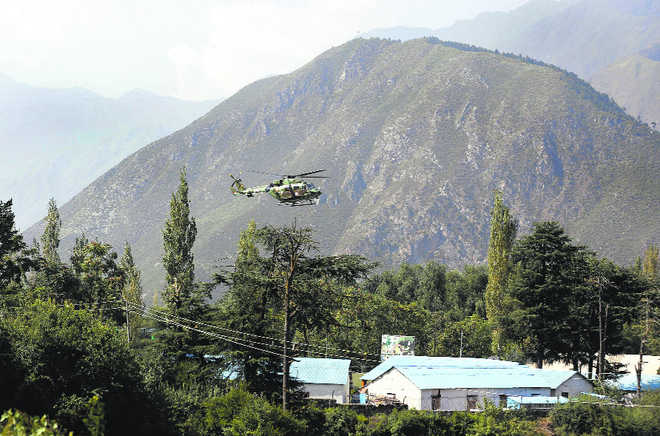
ATTACKED: An Army helicopter hovers over the Brigade HQ which was attacked by militants in Uri in North Kashmir’s Baramulla district. Photo: Mohammad Amin War

Another surprise attack, more precious lives lost, another humiliation, some strong condemnatory statements followed high-level visits to Srinagar and a flurry of high-level meetings in New Delhi, only to culminate in a return to ‘business as usual’. This sums up the standard sequence of events starting with security lapse and intelligence failure that gets repeated with monotonous regularity in a country that prides itself on being the world’s third largest military. History undoubtedly is replete with examples of intelligence failure and of countries being caught by surprise to attacks from adversaries. There is nothing unusual about that and there are library full of books to explain why it happens and why intelligence failures are difficult to prevent. But it takes only a few expressions to describe why in India it has become a habit to be caught unawares and to suffer attrition at the hands of a country one-third its size that brazenly resorts to terrorism as an instrument of state policy and unhesitatingly resorts to nuclear blackmail. And that is incompetence and repeated failure and inability to learn its lessons by the country’s security establishment that often finds it difficult to protect even itself leave aside its citizens.

Remember Haji Pir?

Uri, located close to the Line of Control (LoC), is a virtual gateway to the Kashmir Valley located not far from the 8,652-ft Haji Pir Pass, a dominating feature situated on the western fringe of the formidable Pir Panjal range that divides the Kashmir Valley from Jammu region. Most significantly, the Haji Pir bulge provides a direct ingress to both these regions of the state. It is through this militarily fortified Pass that was infamously returned to Pakistan after its capture by the Indian Army following a tough fight against all odds on August 28, 1965 that Islamabad has been infiltrating terrorists into the Jammu and Kashmir for over a quarter of a century. Again, it was this Pass through which prior to the start of the 1965 India-Pakistan War that the Pakistani Army, as part of its dubious Operation Gibraltar, had surreptitiously launched the main influx of its infiltration campaign into the Kashmir Valley.The Indian Army is heavily deployed all along the jagged and militarily illogical 740-km long LoC that runs along mountain ranges starting from gentle heights of 3,000 feet near Naushera in Jammu region to hostile high altitudes of over 20,000 feet in barren and mountainous Ladakh. Harsh terrain and severe weather are the two biggest enemies for soldiers which on many occasions renders ineffective the high technology wiring and sensors positioned at many places along the LoC. A hundred percent prevention of infiltration is impossible considering that the Berlin Wall built by the Soviets and the East Germans during the Cold War as also the wall built by a highly security conscious Israel at its Palestinian border could not deter 100 per cent infiltration.

What goes wrong?

But how would one explain the Army’s inability to secure its own establishments and repeatedly suffer attrition from small groups of young illiterate terrorists armed with rifles and grenades? From the terrorist point of view, it makes sense to attack the very instrument entrusted with securing the state, especially along the LoC. But the fact that four terrorists could so easily breach the Army’s security reflects poorly on the men in olive green. It reflects adversely on the Army’s state of alertness and awareness to its immediate ‘environment’ (such as movement of people) in the vicinity of the cantonment. To top it all, the outrageous incident occurred when there is continuing violent unrest in the Valley and at a time when relations between India and a Kashmir-obsessed Pakistan are at a low. In fact this is the time when the Army and all security agencies ought to be in a heightened state of security. As was the case prior to the May-June 1999 Kargil War, the Army yet again was caught shamefully unawares.Terrorists from Pakistan have been consciously targeting military installations along the LoC and the International Border – the attack on Pathankot airbase starting from last New Year eve being the last such major attack on a military establishment. Like Uri, Pathankot is located close to the border with Pakistan and was (and continues to be) both a target for Pakistan and a front-line fighter airbase for India during wars between the two countries. Only six months earlier, in July last year, terrorists from Pakistan had attacked a police station in Dinanagar, not far from Pathankot. 

Where it hurts most

Within a period of six months between December 2014 and May 2015, the security forces, mainly the Army, have been attacked by terrorists in their locations. Less than two years earlier (December 5, 2014), a group of heavily armed terrorists stormed the Army’s 31 Field Ordnance Depot (a major depot where ammunition for Army units in the area is stored), located at Mohra, near Uri, killing nine Army men including a Lieutenant Colonel and three policemen. Six terrorists were also killed. Three months later, on March 20, 2015, a group of terrorists stormed into Kathua police station killing five including three security force personnel and wounding 12. Yet, the very next day an Army Major and a soldier were injured in another terrorist attack on an Army camp located not far from Kathua on the Jammu-Pathankot highway. Another two months later (on May 31, 2015), an attack on the Army’s Brigade headquarters in Tangdhar, a bulge ahead of Kupwara that juts into PoK, was foiled. In all there have been over 20 attacks on security force installations in Jammu and Kashmir in the last two years.

Get to the basics

India, which is engaged in purchasing big-ticket items such as aircraft carriers, submarines and fighter aircraft, needs to very critically also ‘sweat the small stuff’ comprising equipment such as thermal imagers and other night fighting equipment, direction finding sensors, better close-quarter battle weapons, high-security perimeter fencing around cantonments etc considering that India has and will continue to be engaged in fighting Pakistan’s low-cost proxy war in a state on which it is not expected to give up until either a decisive and long-lasting action is taken or there is change of heart. 

Deficient — overtly, covertly

What is obvious is that for many years now, India’s huge defence and security establishment and a current defence budget of a staggering Rs 3.5 lakh crore has failed to deter Pakistan. Despite the huge monetary budget, the armed forces are lacking in equipment, War Wastage reserves are restricted, and even the operational readiness of a significant percentage of existing military equipment is suspect. There are issues pertaining to the quality of leadership and training as also the fact that the Army has ceased to attract the best and the brightest among the youth for many years now made no better by grievous anomalies in successive Central Pay Commission awards. India’s covert operations capability is severely restricted while serious qualitative and quantitative deficiencies continue in the country’s operational intelligence gathering capability. The country’s higher defence organization remains structured in a manner whereby the armed forces remain ‘integrated’ with the Ministry of Defence only on paper while in reality remain outside the decision-making process on issues of national security. This leaves India with non-military options which are slower and time-consuming and, some would argue, a wiser approach.More money and equipment apart, the question is whether India’s political executive is taking active interest in and ensuring qualitative supervision of India’s defence and security institutions. But then how could they when they themselves are militarily illiterate and disinterested, focused as they are on vote bank politics, political manipulations and making money and on seeking to secure themselves for the next election. Until then, Pathankot, Uri and the like will recur and the country continue to slowly bleed to which the response in all probability is likely to remain the passive application of bandages to a thousand cuts with statements only getting louder and shriller.


Kashmir Valley shut for 62nd consecutive day

20Curfew

Srinagar: Authorities made heavy deployment of security forces in Srinagar and other areas of the Kashmir Valley on Thursday as life remained paralysed for the 62nd consecutive day, officials said.

A senior police officer said deployment of security forces in sufficient strength have been made in old city and uptown areas of Srinagar and other parts of the valley.

“Curfew has not been imposed anywhere in the valley on Thursday,” the officer said. The militants attacked Pulwama police station in the early hours of Thursday. Police said there were exchange of fire between the militants and security forces for around 15 minutes after which the militants escaped.

The militants also snatched and decamped with four weapons from the residential guards of a regional National Conference (NC) block president in D.H. Pora village of Kulgam district. For the last 62 days, educational institutions, main markets, public transport and other businesses have remained closed in Kashmir Valley.

Seventy-six people including 73 civilians and three policemen have been killed during the ongoing cycle of violence that started on July 9. Separatists have been issuing weekly protest calendars during this period asking people to continue the protest shutdown.

They have issued a fresh protest calendar extending the shutdown and protests till September 16. They have asked people to march to the office of the United Nations Military Observers Group in India and Pakistan (UNMOGIP) in Srinagar city on September 13, the day Muslims would be celebrating the holy festival of Eid-ul-Azha. –IANS


AGUSTA SCAM IN MADHYA PRADESH SC seeks Centre’s response to PIL for probe

SC seeks Centre’s response to PIL for probe
The Bench questioned senior counsel Prashant Bhushan on the nine-year delay in filing the petition.

Legal Correspondent
New Delhi, September 23 

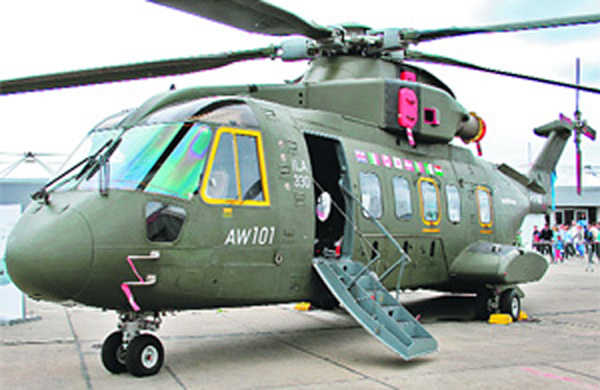
The Supreme Court on Friday sought the Centre’s response to a PIL seeking an independent probe into the purchase of an Agusta A109 VIP helicopter by the Chhattisgarh government in 2007-08 and the alleged offshore accounts of Chief Minister Raman Singh’s son Abhishek Singh.

A Bench comprising Justices Dipak Misra and C Nagappan, however, refused to issue a formal notice to the Centre and the Chhattisgarh government on the PIL by NGO Swaraj Abhiyan and Dr AA Degwekar.

The Bench questioned senior counsel Prashant Bhushan on the nine-year delay in filing the petition. Bhushan pleaded that most of the details about the deal were available only now.

The petition said the deal was for $6.57 million (about Rs 44 crore) and nearly one-third of this ($2 million or Rs 13 cr) was paid to a company registered in British Virgin Islands as commission for early supply. In 2011, the Comptroller and Auditor General (CAG) had indicted the state government for wasting considerable money by going through a charade of global tender.

An Internet search showed that several other companies were selling helicopters with same specifications at prices ranging from $1.3 million to $2.6 million, the petition said.

Soon after the state government paid the amount to Agusta dealer Sharp Ocean, Abhishek Singh also opened an account through a company called Quest Heights Ltd, allegedly incorporated in British Virgin Islands, on July 3, 2008, the petitioner pleaded.


VETERAN TO JUDGE WHO IS SPLITTING ESM OF PUNJAB ::: ESM from punjab OR ESM from outside

Maj Gen Satbir Singh,Chairman IESM(JM) write to Brig Indermohan ,President IESL Punjab unit on Whats App Groups::

A war of Words read at Voice of Ex-Servicemen Blog.Click link


http://voiceofesmpunjab.blogspot.in/


comments can be sent to Sanjha Morcha  sanjhamorcha303@gmail.com


India slams Sharif’s speech at UN, calls it a ‘threat bluster’

Minister of State for External Affairs M J Akbar (File | EPS)

NEW YORK: Strongly reacting to Pakistan Prime Minister’s remarks at the UN, India today described them as non-factual and full of “threat bluster” and said glorification of Hizbul commander Burhan Wani by him at the world forum is an act of “self-incrimination” by Pakistan.

“We just heard a speech full of threat bluster and rising immaturity and complete disregard of facts,” Minister of State for External Affairs M J Akbar said at a press conference at the India’s permanent mission here after Sharif’s address to the UN General Assembly.

He also criticised Sharif for glorifying Wani, who was killed in an encounter with security forces on July 8, and said India “will not succumb to blackmail tactics of the Pakistan Government that seems eager to use terrorism as policy”.

“We heard the glorification of a terrorist. Wani is declared commander of Hizbul, widely acknowledged as a terror group. It is shocking that a leader of a nation can glorify a self-advertised terrorist at such a forum. This is self incrimination by Pakistan PM,” Akbar said.

Rejecting Sharif’s offer to India to enter into a serious and sustained dialogue for the peaceful resolution of all outstanding disputes, the minister said, “Talks and guns don’t go together”.

“Pakistan at this moment seems to be run by a war machine rather than a government. Pakistan wants dialogue while holding a terrorist gun in its hand,” he said.

He also rejected Sharif’s allegations against India with regard to the current unrest in Kashmir and said, “Kashmir occupation is by Pakistan occupation army. The world also knows that Pakistan has been indulged in ethnic cleansing of its own people,” he said.


Spike in early retirement in armed forces

Spike in early retirement in armed forces

Vijay Mohan

Tribune News Service

Chandigarh, August 13

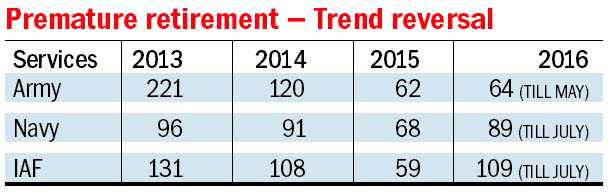
After witnessing a consecutive decline in the number of premature retirements since 2013, the number of officers who opted to hang up their boots before reaching the age of superannuation has gone up in all three services this year.The reversal of trend, which some officers opine could be temporary, comes in the backdrop of the Armed Forces facing a continuing shortage of officers, which is about 17 per cent for the Army, 13 per cent for the Navy and minuscule for the Air Force.According to the Ministry of Defence, the number of premature retirements in the Army was 221 in 2013, 120 in 2014 and 62 in 2015. This figure till the end of May this year is 64.In the Navy, the retirements from 2013-15 were 96, 91 and 68, which went up to 89 in July this year. The corresponding figures for the Air Force are 131, 108 and 59, with the number of officers opting out early this year shooting up to 109 till the beginning of this month.Service conditions and monetary benefits remain the prime reason for officers leaving early.Sources said one reason for the downward trend in premature retirements in the recent past was the Seventh Pay Commission, for which officers were waiting in the hope to get a better pension package. “While there is an all-round hike in the salaries, and consequently the pension, the general perception in the services is that the pay commission has given them a raw deal and further eroded their status and equation vis-à-vis other Central Government services. Several anomalies and demands pertaining to the earlier pay commissions have also not been addressed,” an officer said.The Army has an authorised strength of 49,833 officers but currently has 41,162 officers, having to make do with a shortfall of 8,671 officers mostly at the junior level, which is operationally critical.With a shortage of 1,518 officers, the Navy has 9,866 officers against the authorised strength of 11,384. The Air Force, which reported no deficiency of officers last year, is now short of 29.


Cabinet panel clears final Rafale draft Rs 59-crore deal for 36 fighter jets to be inked with France this week

Cabinet panel clears final Rafale draft

Ajay Banerjee

Tribune News Service

New Delhi, September 21

When India and France ink their much-awaited contract to buy 36 Rafale fighter jets this week, it will not only bridge a two-decade gap in procuring new fighter jets for the Indian Air Force (IAF) but will also provide a technological edge.The Cabinet Committee on Security (CCS) today cleared the final draft of the inter-governmental agreement to be signed with France.The IAF has not procured any new fighter jets since the start of this century. The last one being the Sukhoi 30-MKI from Russia first ordered in mid-1990s and since then licence produced in India by Hindustan Aeronautics Limited (HAL).The two countries are set to sign a €7.878 billion (Rs 58.828 crore) contract with Dassault Aviation of France this week for these 36 Rafale jet fighters. This means around Rs 1634 crore for each plane that will add more power to the IAF’s fleet – currently operating at its lowest force levels in a decade.The first jet is to be delivered in 36 months (September 2019) and the entire lot will be delivered over the following 30 months.The French company will make India-specific changes like the next-generation missiles such as Meteor and Scalp, which will add capability much beyond India’s immediate adversaries. The Meteor, is a BVR (Beyond Visual Range) air-to-air missile with a range in excess of 150 km. It will allow the IAF to hit targets inside both Pakistan and Tibet from within its own territory. The Scalp is a long-range air-to-cruise missile with a range of 300 km.The Ministry of Defence and the IAF team that negotiated the price has secured a concession of almost €722 million (Rs 5390 crore). In January, a day before French President François Hollande and Prime Minister Narendra Modi were to jointly issue a statement during the French President’s visit to India, the French team had quoted a price of €8.6 billion. The negotiations ended at a price of €7.898 billion, sources in the Ministry of Defence said. Of this, €3.42 billion is the cost of the bare planes, €1.8 billion of associate supplies for the infrastructure and support, €1.7 billion for India-specific changes, €710 million is the additional weapons package and €353 million is the cost of ‘Performance-based Logistics Support’.Under this logistics support, Dassault will ensure that at least 75 per cent of the fleet remains operational or air worthy at any given time under what is called the existing frontline fighter, the Sukhoi 30-MKI has only 60 per cent availability. Other concessions include free training for nine IAF personnel, additional guarantee for 60 hours of usage of training aircraft for Indian pilots and six months of free weapons storage without charge. Under the originally planned (and now scrapped) proposal to produce 126 planes in India, the first batch of 18 planes were to be manufactured in France and 108 were to be manufactured in India. France cited that cost of man hours (labour) needed in India to produce a plane was 2.7 times higher due to lack of automation. This along would have meant additional Rs 150 crore per plane.

First jet by September 2019

  • France is set to deliver the first jet in 36 months (September 2019) and the entire lot will be delivered over the following 30 months
  • The IAF has not procured any new fighter jets since the start of this century. The last one being the Sukhoi 30-MKI from Russia first ordered in mid-1990s and since then licence produced in India by Hindustan Aeronautics Limited